check engine light CHEVROLET BLAZER 1995 2.G User Guide
[x] Cancel search | Manufacturer: CHEVROLET, Model Year: 1995, Model line: BLAZER, Model: CHEVROLET BLAZER 1995 2.GPages: 380, PDF Size: 20.04 MB
Page 133 of 380
Downloaded from www.Manualslib.com manuals search engine Don’t exceed the maximum vehicle capacity when loading your vehicle. For
more information on vehicle capacity and loading,
see “Loading Your
Vehicle’’ in the Index.
To prevent damage or loss of cargo as you’re driving, check
now and then to
make sure the luggage carrier and cargo are still securely fastened.
Trailer Wiring Harness
Your vehicle will have a 5-wire and may have a 7-wire harness.
The light duty trailer wiring is a 5-wire harness assembly taped and bundled
at the left corner
of the vehicle. The harness has no connector, and you
should have
a qualified service person wire your harness for you.
The heavy duty trailer wiring is
a 7-wire harness assembly. It is stored
under the vehicle, along the passenger-side frame crossmember on
two-door vehicles and on the driver-side corner frame crossmember on
four-door vehicles. It has a 30-amp feed wire with an inline fuse located by
the junction block. See “Fuses and Circuit Breakers” in
the Index.
Both the 5-wire harness and the 7-wire harness have no connector and
should be wired by a qualified service person. Attach the harness to the
trailer, then tape or strap
it to your vehicle’s frame rail. Be sure you leave it
loose enough
so the wiring doesn’t bend or break, but not so loose that it
drags on the ground.
Store the harness
in its original place. Wrap the harness together and tie it
neatly
so it won’t be damaged.
2-81
Page 152 of 380
Downloaded from www.Manualslib.com manuals search engine To help avoid hearing loss or damage:
1. Adjust the volume control to the lowest setting.
2. Increase volume slowly until you hear comfortably and clearly.
NOTICE:
Before you add any sound equipment to your vehicle - like a
tape player, CB radio, mobile telephone or two-way radio - be
sure you can add what you want.
If you can, it’s very important
to do
it properly. Added sound equipment may interfere with the
operation of your vehicle’s engine, Delco’ radio or other
systems, and even damage them. And, your vehicle’s systems
may interfere with the operation of sound equipment that has
been added improperly.
So, before adding sound equipment, check with your dealer and
be sure to check Federal rules covering mobile radio and
telephone units.
Care of Your Cassette PIayer and Tape
A tape player that is not cleaned regularly is subject to reduce\
d sound
quality, ruining the cassette, or damaging the mechanism. Tape cassettes that
are not properly stored in their plastic cases away from contaminan\
ts, direct
sunlight, and extreme heat, may not operate properly and could cause
premature failure
of the tape player.
Your tape player should be cleaned with every
50 hours of use to provide
optimum performance. Your radio may display “Cln” (Clean) to indicate
that you have used your tape player for
50 hours without re-setting the tape
clean timer.
If you notice a reduction in sound quality, regardless of when
the tape player was last cleaned,
try playing a different cassette to see if the
tape or tape player is at fault. If the second cassette results in no
improvement in sound quality,
try cleaning the tape player.
Proper tape player cleaning should be done with a scrubbing action,
non-abrasive cleaning cassette. This is a wet-type cleaning system that uses
a cleaning cassette with pads which scrub the tape head as the \
hubs of the
cleaner cassette turn.
To properly clean your tape player, follow instructions
with the cleaning cassette. If you use this type of cleaner, the radio may
display an error and eject the cartridge. This is normal and \
is the result
of an
added feature
in the tape player that detects broken tapes. If an error occurs,
you will need to insert the cleaning cassette at least
3 times to thoroughly
clean the tape player.
3-18
Page 153 of 380
Downloaded from www.Manualslib.com manuals search engine You may prefer to use a non-scrubbing action, wet-type cleaner. This type
of cleaner uses a fabric belt to clean the tape head. This type of cleaner
cassette will not cause an error, but it may not clean the tape player as
thoroughly as the scrubbing type cleaner.
A scrubbing action cleaner cassette is available through your retailer (SPO
12344600).
Cassettes are subject to wear and the sound quality may degrade over time.
Always verify that the cassette tape
is in good condition and the tape player
is clean before obtaining service on your tape player.
t
NOTICE:
Cassette tape adapter kits for portable CD players will not work
in your cassette player. These adapters will cause the radio t\
o
display an error and the adapter cassette will be ejected.
Care of Compact Discs
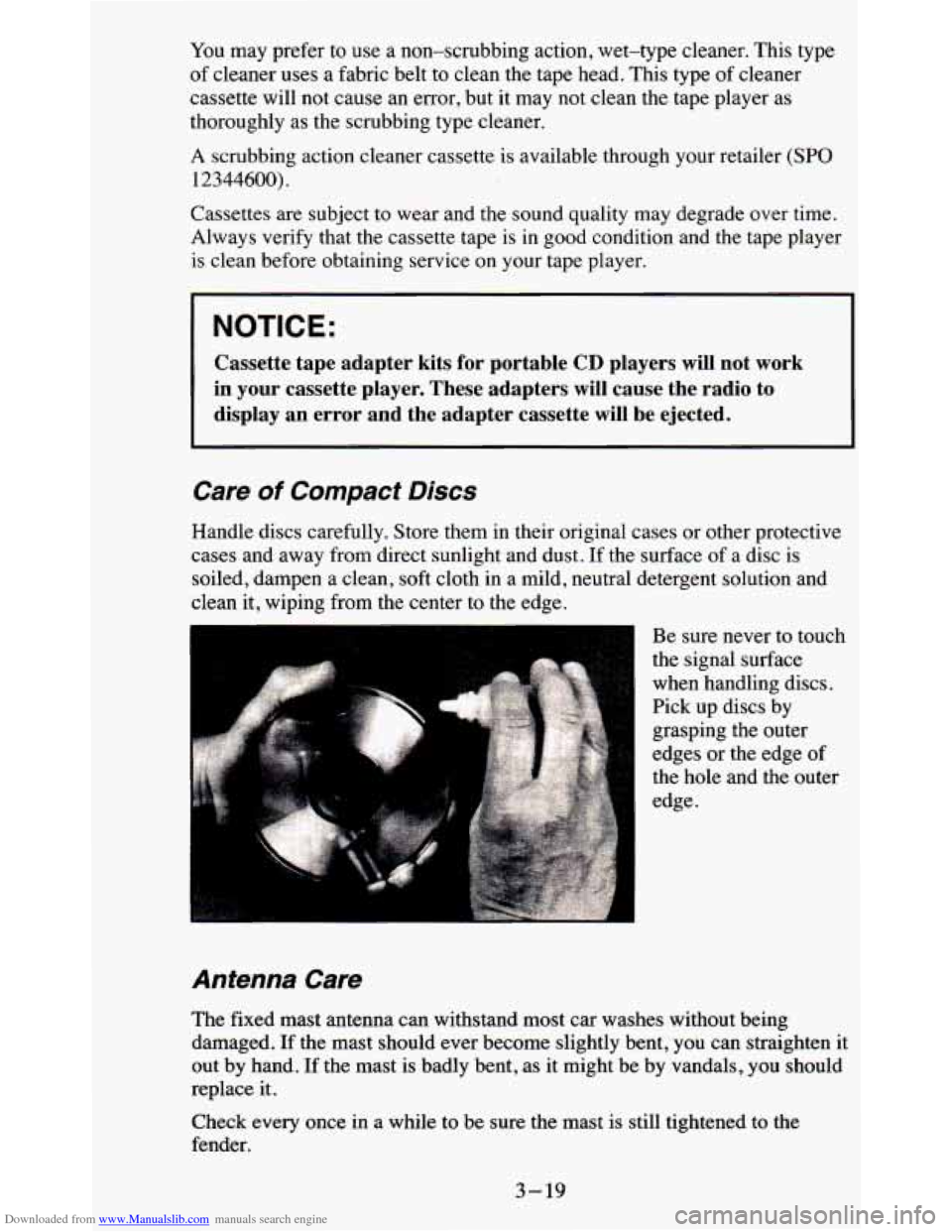
Handle discs carefully. Store them in their original cases or other protective
cases and away from direct sunlight and dust. If the surface of a disc
is
soiled, dampen a clean, soft cloth in a mild, neutral detergent solution and
clean it, wiping from the center to the edge.
Be sure never to touch
the signal surface
when handling discs.
Pick up discs by
grasping the outer
edges or the edge
of
the hole and the outer
edge.
Antenna Care
The fixed mast antenna can withstand most car washes without being
damaged.
If the mast should ever become slightly bent, you can straighten it
out by hand. If the mast is badly bent, as it might be by vandals, you should
replace it.
Check every once in a while to be sure the mast
is still tightened to the
fender.
3-19
Page 177 of 380

Downloaded from www.Manualslib.com manuals search engine Driving In .Water
Light rain causes no special off-road driving problems. But hea\
vy rain can
mean flash flooding, and flood waters demand extreme caution.
Find out how deep the water is before you drive through it. If it’s deep
enough to cover your wheel hubs, axles, or exhaust pipe, don’t
try it - you
probably won’t get through. Also, water that deep can damage your axle and
other vehicle parts.
If the water isn’t too deep, then drive through it slowly. At fast speeas, water
splashes on your ignition system and your vehicle can stall. Stalling can also
occur if you get your tailpipe under water. And, as long as your tailpipe is
under water, you’ll never be able to start your engine. When you
go through
water, remember that when your brakes get wet, it may take
you longer to
stop.
After Off-Road Driving
Remove any brush or debris that has collected on the underbody, chassis or
under the hood. These accumulations can be a fire hazard.
After operation in mud or sand, have the brake linings cleaned and checked.
These substances can cause glazing and uneven braking. Check th\
e body
structure, steering, suspension, wheels, tires, and exhaust system for
damage. Also, check the fuel lines and cooling system for any leakage.
Your vehicle will require more frequent service due to off-road use. Refer
to the Maintenance Schedule for additional information.
4-23
Page 179 of 380
Downloaded from www.Manualslib.com manuals search engine you are faced with severe glare (as from a driver who doesn’t lower the high
beams, or a vehicle
with misaimed headlights), slow down a little. Avoid
staring directly into the approaching lights.
Keep your windshield and all the glass on your vehicle clean
- inside and
out. Glare at night is made much worse by dirt on the glass. Even the inside
of the glass can build up
a film caused by dust. Dirty glass makes lights
dazzle and flash more than clean glass would, making the pupils
of your
eyes contract repeatedly.
Remember that your headlights light up far less
of a roadway when you are
in a turn or curve. Keep your eyes moving; that way, it’s easier to pick out
dimly lighted objects. Just as your headlights should be checked regularly
for proper aim,
so should your eyes be examined regularly. Some drivers
suffer from night blindness
- the inability to see in dim light - and aren’t
even aware of it.
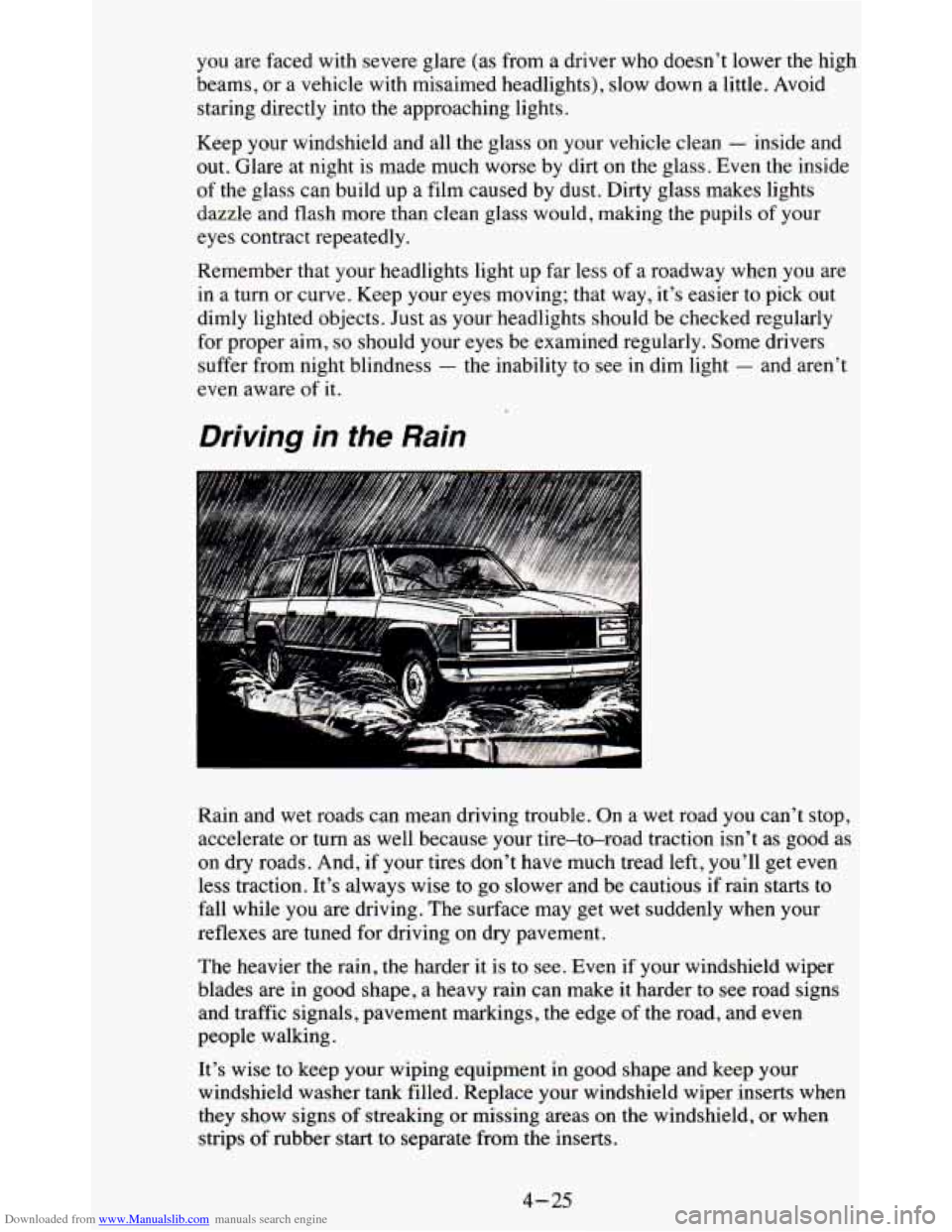
Driving in the Rain
Rain and wet roads can mean driving trouble. On a wet road y\
ou can’t stop,
accelerate or turn as well because your tire-to-road traction isn’t as good as
on dry roads. And, if your tires don’t have much tread left, you’ll get even
less traction. It’s always wise to go slower and be cautious
if rain starts to
fall while you are driving. The surface may get wet suddenly when your
reflexes are tuned for driving on dry pavement.
The heavier the rain, the harder it is to see. Even
if your windshield wiper
blades are in good shape,
a heavy rain can make it harder to see road signs
and traffic signals, pavement markings, the edge
of the road, and even
people walking.
It’s wise to keep your wiping equipment in good shape and keep your
windshield washer tank filled. Replace your windshield wiper inserts when
they show
signs of streaking or missing areas on the windshield, or when
strips of rubber start
to separate from the inserts.
4-25
Page 181 of 380
Downloaded from www.Manualslib.com manuals search engine Some Other Rainy Weather Tips
0 Turn on your low-beam headlights - not just your parking lights - to
help make
you more visible to others.
especially careful when you pass another vehicle. Allow yourself\
more clear room ahead, and be prepared to have your view restricted by road
spray.
0 Besides slowing down, allow some extra following distance. And be
Have good tires with proper tread depth. (See “Tires” in the Index.)
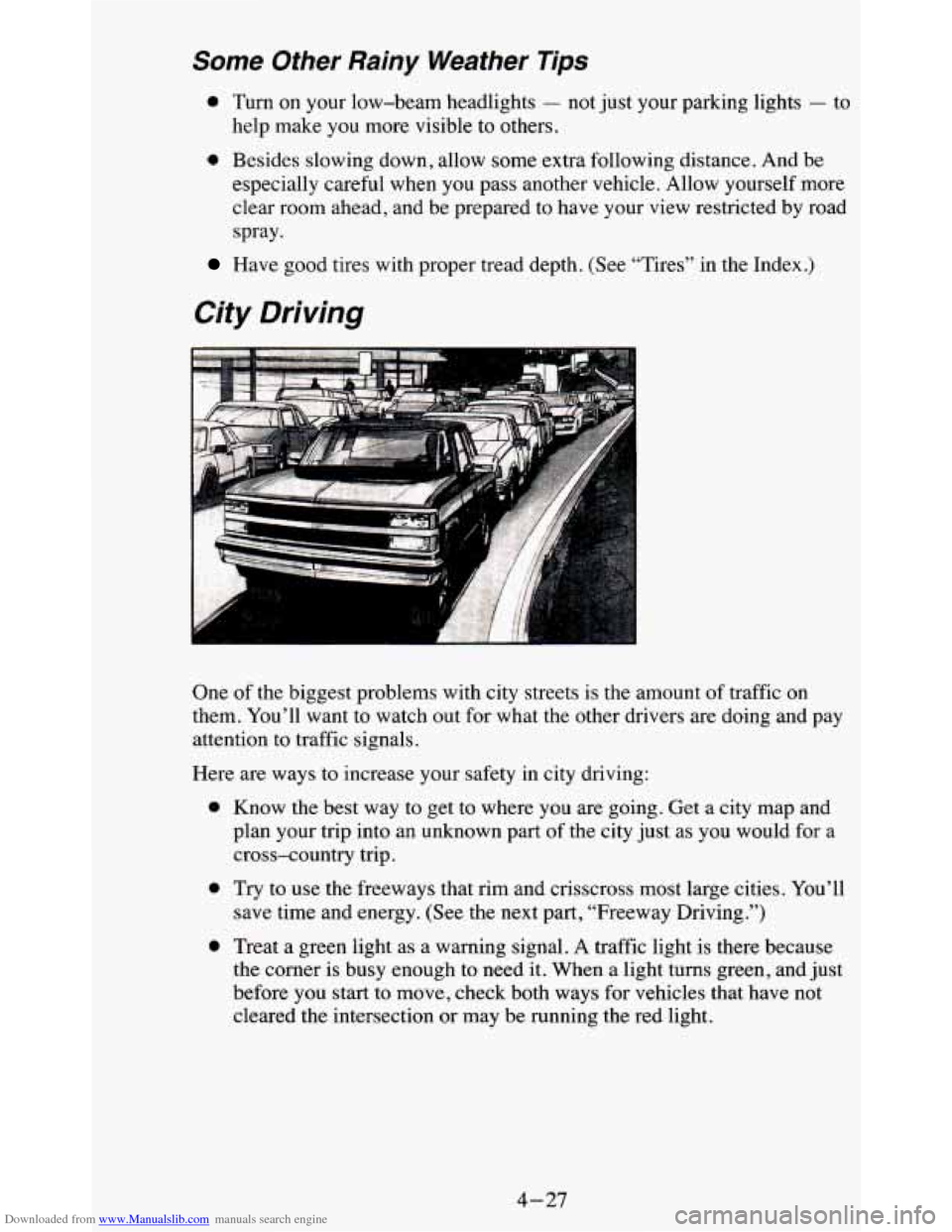
City Driving
One of the biggest problems with city streets is the amount of traffic on
them. You’ll want to watch out for what the other drivers are doing and pay
attention to traffic signals.
Here are ways to increase your safety in city driving:
0
0
e
Know the best way to get to where you are going. Get a city map and
plan your trip into an unknown part
of the city just as you would for a
cross-country trip.
Try to use the freeways that rim and crisscross most large cities. You’ll
save time and energy. (See the next part, “Freeway Driving.”)
Treat a green light as a warning signal.
A traffic light is there because
the corner
is busy enough to need it. When a light turns green, and just
before you start to move, check both ways for vehicles that have not
cleared the intersection or may be running the red light.
4-27
Page 182 of 380
Downloaded from www.Manualslib.com manuals search engine Freeway Driving
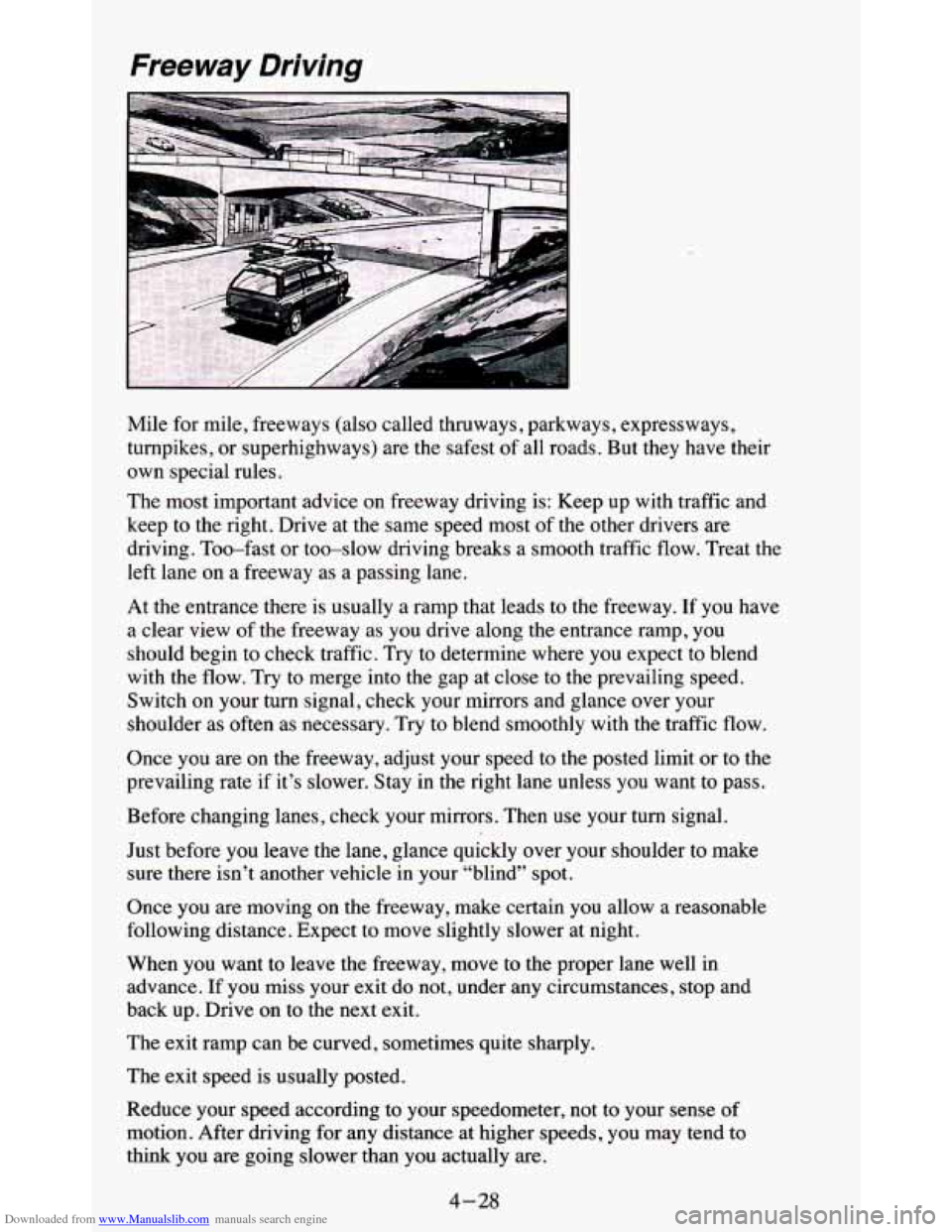
Mile for mile, freeways (also called thruways, parkways, expressways,
turnpikes, or superhighways) are the safest of
all roads. But they have their
own special rules.
The most important advice on freeway driving is: Keep up with traffic and
keep to the right. Drive at the same speed most
of the other drivers are
driving. Too-fast or too-slow driving breaks
a smooth traffic flow. Treat the
left lane on a freeway as a passing lane.
At the entrance there
is usually a ramp that leads to the freeway. If you have
a clear view
of the freeway as you drive along the entrance ramp, you
should begin to check traffic. Try
to determine where you expect to blend
with the flow. Try to merge into the gap at close to the prevailing speed.
Switch on your turn signal, check your mirrors and glance over your
shoulder as often as necessary. Try to blend smoothly with the traffic flow.
Once you are
on the freeway, adjust your speed to the posted limit or to the \
prevailing rate if it’s slower. Stay in the right lane unless you want
to pass.
Before changing lanes, check your mirrors. Then use your
turn signal.
Just before you leave the lane, glance quickly over your shoulder to make
sure there isn’t another vehicle in your “blind” spot. \
Once you are moving
on the freeway, make certain you allow a reasonable
following distance. Expect to move slightly slower at night.
When you want to leave the freeway, move to the proper lane \
well in
advance. If you
miss your exit do not, under any circumstances, stop and
back up. Drive on to the next exit.
The exit ramp can be curved, sometimes quite sharply.
The exit speed is usually posted.
Reduce your speed according to your speedometer, not to your sense of
motion. After driving
for any distance at higher speeds, you may tend to
think you are going slower than you actually are.
4-28
Page 183 of 380
Downloaded from www.Manualslib.com manuals search engine Before Leaving on a Long Trip
Make sure you’re ready. Try to be well rested. If you must start when you’re
not fresh
- such as after a day’s work - don’t plan to make too many
miles that first part of the journey. Wear comfortable clothing and shoes
you
can easily drive in.
Is your vehicle ready for a long trip? If you keep it serviced and maintained,
it’s ready to go. If it needs service, have it done before starting out. Of
course, you’ll find experienced and able service experts in
GM dealerships
all across North America. They’ll be ready and willing to help if you need
it.
Here are some things you can check before a trip:
Windshield Washer Fluid: Is the reservoir full? Are all windows clean
inside and outside?
Wiper Blades: Are they in good shape?
0 Fuel, Engine Oil, Other Fluids: Have you checked all levels?
0 Lights: Are they all working? Are the lenses clean?
Tires: They are vitally important to a safe, trouble-free trip. Is the tread
good enough for long-distance driving? Are the tires all inflated to the
recommended pressure?
0 Weather Forecasts: What’s the weather outlook along your route?
Maps: Do you have up-to-date maps?
Should
you delay your trip a short time to avoid a major storm system?
Highway Hypnosis
Is there actually such a condition as “highway hypnosis”? Or is it just plain
falling asleep at the wheel? Call it highway hypnosis, lack of awareness, or
whatever.
There
is something about an easy stretch of road with the same scenery,
along with the hum of the tires on the road, the drone of the engine, and the
rush
of the wind against the vehicle that can make you sleepy. Don’t let it
happen
to you! If it does, your vehicle can leave the road in less than a
second,
and you could crash and be injured.
What can you
do about highway hypnosis? First, be aware that it can
happen.
4-29
Page 198 of 380

Downloaded from www.Manualslib.com manuals search engine Driving with a Trailer
lowing a trailer requires a certain amount of experience. Before setting \
out
for the open road, you’ll want to get to know your rig. Acquaint yourself
with the feel of handling and braking with the added weight of the trailer. \
And always keep in mind that the vehicle you are driving is now a good
deal longer and not nearly as responsive as your vehicle is by itself.
Before you start, check the trailer hitch and platform (and attachments),
safety chains, electrical connector, lights, tires and mirror adjustment. If the
trailer has electric brakes, start your vehicle and trailer moving and then\
apply the trailer brake controller by hand to be sure the brakes are working.
This lets you check your electrical connection at the same time.
During your
trip, check occasionally to be sure that the load is secure, and
that the lights and any trailer brakes are still working.
Following Distance
Stay at least twice as far behind the vehicle ahead as you would when
driving your vehicle without
a trailer. This can help you avoid situations that
require heavy braking and sudden turns.
4-44
Page 201 of 380
Downloaded from www.Manualslib.com manuals search engine When You Are Ready to Leave After Parking on a Hill
1. Apply your regular brakes and hold the pedal down while you:
Start your engine;
0 Shift into a gear; and
Release the parking brake.
2. Let up on the brake pedal.
3. Drive slowly until the trailer is clear of the chocks.
4. Stop and have someone pick up and store the chocks.
Maintenance When Trailer Towing
Your vehicle will need service more often when you’re pulling a trailer. See
the Maintenance Schedule for more on this. Things that are especially
important
in trailer operation are automatic transmission fluid (don’t
overfill), engine oil, axle lubricant, belt, cooling system, and brake
adjustment. Each
of these is covered in this manual, and the Index will help
you find them quickly. If you’re trailering, it’s a good idea to review these
sections before you start your trip.
Check periodically to see that all hitch nuts and bolts are tight.
Trailer Lighting Systems Wiring
See “Trailer Wiring Harness” in the Index.
4-47