check engine CHEVROLET BLAZER 1995 2.G Workshop Manual
[x] Cancel search | Manufacturer: CHEVROLET, Model Year: 1995, Model line: BLAZER, Model: CHEVROLET BLAZER 1995 2.GPages: 380, PDF Size: 20.04 MB
Page 268 of 380
Downloaded from www.Manualslib.com manuals search engine To Check Brake Fluid
.. .
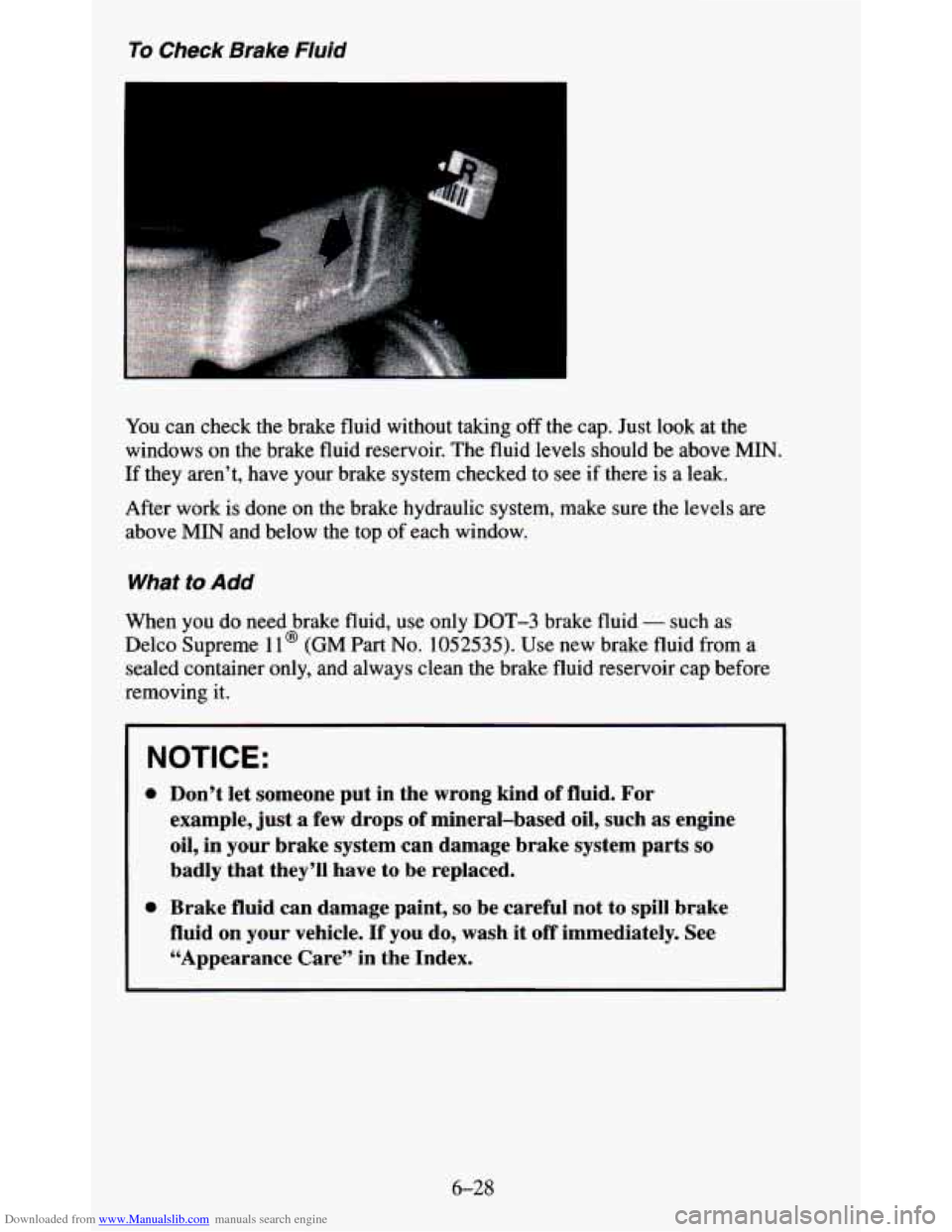
You can check the brake fluid without taking off the cap. Just look at the
windows on the brake fluid reservoir. The fluid levels should be above
MIN.
If they aren’t, have your brake system checked to see if there is a leak.
After work is done on the brake hydraulic system, make sure the levels
are
above MIN and below the top of each window.
What to Add
When you do need brake fluid, use only DOT-3 brake fluid - such as
Delco Supreme
11 @ (GM Part No. 1052535). Use new brake fluid from a
sealed container only, and always clean the brake fluid reservo\
ir cap before
removing it.
NOTICE:
0 Don’t let someone put in the wrong kind of fluid. For
example, just
a few drops of mineral-based oil, such as engine
oil, in your brake system can damage brake system parts
so
badly that they’ll have to be replaced.
0 Brake fluid can damage paint, so be careful not to spill brake
fluid on your vehicle.
If you do, wash it off immediately. See
“Appearance Care”
in the Index.
6-28
Page 280 of 380
Downloaded from www.Manualslib.com manuals search engine Air Conditioning
Every now and then have your dealership check your air conditioning
system to be sure it has not lost any cooling ability. If you think\
the system
is not working properly, have your dealership check it out as \
soon as
possible.
The air conditioning will not work when the temperature is below
40°F
(4°C).
Lock Cylinders
To be sure your locks operate properly, they must be lubricated.
Refer to the Maintenance Schedule to determine how often to lubricate them
and what type
of lubricant to use.
You should not
use penetrating oils because they could wash out me factory
installed lubricant and cause the lock to bind. De-icers which \
contain
alcohol could also wash away the lubricant,
so be sure to lubricate the lock
after using a de-icer of this type.
Exhaust System
To help prevent damage to your exhaust system, do not continue to drive
your vehicle
if you notice:
0 Engine misfiring
0 Loss of performance
0 Exhaust system components hanging lower than normal.
0 Loud exhaust system noises.
0 Other unusual operating conditions
Have your engine and exhaust system serviced regularly.
Three-way Catalytic Converter
Your vehicle’s three-way catalytic converter is designed to reduce \
the
pollutants in your vehicle’s exhaust. Use only unleaded fuel in your vehicle.
If you use leaded fuel, you could damage your three-way catalytic converter
and other engine components.
Engine Control Module System
This system has an oxygen (02) sensor that helps keep your engine’s
air-fuel mixture at a proper level. Use only unleaded fuel
in your vehicle. If
you use leaded fuel, you could damage your oxygen (02) sensor and affect
your vehicle’s emissions.
6-40
Page 282 of 380
Downloaded from www.Manualslib.com manuals search engine NOTICE:
Don’t let anyone tell you that underinflation or overinflation is
all right. It’s not.
If your tires don’t have enough air
(underinflation) you can get:
0 Too much flexing
0 Too much heat
0 Tire overloading
0 Bad wear
0 Bad handling
Bad fuel economy.
If your tires have too much air (overinflation), you can get:
Unusual wear
Bad handling
Rough ride
0 Needless damage from road hazards.
When to Check
Check your tires once a month or more. Also, check the tire pressure of the
spare tire.
How to Check
Use a good quality pocket-type gage to check tire pressure. Simply looking
at the tires will not tell you the pressure, especially if
you have radial tires
- which may look properly inflated even if they’re underinflated.
If your tires have valve caps, be sure to put them back on. They help prevent
leaks by keeping out dirt and moisture.
6-42
Page 283 of 380
Downloaded from www.Manualslib.com manuals search engine lire Inspection and Rotation
Tires should be inspected every 6,000 to 8,000 miles (10 000 to 13 000 km)
for any signs of unusual wear. If unusual wear is present, rotate your tires as
soon as possible and check wheel alignment. Also check for damaged tires
or wheels. See “When It’s Time for New Tires” and “Wheel Replacement”
later in this section for more information.
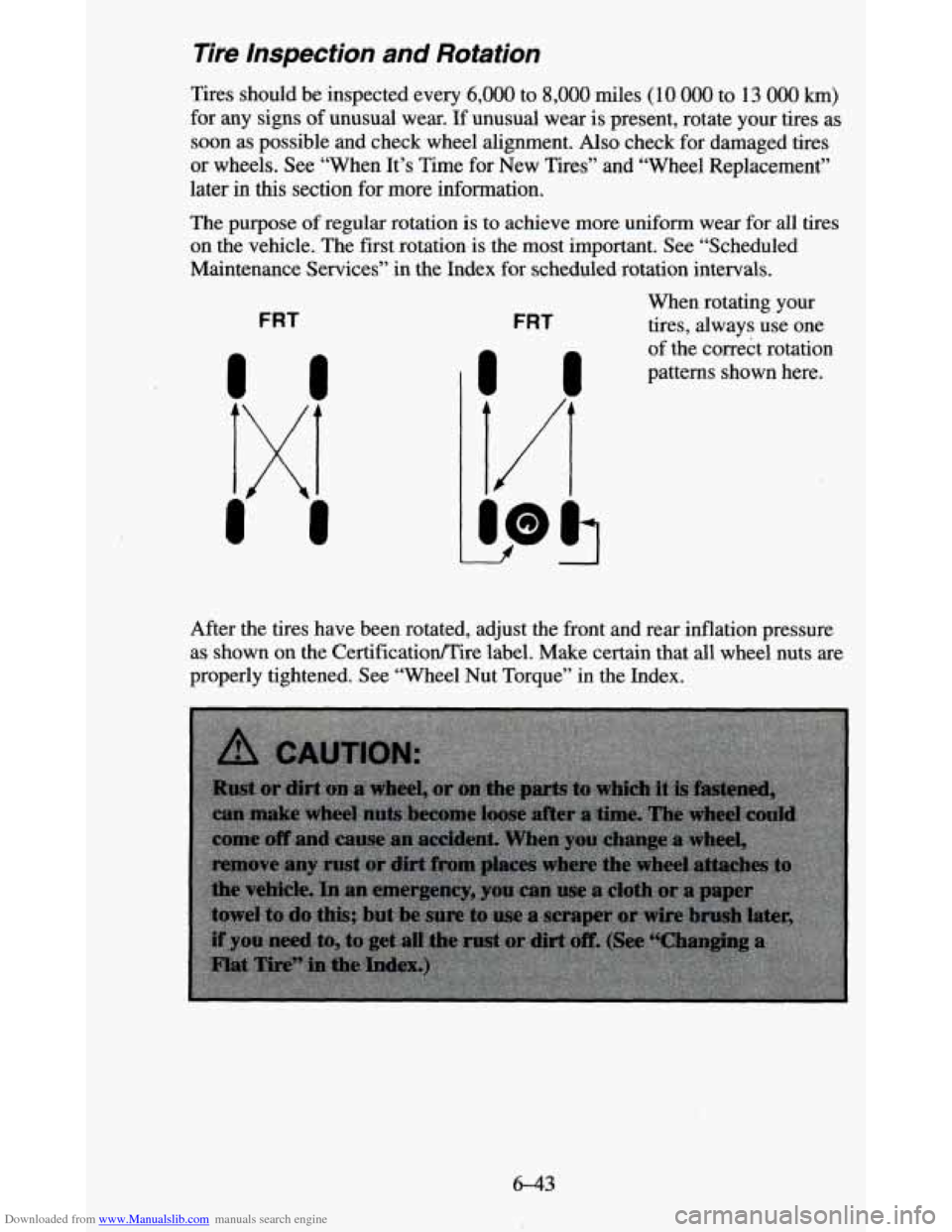
The purpose of regular rotation is to achieve more uniform wear for all tires
on the vehicle. The first rotation is the most important. See “Scheduled
Maintenance Services”
in the Index for scheduled rotation intervals.
FRT
n
FRT When
rotating your
tires, always use one of the correct rotation
patterns shown here.
After the tires have been rotated, adjust the front and rear inflation pressure
as shown on the Certificatioflire label. Make certain that
all wheel nuts are
properly tightened. See “Wheel Nut Torque” in the Index.
6-43
Page 284 of 380
Downloaded from www.Manualslib.com manuals search engine When It’s Time for New Tires
Tkead Wear
Indicators
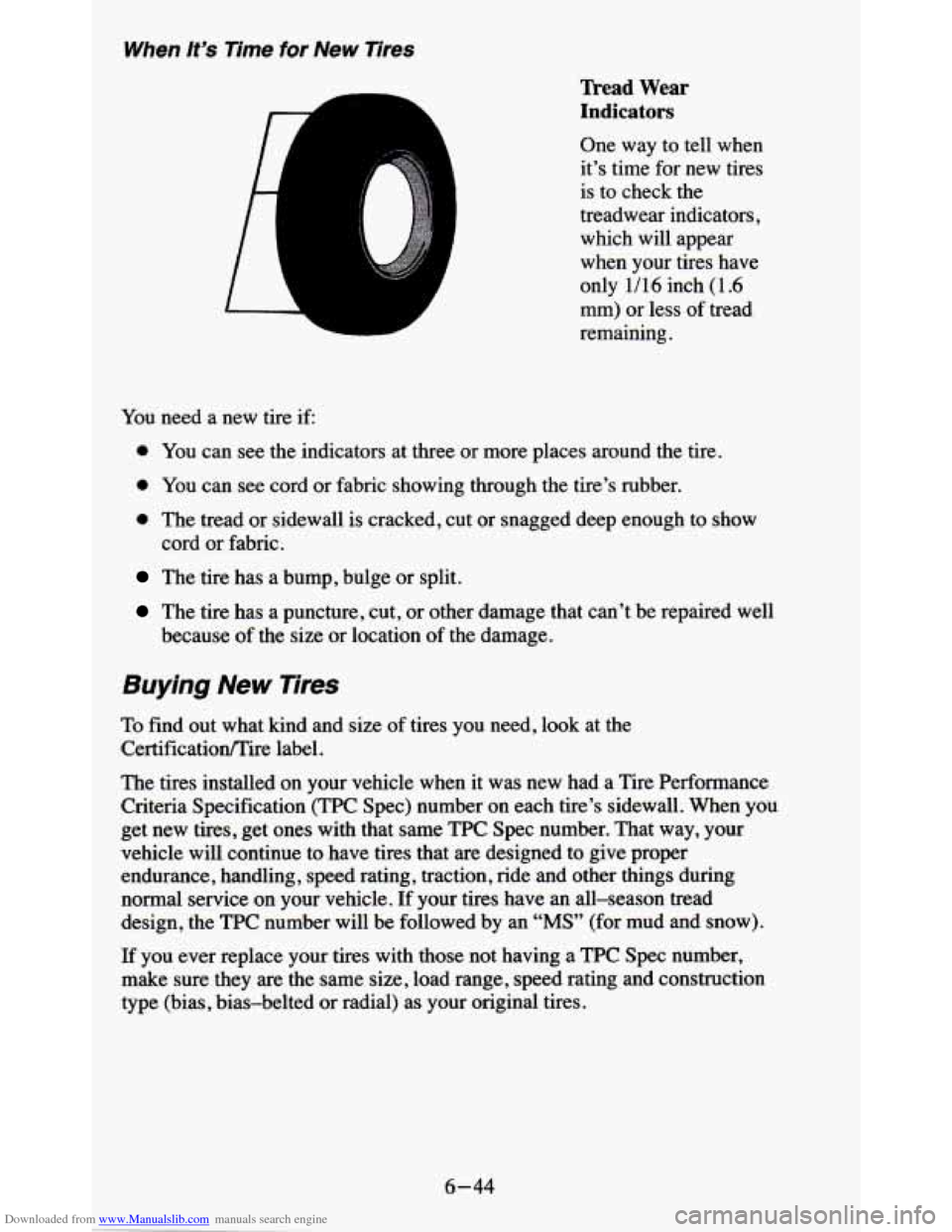
One way to tell when
it’s time for new tires
is to check the
treadwear indicators,
which will appear
when your tires have
only
1/16 inch (1.6
mm) or less
of tread
remaining.
You need a new tire if
0 You can see the indicators at three or more places around the tire.
0 You can see cord or fabric showing through the tire’s rubber.
0 The tread or sidewall is cracked, cut or snagged deep enough to show
cord or fabric.
The tire has a bump, bulge or split.
The tire has a puncture, cut, or other damage that can’t be repaired well
because of the size or location of the damage.
Buying New Tires
To find out what kind and size of tires you need, look at the
Certificatioflire label.
The tires installed on your vehicle when it was new had a Tire Performance
Criteria Specification (TPC Spec) number on each tire’s sidewall. When
you
get new tires, get ones with that same TPC Spec number. That way, your
vehicle
will continue to have tires that are designed to give proper
endurance, handling, speed rating, traction, ride and other things during
normal service on your vehicle. If your tires have an all-season tread
design, the TPC number will be followed by an
“MS” (for mud and snow).
If you ever replace your tires with those not having a TPC Spec number,
make sure they are the same size, load range, speed rating and construction
type (bias, bias-belted or radial) as your original tires.
6-44
Page 293 of 380
Downloaded from www.Manualslib.com manuals search engine Glass
Glass should be cleaned often. GM Glass Cleaner (GM Part No. 1050427)
or a liquid household glass cleaner will remove normal tobacco smoke and
dust films.
Don’t use abrasive cleaners on glass, because they may cause scratches.
Avoid placing decals on the inside rear window, since they may have to be
scraped
off later. If abrasive cleaners are used on the inside of the rear
window, an electric defogger element may be damaged. Any temporary
license should not be attached across the defogger grid.
Cleaning the Outside of the Windshield,
Backglass and Wiper Blades
If the windshield is not clear after using the windshield washer, or if the
wiper blade chatters when running, wax
or other material may be on the
blade or windshield.
Clean the outside of the windshield with GM Windshield Cleaner, Bon-Ami
Powder@ (GM Part
No. 105001 1). The windshield is clean if beads do not
form when you rinse it with water.
Clean the blade by wiping vigorously with a cloth soaked in full strength
windshield washer solvent. Then rinse the blade with water.
Wiper blades should be checked on a regular basis and replaced when worn.
Weatherstrips
Silicone grease on weatherstrips will make them last longer, seal better, and
not stick or squeak. Apply silicone grease with a clean cloth at least every
six months. During
very cold, damp weather more frequent application may
be required. (See “Recommended Fluids
& Lubricants” in the Index.)
Cleaning the Outside of Your Vehicle
The paint finish on your vehicle provides beauty, depth of color, gloss
retention and durability.
6-53
Page 301 of 380
Downloaded from www.Manualslib.com manuals search engine Headlamps
The headlamp wiring is protected by a circuit breaker in the light switch. An
electrical overload will cause the lights to go on and off, or in some cases to
remain
off. If this happens, have your headlamp wiring checked right away.
Windshield Wipers
The windshield wiper motor is protected by a circuit breaker and a fuse. If
the motor overheats due to heavy snow, etc., the wiper will stop until the
motor cools. If the overload is caused by some electrical problem and not
snow, etc., be sure to get it fixed.
Power Windows and Other Power Options
Circuit breakers in the fuse panel protect the power windows and other
power accessories. When the current load is too heavy, the cir\
cuit breaker
opens and closes, protecting the circuit until the problem is fixed.
Trailer Wiring Harness
The optional seven-wire trailer wiring harness is protected by an in-line
fuse in the battery feed wire. This fuse is near the junction block in the
front, driver’s side fender. See “Trailer Wiring Harness” in the
Features &
Controls section.
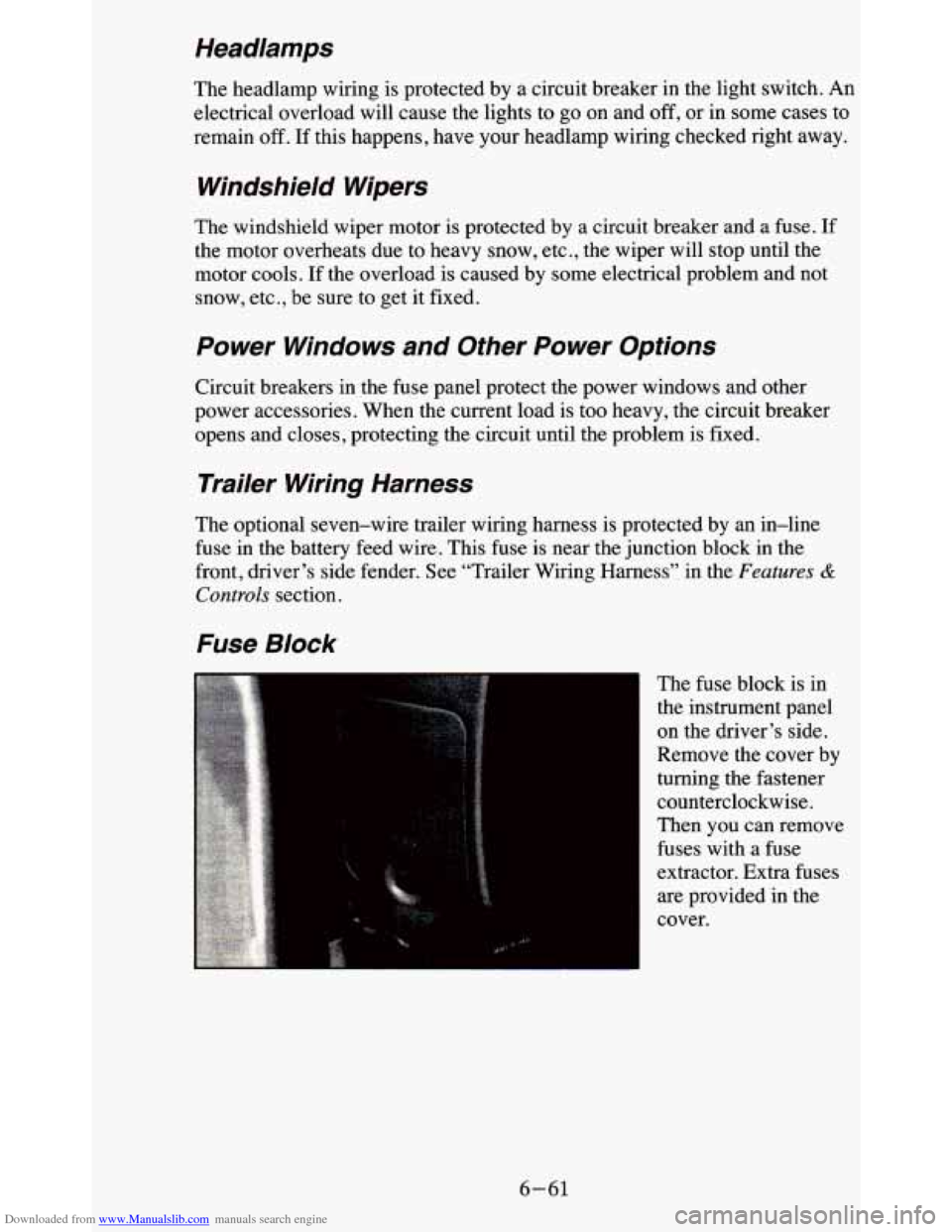
Fuse B/ock
The fuse block is in
the instrument panel
on the driver’s side.
Remove the cover by
turning the fastener
counterclockwise.
Then you can remove
fuses with a fuse
extractor. Extra fuses
are provided in the
cover.
6-61
Page 303 of 380
Downloaded from www.Manualslib.com manuals search engine Wheel Nut Torque
DESCRIPTION
Base or Optional Wheel
Cooling System Capacity
ENGINE VIN CODE
4.3L
W
TORQUE
95 ft.
lbs. ( 130 Nom)
QUANTITY*
12.1 Quarts
(1 1.5 Liters)
*All quantities are approximate. After refill, the level MUST be checked.
Crankcase Capacity
ENGINE
4.3L
VIN CODE
W
QUANTITY WITH
FILTER*
4.5 Quarts (4.3 Liters)
*All quantities are approximate. After refill, the level MUST be checked.
Do not overfill.
Fuel Tank Capacity
TYPE
2-Door Models
4-Door Models
QUANTITY*
20 Gallons (76 Liters)
19 Gallons (72 Liters)
*All quantities are approximate.
6-63
Page 305 of 380
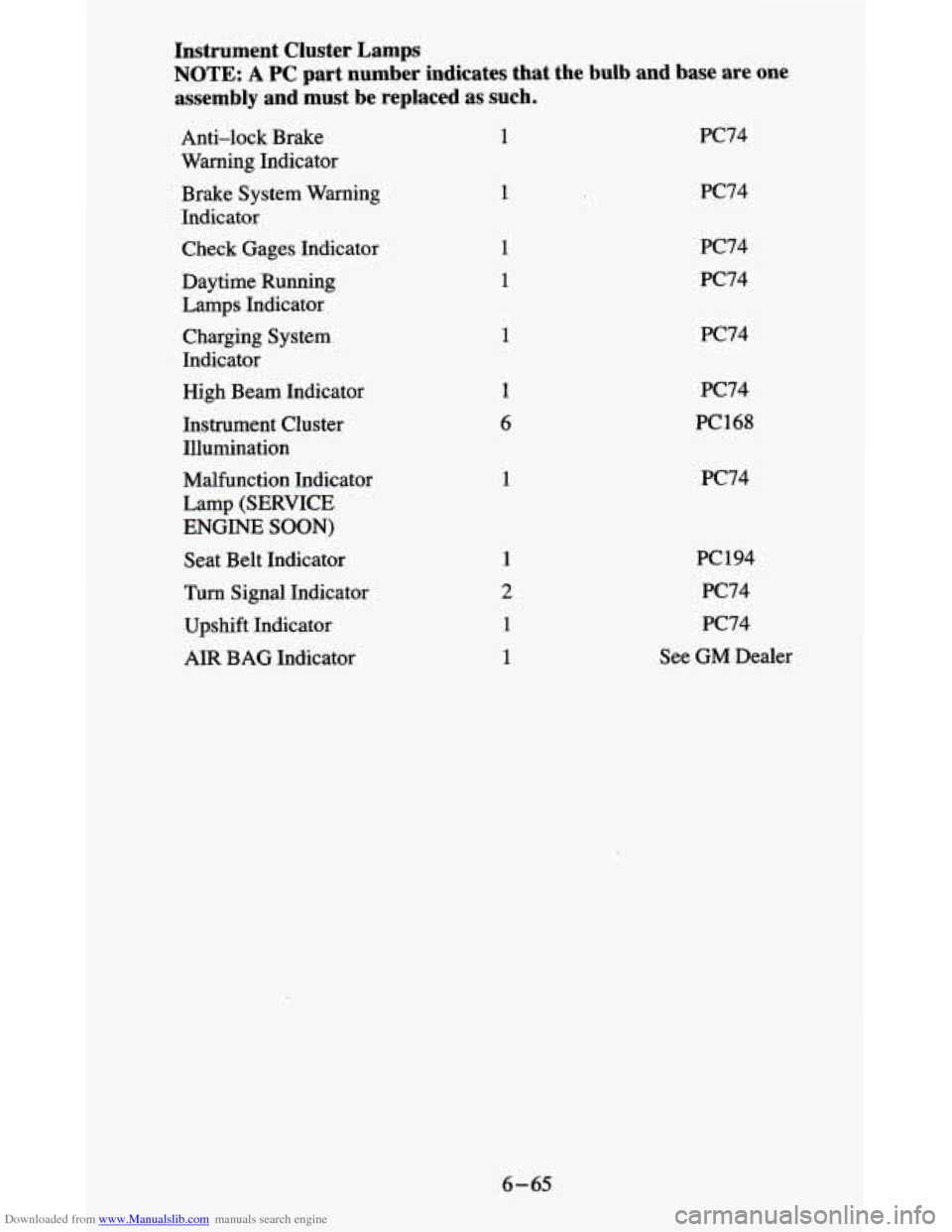
Downloaded from www.Manualslib.com manuals search engine Instrument Cluster Lamps
NOTE: A PC part number indicates that the bulb and base are one
assembly and must be replaced as such.
Anti-lock Brake
Warning Indicator
Brake System Warning
Indicator
Check Gages Indicator
Daytime Running
Lamps Indicator
Charging System
Indicator
High Beam Indicator
Instrument Cluster
Illumination
Malfunction Indicator
Lamp (SERVICE
ENGINE
SOON)
Seat Belt Indicator
Turn Signal Indicator
Upshift Indicator
AIR BAG Indicator
1
1
1
1
1
1
6
1
1
2
1
1
PC74
PC74
PC74 PC74
PC74
PC74
PC168
PC74
PC 194
PC74 PC74
See
GM Dealer
6-65
Page 314 of 380
Downloaded from www.Manualslib.com manuals search engine How This Section is Organized
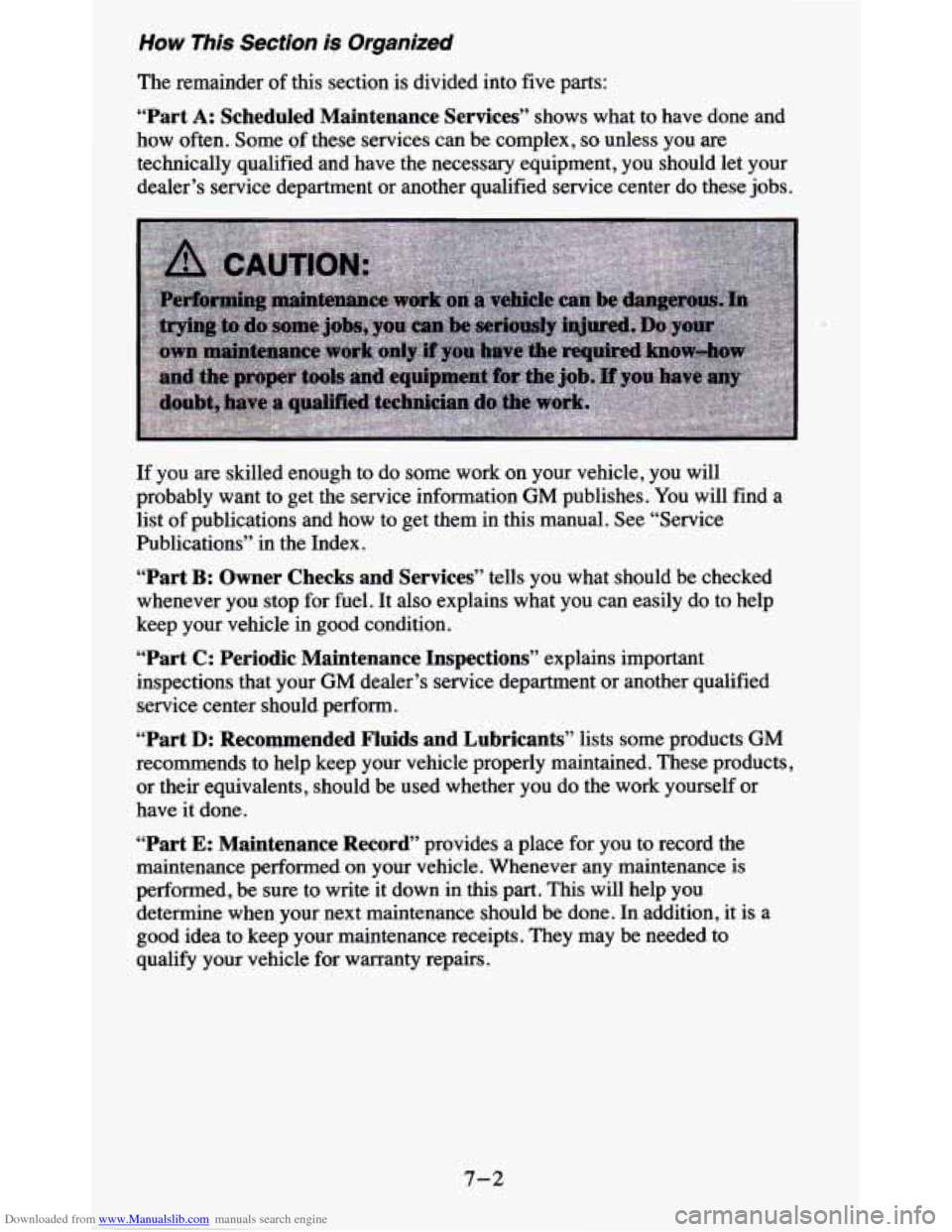
The remainder of this section is divided into five parts:
“Part A: Scheduled Maintenance Services” shows what to have done and
how often. Some
of these services can be complex, so unless you are
technically qualified and have the necessary equipment, you should let your
dealer’s service department
or another qualified service center do these jobs.
If you are skilled enough to do some work on your vehicle, you will
probably want to get the service information
GM publishes. You will find a
list of publications and how to get them in this manual. See “Service
Publications” in the Index.
“Part B: Owner Checks and Services” tells you what should be checked
whenever
you stop for fuel. It also explains what you can easily do to help
keep your vehicle in good condition.
“Part C: Periodic Maintenance Inspections” explains important
inspections that your
GM dealer’s service department or another qualified
service center should perform.
“Part D: Recommended Fluids and Lubricants” lists some products GM
recommends to help keep your vehicle properly maintained. These \
products,
or their equivalents, should be used whether you do the work yourself or
have it done.
“Part E: Maintenance Record’ provides a place for you to record the
maintenance performed on your vehicle. Whenever any maintenance is
performed, be sure to write it down
in this part. This will help you
determine when your next maintenance should be done. In addition, it is a
good idea to keep your maintenance receipts. They may be needed to
qualify your vehicle
for warranty repairs.
7-2