tow CHEVROLET BLAZER 1995 2.G Workshop Manual
[x] Cancel search | Manufacturer: CHEVROLET, Model Year: 1995, Model line: BLAZER, Model: CHEVROLET BLAZER 1995 2.GPages: 380, PDF Size: 20.04 MB
Page 294 of 380
Downloaded from www.Manualslib.com manuals search engine Washing Your Vehicle
The best way to preserve your vehicle’s finish is to keep it clean by washing
it often with lukewarm or cold water.
Don’t wash your vehicle in the direct rays of the sun. Don’t use strong soaps
or chemical detergents. Use liquid hand, dish or car washing (mild
detergent) soaps. Don’t use cleaning agents that are petroleum based, or that
contain acid or abrasives. All cleaning agents should be flushe\
d promptly
and not allowed to dry on the surface, or they could stain. Dry the finish
with a soft, clean chamois
or a 100% cotton towel to avoid surface scratches
and water spotting.
High pressure vehicle washes may cause water to enter your vehicle.
Finish Care
Occasional waxing or mild polishing of your vehicle by hand may be
necessary to remove residue from the paint finish. You can get GM
approved cleaning products from your dealer. (See “Appearance\
Care and
Materials” in the Index.)
Your vehicle has a “basecoatklearcoat” paint finish. The clearcoat gives
more depth and gloss to the colored basecoat. Always use waxes and
polishes that are non-abrasive and made for a basecoatklearcoat paint
finish.
NOTICE:
Machine compounding or aggressive polishing on a .
basecoatlclearcoat paint finish may dull the finish or leave sw\
irl
marks.
Foreign materials such as calcium chloride and other salts, ice melting
agents, road oil and tar, tree sap, bird droppings, chemicals from industrial
chimneys, etc. can damage your vehicle’s finish if they remain on painted
surfaces. Wash the vehicle as soon as possible. If necessary, use
non-abrasive cleaners that are marked safe for painted surfaces to remove
foreign matter.
Exterior painted surfaces are subject to aging, weather and chemical fallout
that can take their toll over a period
of years. You can help to keep the paint
finish looking new by keeping your vehicle garaged
or covered whenever
possible.
6-54
Page 318 of 380
Downloaded from www.Manualslib.com manuals search engine I Maintenance Schedule I
The services shown in this schedule up to 100,000 miles (166 000 km)
should be performed after 100,000 miles (166 000 km) at the same intervals.
Footnotes
? The California Air Resources Board has determined that the failure to
perform this maintenance item will not nullify the emission warranty or
limit recall liability prior to the completion of vehicle useful life. We,
however, urge that all recommended maintenance services be performed at
the indicated intervals and the maintenance be recorded in “\
Section
E:
Maintenance Record.”
** Drive axle service:
0
0
0
Locking Differential - Drain fluid and refill at first engine oil change.
At subsequent oil changes, check fluid level and add fluid as needed.
If
driving in dusty areas or towing a trailer, drain fluid and refill every
15,000 miles (25
000 km).
Standard Differential
- Check fluid level and add fluid as needed at
every oil change. If driving in dusty areas or towing
a trailer, drain
fluid and refill
every 15,000 miles (25 000 km) .
More frequent lubrication may be required for heavy-duty or off-road
use.
3,000 Miles (5 000 km)
0
0
Change engine oil and filter (or every 3 months, whichever occurs
first).
An Emission Control Service.
Lubricate the front suspension, ball joints (ball joints should not be
lubricated unless their temperature is 10°F (-1 2°C) or higher. When
the weather is cold, let them warm up before lubricating them
or they
could be damaged.), steering linkage and transfer case shift linkage,
parking brake cable guides, propshaft splines, universal joints, brake
pedal springs, and clutch pedal springs at every
oil change (or every 6
months
, whichever occurs first).
Check readfront axle fluid level and add fluid as needed. Check
constant velocity joints and axle seals for leaking.
**
I DATE I ACTUALMILEAGE I SERVICED BY:
7-6
Page 327 of 380
Downloaded from www.Manualslib.com manuals search engine I Maintenance Schedule I I
48,000 Miles (80 000 km)
0 Change engine oil and filter (or every 3 months, whichever occurs
0 Lubricate the front suspension, ball joints (ball joints should not be
first).
An Emission Control Service.
lubricated unless their
temperature is 10°F (-1 2°C) or higher. When
the weather is cold, let them warm up before lubricating them or they
could be damaged.), steering linkage and transfer case shift linkage,
parking brake cable guides, propshaft splines, universal joints, brake
pedal springs, and clutch pedal springs at every oil change (or every
6
months, whichever occurs first).
constant velocity joints and axle seals for leaking.**
Check readfront axle fluid level and add fluid as needed. Check
DATE ACTUAL MILEAGE SERVICED BY:
L
50,000 Miles (83 000 km)
0 Change automatic transmission fluid and filter if the vehicle is mainly
driven under one or more of these conditions:
- In heavy city traffic where the outside temperature regularly
reaches
90 OF (32 O C) or higher.
- In hilly or mountainous terrain.
- When doing frequent trailer towing.
- Uses such as found in taxi, police car or delivery service.
If you do not use your vehicle under any of these conditions, the fluid
and filter do not require changing.
Manual transmission fluid doesn’t require change.
I DATE I ACTUALMILEAGE I SERVICED BY: I
7- 15
Page 337 of 380
Downloaded from www.Manualslib.com manuals search engine Maintenance Schedule I
99,000 Miles (165 000 km)
0 Change engine oil and filter (or every 3 months, whichever occurs
0 Lubricate the front suspension, ball joints (ball joints should not be
first).
An Emission Control Service.
lubricated unless their
temperature is 10 "F (-1 2°C) or higher. When
the weather is cold,
let them warm up before lubricating them or they
could be damaged.), steering linkage and transfer case shift linkage,
parking brake cable guides, propshaft splines, universal joints, brake
pedal springs, and clutch pedal springs at every oil change (or every
6
months, whichever occurs first).
0 Check readfront axle fluid level and add fluid as needed. Check
constant velocity joints and axle seals for leaking.**
DATE
SERVICED BY ACTUAL MILEAGE
100,000 Miles (166 000 km)
0 Change automatic transmission fluid and filter if the vehicle is mainly
driven under one or more of these conditions:
- In heavy city traffic where the outside temperature regularly
reaches
90°F (32°C) or higher.
- In hilly or mountainous terrain,
- When doing frequent trailer towing.
- Uses such as found in taxi, police car or delivery service. Ifyou do
not use your vehicle under any of these conditions, the fluid and
filter
do not require changing.
Manual transmission fluid doesn't require change.
DATE
SERVICED BY ACTUAL MILEAGE
L
7-25
Page 338 of 380
Downloaded from www.Manualslib.com manuals search engine The services shown in this schedule up to 100,000 miles (166 000 km)
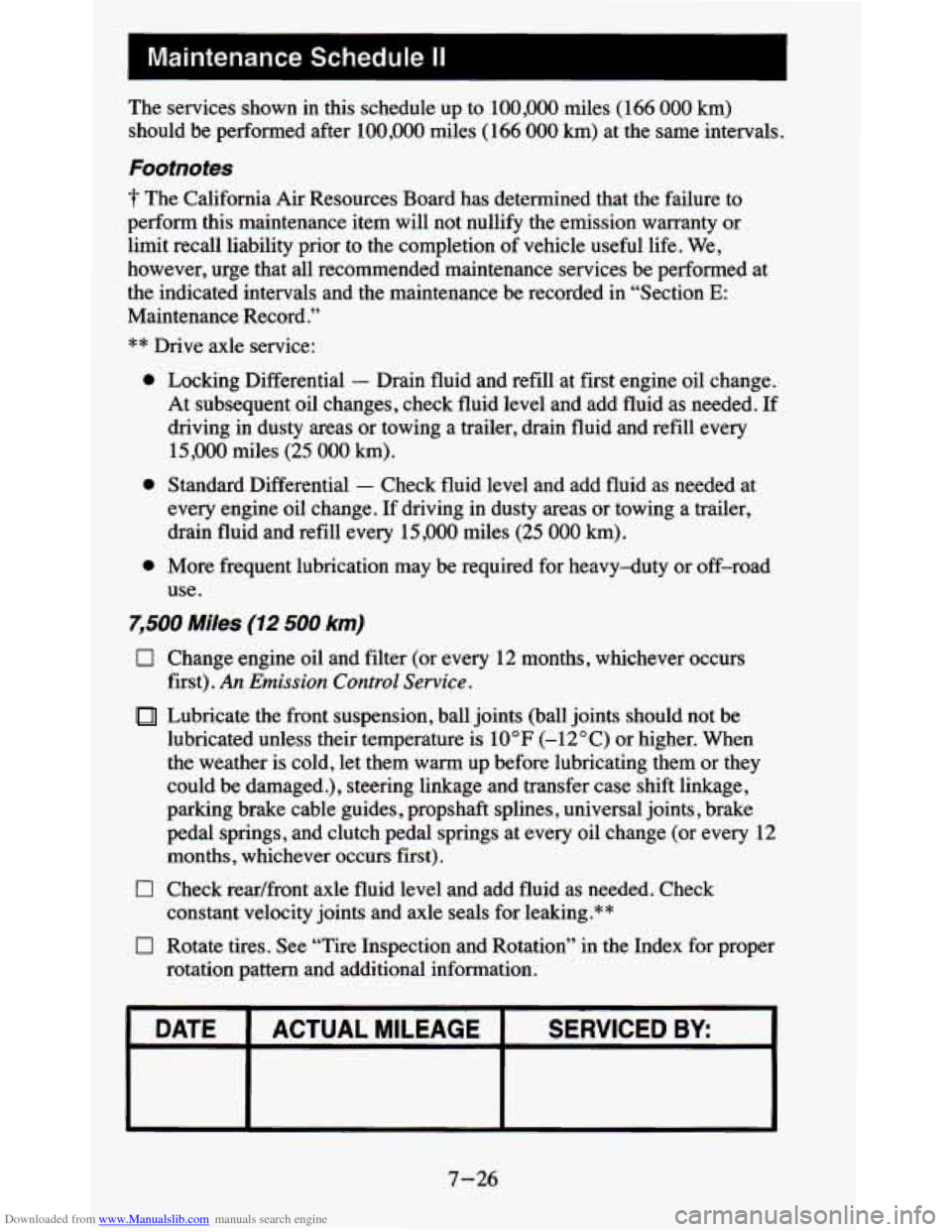
should be performed after 100,000 miles (166 000 km) at the same intervals.
Footnotes
t The California Air Resources Board has determined that the failure to
perform this maintenance item will not nullify the emission warranty or
limit recall liability prior to the completion of vehicle useful life. We,
however, urge that all recommended maintenance services be performed at
the indicated intervals and the maintenance be recorded
in “Section E:
Maintenance Record .”
** Drive axle service:
0 Locking Differential - Drain fluid and refill at first engine oil change.
At subsequent oil changes, check fluid level and add fluid as needed. If
driving in dusty areas or towing a trailer, drain fluid and refill every
15,000 miles (25 000 km).
0 Standard Differential - Check fluid level and add fluid as needed at
every engine oil change. If driving in dusty areas or towing a trailer,
drain fluid and refill every
15,000 miles (25 000 km).
0 More frequent lubrication may be required for heavy-duty or off-road
use.
7,500 Miles (12 500 km)
0 Change engine oil and filter (or every 12 months, whichever occurs
Lubricate the front suspension, ball joints (ball joints should not be
first).
An Emission
Control Service.
lubricated unless their temperature is 10°F (-12°C) or higher. When
the weather is cold, let them warm up before lubricating them or they
could be damaged.), steering linkage and transfer case shift linkage,
parking brake cable guides, propshaft splines, universal joints, brake
pedal springs, and clutch pedal springs at every oil change
(or every 12
months, whichever occurs first).
0 Check readfront axle fluid level and add fluid as needed. Check
constant velocity joints and axle seals for leaking,**
0 Rotate tires. See “Tire Inspection and Rotation” in the Index for proper
rotation pattern and additional information.
DATE SERVICED BY ACTUAL MILEAGE
7-26
Page 342 of 380

0 Change automatic transmission fluid and filter if the vehicle is mainl\
y
- In heavy city traffic whe")
Downloaded from www.Manualslib.com manuals search engine 50,000 Miles (83 000 km)
0 Change automatic transmission fluid and filter if the vehicle is mainl\
y
- In heavy city traffic where the outside temperature regularly
driven under
one or more of these conditions:
reaches
90°F (32°C) or higher.
- In hilly or mountainous terrain.
- When doing frequent trailer towing.
- Uses such as found in taxi, police car or delivery service.
If you do not use your vehicle under any of these conditions, the fluid
and filter
do not require changing.
Manual transmission fluid doesn’t require change.
52,500 Miles (87 500)
0
0
0
Change engine oil and filter (or every 12 months, whichever occurs
first).
An Emission Control Service.
Lubricate the front suspension, ball joints (ball joints should not be
lubricated unless their temperature is
10°F (-12°C) or higher. When
the weather is cold, let them warm up before lubricating them or they
could be damaged.), steering linkage and transfer case shift linkage,
parking brake cable guides, propshaft splines, universal joints, brake
pedal springs, and clutch pedal springs at every oil change (\
or every 12
months, whichever occurs first).
Check readfront axle fluid level and add fluid as needed. Check
constant velocity joints and axle seals for leaking.**
Rotate tires. See “Tire Inspection and Rotation” in the Index for proper
rotation pattern and additional information.
DATE SERVICED BY: ACTUAL MILEAGE I
7-30
Page 347 of 380
Downloaded from www.Manualslib.com manuals search engine I Maintenance Schedule II
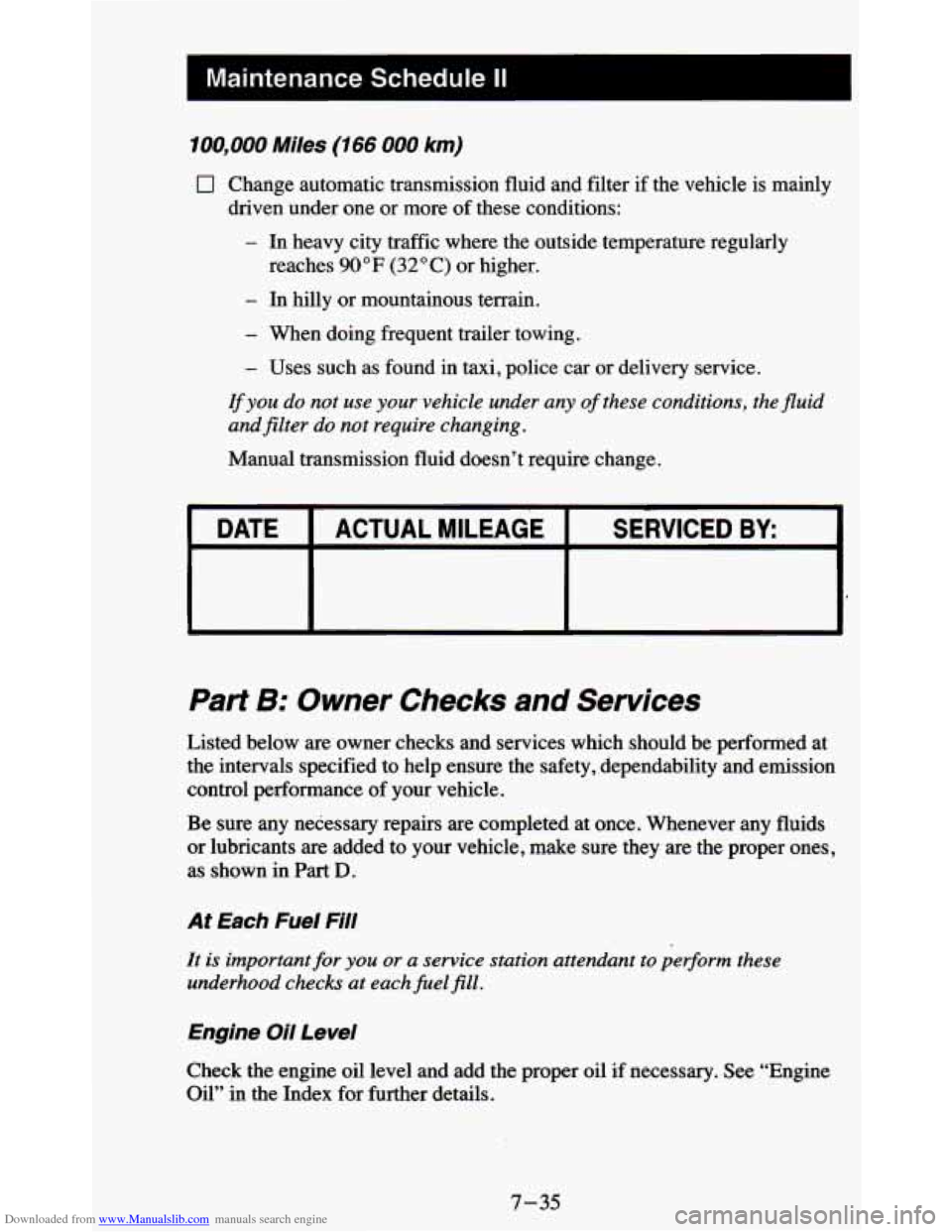
700,000 Miles (766 000 km)
0 Change automatic transmission fluid and filter if the vehicle is mainly
- In heavy city traffic where the outside temperature regularly
driven under
one or more
of these conditions:
reaches
90 OF (32 O C) or higher.
- In hilly or mountainous terrain.
- When doing frequent trailer towing.
- Uses such as found in taxi, police car or delivery service.
IJ you do not use your vehicle under any of these conditions, the fluid
and filter do not require changing.
Manual transmission fluid doesn’t require change.
DATE
SERVICED BY: ACTUAL MILEAGE I
Part B: Owner Checks and Services
Listed below are owner checks and services which should be performed at
the intervals specified to help ensure the safety, dependability and emission
control performance
of your vehicle.
Be sure any necessary repairs are completed at once. Whenever any fluids
or lubricants are added to your vehicle, make sure they are the proper ones,
as shown
in Part D.
At Each Fuel Fill
It is important for you or a sewice station attendant to perform these
underhood checks at each @el
fill.
Engine Oil Level
Check the engine oil level and add the proper oil if necessary. See “Engine
Oil” in the Index for further details.
7-35
Page 362 of 380

Downloaded from www.Manualslib.com manuals search engine Chevrolet Roadside Assistance Program
To enhance Chevrolet’s strong commitment to customer satisfaction,\
Chevrolet is excited to provide the services
of the ChevroletlGeo Roadside
Assistance Center.
24-Hour Roadside Assistance Number
Roadside Assistance is available 24 hours a day, 365 days a year, by calling
1-800-CHEV USA (1-800-243-8872). The call is toll-free and warranty
repairs are covered at no cost. Additional services arranged by the Roadside
representative may entail charges, and those charges, if any, will be
fully
explained to you before you authorize us to act in your behalf. Trained
representatives are available
to help you solve your problem or coordinate a
variety of quality services through Chevrolet’s dealer network\
and their
preferred service providers. The following services are available:
Towing
0 Locksmith
0 Tire repair
Rental car or taxi
0 Additional services as necessary
For prompt assistance when calling, please have the following available to
give to the representative:
Vehicle Identification Number
0 License plate number
0 Vehicle color
0 Vehicle location
Telephone number where you can be reached
Vehicle mileage
0 Description of the problem
uanadian Roadside Assistance
Vehicles purchased in Canada have an extensive Roadside Assistan\
ce
program accessible from anywhere in Canada or the U.S.A. Please refer to
the separate brochure provided by the dealer
or call 1-800-268-6800 for
emergency services.
8-6
Page 372 of 380
Downloaded from www.Manualslib.com manuals search engine Engine (continued) FanNoise
................................................... 5-20
Identification
....................................... 6-58.6-59. 6-62
Oil (See “Oil”)
.l
RunningWhileParked ......................................... 2-28
Starting
..................................................... 2-16
Exhaust System
.................................................. 6-40
Overheating .................................................. 5-13
F .
Filter Replacement Chart (See “Service-Replacement Parts and Filter
Recommendations”)
FluidLeakCheck
................................................ 6-31
Fluids (See “Recommended Fluids and Lubricants”)
Four-wheel Drive
.......................................... 2.30. 6-20
Manual Transfer Case
.......................................... 2-30
Electronic Transfer Case
........................................ 2-32
Fuel
. FillingYourTank .............................................. 6-5
Foreign Countries .............................................. 64
Gage (See “Gages”)
Gasolines for Cleaner Air
....................................... :6-4
Tank Capacity ................................................. 6-63
Fuses and Circuit Breakers
................................... 6-60, 6-66
FuseBlock .................................................. 6-61
G
Gages Engine Coolant Temperature Gage
................................ 2-77
Oil Pressure Gage
............................................. 2-77
Trip Odometer
................................................ 247
FuelGage
................................................... 2-78
Odometer
................................................... 2-66
Speedometer
................................................. 2-66
Tachometer
.................................................. 2-67
Voltmeter
.................................................... 2-79
H
Halogen Bulbs (See “Bulb Replacement”)
Head Restraints (See “Seats”) Headlamps Hazard Wqing Flashers
........................................... 5-1
Replacement (See “Bulb Replacement”)
High Beam Indicator Light (See “Lights”)
. High-Low Beam Changer ................................. 2-39. 2-76
Reminder
.................................................... 249
Heater/Air Conditioning Controls
.................................... 3-1
Refrigerant Capacity
............................................ 6-71
Highway Hypnosis (See “Driving-Highway Hypnosis”)
Hitches (See “Towing a Trailer”)
4
Page 375 of 380
Downloaded from www.Manualslib.com manuals search engine Radiator Pressure Cap ............................................ 6-24
Radio (See “Audio Systems”)
Rear Axle (See “Axle”)
Rear Safety Belt Comfort Guides (See “Safety Belts”)
Rear Window Defogger
............................................ 3-3
Recommended Fluids and Lubricants ................................ 740
Recovery Hooks
................................................. 5-36
Replacement Parts
............................................... 6-62
Reporting Safety Defects
To The United States Government ............... 8-4
Roadside Assistance ............................................... 8-6
RockingYourVehicle
............................................ 5-36
S
SafetyBelts ..................................................... 1-7
Center Front Passenger Position (&Door Model) .................... 1-23
Center Rear Passenger Position (4-Door Models)
.................... 1-29
Cleaning
.................................................... 6-52
Checking Restraint System
...................................... 140
Child Restraints
............................................... 1-32
Center Seat Position (&Door Models)
.......................... 1-35
Larger Children
............................................ 1-38
Right Front Seat Position
..................................... 1-36
Rear Outside Seat Position
................................... 1-33
TopStrap .................................................. 1-32
Where to Put the Restraint
.................................... 1-32
Children
.................................................... 1-30
DriverPosition ............................................... 1-11
Extender
..................................................... 1-40
Properwear ................................................. 1-11
Rear Safety Belt Comfort Guides
................................. 1-27
Reminder Light (See “Lights”)
Replacing Seat and Restraint Parts After a Crash
..................... 1-40
Right Front Passenger Position ................................... 1-22
LapBelt
..................................................... 1-23
Questions
& Answers .......................................... 1-10
RearSeatPassengers ........................................... 1-24
Use During Pregnancy
......................................... 1-22
Why Safety Belts Work
.......................................... 1-8
Safety Chains (See “Towing a Trailer”)
Safety Defects
Reporting Safety Defects to Canada
................................ 8-5
Reporting Safety Defects to General Motors ......................... 8-5
Reporting Safety Defects to the United States ........................ 8-4
Safety Warnings and Symbols
........................................ iv
Scheduled Maintenance Services Maintenance Record
........................................... 7-42
Maintenance Schedule
I ......................................... 7-6
MaintenanceSchedulen
........................................ 7-26
Periodic Maintenance
.......................................... 7-38
Recommended: Fluids and Lubricants
.............................. 7-40
Selecting the Right Schedule
..................................... 7-3
Using Your Maintenance Schedule
................................. 7-3
7