oil pressure CHEVROLET BLAZER 1995 2.G Owners Manual
[x] Cancel search | Manufacturer: CHEVROLET, Model Year: 1995, Model line: BLAZER, Model: CHEVROLET BLAZER 1995 2.GPages: 380, PDF Size: 20.04 MB
Page 10 of 380
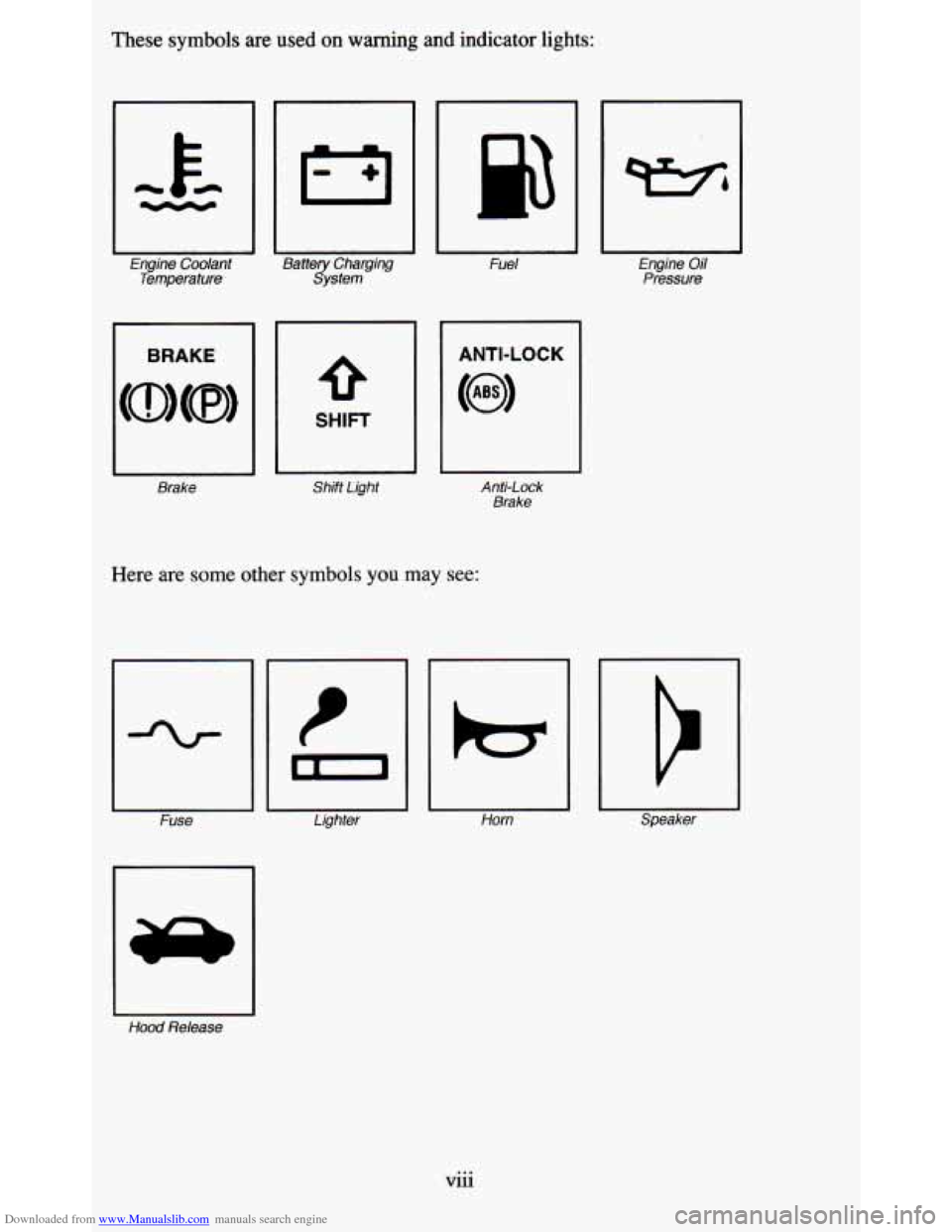
Downloaded from www.Manualslib.com manuals search engine These symbols are used on warning and indicator lights:
Engine Coolant
Temperature
I BRAKE
Brake
Battery Charging
System
1
Fuel
SHIFT
Shift Light
1 ANTI-LOCK
I
Anti-Lock Brake
Here are some other symbols you may see:
Fuse Lighter
I-
I-
Horn
L
Engine Oil Pressure
Hood
Release
Vlll ...
Page 126 of 380
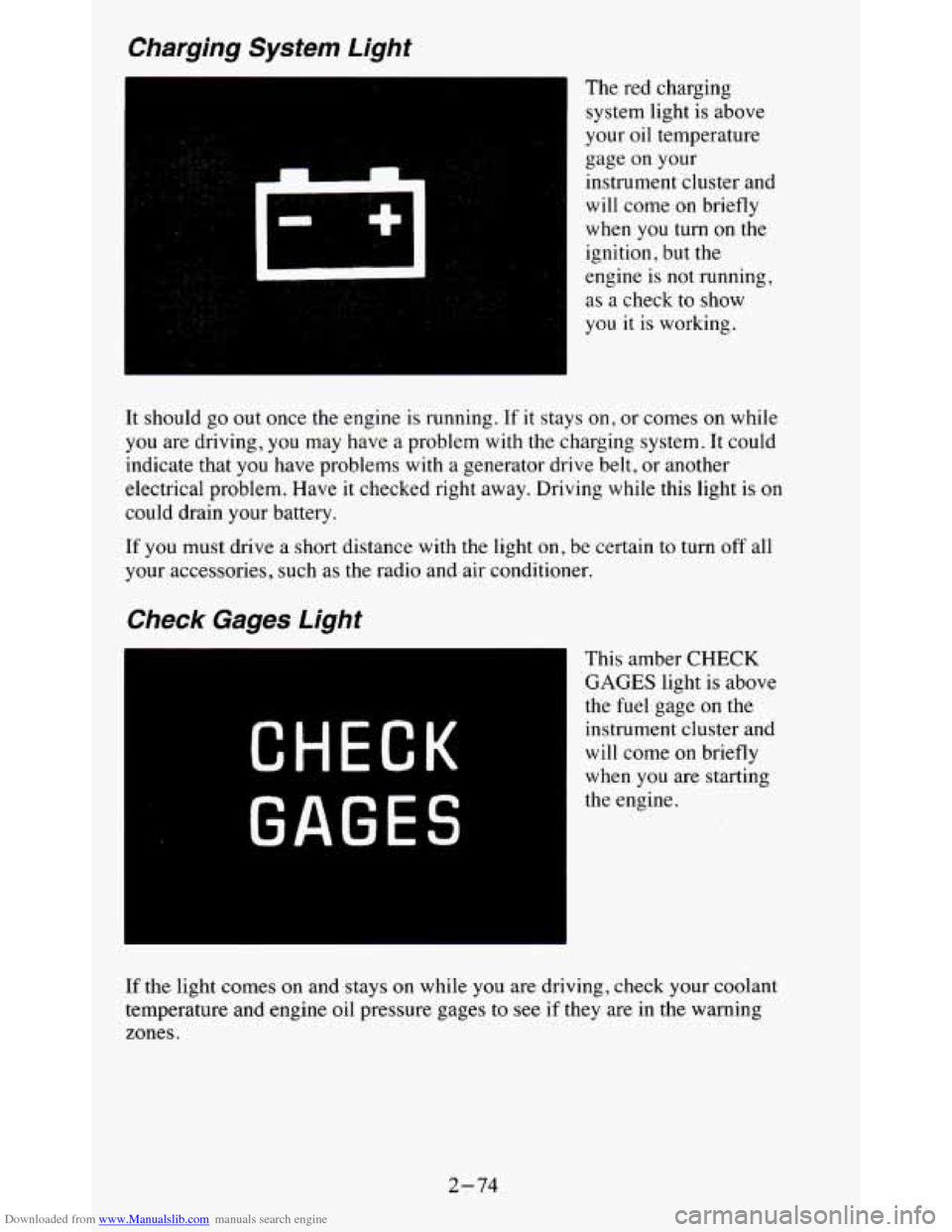
Downloaded from www.Manualslib.com manuals search engine Charging System Light
The red charging
system light is above
your oil temperature
gage on your
instrument cluster and
will come on briefly
when
you turn on the
ignition,
but the
engine
is not running,
as a check to show
you
it is working.
It should go out once the engine is running. If it stays
on, or comes on while
you are driving, you may have a problem with the charging system. It could
indicate that you have problems with a generator drive belt, or another
electrical problem. Have it checked right away. Driving while t\
his light is on
could drain your battery.
If you must drive a short distance with the light on, be certain to turn off all
your accessories, such as the radio and air conditioner.
Check Gages Light
CHECK
GAGES
This amber CHECK
GAGES light is above
the
fuel gage on the
instrument cluster and
will come on briefly
when you are starting
the engine.
If the light comes on and stays on while you are driving, check your coolant
temperature and engine oil pressure gages to see
if they are in the warning
zones.
2-74
Page 129 of 380
Downloaded from www.Manualslib.com manuals search engine Gages
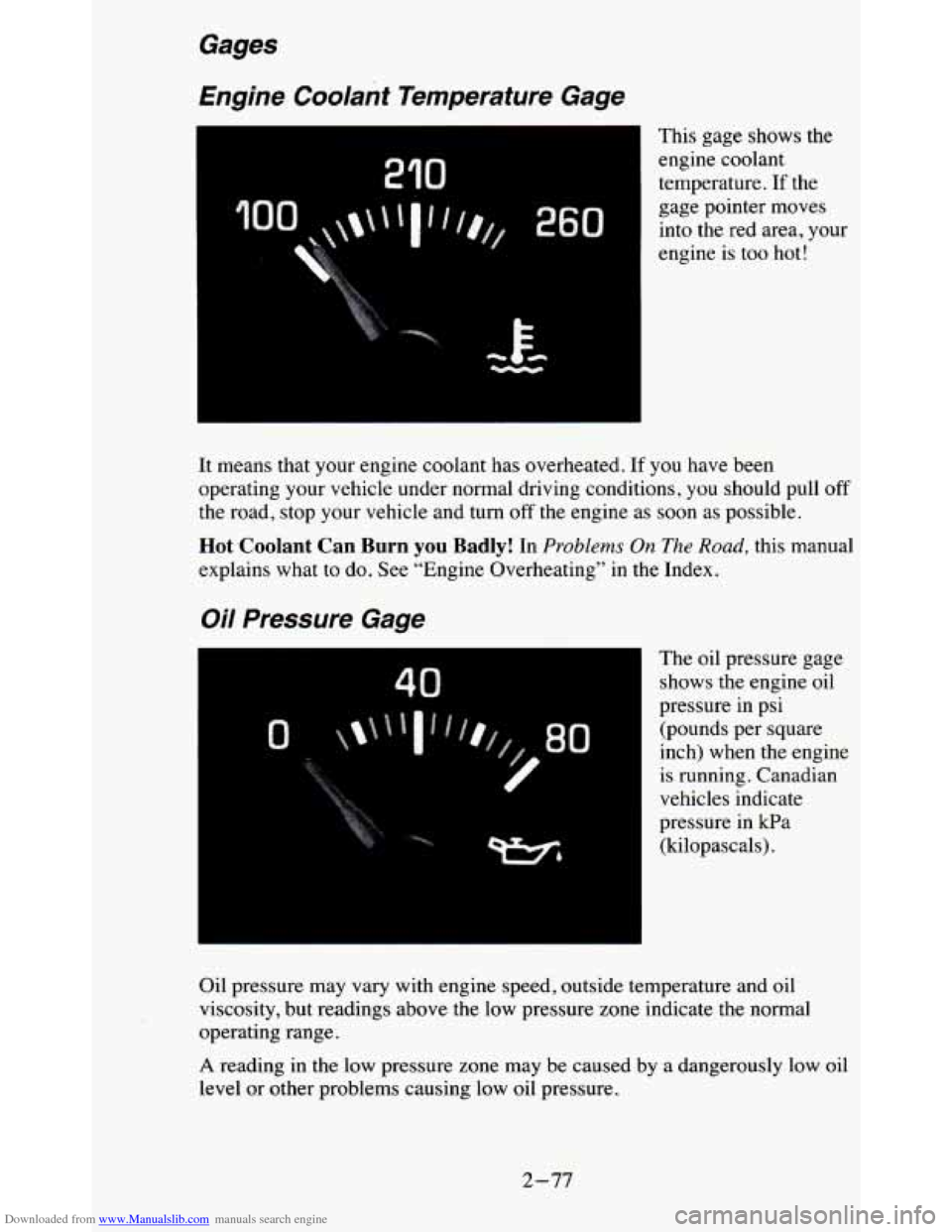
Engine Coolant Temperature Gage
I
210
0
rc E- -
This gage shows the
engine coolant
temperature.
If the
gage pointer moves into the red area, your
engine
is too hot!
It means that your engine coolant has overheated. If you have bee\
n
operating your vehicle under normal driving conditions, you shou\
ld pull off
the road, stop your vehicle and turn
off the engine as soon as possible.
Hot Coolant Can Burn you Badly! In Problems On The Road, this manual
explains what to do. See “Engine Overheating” in the Index.
Oil Pressure Gage
40
The oil pressure gage
shows the engine oil
pressure in psi (pounds per square
inch) when the engine
is running. Canadian
vehicles indicate
pressure in kPa (kilopascals).
Oil pressure may vary with engine speed, outside temperature and oil
viscosity, but readings above the low pressure zone indicate the normal
operating range.
A reading in the low pressure zone may be caused by a dangerously low oil
level or other problems causing low oil pressure.
2-77
Page 183 of 380
Downloaded from www.Manualslib.com manuals search engine Before Leaving on a Long Trip
Make sure you’re ready. Try to be well rested. If you must start when you’re
not fresh
- such as after a day’s work - don’t plan to make too many
miles that first part of the journey. Wear comfortable clothing and shoes
you
can easily drive in.
Is your vehicle ready for a long trip? If you keep it serviced and maintained,
it’s ready to go. If it needs service, have it done before starting out. Of
course, you’ll find experienced and able service experts in
GM dealerships
all across North America. They’ll be ready and willing to help if you need
it.
Here are some things you can check before a trip:
Windshield Washer Fluid: Is the reservoir full? Are all windows clean
inside and outside?
Wiper Blades: Are they in good shape?
0 Fuel, Engine Oil, Other Fluids: Have you checked all levels?
0 Lights: Are they all working? Are the lenses clean?
Tires: They are vitally important to a safe, trouble-free trip. Is the tread
good enough for long-distance driving? Are the tires all inflated to the
recommended pressure?
0 Weather Forecasts: What’s the weather outlook along your route?
Maps: Do you have up-to-date maps?
Should
you delay your trip a short time to avoid a major storm system?
Highway Hypnosis
Is there actually such a condition as “highway hypnosis”? Or is it just plain
falling asleep at the wheel? Call it highway hypnosis, lack of awareness, or
whatever.
There
is something about an easy stretch of road with the same scenery,
along with the hum of the tires on the road, the drone of the engine, and the
rush
of the wind against the vehicle that can make you sleepy. Don’t let it
happen
to you! If it does, your vehicle can leave the road in less than a
second,
and you could crash and be injured.
What can you
do about highway hypnosis? First, be aware that it can
happen.
4-29
Page 290 of 380
Downloaded from www.Manualslib.com manuals search engine Using Foam-Type Cleaner on Fabric
0 Vacuum and brush the area to remove any loose dirt.
0 Always clean a whole trim panel or section. Mask surrounding trim
0 Mix Multi-Purpose Powdered Cleaner following the directions on the
along stitch or welt
lines.
container label.
0 Use suds only and apply with a clean sponge.
0 Don’t saturate the material.
Don’t rub it roughly.
0 As soon as you’ve cleaned the section, use a sponge to remove the
suds.
Rinse the section with a clean, wet sponge.
0 Wipe off what’s left with a slightly damp paper towel or cloth.
0 Then dry it immediately with a blow dryer or a heat lamp.
.
NOTICE:
Be careful. A blow dryer may scorch the fabric.
0 Wipe with a clean cloth.
Using Solvent-Type Cleaner on Fabric
First, see if you have to use solvent-type cleaner at all. Some spots and
stains will clean
off better with just water and mild soap.
If you need to use a solvent:
0 Gently scrape excess soil from the trim material with a clean, dull knife
or scraper. Use very little cleaner, light pressure and clean cloths
(preferably cheesecloth). Cleaning should start at the outside
of the
stain, “feathering” toward the center. Keep changing to a clean section
of the cloth.
0 When you clean a stain from fabric, immediately dry the area with a
blow dryer to help prevent
a cleaning ring. (See the previous NOTICE.)
6-50
Page 294 of 380
Downloaded from www.Manualslib.com manuals search engine Washing Your Vehicle
The best way to preserve your vehicle’s finish is to keep it clean by washing
it often with lukewarm or cold water.
Don’t wash your vehicle in the direct rays of the sun. Don’t use strong soaps
or chemical detergents. Use liquid hand, dish or car washing (mild
detergent) soaps. Don’t use cleaning agents that are petroleum based, or that
contain acid or abrasives. All cleaning agents should be flushe\
d promptly
and not allowed to dry on the surface, or they could stain. Dry the finish
with a soft, clean chamois
or a 100% cotton towel to avoid surface scratches
and water spotting.
High pressure vehicle washes may cause water to enter your vehicle.
Finish Care
Occasional waxing or mild polishing of your vehicle by hand may be
necessary to remove residue from the paint finish. You can get GM
approved cleaning products from your dealer. (See “Appearance\
Care and
Materials” in the Index.)
Your vehicle has a “basecoatklearcoat” paint finish. The clearcoat gives
more depth and gloss to the colored basecoat. Always use waxes and
polishes that are non-abrasive and made for a basecoatklearcoat paint
finish.
NOTICE:
Machine compounding or aggressive polishing on a .
basecoatlclearcoat paint finish may dull the finish or leave sw\
irl
marks.
Foreign materials such as calcium chloride and other salts, ice melting
agents, road oil and tar, tree sap, bird droppings, chemicals from industrial
chimneys, etc. can damage your vehicle’s finish if they remain on painted
surfaces. Wash the vehicle as soon as possible. If necessary, use
non-abrasive cleaners that are marked safe for painted surfaces to remove
foreign matter.
Exterior painted surfaces are subject to aging, weather and chemical fallout
that can take their toll over a period
of years. You can help to keep the paint
finish looking new by keeping your vehicle garaged
or covered whenever
possible.
6-54
Page 323 of 380
Downloaded from www.Manualslib.com manuals search engine I Maintenance Schedule I
27,000 Miles (45 000)
0
0
0
Change engine oil and filter (or every 3 months, whichever occurs
first).
An Emission Control Service.
Lubricate the front suspension, ball joints (ball joints should not be
lubricated unless their temperature is 10°F (-12°C) or higher. When
the weather is cold, let them warm up before lubricating them or they
could be damaged.), steering linkage and transfer case shift linkage,
parking brake cable guides, propshaft splines, universal joints, brake
pedal springs, and clutch pedal springs at every oil change (or every
6
months, whichever occurs first).
Check readfront axle fluid level and add fluid as needed. Check
constant velocity joints and axle seals for leaking.**
DATE SERVICED BY ACTUAL MILEAGE
30,000 Miles (50 000 km)
0 Change engine oil and filter (or every 3 months, whichever occurs
0 Lubricate the front suspension, ball joints (ball joints should not be
first).
An
Emission Control Service.
lubricated unless their temperature is 10°F (-1 2°C) or higher. When
the weather is cold, let them
wm up before lubricating them or they
could be damaged.), steering linkage and transfer case shift linkage,
parking brake cable guides, propshaft splines, universal joints, brake
pedal springs, and clutch pedal springs at every oil change (or every
6
months, whichever occurs first).
0 Check readfront axle fluid level and add fluid as needed. Check
constant velocity joints and axle seals for leaking.**
occurs first).
An Emission Control Service
0 Inspect engine accessory drive belts (or every 24 months, whichever
0 Drain, flush and refill cooling system (or every 24 months, whichever
occurs first). Inspect hoses. Clean radiator, condenser, pressure cap and
neck. Pressure test the cooling system and pressure cap.
An Emission
Control Service.
(Continued)
7-11
Page 329 of 380
Downloaded from www.Manualslib.com manuals search engine I Maintenance Schedule I I
57,000 Miles (95 000 km)
0 Change engine oil and filter (or every 3 months, whichever occurs
0 Lubricate the front suspension, ball joints (ball joints should not be
first).
An Emission Control
Service.
lubricated unless their temperature is 10°F (-12°C) or higher. When
the weather is cold, let them warm up before lubricating them or they
could be damaged.), steering linkage and transfer case shift linkage,
parking brake cable guides, propshaft splines, universal joints, brake
pedal springs, and clutch pedal springs at every oil change (or every
6
months, whichever occurs first).
constant velocity joints and axle seals for leaking.**
0 Check readfront axle fluid level and add fluid as needed. Check
DATE
SERVICED BY ACTUAL MILEAGE
60,000 Miles (I00 000 km)
0
0
0
0
0
Change engine oil and filter (or every 3 months, whichever occurs
first).
An Emission Control Service.
Lubricate the front suspension, ball joints (ball joints should not be
lubricated unless their temperature is 10
"F (-1 2" C) or higher. When
the weather is cold, let them warm up before lubricating them or they
could be damaged.), steering linkage and transfer case shift linkage,
parking brake cable guides, propshaft splines, universal joints, brake
pedal,springs, and clutch pedal springs at
every oil change (or every 6
months, whichever occurs first).
Check readfront axle fluid level and add fluid as needed. Check
constant velocity joints and axle seals for leaking.**
Inspect engine accessory drive belt (or
every 24 months, whichever
occurs first).
An Emission Control Service.
Drain, flush and refill cooling system (or every 24 months, whichever
occurs first). Inspect hoses. Clean radiator, condenser, pressure cap and
neck. Pressure test the cooling system and pressure cap.
An Emission
Control Service.
(Continued)
7-17
Page 335 of 380
Downloaded from www.Manualslib.com manuals search engine I Maintenance Schedule I
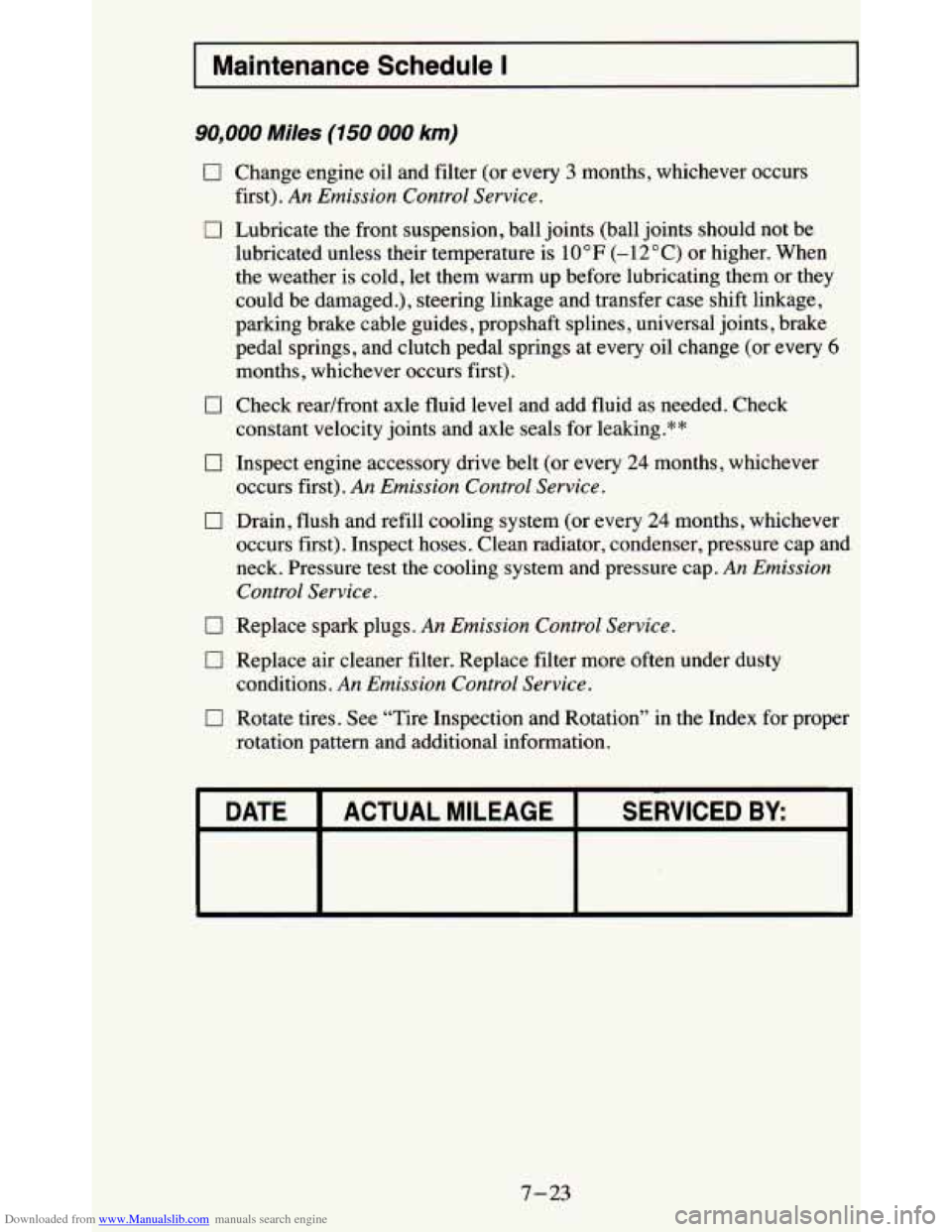
90,000 Miles (150 000 km)
0
0
0
0
0
0
0
0
Change engine oil and filter (or every 3 months, whichever occurs
first).
An Emission Control Service.
Lubricate the front suspension, ball joints (ball joints should not be
lubricated unless their temperature is
10 OF (- 12 O C) or higher. When
the weather is cold, let them warm up before lubricating them or they
could be damaged.), steering linkage and transfer case shift linkage,
parking brake cable guides, propshaft splines, universal joints, brake
pedal springs, and clutch pedal springs at every oil change (or every
6
months, whichever occurs first).
Check readfront axle fluid level and add fluid
as needed. Check
constant velocity joints and axle seals for leaking.**
Inspect engine accessory drive belt (or every
24 months, whichever
occurs first).
An Emission Control Service.
Drain, flush and refill cooling system (or every 24 months, whichever
occurs first). Inspect hoses. Clean radiator, condenser, pressure cap and
neck. Pressure test the cooling system and pressure cap.
An Emission
Control Service.
Replace spark plugs. An Emission Control Service.
Replace air cleaner filter. Replace filter more often under dusty
conditions.
An Emission Control Service.
Rotate tires. See “Tire Inspection and Rotation” in the Index for proper
rotation pattern and additional information.
I DATE I ACTUALMILEAGE I SERVICED BY I
7-23
Page 340 of 380
Downloaded from www.Manualslib.com manuals search engine Maintenance Schedule II
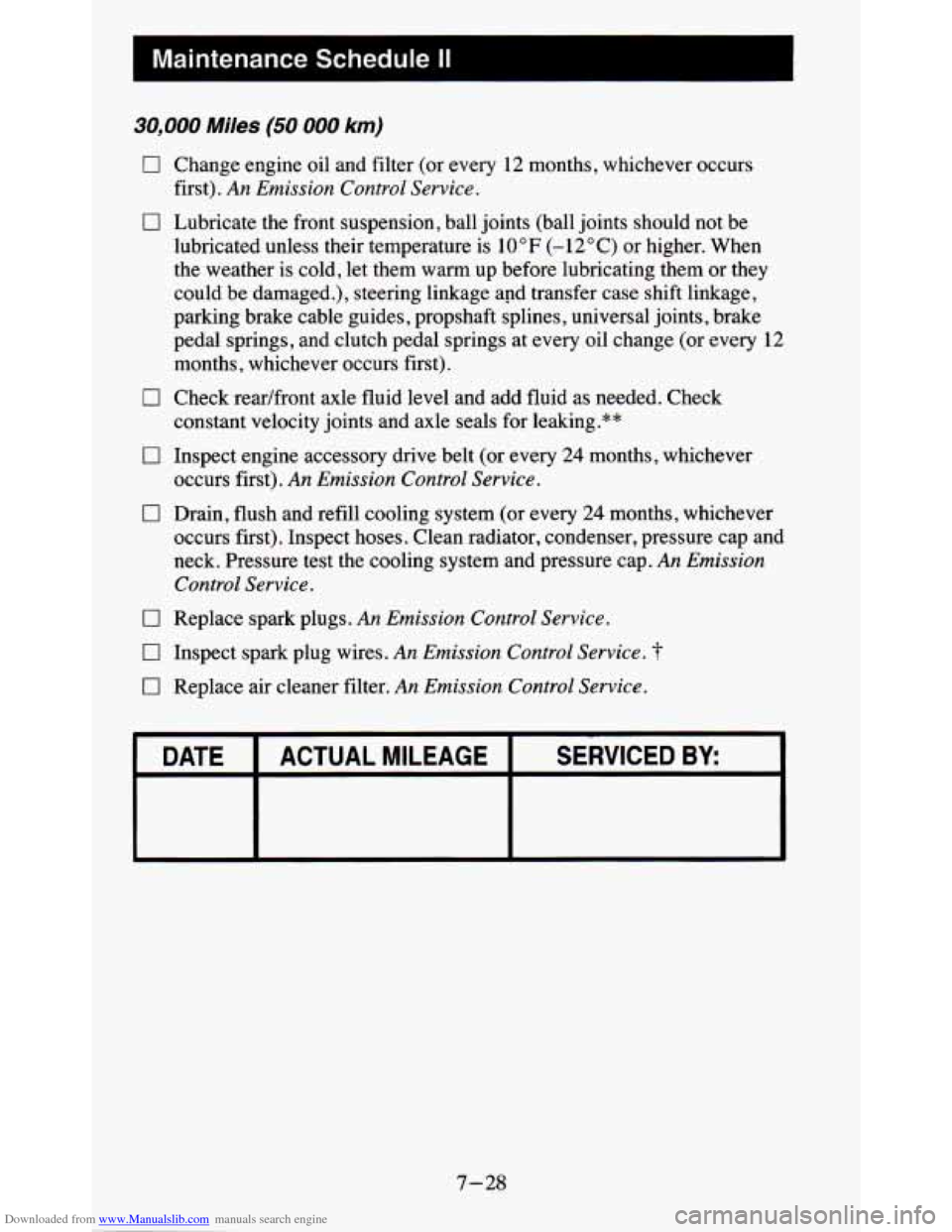
30,000 Miles (50 000 km)
0 Change engine oil and filter (or every 12 months, whichever occurs
first).
An Emission Control Service.
0 Lubricate the front suspension, ball joints (ball joints should not be
lubricated unless their temperature is
10°F (-12°C) or higher. When
the weather is cold, let them warm up before lubricating them or they
could be damaged.), steering linkage and transfer case shift linkage,
parking brake cable guides, propshaft splines, universal joints, brake
pedal springs, and clutch pedal springs at every oil change (or
every 12
months, whichever occurs first).
0 Check readfront axle fluid level and add fluid as needed. Check
constant velocity joints and axle seals for leaking.**
0 Inspect engine accessory drive belt (or every 24 months, whichever
occurs first).
An Emission Control Service.
0 Drain, flush and refill cooling system (or every 24 months, whichever
occurs first). Inspect hoses. Clean radiator, condenser, pressure cap and
neck. Pressure test the cooling system and pressure cap.
An Emission
Control Service.
0 Replace spark plugs. An Emission Control Service.
0 Inspect spark plug wires. An Emission Control Service. 3'
17 Replace air cleaner filter. An Emission Control Service.
I DATE SERVICED BY ACTUAL MILEAGE
7-28