clock CHEVROLET BLAZER 1996 2.G User Guide
[x] Cancel search | Manufacturer: CHEVROLET, Model Year: 1996, Model line: BLAZER, Model: CHEVROLET BLAZER 1996 2.GPages: 392, PDF Size: 20.35 MB
Page 146 of 392
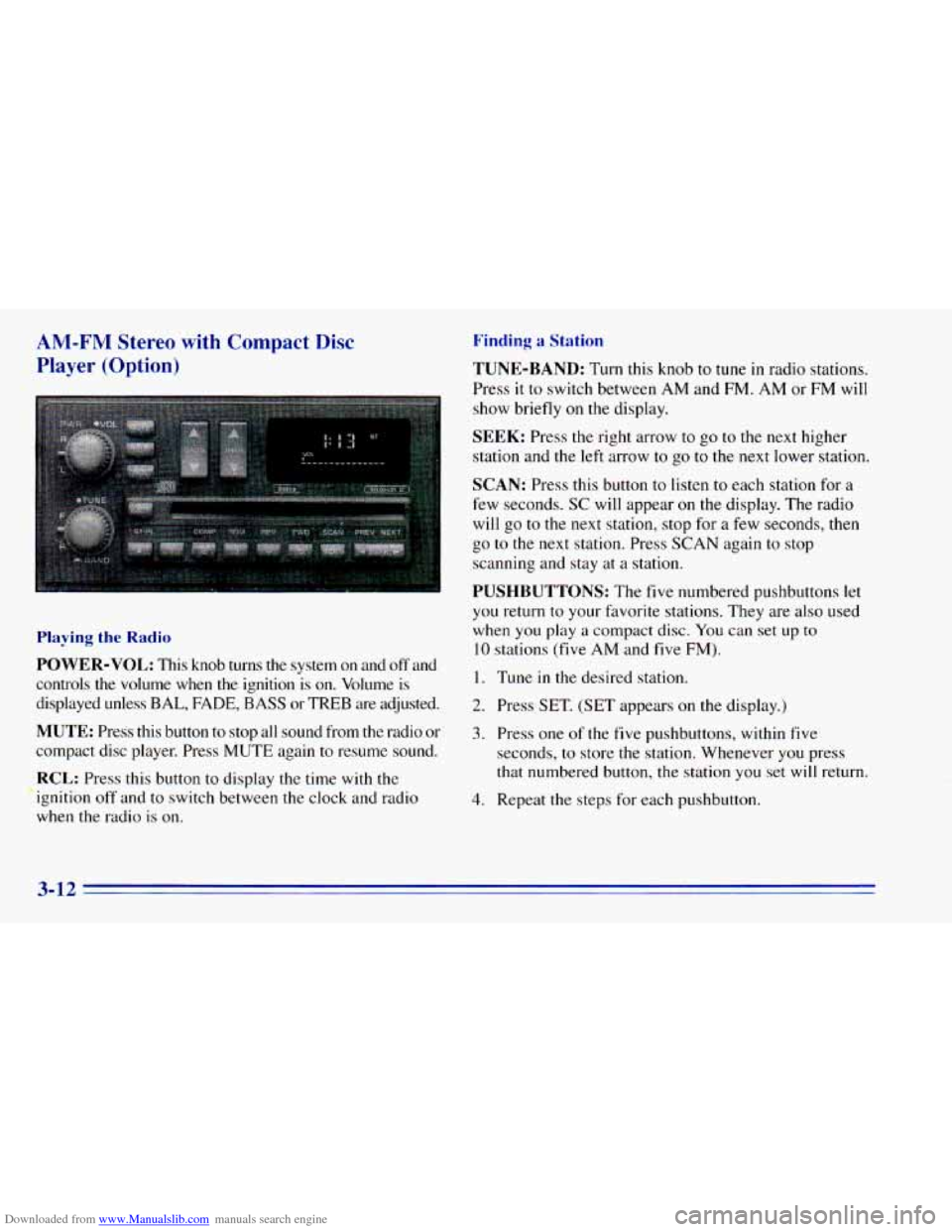
Downloaded from www.Manualslib.com manuals search engine AM-FM Stereo with Compact Disc
Player (Option)
Playing the Radio
POWER-VOL: This knob turns the system on and off and
controls
the volume when the ignition is on. Volume is
displayed unless
BAL, FADE, BASS or TREB are adjusted.
MUTE: Press this button to stop all sound from the radio or
compact disc player. Press MUTE again to resume sound.
RCL: Press this button to display the time with the
ignition off and to switch between the clock and radio
when the radio
is on.
Finding a Station
TUNE-BAND: Turn this knob to tune in radio stations.
Press
it to switch between AM and FM. AM or FM will
show briefly on the display.
SEEK: Press the right arrow to go to the next higher
station and
the left arrow to go to the next lower station.
SCAN: Press this button to listen to each station for a
few seconds.
SC will appear on the display. The radio
will go to the next station, stop for a few seconds, then
go
to the next station. Press SCAN again to stop
scanning and stay at
a station.
PUSHBUTTONS: The five numbered pushbuttons let
you return to your favorite stations. They are also used
when you play
a compact disc. You can set up to
10 stations (five AM and five FM).
I. Tune in the desired station.
2. Press SET. (SET appears on the display.)
3. Press one of the five pushbuttons, within five
seconds, to store the station. Whenever you press
that numbered button, the station you set
will return.
4. Repeat the steps for each pushbutton.
3-12
Page 164 of 392
Downloaded from www.Manualslib.com manuals search engine An emergency like this requires close attention and a
quick decision. If you are holding
the steering wheel at
the recommended
9 and 3 o’clock positions, you can
turn it a full
180 degrees very quickly without removing
either hand. But you have
to act fast, steer quickly, and
just
as quickly straighten the wheel once you have
avoided the object.
The fact that such emergency situations are always
possible is a good reason to practice defensive driving at
all times and wear safety belts properly.
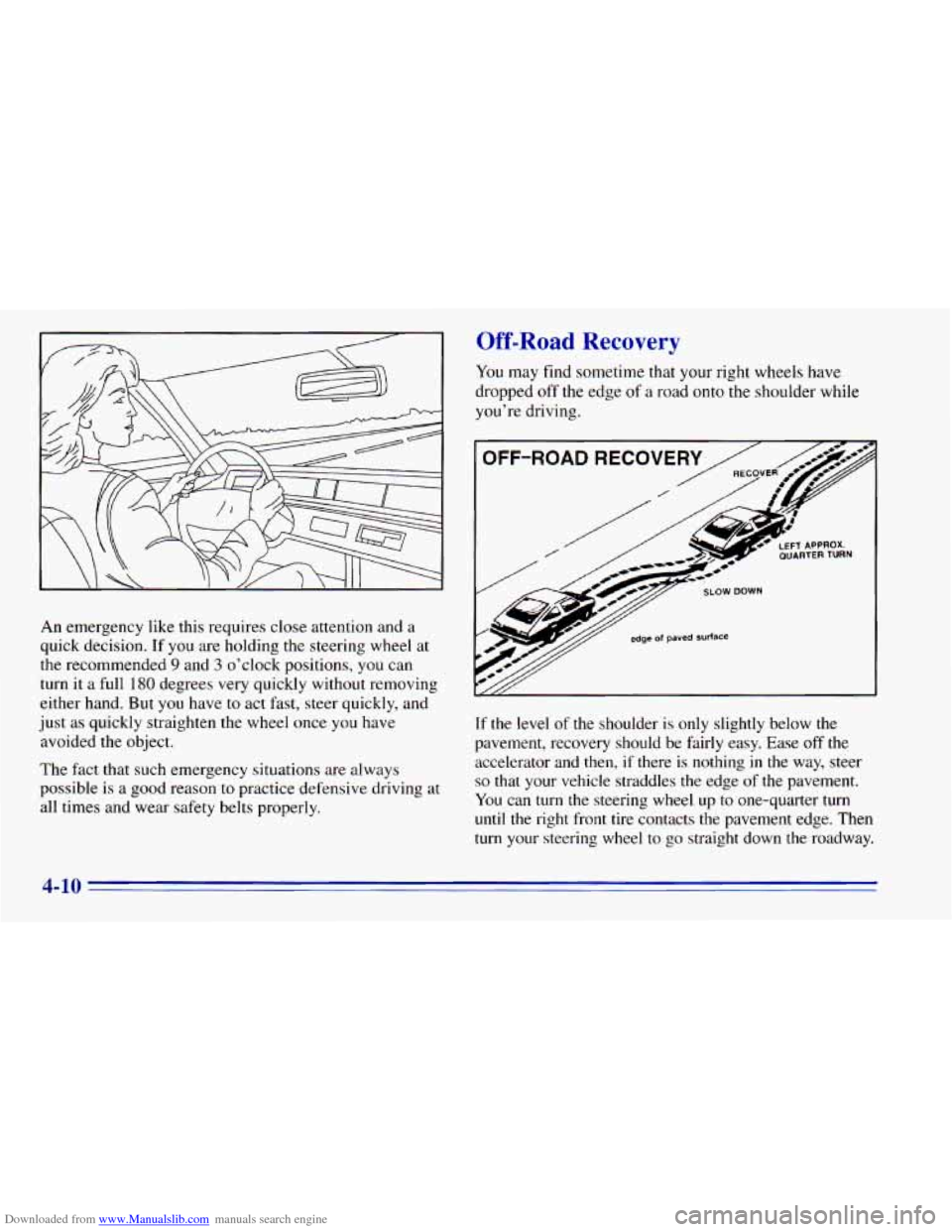
Off-Road Recovery
You may find sometime that your right wheels have
dropped
off the edge of a road onto the shoulder while
you’re driving.
If the level of the shoulder is only slightly below the
pavement, recovery should be fairly easy. Ease off the
accelerator and then,
if there is nothing in the way, steer
so that your vehicle straddles the edge of the pavement.
You can
turn the steering wheel. up to one-quarter turn
until the right front tire contacts the pavement edge. Then
turn your steering wheel to go straight down the roadway.
4-10
Page 175 of 392
Downloaded from www.Manualslib.com manuals search engine What should I do if my vehicle stalls, or is about
to stall, and
I can’t make it up the hill?
A: If this happens, there are some things you should
0
0
0
do, and there are some things you must not do.
First, here’s what
you should do:
Push the brake pedal to stop the vehicle and keep it
from rolling backwards. Also, apply the parking
brake.
If your engine is still running, shift the transmission
to REVERSE (R), release the parking brake, and
slowly back down the hill in REVERSE (R).
If your engine has stopped running, you’ll need to
restart it. With the brake pedal depressed and the
parking brake still applied, shift the transmission to
PARK (P) (or, shift
to NEUTRAL (N) if your
vehicle has a manual transmission) and restart the
engine. Then, shift
to REVERSE (R), release the
parking brake, and slowly back down the hill as
straight as possible in REVERSE
(R).
As you are backing down the hill, put your left hand
on the steering wheel at the 12 o’clock position. This
way,
you’ll be able to tell if your wheels are straight
and maneuver as
you back down. It’s best that you
back down the hill with your wheels straight rather
than in the
left or right direction. Turning the wheel
too far to
the left or right will increase the possibility
of a rollover.
Here are some things
you must not do if you stall, or are
about to stall, when going up a hill.
0 Never attempt to prevent a stall by shifting into
NEUTRAL (N) (or depressing the clutch, if
you
have a manual transmission) to “rev-up” the engine
and regain forward momentum. This won’t work.
Your vehicle will roll backwards very quickly and
you could go
out of control.
Instead, apply the regular brake
to stop the vehicle.
Then apply the parking brake.
Shift to REVERSE (R),
release the parking brake,
and slowly back straight down.
0 Never attempt to turn around if you are about to stall
when going up a hill. If the hill is steep enough
to
stall your vehicle, it’s steep enough to cause you to
roll over if you turn around. If you can’t make it up
the
hill, you must back straight down the hill.
Page 229 of 392
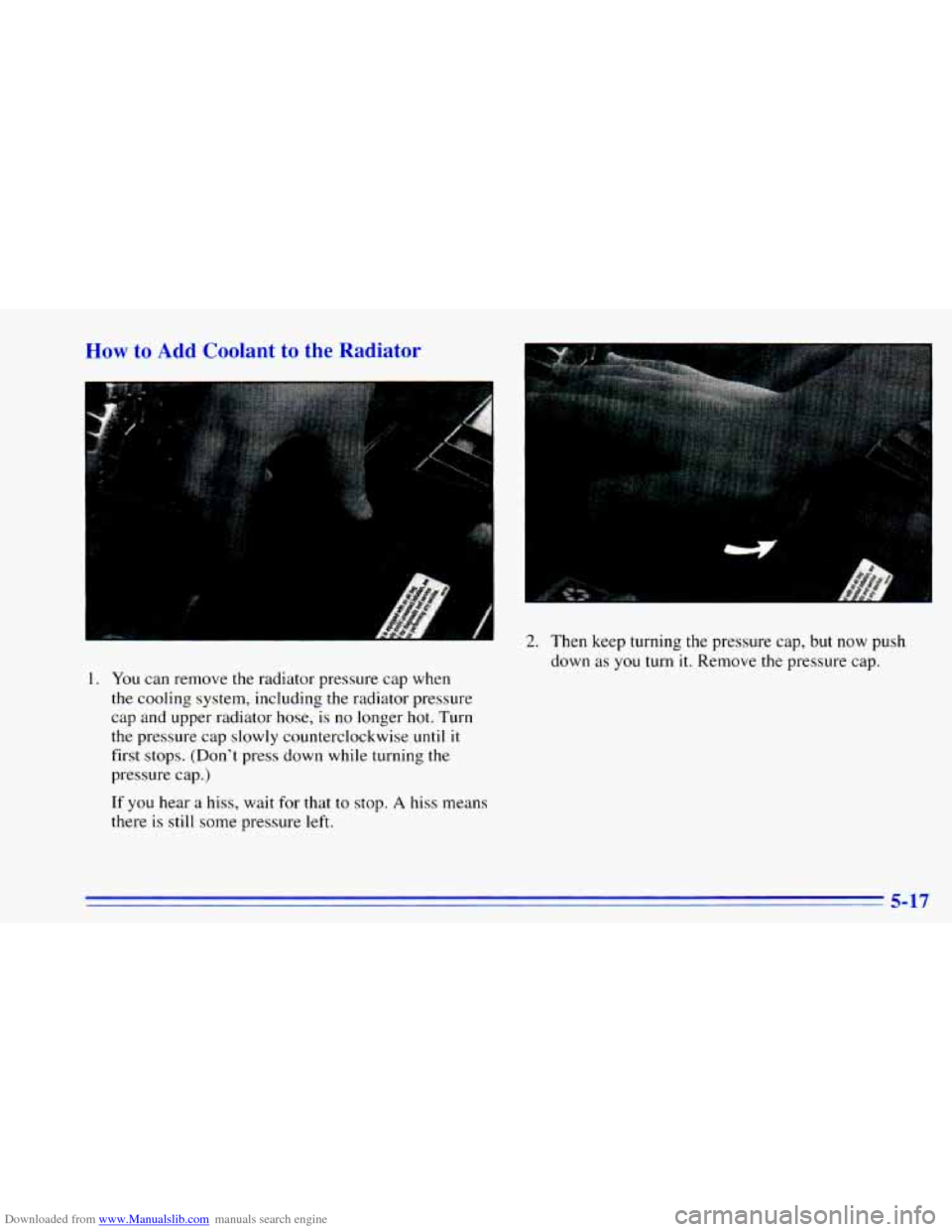
Downloaded from www.Manualslib.com manuals search engine How to Add Coolant to the Radiator
A
1. You can remove the radiator pressure cap when
the cooling system, including
the radiator pressure
cap and upper radiator hose, is
no longer hot. Turn
the pressure cap slowly counterclockwise until
it
first stops. (Don’t press down while turning the
pressure cap.)
If you hear a hiss, wait for that to stop. A hiss means
there
is still some pressure left.
2. Then keep turning the pressure cap, but now push
down
as you turn it. Remove the pressure cap.
5-17
Page 235 of 392
Downloaded from www.Manualslib.com manuals search engine Turn the wheel wrench counterclockwise to lower the
spare tire. Keep turning the wheel wrench until the spare
tire can be pulled
out from under the vehicle.
When the tire has been completely lowered,
tilt the
retainer at
the end of the cable and pull it through the
wheel opening. Pull the tire out from under
the vehicle.
I NOTICE:
I
To help avoid vehicle damage, do not drive the
vehicle before the cable
is restored.
If you have an inside-mounted spare tire, the tire must
be removed
in order to have access to the jack storage. The
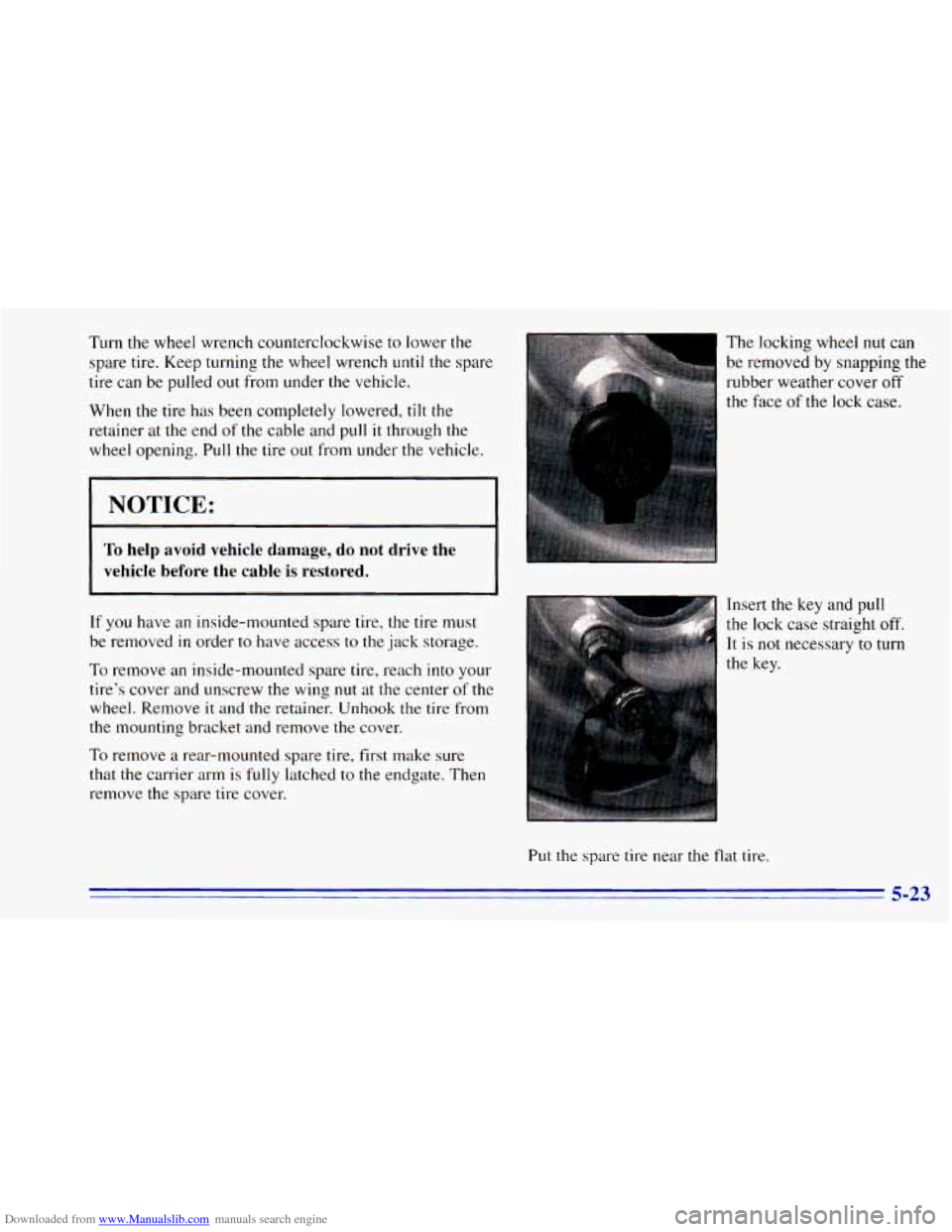
locking wheel nut can
be removed by snapping
the
rubber weather cover off
the face
of the lock case.
Insert the key and pull
the lock case straight off.
It is
not necessary to turn
To remove an inside-mounted spare tire, reach into your
tire’s cover and unscrew
the wing nut at the center of the
wheel. Remove
it and the retainer. Unhook the tire from
the mounting bracket and remove
the cover.
To remove a rear-mounted spare tire, first make sure
that the carrier arm
is fully latched to the endgate. Then
remove the spare tire cover.
Put the spare tire near the flat tire.
5-23
Page 237 of 392
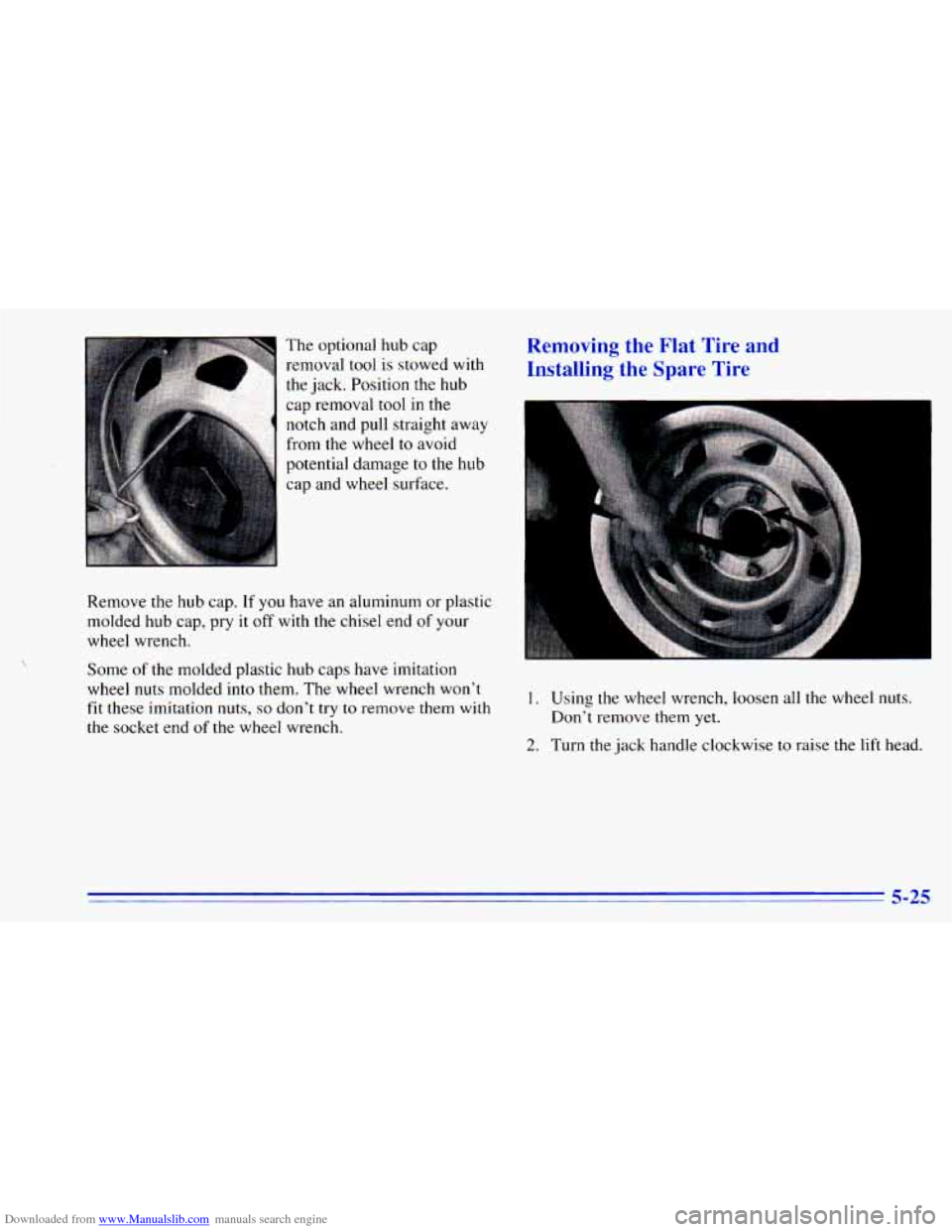
Downloaded from www.Manualslib.com manuals search engine The optional hub cap
removal tool
is stowed with
the jack. Position the hub
cap removal tool in the
notch and pull straight away
from
the wheel to avoid
potential damage
to the hub
cap and wheel surface.
Remove the hub cap.
If you have an aluminum or plastic
molded hub cap, pry
it off with the chisel end of your
wheel wrench.
Some of the molded plastic hub caps have imitation
wheel nuts molded into them. The wheel wrench won't
fit these imitation nuts,
so don't try to remove them with
the socket end of the wheel wrench.
Removing the Flat Tire and
Installing the Spare Tire
1. Using the wheel wrench, loosen all the wheel nuts.
2. Turn the jack handle clockwise to raise the lift head.
Don't
remove them
yet.
5-25
Page 239 of 392
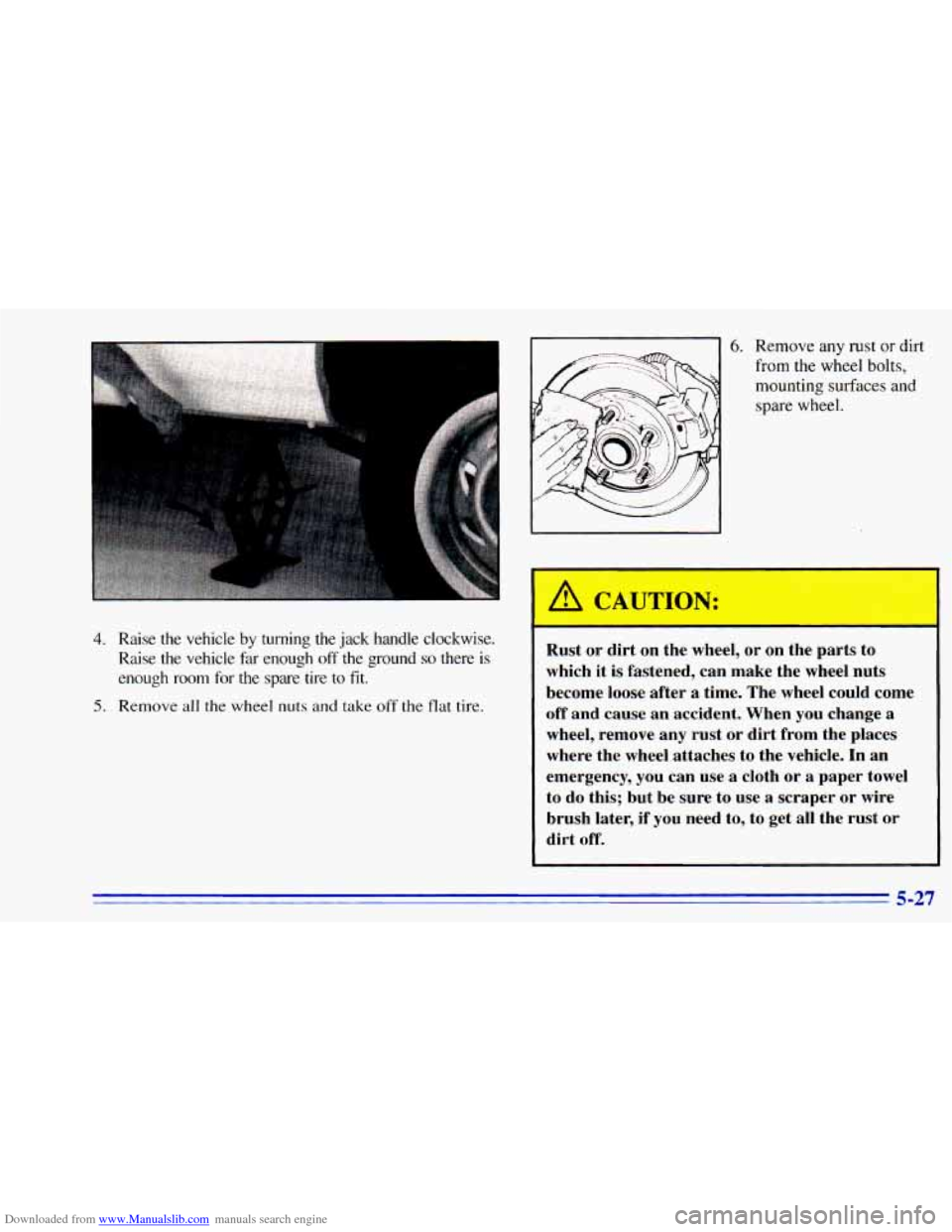
Downloaded from www.Manualslib.com manuals search engine 4. Raise the vehicle by turning the jack handle clockwise.
Raise the vehicle far enough
off the ground so there is
enough room for
the spare tire to fit.
5. Remove all the wheel nuts and take off the flat tire.
6. Remove any rust or dirt
from the wheel bolts,
mounting surfaces
and
spare wheel.
A CAUTION:
Rust or dirt on the wheel, or on the parts to
which it is fastened, can make the wheel nuts
become loose after a time. The wheel could come
off and cause an accident. When you change a
wheel, remove any rust or dirt from the places
where the wheel attaches to the vehicle. In an
emergency, you can use a cloth or a paper towel
to do this; but be sure to use a scraper or wire
brush later, if you need to, to get all the rust or
dirt
off.
5-27
Page 240 of 392
Downloaded from www.Manualslib.com manuals search engine '
A CAUTION:
Never use oil or grease on studs or nuts. If you
do, the nuts might come loose. Your wheel could
fall off, causing
a serious accident.
1
7. Place the spare on the wheel mounting surface.
8. Put the nuts on by
hand. Make sure
the
cone-shaped end is
toward the wheel.
Tighten each
nut by
hand until the wheel
is held against the hub.
If a nut can't be turned
by hand,
use the wheel
wrench and see your
dealer as soon
as possible.
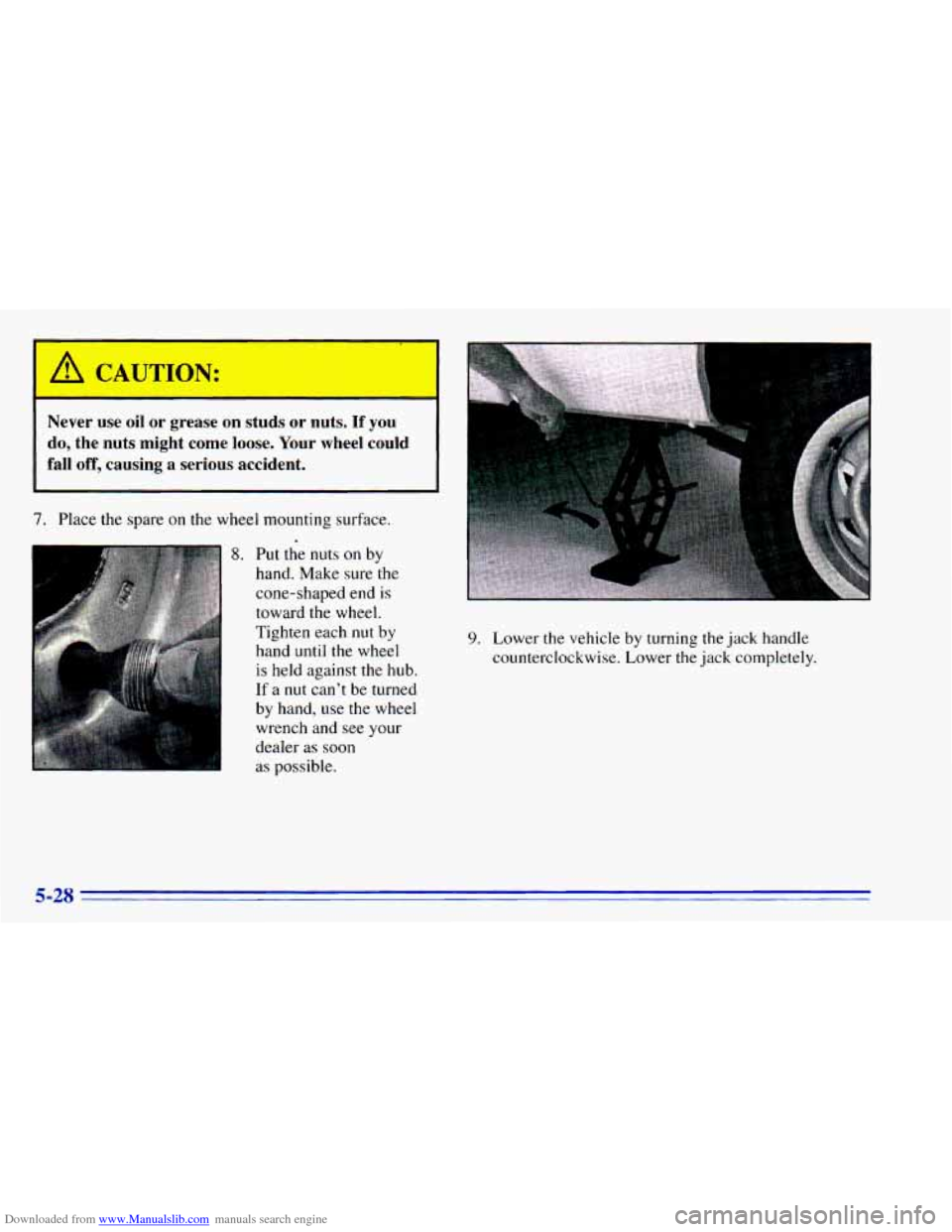
9. Lower the vehicle by turning the jack handle
counterclockwise. Lower the jack completely.
5-28
Page 242 of 392
Downloaded from www.Manualslib.com manuals search engine Storing a Flat or Spare Tire -..ne Tn4s
Storing a jack, a tire or other equipment in the
passenger compartment
of the vehicle could
cause injury. In a sudden
stop or collision, loose
equipment could strike someone. Store all these in the proper place.
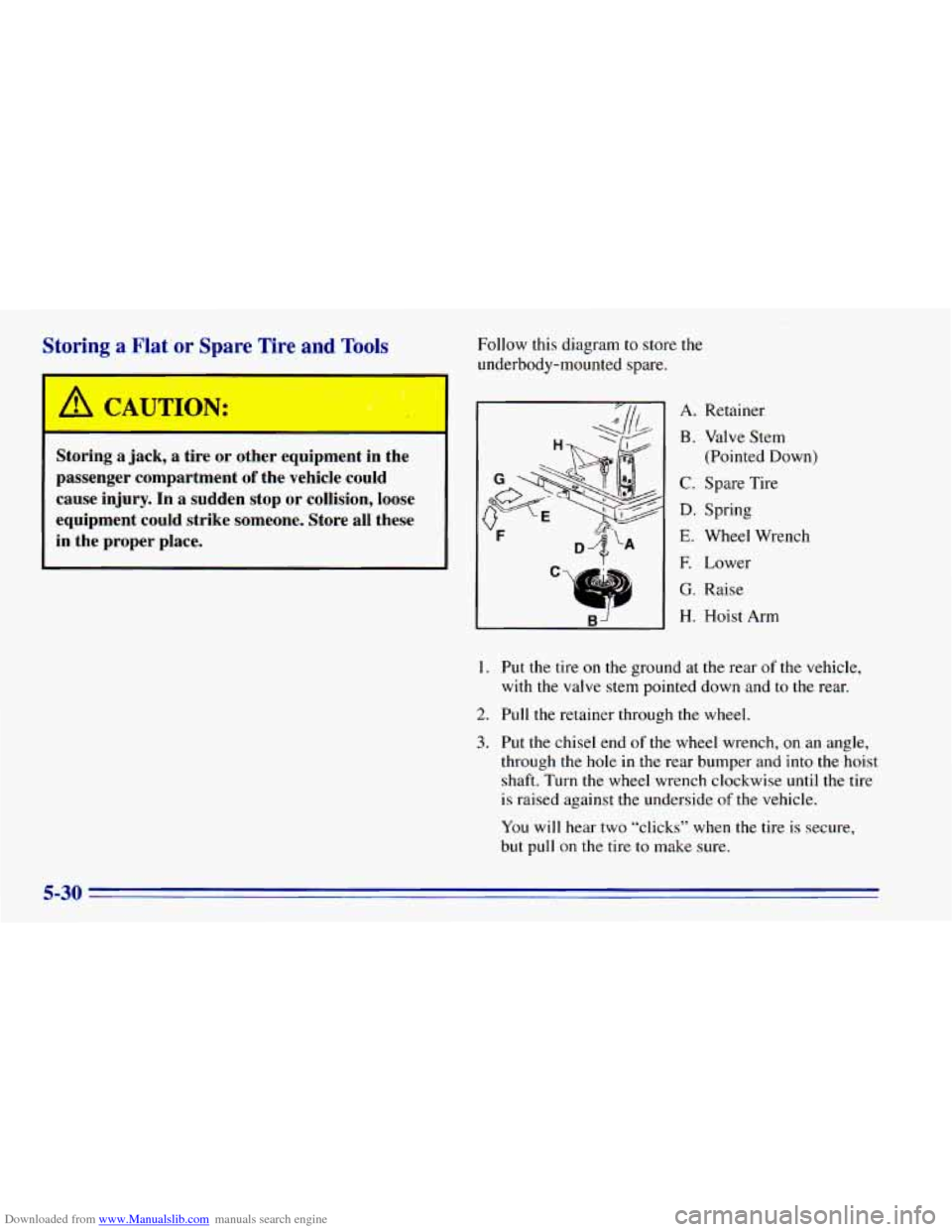
Follow this diagram to store the
underbody-mounted spare.
cTD B
A. Retainer
B. Valve Stem
(Pointed Down)
C. Spare Tire
D. Spring
E. Wheel Wrench
E Lower
G. Raise
H. Hoist Arm
1. Put the tire on the ground at the rear of the vehicle,
with the valve stem pointed down and
to the rear.
2. Pull the retainer through the wheel.
3. Put the chisel end of the wheel wrench, on an angle,
through the hole
in the rear bumper and into the hoist
shaft. Turn the wheel wrench clockwise until the tire
is raised against
the underside of the vehicle.
You will hear two “clicks” when the tire is secure,
but
pull on the tire to make sure.
5-30
Page 253 of 392
Downloaded from www.Manualslib.com manuals search engine Filling Your Tank The fuel cap is behind a hinged door on the driver’s side
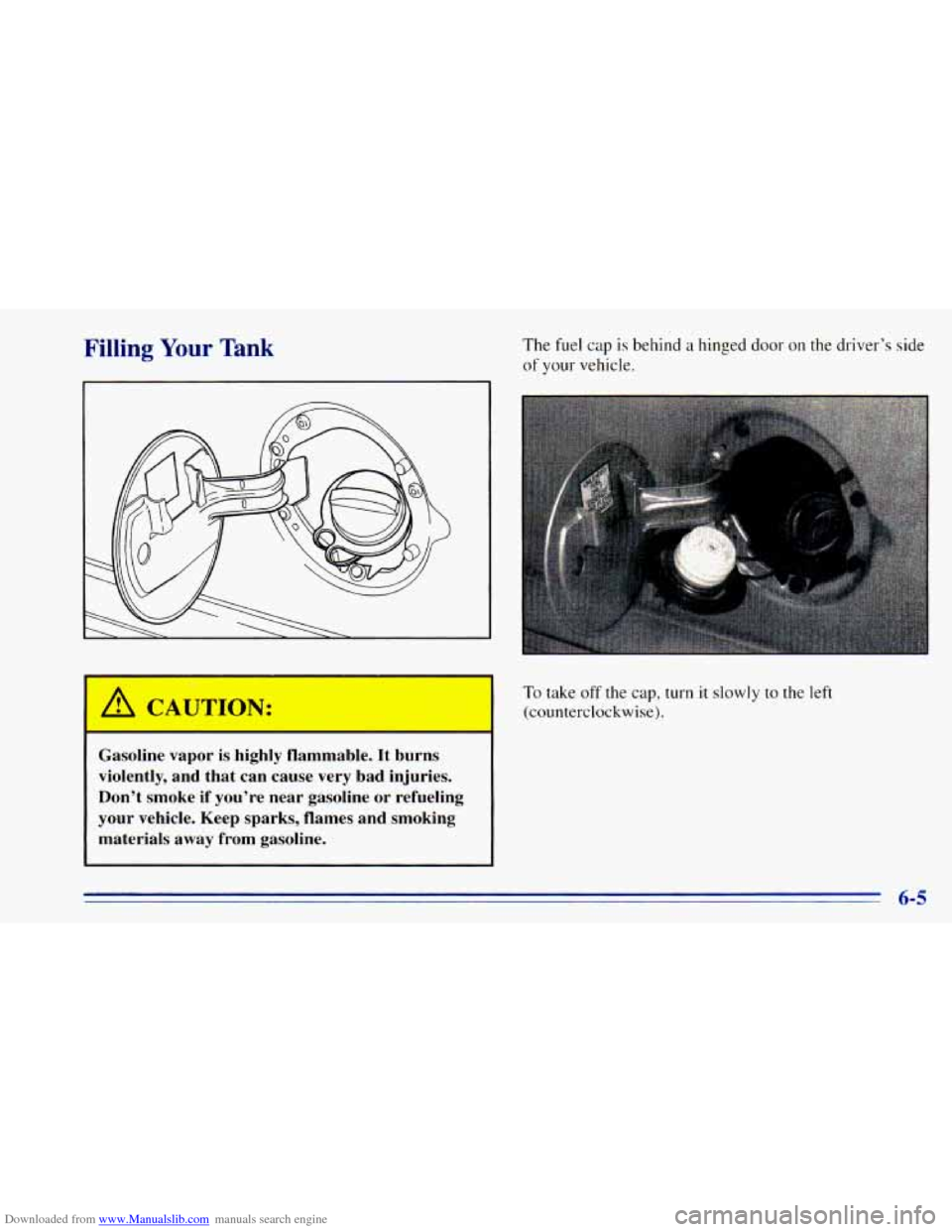
of your vehicle.
To take off the cap, turn it slowly to the left
(counterclockwise).
JTION:
-
Gasoline vapor is highly flammable. It burns
violently, and that can cause very bad injuries.
Don’t smoke if you’re near gasoline or refueling
your vehicle. Keep sparks, flames and smoking
materials away from gasoline.
- 6-5