steering wheel CHEVROLET BLAZER 1996 2.G Owner's Manual
[x] Cancel search | Manufacturer: CHEVROLET, Model Year: 1996, Model line: BLAZER, Model: CHEVROLET BLAZER 1996 2.GPages: 392, PDF Size: 20.35 MB
Page 197 of 392
Downloaded from www.Manualslib.com manuals search engine Run your engine only as long as you must. This saves
fuel. When
you run the engine, make it go a little faster
than just idle. That
is, push the accelerator slightly. This
uses less fuel for the heat that
you get and it keeps the
battery charged. You will need a well-charged battery
to
restart the vehicle, and possibly for signaling later on
with your headlamps. Let the heater run for awhile.
Then, shut the engine off and close the window almost
all
the way to preserve the heat. Start the engine again
and repeat this
only when you feel really uncomfortable
from the cold. But
do it as little as possible. Preserve the
fuel as long as you can. To help keep warm, you can get
out
of the vehicle and do some fairly vigorous exercises
every half hour or
so until help comes.
Recreational Vehicle Towing
(Four-wheel Drive Only)
1. Set the parking brake firmly.
2. Place an automatic transmission in PARK (P) or a
manual transmission
in FIRST (1).
3. Firmly attach the vehicle being towed to the tow
vehicle.
Do not tow the vehicle by the rear bumper
bar. Refer to the hitch manufacturer’s instructions.
4. Place the transfer case shift lever in NEUTRAL (N).
Recreational vehicle towing is not recommended for
vehicles with
the optional electronic shift transfer
case or all-wheel drive because the transfer cases
have
no neutral position.
Shifting the transfer case into NEUTRAL (N) can
cause your vehicle to roll even if the transmission
is in PARK (P), for an automatic transmission,
or if your vehicle is in gear, for a manual
transmission. This is because the transfer case
overrides the transmission.
5. Release the parking brake only after the vehicle
being towed is firmly attached to the tow vehicle.
6. Insert the ignition key into the ignition switch and
turn it
one notch forward of the LOCK position. This
places the key
in the OFF position, which unlocks
the steering column while preventing battery drain.
Unlocking the steering column will allow for proper
movement
of the front wheelshires during towing.
4-43
Page 206 of 392
Downloaded from www.Manualslib.com manuals search engine Towing a trailer requires a certain amount of experience.
Before setting out for
the open road, you’ll want to get
to know your rig. Acquaint yourself with the
feel of
handling and braking with the added weight of the
trailer. And always keep in mind that the vehicle you are
driving is now a good deal longer and
not nearly as
responsive as your
vehicle is by itself.
Before
you start, check the trailer hitch and platform
(and attachments), safety chains, electrical connector,
lamps, tires and mirror adjustment. If the trailer has
electric brakes, start your vehicle and trailer moving and
then apply the trailer brake controller by hand to be sure
the brakes are working. This lets
you check your
electrical connection at the same time.
During your trip, check occasionally
to be sure that the
load is secure, and that the lamps and any trailer brakes
are still working.
Following Distance
Stay at least twice as far behind the vehicle ahead as you
would when driving your vehicle without a trailer. This
can help
you avoid situations that require heavy braking
and sudden turns.
Passing
You’ll need more passing distance up ahead when
you’re towing
a trailer. And, because you’re a good deal
longer, you’ll need to go much farther beyond the
passed vehicle before you can return
to your lane.
Backing Up
Hold the bottom of the steering wheel with one hand.
Then, to move the trailer
to the left, just move that hand
to the left. To move the trailer to the right, move your
hand
to the right. Always back up slowly and, if
possible, have someone guide
you.
4-52
Page 220 of 392
Downloaded from www.Manualslib.com manuals search engine A vehicle can fall from a car carrier if it isn't
adequately secured. This can cause
a collision,
serious personal injury and vehicle damage. The
vehicle should be tightly secured with chains or
steel cables before it is transported.
Don't use substitutes (ropes, leather straps, canvas webbing, etc.) that can be cut
by sharp
edges underneath the towed vehicle. Always use
T-hooks inserted in the T-hook slots. Never use
J-hooks. They will damage drivetrain and
suspension components. When your vehicle
is being towed, have the ignition
key turned to the
OFF position. The steering wheel
should be clamped
in a straight-ahead position with a
clamping device designed for towing service. Do not
use the vehicle's steering column lock for this. The
transmission should be in
NEUTRAL (N) and the
transfer case, if you have one, should be
in 2HI. The
parking brake should be released.
Don't have
your vehicle towed on the drive wheels
unless
you must. If the vehicle must be towed on the
drive wheels, be sure to follow the speed and distance
restrictions later
in this section or your transmission will
be damaged.
If these limitations must be exceeded, then
the drive wheels have to be supported on a dolly.
5-8
Page 232 of 392
Downloaded from www.Manualslib.com manuals search engine Engine Fan Noise
This vehicle has a clutched engine cooling fan. When
the
clutch is engaged, the fan spins faster to provide
more air to cool the engine. In most every day driving
conditions, the clutch is
not engaged. This improves
fuel economy and reduces fan noise. Under heavy
vehicle loading, trailer towing and/or high outside
temperatures, the’ fan speed increases when
the clutch
engages.
So you may hear an increase in fan noise.
This is normal and should not be mistaken as
the
transmission slipping or making extra shifts. It is
merely the cooling system functioning properly. The
fan will slow down when additional cooling
is not
required and the clutch disengages.
You may also hear this fan noise when you start the
engine. It will go away as the fan clutch disengages.
If a Tire Goes Flat
It’s unusual for a tire to “blow out” while you’re driving,
especially
if you maintain your tires properly. If air goes
out of a tire, it’s much more likely
to leak out slowly.
But
if you should ever have a “blowout,” here are a few
tips about what to expect and what
to do:
If a front tire fails, the flat tire will create a drag that
pulls
the vehicle toward that side. Take your foot off the
accelerator pedal and grip
the steering wheel firmly.
Steer
to maintain lane position, and then gently brake to
a stop well out of the traffic lane.
A rear blowout, particularly on a curve, acts much like
a skid and may require the same correction you’d use in
a skid. In any rear blowout, remove your
foot from the
accelerator pedal. Get
the vehicle under control by
steering the way you want the vehicle
to go. It may be
very bumpy and noisy, but you can
still steer. Gently
brake to a stop
-- well off the road if possible.
If a tire goes flat, the next part shows how to use your
jacking equipment
to change a flat tire safely.
5-20
Page 246 of 392
Downloaded from www.Manualslib.com manuals search engine Rocking your vehicle to get it out:
First, turn your steering wheel left and right. That will
clear the area around
your front wheels. Then shift back
and forth between REVERSE (R) and a forward gear (or
with a manual transmission, between FIRST
(1) or
SECOND (2) and REVERSE(R)), spinning the wheels
as little as possible. Release the accelerator pedal while
you shift, and press lightly on the accelerator pedal
when the transmission is in gear.
If that doesn’t get you
out after a few tries, you may need to be towed out. Or,
you can use your recovery hooks if your vehicle has
them. If you do need
to be towed out, see “Towing Your
Vehicle” in the Index.
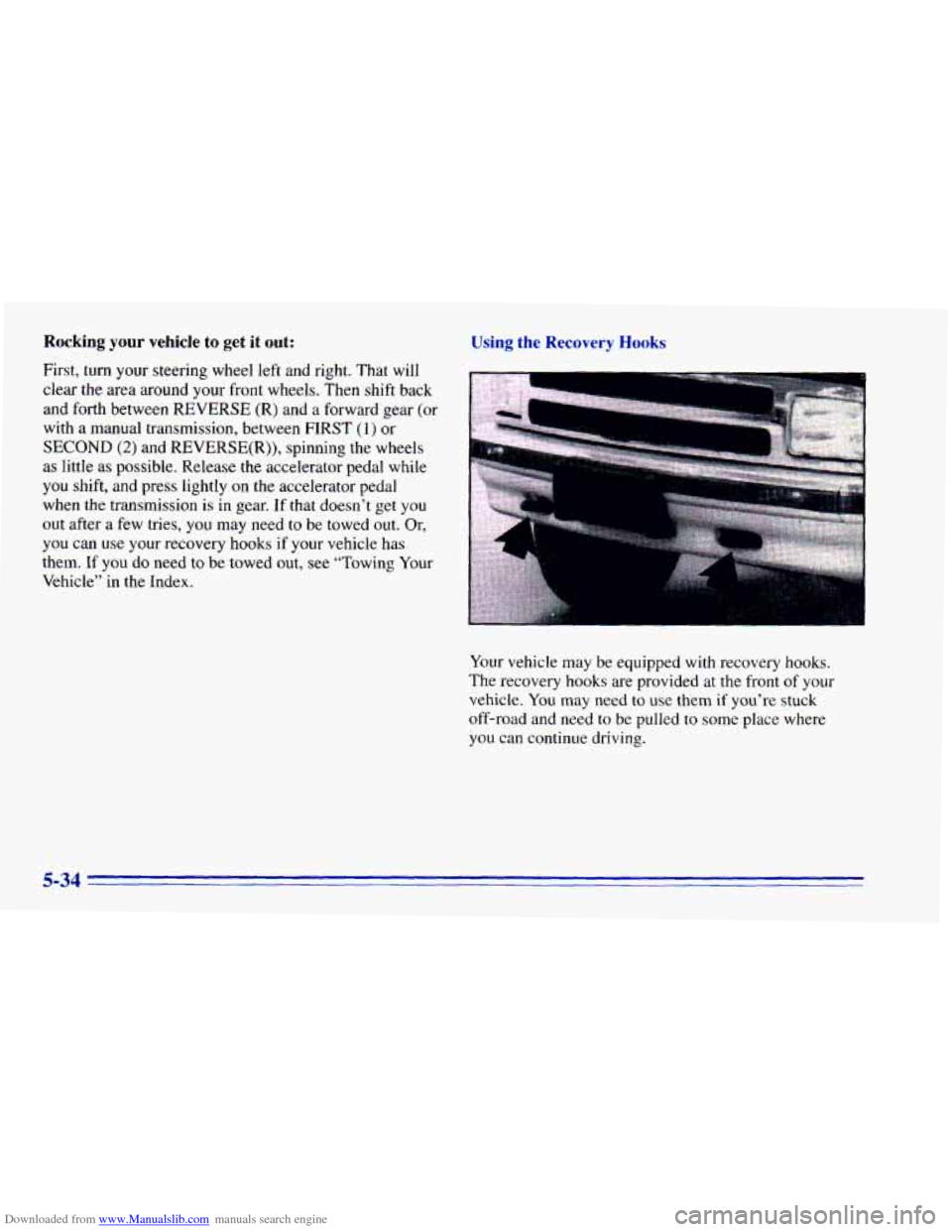
Using the Recovery Hooks
.“ .
Your vehicle may be equipped with recovery hooks.
The recovery hooks are provided at the front of your
vehicle.
You may need to use them if you’re stuck
off-road and need
to be pulled to some place where
you can continue driving.
i
5-34
Page 260 of 392
Downloaded from www.Manualslib.com manuals search engine When to Change Engine Oil
See if any one of these is true for you:
e
0
0
e
e
Most trips are less than 5 to 10 miles (8 to 16 km),
This is particularly important when outside
temperatures are below freezing.
Most trips include extensive idling (such as frequent
driving in stop-and-go traffic).
You operate your vehicle in dusty areas or off-road
frequently.
You frequently tow a trailer or use a carrier on top of
your vehicle.
The vehicle is used for delivery service, police, taxi
or other commercial application.
Driving under these conditions causes engine oil
to
break down sooner. If any one of these is true for your
vehicle, then you need to change your oil and filter
every
3,000 miles (5 000 km) or 3 months -- whichever
occurs first.
If none of them is true, change the oil and filter every
7,500 miles (12 500 km) or 12 months -- whichever
occurs first. Driving a vehicle with a
fully warmed
engine under highway conditions causes engine oil
to
break down slower.
Remote Oil Filter (Four-Wheel Drive)
The access door for the remote oil filter is in the steering
linkage shield assembly located under the radiator
support. Twist the screw to unlock or lock the door.
What to Do with Used Oil
Did you know that used engine oil contains certain
elements that may be unhealthy for your skin and could
even cause cancer? Don’t let used oil stay
on your skin
for very long. Clean
your skin and nails with soap and
water, or a good hand cleaner. Wash or properly throw
away clothing or rags containing used engine oil. (See
the manufacturer’s warnings about the use and disposal
of
oil products.)
Used oil can be a real threat to the environment.
If you
change your own oil, be sure to drain all free-flowing oil
from the filter before disposal. Don’t ever dispose of oil
by putting
it in the trash, pouring it on the ground, into
sewers, or into streams or bodies
of water. Instead,
recycle
it by taking it to a place that collects used oil. If
you have a problem properly disposing of your used oil,
ask your dealer, a service station or
a local recycling
center for help.
6-12
Page 322 of 392

Downloaded from www.Manualslib.com manuals search engine ' Short TripKity Maintenance Schedule
15,000 Miles '(25 000 km) (Continwkd).
Check readfront axle fluid level and add
fluid as needed. Check constant velocity
joints and axle seals for leaking.**
0 For Two-Wheel-Drive vehicles only: Clean
and repack the front wheel bearings (or at
each brake relining, whichever occurs- first).
!
t
DATE
SERVICED BY: ACTUAL MILEAGE
I I
18,000 Miles (30 000 km) ' .
Change engine oil and filter (or every
3 months, whichever occurs first).
An Emission Control Service.
0 Lubricate the front suspension, ball joints,
steering linkage and transfer case shift
linkage, parking brake cable guides,
propshaft splines, universal joints, brake
pedal springs and clutch, pedal springs at
every oil change (or every
3 months,
whichever occurs first).
Page 325 of 392

Downloaded from www.Manualslib.com manuals search engine 30,000 Miles (50 000 km)
0 Change engine oil and filter (or every
3 months, whichever occurs first).
An Emission Control Service.
0 Lubricate the front suspension, ball joints,
steering linkage and transfer case shift
linkage, parking brake cable guides,
propshaft splines, universal joints, brake
pedal springs and clutch pedal springs at
every oil change (or every
3 months,
whichever occurs first).
0 Check readfront axle fluid level and add
fluid as needed. Check constant velocity
joints and axle seals for leaking.
**
0 For Two-Wheel-Drive vehicles only: Clean
and repack the front wheel bearings (or at
each brake relining, whichever occurs first).
0 Replace fuel filter.
0 Replace air cleaner filter.
An Emission Control Service.
0 Rotate tires. See “Tire Inspection and
Rotation” in the Index for proper rotation
pattern and additional information.
During tire rotation, check brake calipers
for freedom of movement. Refer to the
appropriate
GM service manual for proper
caliper service procedures.
An Emission Control Service.?
DATE SERVICED BY: ACTUAL MILEAGE
Short TripKity Maintenance Schedule
7-13
Page 329 of 392

Downloaded from www.Manualslib.com manuals search engine I Short Trip/City Maintenance Schedule I
0 For Two-Wheel-Drive vehicles only: Clean
and repack the front wheel bearings (or at
each brake relining, whichever occurs first).
0 Inspect air cleaner filter if you are driving
in dusty conditions. ,Replace filter if
necessary.
An Emission Control Service.?
DATE
SERVICED BY ACTUAL MILEAGE
48,000 Miles (80 000 km)
0 Change engine oil and filter (or every
3 months, whichever occurs first).
An Emission Control Service.
0 Lubricate the front suspension, ball joints,
steering linkage and transfer case shift
linkage, parking brake cable guides,
propshaft splines, universal joints, brake
pedal springs and clutch pedal springs at
every oil change (or every
3 months,
whichever occurs first).
0 Check readfront axle fluid level and add
fluid
as needed. Check constant velocity
joints and axle seals for leaking.**
DATE SERVICED BY: ACTUAL MILEAGE
7-17
Page 333 of 392

Downloaded from www.Manualslib.com manuals search engine Short Trip/City Maintenance Schedule *
60,000 Miles (100 000 km)
c3 Change engine oil and filter (or every
3 months, whichever occurs first).
An Emission Control Service.
Lubricate the front suspension, ball joints,
steering linkage and transfer case shift
linkage, parking brake cable guides,
propshaft splines, universal joints, brake
pedal springs and clutch pedal springs at
every oil change (or every
3 months,
whichever occurs first).
0 Check readfront axle fluid level and add
fluid as needed. Check constant velocity
joints and axle seals for leaking.**
0 For Two-Wheel-Drive vehicles only: Clean
and repack the front wheel bearings
(or at
each brake relining, whichever occurs first).
0 Inspect engine accessory drive belt.
0 Replace fuel filter.
0 Replace air cleaner filter.
0 Inspect fuel tank, cap and lines for damage
or leaks. Inspect
fuel cap gasket for any
damage. Replace parts as needed.
An Emission Control Service.?
An Emission Control Service.
An Emission Control Service.?
DATE
SERVICED BY ACTUAL MILEAGE
7-21