roof CHEVROLET BLAZER 1996 2.G Owners Manual
[x] Cancel search | Manufacturer: CHEVROLET, Model Year: 1996, Model line: BLAZER, Model: CHEVROLET BLAZER 1996 2.GPages: 392, PDF Size: 20.35 MB
Page 114 of 392
Downloaded from www.Manualslib.com manuals search engine L --
vehicle that is longer or wider than the luggage
carrier
-- like paneling, plywood, a mattress, and
so forth -- the wind can catch it as you drive
along. This can cause you to lose control. What
you are carrying could be violently torn
off, and
this could cause you or other drivers to have a
collision, and
of course damage your vehicle. You
may be able to carry something like this inside.
But, never carry something longer or wider than
your luggage carrier on top
of your vehicle.
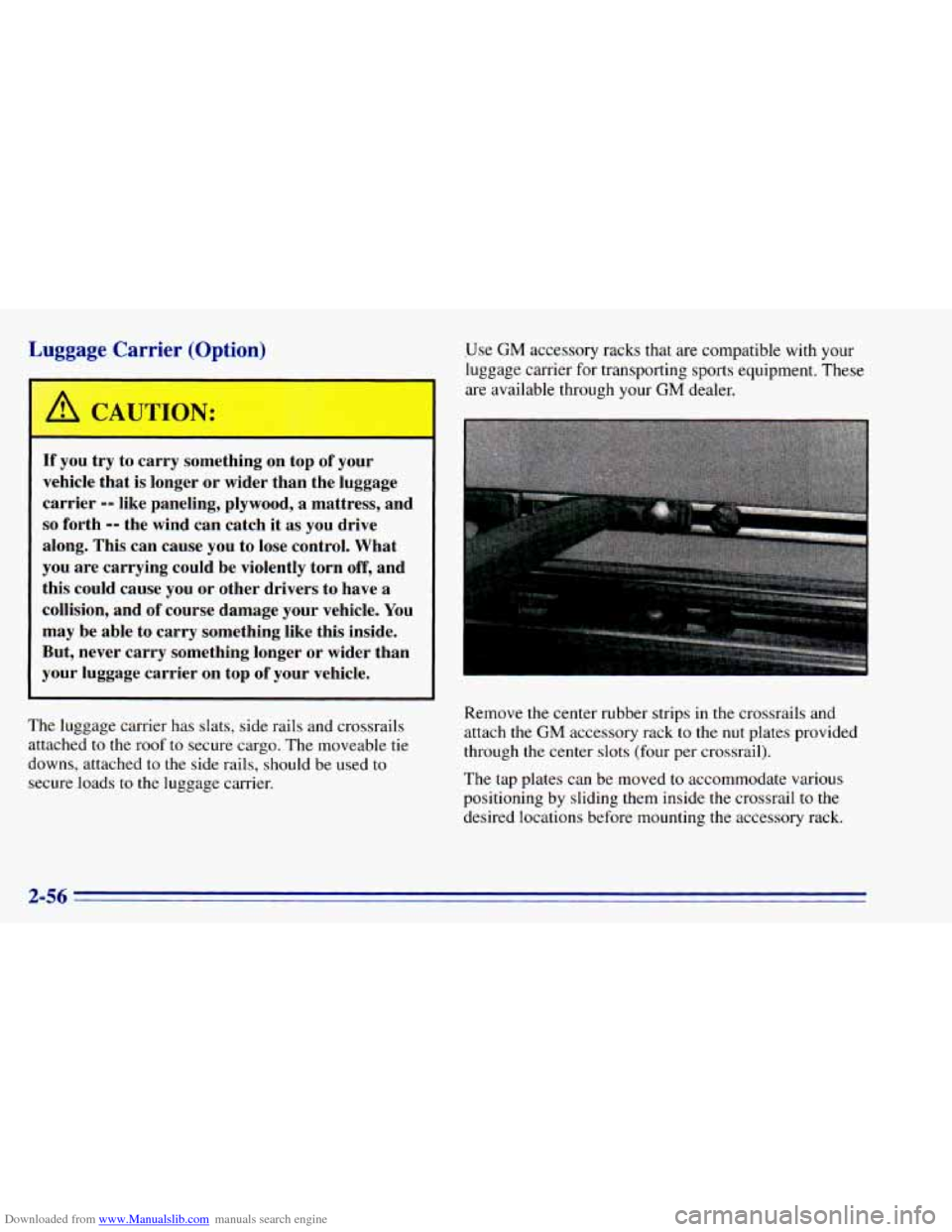
The luggage carrier has slats, side rails and crossrails
attached
to the roof to secure cargo, The moveable tie
downs, attached to
the side rails, should be used to
secure loads to the luggage carrier. Use
GM accessory racks that
are compatible with your
luggage carrier for transporting
sports equipment. These
are available through your GM dealer.
Remove
the center rubber strips in the crossrails and
attach
the GM accessory rack to the nut plates provided
through the center slots (four per crossrail).
The tap plates can be moved to accommodate various
positioning by sliding them inside the crossrail to
the
desired locations before mounting the accessory rack.
Page 115 of 392
Downloaded from www.Manualslib.com manuals search engine You can adjust the crossrails to handle different size
loads. Just loosen the slider knobs at each end of the
crossrail and move them where you want them. Make
sure both sides of the crossrail are even, then tighten the
slider knobs.
Be sure the cargo is properly loaded. Follow
these guidelines:
0 Carrying small, heavy loads on the roof is not
recommended.
0 Tie the load to the moveable tie down (two per each
side
of the side rails). Use the crossrails only to keep
the load from sliding.
If you need to carry long items, move the crossrails
as far apart as possible. Tie the load
to the moveable
tie downs provided in the side rails. Also tie the load
to the bumpers.
Do not tie the load so tightly that the
crossrails or side rails are damaged.
NOTICE:
Loading cargo that weighs more than 200 lbs.
(91 kg) on the luggage carrier may damage your
vehicle. When you carry large things, never let
them hang over the rear
or the sides of your
vehicle. Load your cargo
so that it rests on the
slats and does not scratch or damage the vehicle.
Put the cargo against the side rails and fasten it
, securely to the luggage carrier. Put the main
I weight as far forward as you can.
Don’t exceed the maximum vehicle capacity when loading your vehicle. For more information on vehicle capacity
and loading, see “Loading Your Vehicle’’ in the Index.
To prevent damage or loss of cargo as you’re driving,
check now and then to make sure the luggage carrier and
cargo are still securely fastened.
2-57
Page 169 of 392
Downloaded from www.Manualslib.com manuals search engine Before You Go Off-Roading
There are some things to do before you go out. For
example, be sure
to have all necessary maintenance and
service work done. Check to make sure all underbody
shields (if
so equipped) are properly attached. Be sure
you read
all the information about your four-wheel-drive
vehicle
in this manual. Is there enough fuel? Is the spare
tire
fully inflated? Are the fluid levels up where they
should be? What are the local laws that apply to
off-roading where you’ll be driving? If you don’t know,
you should check with law enforcement people
in the
area. Will you be
on someone’s private land? If so, be
sure to get the necessary permission.
Loading Your Vehicle for Off-Road Driving
There are some important things to remember about
how to load your vehicle.
0 The heaviest things should be on the load floor and
forward of your rear axle. Put heavier items as far
forward as you can.
Be sure the load is secured properly, so driving on
the off-road terrain doesn’t toss things around.
A CAUTION:
0 Cargo on the load floor piled higher than
the seatbacks can be thrown forward
during a sudden stop. You or your
passengers could be injured. Keep cargo
below the top of the seatbacks.
Unsecured cargo on the load floor can
be tossed about when driving over rough
terrain. You or your passengers can
be struck by flying objects. Secure the
cargo properly,
Heavy loads on the roof raise the vehicle’s
center of gravity, making it more likely to
roll over. You can be seriously
or fatally
injured if the vehicle rolls over, Put heavy
loads inside the cargo area, not on the roof,
Keep cargo in the cargo area as far forward
and low as possible.
You’ll find other important information in
this manual.
See “Vehicle Loading,” “Luggage Carrier” and “Tires”
in the Index.
I
4-15