automatic transmission CHEVROLET BLAZER 1997 2.G Owner's Manual
[x] Cancel search | Manufacturer: CHEVROLET, Model Year: 1997, Model line: BLAZER, Model: CHEVROLET BLAZER 1997 2.GPages: 402, PDF Size: 21.93 MB
Page 215 of 402
Downloaded from www.Manualslib.com manuals search engine When You Are Ready to Leave After
Parking
on a Hill
1. Apply your regular brakes and hold the pedal down
whiie you:
Start your engine:
Shift into a gear: and
Release the parking brake.
3,. Let up on the brake pedal.
3. Drive slowly until the trailer is clear of the chocks.
4. Stop and have someone pick up and store the chocks.
Maintenance When Trailer Towing
Your vehicle will need service more often when you’re
pulling
a trailer. See the Maintenance Schedule for more
on this. Things that are especially important in trailer
operation are automatic transmission fluid (don’t
overfill), engine
oil, axle lubricant, belt. cooling system
and brake adjustment. Each
of these is covered in this
manual. and
the Index will help you find them quickly.
If you’re trailering, it‘s a good idea to review these
sections before you start your
trip.
Check periodically to see that all hitch nuts and bolts
are tight.
4-54
Page 220 of 402
Downloaded from www.Manualslib.com manuals search engine Jump Starting
If your battery has run down, you may want to use
another vehicle and some jumper cables to start your
vehicle.
But please use the following steps to do
it safely.
NOTICE:
Ignoring these steps could result in costly damage
to your vehicle that wouldn’t be covered
by
your warranty.
Do not try to start your vehicle by pushing or
pulling it. This could damage your vehicle, even if
you have
a manual transmission. And if you have
an automatic transmission, it won’t start that
way.
I A CAUTION:
I
~ Batteries can hurt you. They can be dangerous
1 because:
~ 0 They contain acid that can burn you.
I They contain gas that can explode or ignite.
~ 0 They contain enough electricity to
~ burn you.
~ If you don’t follow these steps exactly, some or all
~ of these things can hurt you.
1. Check the other vehicle. It must have a 12-volt
battery with a negative ground system.
I NOTICE:
If the other system isn’t a 12-volt system with a
negative ground, both vehicles can be damaged.
5-3
Page 221 of 402
Downloaded from www.Manualslib.com manuals search engine 2. Get the vehicles close enough so the jumper cabIes
can reach. but be sure the vehicles aren't touching
each other.
If they are, it could cause a ground
connection
you don't want. You wouldn't be able to
start your vehicle. and the bad grounding could
damage the electrical systems.
You could be injured if the vehicles roll. Set the
parking brake firmly on each vehicle. Put
an
automatic transmission in PARK (Pj or a manual
transmission
in NEUTRAL (N). If you have a
four-wheel-drive vehicle with a manual transfer case
shift lever. be sure the transfer case is not
in
NEUTRAL (N).
I A CAUTION:
An electric fan can start up even when the engine
is not running and can injure you. Keep hands,
clothing and tools away from any underhood
electric
Fan.
3. Turn off the ignition on both vehicles. Unplug
unnecessary accessories plugged into
the cigarette
lighter. or accessory power outlets,
if you have this
option.
Turn off all lamps that aren't needed as well
as radios. This will avoid sparks and help save both
batteries.
In addition, it could save your radio!
I NOTICE:
If you leave your radio on, it could be badly
damaged. The repair wouldn't be covered
by
your warranty.
I A CAUTION:
If your vehicle has air conditioning, the auxiliary
electric fan under the hood can
start up even
when the engine
is not running and can injure
you. Keep hands, clothing and tools away from
any underhood electric fan.
Page 230 of 402
Downloaded from www.Manualslib.com manuals search engine If No Steam Is Coming From Your Engine
If you get the overheat warning but see or hear no
steam, the problem may not be too serious. Sometimes
the engine can get a little too hot when you:
Climb a long hill on a hot day.
0 Stop after high-speed driving.
Idle for long periods in traffic.
Tow a trailer. See “Driving on Grades” in the Index.
If you get the overheat warning with no sign of steam,
try
this for a minute or so:
1. Turn off your air conditioner.
2. Turn on your heater to full hot at the highest fan
speed and open the window
as necessary.
3. If you’re in a traffic jam, shift to NEUTRAL (N);
otherwise, shift to the highest gear while
driving
-- AUTOMATIC OVERDRIVE (@) or
DRIVE (D) for automatic transmissions. If
you
no longer have the overheat warning, you
can drive. Just
to be safe, drive slower for about
10 minutes. If the warning doesn’t come back on,
you can drive normally.
If
the warning continues, pull over, stop, and park your
vehicle right away.
If there’s
still no sign of steam, push the accelerator until
the engine speed
is about twice as fast as normal idle
speed. Bring the engine speed back to normal idle speed
after two or three minutes. Now
see if the warning stops.
But then, if you still have the warning,
turn ofthe
engine and get everyone out of the vehicle until it
cools down.
You may decide not to lift the hood but
to get service
help right away.
5-13
Page 240 of 402
Downloaded from www.Manualslib.com manuals search engine Changing a Flat Tire
If a tire goes flat, avoid further tire and wheel damage
by driving slowly to a level
place. Turn on your hazard
warning flashers.
A CAUTION:
Changing a tire can cause an injury. The vehicle
can slip off the jack and roll over you or other
people.
You and they could be badly injured.
Find a level place to change your tire.
To help
prevent the vehicle from moving:
1. Set the parking brake firmly.
2. Put an automatic transmission shift
lever in PARK
(P) or shift a manual
transmission
to FIRST (1) or
REVERSE
(R).
CAUTION: (Continued)
CAUTION: (Continued)
3. If you have a four-wheel-drive vehicle
with a manual transfer case shift lever,
be sure the transfer case is in a drive
gear
-- not in NEUTRAL (N).
4. lbrn off the engine.
5. Put the wheel blocks at the front and
rear
of the tire farthest away from the
one being changed. That would be the
tire
on the other side of the vehicle, at
the opposite end.
5-23
Page 253 of 402
Downloaded from www.Manualslib.com manuals search engine NOTICE:
When the compact spare is installed, don’t take
your vehicle through an automatic car wash with
guide rails. The compact spare can get caught on
the rails. That can damage the tire and wheel,
and maybe other parts
of your vehicle.
Don‘t use your compact spare on other vehicles
And
don’t mix your compact spare tire or wheel with
other wheels or tires. They won‘t fit. Keep your spare
tire and
its wheel together.
NOTICE:
Tire chains won’t tit your compact spare. Using
them can damage your vehicle and can damage
the chains too. Don’t use tire chains on your
compact spare.
If You’re Stuck: In Sand, Mud,
Ice or Snow
What you don‘t want to do when your vehicle is stuck is
to spin your wheels too fast. The method known as
“rocking“ can help you get out when you’re stuck, but
you must use caution.
A CAUTION:
If you let your tires spin at high speed, they can
explode, and you or others could be injured. And,
the transmission or other parts
of the vehicle can
overheat. That could cause an engine
compartment fire
or other damage. When you’re
stuck, spin the wheels as little as possible. Don’t
spin the wheels above
35 mph (55 kmh) as shown
on the speedometer.
5-36
Page 256 of 402
Downloaded from www.Manualslib.com manuals search engine Section 6 Service and Appearance Care
Here you will find information about the care of your vehicle. This section begins with service and fuel information,
and then
it shows how to check important fluid and lubricant levels. There is also technical information about your
vehicle, and a part devoted
to its appearance care.
6-3
6-4
6-5
6-6
6-9 6-
13
6- 14
6-18
6- 19
6-
20
6-2 1
6-23
6-26
6-26
6-26 6-27
Fuel
Fuels in Foreign Countries
Filling Your Tank
Checking Things Under the Hood
Engine Oil
Air Cleaner
Automatic Transmission Fluid
Manual Transmission Fluid
Hydraulic Clutch
Rear Axle
Four-wheel Drive and All-Wheel Drive
Engine Coolant Radiator Pressure Cap
Thermostat Power Steering Fluid
Windshield Washer Fluid 6-28
6-32
6-3 3 6-3 8
6-40 6-49
6-49
6-52
6-54
6-5
7
6-5 8
6-58
6-58
6-62
6-63
6-64
Brakes
Battery
Bulb Replacement
Windshield Wiper Blade Replacement
Tires
Appearance Care
Cleaning the Inside
of Your Vehicle
Care
of Safety Belts
Cleaning the Outside of Your Vehicle
Appearance Care Materials Chart
Vehicle Identification Number
(VIN)
Service Parts Identification Label
Electrical System
Replacement Bulbs
Capacities and Specifications
Air Conditioning Refrigerants
Page 269 of 402
Downloaded from www.Manualslib.com manuals search engine A CAUTION:
Operating the engine with the air cleaner off can
cause you or others to be burned. The air cleaner
not only cleans the
air, it stops flame if the engine
backfires.
If it isn’t there, and the engine
backfires, you could be burned. Don’t drive with
it
off, and be careful working on the engine with
the air cleaner
off.
NOTICE:
If the air cleaner is off, a backfire can cause a
damaging engine fire. And, dirt can easily get
into your engine, which will damage
it. Always
have the air cleaner in place when you’re driving.
Automatic Transmission Fluid
When to Check and Change
A good time to check your automatic transmission fluid
level is when the engine oil is changed.
Change both the fluid and filter every
50,000 miles
(53 000 km) if the vehicle is mainly driven under one or
more
of these conditions:
In heavy city traffic where the outside temperature
regularly reaches
90°F (32°C) or higher.
In hilly or mountainous terrain.
When doing frequent trailer towing.
Uses such as found in taxi. police or delivery service.
If you do not use your vehicle under any of these
conditions, the fluid and filter
do not require changing.
See “Scheduled Maintenance Services”
in the Index.
6-14
Page 272 of 402
Downloaded from www.Manualslib.com manuals search engine How to Add Fluid
Refer to the Maintenance Schedule to determine what
kind
of transmission fluid to use. See “Recommended
Fluids and Lubricants”
in the Index.
Add fluid
only after checking the transmission fluid
HOT. (A COLD check is used only as a reference.) If
the fluid level is low, add only enough of the proper
fluid
to bring the level up to the HOT area for a hot
check. it doesn’t take much fluid, generally less than
one pint
(0.5 L). Don’t overfill.
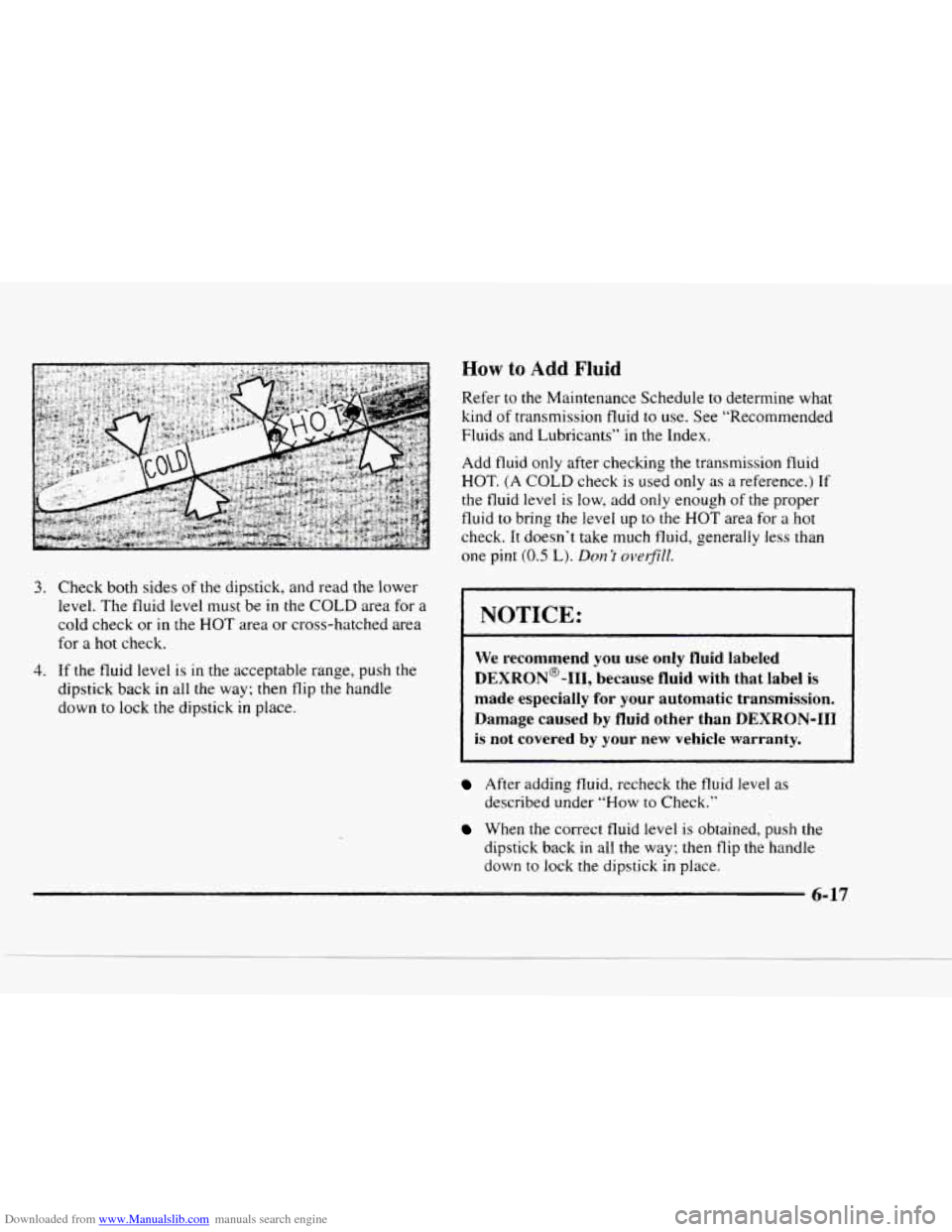
3. Check both sides of the dipstick, and read the lower
level. The fluid level must be in the
COLD area for a
cold check
or in the HOT area or cross-hatched area
for
a hot check.
4. If the fluid level is in the acceptable range, push the
dipstick back in all the way; then flip the handle
down
to lock the dipstick in place.
I NOTICE:
~ ~~ ~
We recommend you use only fluid labeled
DEXRON@-111, because fluid with that label is
made especially for your automatic transmission.
Damage caused by fluid other than
DEXRON-111
is not covered by your new vehicle warranty.
After adding fluid, recheck the fluid level as
described under “How to Check.”
When the correct fluid level is obtained, push the
dipstick back in all the
way; then flip the handle
down
to lock the dipstick in place.
6-17
Page 316 of 402
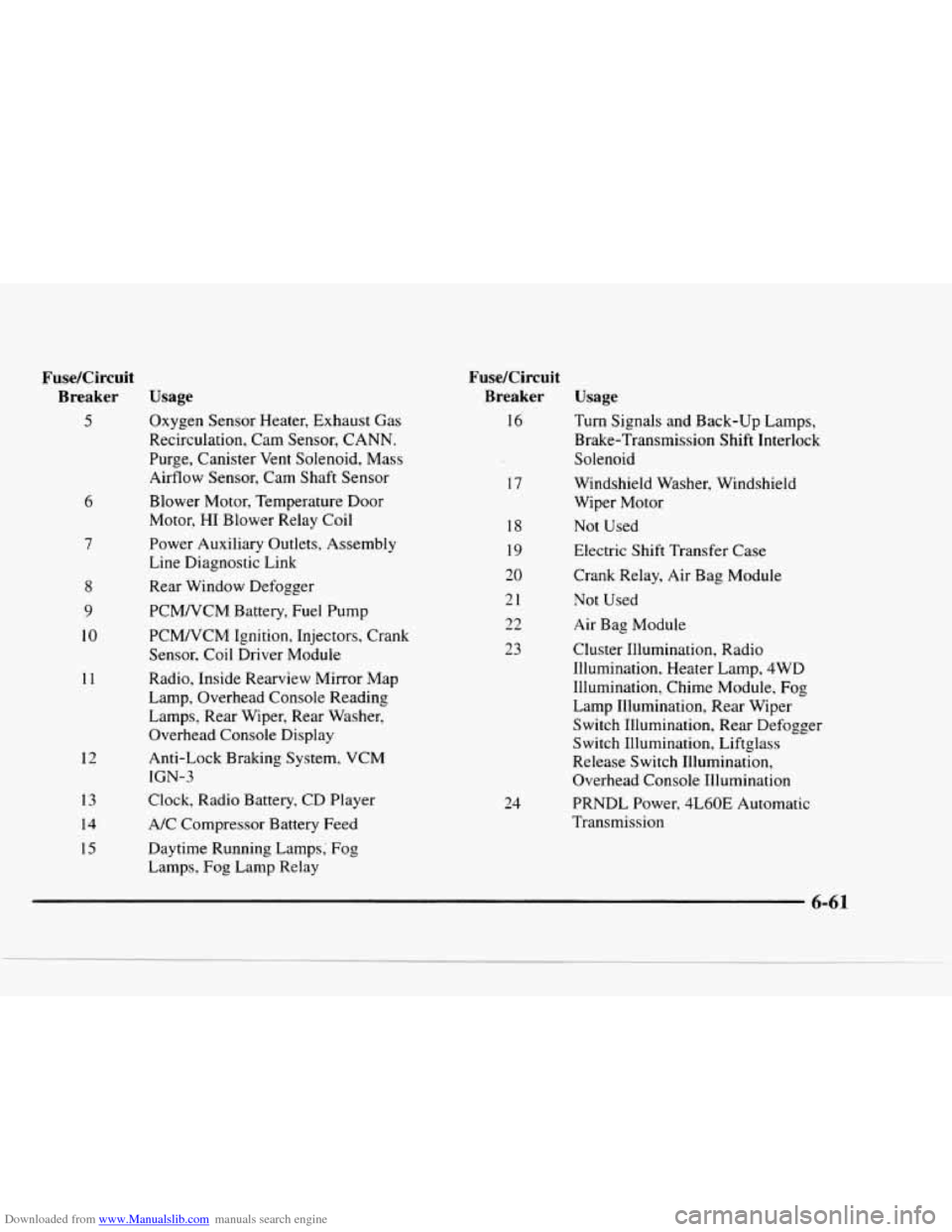
Downloaded from www.Manualslib.com manuals search engine FuseKircuit Breaker Usage
5
6
7
8
9
10
11
12
13
14
15
Oxygen Sensor Heater, Exhaust Gas
Recirculation, Cam Sensor,
CANN.
Purge, Canister Vent Solenoid, Mass
Airflow Sensor, Cam Shaft Sensor
Blower Motor, Temperature
Door
Motor, HI Blower Relay Coil
Power Auxiliary Outlets, Assembly
Line Diagnostic Link
Rear Window Defogger
PCMNCM Battery,
Fuel Pump
PCM/VCM Ignition, Injectors, Crank
Sensor, Coil Driver Module
Radio, Inside Rearview Mirror Map
Lamp, Overhead Console Reading
Lamps, Rear Wiper, Rear Washer,
Overhead Console Display
Anti-Lock Braking System, VCM
Clock, Radio Battery, CD Player
A/C Compressor Battery Feed
Daytime Running Lamps;
Fog
Lamps, Fog Lamp Relay
IGN-3
FuseKircuit
Breaker
Usage
16
17
18
19
20
21
22
23
24
Turn Signals and Back-up Lamps,
Brake-Transmission Shift Interlock
Solenoid
Windshield Washer, Windshield
Wiper Motor
Not Used
Electric Shift Transfer Case
Crank Relay, Air Bag Module
Not Used
Air Bag Module
Cluster Illumination, Radio
Illumination, Heater Lamp,
4WD
Illumination, Chime Module, Fog
Lamp Illumination, Rear Wiper
Switch Illumination, Rear Defogger
Switch Illumination, Liftglass
Release Switch Illumination,
Overhead Console Illumination
PRNDL Power, 4L6OE Automatic
Transmission
6-61