trailer CHEVROLET BLAZER 1997 2.G Owner's Manual
[x] Cancel search | Manufacturer: CHEVROLET, Model Year: 1997, Model line: BLAZER, Model: CHEVROLET BLAZER 1997 2.GPages: 402, PDF Size: 21.93 MB
Page 216 of 402
Downloaded from www.Manualslib.com manuals search engine Trailer Wiring Harness
The light duty trailer wiring is a six-wire harness
assembly. The optional heavy-duty trailer wiring is an
eight-wire harness assembly. The harnesses are stored
under the vehicle, along the passenger-side frame
crossmember on two-door vehicles or on the driver’s
side corner frame crossmember on four-door vehicles.
The heavy-duty trailer wiring has
a 30-amp feed wire
with an inline
fuse located by the junction block. See
“Fuses and Circuit Breakers”
in the Index. Both
harnesses have no connector and should be wired by a
qualified electrical technician. The technician can
use
the following color code chart when connecting the
wiring harness
to your trailer.
Dark Blue: Use for electric trailer brakes or
auxiliary wiring.
0 Red: Use for battery charging; it connects to the
starter solenoid (eight-wire harness only).
0 Light Green: Back-up lamps (eight-wire
harness only).
Brown: Taillamps and parking lamps.
0 Yellow: Left stoplamp and turn signal.
0 Dark Green: Right stoplamp and turn signal.
0 White (Heavy Gage): Ground wire.
0 White (Light Gage): Auxiliary stoplamp.
Securely attach the harness
to the trailer, then tape or
strap
it to your vehicle’s frame rail. Be sure you leave it
loose enough so the wiring doesn‘t bend or break, but
not so loose that it drags on the ground. Store the
harness in its original place. Wrap the harness together
and tie
it neatly so it won’t be damaged.
4-55
Page 230 of 402
Downloaded from www.Manualslib.com manuals search engine If No Steam Is Coming From Your Engine
If you get the overheat warning but see or hear no
steam, the problem may not be too serious. Sometimes
the engine can get a little too hot when you:
Climb a long hill on a hot day.
0 Stop after high-speed driving.
Idle for long periods in traffic.
Tow a trailer. See “Driving on Grades” in the Index.
If you get the overheat warning with no sign of steam,
try
this for a minute or so:
1. Turn off your air conditioner.
2. Turn on your heater to full hot at the highest fan
speed and open the window
as necessary.
3. If you’re in a traffic jam, shift to NEUTRAL (N);
otherwise, shift to the highest gear while
driving
-- AUTOMATIC OVERDRIVE (@) or
DRIVE (D) for automatic transmissions. If
you
no longer have the overheat warning, you
can drive. Just
to be safe, drive slower for about
10 minutes. If the warning doesn’t come back on,
you can drive normally.
If
the warning continues, pull over, stop, and park your
vehicle right away.
If there’s
still no sign of steam, push the accelerator until
the engine speed
is about twice as fast as normal idle
speed. Bring the engine speed back to normal idle speed
after two or three minutes. Now
see if the warning stops.
But then, if you still have the warning,
turn ofthe
engine and get everyone out of the vehicle until it
cools down.
You may decide not to lift the hood but
to get service
help right away.
5-13
Page 239 of 402
Downloaded from www.Manualslib.com manuals search engine Engine Fan Noise
This vehicle has a clutched engine cooling fan. When
the clutch
is engaged, the fan spins faster to provide
more air
to cool the engine. In most everyday driving
conditions, the clutch
is not engaged. This improves
fuel economy and reduces fan noise. Under heavy
vehicle loading, trailer towing and/or high outside
temperatures. the fan speed increases when the clutch
engages.
So you may hear an increase in fan noise. This
is normal and should
not be mistaken as the
transmission slipping or making extra shifts.
It is merely
the cooling system functioning properly. The
fa11 will
slow down when additional cooling is not required and
the clutch disengages.
You may also hear this fan noise when you start the
engine.
It will go away as the fan clutch disengages.
If a Tire Goes Flat
It's unusual for a tire to "blow out" while you're driving.
especially
if you maintain your tires properly. If air goes
out of a tire, it's much Inore likely to leak out slowly.
But if you should ever have ;I "blowout." here are a few
tips about what to expect and what to do:
If a front tire fails. the flat tire will create a drag that
pulls the vehicle toward that side. Take your foot off the
accelerator pedal and grip the steering wheel firmly.
Steer
to maintain lane position. and then gently brake to
a stop well out of the traffic lane.
A rear blowout. particularly on a curve. acts much like a
skid and may require the same correction you'd use in a
skid. In any rear blowout. remove your foot from the
xcelerator pedal. Get the \,chicle under control by
steering the way you want the vehicle to go. It may be
\.cry bunlpy and noisy. but you can still steer. Gently
brake
to a stop -- well off the road if possible.
5-22
Page 267 of 402
Downloaded from www.Manualslib.com manuals search engine Engine Oil Additives
Don't add anything to your oil. Your GM dealer is ready
to advise if you think something should be added.
When to Change Engine Oil
If any one of these is true for you. use the short tripkity
. maintenance schedule:
a
a
a
0
a
Most trips are less than 5 to 10 miles (8 to 16 km).
This is particularly important when outside
temperatures are below freezing.
Most trips include extensive idling (such
as frequent
driving in stop-and-go traffic).
You operate
your vehicle in dusty areas or
off-road frequently.
You frequently tow
a trailer or use a currier on top of
your vehicle.
The vehicle is used for delivery service. police, taxi
or other commercial application. Driving under
these conditions causes engine oil
to
break down sooner. If any one of these is true for your
vehicle, then you need
to change your oil and filter
every
3.000 miles (5 000 km) or 3 months -- whichever
occllrs first.
If none of them is true, use the long trip/highway
maintenance schedule. Change the oil and filter every
7,500 miles ( 12 500 km) or 12 months -- whichever
occurs first. Driving
a vehicle with a fully warmed
engine under highway conditions causes engine oil
to
break down slower.
Remote Oil Filter (Four-wheel Drive)
The access door for the remote oil filter is in the steering
linkage shield assembly located under the radiator
support.
Twist the screw to unlock or lock the door.
Make sure
if you open the door. it is securely closed
when
~OLI are finished.
6-12
Page 269 of 402
Downloaded from www.Manualslib.com manuals search engine A CAUTION:
Operating the engine with the air cleaner off can
cause you or others to be burned. The air cleaner
not only cleans the
air, it stops flame if the engine
backfires.
If it isn’t there, and the engine
backfires, you could be burned. Don’t drive with
it
off, and be careful working on the engine with
the air cleaner
off.
NOTICE:
If the air cleaner is off, a backfire can cause a
damaging engine fire. And, dirt can easily get
into your engine, which will damage
it. Always
have the air cleaner in place when you’re driving.
Automatic Transmission Fluid
When to Check and Change
A good time to check your automatic transmission fluid
level is when the engine oil is changed.
Change both the fluid and filter every
50,000 miles
(53 000 km) if the vehicle is mainly driven under one or
more
of these conditions:
In heavy city traffic where the outside temperature
regularly reaches
90°F (32°C) or higher.
In hilly or mountainous terrain.
When doing frequent trailer towing.
Uses such as found in taxi. police or delivery service.
If you do not use your vehicle under any of these
conditions, the fluid and filter
do not require changing.
See “Scheduled Maintenance Services”
in the Index.
6-14
Page 270 of 402
Downloaded from www.Manualslib.com manuals search engine How to Check
Because this operation can be a little difficult, you may
choose
to have this done at your GM dealership
Service Department.
If
you do it yourself, be sure to follow all the
instructions here, or
you could get a false reading
on
the dipstick.
NOTICE:
Too much or too little fluid can damage your
transmission.
Too much can mean that some of
~ the fluid could come out and fall on hot engine
parts
or exhaust system parts, starting a fire. Be
' sure to get an accurate reading if you check your
transmission fluid.
Wait at least 30 minutes before checking the
transmission
fluid level if you have been driving:
0 When outside temperatures are above 90°F (32°C).
At high speed for quite a while.
In heavy traffic -- especially in hot weather.
0 While pulling a trailer.
To get the right reading, the fluid should be at normal
operating temperature, which is
180°F to 200°F (83OC
to 93°C).
Checking Transmission Fluid Hot
Get the vehicle warmed up by driving about 15 miles
(24 km) when outside temperatures are above 50°F
(IOOC). If it's colder than 50°F (IOOC), drive the
vehicle
in DRIVE (D) until the engine temperature gage
moves and then remains steady for
10 minutes. Then
follow the hot check procedures.
6-15
Page 324 of 402
Downloaded from www.Manualslib.com manuals search engine Maintenance Schedule
I Short TripKity Definition - ~-
Follow the Short TripKity Maintenance Schedule if any
one
of these conditions is true for your vehicle:
Most trips are less than 5 to 10 miles (8 to 16 km).
This is particularly important when outside
temperatures are below freezing.
driving in stop-and-go traffic).
off-road frequently.
your vehicle.
or other commercial application.
Most trips include extensive idling (such as frequent
You operate your vehicle in dusty areas or
You frequently tow a trailer or use a carrier on top of
If the vehicle is used for delivery service, police, taxi
One of the reasons you should follow this schedule if you
operate your vehicle under any
of these conditions is that
these conditions cause engine oil
to break down sooney:
I Short TripKity Intervals
Every 3,000 Miles (5 000 km): Engine Oil and Filter
Change (or
3 months, whichever occurs first). Chassis
Lubrication (or
3 months, whichever occurs first). Drive
Axle Service (or 3 months, whichever occurs first).
Short TripKity Intervals
Every 6,000 Miles (10 000 km): Tire Rotation.
Every 15,000 Miles (25 000 km): Air Cleaner Filter
Inspection,
if driving in dusty conditions. Front
Wheel Bearing Repack
(2WD only) (or at each brake
relining, whichever occurs first).
Every 30,000 Miles (50 000 km): Air Cleaner Filter
Replacement. Fuel Filter Replacement.
Every 50,000 Miles (83 000 km): Automatic
Transmission Service (severe conditions only).
Every 60,000 Miles (100 000 km): Engine
Accessory Drive Belt Inspection. Fuel Tank, Cap
and Lines Inspection.
Every 100,000 Miles (166 000 km): Spark Plug Wire
Inspection. Spark
Plug Replacement. Positive
Crankcase Ventilation (PCV) Valve Inspection.
Every 150,000 Miles (240 000 km): Cooling System
Service
(or every 60 months, whichever occurs first).
These intervals only summarize maintenance services.
Be sure to follow the complete maintenance schedule
on the following pages.
Page 325 of 402
Downloaded from www.Manualslib.com manuals search engine Maintenance Schedule
c
Long Trip/Highway Definition I
Follow this maintenance schedule only if none of the
conditions from the Short Trip/City Maintenance
Schedule is true.
Do not use this schedule if the vehicle
is used for trailer towing, driven in a dusty area
or used
off paved roads. Use the Short Trip/City schedule for
these conditions.
Driving a vehicle with a fully warmed engine under
highway conditions causes engine oil to break
down slowel:
1 Long Trip/Highway Intervals I
Every 7,500 Miles (12 500 km): Engine Oil and Filter
Change (or every
12 months, whichever occurs first).
Chassis Lubrication (or every
12 months, whichever
occurs first). Drive Axle Service. Tire Rotation.
Replacement. Air Cleaner Filter Replacement. Front
Wheel Bearing Repack
(2WD only).(or at each brake
relining, whichever occurs first).
Transmission Service (severe conditions only).
Drive Belt Inspection. Fuel Tank, Cap and
Lines Inspection.
Inspection.
Spark Plug Replacement. Positive
Crankcase Ventilation (PCV) Valve Inspection.
Every 150,000 Miles (240 000 km): Cooling System
Every 30,000 Miles (50 000 km): Fuel Filter
Every 50,000 Miles (83 000 km): Automatic
Every 60,000 Miles (100 000 km): Engine Accessory
Every 100,000 Miles (166 000 km): Spark Plug Wire
I Service (or every 60 months, whichever occurs first).
These intervals only summarize maintenance services.
Be sure to follow the complete maintenance schedule
on the following pages.
7-6
Page 326 of 402
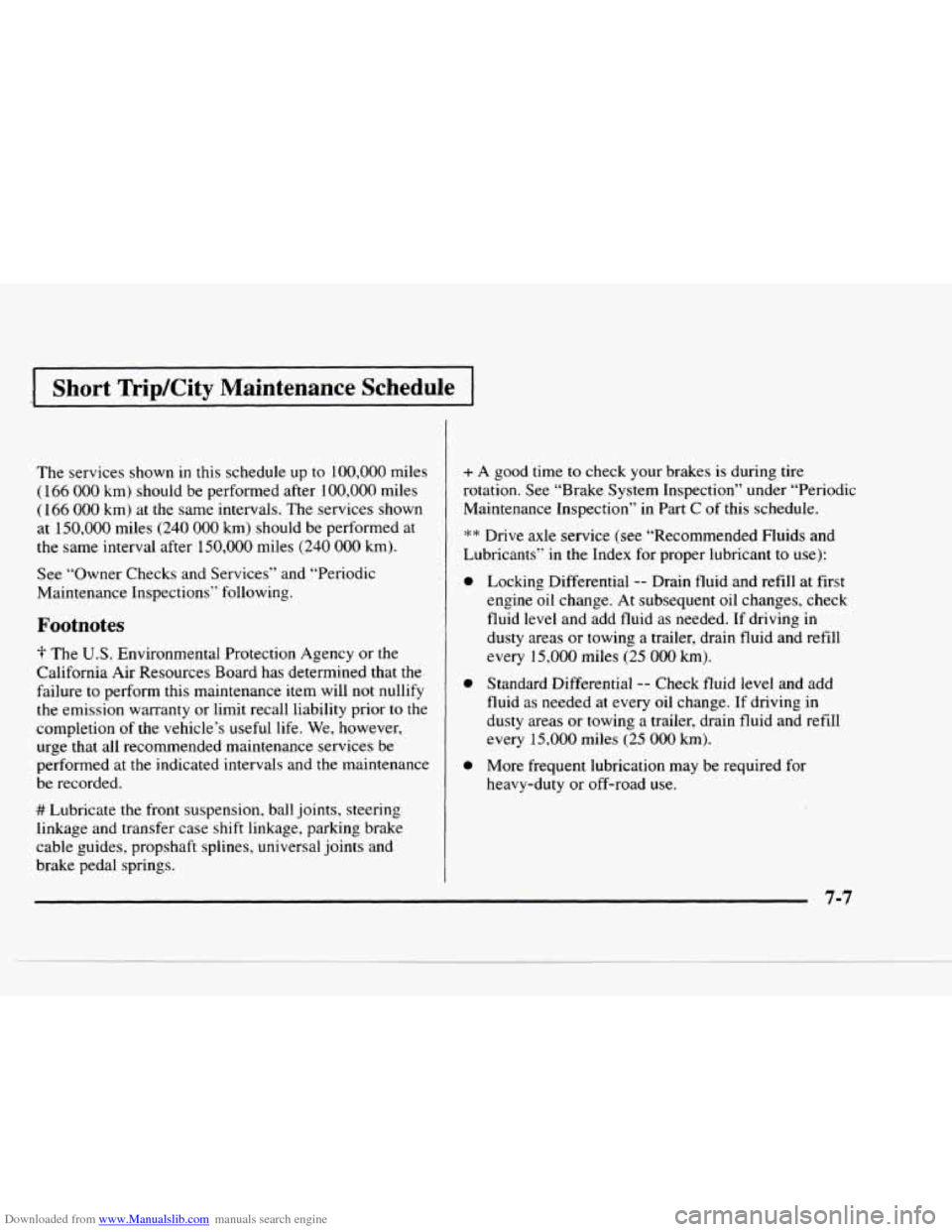
Downloaded from www.Manualslib.com manuals search engine Short TripKity Maintenance Schedule
The services shown in this schedule up to 100,000 miles
( 166 000 km) should be performed after 100,000 miles
(166 000 km) at the same intervals. The services shown
at
150,000 miles (240 000 km) should be performed at
the same interval after 150,000 miles
(240 000 km).
See “Owner Checks and Services” and “Periodic
Maintenance inspections” following.
Footnotes
? The U.S. Environmental Protection Agency or the
California Air Resources Board has determined that
the
failure to perform this maintenance item will not nullify
the emission warranty or limit recall liability prior
to the
completion of the vehicle’s
useful life. We, however,
urge that all recommended maintenance services
be
performed at the indicated intervals and the maintenance
be recorded.
# Lubricate the front suspension, ball joints, steering
linkage and transfer case shift linkage, parking brake
cable guides, propshaft splines, universal joints and
brake pedal springs.
+ A good time to check your brakes is during tire
rotation. See “Brake System Inspection” under “Periodic Maintenance Inspection” in Part
C of this schedule.
** Drive axle service (see “Recommended Fluids and
Lubricants’’ in
the Index for proper lubricant to use):
0
a
0
Locking Differential -- Drain fluid and refill at first
engine oil change. At subsequent oil changes, check
fluid level and add fluid as needed. If driving in
dusty areas or towing a trailer, drain fluid and refill
every
15,000 miles (25 000 km).
Standard Differential -- Check fluid level and add
fluid
as needed at every oil change. If driving in
dusty areas
or towing a trailer, drain fluid and refill
every
15,000 miles (25 000 km).
More frequent lubrication may be required for
heavy-duty
or off-road use.
Page 336 of 402
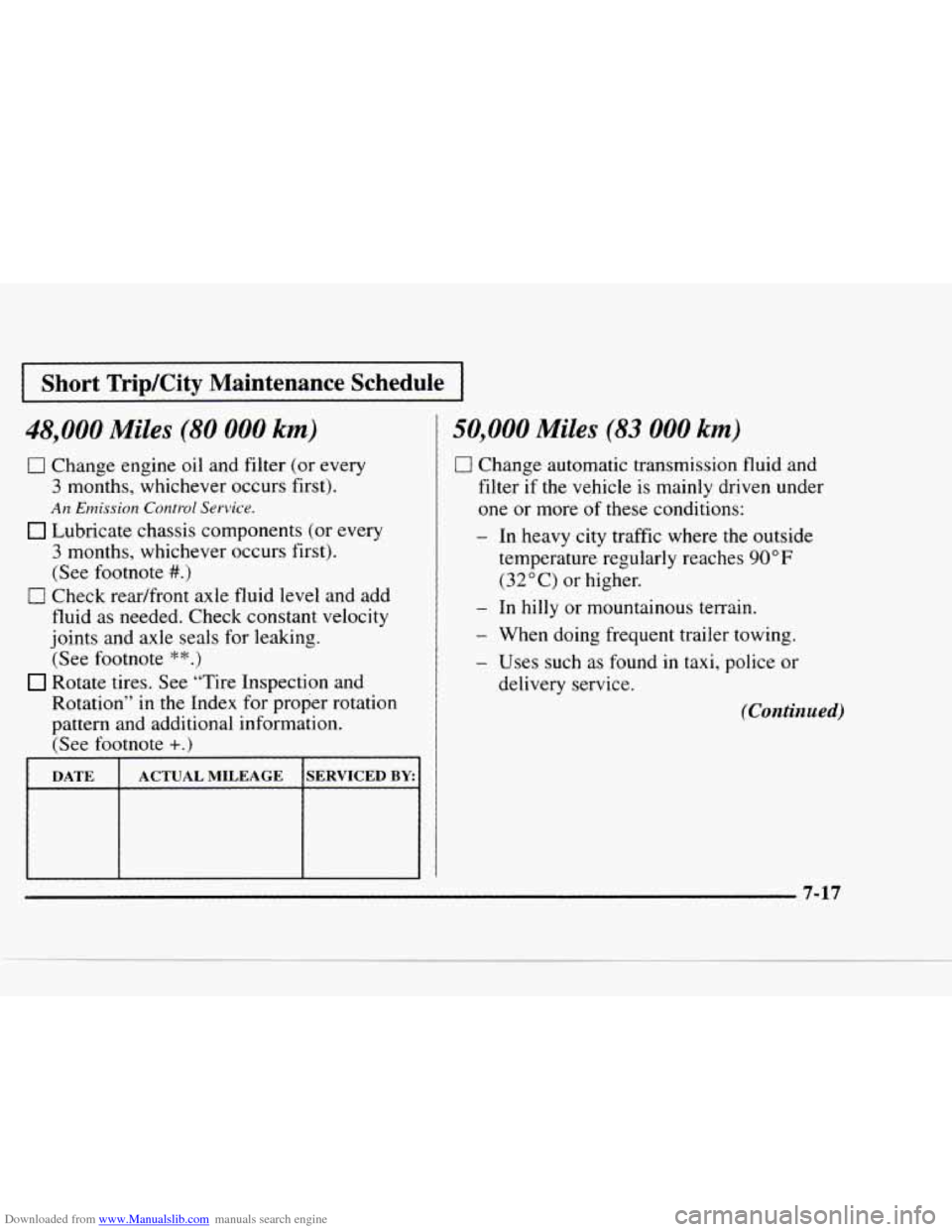
Downloaded from www.Manualslib.com manuals search engine Short TripKity Maintenance Schedule
48,000 Miles (80 000 km)
0 Change engine oil and filter (or every
3 months, whichever occurs first).
An Emission Control Service.
Lubricate chassis components (or every
3 months, whichever occurs first).
(See footnote
#.)
0 Check readfront axle fluid level and add
fluid as needed. Check constant velocity
joints and axle seals for leaking.
(See footnote
* *.)
Rotate tires. See “Tire Inspection and
Rotation”
in the Index for proper rotation
pattern and additional information.
(See footnote
+.)
1 DATE ACTUAL MILEAGE SERVICED BY
50,000 Miles (83 000 km)
IJ Change automatic transmission fluid and
filter if
the vehicle is mainly driven under
one or more of these conditions:
- In heavy city traffic where the outside
temperature regularly reaches
90 OF
(32°C) or higher.
- In hilly or mountainous terrain.
- When doing frequent trailer towing.
- Uses such as found in taxi, police or
delivery service.
(Continued)
7-17