ECU CHEVROLET BLAZER 1998 2.G User Guide
[x] Cancel search | Manufacturer: CHEVROLET, Model Year: 1998, Model line: BLAZER, Model: CHEVROLET BLAZER 1998 2.GPages: 416, PDF Size: 22.4 MB
Page 64 of 416
Downloaded from www.Manualslib.com manuals search engine Securing a Child Restraint in a Rear
Outside Seat Position
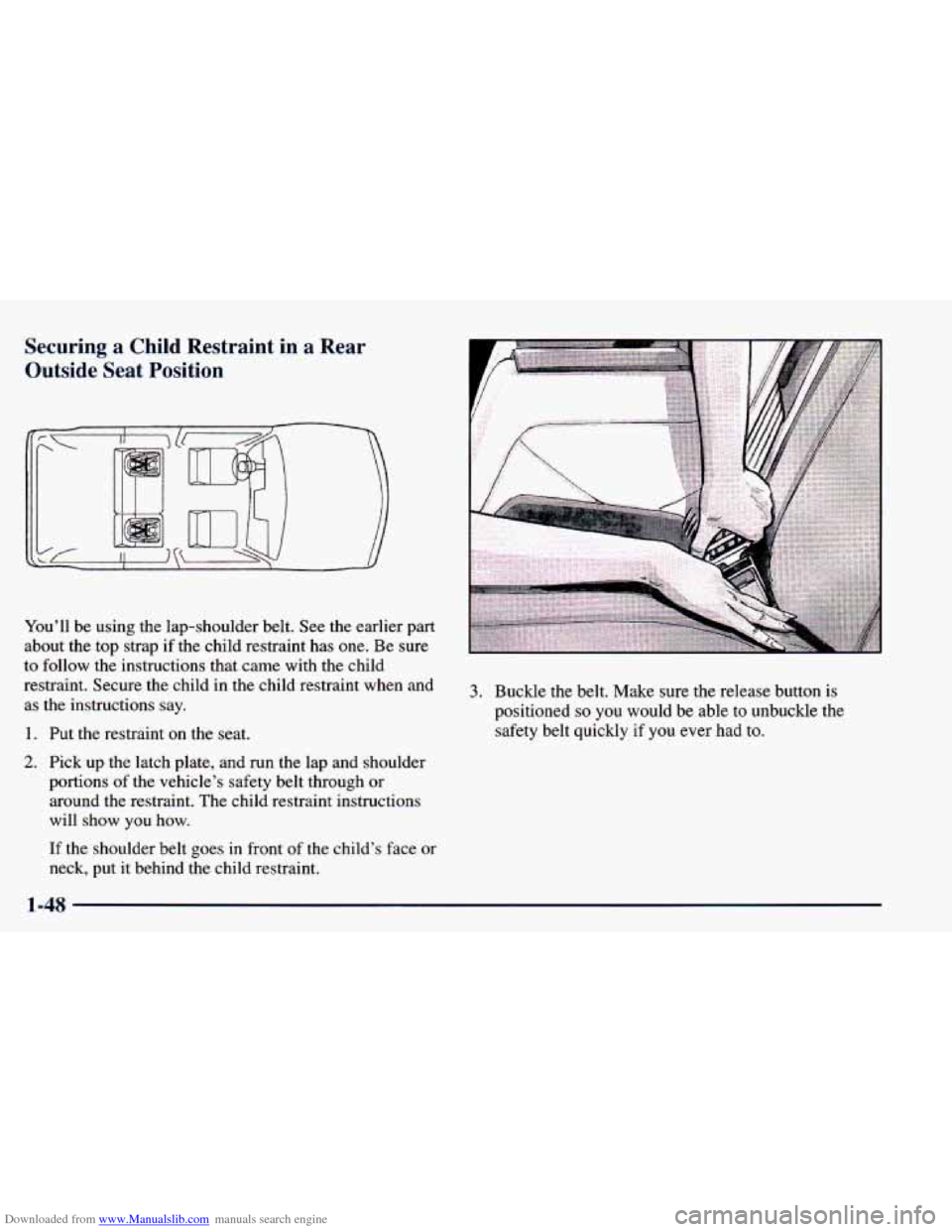
You’ll be using the lap-shoulder belt. See the earlier part
about the top strap
if the child restraint has one. Be sure
to follow the instructions that came with the child
restraint. Secure the child in the child restraint when and
as the instructions say.
1. Put the restraint on the seat.
2. Pick up the latch plate, and run the lap and shoulder
portions
of the vehicle’s safety belt through or
around the restraint. The child restraint instructions
will show
you how.
If the shoulder belt goes in front of the child’s face
or
neck, put it behind the child restraint.
3. Buckle the belt. Make sure the release button is
positioned
so you would be able to unbuckle the
safety belt quickly if
you ever had to.
1-48
Page 65 of 416
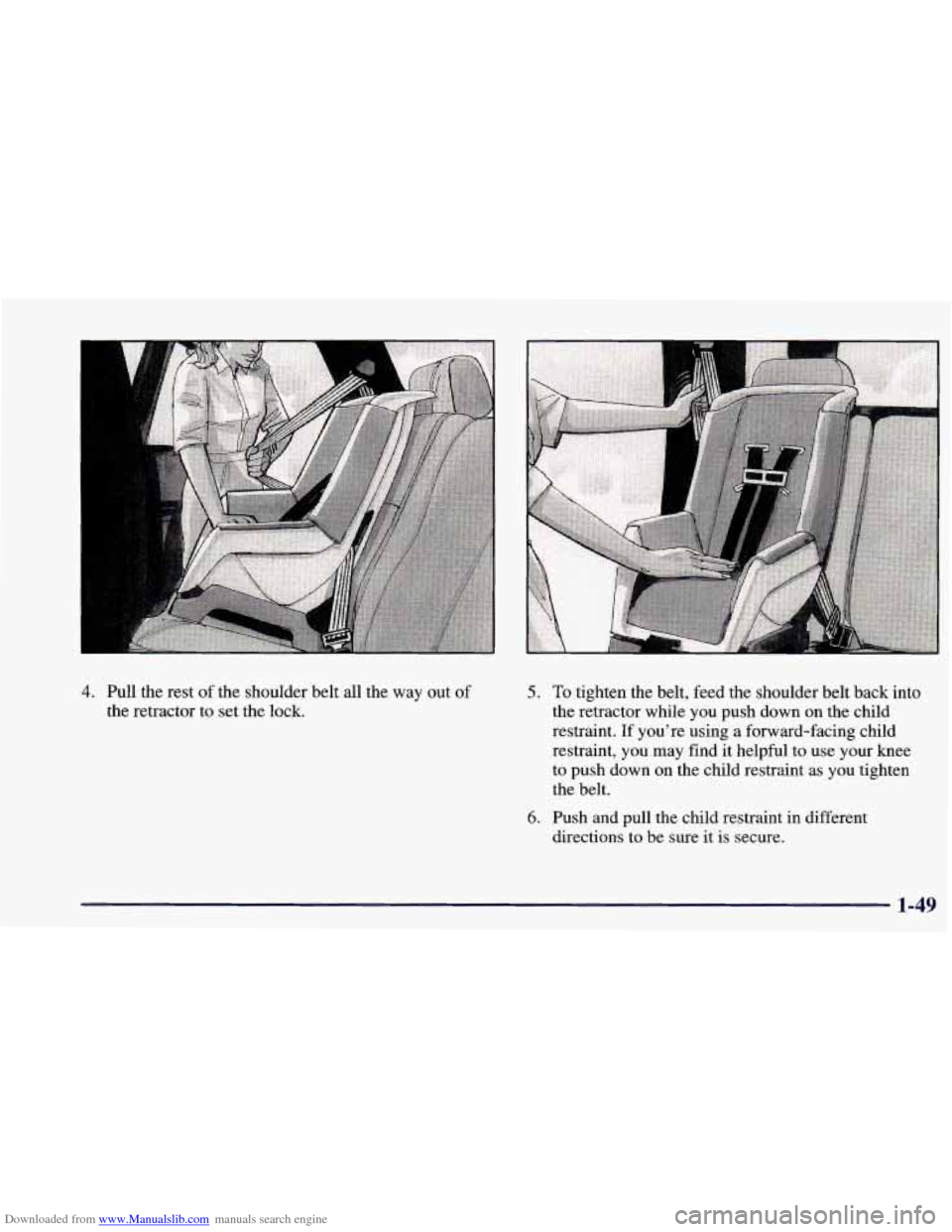
Downloaded from www.Manualslib.com manuals search engine 4. Pull the rest of the shoulder belt all the way out of
the retractor to set the lock.
5. To tighten the belt, feed the shoulder belt back into
the retractor while you push down on the child
restraint.
If you’re using a forward-facing child
restraint, you may find
it helpful to use your knee
to push down on the child restraint as you tighten
the belt.
6. Push and pull the child restraint in different
directions to be sure
it is secure.
1-49
Page 66 of 416
Downloaded from www.Manualslib.com manuals search engine To remove the child restraint, just unbuckle the vehicle’s
safety belt and let it
go back all the way. The safety belt
will move freely again and be ready to work for an adult
or larger child passenger.
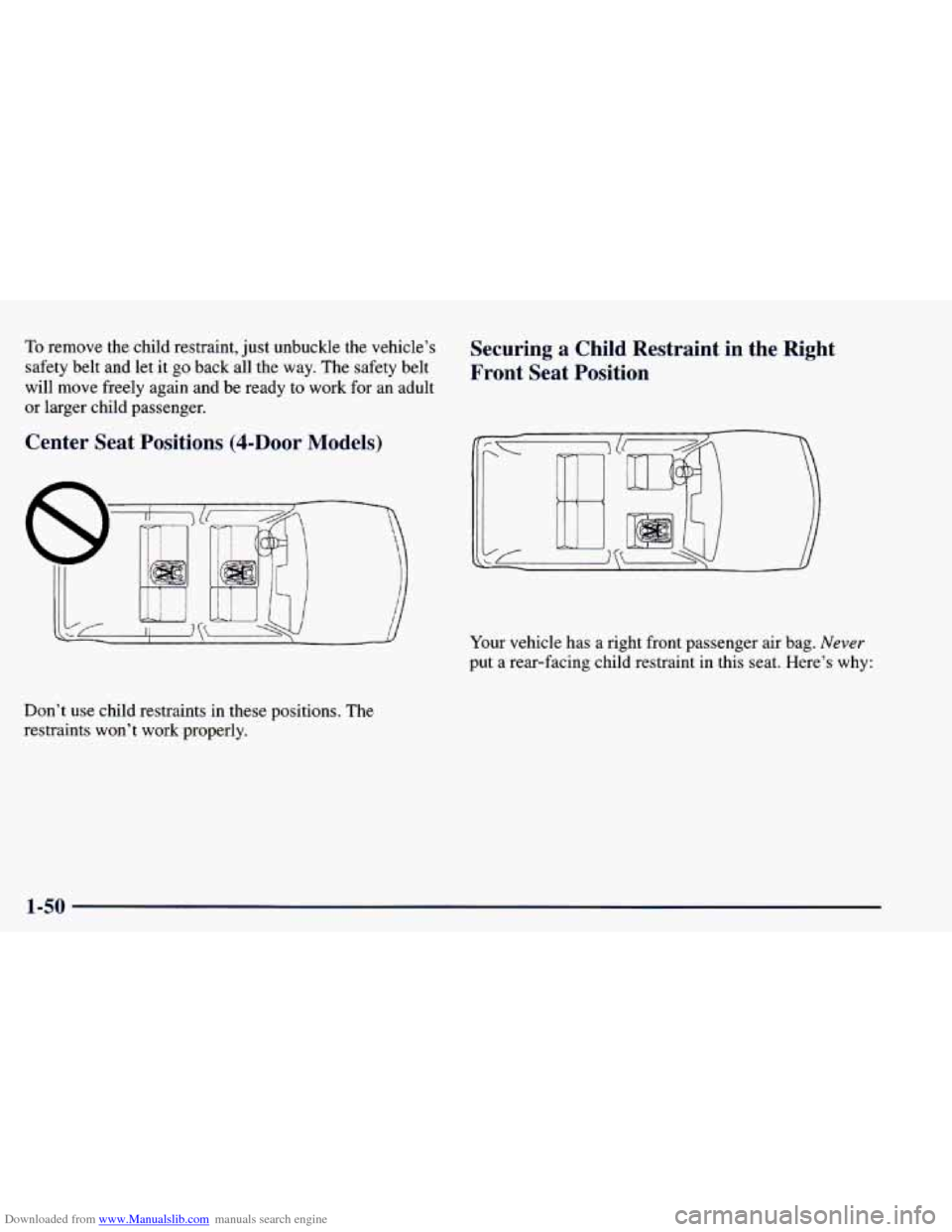
Center Seat Positions (4-Door Models)
Don’t use child restraints in these positions. The
restraints won’t work properly.
Securing a Child Restraint in the Right
Front Seat
Position
Your vehicle has a right front passenger air bag. Never
put a rear-facing child restraint in this seat. Here’s why:
1-50
Page 67 of 416
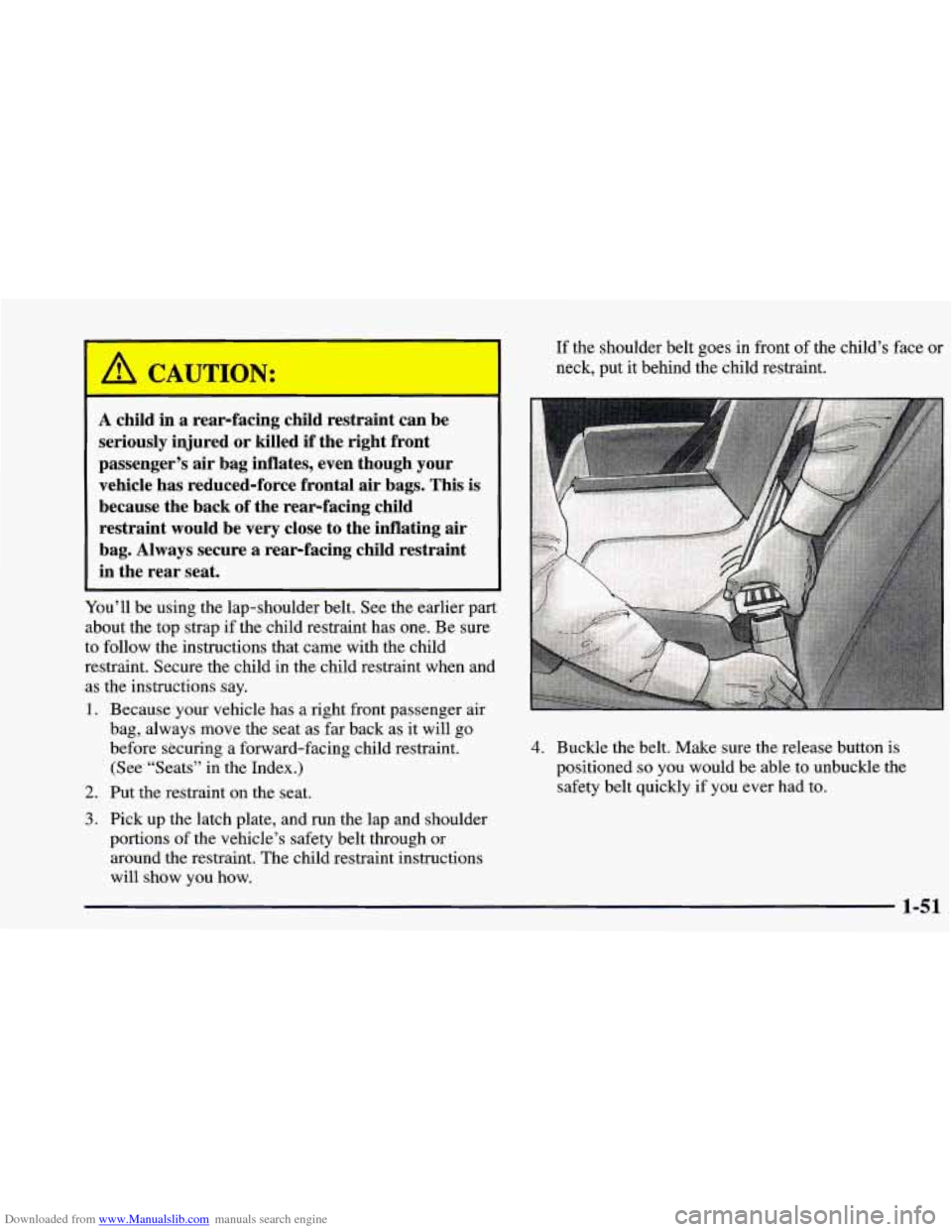
Downloaded from www.Manualslib.com manuals search engine If the shoulder belt goes in front of the child’s face or
A child in a rear-facing child restraint can be
seriously injured or killed if the right front
passenger’s air bag inflates, even though your
vehicle has reduced-force frontal air bags. This is
because the back of the rear-facing child
restraint would be very close to the inflating air
bag. Always secure a rear-facing child restraint
in the rear seat.
You’ll be using the lap-shoulder belt. See the earlier part
about the top strap if the child restraint has one. Be sure
to follow the instructions that came with the child
restraint. Secure the child in the child restraint when and
as the instructions say.
1. Because your vehicle has a right front passenger air
bag, always move the seat as far back as it will go
before securing a forward-facing child restraint.
(See “Seats” in the Index.)
2. Put the restraint on the seat.
3. Pick up the latch plate, and run the lap and shoulder
portions of the vehicle’s safety belt through or
around the restraint. The child restraint instructions
will show you how. neck, put
it behind the child restraint.
4. Buckle the belt. Make sure the release button is
positioned
so you would be able to unbuckle the
safety belt quickly if you ever had to.
1-51
Page 68 of 416
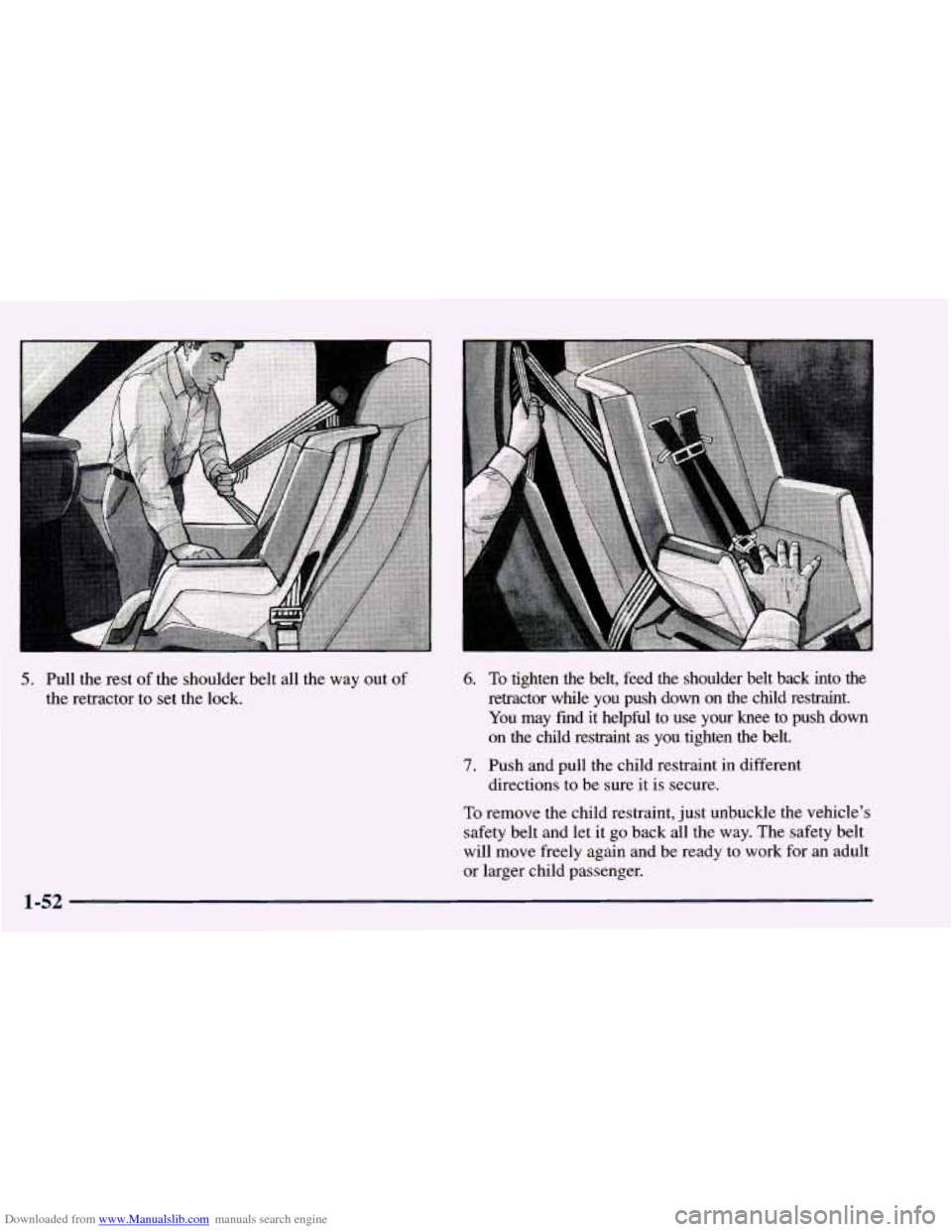
Downloaded from www.Manualslib.com manuals search engine 5. Pull the rest of the shoulder belt all the way out of
the retractor to set the lock. 6.
7.
To tighten the belt, feed the shoulder belt back into the
retractor while you push down on the child restraint.
You may find it helpful to use your knee to push down
on the child restraint as you tighten the belt.
Push and pull the child restraint in different
directions to be sure it is secure.
To remove the child restraint, just unbuckle the vehicle’s
safety belt and let it go back all the way. The safety belt
will move freely again and be ready to work for an adult
or larger child passenger.
Page 79 of 416
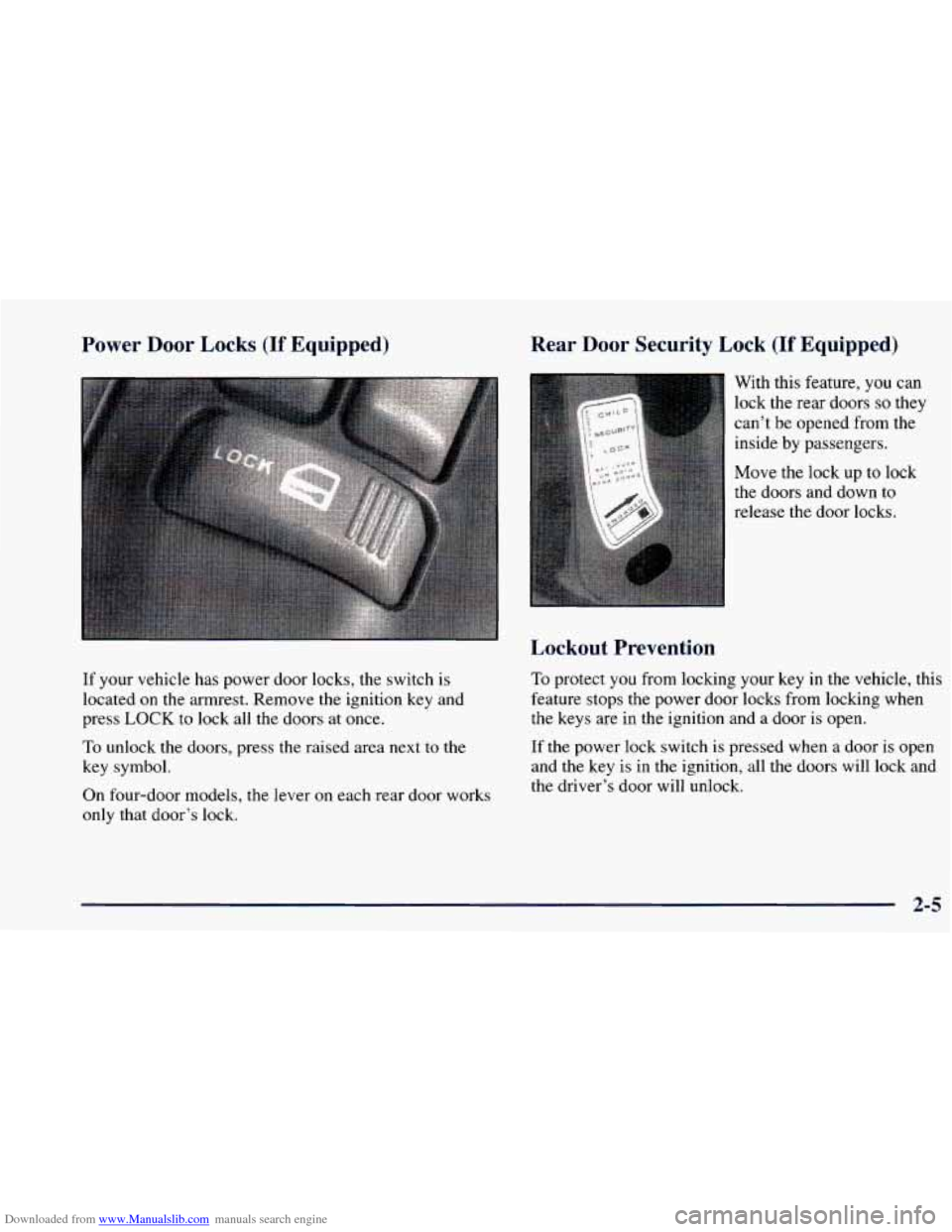
Downloaded from www.Manualslib.com manuals search engine Power Door Locks (If Equipped) Rear Door Security Lock (If Equipped)
If your vehicle has power door
locks, the switch is
located on the armrest. Remove the ignition key and
press
LOCK to lock all the doors at once.
To unlock the doors, press the raised area next to the
key symbol.
On four-door models, the lever on each rear door works
only that door’s lock. With
this feature, you
can
lock the rear doors so they
can’t be opened from the
inside
by passengers.
Move the lock up to lock
the doors and down to
release the door locks.
Lockout Prevention
To protect you from locking your key in the vehicle, this
feature stops the power door locks from locking when
the keys are in the ignition and a door is open.
If the power lock switch is pressed when a door is open
and the key is in the ignition, all the doors will lock and
the driver’s door will unlock.
2-5
Page 82 of 416
Downloaded from www.Manualslib.com manuals search engine NOTICE:
When replacing the battery, use care not to touch
any of the circuitry. Static from your body
transferred to these surfaces may damage
the transmitter.
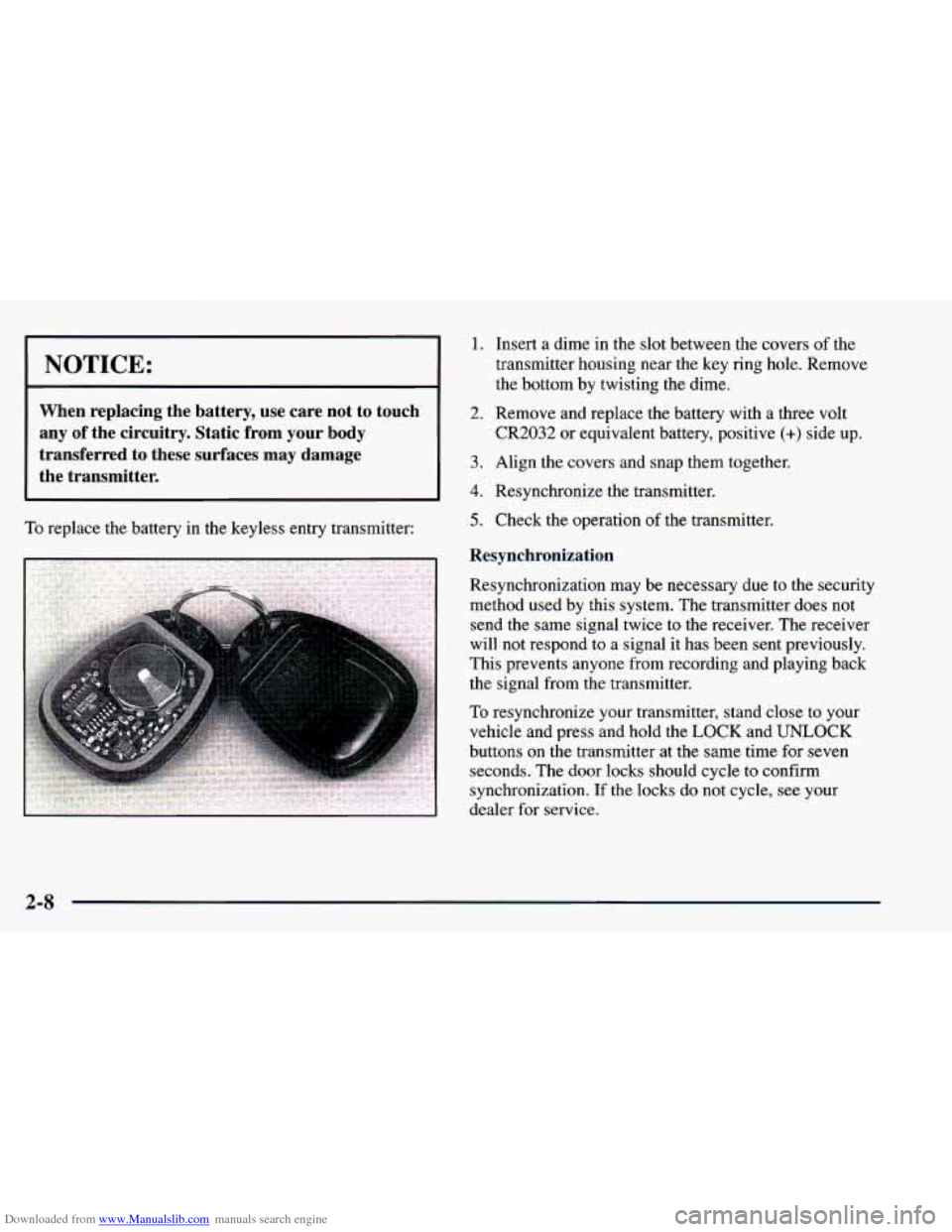
To replace the battery in the keyless entry transmitter:
1.
2.
3.
4.
5.
Insert a dime in the slot between the covers of the
transmitter housing near the key ring hole. Remove
the bottom by twisting the dime.
Remove and replace the battery with a three volt
CR2032 or equivalent battery, positive
(+) side up.
Align the covers and snap them together.
Resynchronize the transmitter.
Check the operation of the transmitter.
Resynchronization
Resynchronization may be necessary due to the security
method used by this system. The transmitter does not
send the same signal twice to the receiver. The receiver
will not respond to
a signal it has been sent previously.
This prevents anyone from recording and playing back
the signal from the transmitter.
To resynchronize your transmitter, stand close to your
vehicle and press and hold the
LOCK and UNLOCK
buttons on the transmitter at the same time for seven
seconds. The door locks should cycle
to confirm
synchronization.
If the locks do not cycle, see your
dealer for service.
2-8
Page 85 of 416
Downloaded from www.Manualslib.com manuals search engine Remote Rear Glass Release
1
This button on the
passenger’s side
of the
steering column allows you
to release the rear glass
If your vehicle has an automatic transmission, your shift
lever must be in PARK (P)
or NEUTRAL (N) for the
release to work.
If
you have a manual transmission, either with or
without the Keyless Entry option, you must apply your
parking brake or have the ignition off before you can
open the endgate glass.
so equipped. Use the handle to open the liftgate. Press
the button to open the glass
when the liftgate is closed.
The glass won’t release if the vehicle
is in gear.
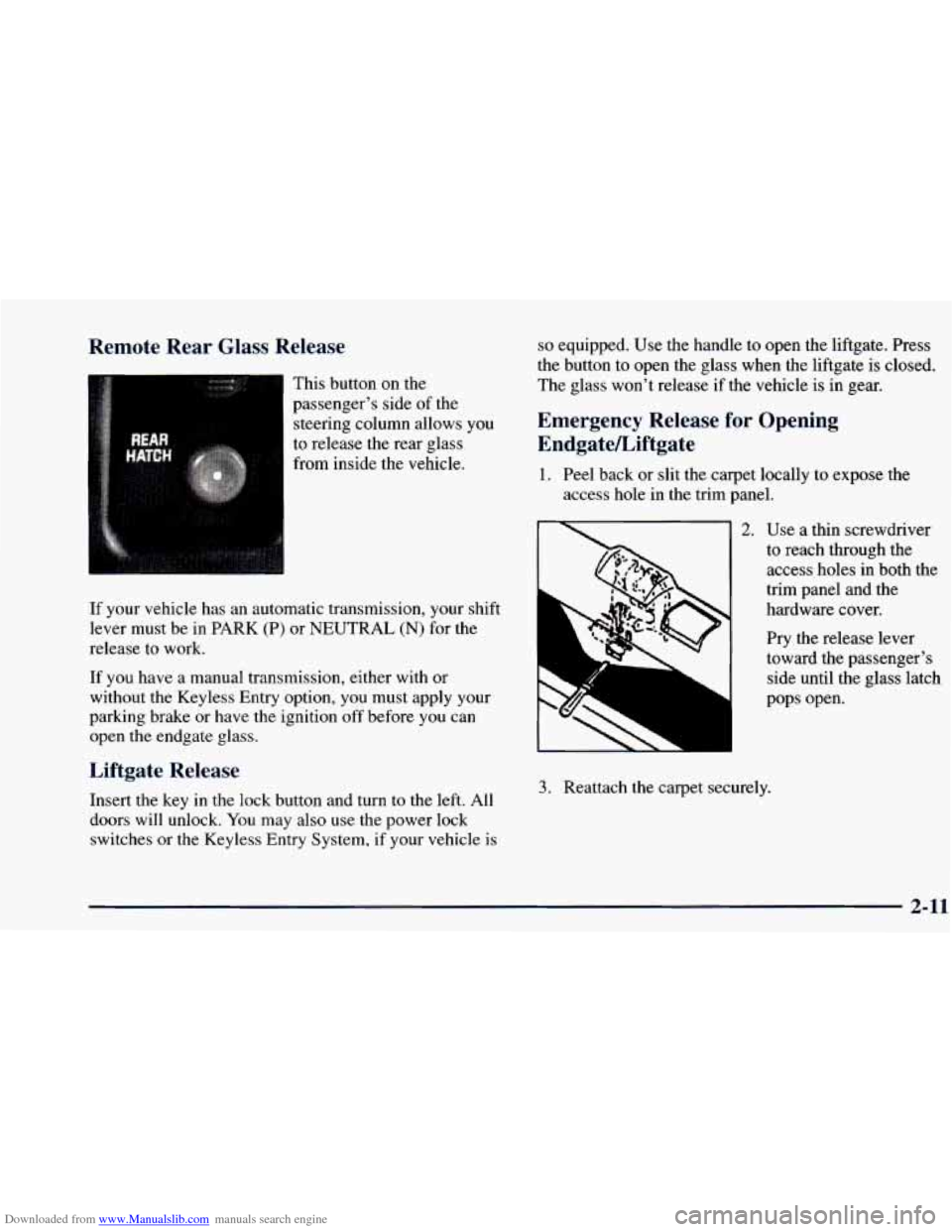
Emergency Release for Opening
EndgateLiftgate
1. Peel back or slit the carpet locally to expose the
access hole in the trim panel.
11 2. Use a thin screwdriver
to reach through the
access holes in both the
trim panel and the
hardware cover.
Liftgate Release
Insert the key in the lock button and turn to the left. All
doors will unlock. You may also use the power lock
switches or the Keyless Entry System,
if your vehicle is
3. Reattach the carpet securely. Pry
the release lever
toward the passenger’s
side until the glass latch
pops open.
2-11
Page 86 of 416
Downloaded from www.Manualslib.com manuals search engine Theft Parking Lots
Vehicle theft is big business, especially in some cities.
Although your vehicle has a number of theft-deterrent features, we know that nothing we put on it can make it
impossible to steal. However, there are ways you
can help.
Key in the Ignition
If you leave your vehicle with the keys inside, it’s an
easy target for joy riders or professional thieves
-- so
don’t do it.
When you park your vehicle and open the driver’s door, you’ll hear a chime reminding you to remove your key
from the ignition and take it with you. Always
do this.
Your steering wheel will be locked, and
so will your
ignition. If you have an automatic transmission, taking
your key out also locks your transmission. And
remember to lock the doors.
Parking at Night
Park in a lighted spot, close all windows and lock your
vehicle. Remember to keep your valuables out of sight.
Put them in a storage area, or take them with
you.
If you park in a lot where someone will be watching
your vehicle, it’s best to lock it up and take your keys.
But what if
you have to leave your ignition key? What if
you have to leave something valuable in your vehicle?
Put your valuables in a storage area, like your
glove box.
0 Lock all the doors except the driver’s.
Passlock@
Your vehicle is equipped with the Passlock
theft-deterrent system.
Passlock is a passive theft-deterrent system. The system
is armed once the key is removed from the ignition.
Passlock enables fuel if the ignition lock cylinder is
turned with a valid key. If a correct key is not used, fuel
is disabled.
During normal operation, the
SECURITY light will go
off after the engine is started.
2-12
Page 87 of 416
Downloaded from www.Manualslib.com manuals search engine If the engine stalls and the SECURITY light flashes,
wait about
10 minutes until the light stops flashing
before trying to restart the engine. Remember to release
the
key from the START position as soon as the
engine starts.
If the engine does not start after three (3) tries, the
vehicle needs service.
If you are driving and the SECURITY light comes on,
you will be able to restart the engine if you turn the
engine
off. However, your Passlock system is not
working properly and must be serviced by your dealer.
Your vehicle is not protected by Passlock at this time.
You may also want to check the fuse (see “Fuses and
Circuit Breakers” in the Index). See your dealer
for service.
If the
SECURITY light flashes, wait until the light stops
flashing before starting the engine.
If the
SECURITY light comes on while the engine is
running, a problem has been detected and the system
may need service. See your dealer for service.
In an emergency, call the
GM Roadside Assistance
Center. See “Roadside Assistance” in the Index.
New Vehicle “Break-In”
NOTICE:
Your vehicle doesn’t need an elaborate
“break-in.” But
it will perform better in the long
run if
you follow these guidelines:
a
0
0
0
Keep your speed at 55 mph (88 km/h) or
less for the
first 500 miles (805 km).
Don’t drive at any one speed
-- fast or
slow -- for the first 500 miles (805 km).
Don’t make full-throttle starts.
Avoid making hard stops for the first
200 miles (322 km) or so. During this time
your new brake linings aren’t yet broken
in. Hard stops with new linings can mean
premature wear and earlier replacement.
Follow this breaking-in guideline every
time
you get new brake linings.
Don’t tow
a trailer during break-in.
See “Towing a Trailer’’ in the Index for
more information.
2-13