change time CHEVROLET BLAZER 1998 2.G User Guide
[x] Cancel search | Manufacturer: CHEVROLET, Model Year: 1998, Model line: BLAZER, Model: CHEVROLET BLAZER 1998 2.GPages: 416, PDF Size: 22.4 MB
Page 199 of 416
Downloaded from www.Manualslib.com manuals search engine Controlling your vehicle is the key to successful
off-road driving. One
of the best ways to control your
vehicle is to control your speed. Here are some things to
keep in mind. At higher speeds:
you approach things faster and you have less time to
scan the terrain for obstacles.
0 you have less time to react.
0 you have more vehicle bounce when you drive
over obstacles.
0 you'll need more distance for braking, especially
since you're on an unpc"=.?d surface.
Scanning the Terrain
Off-road driving can take you over many different kinds
of terrain. You need to be familiar with the terrain and
its many different features. Here are some things
to consider.
Sugace Conditions. Off-roading can take you over
hard-packed dirt, gravel, rocks, grass, sand, mud, snow
or ice. Each of these surfaces affects the steering,
acceleration and braking of your vehicle
in different
ways. Depending upon the kind
of surface you are on,
you may experience slipping, sliding, wheel spinning,
delayed acceleration, poor traction and longer
braking distances.
Sugace Obstacles . Unseen or hidden obstacles can be
hazardous.
A rock, log, hole, rut or bump can startle you if
you're not prepared for them. Often these obstacles are
hidden by grass, bushes, snow or even the
rise and fall of
the terrain itself. Here are some things to consider:
I
When you're driving off-road, bouncing and
quick changes in direction can easily throw
you
out of position. This could cause you to lose
control and crash.
So, whether you're driving on
or off the road, you and your passengers should
wear safety belts.
0 Does the travel take you uphill or downhill? (There's
0 Is the path ahead clear?
0 Will the surface texture change abruptly up ahead?
more discussion
of these subjects later.)
0 Will you have to stop suddenly or change
direction quickly?
4-17
Page 225 of 416
Downloaded from www.Manualslib.com manuals search engine Every Vehicle is ready for some trailer towing. If yours
was built with trailering options, as many are, it’s ready
for heavier trailers. But trailering
is different than just
driving your vehicle by itself. Trailering means changes
in handling, durability and fuel economy. Successful,
safe trailering takes correct equipment, and it has to be
used properly.
That’s the reason for this part. In
it are many
time-tested, important trailering tips and safety rules.
Many
of these are important for your safety and that of
your passengers.
So please read this section carefully
before you pull a trailer.
If You Do Decide To Pull A Trailer
If you do, here are some important points:
0
0
There are many different laws, including speed limit
restrictions, having to do with trailering. Make sure
your rig
will be legal, not only where you live but
also where you’ll be driving.
A good source for this
information can be state or provincial police.
Consider using a sway control if your trailer will
weigh
2,000 lbs. (900 kg) or less. You should always
use a sway control if your trailer will weigh more
than
2,000 lbs. (900 kg). You can ask a hitch dealer
about sway controls.
0
0
0
Don’t tow a trailer at all during the first 500 miles
(800 km) your new vehicle is driven. Your engine,
axle or other parts could be damaged.
Then, during the first
500 miles (800 km) that you
tow a trailer, don’t drive over
50 mph (80 kmh) and
don’t make starts at full throttle. This helps your
engine and other parts of your vehicle wear
in at the
heavier loads.
If you have an automatic transmission, you can
use THIRD
(3) (or, as you need to, a lower gear)
when towing
a trailer. Operating your vehicle in
THIRD
(3) when towing a trailer will minimize heat
buildup and extend the life of your transmission. If
you have a manual transmission and you are towing
a trailer, it’s better not to use FIFTH
(5) gear. Just
drive
in FOURTH (4) gear (or, as you need to, a
lower gear).
Three important considerations have to
do with weight:
0 the weight of the trailer,
0 the weight of the trailer tongue
0 and the weight on your vehicle’s tires.
4-43
Page 260 of 416
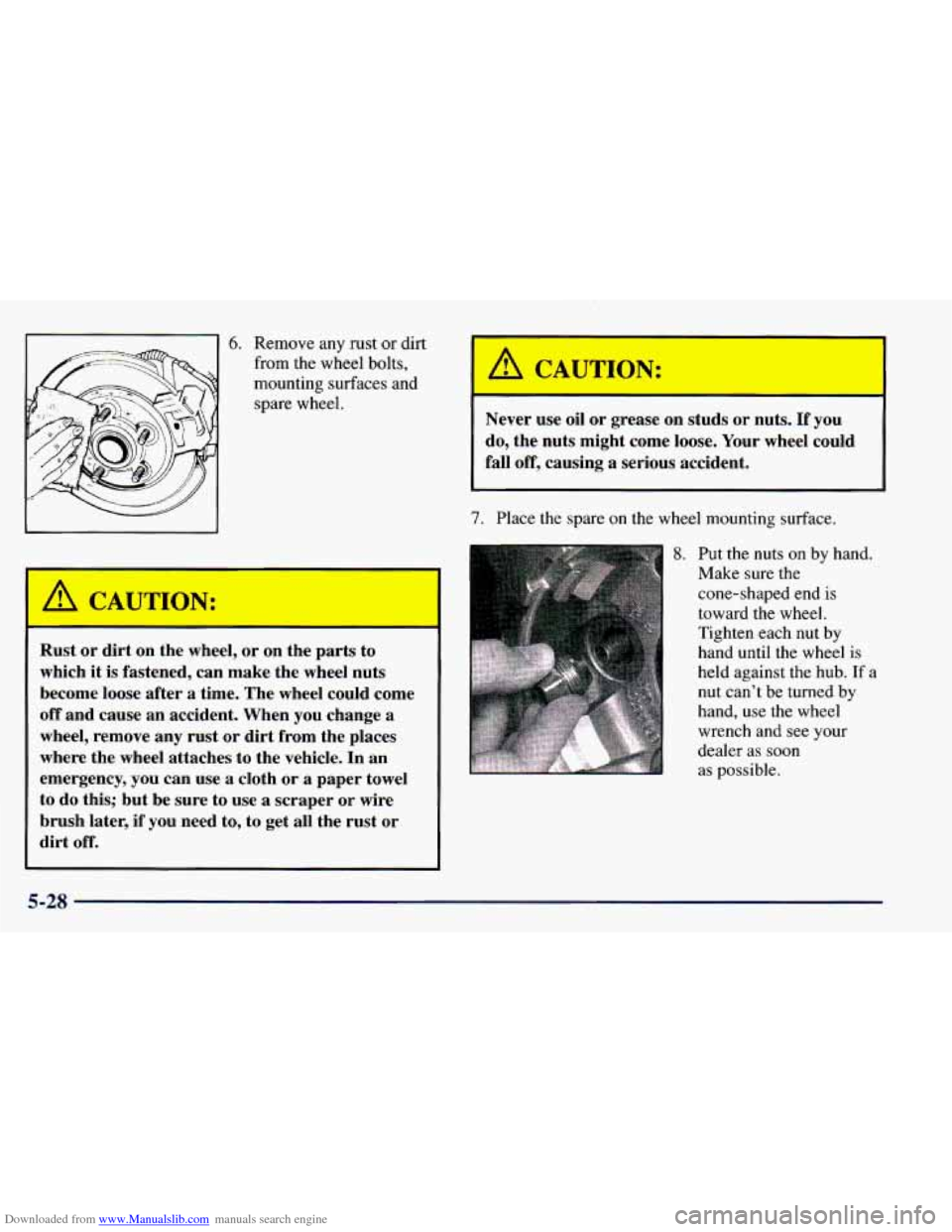
Downloaded from www.Manualslib.com manuals search engine 6. Remove any rust or dirt
from the wheel bolts,
mounting surfaces and spare wheel.
1st or dirt on the
w ,el, or on the parts to
which it is fastened, can make the wheel nuts
become loose after a time. The wheel could come
off and cause an accident. When you change a
wheel, remove any rust or dirt from the places
where the wheel attaches to the vehicle. In an
emergency, you can use a cloth
or a paper towel
to
do this; but be sure to use a scraper or wire
brush later, if you need to, to get all the rust or
dirt
off.
I
Never use oil or grease on studs or nuts. If you
do, the nuts might come loose. Your wheel could
fall
off, causing a serious accident.
7. Place the spare on the wheel mounting surface.
Put the nuts
on by hand.
Make sure the
cone-shaped end
is
toward the wheel.
Tighten each nut by hand until the wheel
is
held against the hub. If a
nut can’t be turned by
hand, use the wheel
wrench and see your
dealer as soon
as possible.
5-28
Page 285 of 416
Downloaded from www.Manualslib.com manuals search engine Operating the engine with the air cleaner off can
cause you or others to be burned. The
air cleaner
not only cleans the air, it stops flame
if the engine
backfires.
If it isn’t there, and the engine
backfires, you could be burned. Don’t drive with
it
off, and be careful working on the engine with
the air cleaner
off.
NOTICE:
If the air cleaner is off, a backfire can cause a
damaging engine fire. And, dirt can easily get
into your engine, which will damage it. Always
have the
air cleaner in place when you’re driving.
Automatic Transmission Fluid
When to Check and Change
A good time to check your automatic transmission fluid
level is when the engine oil is changed.
Change both the fluid and filter every
15,000 miles
(25 000 km) if the vehicle is mainly driven under one
or more of these conditions:
0 In heavy city traffic where the outside temperature
0 In hilly or mountainous terrain.
0 When doing frequent trailer towing.
Uses such as found in taxi, police or delivery service.
If you do not
use your vehicle under any of these
conditions, change the fluid and filter every
50,000 miles (83 000 km).
See “Scheduled Maintenance Services” in the Index.
regularly
reaches
90°F (32” C) or higher.
6-15
Page 289 of 416
Downloaded from www.Manualslib.com manuals search engine Manual Transmission Fluid
When to Check
A good time to have it checked is when the engine
oil is changed. However, the fluid in your manual
transmission doesn't require changing.
How to Check
Because this operation can be a little difficult, you may
choose to have this done at your
GM dealership Service
Department.
If you do it yourself, be sure to follow all the
instructions here,
or you could get a false reading.
NOTICE:
.
Too much or too little fluid can damage your
transmission.
Too much can mean that some of
the fluid could come out and fall on hot engine
parts or exhaust system parts, starting
a fire. Be
sure to get an accurate reading if you check your
transmission fluid.
Check the fluid level only when your engine is off, the
vehicle
is parked on a level place and the transmission is
cool enough for
you to rest your fingers on the
transmission case.
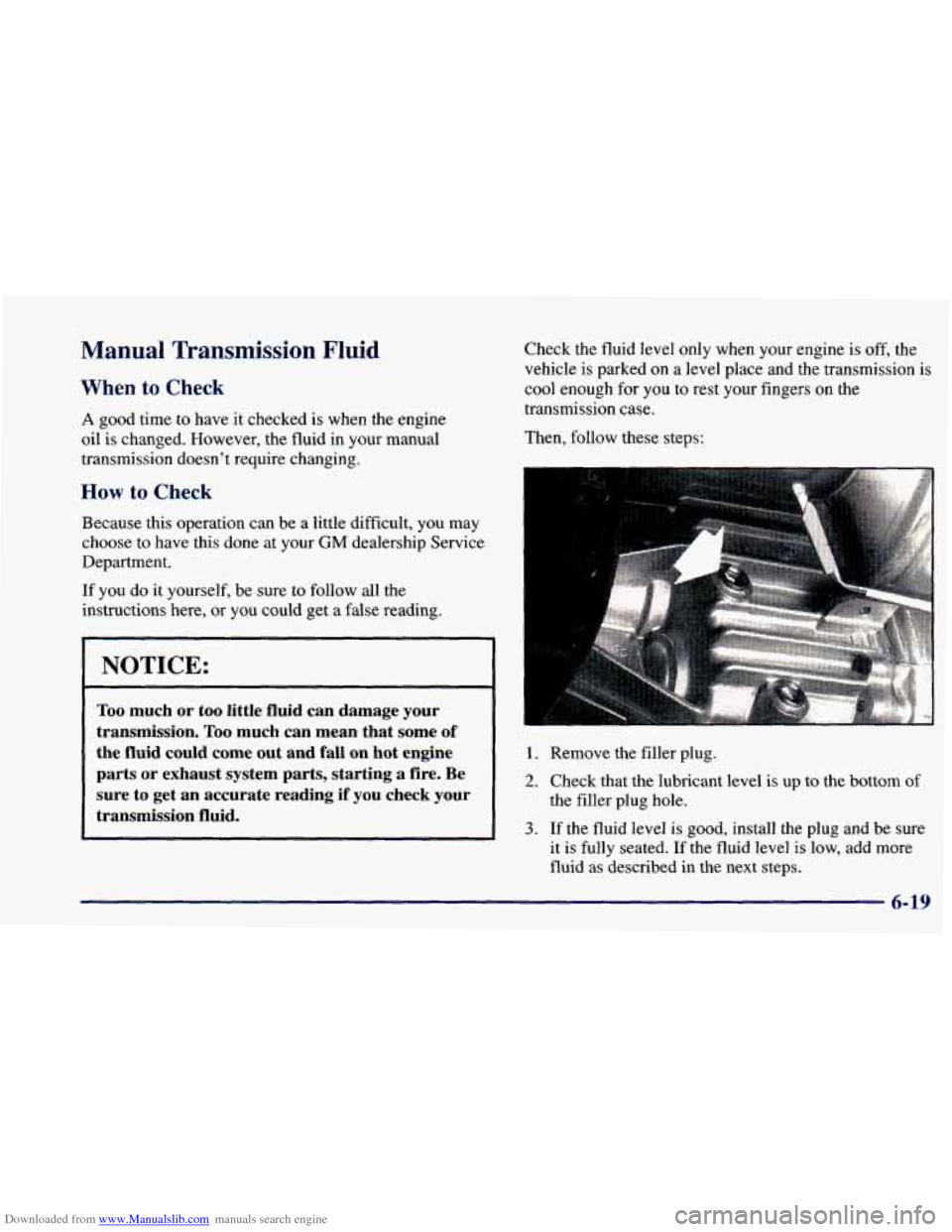
Then, follow these steps:
,' .,',
1. Remove the filler plug.
2. Check that the lubricant level is up to the bottom of
3. If the fluid level is good, install the plug and be sure
the filler
plug hole.
it is fully seated. If the fluid level is low, add more
fluid
as described in the next steps.
6-19
Page 302 of 416
Downloaded from www.Manualslib.com manuals search engine Some driving conditions or climates may cause a brake
squeal when the brakes are first applied or lightly
applied. This does
not mean something is wrong with
your brakes.
Properly torqued wheel nuts are necessary to help
prevent brake pulsation. When tires are rotated, inspect
brake pads for wear and evenly torque wheel
nuts in the
proper sequence to
GM specifications.
Brake linings should always be replaced
as complete
axle sets.
See “Brake System Inspection” in Section
7 of this
manual under
Part C “Periodic Maintenance Inspections.”
Brake Pedal Travel
See your dealer if the brake pedal does not return to
normal height, or if there is a rapid increase in pedal
travel. This could be a sign
of brake trouble.
Brake Adjustment
Every time you make a brake stop, your disc brakes
adjust for wear.
Replacing Brake System Parts
The braking system on a modem vehicle is complex.
Its many parts have to be
of top quality and work well
together
if the vehicle is to have really good braking.
Your vehicle was designed and tested with top-quality
GM brake parts. When you replace parts of your braking
system
-- for example, when your brake linings wear
down and you have to have new ones put in
-- be sure
you get new approved
GM replacement parts. If you
don’t, your brakes may
no longer work properly. For
example, if someone puts in brake linings that are wrong
for your vehicle, the balance between your front and
rear brakes can change
-- for the worse. The braking
performance you’ve come to expect can change in many
other ways if someone puts
in the wrong replacement
brake parts.
Battery
Every new vehicle has an ACDelco Freedom@ battery.
You never have to add water to one of these. When it’s
time for a new battery, we recommend an ACDelco
Freedom battery. Get one that has the replacement
number shown
on the original battery’s label.
6-32
Page 313 of 416
Downloaded from www.Manualslib.com manuals search engine 1
Q
i
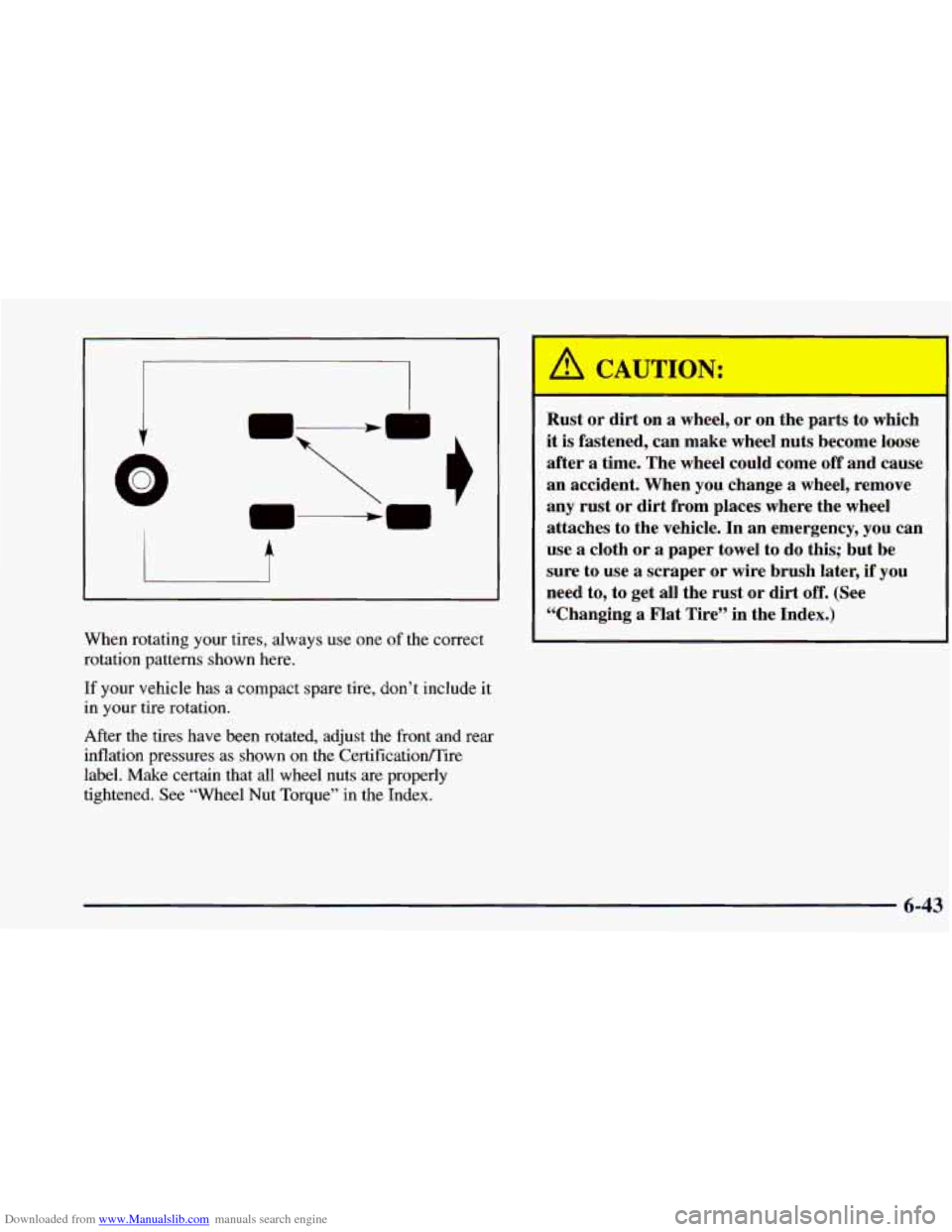
When rotating your tires, always use one of the correct
rotation patterns shown here.
If your vehicle has a compact spare tire, don’t include it
in your tire rotation.
After the tires have been rotated, adjust the front and rear
inflation pressures as shown on the Certificatiomire
label.
Make certain that all wheel nuts are properly
tightened. See “Wheel Nut Torque” in the
Index.
A C. UTION:
Rust or dirt on a wheel, or on the parts to which
it is fastened, can make wheel nuts become loose
after a time. The wheel could come
off and cause
an accident. When you change a wheel, remove
any rust or dirt from places where the wheel
attaches to the vehicle. In an emergency, you can
use
a cloth or a paper towel to do this; but be
sure to use a scraper or wire brush later, if you
need
to, to get all the rust or dirt off. (See
“Changing a Flat Tire” in the Index.)
6-43
Page 335 of 416
Downloaded from www.Manualslib.com manuals search engine Normal Maintenance Replacement Parts
Replacement part numbers listed in this section are
based on the latest information available at the time of
printing, and are subject to change. If a part listed
in this
manual is not the same as the part used
in your vehicle
when it was built, or if you have any questions, please
contact your
GM truck dealer.
Thermostat
......................... 12551472
Oil Filter
............................... PF52
Air Cleaner Filter
...................... A1163C
PCV Valve
.......................... CV746C
Automatic Transmission Filter Kit
...... 24200796
Spark Plugs
.......................... .4 1-932
Fuel Filter
............................. GF48 1
Front Windshield Wiper
Blade
................ Trico (20 inched50.8 cm)
Backglass Wiper Blade
. . Trico (14 inched35.6 cm)
Capacities (Approximate)
Cooling System*
Automatic Trans.
............ 1 1.7 quarts (1 1.1 L)
Manual Trans. .............. 1 I .9 quarts (I 1.3 L)
Crankcase* ................... 4.5 quarts (4.3 L)
Automatic Transmission
Differential Fluid
(Drain and
Refill)"
........... 5.0 quarts (4.7 L)
Rear ........................ 4.0 pints (1.9 L)
Front ....................... 2.6 pints (1.2 L)
Fuel Tank (2-Door Models) ....... 19 gallons (72 L)
Fuel Tank (4-DOOr Models) ....... 18 gallons (68 L)
A/C Refrigerant .......... 30 oz. or 2 Ibs. (0.9 kg)
of R-134a
*After refill, the level
must be checked.
Air Conditioning Refrigerants
Not all air conditioning refrigerants are the same.
If the air conditioning system in your vehicle needs
refrigerant, be sure the proper refrigerant is used.
If
you're not sure, ask your dealer.
6-65
Page 343 of 416
Downloaded from www.Manualslib.com manuals search engine I Fzlort TripKity Maintenance Schedule I
The services shown in this schedule up to 100,000 miles
(166
000 km) should be performed after 100,000 miles
(166
000 km) at the same intervals. The services shown
at 150,000 miles (240
000 km) should be performed at
the same interval after 150,000 miles (240
000 km).
See “Owner Checks and Services” and “Periodic
Maintenance Inspections” following.
Footnotes
The U.S. Environmental Protection Agency or the
California Air Resources Board has determined that the
failure to perform this maintenance item
will not nullify
the emission warranty or limit recall liability prior to the
completion of the vehicle’s useful life. We, however,
urge that all recommended maintenance services be
performed at the indicated intervals and the maintenance
be recorded.
# Lubricate the front suspension, ball joints, steering
linkage, parking brake cable guides, propshaft splines,
universal joints and brake pedal springs.
+ A good time to check your brakes is during tire
rotation. See “Brake System Inspection” under “Periodic
Maintenance Inspections’’
in Part C of this schedule.
** Drive axle service (see “Recommended Fluids and
Lubricants” in the Index for proper lubricant to use):
0
0
0
Locking Differential -- Drain fluid and refill at first
engine oil change. At subsequent oil changes, check
fluid level and add fluid as needed. If driving in
dusty areas or towing a trailer, drain fluid and refill
every
15,000 miles (25 000 km).
Standard Differential -- Check fluid level and add
fluid as needed at every oil change. If driving in
dusty areas or towing a trailer, drain fluid and refill
every 15,000 miles
(25 000 km).
More frequent lubrication may be required for
heavy-duty or off-road use.
7-7
Page 363 of 416
Downloaded from www.Manualslib.com manuals search engine Long Tripmighway Maintenance Schedule
The services shown in this schedule up to 100,000 miles
(166
000 km) should be performed after 100,000 miles
(166 000 km) at the same intervals. The services shown
at 150,000 miles
(240 000 km) should be performed at
the same interval after 150,000 miles
(240 000 km).
See “Owner Checks and Services’’ and “Periodic
Maintenance Inspections” following.
Footnotes
-i- The U.S. Environmental Protection Agency or the
California Air Resources Board has determined that the
failure to perform this maintenance item will not
nullify
the emission warranty or limit recall liability prior to the
completion of the vehicle’s useful life. We, however,
urge that all recommended maintenance services be
performed at the indicated intervals and the maintenance
be recorded.
# Lubricate the front suspension, ball joints, steering
linkage and transfer case shift linkage, parking brake
cable guides, propshaft splines, universal joints and
brake pedal springs.
+ A good time to check your brakes is during tire
rotation. See “Brake System Inspection” under “Periodic
Maintenance Inspections” in Part
C of this schedule.
** Drive axle service (see “Recommended Fluids and
Lubricants” in the Index for proper lubricant to use):
0 Locking Differential -- Drain fluid and refill at first
engine oil change. At subsequent oil changes, check
fluid level and add fluid
as needed.
fluid as needed at every engine
oil change.
Standard Differential -- Check fluid level and add
7-27