ignition CHEVROLET BLAZER 1998 2.G User Guide
[x] Cancel search | Manufacturer: CHEVROLET, Model Year: 1998, Model line: BLAZER, Model: CHEVROLET BLAZER 1998 2.GPages: 416, PDF Size: 22.4 MB
Page 92 of 416
Downloaded from www.Manualslib.com manuals search engine How long should you keep the coolant heater plugged
in? The answer depends on the outside temperature, the
kind
of oil you have, and some other things. Instead of
trying to list everything here,
we ask that you contact
your dealer in the area where you’ll be parking your
vehicle. The dealer can give you the best advice for that
particular area.
Automatic Transmission Operation
Your automatic transmission may have a shift lever
located on the console between the seats
or on the
steering column.
There
are several different positions for your shift lever.
If your vehicle is equipped with a column shift lever, it
features an electronic shift position indicator within the
instrument cluster. This display must be powered
anytime the shift lever is capable
of being moved out of
PARK (P). This means that if your key is in OFF, but
not locked, there will be
a small current drain on your
battery which could discharge your battery over a period
of time. If you need to leave your key in the ignition in
OFF for an extended period, it is recommended that you
disconnect the battery cable from the battery to prevent
discharging your battery. PARK
(P): This
locks your rear wheels. It’s the best
position to use when you start your engine because your
vehicle can’t move easily.
It is dangerous to get out of your vehicle if the
shift lever is
not fully in PARK (P) with the
parking brake firmly set. Your vehicle can roll.
Don’t leave your vehicle when the engine is
running unless you have to. If you have left the
engine running, the vehicle can move suddenly.
You
or others could be injured. To be sure your
vehicle won’t move, even when you’re on
fairly
level ground, always set your parking brake and
move the shift lever to PARK
(P).
See “Shifting Into PARK (P)” in the Index. If
you’re pulling a trailer, see “Towing a nailer’’ in
the Index.
2-18
Page 93 of 416
Downloaded from www.Manualslib.com manuals search engine Ensure the shift lever is fully in PARK (P) range
before starting the engine. Your vehicle has
a
Brake-Transmission Shift Interlock (BTSI). You have to
fully apply your regular brakes before you
can shift
from PARK
(P) when the ignition key is in RUN. If you
cannot shift out of PARK (P), ease pressure on the shift
lever
-- push the shift lever all the way into PARK (P)
(press the button in on the console shift lever) as you
maintain brake application. Then move the shift lever
into the gear
you wish. See “Shifting Out of PARK (P)”
in the Index.
REVERSE (R): Use this gear to back up.
NOTICE:
Shifting to REVERSE (R) while your vehicle
is moving forward could damage your
transmission. Shift
to REVERSE (R) only after
your vehicle is stopped.
To rock your vehicle back and forth to get out
of snow,
ice or sand without damaging your transmission, see
“Stuck: In Sand,
Mud, Ice or Snow” in the Index. NEUTRAL
(N): In this position,
your engine doesn’t
connect with the wheels.
To restart when you’re already
moving, use NEUTRAL
(N) only.
Shifting out of PARK
(P) or NEUTRAL (N) while
your engine is “racing” (running at high speed) is
dangerous. Unless your foot
is firmly on the
brake pedal, your vehicle could move very
rapidly. You could lose control and hit people or
objects. Don’t shift out of PARK
(P) or
NEUTRAL
(N) while your engine is racing.
NOTICE:
Damage to your transmission caused by shifting
out of PARK
(P) or NEUTRAL (N) with the
engine racing isn’t covered by your warranty.
2-19
Page 96 of 416
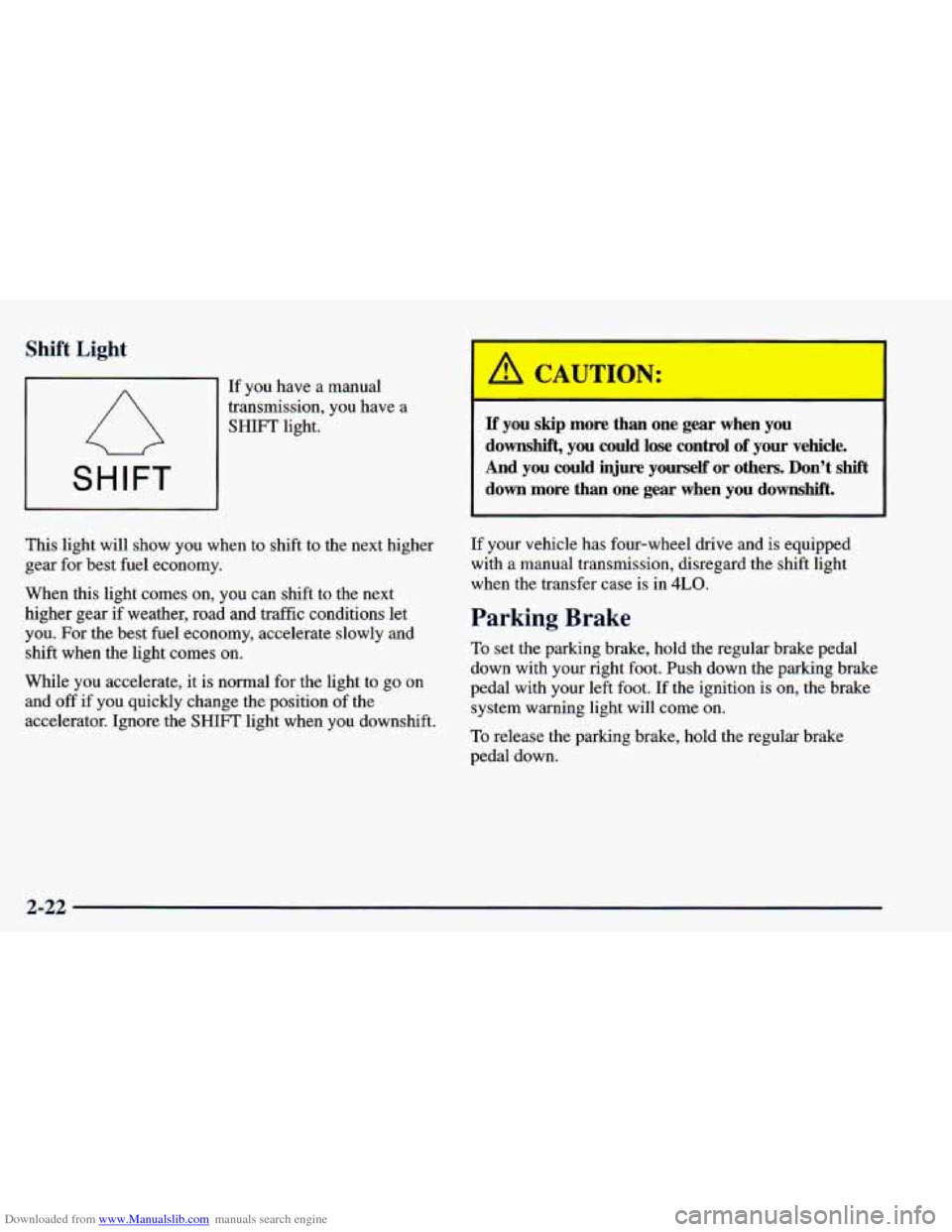
Downloaded from www.Manualslib.com manuals search engine Shift Light
A
SHIFT
If you have a manual
transmission, you have
a
SHIFT light.
This light will show you when to shift to the next higher
gear for best fuel economy.
When this light comes on, you can shift to the next
higher gear if weather, road and traffic conditions let
you.
For the best fuel economy, accelerate slowly and
shift when
e light comes on.
While you accelerate, it is normal for the light to go
on
and off if you quickly change the position of the
accelerator. Ignore the SHIFT light when you downshift.
I ' A CAUTION: I
If you skip more than one gear when you
downshift, you could lose control
of your vehicle.
And you could injure yourself or others. Don't shift down more than one gear when you downshift.
If your vehicle has four-wheel drive and is equipped
with a manual transmission, disregard the shift light
when the transfer case is in
4LO.
Parking Brake
To set the parking brake, hold the regular brake pedal
down with your right foot. Push down the parking brake
pedal with your left foot.
If the ignition is on, the brake
system warning light will come on.
To release the parking brake, hold the regular brake
pedal down.
2-22
Page 98 of 416
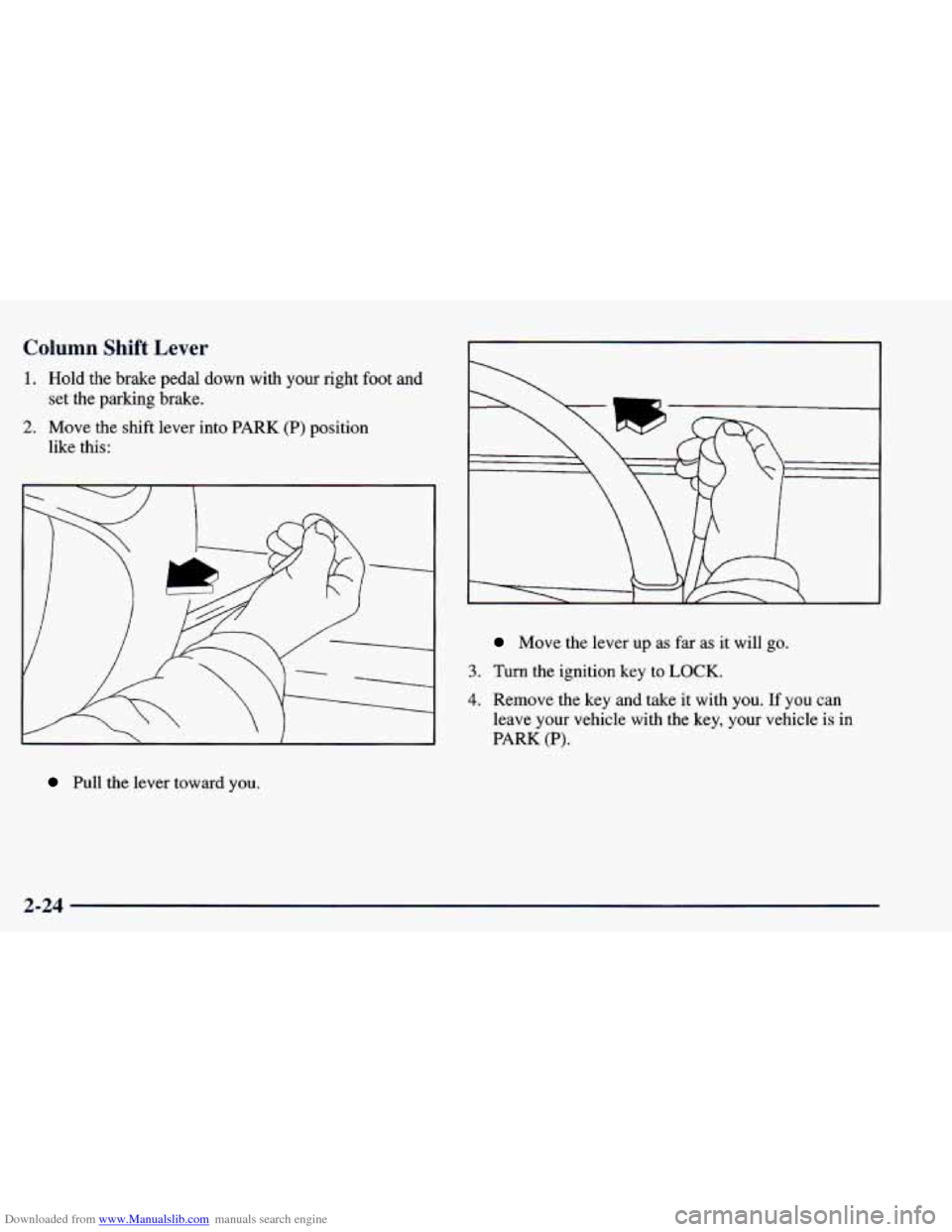
Downloaded from www.Manualslib.com manuals search engine Column Shift Lever
1. Hold the brake pedal down with your right foot and
set the parking brake.
2. Move the shift lever into PARK (P) position
like this:
Pull the lever toward you.
Move the lever up as far as it will go.
3. Turn the ignition key to LOCK.
4. Remove the key and take it with you. If you can
leave your vehicle with the key, your vehicle is
in
PARK (P).
2-24
Page 99 of 416
Downloaded from www.Manualslib.com manuals search engine Console Shift Lever
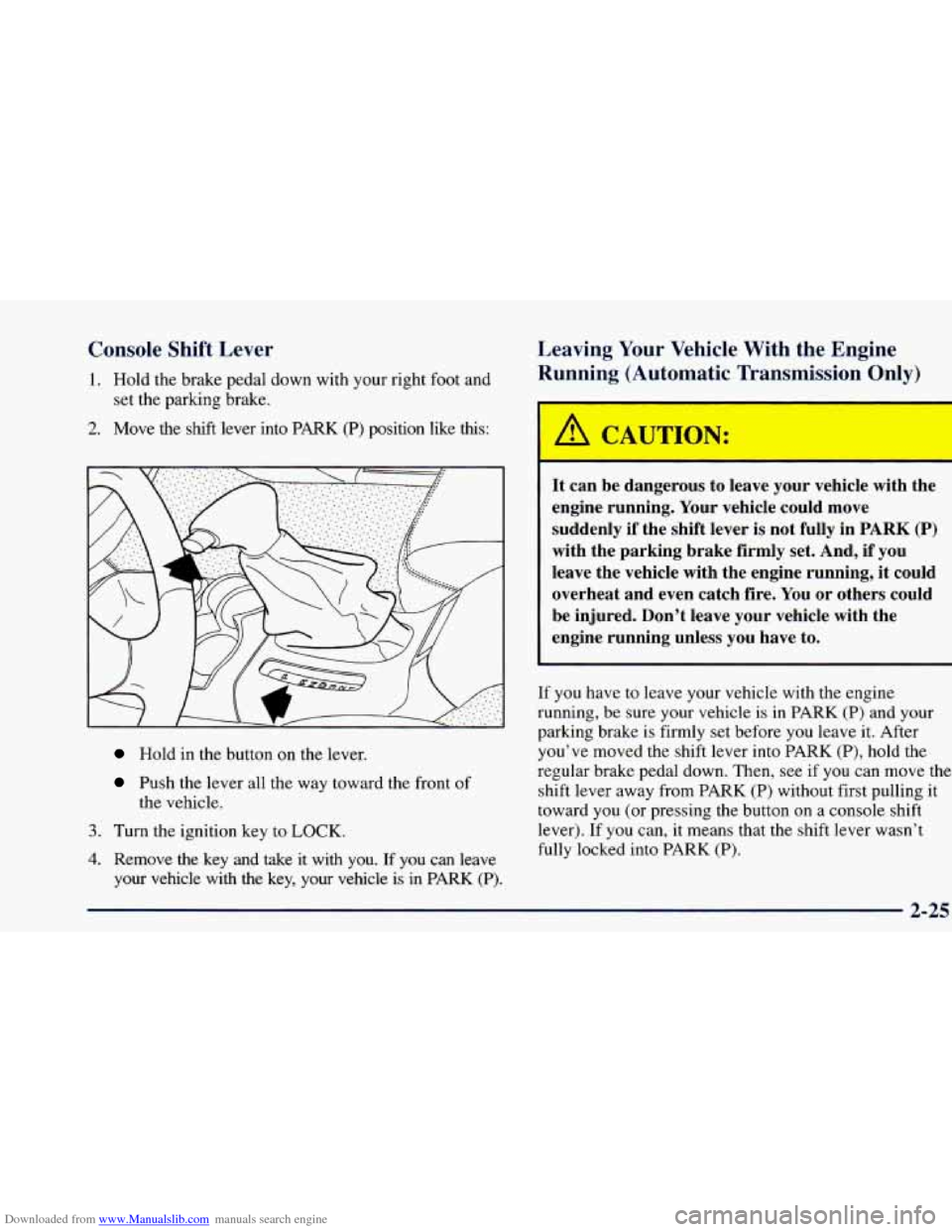
1. Hold the brake pedal down with your right foot and
set the parking brake.
2. Move the shift lever into PARK (P) position like this:
Hold in the button on the lever.
Push the lever all the way toward the front of
the vehicle.
3. Turn the ignition key to LOCK.
4. Remove the key and take it with you. If you can leave
your vehicle with the key, your vehicle is in
PARK (P).
Leaving Your Vehicle With the Engine
Running
(Autom ~ ’ic Transmission C dy)
It can be dangerous to leave your vehicle with the
engine running. Your vehicle could move
suddenly if the shift lever is not fully in PARK
(P)
with the parking brake firmly set. And, if you
leave the vehicle with the engine running, it could
overheat and even catch fire. You or others could
be injured. Don’t leave your vehicle with the
engine running unless you have to.
If you have to leave your vehicle with the engine
running, be sure your vehicle is in PARK
(P) and your
parking brake is firmly set before you leave it. After
you’ve moved the shift lever into PARK
(P), hold the
regular brake pedal down. Then, see
if you can move the
shift lever away from PARK
(P) without first pulling it
toward
you (or pressing the button on a console shift
lever).
If you can, it means that the shift lever wasn’t
fully locked into PARK
(P).
2-25
Page 100 of 416
Downloaded from www.Manualslib.com manuals search engine Torque Lock (Automatic Transmission)
If you are parking on a hill and you don’t shift your
transmission into PARK (P) properly, the weight of the
vehicle may put too much force
on the parking pawl in
the transmission. You may find it difficult to pull the
shift lever out
of PARK (P). This is called “torque lock.”
To prevent torque lock, set the parking brake and then
shift into PARK (P) properly before you leave the
driver’s seat. To find
out how, see “Shifting Into
PARK
(P)” in the Index.
When
you are ready to drive, move the shift lever out of
PARK (P)
before you release the parking brake.
If torque lock does occur, you may need to have another
vehicle push yours a little uphill
to take some of the
pressure from the parking pawl in the transmission,
so
you can pull the shift lever out of PARK (P).
Shifting Out of Park (P)
(Automatic Transmission)
Your vehicle has a Brake-Transmission Shift Interlock
(BTSI). You have
to fully apply your regular brake
before you can shift from PARK
(P) when the ignition is
in
RUN. See “Automatic Transmission Operation” in
the Index.
If you cannot shift out of PARK (P), ease pressure on
the shift lever
-- push the shift lever all the way into
PARK
(P) as you maintain brake application. Then move
the shift lever into the gear you want (you must press the
shift lever button if you have the console shift lever.)
If you ever hold the brake pedal down but still can’t
shift out of PARK
(P), try this:
1. Turn the key to OFF.
2. Apply and hold the brake until the end of Step 4.
3. Shift to NEUTRAL (N).
4. Start the vehicle and then shift to the drive gear
5. Have the vehicle fixed as soon as you can.
you want.
Parking
Your Vehicle (Manual
Transmission Models Only)
Before you get out of your vehicle, turn off your engine,
put your manual transmission in
REVERSE (R) and
firmly apply the parking brake.
If
you are parking on a hill, or if your vehicle is pulling
a trailer, see “Towing
a Trailer” in the Index.
2-26
Page 104 of 416
Downloaded from www.Manualslib.com manuals search engine 4LO: This setting also engages your front axle to give
you extra traction.
You may never need 4LO. It sends
the maximum power to
all four wheels. You might
choose 4LO if you were driving off-road in sand, mud
or deep snow and climbing or descending steep hills.
Indicator lights in the switches show you which setting
you
are in. The indicator lights will come on briefly when
you
turn on the ignition and one will stay on. If the lights
do not
come on, you should take your vehicle in for
service.
An indicator light will flash while shifting. It will
remain illuminated when the shift is completed.
Shifting from 2HI to 4HI
Press and release the 4HI switch. This can be done at
any speed, and the front axle will lock automatically.
Shifting from 4HI to 2HI
Press and release the 2HI switch. This can be done at
any speed, and the front axle will unlock automatically.
Shifting from 2HI or 4HI to 4LO
To shift from 2HI or 4HI to 4L0, the vehicle must be
stopped or moving less than 3 mph (4.8 kmh) with the
transmission
in NEUTRAL (N) in vehicles equipped with an automatic transmission
or the clutch pedal
engaged in vehicles equipped with
a manual
transmission. The preferred method for shifting into
4LO is to have your vehicle moving
1 to 2 mph
(1.6 to 3.2 km/h). Press and release the 4LO switch.
You must wait for the 4LO indicator light to stop
flashing and remain illuminated before shifting your
transmission into gear or releasing the clutch pedal.
If the 4LO switch is pressed when your vehicle is in
gear
and/or moving, the 4LO indicator light will flash
for 30 seconds and not complete the shift unless your
vehicle is moving slower than 3 mph (4.8
kmh) and
the transmission is in NEUTRAL
(N) or the clutch
pedal engaged.
On automatic transmission equipped vehicles, if your
transfer case does
not shift into 4L0, your transmission
indicator switch may require adjustment. With your
transmission in NEUTRAL
(N), press and release the
4LO switch. While the 4LO indicator light is flashing,
shift your transmission into PARK (P). Wait until the
4LO indicator light remains illuminated before shifting
your transmission into gear. This will get you into 4L0,
but you should take your vehicle in for service to restore
normal operation.
2-30
Page 105 of 416
Downloaded from www.Manualslib.com manuals search engine Shifting from 4LO to 4HI or 2HI
To shift from 4LO to 4HI or ZHI, your vehicle must be
stopped or moving less than
3 mph (4.8 kdh) with the
transmission in NEUTRAL (N) or the clutch pedal
engaged. The preferred method for shifting out of 4LO
is to have your vehicle moving
1 to 2 mph (1.6 to 3.2
km/h). Press and release the 4HI switch. You must wait
for the 4HI indicator light to stop flashing and remain
illuminated before shifting your transmission into gear
or releasing the clutch pedal.
If the 4HI switch
is pressed when your vehicle is in gear
and/or moving, the 4HI indicator light will flash for
30 seconds but not complete the shift unless the vehicle
is moving slower than
3 mph (4.8 kmh) and the
transmission is
in NEUTRAL (N) or the clutch
pedal engaged.
On automatic transmission equipped vehicles,
if your
transfer case does not shift into 4H1, your transmission
indicator switch may require adjustment. With your
transmission in NEUTRAL
(N), press and release the
4HI switch. While the 4HI indicator light is flashing,
shift your transmission into PARK
(P). Wait until the
4HI indicator light remains illuminated before shifting
your transmission into gear. This
will get you into 4H1,
but you should take your vehicle in for service to restore
normal operation.
Windows
Manual Windows
Turn the hand crank on each door to raise or lower your
manual side door windows.
Power Windows (If Equipped)
If you have the optional power windows, the controls
are
on each of the side doors. With power windows, the
switches control the windows when the ignition
is on or
when Retained Accessory Power (RAP)
is present. (See
“Retained Accessory Power” in the Index.) The driver’s
door has a switch for the passenger windows as well.
Page 114 of 416
Downloaded from www.Manualslib.com manuals search engine Using Cruise Control on Hills
How well your cruise control will work on hills depends
upon your speed, load and the steepness
of the hills.
When going up steep hills, you may want to step on the
accelerator pedal to maintain your speed. When going
downhill, you may have to brake or shift to a lower gear
to keep your speed down. Of course, applying the brake
takes you out
of cruise control. Many drivers find this to
be too much trouble and don’t use cruise control on
steep hills.
Ending Cruise Control
There are two ways to turn off the cruise control:
Step lightly on the brake pedal or push the clutch
pedal, if you have a manual transmission.
0 Move the cruise switch to OFF.
Erasing Speed Memory
When you turn off the cruise control or the ignition,
your cruise control set speed memory is erased.
Exterior Lamps
0
DOME OVERRIDE
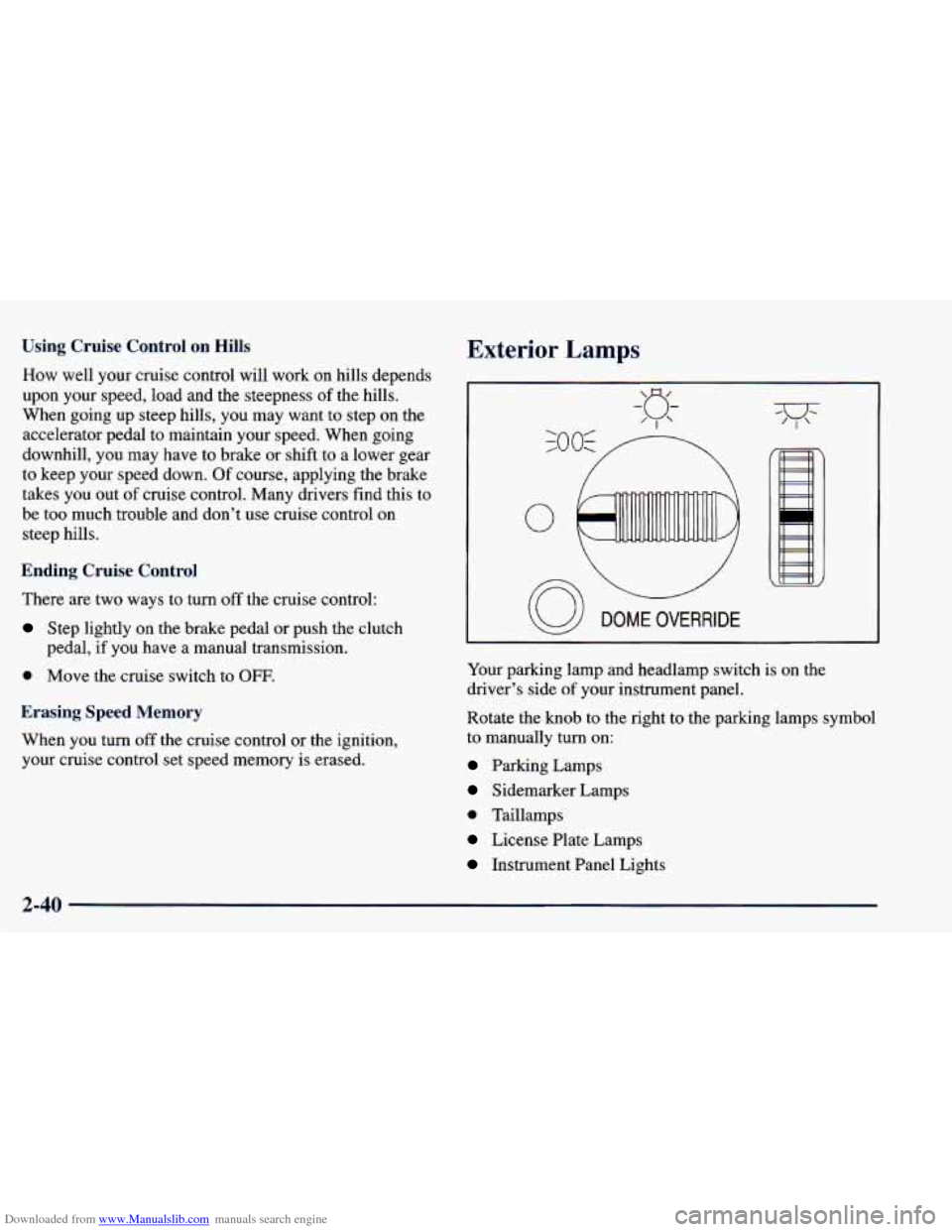
Your parking lamp and headlamp switch is on the
driver’s side
of your instrument panel.
Rotate the knob to
the right to the parking lamps symbol
to manually turn on:
Parking Lamps
Sidemarker Lamps
0 Taillamps
License Plate Lamps
Instrument Panel Lights
2-40
Page 115 of 416
Downloaded from www.Manualslib.com manuals search engine Rotate the knob to the right to the master lamps symbol
to turn on all the lamps listed as well as the headlamps.
Rotate the knob all the
way to the left to turn off your
lamps and put the system in auto headlamp mode.
Automatic Headlamp System
When it is dark enough outside, your automatic
headlamp system will turn on your headlamps at the
normal brightness along with other lamps such as the
taillamps, sidemarker, parking lamps and the instrument
panel lights. The radio lights will also be dim.
Your vehicle is equipped with a light sensor on the top
of the instrument panel under the radio speaker grill so
be sure it is not covered, which will cause the system to
be on whenever the ignition is on.
The system may also turn on your headlamps when
driving through a parking garage, heavy overcast
weather, a tunnel or fueling your vehicle in a low-light
area. This is normal. There is
a delay in the transition between the daytime and
nighttime operation of the Daytime Running Lamps
(DRL) and the automatic headlamp systems so that driving
under bridges or bright overhead street lights does not
affect the system. The
DRL and automatic headlamp
system will
only be affected when the light sensor sees a
change in lighting lasting longer than the delay.
To idle your vehicle with the automatic headlamp
system off, set the parking brake while the ignition is
off. Then
start your vehicle. The automatic headlamp
system will stay off until you release the parking brake.
As with any vehicle, you should turn on the regular
headlamp system when you need it.
Lamps On Reminder
A reminder chime will sound when your headlamps or
parking lamps are manually turned on and your ignition
is in
OFF, LOCK or ACCESSORY. To turn the chime
off, turn the knob all the way to the left or turn the
instrument panel dimmer down to the fully dimmed
position. In the automatic mode, the headlamps turn off
once the ignition key is in
OFF.
2-41