towing CHEVROLET BLAZER 1998 2.G Owner's Manual
[x] Cancel search | Manufacturer: CHEVROLET, Model Year: 1998, Model line: BLAZER, Model: CHEVROLET BLAZER 1998 2.GPages: 416, PDF Size: 22.4 MB
Page 240 of 416
Downloaded from www.Manualslib.com manuals search engine I
’ A CAUTION:
To help avoid injury to you or others:
0 Never let passengers ride in a vehicle that is
Never tow faster than safe or posted speeds.
Never tow with damaged parts not fdy secured.
0 Never get under your vehicle after it has
Always use separate safety chains on each
0 Never use J-hooks. Use T-hooks instead. being towed.
been lifted
by the tow truck.
side when towing
a vehicle.
A vehicle can fall from a car carrier if it isn’t
adequately secured. This can cause
a collision,
serious personal injury and vehicle damage. The
vehicle should be tightly secured with chains or
steel cables before it is transported.
Don’t use substitutes (ropes, leather straps,
canvas webbing, etc.) that can be cut by sharp
edges underneath the towed vehicle. Always use
T-hooks inserted in the T-hook slots. Never use
J-hooks. They will damage drivetrain and
suspension components.
1
5-8
Page 241 of 416
Downloaded from www.Manualslib.com manuals search engine When your vehicle is being towed, have the ignition key
turned to the OFF position. The steering wheel should
be clamped in a straight-ahead position with
a clamping
device designed for towing service.
Do not use the
vehicle’s steering column lock for this. The transmission
should be in
NEUTRAL (N) and the transfer case, if you
have one, should be in 2HI. The parking brake should
be released.
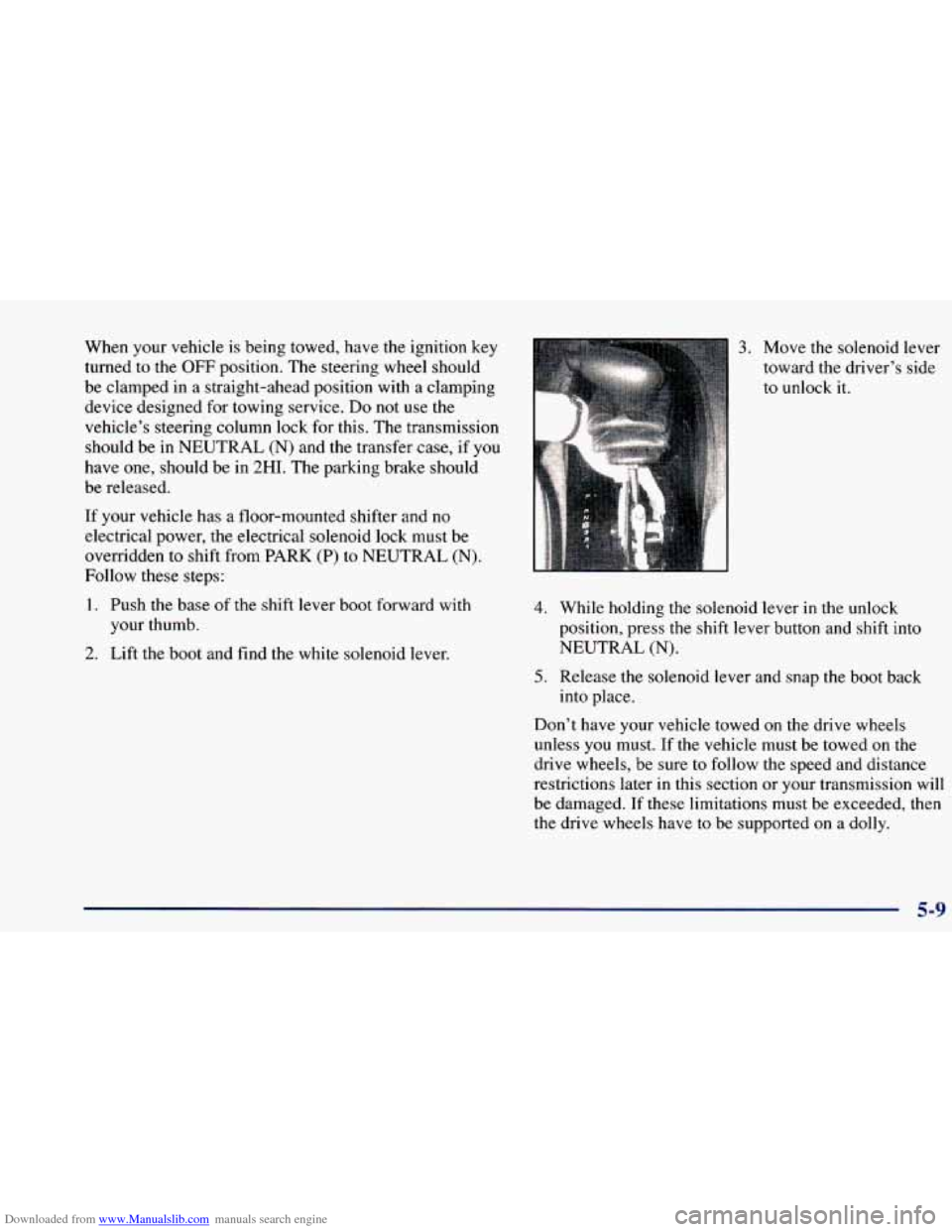
If your vehicle has a floor-mounted shifter and no
electrical power, the electrical solenoid lock must be
overridden to shift from PARK
(P) to NEUTRAL (N).
Follow these steps:
1. Push the base of the shift lever boot forward with
your thumb.
2. Lift the boot and find the white solenoid lever.
3. Move the solenoid lever
toward the driver’s side
to unlock
it.
4. While holding the solenoid lever in the unlock
position, press
the shift lever button and shift into
NEUTRAL
(N).
5. Release the solenoid lever and snap the boot back
into place.
Don’t have your vehicle towed on the drive wheels
unless you must. If the vehicle must be towed on the
drive wheels, be sure to follow the speed and distance
restrictions later
in this section or your transmission will
be damaged. If these limitations must be exceeded, then
the drive wheels have to be supported on a dolly.
5-9
Page 242 of 416
Downloaded from www.Manualslib.com manuals search engine Front Towing
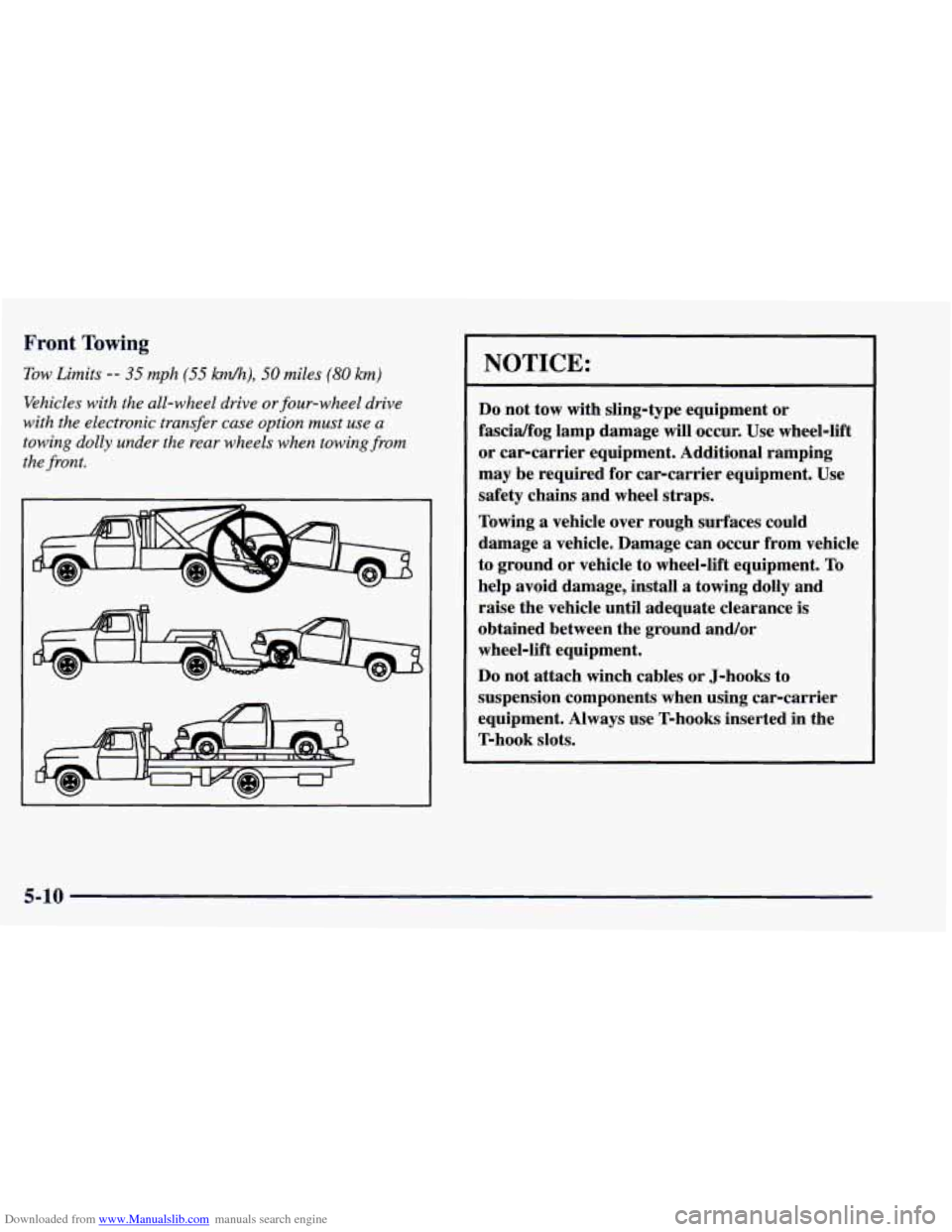
Tow Limits -- 35 mph (55 kd), 50 miles (80 km)
Vehicles with the all-wheel drive or four-wheel drive
with the electronic transfer case option must use a towing dolly under the rear wheels when towing
from
the front.
NOTICE:
Do not tow with sling-type equipment or
fascidfog lamp damage will occur. Use wheel-lift
or car-carrier equipment. Additional ramping
may be required for car-carrier equipment. Use
safety chains and wheel straps.
Towing a vehicle over rough surfaces could
damage a vehicle. Damage can occur from vehicle
to ground or vehicle to wheel-lift equipment. To
help avoid damage, install
a towing dolly and
raise the vehicle until adequate clearance is
obtained between the ground and/or
wheel-lift equipment.
Do not attach winch cables or J-hooks to
suspension components when using car-carrier
equipment. Always use T-hooks inserted in the
T-hook slots.
5-10
Page 243 of 416
Downloaded from www.Manualslib.com manuals search engine Rear Towing
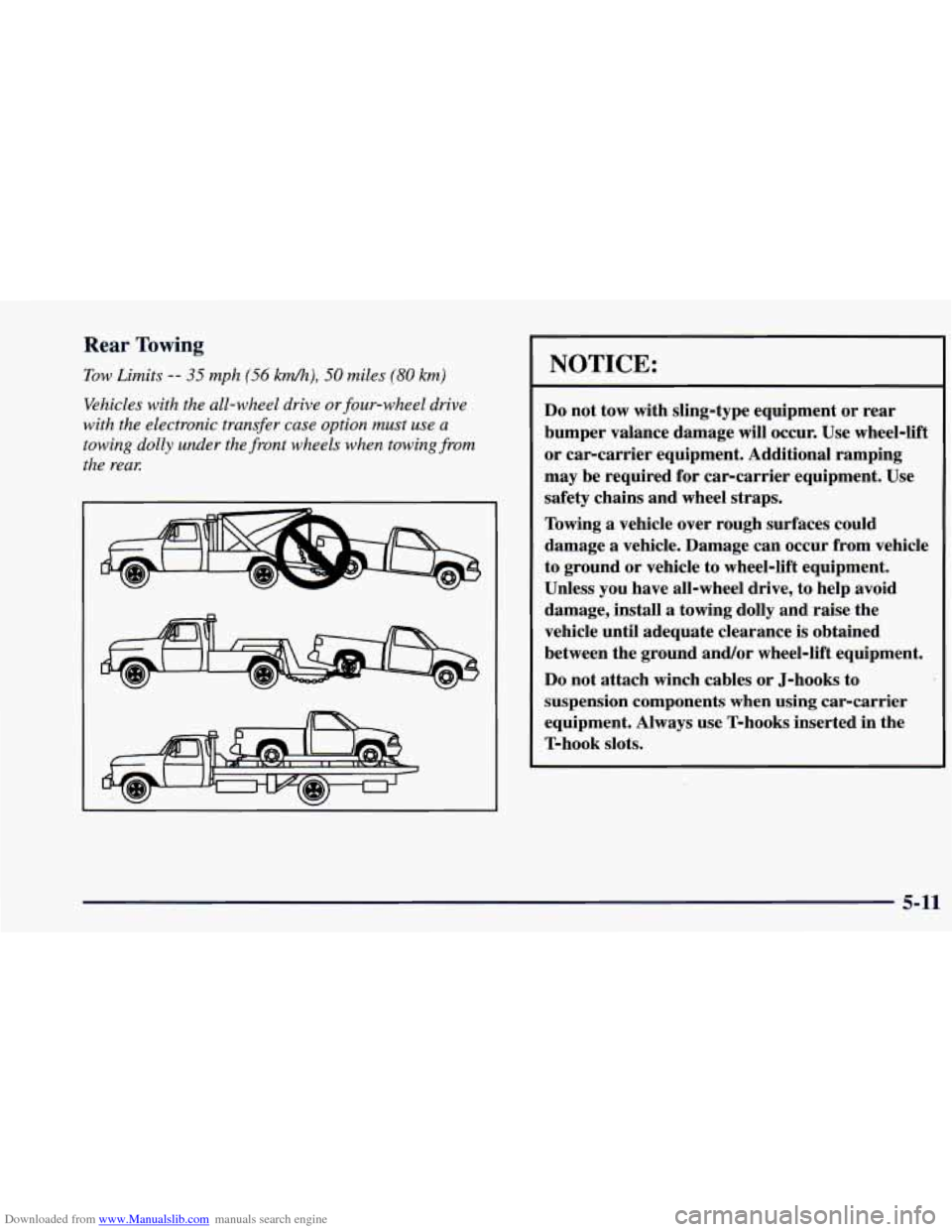
Tow Limits -- 35 mph (56 kh), 50 miles (80 km)
Vehicles with the all-wheel drive or four-wheel drive
with the electronic transfer case option must use a
towing
dolly under the front wheels when towing from
the reaE
k3?
NOTICE:
Do not tow with sling-type equipment or rear
bumper valance damage will occur. Use wheel-lift
or car-carrier equipment. Additional ramping
may be required for car-carrier equipment. Use
safety chains and wheel straps.
Towing
a vehicle over rough surfaces could
damage a vehicle. Damage can occur from vehicle
to ground or vehicle to wheel-lift equipment.
Unless you have all-wheel drive, to help avoid
damage, install
a towing dolly and raise the
vehicle until adequate clearance is obtained
between the ground and/or wheel-lift equipment.
Do not attach winch cables or J-hooks to
suspension components when using car-carrier
equipment. Always use T-hooks inserted in the
T-hook slots.
5-11
Page 252 of 416
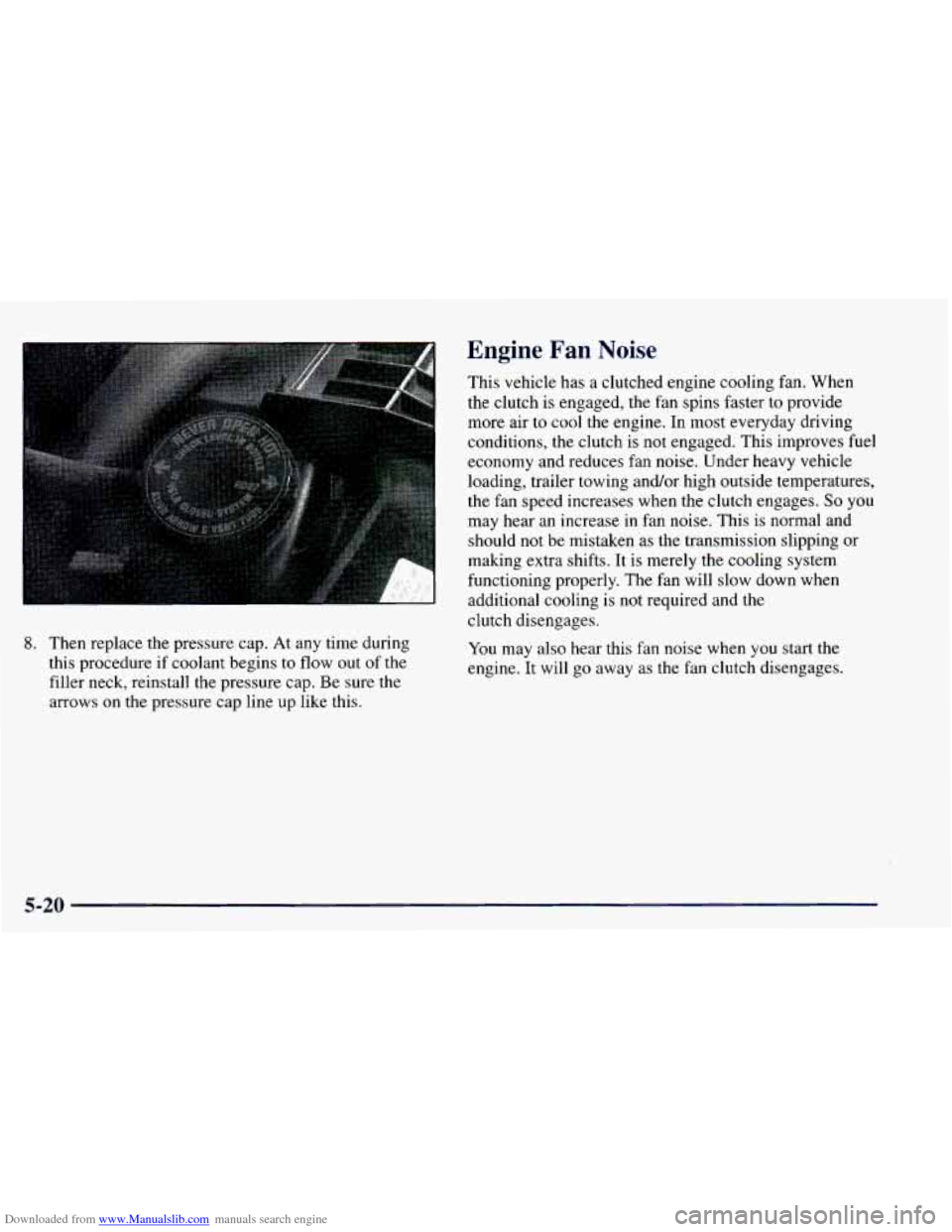
Downloaded from www.Manualslib.com manuals search engine 8. Then replace the pressure cap. At any time during
this procedure if coolant begins to flow out of the
filler neck, reinstall the pressure cap. Be sure the
arrows on the pressure cap line
up like this.
Engine Fan Noise
This vehicle has a clutched engine cooling fan. When
the clutch is engaged, the fan spins faster
to provide
more air to cool the engine.
In most everyday driving
conditions, the clutch is not engaged. This improves fuel
economy and reduces fan noise. Under heavy vehicle
loading, trailer towing and/or high outside temperatures,
the fan speed increases when the clutch engages.
So you
may hear an increase
in fan noise. This is normal and
should
not be mistaken as the transmission slipping or
making extra shifts. It is merely the cooling system
functioning properly. The fan will slow down when
additional cooling is
not required and the
clutch disengages.
You may also hear this fan noise when you start the
engine. It will go away
as the fan clutch disengages.
5-20
Page 254 of 416
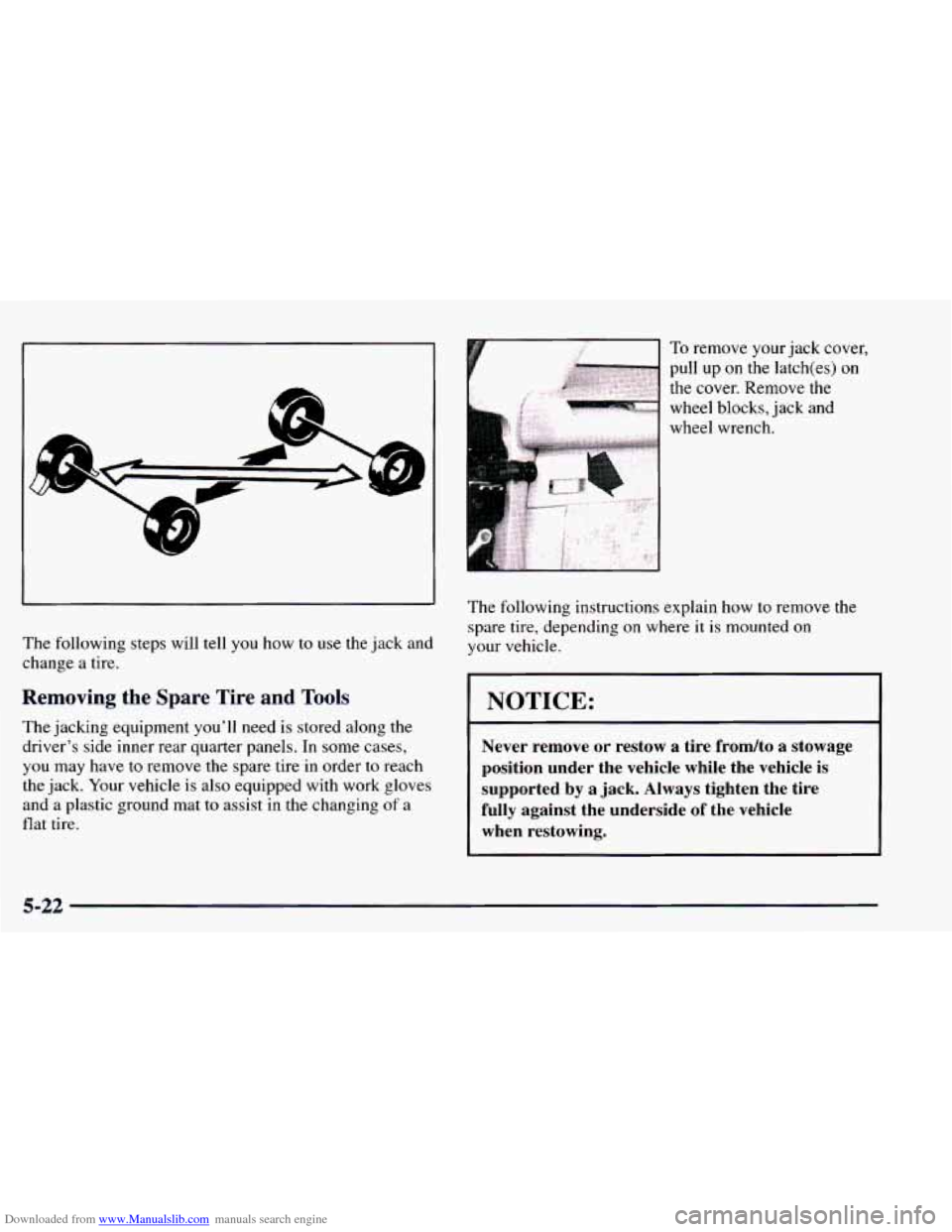
Downloaded from www.Manualslib.com manuals search engine The following steps will tell you how to use the jack and
change a tire.
Removing the Spare Tire and Tools
The jacking equipment you’ll need is stored along the
driver’s side inner rear quarter panels.
In some cases,
you may have to remove the spare tire in order to reach
the jack. Your vehicle is
also equipped with work gloves
and a plastic ground mat
to assist in the changing of a
flat tire. The following instructions explain how
to remove the
spare tire, depending on where
it is mounted on
your vehicle.
I NOTICE:
Never remove or restow a tire frondto a stowage
position under the vehicle while the vehicle is supported
by a jack. Always tighten the tire
fully against the underside of the vehicle
when restowing.
5-22
Page 268 of 416
Downloaded from www.Manualslib.com manuals search engine Rocking Your Vehicle To Get It Out
First, turn your steering wheel left and right. That will
clear the area around your front wheels. If you have a
four-wheel drive vehicle, shift into 4HI. Then shift back
and forth between REVERSE
(R) and a forward gear (or
with a manual transmission, between FIRST (1) or
SECOND (2) and REVERSE (R)), spinning the wheels
as little as possible. Release the accelerator pedal while
you shift, and press lightly on the accelerator pedal
when the transmission is in gear. If that doesn’t get you
out after a few tries, you may need to be towed out. Or,
you can use your recovery hooks if your vehicle has
them. If you
do need to be towed out, see “Towing Your
Vehicle” in the Index.
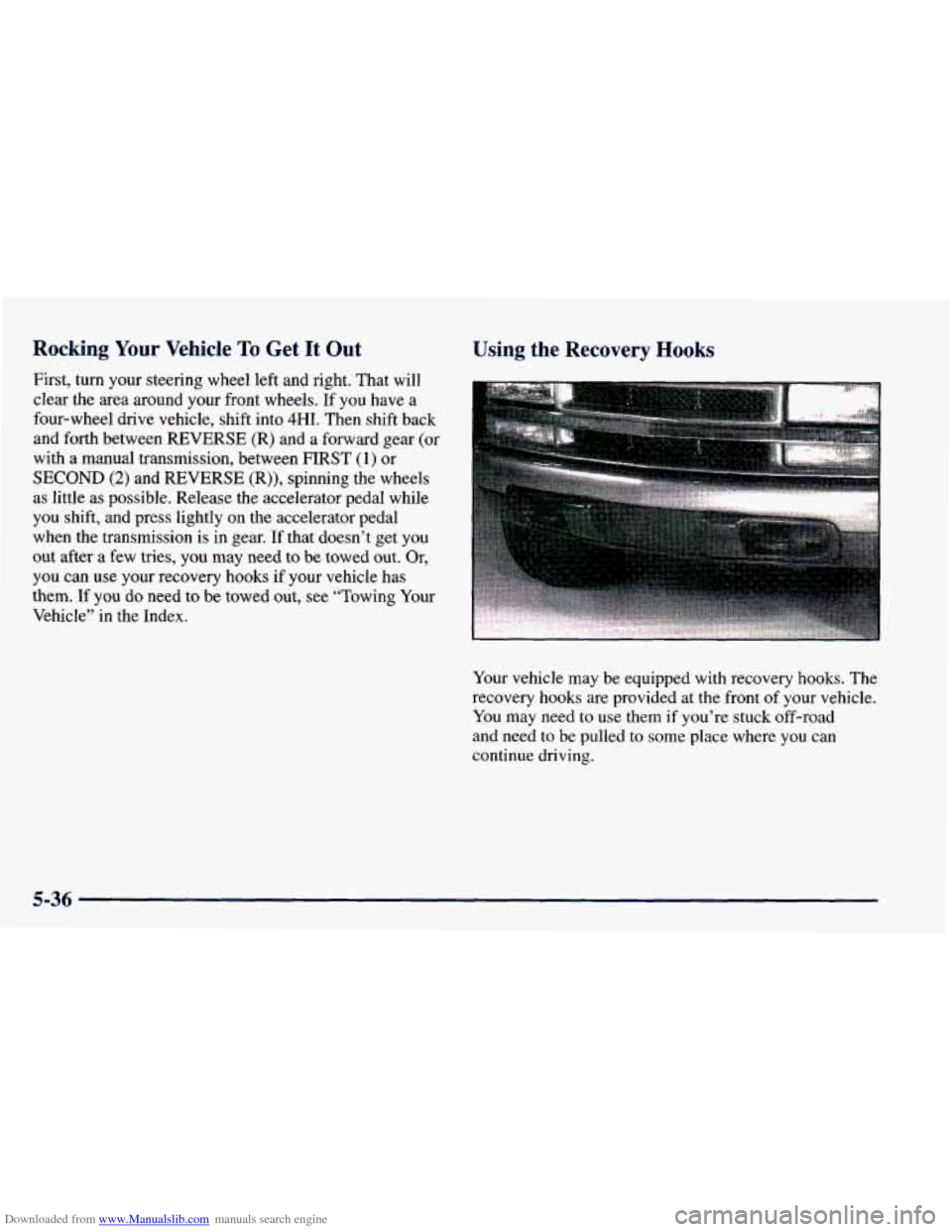
Using the Kecovery Hooks
Your vehicle may be equipped with recovery hooks. The
recovery hooks are provided at the front of your vehicle.
You may need to use them
if you’re stuck off-road
and need to be pulled to some place where you can
continue driving.
5-36
Page 285 of 416
Downloaded from www.Manualslib.com manuals search engine Operating the engine with the air cleaner off can
cause you or others to be burned. The
air cleaner
not only cleans the air, it stops flame
if the engine
backfires.
If it isn’t there, and the engine
backfires, you could be burned. Don’t drive with
it
off, and be careful working on the engine with
the air cleaner
off.
NOTICE:
If the air cleaner is off, a backfire can cause a
damaging engine fire. And, dirt can easily get
into your engine, which will damage it. Always
have the
air cleaner in place when you’re driving.
Automatic Transmission Fluid
When to Check and Change
A good time to check your automatic transmission fluid
level is when the engine oil is changed.
Change both the fluid and filter every
15,000 miles
(25 000 km) if the vehicle is mainly driven under one
or more of these conditions:
0 In heavy city traffic where the outside temperature
0 In hilly or mountainous terrain.
0 When doing frequent trailer towing.
Uses such as found in taxi, police or delivery service.
If you do not
use your vehicle under any of these
conditions, change the fluid and filter every
50,000 miles (83 000 km).
See “Scheduled Maintenance Services” in the Index.
regularly
reaches
90°F (32” C) or higher.
6-15
Page 342 of 416
Downloaded from www.Manualslib.com manuals search engine Maintenance Schedule
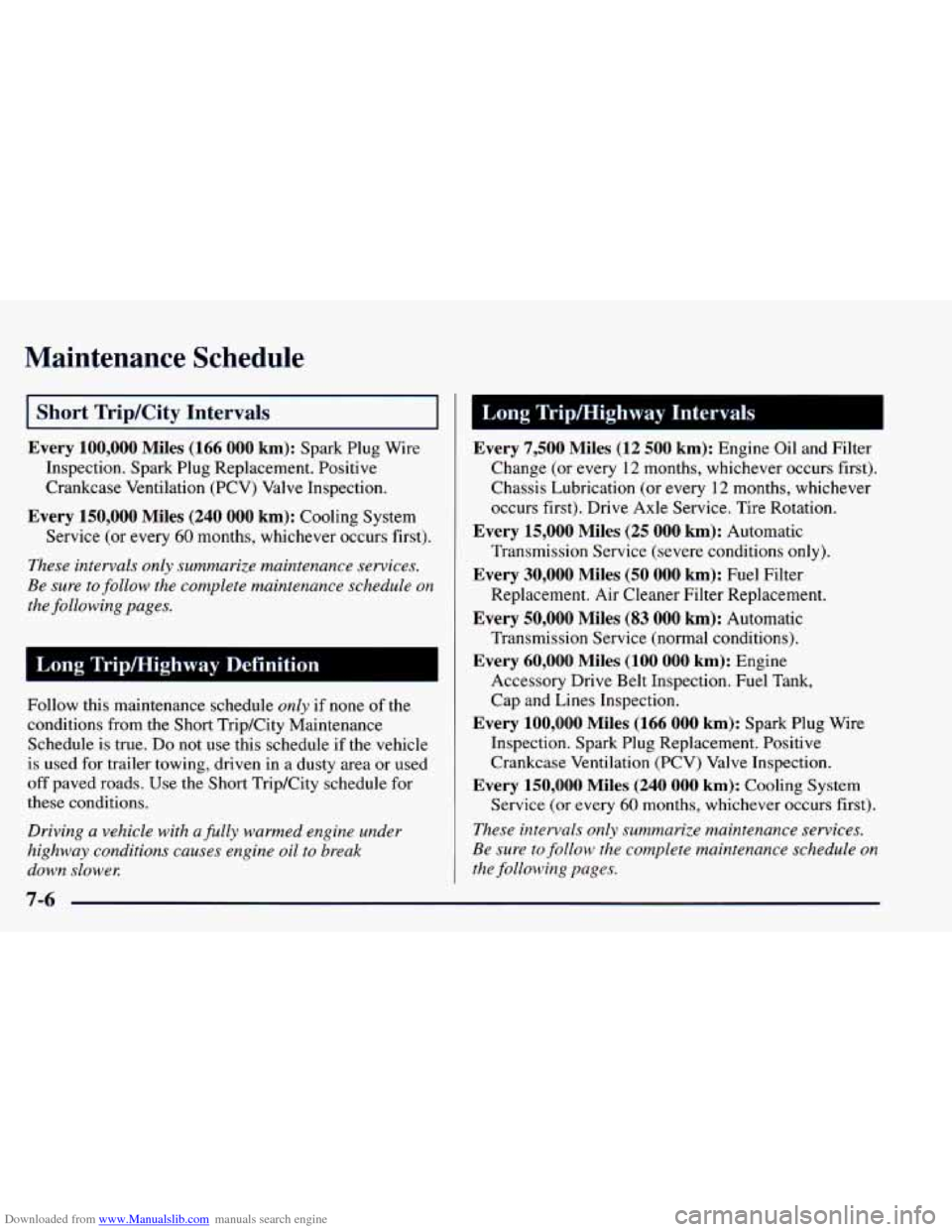
I Short Trip/City Intervals I
Every 100,000 Miles (166 000 km): Spark Plug Wire
Inspection. Spark Plug Replacement. Positive
Crankcase Ventilation (PCV) Valve Inspection.
Every 150,000 Miles (240 000 km): Cooling System
Service (or every
60 months, whichever occurs first).
These intervals only summarize maintenance services.
Be sure to follow the complete maintenance schedule on
the following pages.
Follow this maintenance schedule only if none of the
conditions from the Short Trip/City Maintenance Schedule is true.
Do not use this schedule if the vehicle
is used for trailer towing, driven in a dusty area or used
off paved roads. Use the Short Trip/City schedule for
these conditions.
Driving a vehicle with a fully warmed engine under
highway conditions causes engine oil to break
down slowez
Every 7,500 Miles (12 500 km): Engine Oil and Filter
Change (or every
12 months, whichever occurs first).
Chassis Lubrication (or every
12 months, whichever
occurs first). Drive Axle Service. Tire Rotation.
Every 15,000 Miles (25 000 km): Automatic
Transmission Service (severe conditions only).
Every 30,000 Miles (50 000 km): Fuel Filter
Replacement. Air Cleaner Filter Replacement.
Every 50,000 Miles (83 000 km): Automatic
Transmission Service (normal conditions).
Every 60,000 Miles (100 000 km): Engine
Accessory Drive Belt Inspection. Fuel
Tank,
Cap and Lines Inspection.
Inspection. Spark Plug Replacement. Positive
Crankcase Ventilation (PCV) Valve Inspection.
Every 150,000 Miles (240 000 km): Cooling System
Service (or every
60 months, whichever occurs first).
Every 100,000 Miles (166 000 km): Spark Plug Wire
These intervals only summarize maintenance services.
Be sure to follow the complete maintenance schedule
on
the following pages.
7-6
Page 343 of 416
Downloaded from www.Manualslib.com manuals search engine I Fzlort TripKity Maintenance Schedule I
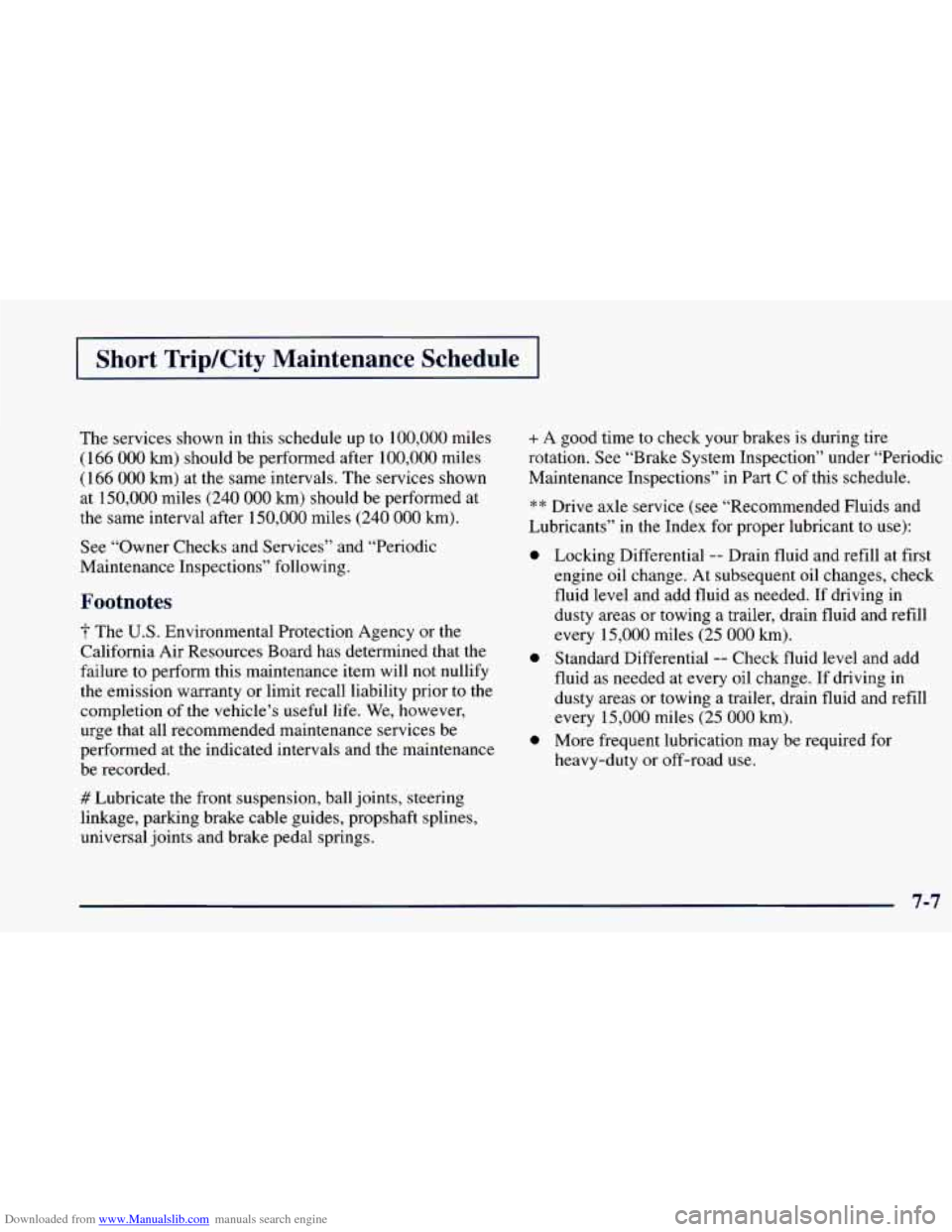
The services shown in this schedule up to 100,000 miles
(166
000 km) should be performed after 100,000 miles
(166
000 km) at the same intervals. The services shown
at 150,000 miles (240
000 km) should be performed at
the same interval after 150,000 miles (240
000 km).
See “Owner Checks and Services” and “Periodic
Maintenance Inspections” following.
Footnotes
The U.S. Environmental Protection Agency or the
California Air Resources Board has determined that the
failure to perform this maintenance item
will not nullify
the emission warranty or limit recall liability prior to the
completion of the vehicle’s useful life. We, however,
urge that all recommended maintenance services be
performed at the indicated intervals and the maintenance
be recorded.
# Lubricate the front suspension, ball joints, steering
linkage, parking brake cable guides, propshaft splines,
universal joints and brake pedal springs.
+ A good time to check your brakes is during tire
rotation. See “Brake System Inspection” under “Periodic
Maintenance Inspections’’
in Part C of this schedule.
** Drive axle service (see “Recommended Fluids and
Lubricants” in the Index for proper lubricant to use):
0
0
0
Locking Differential -- Drain fluid and refill at first
engine oil change. At subsequent oil changes, check
fluid level and add fluid as needed. If driving in
dusty areas or towing a trailer, drain fluid and refill
every
15,000 miles (25 000 km).
Standard Differential -- Check fluid level and add
fluid as needed at every oil change. If driving in
dusty areas or towing a trailer, drain fluid and refill
every 15,000 miles
(25 000 km).
More frequent lubrication may be required for
heavy-duty or off-road use.
7-7