trailer CHEVROLET BLAZER 1998 2.G Owner's Manual
[x] Cancel search | Manufacturer: CHEVROLET, Model Year: 1998, Model line: BLAZER, Model: CHEVROLET BLAZER 1998 2.GPages: 416, PDF Size: 22.4 MB
Page 252 of 416
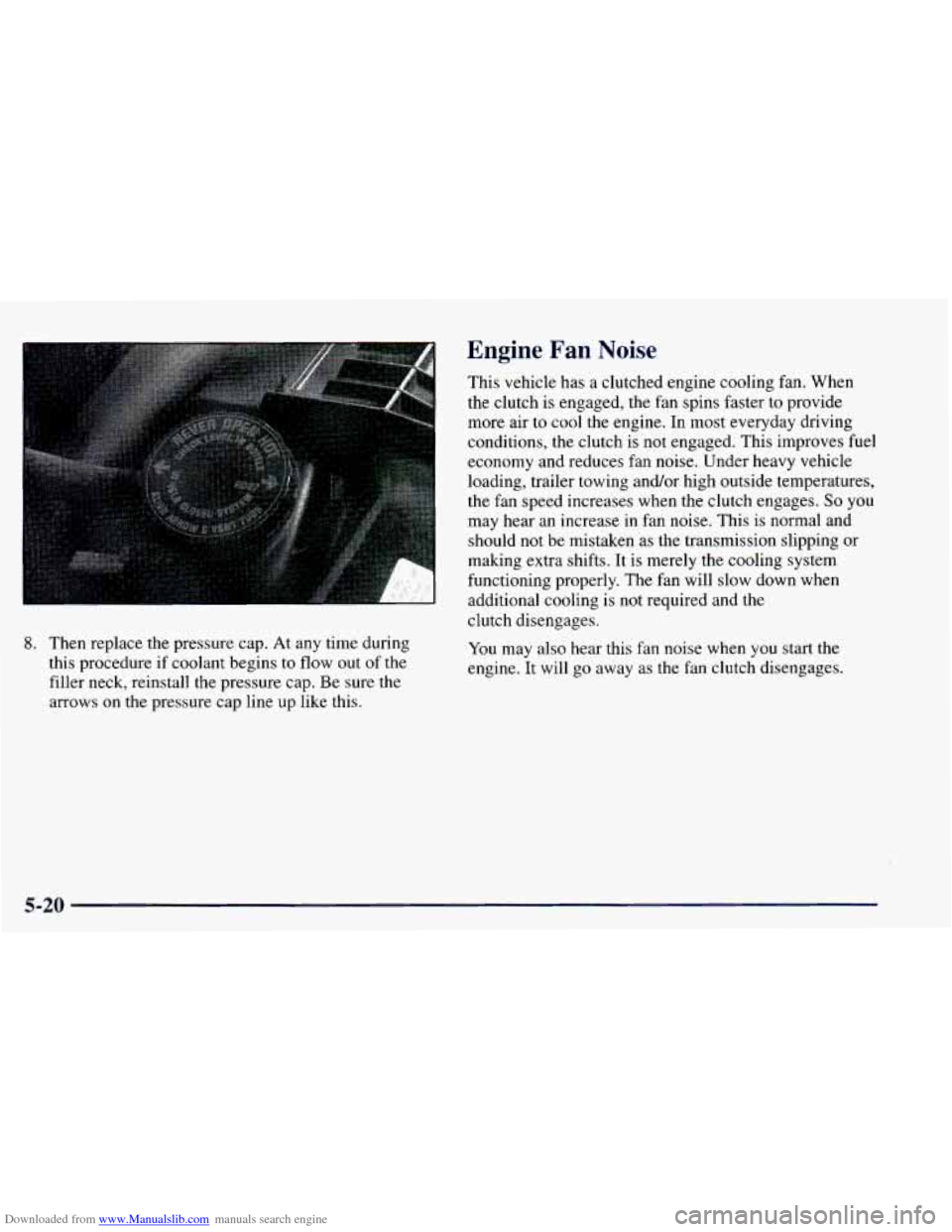
Downloaded from www.Manualslib.com manuals search engine 8. Then replace the pressure cap. At any time during
this procedure if coolant begins to flow out of the
filler neck, reinstall the pressure cap. Be sure the
arrows on the pressure cap line
up like this.
Engine Fan Noise
This vehicle has a clutched engine cooling fan. When
the clutch is engaged, the fan spins faster
to provide
more air to cool the engine.
In most everyday driving
conditions, the clutch is not engaged. This improves fuel
economy and reduces fan noise. Under heavy vehicle
loading, trailer towing and/or high outside temperatures,
the fan speed increases when the clutch engages.
So you
may hear an increase
in fan noise. This is normal and
should
not be mistaken as the transmission slipping or
making extra shifts. It is merely the cooling system
functioning properly. The fan will slow down when
additional cooling is
not required and the
clutch disengages.
You may also hear this fan noise when you start the
engine. It will go away
as the fan clutch disengages.
5-20
Page 283 of 416
Downloaded from www.Manualslib.com manuals search engine As shown in the chart, SAE 5W-30 is best for your
vehicle. However, you can use
SAE 1OW-30 if it’s going
to be 0” F (- 18 O C) or above. These numbers on an oil
container show its viscosity, or thickness.
Do not use
other viscosity oils, such
as SAE 20W-50.
NOTICE:
Use only engine oil with the American Petroleum
Institute Certified For Gasoline Engines
“Starburst” symbol. Failure to use the
recommended
oil can result in engine damage not
covered by your warranty.
GM Goodwrench@ oil meets all the requirements for
your vehicle.
If you are in an area where the temperature falls below
-20°F (-29”C), consider using either an SAE 5W-30
synthetic oil or an
SAE OW-30 oil. Both will provide
easier cold starting and better protection for your engine
at extremely low temperatures.
Engine Oil Additives
Don’t add anything to your oil. Your dealer is ready to
advise
if you think something should be added.
When to Change Engine Oil
If any one of these is true for you, use the short tripkity
maintenance schedule:
0 Most trips are less than 5 to 10 miles (8 to 16 km).
This is particularly important when outside
temperatures are below freezing.
driving in stop-and-go traffic).
frequently.
your vehicle.
or other commercial application.
0 Most trips include extensive idling (such as frequent
0 You operate your vehicle in dusty areas or off-road
0 You frequently tow a trailer or uSe a carrier on top of
0 The vehicle is used for delivery service, police, taxi
Driving under these conditions causes engine oil to
break down sooner. If any one of these is true for your
vehicle, then you need to change your oil and filter
every
3,000 miles (5 000 km) or 3 months -- whichever
occurs first.
If none of them is true, use the long triphighway
maintenance schedule. Change the oil and filter
every
7,500 miles (12 500 km) or 12 months -- whichever
occurs first. Driving a vehicle with
a fully warmed
engine under highway conditions causes engine oil to
break down slower.
6-13
Page 285 of 416
Downloaded from www.Manualslib.com manuals search engine Operating the engine with the air cleaner off can
cause you or others to be burned. The
air cleaner
not only cleans the air, it stops flame
if the engine
backfires.
If it isn’t there, and the engine
backfires, you could be burned. Don’t drive with
it
off, and be careful working on the engine with
the air cleaner
off.
NOTICE:
If the air cleaner is off, a backfire can cause a
damaging engine fire. And, dirt can easily get
into your engine, which will damage it. Always
have the
air cleaner in place when you’re driving.
Automatic Transmission Fluid
When to Check and Change
A good time to check your automatic transmission fluid
level is when the engine oil is changed.
Change both the fluid and filter every
15,000 miles
(25 000 km) if the vehicle is mainly driven under one
or more of these conditions:
0 In heavy city traffic where the outside temperature
0 In hilly or mountainous terrain.
0 When doing frequent trailer towing.
Uses such as found in taxi, police or delivery service.
If you do not
use your vehicle under any of these
conditions, change the fluid and filter every
50,000 miles (83 000 km).
See “Scheduled Maintenance Services” in the Index.
regularly
reaches
90°F (32” C) or higher.
6-15
Page 286 of 416
Downloaded from www.Manualslib.com manuals search engine How to Check
Because this operation can be a little difficult, you
may choose to have this done at your GM dealership
Service Department.
If you do it yourself, be sure to follow all the instructions
here, or you could get a false reading on the dipstick.
NOTICE:
~ Too much or too little fluid can damage your
transmission.
Too much can mean that some of
the fluid could come out and fall on hot engine
parts
or exhaust system parts, starting a fire. Be
sure to get an accurate reading if you check your
transmission fluid.
Wait at least 30 minutes before checking the
transmission fluid level
if you have been driving:
When outside temperatures are above 90°F (32°C).
At high speed for quite a while.
In heavy traffic -- especially in hot weather.
0 While pulling a trailer.
To get the right reading, the fluid should be at
normal operating temperature, which is
180°F to 200°F
(82” C to 93 “C). See “Checking Transmission Fluid
Hot”
in the Index.
6-16
Page 332 of 416
Downloaded from www.Manualslib.com manuals search engine Engine Compartment Fuse Block
J. ,.,:.. I, .
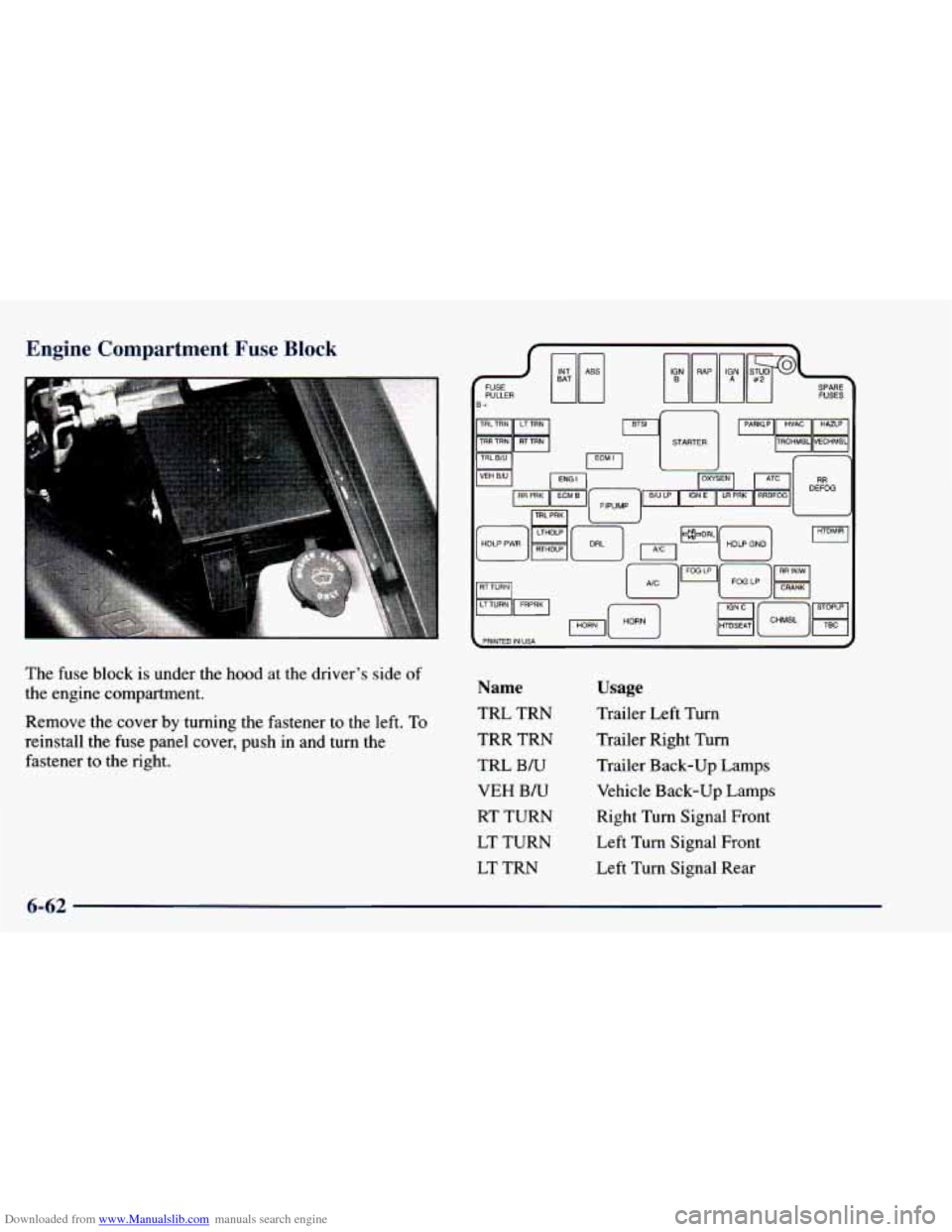
The fuse block is under the hood at the driver's side of
the engine compartment.
Remove the cover
by turning the fastener to the left. To
reinstall the fuse panel cover, push in and turn the
fastener to the right.
Name
TRL TRN
TRR TRN
TRL
B/U
VEH B/U
RT
TURN
LT TURN
LT TRN
Usage
Trailer Left Turn
Trailer Right
Turn
Trailer Back-up Lamps
Vehicle Back-up Lamps
Right Turn Signal Front
Left Turn Signal Front
Left Turn Signal Rear
6-62
Page 333 of 416
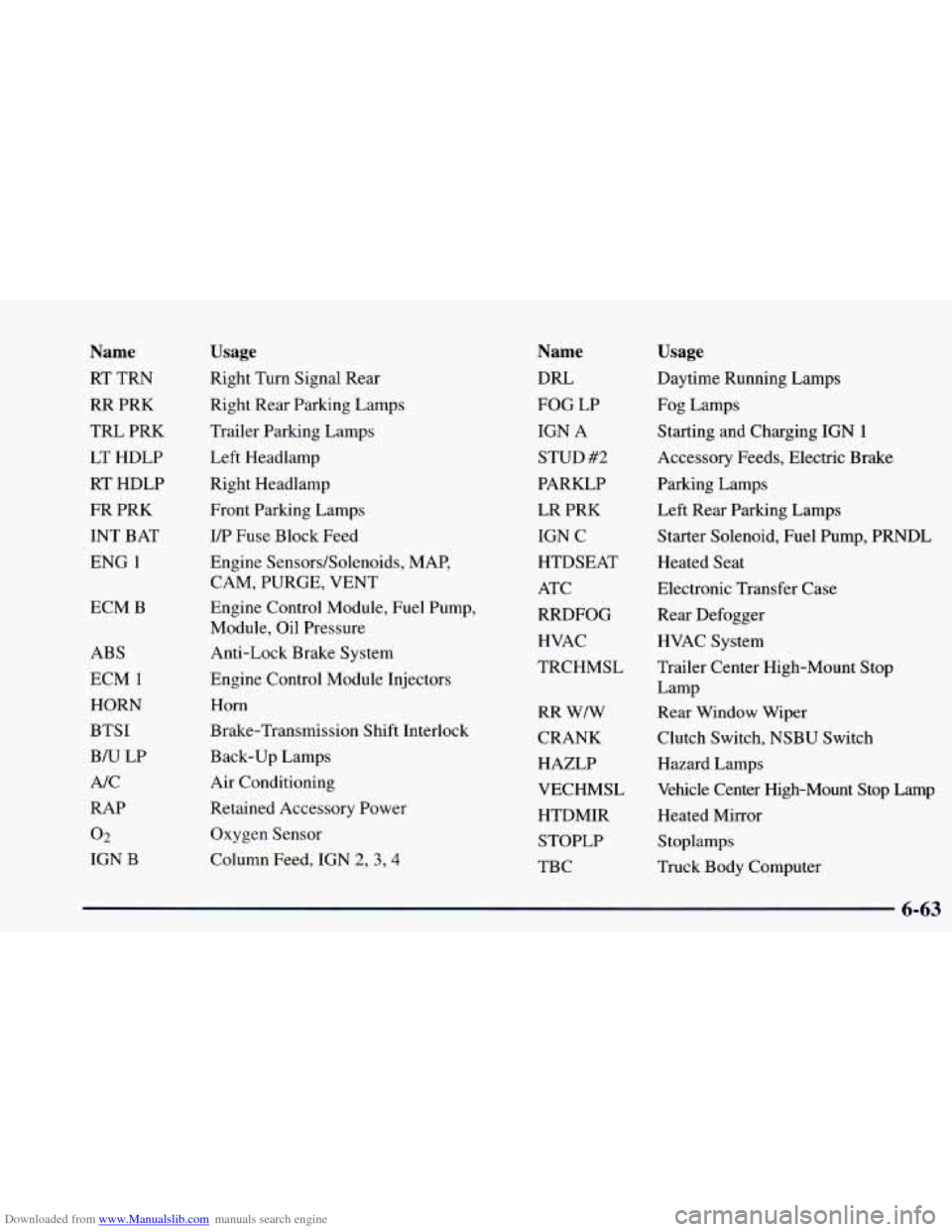
Downloaded from www.Manualslib.com manuals search engine Name
RT TRN
RR PRK
TRL PRK
LT HDLP
RT HDLP
FR PRK
INT BAT
ENG
1
ECM B
ABS
ECM
1
HORN
BTSI
BN LP
NC
RAP
02
IGN B
Usage
Right Turn Signal Rear
Right Rear Parking Lamps
Trailer Parking Lamps
Left Headlamp
Right Headlamp
Front Parking Lamps I/P Fuse Block Feed
Engine Sensors/Solenoids, MAP,
CAM, PURGE, VENT
Engine Control Module,
Fuel Pump,
Module, Oil Pressure
Anti-Lock Brake System
Engine Control Module Injectors
Horn
Brake-Transmission Shift Interlock
Back-up Lamps
Air Conditioning
Retained Accessory Power Oxygen Sensor
Column Feed, IGN
2, 3,4
Name
DRL
FOG LP
IGN A
STUD #2
PARKLP LR PRK
IGN C
HTDSEAT
ATC
RRDFOG
HVAC
TRCHMSL
RR WIW
CRANK
HAZLP
VECHMSL
HTDMIR STOPLP
TBC
Usage
Daytime Running Lamps
Fog Lamps Starting and Charging IGN
1
Accessory Feeds, Electric Brake
Parking Lamps
Left Rear Parking Lamps
Starter Solenoid, Fuel Pump, PRNDL
Heated Seat
Electronic Transfer Case
Rear Defogger HVAC System
Trailer Center High-Mount Stop
Lamp
Rear Window Wiper
Clutch Switch, NSBU Switch
Hazard Lamps
Vehicle Center High-Mount Stop Lamp
Heated Mirror
S toplamps
Truck Body Computer
6-63
Page 341 of 416
Downloaded from www.Manualslib.com manuals search engine Maintenance Schedule
Short Trip/City Definition i
Follow the Short Trip/City Maintenance Schedule if any
one
of these conditions is true for your vehicle:
0 Most trips are less than 5 to 10 miles (8 to 16 km).
This is particularly important when outside
temperatures are below freezing.
driving in stop-and-go traffic).
0 Most trips include extensive idling (such as frequent
0 You operate your vehicle in dusty areas or
off-road frequently.
your vehicle.
or other commercial application.
0 You frequently tow a trailer or use a carrier on top of
0 If the vehicle is used for delivery service, police, taxi
One of the reasons you should follow this schedule
if you operate your vehicle under any of these conditions
is that these conditions cause engine oil to break
down soonel:
Short Trip/City Intervals
Every 3,000 Miles (5 000 km): Engine Oil and
Filter Change (or
3 months, whichever occurs first).
Chassis Lubrication (or
3 months, whichever occurs
first). Drive Axle Service
(or 3 months, whichever
occurs first),
Every 6,000 Miles (10 000 km): Tire Rotation.
Every 15,000 Miles (25 000 km): Air Cleaner Filter
Inspection, if driving
in dusty conditions. Automatic
Transmission Service (severe conditions only).
Every 30,000 Miles (50 000 km): Air Cleaner Filter
Replacement. Fuel Filter Replacement.
Every 50,000 Miles (83 000 km): Automatic
Transmission Service (normal conditions).
Every 60,000 Miles (100 000 km): Engine
Accessory Drive Belt Inspection. Fuel Tank, Cap
and Lines Inspection.
795
Page 342 of 416
Downloaded from www.Manualslib.com manuals search engine Maintenance Schedule
I Short Trip/City Intervals I
Every 100,000 Miles (166 000 km): Spark Plug Wire
Inspection. Spark Plug Replacement. Positive
Crankcase Ventilation (PCV) Valve Inspection.
Every 150,000 Miles (240 000 km): Cooling System
Service (or every
60 months, whichever occurs first).
These intervals only summarize maintenance services.
Be sure to follow the complete maintenance schedule on
the following pages.
Follow this maintenance schedule only if none of the
conditions from the Short Trip/City Maintenance Schedule is true.
Do not use this schedule if the vehicle
is used for trailer towing, driven in a dusty area or used
off paved roads. Use the Short Trip/City schedule for
these conditions.
Driving a vehicle with a fully warmed engine under
highway conditions causes engine oil to break
down slowez
Every 7,500 Miles (12 500 km): Engine Oil and Filter
Change (or every
12 months, whichever occurs first).
Chassis Lubrication (or every
12 months, whichever
occurs first). Drive Axle Service. Tire Rotation.
Every 15,000 Miles (25 000 km): Automatic
Transmission Service (severe conditions only).
Every 30,000 Miles (50 000 km): Fuel Filter
Replacement. Air Cleaner Filter Replacement.
Every 50,000 Miles (83 000 km): Automatic
Transmission Service (normal conditions).
Every 60,000 Miles (100 000 km): Engine
Accessory Drive Belt Inspection. Fuel
Tank,
Cap and Lines Inspection.
Inspection. Spark Plug Replacement. Positive
Crankcase Ventilation (PCV) Valve Inspection.
Every 150,000 Miles (240 000 km): Cooling System
Service (or every
60 months, whichever occurs first).
Every 100,000 Miles (166 000 km): Spark Plug Wire
These intervals only summarize maintenance services.
Be sure to follow the complete maintenance schedule
on
the following pages.
7-6
Page 343 of 416
Downloaded from www.Manualslib.com manuals search engine I Fzlort TripKity Maintenance Schedule I
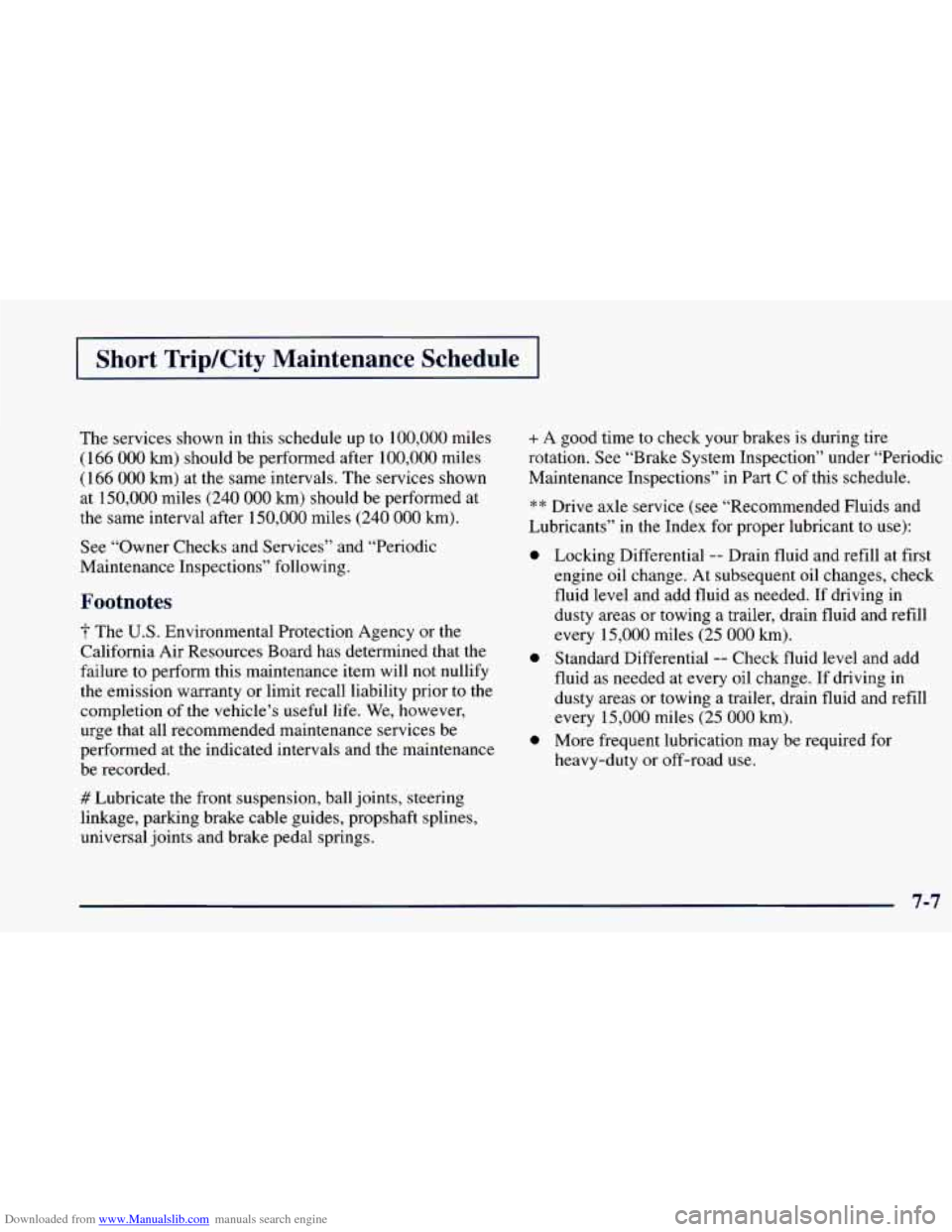
The services shown in this schedule up to 100,000 miles
(166
000 km) should be performed after 100,000 miles
(166
000 km) at the same intervals. The services shown
at 150,000 miles (240
000 km) should be performed at
the same interval after 150,000 miles (240
000 km).
See “Owner Checks and Services” and “Periodic
Maintenance Inspections” following.
Footnotes
The U.S. Environmental Protection Agency or the
California Air Resources Board has determined that the
failure to perform this maintenance item
will not nullify
the emission warranty or limit recall liability prior to the
completion of the vehicle’s useful life. We, however,
urge that all recommended maintenance services be
performed at the indicated intervals and the maintenance
be recorded.
# Lubricate the front suspension, ball joints, steering
linkage, parking brake cable guides, propshaft splines,
universal joints and brake pedal springs.
+ A good time to check your brakes is during tire
rotation. See “Brake System Inspection” under “Periodic
Maintenance Inspections’’
in Part C of this schedule.
** Drive axle service (see “Recommended Fluids and
Lubricants” in the Index for proper lubricant to use):
0
0
0
Locking Differential -- Drain fluid and refill at first
engine oil change. At subsequent oil changes, check
fluid level and add fluid as needed. If driving in
dusty areas or towing a trailer, drain fluid and refill
every
15,000 miles (25 000 km).
Standard Differential -- Check fluid level and add
fluid as needed at every oil change. If driving in
dusty areas or towing a trailer, drain fluid and refill
every 15,000 miles
(25 000 km).
More frequent lubrication may be required for
heavy-duty or off-road use.
7-7
Page 346 of 416
Downloaded from www.Manualslib.com manuals search engine Short TripKity Maintenance Schedule
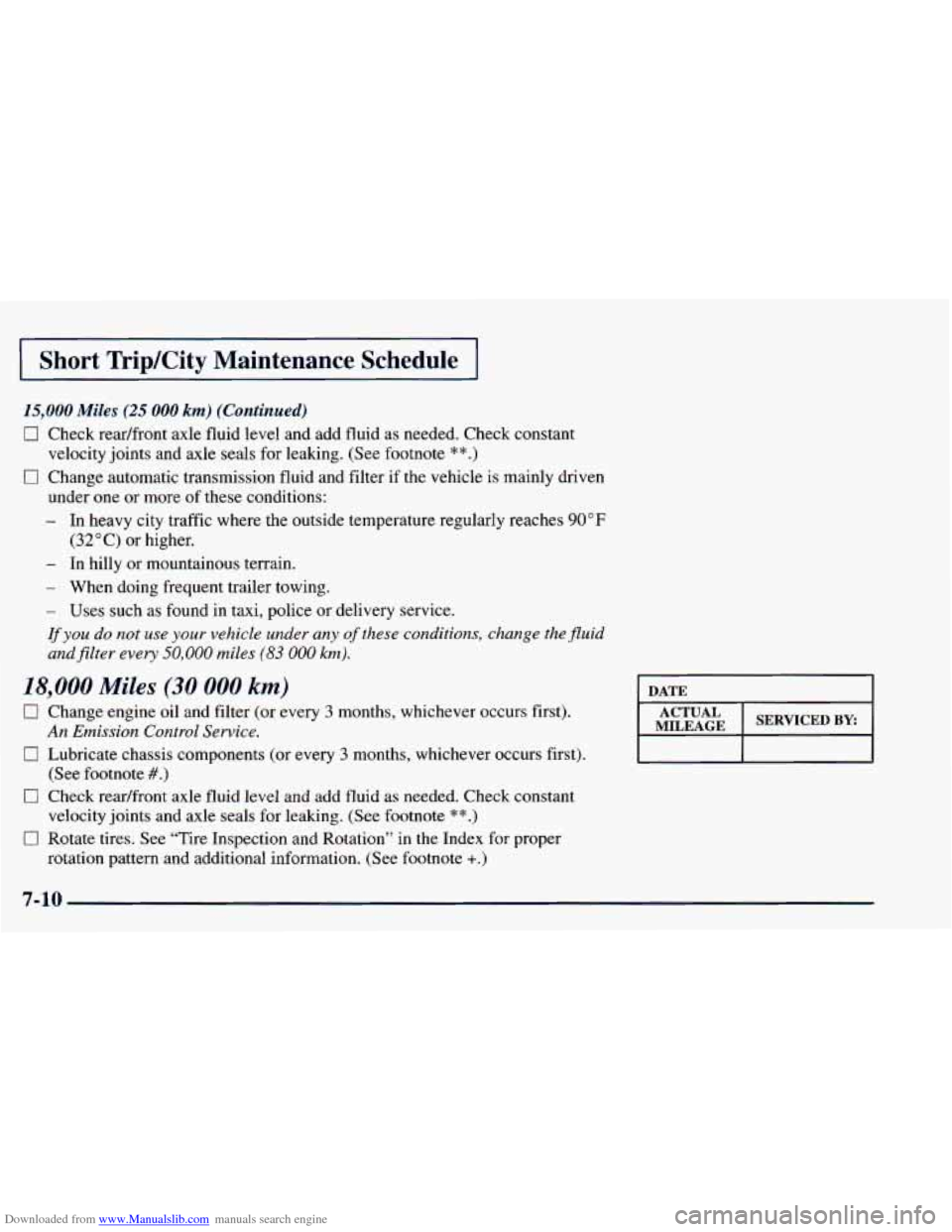
15,000 Miles (25 000 km) (Continued)
Cl Check readfront axle fluid level and add fluid as needed. Check constant
velocity joints and axle seals for leaking. (See footnote
**.)
0 Change automatic transmission fluid and filter if the vehicle is mainly driven
under one or more
of these conditions:
- In heavy city traffic where the outside temperature regularly reach\
es 90°F
- In hilly or mountainous terrain.
(32°C) or higher.
- When doing frequent trailer towing.
- Uses such as found in taxi, police or delivery service.
If you do not use your vehicle under any of these conditions, change the fluid
and filter every
50,000 miles (83 000 km).
18,000 Miles (30 000 km)
0 Change engine oil and filter (or every 3 months, whichever occurs first).
0 Lubricate chassis components (or every 3 months, whichever occurs first).
0 Check readfront axle fluid level and add fluid as needed. Check constant
0 Rotate tires. See “Tire Inspection and Rotation” in the Index for proper
An Emission Control Service.
(See footnote #.)
velocity joints and axle seals for leaking. (See footnote **.)
rotation pattern and additional information, (See footnote +.)
7-10