belt CHEVROLET BLAZER 1998 2.G Workshop Manual
[x] Cancel search | Manufacturer: CHEVROLET, Model Year: 1998, Model line: BLAZER, Model: CHEVROLET BLAZER 1998 2.GPages: 416, PDF Size: 22.4 MB
Page 192 of 416
Downloaded from www.Manualslib.com manuals search engine Steering in Emergencies
There are times when steering can be more effective
than braking. For example, you come over a hill and
find a truck stopped in your lane,
or a car suddenly pulls
out from nowhere, or a child darts
out from between
parked cars and stops right
in front of you. You can
avoid these problems by braking
-- if you can stop in
time. But sometimes
you can’t; there isn’t room. That’s
the time for evasive action
-- steering around
the problem.
Your vehicle can perform very well in emergencies like
these. First apply your brakes. (See “Braking in
Emergencies” earlier in this section.) It is better to
remove as much speed as you can from a possible
collision. Then steer around the problem, to the left or
right depending on the space available. An emergency
like this requires close attention
and a
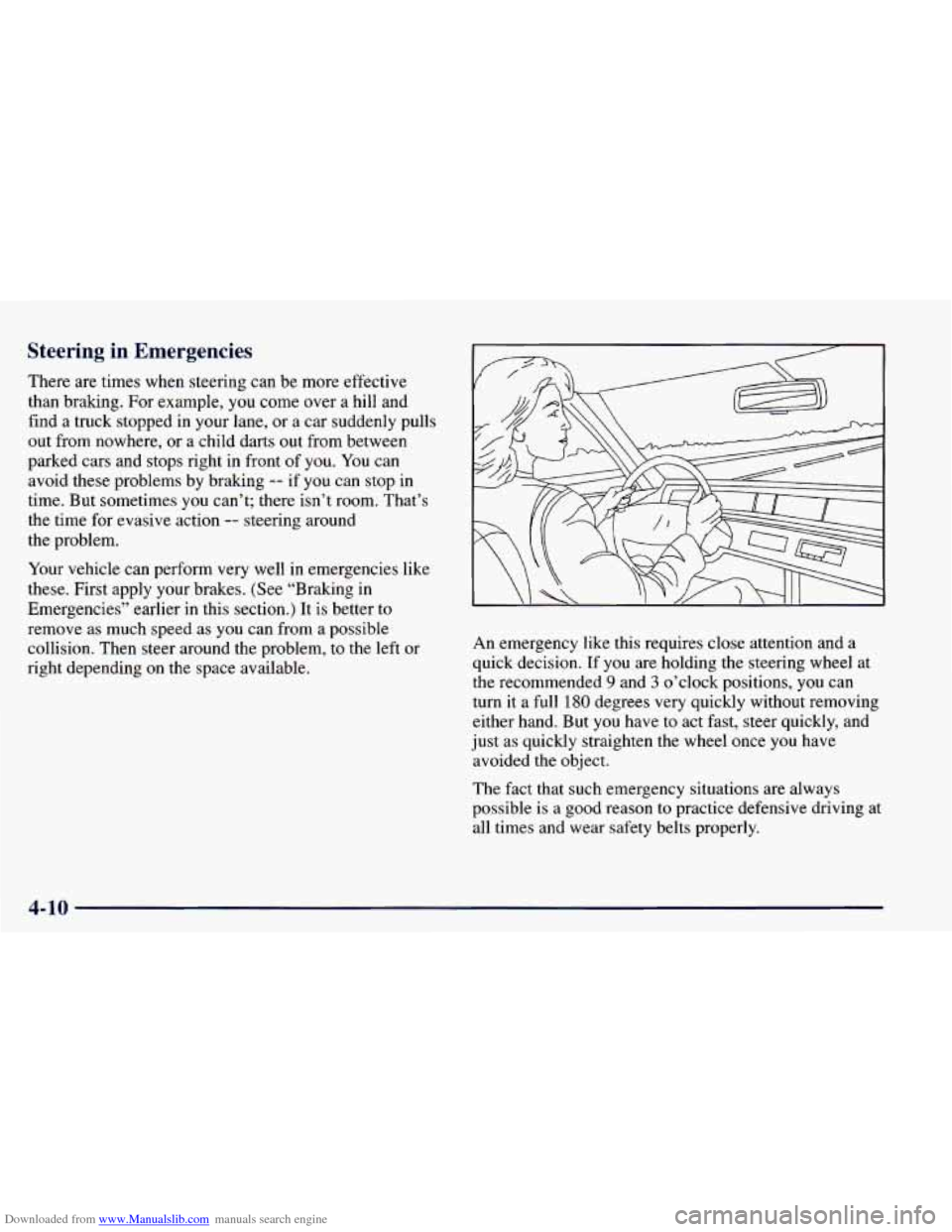
quick decision. If
you are holding the steering wheel at
the recommended
9 and 3 o’clock positions, you can
turn it a full
180 degrees very quickly without removing
either hand. But you have to act fast, steer quickly, and
just
as quickly straighten the wheel once you have
avoided the object.
The fact that such emergency situations are always
possible is a good reason to practice defensive driving at
all times and wear safety belts properly.
4-10
Page 199 of 416
Downloaded from www.Manualslib.com manuals search engine Controlling your vehicle is the key to successful
off-road driving. One
of the best ways to control your
vehicle is to control your speed. Here are some things to
keep in mind. At higher speeds:
you approach things faster and you have less time to
scan the terrain for obstacles.
0 you have less time to react.
0 you have more vehicle bounce when you drive
over obstacles.
0 you'll need more distance for braking, especially
since you're on an unpc"=.?d surface.
Scanning the Terrain
Off-road driving can take you over many different kinds
of terrain. You need to be familiar with the terrain and
its many different features. Here are some things
to consider.
Sugace Conditions. Off-roading can take you over
hard-packed dirt, gravel, rocks, grass, sand, mud, snow
or ice. Each of these surfaces affects the steering,
acceleration and braking of your vehicle
in different
ways. Depending upon the kind
of surface you are on,
you may experience slipping, sliding, wheel spinning,
delayed acceleration, poor traction and longer
braking distances.
Sugace Obstacles . Unseen or hidden obstacles can be
hazardous.
A rock, log, hole, rut or bump can startle you if
you're not prepared for them. Often these obstacles are
hidden by grass, bushes, snow or even the
rise and fall of
the terrain itself. Here are some things to consider:
I
When you're driving off-road, bouncing and
quick changes in direction can easily throw
you
out of position. This could cause you to lose
control and crash.
So, whether you're driving on
or off the road, you and your passengers should
wear safety belts.
0 Does the travel take you uphill or downhill? (There's
0 Is the path ahead clear?
0 Will the surface texture change abruptly up ahead?
more discussion
of these subjects later.)
0 Will you have to stop suddenly or change
direction quickly?
4-17
Page 232 of 416
Downloaded from www.Manualslib.com manuals search engine 2. Let up on the brake pedal.
3. Drive slowly until the trailer is clear of the chocks.
4. Stop and have someone pick up and store the chocks.
Maintenance When Trailer Towing
Your vehicle will need service more often when you’re
pulling
a trailer. See the Maintenance Schedule for more
on this. Things that are especially important
in trailer
operation are automatic transmission fluid (don’t
overfill), engine oil, axle lubricant, belt, cooling system
and brake adjustment. Each
of these is covered in this
manual, and the Index will help
you find them quickly.
If
you’re trailering, it’s a good idea to review these
sections before you start your trip.
Check periodically to see that all hitch nuts and bolts
are tight.
Trailer Wiring H-T--- ess
The light duty trailer wir is a six-wire harness
assembly. The optional heavy-duty trailer wiring
is an
eight-wire harness assembly. The harnesses are stored under the vehicle, along the passenger-side frame
crossmember on two-door vehicles or on the driver’s side
corner frame rear crossmember on four-door vehicles. The
heavy-duty trailer wiring has a 30-amp feed wire with
an
inline fuse located by the junction block. See
“Fuses and Circuit Breakers” in the Index. Both
harnesses have
no connector and should be wired by a
qualified electrical technician. The technician
can use
the following color code chart when connecting the
wiring harness to your trailer.
0
0
0
0
0
0
0
0
Dark Blue: Use for electric trailer brakes or
auxiliary wiring.
Red: Use for battery charging; it connects to the
starter solenoid (eight-wire harness only).
Light Green: Back-up lamps (eight-wire
harness only).
Brown: Taillamps and parking lamps. Yellow: Left stoplamp and turn signal.
Dark Green: Right stoplamp and turn signal.
White (Heavy Gage): Ground wire.
White (Light Gage): Auxiliary stoplamp.
Securely attach the harness to the trailer, then tape or
strap
it to your vehicle’s frame rail. Be sure you leave
it loose enough
so the wiring doesn’t bend or break,
but not
so loose that it drags on the ground. Store the
harness in its original place. Wrap the harness together
and tie it neatly
so it won’t be damaged.
Page 271 of 416
Downloaded from www.Manualslib.com manuals search engine Section 6 Service and Appnara-- ~2 Care
Here you will find information about the care of your vehicle. This section begins with service and fuel information,
and then it shows how to check important fluid and lubricant levels. There is also technical information about your
vehicle, and a part devoted to its appearance care.
6-2
6-3
6-5
6-5
6-7
6-8
6-10
6- 14
6-15
6-1 9
6-20
6-2
1
6-22 6-23
6-26 6-27
6-27
Service
Fuel
Fuels
in Foreign Countries
Filling Your Tank
Filling a Portable Fuel Container
Checking Things Under the Hood
Engine Oil
Air Cleaner
Automatic Transmission Fluid
Manual Transmission Fluid
Hydraulic Clutch
Rear Axle
Four-wheel Drive
Engine Coolant
Radiator Pressure Cap
Thermostat Power Steering Fluid 6-28
6-29
6-32
6-33
6-38
6-40
6-49
6-50
6-52
6-54
6-57
6-58
6-58
6-58
6-64 6-64
6-65 Windshield Washer Fluid
Brakes
Battery
Bulb Replacement
Windshield Wiper Blade Replacement
Tires
Appearance Care
Cleaning the Inside of Your Vehicle
Care
of Safety Belts
Cleaning the Outside
of Your Vehicle
Appearance Care Materials Chart
Vehicle Identification Number (VTN)
Service Parts Identification Label
Electrical System
Replacement Bulbs Capacities and Specifications
Air Conditioning Refrigerants
Page 314 of 416
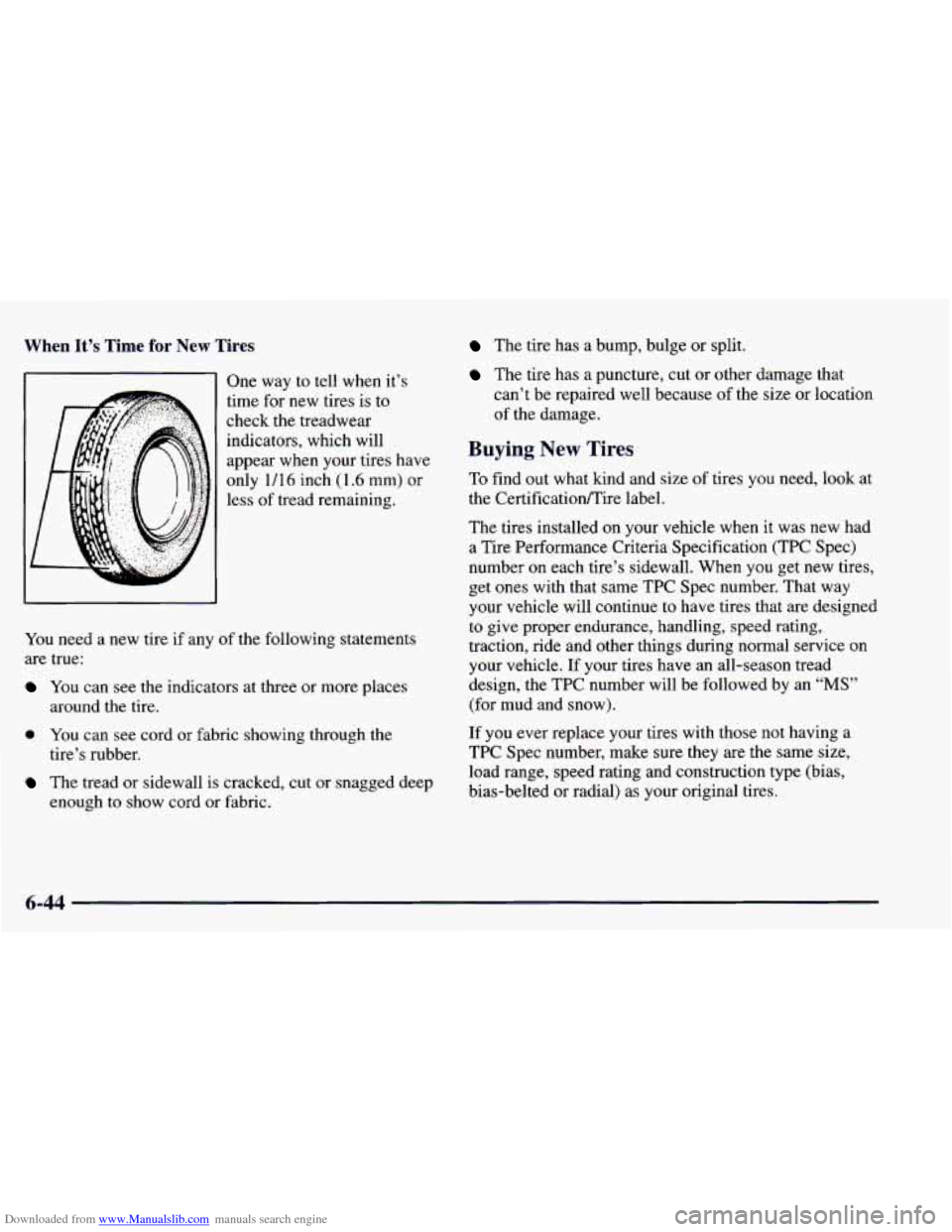
Downloaded from www.Manualslib.com manuals search engine When It’s Time for New Tires
One way to tell when it’s
time for new tires is to
check the treadwear
indicators, which will
appear when your tires have
only
1/16 inch (1.6 mm) or
less
of tread remaining.
The tire has a bump, bulge or split.
The tire has a puncture, cut or other damage that
can’t be repaired well because
of the size or location
of the damage.
Buying New Tires
To find out what kind and size of tires you need, look at
the Certificatioflire label.
You need a new tire if
any of the following statements
are true:
You can see the indicators at three or more places
0 You can see cord or fabric showing through the
The tread or sidewall is cracked, cut or snagged deep
around
the tire.
tire’s rubber.
enough
to show cord or fabric. The
tires installed on your vehicle when it
was new had
a Tire Performance Criteria Specification (TPC Spec)
number on each tire’s sidewall. When you get new tires,
get ones with that same TPC Spec number. That way
your vehicle will continue
to have tires that are designed
to give proper endurance, handling, speed rating,
traction, ride and other things during normal service on
your vehicle. If your tires have an all-season tread
design, the TPC number will be followed by an
“MS”
(for mud and snow).
If you ever replace your tires with those not having a
TPC Spec number, make sure they are the same size,
load range, speed rating and construction type (bias,
bias-belted or radial) as your original tires.
6-44
Page 315 of 416
Downloaded from www.Manualslib.com manuals search engine Mixing tires could cause you to lose control while
driving.
If you mix tires of different sizes or types
(radial and bias-belted tires), the vehicle may not
handle properly, and you could have
a crash.
Using tires of different sizes may also cause
damage
to your vehicle. Be sure to use the same
size and type tires on all wheels.
It’s all right to drive with your compact spare
(if you have one). It
was developed for use on
your vehicle.
A CAUTION:
If you use bias-ply tires on your vehicle, the
wheel rim flanges could develop cracks after
many miles of driving.
A tire and/or wheel could
fail suddenly, causing
a crash. Use only radial-ply
tires
with the wheels on your vehicle.
Uniform Tire Quality Grading
The following information relates to the system
developed by the United States National Highway
Traffic Safety Administration, which grades tires by
treadwear, traction and temperature performance. (This applies
only to vehicles sold in the United States.)
The grades are molded
on the sidewalls of most
passenger car tires. The Uniform Tire Quality Grading
system does not apply
to deep tread, winter-type snow
tires, space-saver or temporary use spare tires, tires with
nominal rim diameters
of 10 to 12 inches (25 to 30 cm),
or to some limited-production tires.
While the tires available on General Motors passenger
cars and light trucks may vary with respect to these
grades, they must also conform to Federal safety
requirements and additional General Motors Tire
Performance Criteria (TPC) standards.
6-45
Page 322 of 416
Downloaded from www.Manualslib.com manuals search engine Cleaning Leather
Use a soft cloth with lukewarm water and a mild soap
or saddle soap and wipe dry with a soft cloth. Then, let
the leather dry naturally.
Do not use heat to dry.
0 For stubborn stains, use a leather cleaner. See your
dealer for this product.
Never use oils, varnishes, solvent-based or abrasive
cleaners, furniture polish or shoe polish
on leather.
immediately. If dirt is allowed to work into the
finish, it can harm the leather.
Soiled or stained leather should be cleaned
Cleaning the Top of the Instrument Panel
Use only mild soap and water to clean the top surfaces
of the instrument panel. Sprays containing silicones or
waxes may cause annoying reflections
in the windshield
and even make it difficult to see through the windshield
under certain conditions.
Cleaning Interior Plastic Components
Use only a mild soap and water solution on a soft
cloth or sponge, Commercial cleaners may affect the
surface finish.
Care of Safety Belts
Keep belts clean and dry.
Do not bleach or dye safety belts. If you do, it
may severely weaken them. In
a crash, they
might not be able to provide adequate protection.
Clean safety belts only with mild soap
and
lukewarm water.
6-52
Page 341 of 416
Downloaded from www.Manualslib.com manuals search engine Maintenance Schedule
Short Trip/City Definition i
Follow the Short Trip/City Maintenance Schedule if any
one
of these conditions is true for your vehicle:
0 Most trips are less than 5 to 10 miles (8 to 16 km).
This is particularly important when outside
temperatures are below freezing.
driving in stop-and-go traffic).
0 Most trips include extensive idling (such as frequent
0 You operate your vehicle in dusty areas or
off-road frequently.
your vehicle.
or other commercial application.
0 You frequently tow a trailer or use a carrier on top of
0 If the vehicle is used for delivery service, police, taxi
One of the reasons you should follow this schedule
if you operate your vehicle under any of these conditions
is that these conditions cause engine oil to break
down soonel:
Short Trip/City Intervals
Every 3,000 Miles (5 000 km): Engine Oil and
Filter Change (or
3 months, whichever occurs first).
Chassis Lubrication (or
3 months, whichever occurs
first). Drive Axle Service
(or 3 months, whichever
occurs first),
Every 6,000 Miles (10 000 km): Tire Rotation.
Every 15,000 Miles (25 000 km): Air Cleaner Filter
Inspection, if driving
in dusty conditions. Automatic
Transmission Service (severe conditions only).
Every 30,000 Miles (50 000 km): Air Cleaner Filter
Replacement. Fuel Filter Replacement.
Every 50,000 Miles (83 000 km): Automatic
Transmission Service (normal conditions).
Every 60,000 Miles (100 000 km): Engine
Accessory Drive Belt Inspection. Fuel Tank, Cap
and Lines Inspection.
795
Page 342 of 416
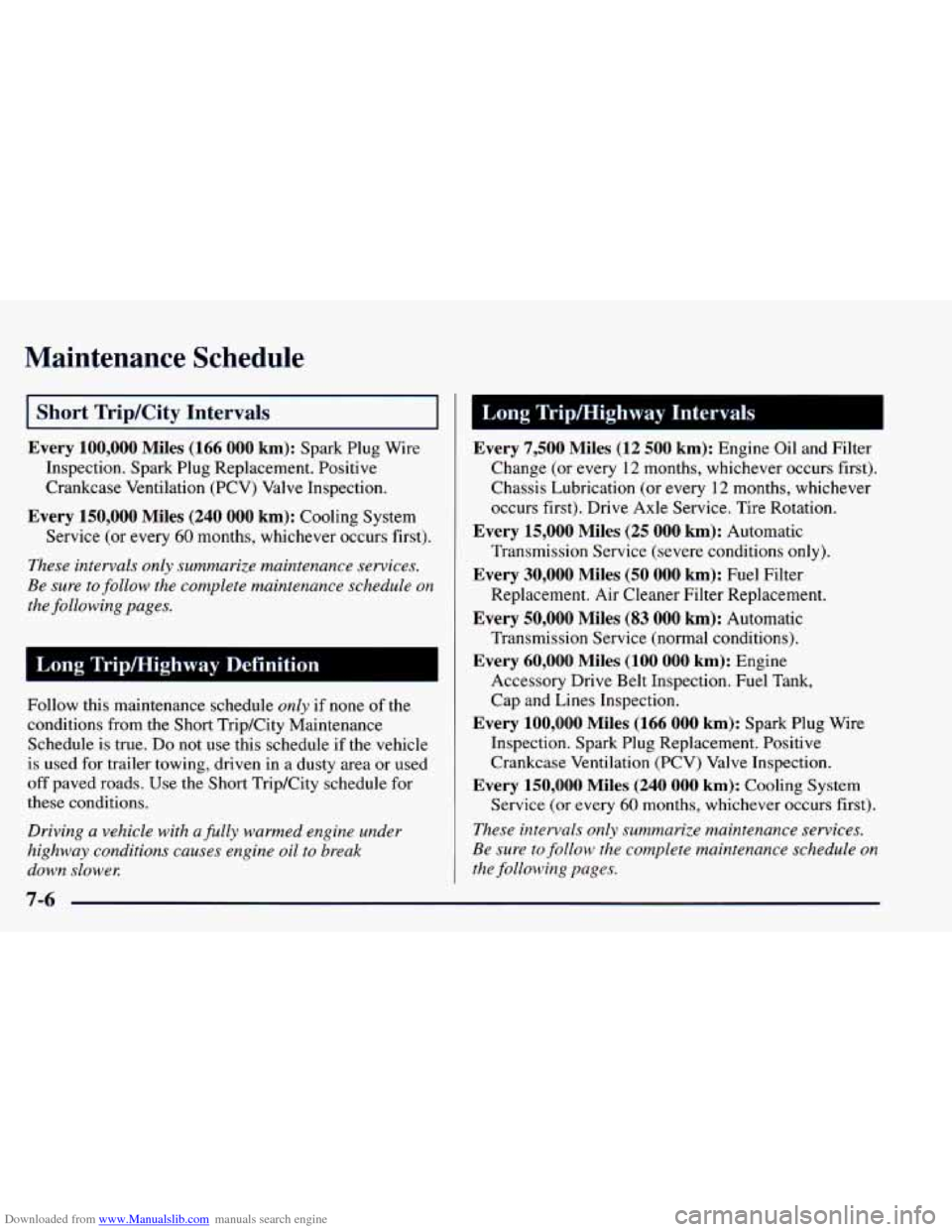
Downloaded from www.Manualslib.com manuals search engine Maintenance Schedule
I Short Trip/City Intervals I
Every 100,000 Miles (166 000 km): Spark Plug Wire
Inspection. Spark Plug Replacement. Positive
Crankcase Ventilation (PCV) Valve Inspection.
Every 150,000 Miles (240 000 km): Cooling System
Service (or every
60 months, whichever occurs first).
These intervals only summarize maintenance services.
Be sure to follow the complete maintenance schedule on
the following pages.
Follow this maintenance schedule only if none of the
conditions from the Short Trip/City Maintenance Schedule is true.
Do not use this schedule if the vehicle
is used for trailer towing, driven in a dusty area or used
off paved roads. Use the Short Trip/City schedule for
these conditions.
Driving a vehicle with a fully warmed engine under
highway conditions causes engine oil to break
down slowez
Every 7,500 Miles (12 500 km): Engine Oil and Filter
Change (or every
12 months, whichever occurs first).
Chassis Lubrication (or every
12 months, whichever
occurs first). Drive Axle Service. Tire Rotation.
Every 15,000 Miles (25 000 km): Automatic
Transmission Service (severe conditions only).
Every 30,000 Miles (50 000 km): Fuel Filter
Replacement. Air Cleaner Filter Replacement.
Every 50,000 Miles (83 000 km): Automatic
Transmission Service (normal conditions).
Every 60,000 Miles (100 000 km): Engine
Accessory Drive Belt Inspection. Fuel
Tank,
Cap and Lines Inspection.
Inspection. Spark Plug Replacement. Positive
Crankcase Ventilation (PCV) Valve Inspection.
Every 150,000 Miles (240 000 km): Cooling System
Service (or every
60 months, whichever occurs first).
Every 100,000 Miles (166 000 km): Spark Plug Wire
These intervals only summarize maintenance services.
Be sure to follow the complete maintenance schedule
on
the following pages.
7-6
Page 354 of 416
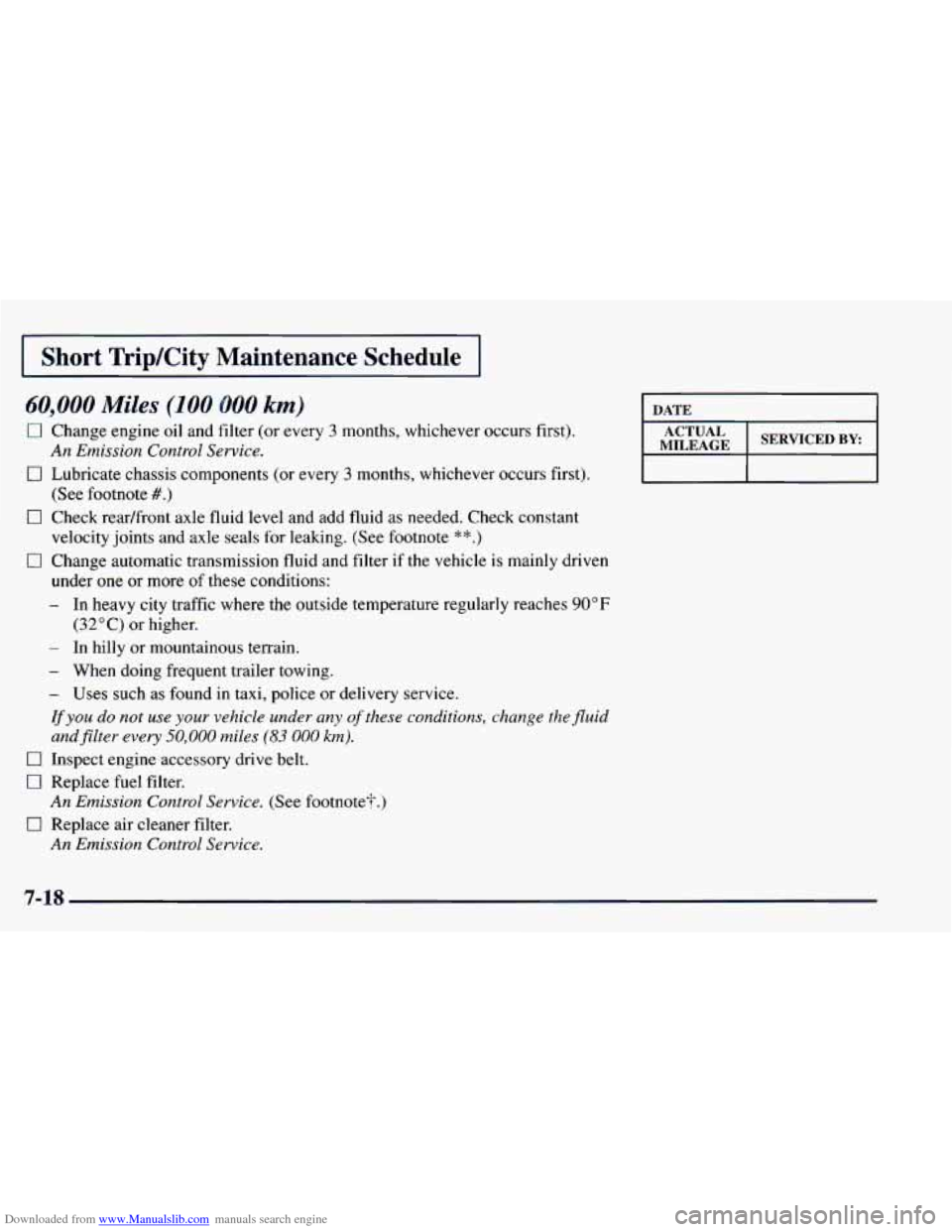
Downloaded from www.Manualslib.com manuals search engine 1 Short TripKity Maintenance Schedule I
60,000 Miles (100 000 km)
0
CI
0
0
Change engine oil and filter (or every 3 months, whichever occurs first).
An Emission Control Service.
Lubricate chassis components (or every 3 months, whichever occurs first).
(See footnote
#.)
Check readfront axle fluid level and add fluid as needed. Check constant
velocity joints and axle seals for leaking. (See footnote
**.)
Change automatic transmission fluid and filter if the vehicle is mainly driven
under
one or more of these conditions:
- In heavy city traffic where the outside temperature regularly reaches 90°F
- In hilly or mountainous terrain.
- When doing frequent trailer towing.
- Uses such as found in taxi, police or delivery service.
If you do not use your vehicle under any of these conditions, change the fluid
andfilter every
50,000 miles (83 000 km).
Inspect engine accessory drive belt.
Replace fuel filter.
An Emission Control Service. (See footnote?.)
Replace air cleaner filter.
An Emission Control Service.
(32°C) or higher.
DATE
MILEAGE
7-18