light CHEVROLET BLAZER 1998 2.G Manual PDF
[x] Cancel search | Manufacturer: CHEVROLET, Model Year: 1998, Model line: BLAZER, Model: CHEVROLET BLAZER 1998 2.GPages: 416, PDF Size: 22.4 MB
Page 232 of 416
Downloaded from www.Manualslib.com manuals search engine 2. Let up on the brake pedal.
3. Drive slowly until the trailer is clear of the chocks.
4. Stop and have someone pick up and store the chocks.
Maintenance When Trailer Towing
Your vehicle will need service more often when you’re
pulling
a trailer. See the Maintenance Schedule for more
on this. Things that are especially important
in trailer
operation are automatic transmission fluid (don’t
overfill), engine oil, axle lubricant, belt, cooling system
and brake adjustment. Each
of these is covered in this
manual, and the Index will help
you find them quickly.
If
you’re trailering, it’s a good idea to review these
sections before you start your trip.
Check periodically to see that all hitch nuts and bolts
are tight.
Trailer Wiring H-T--- ess
The light duty trailer wir is a six-wire harness
assembly. The optional heavy-duty trailer wiring
is an
eight-wire harness assembly. The harnesses are stored under the vehicle, along the passenger-side frame
crossmember on two-door vehicles or on the driver’s side
corner frame rear crossmember on four-door vehicles. The
heavy-duty trailer wiring has a 30-amp feed wire with
an
inline fuse located by the junction block. See
“Fuses and Circuit Breakers” in the Index. Both
harnesses have
no connector and should be wired by a
qualified electrical technician. The technician
can use
the following color code chart when connecting the
wiring harness to your trailer.
0
0
0
0
0
0
0
0
Dark Blue: Use for electric trailer brakes or
auxiliary wiring.
Red: Use for battery charging; it connects to the
starter solenoid (eight-wire harness only).
Light Green: Back-up lamps (eight-wire
harness only).
Brown: Taillamps and parking lamps. Yellow: Left stoplamp and turn signal.
Dark Green: Right stoplamp and turn signal.
White (Heavy Gage): Ground wire.
White (Light Gage): Auxiliary stoplamp.
Securely attach the harness to the trailer, then tape or
strap
it to your vehicle’s frame rail. Be sure you leave
it loose enough
so the wiring doesn’t bend or break,
but not
so loose that it drags on the ground. Store the
harness in its original place. Wrap the harness together
and tie it neatly
so it won’t be damaged.
Page 236 of 416
Downloaded from www.Manualslib.com manuals search engine 2. Get the vehicles close enough so the jumper cables
can reach, but be sure the vehicles aren’t touching
each other.
If they are, it could cause a ground
connection you don’t want. You wouldn’t be able to
start your vehicle, and the bad grounding could
damage the electrical systems.
To avoid the possibility of the vehicles rolling, set
the parlung brake firmly on both vehicles involved in
the procedure. Put an automatic transmission vehicle
in
PARK (P) and a manual transmission vehicle in
NEUTRAL (N).
3. Turn off the ignition on both vehicles. Unplug
unnecessary accessories plugged into the cigarette
lighter, or accessory power outlets, if you have this
option. Turn off all lamps that aren’t needed as well
as radios. This will avoid sparks and help save both
batteries. In addition, it could save your radio!
NOTICE:
If you leave your radio on, it could be badly
damaged. The repair wouldn’t be covered
by
your warranty.
4. Open both hoods and locate the batteries. Find
the positive
(+) and negative (-) terminals on
each battery.
AUTION:
I
Using a match near a battery can cause battery
gas to explode. People have been hurt doing this,
and some have been blinded.
Use a flashlight if
you need more light.
Be sure the battery has enough water.
You don’t
need to add water to the ACDelco Freedom@
battery installed in every new
GM vehicle. But if
a battery has filler caps, be sure the right amount
of fluid is there. If it is low, add water to take care
of that first.
If you don’t, explosive gas could
be present.
Battery fluid contains acid that can burn you.
Don’t get it on you.
If you accidentally get it in
your eyes or on your
skin, flush the place with
water and get medical help immediately.
5-4
Page 268 of 416
Downloaded from www.Manualslib.com manuals search engine Rocking Your Vehicle To Get It Out
First, turn your steering wheel left and right. That will
clear the area around your front wheels. If you have a
four-wheel drive vehicle, shift into 4HI. Then shift back
and forth between REVERSE
(R) and a forward gear (or
with a manual transmission, between FIRST (1) or
SECOND (2) and REVERSE (R)), spinning the wheels
as little as possible. Release the accelerator pedal while
you shift, and press lightly on the accelerator pedal
when the transmission is in gear. If that doesn’t get you
out after a few tries, you may need to be towed out. Or,
you can use your recovery hooks if your vehicle has
them. If you
do need to be towed out, see “Towing Your
Vehicle” in the Index.
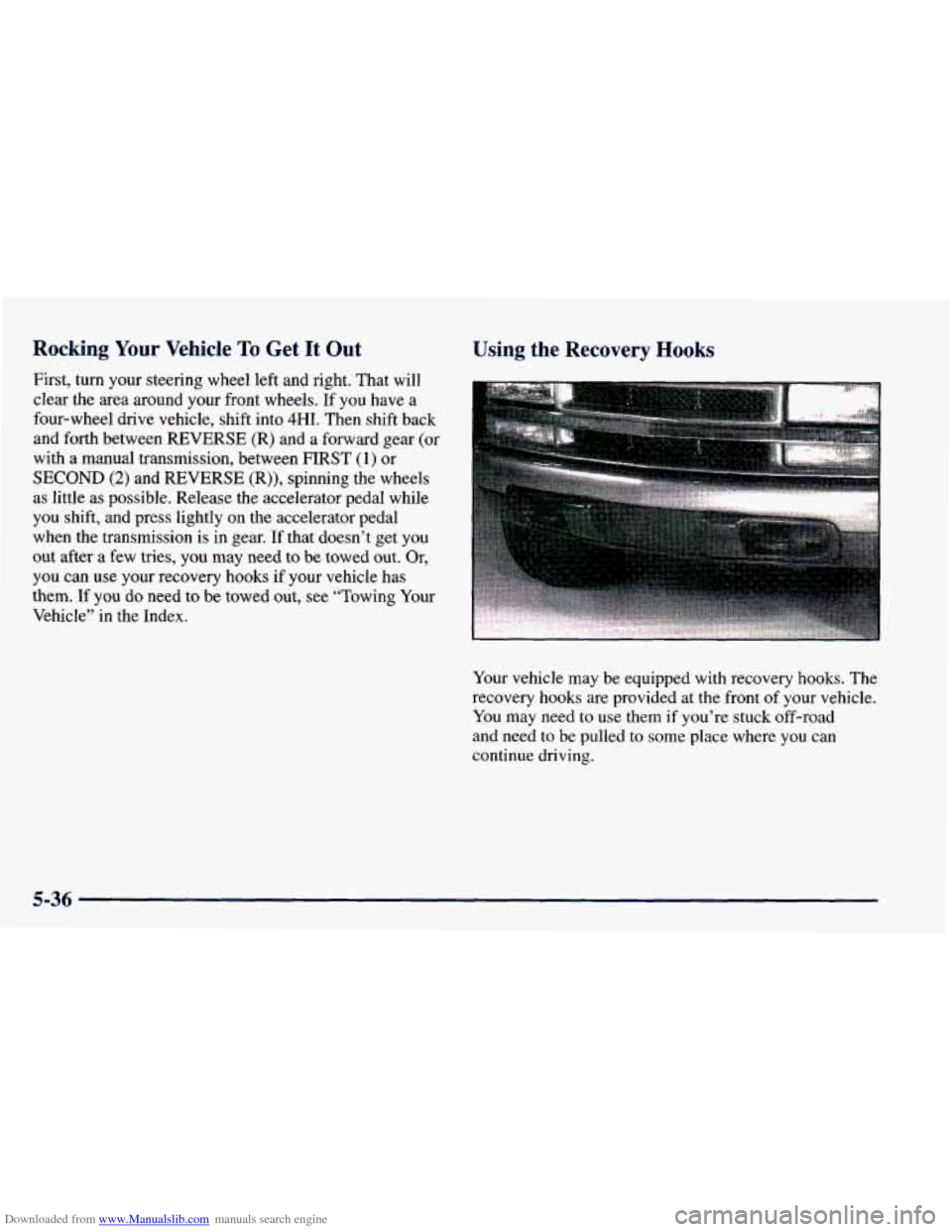
Using the Kecovery Hooks
Your vehicle may be equipped with recovery hooks. The
recovery hooks are provided at the front of your vehicle.
You may need to use them
if you’re stuck off-road
and need to be pulled to some place where you can
continue driving.
5-36
Page 277 of 416
Downloaded from www.Manualslib.com manuals search engine When you put the cap back on, turn it to the right
(clockwise) until you hear a clicking sound. Make
sure you fully install the cap. The diagnostic system
can determine
if the fuel cap has been left off or
improperly installed. This would allow fuel to
evaporate into the atmosphere. See “Malfunction
Indicator Lamp” in the Index.
NOTICE:
If you need a new cap, be sure to get the right
type. Your dealer can get one for you.
If you get
the wrong type,
it may not fit properly. This may
cause your malfunction indicator lamp to light
and your fuel tank and emissions system may be
damaged. See “Malfunction Indicator Lamp” in
the Index.
Filling a Portable Fuel Container
Never fill a portable fuel container while it is in
your vehicle. Static electricity discharge from the
container can ignite the gasoline vapor. You can
be badly burned and your vehicle damaged
if this
occurs. To help avoid injury to you and others:
Dispense gasoline only into approved
containers.
Do not fill a container while it is inside a
vehicle, in a vehicle’s trunk, pickup bed or
on any surface other than the ground.
inside of the
fill opening before operating
the nozzle. Contact should be maintained
until the filling is complete.
Bring the fill nozzle in contact with the
Don’t smoke while pumping gasoline.
6-7
Page 290 of 416
Downloaded from www.Manualslib.com manuals search engine How to Add Fluid
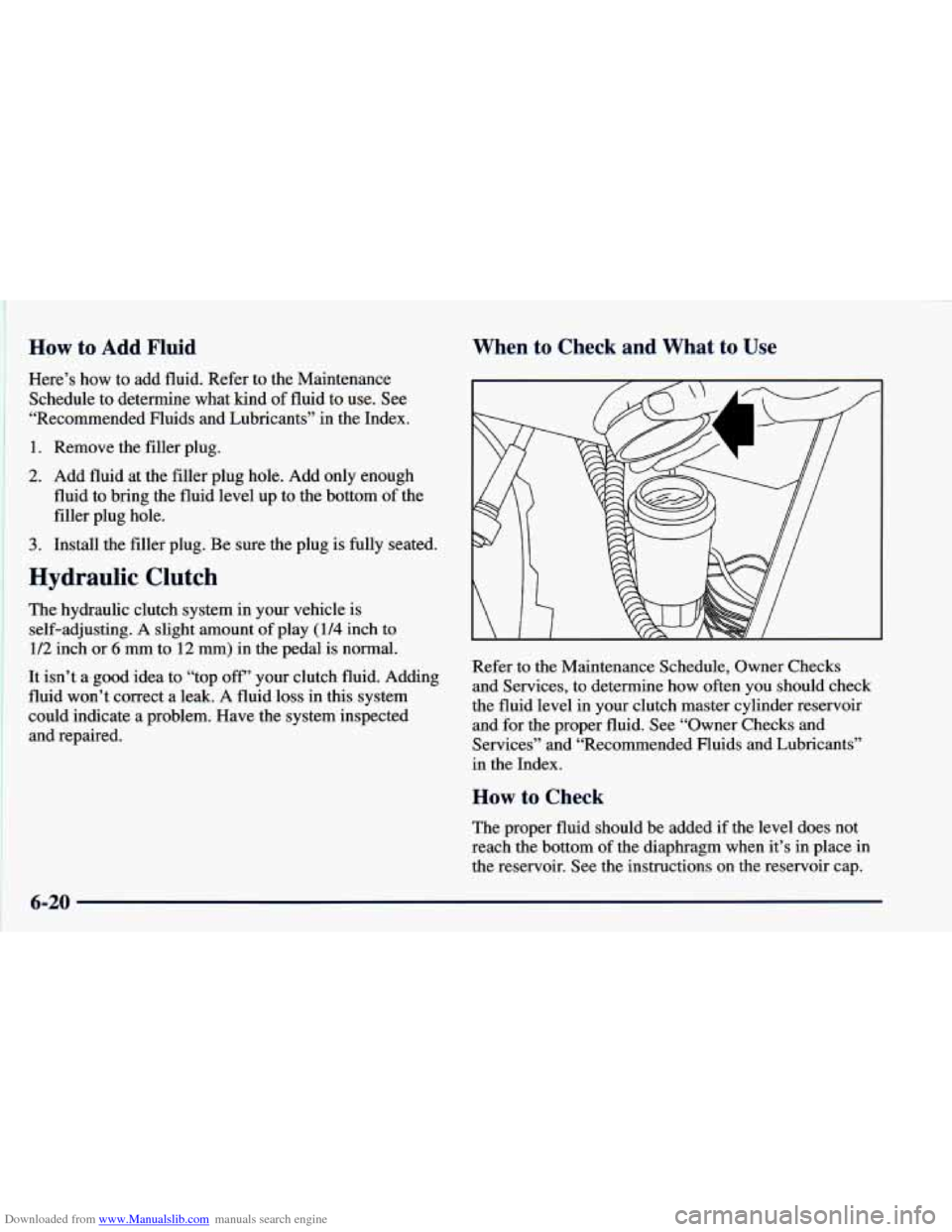
Here’s how to add fluid. Refer to the Maintenance
Schedule to determine what kind of fluid to use. See
“Recommended Fluids and Lubricants” in the Index.
1. Remove the filler plug.
2. Add fluid at the filler plug hole. Add only enough
fluid to bring the fluid level up to the bottom of the
filler plug hole.
3. Install the filler plug. Be sure the plug is fully seated.
Hydraulic Clutch
The hydraulic clutch system in your vehicle is
self-adjusting.
A slight amount of play (1/4 inch to
1/2 inch or 6 rnm to 12 mm) in the pedal is normal.
It isn’t
a good idea to “top off” your clutch fluid. Adding
fluid won’t correct a leak. A fluid loss in this system
could indicate
a problem. Have the system inspected
and repaired.
When to Check and What to Use
Refer to the Maintenance Schedule, Owner Checks
and Services, to determine how often you should check
the fluid level in your clutch master cylinder reservoir
and for the proper fluid. See “Owner Checks and
Services” and “Recommended Fluids and Lubricants”
in the Index.
How to Check
The proper fluid should be added if the level does not
reach the bottom
of the diaphragm when it’s in place in
the reservoir. See the instructions on the reservoir cap.
6-20
Page 294 of 416
Downloaded from www.Manualslib.com manuals search engine A 50/50 mixture of water and DEX-COOL@ coolant will:
Give freezing protection down to -34°F (-37°C).
Give boiling protection up to 265 “F ( 129°C).
Protect against rust and corrosion.
Help keep the proper engine temperature.
0 Let the warning lights and gages work as
they should.
NOTICE:
When adding coolant, it is important that you use
only
DEX-COOL@ (silicate-free) coolant.
If coolant other than DEX-COOL is added to the
system, premature engine, heater core or
radiator corrosion may result. In addition, the
engine coolant will require change sooner
-- at
30,000 miles (50 000 km) or 24 months,
whichever occurs first. Damage caused by the
use
of coolant other than DEX-COOL@ is not
covered by your new vehicle warranty.
What to Use
Use a mixture of one-half clean water (preferably
distilled) and one-half DEX-COOL@ coolant
which
won’t damage aluminum parts. If you use this mixture,
you don’t need to add anything else.
A CAUTION:
Adding only plain water to your cooling system
can be dangerous. Plain water, or some other
liquid like alcohol, can boil before the proper
coolant mixture will. Your vehicle’s coolant
warning system is set for the proper coolant
mixture. With plain water or the wrong mixture,
your engine could get too hot but you wouldn’t
get the overheat warning. Your engine could
catch fire and you or others could be burned.
Use
a 50/50 mixture of clean water and
DEX-COOL@ coolant.
6-24
Page 302 of 416
Downloaded from www.Manualslib.com manuals search engine Some driving conditions or climates may cause a brake
squeal when the brakes are first applied or lightly
applied. This does
not mean something is wrong with
your brakes.
Properly torqued wheel nuts are necessary to help
prevent brake pulsation. When tires are rotated, inspect
brake pads for wear and evenly torque wheel
nuts in the
proper sequence to
GM specifications.
Brake linings should always be replaced
as complete
axle sets.
See “Brake System Inspection” in Section
7 of this
manual under
Part C “Periodic Maintenance Inspections.”
Brake Pedal Travel
See your dealer if the brake pedal does not return to
normal height, or if there is a rapid increase in pedal
travel. This could be a sign
of brake trouble.
Brake Adjustment
Every time you make a brake stop, your disc brakes
adjust for wear.
Replacing Brake System Parts
The braking system on a modem vehicle is complex.
Its many parts have to be
of top quality and work well
together
if the vehicle is to have really good braking.
Your vehicle was designed and tested with top-quality
GM brake parts. When you replace parts of your braking
system
-- for example, when your brake linings wear
down and you have to have new ones put in
-- be sure
you get new approved
GM replacement parts. If you
don’t, your brakes may
no longer work properly. For
example, if someone puts in brake linings that are wrong
for your vehicle, the balance between your front and
rear brakes can change
-- for the worse. The braking
performance you’ve come to expect can change in many
other ways if someone puts
in the wrong replacement
brake parts.
Battery
Every new vehicle has an ACDelco Freedom@ battery.
You never have to add water to one of these. When it’s
time for a new battery, we recommend an ACDelco
Freedom battery. Get one that has the replacement
number shown
on the original battery’s label.
6-32
Page 315 of 416
Downloaded from www.Manualslib.com manuals search engine Mixing tires could cause you to lose control while
driving.
If you mix tires of different sizes or types
(radial and bias-belted tires), the vehicle may not
handle properly, and you could have
a crash.
Using tires of different sizes may also cause
damage
to your vehicle. Be sure to use the same
size and type tires on all wheels.
It’s all right to drive with your compact spare
(if you have one). It
was developed for use on
your vehicle.
A CAUTION:
If you use bias-ply tires on your vehicle, the
wheel rim flanges could develop cracks after
many miles of driving.
A tire and/or wheel could
fail suddenly, causing
a crash. Use only radial-ply
tires
with the wheels on your vehicle.
Uniform Tire Quality Grading
The following information relates to the system
developed by the United States National Highway
Traffic Safety Administration, which grades tires by
treadwear, traction and temperature performance. (This applies
only to vehicles sold in the United States.)
The grades are molded
on the sidewalls of most
passenger car tires. The Uniform Tire Quality Grading
system does not apply
to deep tread, winter-type snow
tires, space-saver or temporary use spare tires, tires with
nominal rim diameters
of 10 to 12 inches (25 to 30 cm),
or to some limited-production tires.
While the tires available on General Motors passenger
cars and light trucks may vary with respect to these
grades, they must also conform to Federal safety
requirements and additional General Motors Tire
Performance Criteria (TPC) standards.
6-45
Page 327 of 416
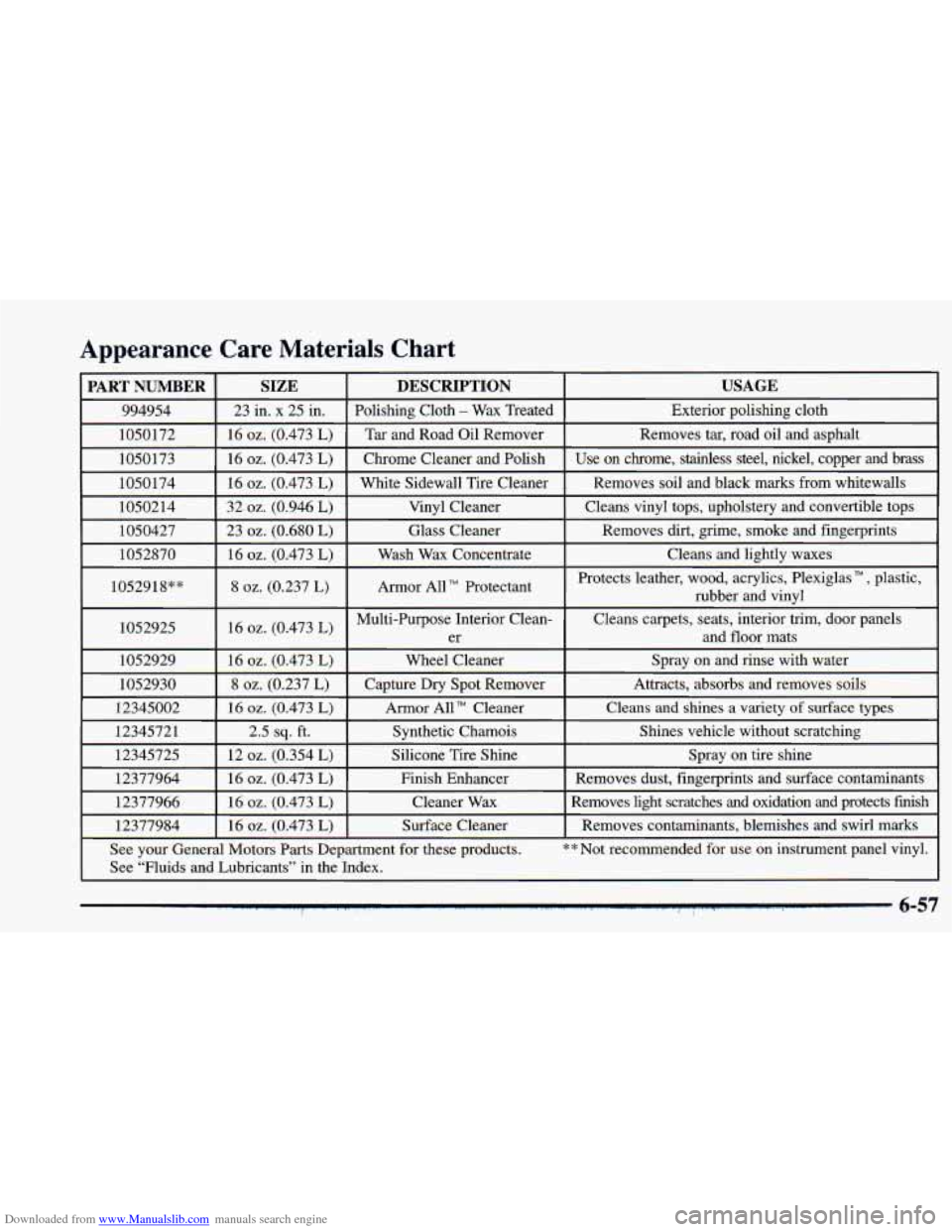
Downloaded from www.Manualslib.com manuals search engine Appearance Care Materials Chart
PART NUMBER
1050427 I 23 oz. (0.680 L)
1052870 I 16 oz. (0.473 L)
1052918**
I 8 oz. (0.237 L)
DESCRIPTION
Exterior polishing cloth
Polishing Cloth - Wax Treated
USAGE
Tar and Road Oil Remover
Removes soil and black marks from whitewalls
White Sidewall Tire Cleaner Use on chrome, stainless steel, nickel, copper and brass
Chrome Cleaner and Polish Removes tar, road oil and asphalt
Vinyl Cleaner Removes dirt, grime, smoke and fingerprints
Glass Cleaner Cleans vinyl tops, upholstery and convertible tops
Wash Wax Concentrate Cleans and lightly waxes
Armor All
TM Protectant Protects leather, wood, acrylics, Plexiglas , plastic,
rubber and vinyl
1052925 16
oz. (0.473 L) Multi-Purpose Interior Clean- Cleans carpets, seats, interior trim, door panels
er and floor mats
1052929
See your General Motors
Parts Department for these products. **Not recommended for use on instrument panel vinyl.
Removes contaminants, blemishes and swirl marks
Surface Cleaner
16
oz. (0.473 L) 12377984 Removes light scratches and oxidation and protects finish
Cleaner
Wax 16 oz. (0.473 L) 12377966 Removes dust, fingerprints and surface contaminants
Finish Enhancer
16 oz. (0.473 L) 12377964 Spray on tire shine
Silicone Tire Shine
12
oz. (0.354 L) 12345725 Shines vehicle without scratching Synthetic Chamois 2.5
sq. ft. 1234572 1
Cleans and shines a variety of surface types
Armor All TM Cleaner 16 02. (0.473 L) 12345002 Attracts, absorbs and removes soils Capture Dry Spot Remover
8 oz. (0.237 L) 1052930 Spray on and rinse with water Wheel Cleaner
16
oz. (0.473 L)
See “Fluids and Lubricants’’ in the Index.
6-57
Page 329 of 416
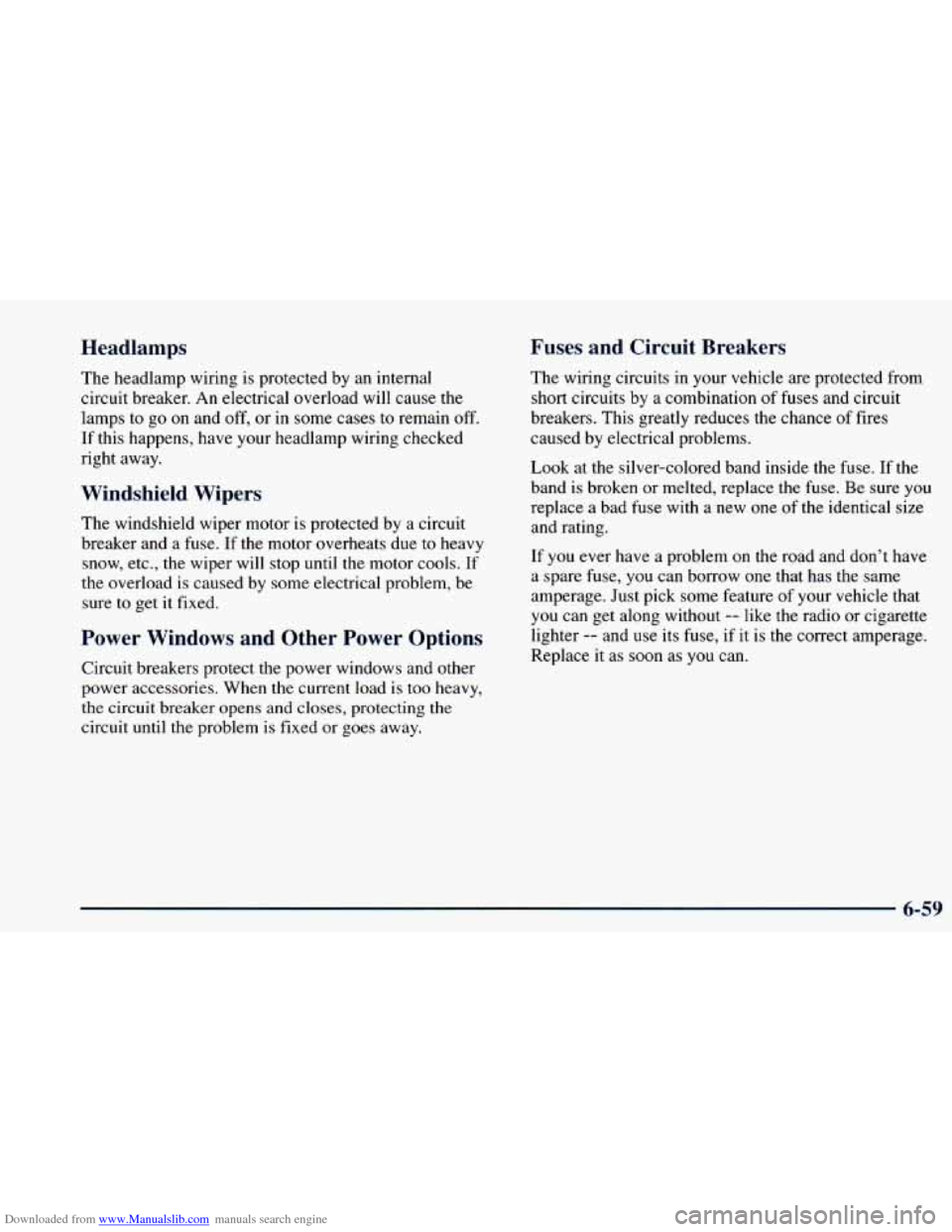
Downloaded from www.Manualslib.com manuals search engine Headlamps Fuses and Circuit Breakers
The headlamp wiring is protected by an internal
circuit breaker. An electrical overload will cause the
lamps to go
on and off, or in some cases to remain off.
If this happens, have your headlamp wiring checked
right away.
Windshield Wipers
The windshield wiper motor is protected by a circuit
breaker and a fuse. If the motor overheats due to heavy
snow, etc., the wiper will stop until the motor cools. If
the overload is caused by some electrical problem, be
sure to get it fixed.
Power Windows and Other Power Options
Circuit breakers protect the power windows and other
power accessories. When the current load is
too heavy,
the circuit breaker opens and closes, protecting the
circuit until the problem is fixed or goes away. The
wiring circuits in your vehicle are protected from
short circuits by a combination
of fuses and circuit
breakers. This greatly reduces the chance of fires
caused by electrical problems.
Look at the silver-colored band inside the fuse. If the
band
is broken or melted, replace the fuse. Be sure you
replace
a bad fuse with a new one of the identical size
and rating.
If
you ever have a problem on the road and don’t have
a spare fuse, you can borrow one that has the same
amperage. Just pick some feature of your vehicle that
you can get along without -- like the radio or cigarette
lighter
-- and use its fuse, if it is the correct amperage.
Replace it as soon as
you can.
6-59