recommended oil CHEVROLET BLAZER 1998 2.G Owners Manual
[x] Cancel search | Manufacturer: CHEVROLET, Model Year: 1998, Model line: BLAZER, Model: CHEVROLET BLAZER 1998 2.GPages: 416, PDF Size: 22.4 MB
Page 92 of 416
Downloaded from www.Manualslib.com manuals search engine How long should you keep the coolant heater plugged
in? The answer depends on the outside temperature, the
kind
of oil you have, and some other things. Instead of
trying to list everything here,
we ask that you contact
your dealer in the area where you’ll be parking your
vehicle. The dealer can give you the best advice for that
particular area.
Automatic Transmission Operation
Your automatic transmission may have a shift lever
located on the console between the seats
or on the
steering column.
There
are several different positions for your shift lever.
If your vehicle is equipped with a column shift lever, it
features an electronic shift position indicator within the
instrument cluster. This display must be powered
anytime the shift lever is capable
of being moved out of
PARK (P). This means that if your key is in OFF, but
not locked, there will be
a small current drain on your
battery which could discharge your battery over a period
of time. If you need to leave your key in the ignition in
OFF for an extended period, it is recommended that you
disconnect the battery cable from the battery to prevent
discharging your battery. PARK
(P): This
locks your rear wheels. It’s the best
position to use when you start your engine because your
vehicle can’t move easily.
It is dangerous to get out of your vehicle if the
shift lever is
not fully in PARK (P) with the
parking brake firmly set. Your vehicle can roll.
Don’t leave your vehicle when the engine is
running unless you have to. If you have left the
engine running, the vehicle can move suddenly.
You
or others could be injured. To be sure your
vehicle won’t move, even when you’re on
fairly
level ground, always set your parking brake and
move the shift lever to PARK
(P).
See “Shifting Into PARK (P)” in the Index. If
you’re pulling a trailer, see “Towing a nailer’’ in
the Index.
2-18
Page 182 of 416
Downloaded from www.Manualslib.com manuals search engine 3.
4.
5.
Press and hold the TAPE AUX button for five
seconds. The tape symbol
on the display will flash
for two seconds.
Insert the scrubbing action cleaning cassette while
the tape symbol is flashing.
Eject the cleaning cassette after the manufacturer’s
recommended cleaning time.
When the cleaning cassette has been ejected, the cut tape
detection feature is active again.
You may also choose a non-scrubbing action, wet-type
cleaner which uses a cassette with a fabric belt to clean
the tape head. This type of cleaning cassette will not
eject
on its own. A non-scrubbing action cleaner may
not clean as thoroughly as the scrubbing type cleaner.
The use of a non-scrubbing action, dry-type cleaning
cassette is not recommended.
After you clean the player, press and hold
EJECT for
five seconds to reset the
CLN indicator. The radio will
display
--- to show the indicator was reset.
Cassettes are subject to wear and
the sound quality may
degrade over time. Always make sure the cassette tape is
in good condition before
you have your tape
player serviced.
Care of Your Compact Discs
Handle discs carefully. Store them in their original cases
or other protective cases and away from direct sunlight
and dust. If the surface
of a disc is soiled, dampen a
clean, soft cloth in
a mild, neutral detergent solution and
clean it, wiping from the center
to the edge.
Be sure never to touch the signal surface when handling
discs. Pick up discs by grasping the outer edges or the
edge
of the hole and the outer edge.
Care of Your Compact Disc Player
The use of CD lens cleaner discs is not advised, due to
the risk of contaminating the lens of the
CD optics with
lubricants internal to the
CD mechanism.
Fixed Mast Antenna
The fixed mast antenna can withstand most car washes
without being damaged. If the mast should ever become
slightly bent,
you can straighten it out by hand. If the
mast is badly bent, as it might be by vandals, you should
replace it.
Check every
once in a while to be sure the mast is still
tightened to the fender.
3-30
Page 215 of 416
Downloaded from www.Manualslib.com manuals search engine The exit speed is usually posted.
Reduce your speed according to your speedometer,
not
to your sense of motion. After driving for any distance
at higher speeds,
you may tend to think you are going
slower than
you actually are.
Before Leaving on a Long Trip
Make sure you’re ready. Try to be well rested. If you
must start when you’re not fresh -- such as after a day’s
work
-- don’t plan to make too many miles that first part
of the journey. Wear comfortable clothing and shoes you
can easily drive in.
Is your vehicle ready for a long trip? If you keep it
serviced and maintained, it’s ready to go. If it needs
service, have it done before starting out. Of course,
you’ll find experienced and able service experts in GM
dealerships all across North America. They’ll be ready
and willing
to help if you need it. Here are
some things you can check before
a trip:
0
0
0
0
0
0
0
Windshield Washer Fluid: Is the reservoir full? Are
all windows clean inside and outside?
Wiper Blades: Are they in good shape?
Fuel, Engine Oil, Other Fluids: Have you checked
all levels?
Lamps: Are they all working? Are the lenses clean?
Tires: They are vitally important to a safe,
trouble-free trip.
Is the tread good enough for
long-distance driving? Are the tires all inflated to the
recommended pressure?
Weather Forecasts: What’s the weather outlook
along your route? Should
you delay your trip a short
time
to avoid a major storm system?
Maps: Do you have up-to-date maps?
4-33
Page 275 of 416
Downloaded from www.Manualslib.com manuals search engine Fuels in Foreign Countries
If you plan on driving in another country outside the
United States or Canada, the proper fuel may be hard to
find. Never use leaded gasoline or any other fuel not
recommended in the previous text on
fuel. Costly repairs
caused by use of improper fuel wouldn’t be covered by
your warranty.
To check on fuel availability, ask an auto club, or
contact a major oil company that does business in the
country where you’ll be driving.
You can also write us at the following address for
advice. Just tell us where you’re going and give your
Vehicle Identification Number (VIN).
General Motors Overseas Distribution Corporation
1908 Colonel Sam Drive
Oshawa, Ontario
L1H 8P7
Filling Your Tank
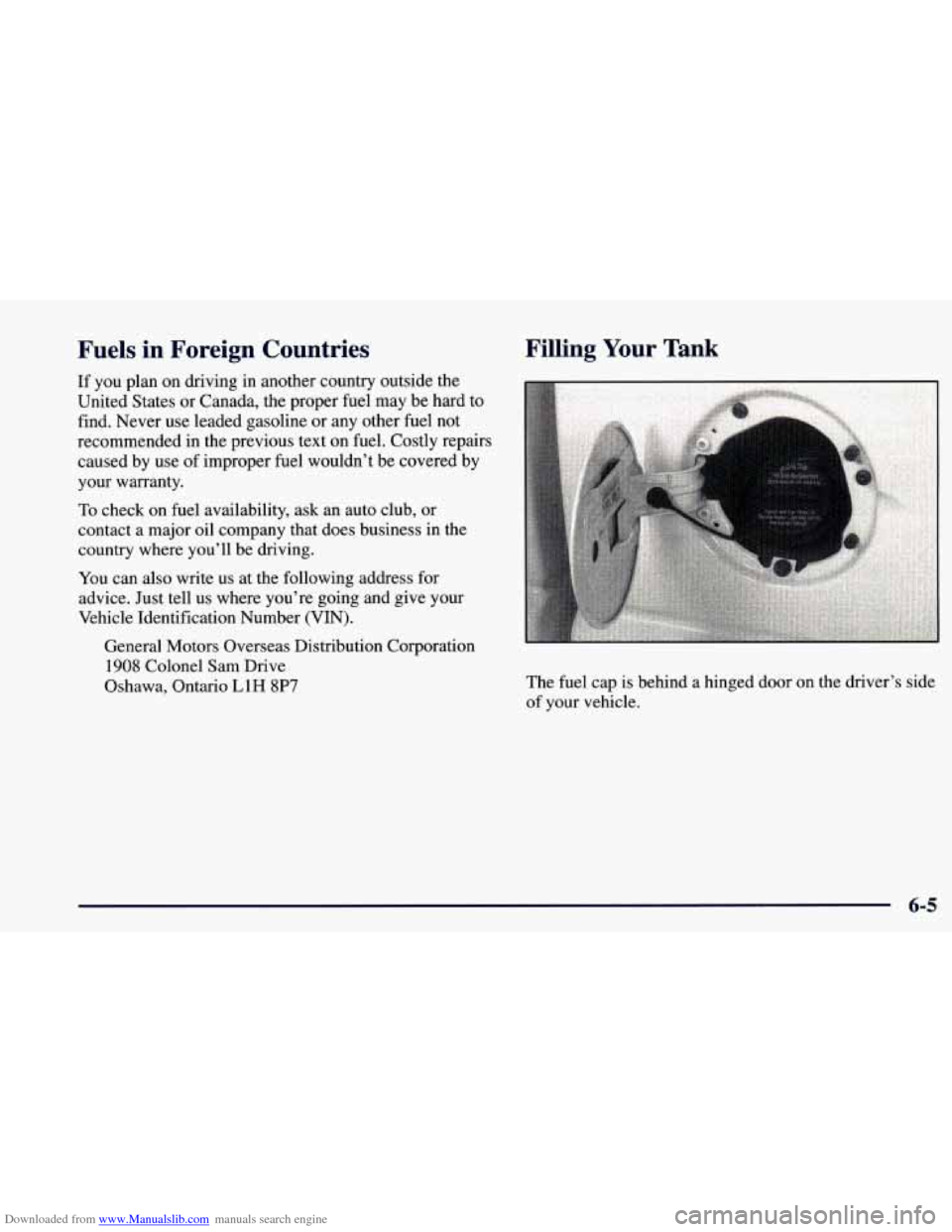
The fuel cap is behind a hinged door on the driver’s side
of your vehicle.
6-5
Page 282 of 416
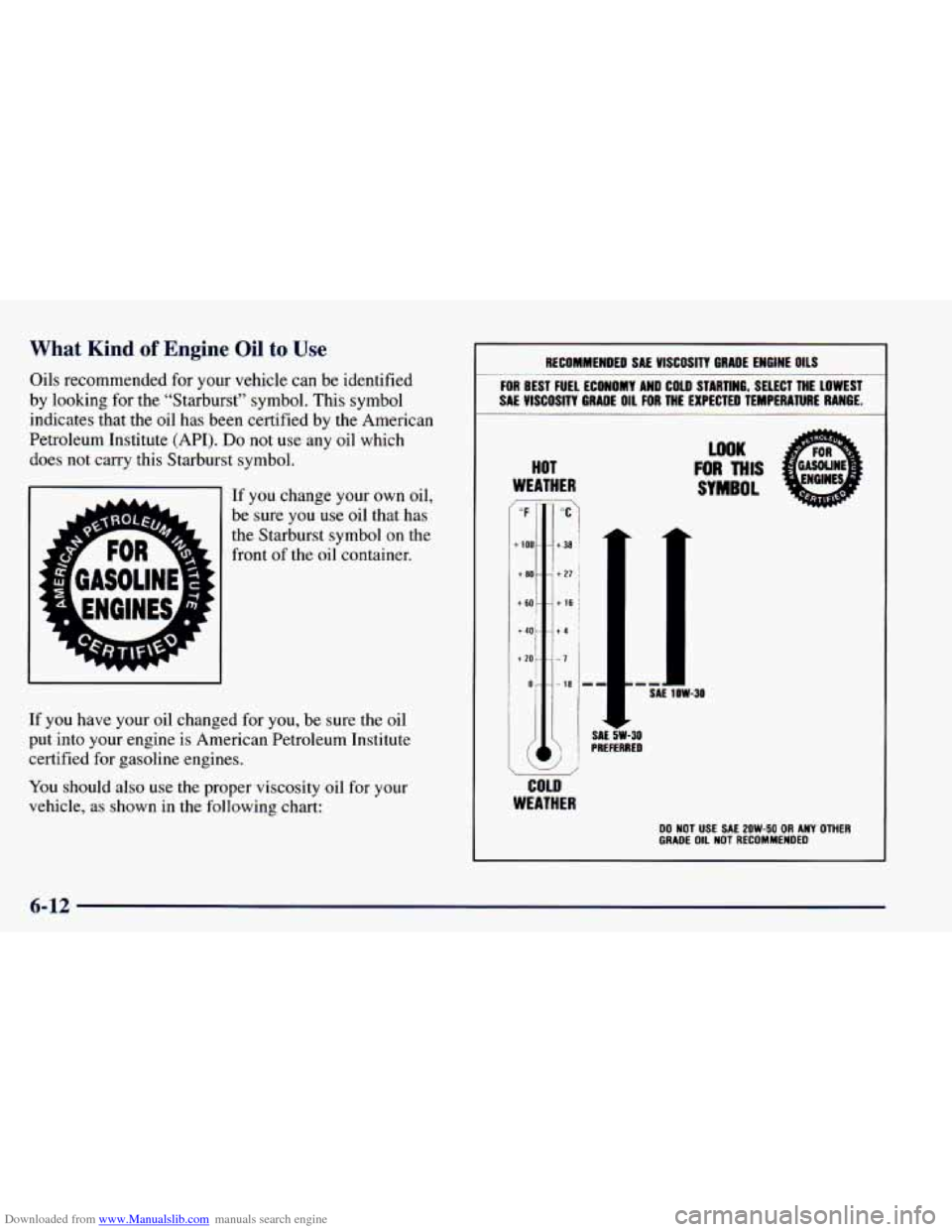
Downloaded from www.Manualslib.com manuals search engine What Kind of Engine Oil to Use
Oils recommended for your vehicle can be identified
by looking for the “Starburst” symbol. This symbol
indicates that the oil has been certified by the American
Petroleum Institute
(API). Do not use any oil which
does not carry this Starburst symbol.
If
you change your own oil,
be sure you use oil that has
the Starburst symbol on the
front of the oil container.
If you have your oil changed for you, be sure the oil
put into your engine
is American Petroleum Institute
certified for gasoline engines.
You should also use the proper viscosity oil for your
vehicle, as shown in the following chart:
RECOMMENDED SAE VlSCOSlN GRADE ENGINE OILS
FOR BEST FUEL ECONOMY AND COLD STARTING, SELECT THE LOWEST
SAL VlSCOSlN GRADE
OIL FOR THE EXPECTED TEMPERATURE RANGE.
HOT
WEATHER
/.Frl/)
-- SAE 1OW-30
SAE 5W-30 i PREFERRED
COLD
WEATHER
LOOK
FOR THIS
SYMBOL
DO NOT USE SAE 2OW-50 OR ANY OTHER GRADE OIL NOT RECOMMENDED
6-12
Page 283 of 416
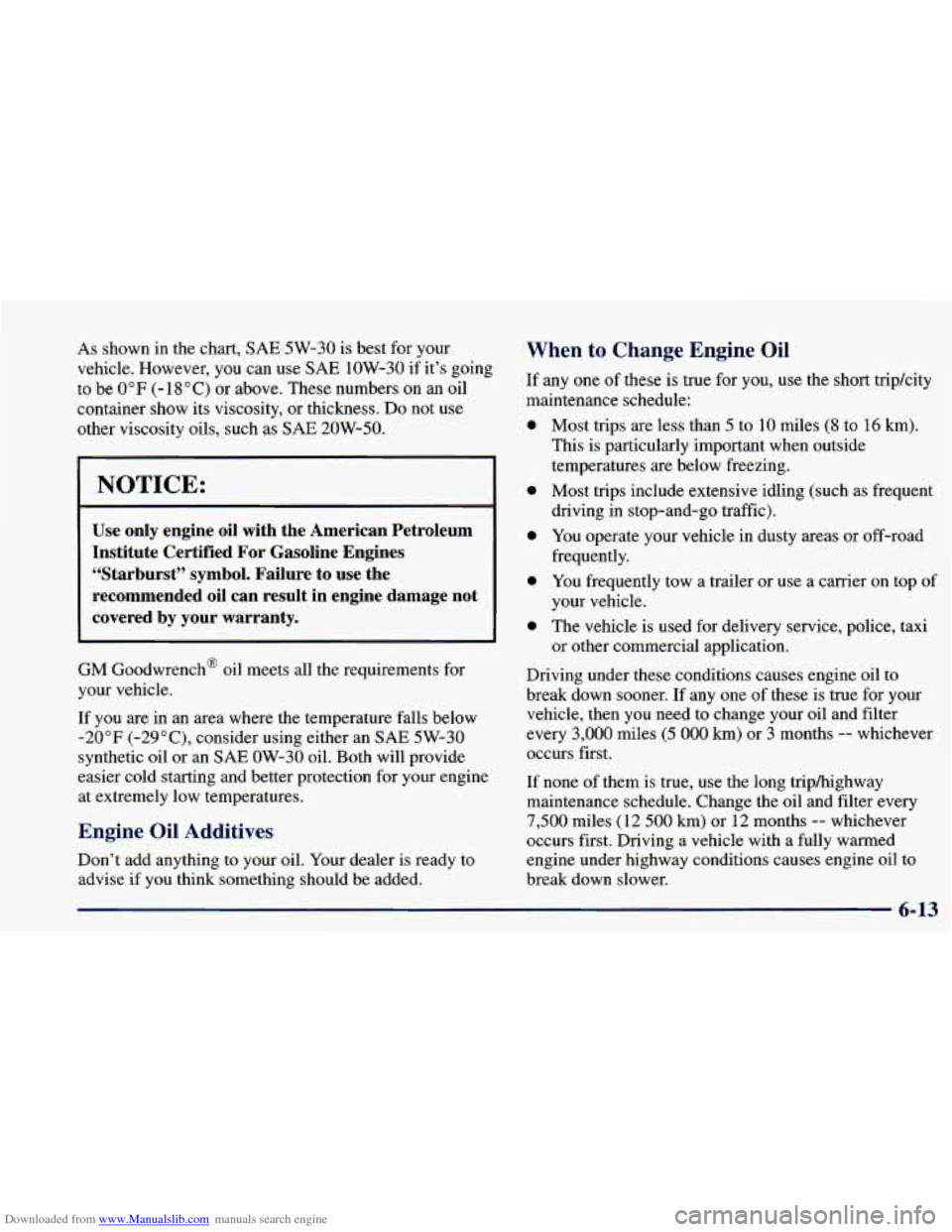
Downloaded from www.Manualslib.com manuals search engine As shown in the chart, SAE 5W-30 is best for your
vehicle. However, you can use
SAE 1OW-30 if it’s going
to be 0” F (- 18 O C) or above. These numbers on an oil
container show its viscosity, or thickness.
Do not use
other viscosity oils, such
as SAE 20W-50.
NOTICE:
Use only engine oil with the American Petroleum
Institute Certified For Gasoline Engines
“Starburst” symbol. Failure to use the
recommended
oil can result in engine damage not
covered by your warranty.
GM Goodwrench@ oil meets all the requirements for
your vehicle.
If you are in an area where the temperature falls below
-20°F (-29”C), consider using either an SAE 5W-30
synthetic oil or an
SAE OW-30 oil. Both will provide
easier cold starting and better protection for your engine
at extremely low temperatures.
Engine Oil Additives
Don’t add anything to your oil. Your dealer is ready to
advise
if you think something should be added.
When to Change Engine Oil
If any one of these is true for you, use the short tripkity
maintenance schedule:
0 Most trips are less than 5 to 10 miles (8 to 16 km).
This is particularly important when outside
temperatures are below freezing.
driving in stop-and-go traffic).
frequently.
your vehicle.
or other commercial application.
0 Most trips include extensive idling (such as frequent
0 You operate your vehicle in dusty areas or off-road
0 You frequently tow a trailer or uSe a carrier on top of
0 The vehicle is used for delivery service, police, taxi
Driving under these conditions causes engine oil to
break down sooner. If any one of these is true for your
vehicle, then you need to change your oil and filter
every
3,000 miles (5 000 km) or 3 months -- whichever
occurs first.
If none of them is true, use the long triphighway
maintenance schedule. Change the oil and filter
every
7,500 miles (12 500 km) or 12 months -- whichever
occurs first. Driving a vehicle with
a fully warmed
engine under highway conditions causes engine oil to
break down slower.
6-13
Page 327 of 416
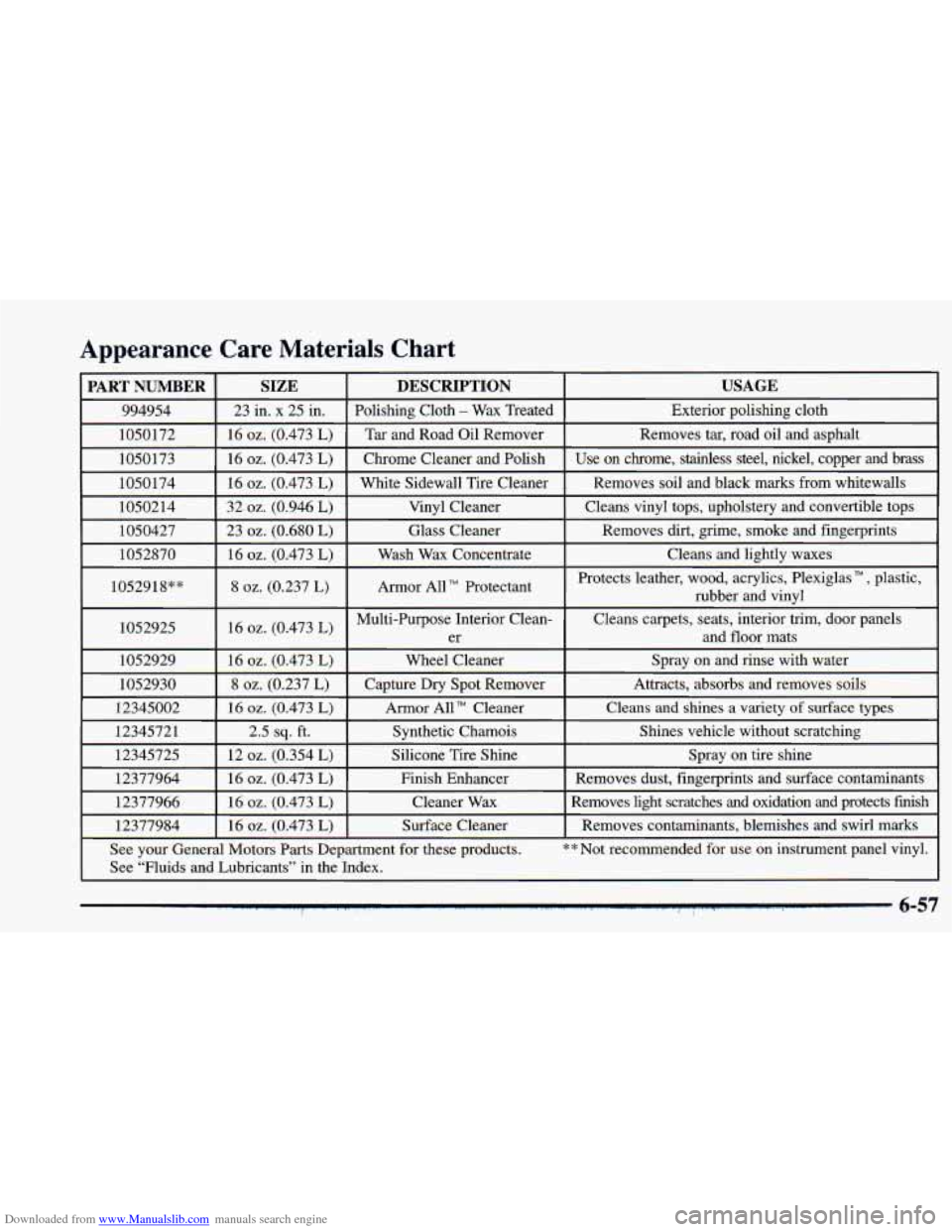
Downloaded from www.Manualslib.com manuals search engine Appearance Care Materials Chart
PART NUMBER
1050427 I 23 oz. (0.680 L)
1052870 I 16 oz. (0.473 L)
1052918**
I 8 oz. (0.237 L)
DESCRIPTION
Exterior polishing cloth
Polishing Cloth - Wax Treated
USAGE
Tar and Road Oil Remover
Removes soil and black marks from whitewalls
White Sidewall Tire Cleaner Use on chrome, stainless steel, nickel, copper and brass
Chrome Cleaner and Polish Removes tar, road oil and asphalt
Vinyl Cleaner Removes dirt, grime, smoke and fingerprints
Glass Cleaner Cleans vinyl tops, upholstery and convertible tops
Wash Wax Concentrate Cleans and lightly waxes
Armor All
TM Protectant Protects leather, wood, acrylics, Plexiglas , plastic,
rubber and vinyl
1052925 16
oz. (0.473 L) Multi-Purpose Interior Clean- Cleans carpets, seats, interior trim, door panels
er and floor mats
1052929
See your General Motors
Parts Department for these products. **Not recommended for use on instrument panel vinyl.
Removes contaminants, blemishes and swirl marks
Surface Cleaner
16
oz. (0.473 L) 12377984 Removes light scratches and oxidation and protects finish
Cleaner
Wax 16 oz. (0.473 L) 12377966 Removes dust, fingerprints and surface contaminants
Finish Enhancer
16 oz. (0.473 L) 12377964 Spray on tire shine
Silicone Tire Shine
12
oz. (0.354 L) 12345725 Shines vehicle without scratching Synthetic Chamois 2.5
sq. ft. 1234572 1
Cleans and shines a variety of surface types
Armor All TM Cleaner 16 02. (0.473 L) 12345002 Attracts, absorbs and removes soils Capture Dry Spot Remover
8 oz. (0.237 L) 1052930 Spray on and rinse with water Wheel Cleaner
16
oz. (0.473 L)
See “Fluids and Lubricants’’ in the Index.
6-57
Page 338 of 416
Downloaded from www.Manualslib.com manuals search engine IMPORTANT:
KEEP ENGINE OIL
AT THE PROPER
LEVEL AND CHANGE AS
RECOMMENDED
-
El
protection
Plan
Have you purchased the GM Protection Plan? The Plan
supplements
your new vehicle warranties. See your
Warranty and Owner Assistance booklet, or your GM
dealer for details.
Introduction
Your Vehicle and the Environment
Proper vehicle maintenance not only helps to keep your
vehicle in
good working condition, but also helps the
environment. All recommended maintenance procedures
are important. Improper vehicle maintenance can
even
affect the quality of the air we breathe. Improper fluid
levels or the wrong tire inflation can increase the level
of emissions from your vehicle. To help protect our
environment, and to keep your vehicle
in good
condition, please maintain your vehicle properly.
7-2
Page 343 of 416
Downloaded from www.Manualslib.com manuals search engine I Fzlort TripKity Maintenance Schedule I
The services shown in this schedule up to 100,000 miles
(166
000 km) should be performed after 100,000 miles
(166
000 km) at the same intervals. The services shown
at 150,000 miles (240
000 km) should be performed at
the same interval after 150,000 miles (240
000 km).
See “Owner Checks and Services” and “Periodic
Maintenance Inspections” following.
Footnotes
The U.S. Environmental Protection Agency or the
California Air Resources Board has determined that the
failure to perform this maintenance item
will not nullify
the emission warranty or limit recall liability prior to the
completion of the vehicle’s useful life. We, however,
urge that all recommended maintenance services be
performed at the indicated intervals and the maintenance
be recorded.
# Lubricate the front suspension, ball joints, steering
linkage, parking brake cable guides, propshaft splines,
universal joints and brake pedal springs.
+ A good time to check your brakes is during tire
rotation. See “Brake System Inspection” under “Periodic
Maintenance Inspections’’
in Part C of this schedule.
** Drive axle service (see “Recommended Fluids and
Lubricants” in the Index for proper lubricant to use):
0
0
0
Locking Differential -- Drain fluid and refill at first
engine oil change. At subsequent oil changes, check
fluid level and add fluid as needed. If driving in
dusty areas or towing a trailer, drain fluid and refill
every
15,000 miles (25 000 km).
Standard Differential -- Check fluid level and add
fluid as needed at every oil change. If driving in
dusty areas or towing a trailer, drain fluid and refill
every 15,000 miles
(25 000 km).
More frequent lubrication may be required for
heavy-duty or off-road use.
7-7
Page 363 of 416
Downloaded from www.Manualslib.com manuals search engine Long Tripmighway Maintenance Schedule
The services shown in this schedule up to 100,000 miles
(166
000 km) should be performed after 100,000 miles
(166 000 km) at the same intervals. The services shown
at 150,000 miles
(240 000 km) should be performed at
the same interval after 150,000 miles
(240 000 km).
See “Owner Checks and Services’’ and “Periodic
Maintenance Inspections” following.
Footnotes
-i- The U.S. Environmental Protection Agency or the
California Air Resources Board has determined that the
failure to perform this maintenance item will not
nullify
the emission warranty or limit recall liability prior to the
completion of the vehicle’s useful life. We, however,
urge that all recommended maintenance services be
performed at the indicated intervals and the maintenance
be recorded.
# Lubricate the front suspension, ball joints, steering
linkage and transfer case shift linkage, parking brake
cable guides, propshaft splines, universal joints and
brake pedal springs.
+ A good time to check your brakes is during tire
rotation. See “Brake System Inspection” under “Periodic
Maintenance Inspections” in Part
C of this schedule.
** Drive axle service (see “Recommended Fluids and
Lubricants” in the Index for proper lubricant to use):
0 Locking Differential -- Drain fluid and refill at first
engine oil change. At subsequent oil changes, check
fluid level and add fluid
as needed.
fluid as needed at every engine
oil change.
Standard Differential -- Check fluid level and add
7-27