wheel CHEVROLET BLAZER 2000 2.G Repair Manual
[x] Cancel search | Manufacturer: CHEVROLET, Model Year: 2000, Model line: BLAZER, Model: CHEVROLET BLAZER 2000 2.GPages: 430, PDF Size: 2.93 MB
Page 282 of 430
5-22
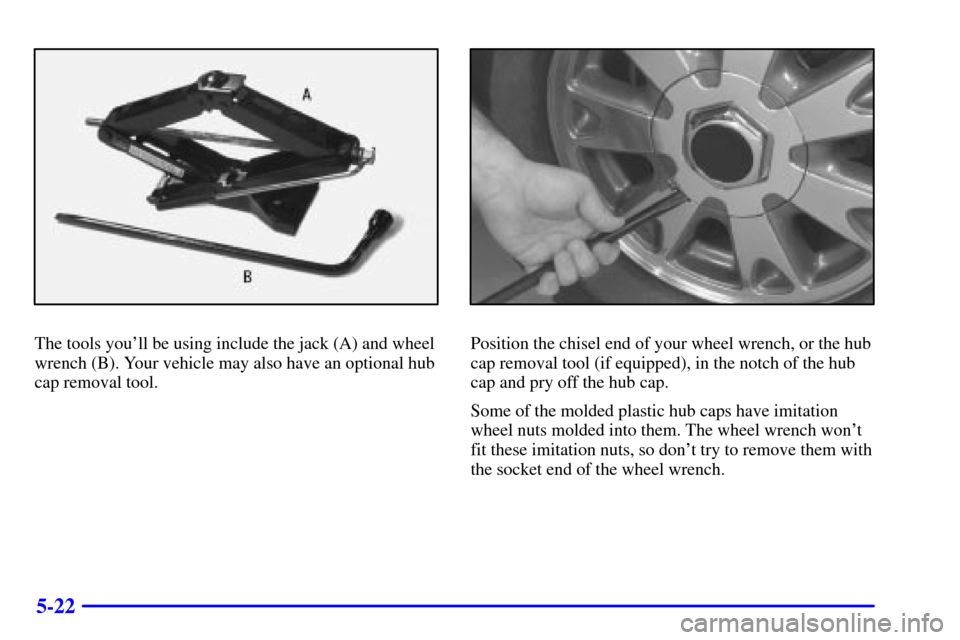
The tools you'll be using include the jack (A) and wheel
wrench (B). Your vehicle may also have an optional hub
cap removal tool.Position the chisel end of your wheel wrench, or the hub
cap removal tool (if equipped), in the notch of the hub
cap and pry off the hub cap.
Some of the molded plastic hub caps have imitation
wheel nuts molded into them. The wheel wrench won't
fit these imitation nuts, so don't try to remove them with
the socket end of the wheel wrench.
Page 283 of 430
5-23
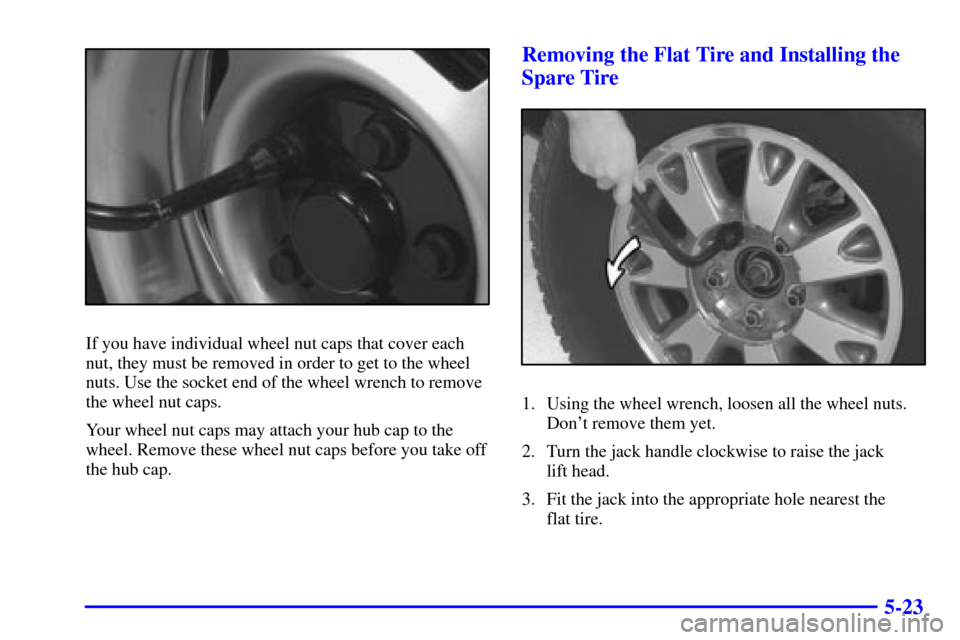
If you have individual wheel nut caps that cover each
nut, they must be removed in order to get to the wheel
nuts. Use the socket end of the wheel wrench to remove
the wheel nut caps.
Your wheel nut caps may attach your hub cap to the
wheel. Remove these wheel nut caps before you take off
the hub cap.
Removing the Flat Tire and Installing the
Spare Tire
1. Using the wheel wrench, loosen all the wheel nuts.
Don't remove them yet.
2. Turn the jack handle clockwise to raise the jack
lift head.
3. Fit the jack into the appropriate hole nearest the
flat tire.
Page 285 of 430
5-25
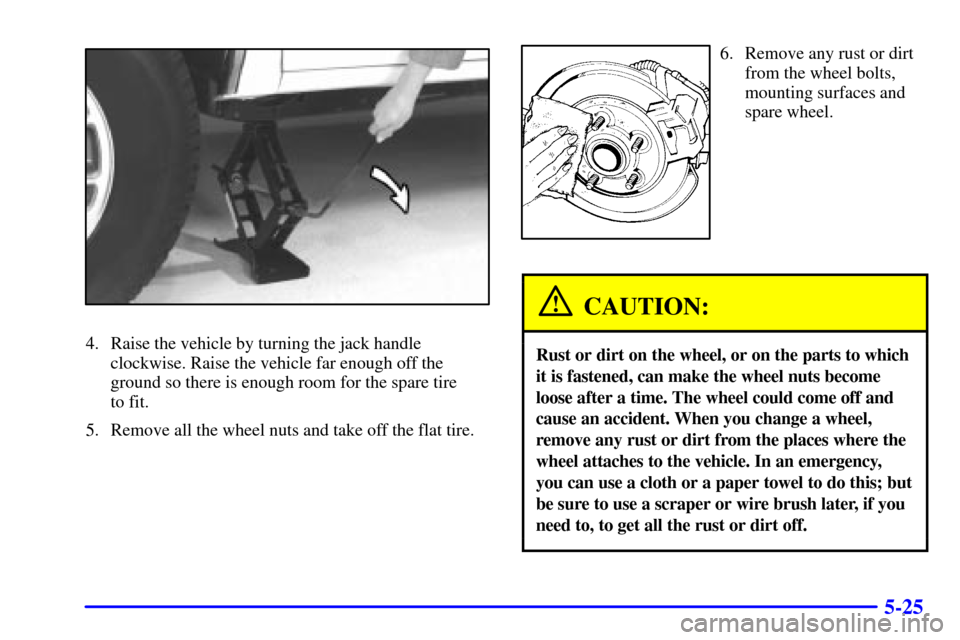
4. Raise the vehicle by turning the jack handle
clockwise. Raise the vehicle far enough off the
ground so there is enough room for the spare tire
to fit.
5. Remove all the wheel nuts and take off the flat tire.
6. Remove any rust or dirt
from the wheel bolts,
mounting surfaces and
spare wheel.
CAUTION:
Rust or dirt on the wheel, or on the parts to which
it is fastened, can make the wheel nuts become
loose after a time. The wheel could come off and
cause an accident. When you change a wheel,
remove any rust or dirt from the places where the
wheel attaches to the vehicle. In an emergency,
you can use a cloth or a paper towel to do this; but
be sure to use a scraper or wire brush later, if you
need to, to get all the rust or dirt off.
Page 286 of 430
5-26
CAUTION:
Never use oil or grease on studs or nuts. If you
do, the nuts might come loose. Your wheel could
fall off, causing a serious accident.
7. Place the spare on the wheel mounting surface.
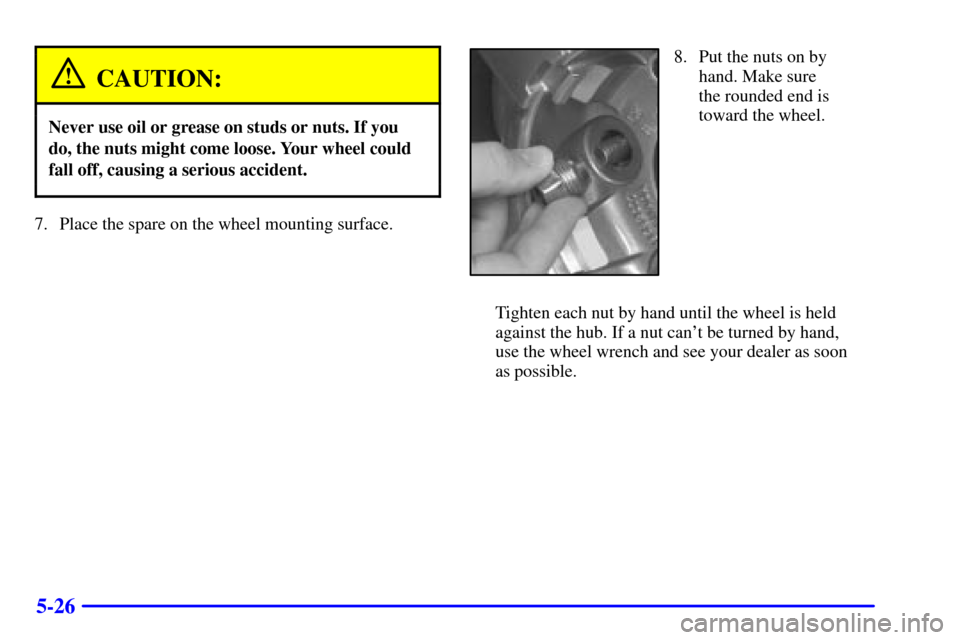
8. Put the nuts on by
hand. Make sure
the rounded end is
toward the wheel.
Tighten each nut by hand until the wheel is held
against the hub. If a nut can't be turned by hand,
use the wheel wrench and see your dealer as soon
as possible.
Page 287 of 430
5-27
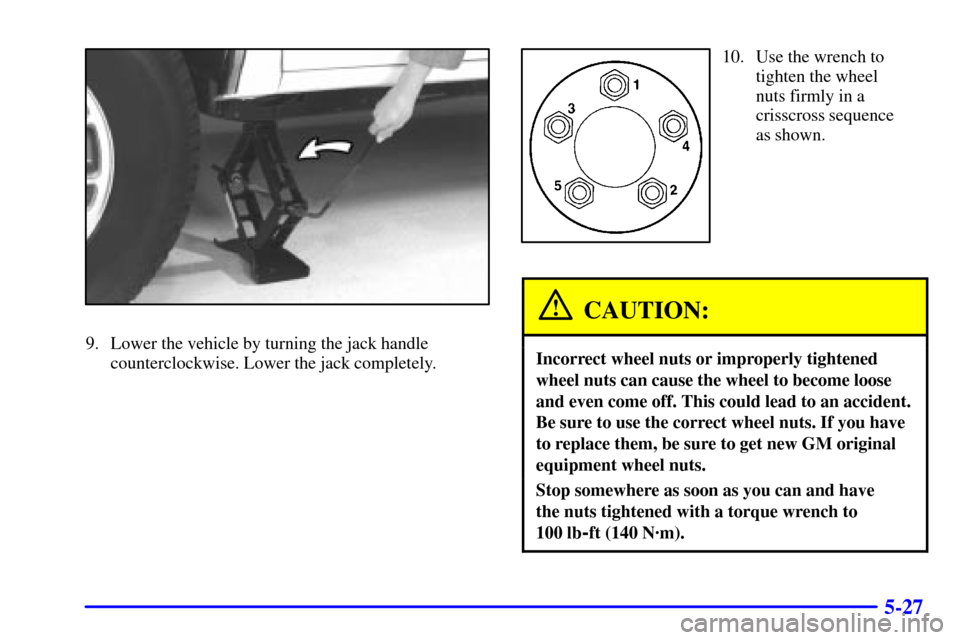
9. Lower the vehicle by turning the jack handle
counterclockwise. Lower the jack completely.
10. Use the wrench to
tighten the wheel
nuts firmly in a
crisscross sequence
as shown.
CAUTION:
Incorrect wheel nuts or improperly tightened
wheel nuts can cause the wheel to become loose
and even come off. This could lead to an accident.
Be sure to use the correct wheel nuts. If you have
to replace them, be sure to get new GM original
equipment wheel nuts.
Stop somewhere as soon as you can and have
the nuts tightened with a torque wrench to
100 lb
-ft (140 N´m).
Page 288 of 430
5-28
NOTICE:
Improperly tightened wheel nuts can lead to
brake pulsation and rotor damage. To avoid
expensive brake repairs, evenly tighten the wheel
nuts in the proper sequence and to the proper
torque specification.
Storing a Flat or Spare Tire and Tools
CAUTION:
Storing a jack, a tire or other equipment in the
passenger compartment of the vehicle could
cause injury. In a sudden stop or collision, loose
equipment could strike someone. Store all these
in the proper place.
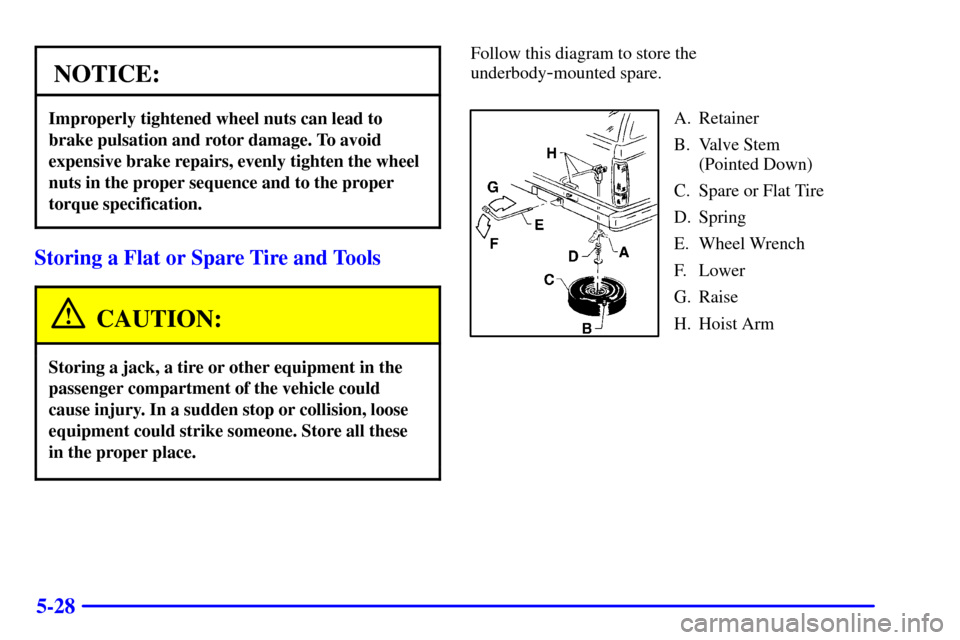
Follow this diagram to store the
underbody
-mounted spare.
A. Retainer
B. Valve Stem
(Pointed Down)
C. Spare or Flat Tire
D. Spring
E. Wheel Wrench
F. Lower
G. Raise
H. Hoist Arm
Page 289 of 430

5-29
1. Put the tire on the ground at the rear of the vehicle,
with the valve stem pointed down and to the rear.
2. Pull the retainer through the wheel.
3. Put the chisel end of the wheel wrench, on an angle,
through the hole in the rear bumper and into the
hoist shaft.
4. Raise the tire fully against the underside of the
vehicle. Continue turning the wheel wrench until the
tire is secure and the cable is tight. The spare tire
hoist cannot be overtightened.
5. Make sure the tire is stored securely. Push, pull, and
then try to rotate or turn the tire. If the tire moves,
use the wheel wrench to tighten the cable.
Page 290 of 430

5-30
Follow this diagram for the inside-mounted spare.
A. Spare or Flat Tire
B. Retainer
C. Nut
D. Wheel Carrier
E. HookFollow this diagram for the rear
-mounted spare.
A. Wheel Carrier
B. Spare or Flat Tire
C. Wheel Nut and Locking Nut Cylinder
Reinstall the locking wheel nut using the wheel wrench.
Then push the lock case onto the lug nut until it stops.
The key does not have to be inserted into the lock. Push
the lock case to be sure it is secured. The special lug nut
and lock case is not intended to be used on any road
wheel, only on the spare wheel carrier. Tighten the nuts
on the wheel carrier to 22 to 32 lb
-ft (30 to 40 N´m).
Page 291 of 430
5-31
CAUTION:
Make sure the tire and carrier are secure.
Driving with the tire or carrier unlatched could
injure pedestrians or damage the vehicle.
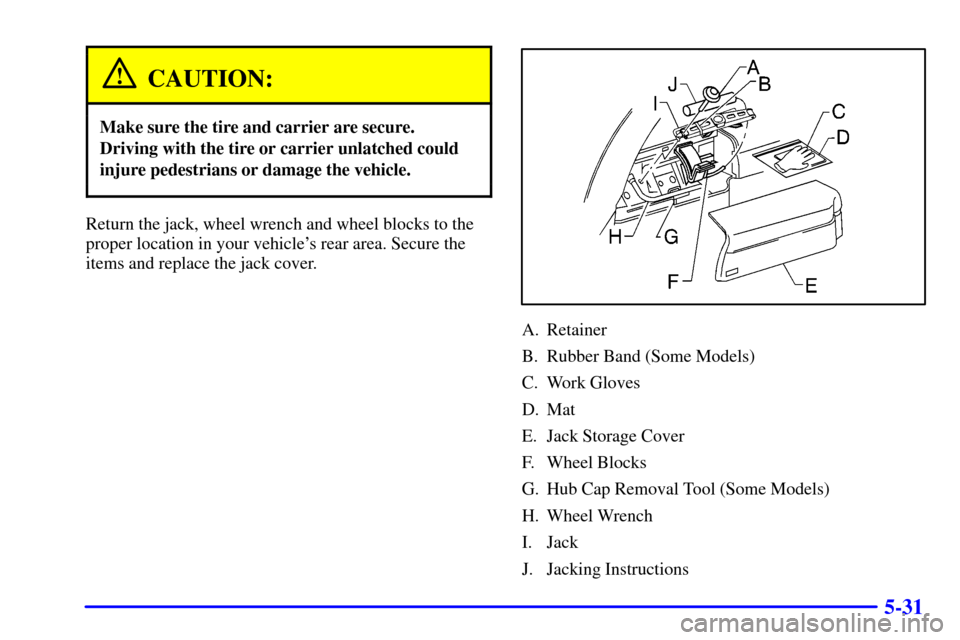
Return the jack, wheel wrench and wheel blocks to the
proper location in your vehicle's rear area. Secure the
items and replace the jack cover.
A. Retainer
B. Rubber Band (Some Models)
C. Work Gloves
D. Mat
E. Jack Storage Cover
F. Wheel Blocks
G. Hub Cap Removal Tool (Some Models)
H. Wheel Wrench
I. Jack
J. Jacking Instructions
Page 292 of 430
5-32
If You're Stuck: In Sand, Mud,
Ice or Snow
In order to free your vehicle when it is stuck, you will
need to spin the wheels, but you don't want to spin your
wheels too fast. The method known as ªrockingº can
help you get out when you're stuck, but you must
use caution.
CAUTION:
If you let your tires spin at high speed, they can
explode, and you or others could be injured.
And, the transmission or other parts of the
vehicle can overheat. That could cause an engine
compartment fire or other damage. When you're
stuck, spin the wheels as little as possible. Don't
spin the wheels above 35 mph (55 km/h) as shown
on the speedometer.
NOTICE:
Spinning your wheels can destroy parts of your
vehicle as well as the tires. If you spin the wheels
too fast while shifting your transmission back
and forth, you can destroy your transmission.
For information about using tire chains on your vehicle,
see ªTire Chainsº in the Index.