wheel CHEVROLET BLAZER 2002 2.G Repair Manual
[x] Cancel search | Manufacturer: CHEVROLET, Model Year: 2002, Model line: BLAZER, Model: CHEVROLET BLAZER 2002 2.GPages: 488, PDF Size: 2.95 MB
Page 312 of 488
5-4
1. Check the other vehicle. It must have a 12-volt
battery with a negative ground system.
NOTICE:
If the other system isn't a 12-volt system with a
negative ground, both vehicles can be damaged.
2. Get the vehicles close enough so the jumper cables
can reach, but be sure the vehicles aren't touching
each other. If they are, it could cause a ground
connection you don't want. You wouldn't be able to
start your vehicle, and the bad grounding could
damage the electrical systems.
To avoid the possibility of the vehicles rolling, set
the parking brake firmly on both vehicles involved in
the jump start procedure. Put an automatic
transmission in PARK (P) or a manual transmission
in NEUTRAL before setting the parking brake. If
you have a four
-wheel-drive vehicle, be sure the
transfer case is not in NEUTRAL (N).
NOTICE:
If you leave your radio on, it could be badly
damaged. The repairs wouldn't be covered by
your warranty.
3. Turn off the ignition on both vehicles. Unplug
unnecessary accessories plugged into the cigarette
lighter or in the accessory power outlets. Turn off the
radio and all lamps that aren't needed. This will
avoid sparks and help save both batteries. And it
could save your radio!
4. Open the hoods and locate the batteries. Find the
positive (+) and negative (
-) terminal locations on
each vehicle. See ªEngine Compartment Overviewº
in the Index for more information on location of
the battery.
Page 326 of 488

5-18
Engine Fan Noise
This vehicle has a clutched engine cooling fan. When
the clutch is engaged, the fan spins faster to provide
more air to cool the engine. In most everyday driving
conditions, the clutch is not engaged. This improves
fuel economy and reduces fan noise. Under heavy
vehicle loading, trailer towing and/or high outside
temperatures, the fan speed increases when the clutch
engages. So you may hear an increase in fan noise.
This is normal and should not be mistaken as the
transmission slipping or making extra shifts. It is merely
the cooling system functioning properly. The fan will
slow down when additional cooling is not required and
the clutch disengages.
You may also hear this fan noise when you start the
engine. It will go away as the fan clutch disengages.
If a Tire Goes Flat
It's unusual for a tire to ªblow outº while you're driving,
especially if you maintain your tires properly. If air goes
out of a tire, it's much more likely to leak out slowly.
But if you should ever have a ªblowout,º here are a few
tips about what to expect and what to do:
If a front tire fails, the flat tire will create a drag that
pulls the vehicle toward that side. Take your foot off the
accelerator pedal and grip the steering wheel firmly.
Steer to maintain lane position, and then gently brake to
a stop well out of the traffic lane.
A rear blowout, particularly on a curve, acts much like a
skid and may require the same correction you'd use in a
skid. In any rear blowout, remove your foot from the
accelerator pedal. Get the vehicle under control by
steering the way you want the vehicle to go. It may be
very bumpy and noisy, but you can still steer. Gently
brake to a stop
-- well off the road if possible.
If a tire goes flat, the next part shows how to use your
jacking equipment to change a flat tire safely.
Page 327 of 488
5-19
Changing a Flat Tire
If a tire goes flat, avoid further tire and wheel damage
by driving slowly to a level place. Turn on your hazard
warning flashers.
CAUTION:
Changing a tire can cause an injury. The vehicle
can slip off the jack and roll over you or other
people. You and they could be badly injured.
Find a level place to change your tire. To help
prevent the vehicle from moving:
1. Set the parking brake firmly.
2. Put an automatic transmission
shift lever in PARK (P) or shift a
manual transmission to FIRST (1)
or REVERSE (R).
3. If you have a four
-wheel-drive vehicle,
be sure the transfer case is in a drive
gear
-- not in NEUTRAL.
CAUTION: (Continued)
CAUTION: (Continued)
4. Turn off the engine.
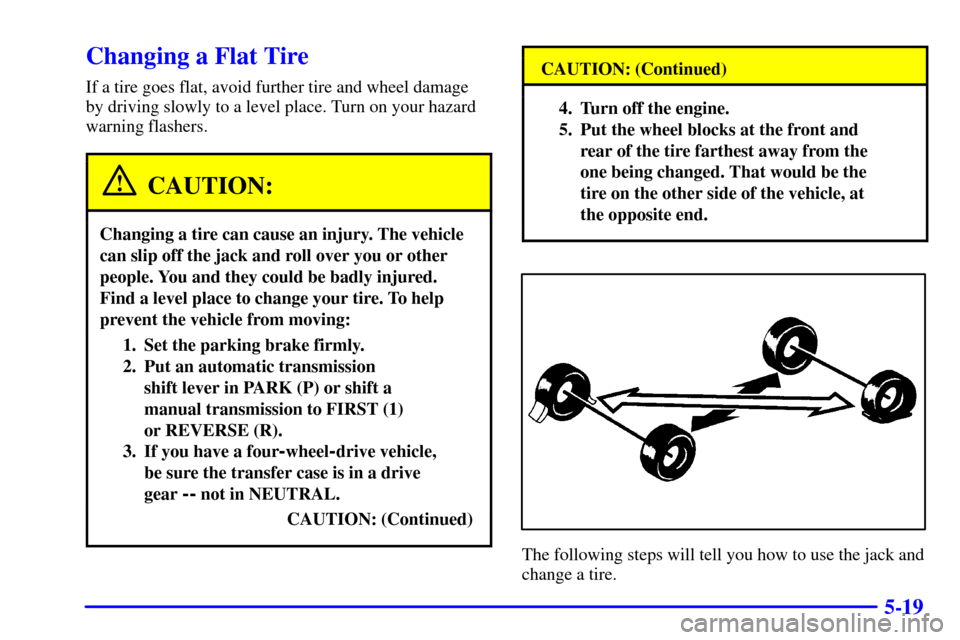
5. Put the wheel blocks at the front and
rear of the tire farthest away from the
one being changed. That would be the
tire on the other side of the vehicle, at
the opposite end.
The following steps will tell you how to use the jack and
change a tire.
Page 328 of 488
5-20 Removing the Spare Tire and Tools
The jacking equipment you'll need is stored along the
driver's side inner rear quarter panel. In some cases, you
may have to remove the spare tire in order to reach the
jack. Your vehicle is also equipped with work gloves
and a plastic ground mat to assist in the changing of a
flat tire.
The following instructions explain how to remove the
spare tire, depending on where it is mounted on your
vehicle. See ªSpare Tireº or ªCompact Spare Tireº later
in this section for more information about the spare.
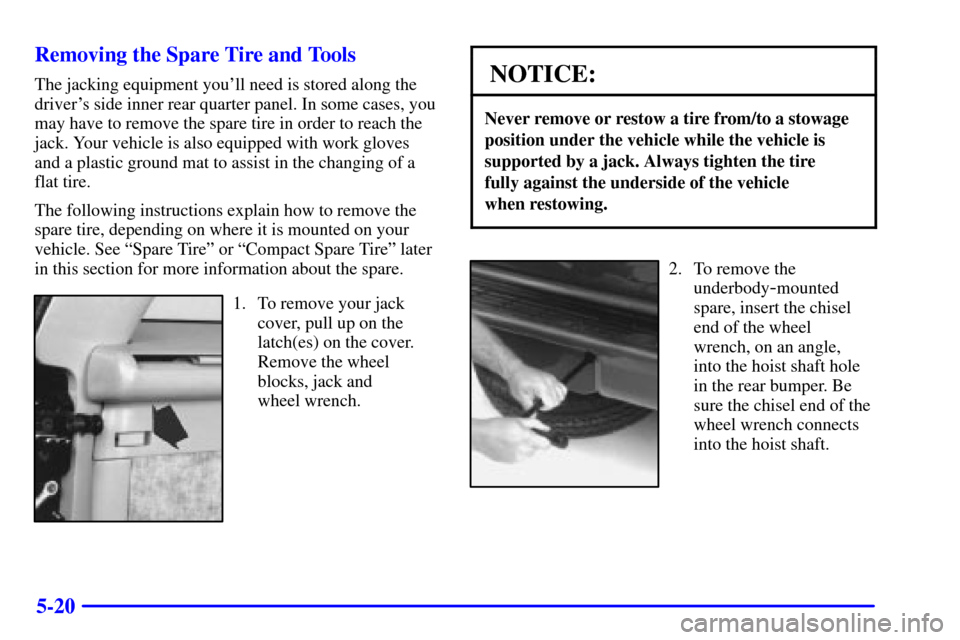
1. To remove your jack
cover, pull up on the
latch(es) on the cover.
Remove the wheel
blocks, jack and
wheel wrench.
NOTICE:
Never remove or restow a tire from/to a stowage
position under the vehicle while the vehicle is
supported by a jack. Always tighten the tire
fully against the underside of the vehicle
when restowing.
2. To remove the
underbody
-mounted
spare, insert the chisel
end of the wheel
wrench, on an angle,
into the hoist shaft hole
in the rear bumper. Be
sure the chisel end of the
wheel wrench connects
into the hoist shaft.
Page 329 of 488
5-21
3. Turn the wheel wrench counterclockwise to lower
the spare tire. Keep turning the wheel wrench until
the spare tire has been completely lowered. Tilt the
retainer at the end of the cable and pull it through
the wheel opening. Pull the tire out from under
the vehicle.
NOTICE:
To help avoid vehicle damage, do not drive the
vehicle before the cable is properly stored.
If you have an inside-mounted spare tire, the
tire must be removed in order to have access to the
jack storage.
To remove an inside
-mounted spare tire, reach into
your tire's cover and unscrew the wing nut at the
center of the wheel. Remove it and the retainer.
Unhook the tire from the mounting bracket and
remove the cover.
To remove a rear
-mounted spare tire, first make sure
that the carrier arm is fully
-latched to the endgate.
Then remove the spare tire cover.
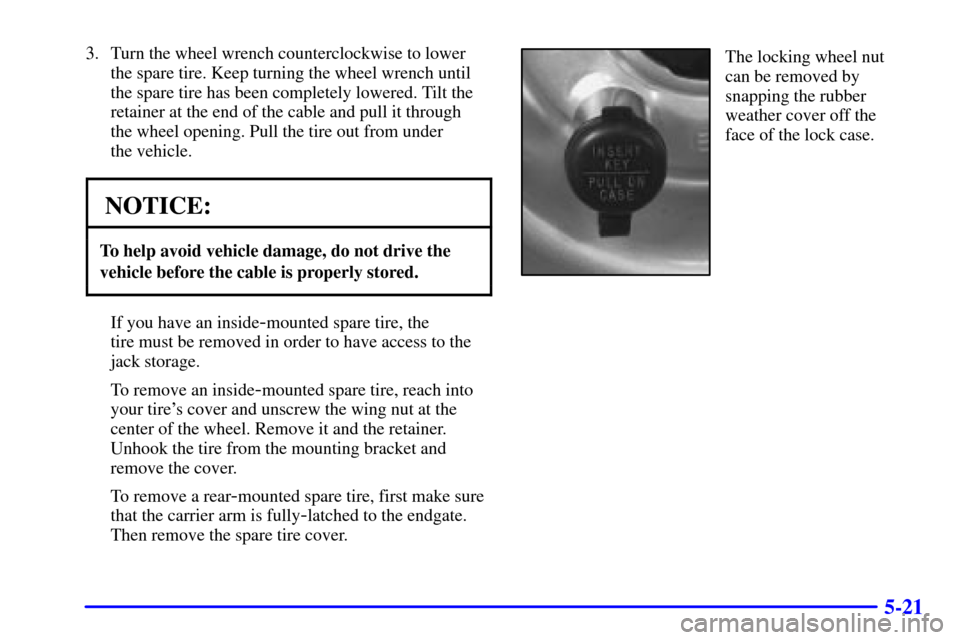
The locking wheel nut
can be removed by
snapping the rubber
weather cover off the
face of the lock case.
Page 330 of 488
5-22
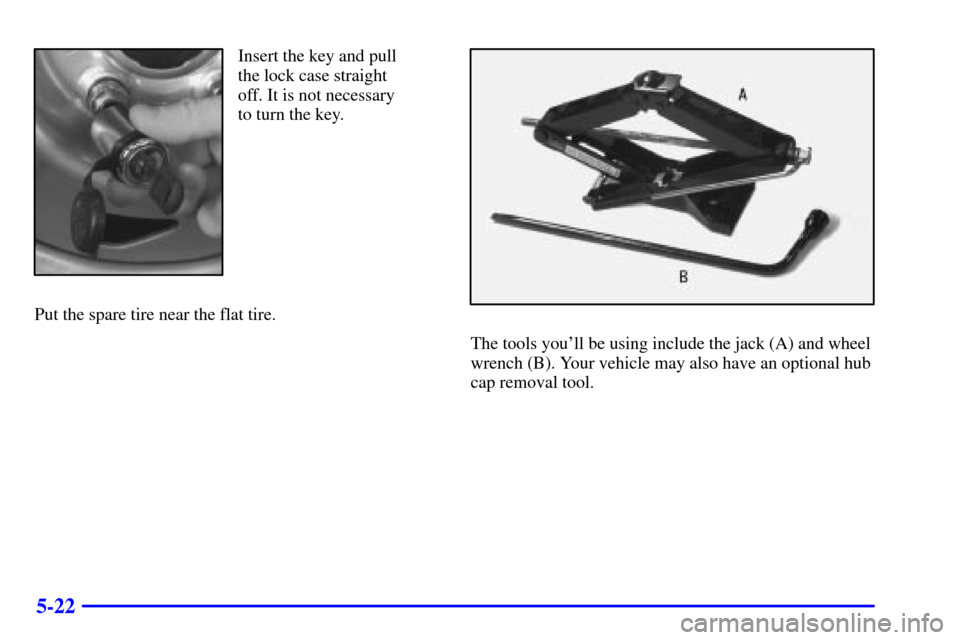
Insert the key and pull
the lock case straight
off. It is not necessary
to turn the key.
Put the spare tire near the flat tire.
The tools you'll be using include the jack (A) and wheel
wrench (B). Your vehicle may also have an optional hub
cap removal tool.
Page 331 of 488
5-23 Removing the Wheel Cover
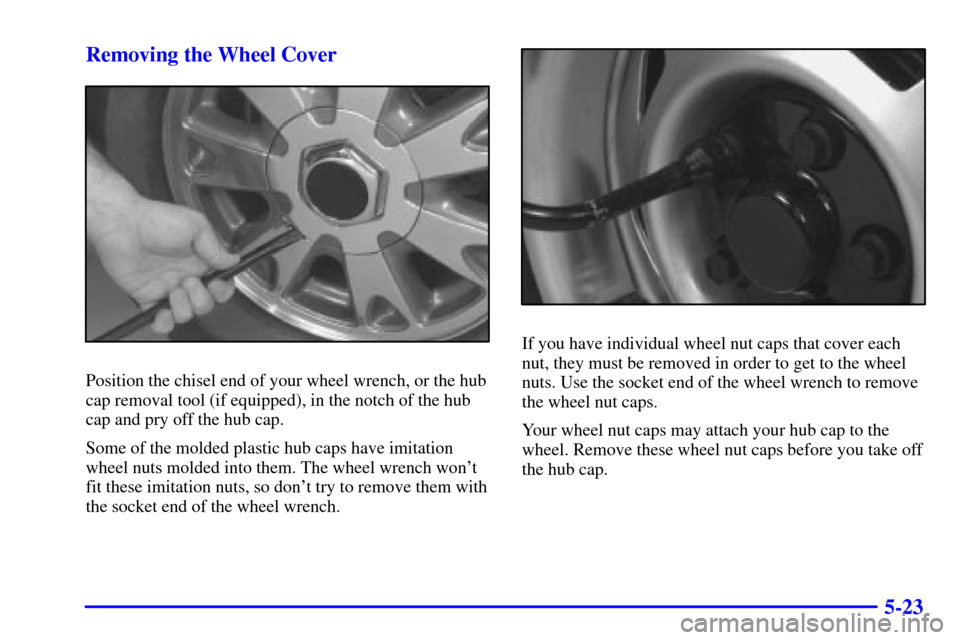
Position the chisel end of your wheel wrench, or the hub
cap removal tool (if equipped), in the notch of the hub
cap and pry off the hub cap.
Some of the molded plastic hub caps have imitation
wheel nuts molded into them. The wheel wrench won't
fit these imitation nuts, so don't try to remove them with
the socket end of the wheel wrench.
If you have individual wheel nut caps that cover each
nut, they must be removed in order to get to the wheel
nuts. Use the socket end of the wheel wrench to remove
the wheel nut caps.
Your wheel nut caps may attach your hub cap to the
wheel. Remove these wheel nut caps before you take off
the hub cap.
Page 332 of 488
5-24 Removing the Flat Tire and Installing the
Spare Tire
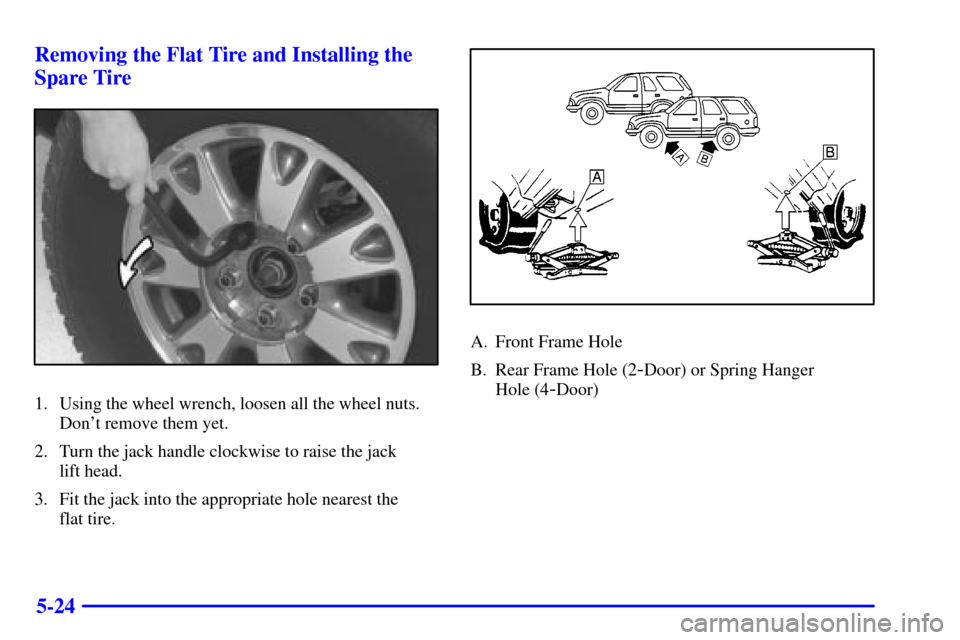
1. Using the wheel wrench, loosen all the wheel nuts.
Don't remove them yet.
2. Turn the jack handle clockwise to raise the jack
lift head.
3. Fit the jack into the appropriate hole nearest the
flat tire.
A. Front Frame Hole
B. Rear Frame Hole (2
-Door) or Spring Hanger
Hole (4
-Door)
Page 333 of 488
5-25
CAUTION:
Getting under a vehicle when it is jacked up is
dangerous. If the vehicle slips off the jack, you
could be badly injured or killed. Never get under
a vehicle when it is supported only by a jack.
CAUTION:
Raising your vehicle with the jack improperly
positioned can damage the vehicle and even
make the vehicle fall. To help avoid personal
injury and vehicle damage, be sure to fit the jack
lift head into the proper location before raising
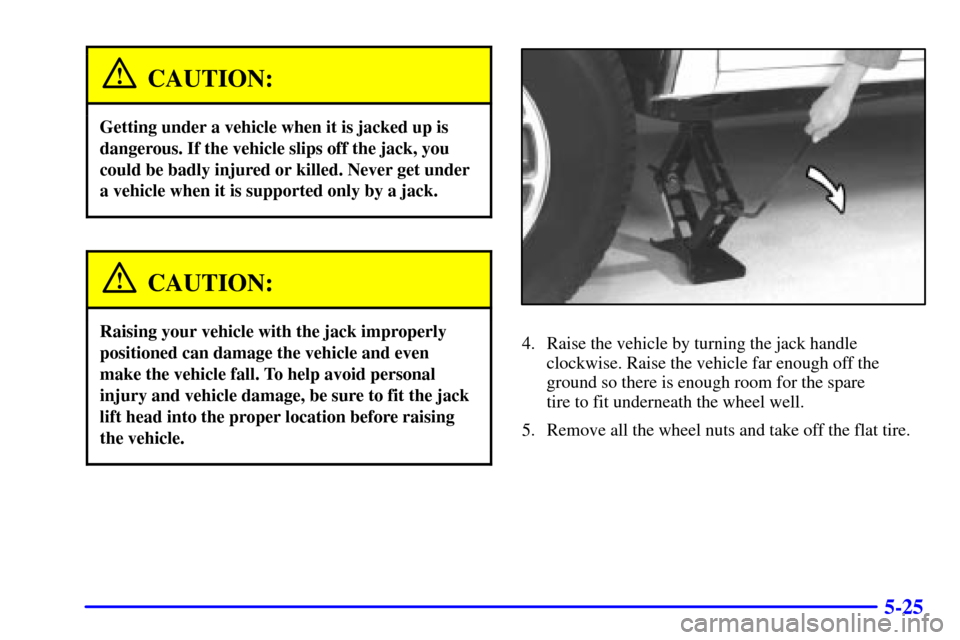
the vehicle.4. Raise the vehicle by turning the jack handle
clockwise. Raise the vehicle far enough off the
ground so there is enough room for the spare
tire to fit underneath the wheel well.
5. Remove all the wheel nuts and take off the flat tire.
Page 334 of 488
5-26
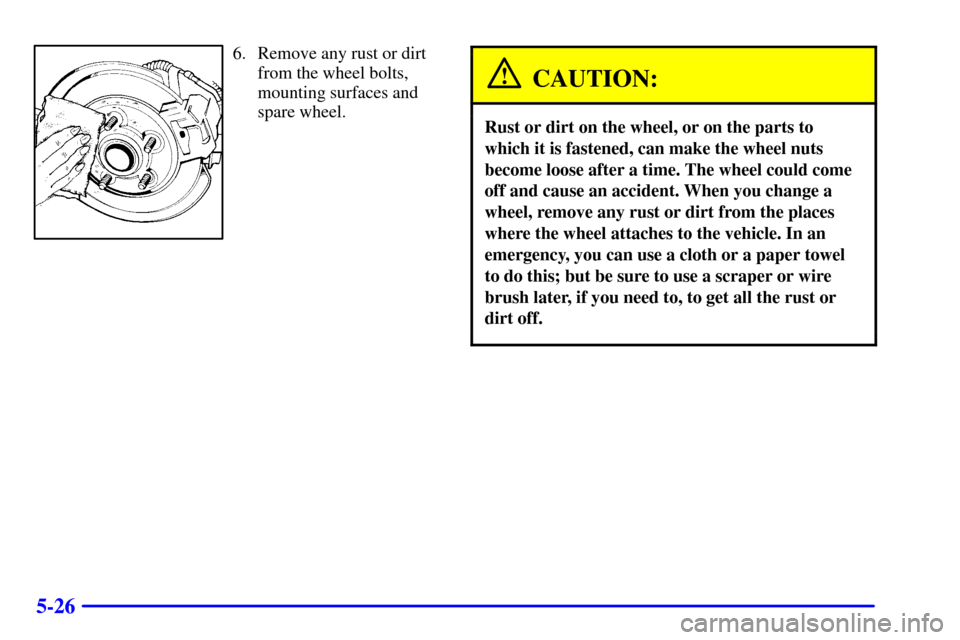
6. Remove any rust or dirt
from the wheel bolts,
mounting surfaces and
spare wheel.
CAUTION:
Rust or dirt on the wheel, or on the parts to
which it is fastened, can make the wheel nuts
become loose after a time. The wheel could come
off and cause an accident. When you change a
wheel, remove any rust or dirt from the places
where the wheel attaches to the vehicle. In an
emergency, you can use a cloth or a paper towel
to do this; but be sure to use a scraper or wire
brush later, if you need to, to get all the rust or
dirt off.