hood release CHEVROLET BLAZER 2003 2.G Owners Manual
[x] Cancel search | Manufacturer: CHEVROLET, Model Year: 2003, Model line: BLAZER, Model: CHEVROLET BLAZER 2003 2.GPages: 420, PDF Size: 2.94 MB
Page 222 of 420

Q:Are there some things I should not do when
driving down a hill?
A:Yes! These are important because if you ignore
them you could lose control and have a serious
accident.
·When driving downhill, avoid turns that take you
across the incline of the hill. A hill that's not too steep
to drive down may be too steep to drive across. You
could roll over if you don't drive straight down.
·Never go downhill with the transmission in
NEUTRAL (N), or with the clutch pedal pressed
down in a manual shift. This is called ªfree-wheeling.º
Your brakes will have to do all the work and could
overheat and fade.
Q:Am I likely to stall when going downhill?
A:It's much more likely to happen going uphill. But if
it happens going downhill, here's what to do.
·Stop your vehicle by applying the regular brakes.
Apply the parking brake.
·Shift to PARK (P) (or to neutral with the manual
transmission) and, while still braking, restart the
engine.
·Shift back to a low gear, release the parking brake,
and drive straight down.
·If the engine won't start, get out and get help.
Driving Across an Incline
Sooner or later, an off-road trail will probably go across
the incline of a hill. If this happens, you have to
decide whether to try to drive across the incline. Here
are some things to consider:
·A hill that can be driven straight up or down may be
too steep to drive across. When you go straight up
or down a hill, the length of the wheel base (the
distance from the front wheels to the rear wheels)
reduces the likelihood the vehicle will tumble
end over end. But when you drive across an incline,
the much more narrow track width (the distance
between the left and right wheels) may not prevent
the vehicle from tilting and rolling over. Also,
driving across an incline puts more weight on the
downhill wheels. This could cause a downhill
slide or a rollover.
·Surface conditions can be a problem when you
drive across a hill. Loose gravel, muddy spots,
or even wet grass can cause your tires to slip
sideways, downhill. If the vehicle slips sideways, it
can hit something that will trip it (a rock, a rut,
etc.) and roll over.
·Hidden obstacles can make the steepness of the
incline even worse. If you drive across a rock
with the uphill wheels, or if the downhill wheels drop
into a rut or depression, your vehicle can tilt
even more.
4-24
Page 265 of 420

Service............................................................5-3
Doing Your Own Service Work.........................5-3
Adding Equipment to the Outside of Your
Vehicle......................................................5-4
Fuel................................................................5-4
Gasoline Octane............................................5-4
Gasoline Speci®cations....................................5-5
California Fuel...............................................5-5
Additives.......................................................5-5
Fuels in Foreign Countries...............................5-6
Filling Your Tank............................................5-6
Filling a Portable Fuel Container.......................5-8
Checking Things Under
the Hood......................................................5-8
Hood Release................................................5-9
Engine Compartment Overview.......................5-10
Engine Oil...................................................5-11
Engine Air Cleaner/Filter................................5-15
Automatic Transmission Fluid.........................5-17
Manual Transmission Fluid.............................5-20
Hydraulic Clutch...........................................5-21
Engine Coolant.............................................5-22
Radiator Pressure Cap..................................5-25
Engine Overheating.......................................5-25
Cooling System............................................5-27
Engine Fan Noise.........................................5-34Power Steering Fluid.....................................5-35
Windshield Washer Fluid................................5-36
Brakes........................................................5-37
Battery........................................................5-40
Jump Starting...............................................5-41
Rear Axle.......................................................5-45
Four-Wheel Drive............................................5-45
Front Axle......................................................5-46
Bulb Replacement..........................................5-47
Halogen Bulbs..............................................5-47
Headlamps..................................................5-48
One-Piece Front Turn Signal Lamps................5-50
Two-Piece Front Turn Signal Lamps................5-50
Taillamps.....................................................5-51
Replacement Bulbs.......................................5-52
Windshield Wiper Blade Replacement..............5-52
Tires..............................................................5-54
In¯ation -- Tire Pressure................................5-55
Tire Inspection and Rotation...........................5-56
When It Is Time for New Tires.......................5-57
Buying New Tires.........................................5-58
Uniform Tire Quality Grading..........................5-59
Wheel Alignment and Tire Balance..................5-60
Wheel Replacement......................................5-60
Tire Chains..................................................5-62
Section 5 Service and Appearance Care
5-1
Page 273 of 420
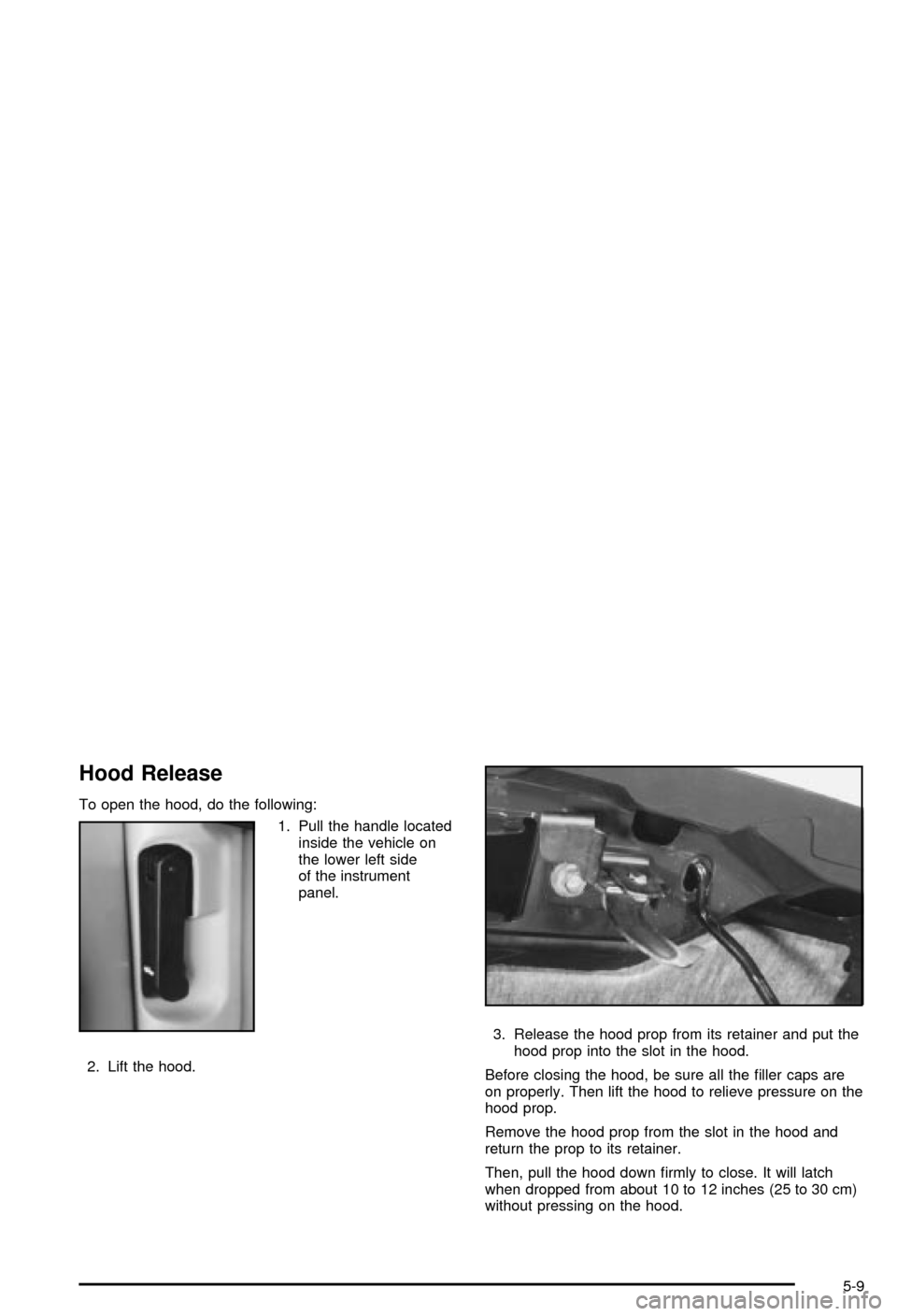
Hood Release
To open the hood, do the following:
1. Pull the handle located
inside the vehicle on
the lower left side
of the instrument
panel.
2. Lift the hood.3. Release the hood prop from its retainer and put the
hood prop into the slot in the hood.
Before closing the hood, be sure all the ®ller caps are
on properly. Then lift the hood to relieve pressure on the
hood prop.
Remove the hood prop from the slot in the hood and
return the prop to its retainer.
Then, pull the hood down ®rmly to close. It will latch
when dropped from about 10 to 12 inches (25 to 30 cm)
without pressing on the hood.
5-9
Page 384 of 420

Manual Transmission Check
Check the transmission ¯uid level; add if needed. SeeManual Transmission Fluid on page 5-20. Check
for leaks. A ¯uid leak is the only reason for ¯uid loss.
Have the system inspected and repaired if needed.
Automatic Transmission Check
Check the transmission ¯uid level; add if needed. SeeAutomatic Transmission Fluid on page 5-17. A ¯uid loss
may indicate a problem. Check the system and repair
if needed.
Hydraulic Clutch System Check
Check the ¯uid level in the clutch reservoir. SeeHydraulic Clutch on page 5-21.
A ¯uid loss in this system could indicate a problem.
Have the system inspected and repaired at once.
At Least Once a Year
Key Lock Cylinders Service
Lubricate the key lock cylinders with the lubricant
speci®ed in Part D.
Body Lubrication Service
Lubricate all hood hinges, hood latch assembly,
secondary latch, pivots, spring anchor, release pawl,
door hinges, fuel door hinge, endgate hinges, outer
tailgate handle pivot points, tailgate hinges, tailgate
mounted spare tire (if equipped), glove box and console
doors, moving seat hardware and folding seat
hardware. Part D tells you what to use. More frequent
lubrication may be required when exposed to a corrosive
environment.
Starter Switch Check
{CAUTION:
When you are doing this check, the vehicle
could move suddenly. If it does, you or others
could be injured. Follow the steps below.
1. Before you start, be sure you have enough room
around the vehicle.
2. Firmly apply both the parking brake and the regular
brake. See
Parking Brake on page 2-34if
necessary.
Do not use the accelerator pedal, and be ready to
turn off the engine immediately if it starts.
6-28
Page 390 of 420
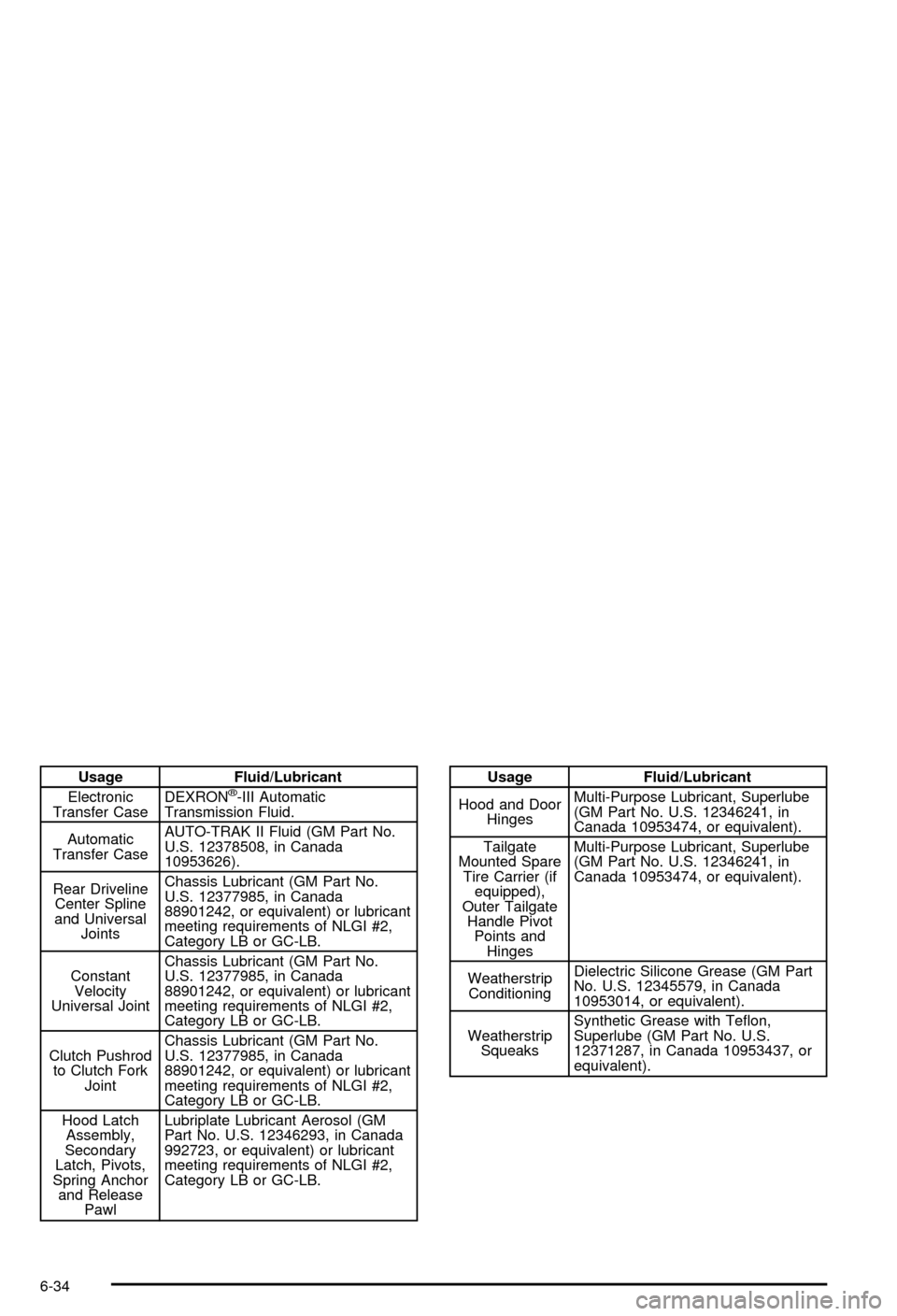
Usage Fluid/Lubricant
Electronic
Transfer CaseDEXRONž-III Automatic
Transmission Fluid.
Automatic
Transfer CaseAUTO-TRAK II Fluid (GM Part No.
U.S. 12378508, in Canada
10953626).
Rear Driveline
Center Spline
and Universal
JointsChassis Lubricant (GM Part No.
U.S. 12377985, in Canada
88901242, or equivalent) or lubricant
meeting requirements of NLGI #2,
Category LB or GC-LB.
Constant
Velocity
Universal JointChassis Lubricant (GM Part No.
U.S. 12377985, in Canada
88901242, or equivalent) or lubricant
meeting requirements of NLGI #2,
Category LB or GC-LB.
Clutch Pushrod
to Clutch Fork
JointChassis Lubricant (GM Part No.
U.S. 12377985, in Canada
88901242, or equivalent) or lubricant
meeting requirements of NLGI #2,
Category LB or GC-LB.
Hood Latch
Assembly,
Secondary
Latch, Pivots,
Spring Anchor
and Release
PawlLubriplate Lubricant Aerosol (GM
Part No. U.S. 12346293, in Canada
992723, or equivalent) or lubricant
meeting requirements of NLGI #2,
Category LB or GC-LB.
Usage Fluid/Lubricant
Hood and Door
HingesMulti-Purpose Lubricant, Superlube
(GM Part No. U.S. 12346241, in
Canada 10953474, or equivalent).
Tailgate
Mounted Spare
Tire Carrier (if
equipped),
Outer Tailgate
Handle Pivot
Points and
HingesMulti-Purpose Lubricant, Superlube
(GM Part No. U.S. 12346241, in
Canada 10953474, or equivalent).
Weatherstrip
ConditioningDielectric Silicone Grease (GM Part
No. U.S. 12345579, in Canada
10953014, or equivalent).
Weatherstrip
SqueaksSynthetic Grease with Te¯on,
Superlube (GM Part No. U.S.
12371287, in Canada 10953437, or
equivalent).
6-34
Page 411 of 420

Gate Operator and Canadian Programming........2-47
Getting Familiar with Off-Road Driving................4-17
Glove Box.....................................................2-48
GM Mobility Program for Persons with
Disabilities.................................................... 7-6
H
Hazard Warning Flashers................................... 3-3
Head Restraints............................................... 1-7
Headlamp High/Low-Beam Changer.................... 3-6
Headlamps....................................................5-48
Bulb Replacement.......................................5-47
Electrical System.........................................5-84
Halogen Bulbs............................................5-47
One-Piece Front Turn Signal Lamps...............5-50
Two-Piece Front Turn Signal Lamps...............5-50
Heated Seats................................................... 1-5
Heating.........................................................3-18
Highway Hypnosis...........................................4-36
Hill and Mountain Roads..................................4-36
Hitches..........................................................4-59
HomeLink Transmitter, Programming..................2-45
HomeLink
žTransmitter....................................2-44
Hood.............................................................. 5-8
Checking Things Under.................................. 5-8
Release....................................................... 5-9
Horn............................................................... 3-4How to Add Coolant to the Coolant
Recovery Tank............................................5-29
How to Add Coolant to the Radiator..................5-31
How to Add Fluid....................................5-19, 5-21
How to Check and Add Fluid............................5-22
How to Check Lubricant..........................5-45, 5-46
How to Check Power Steering Fluid..................5-35
How to Check................................5-17, 5-20, 5-56
How to Inspect the Engine Air
Cleaner/Filter..............................................5-16
How to Use This Manual...................................... ii
How to Wear Safety Belts Properly...................1-14
Hydraulic Clutch System Check........................6-28
Hydraulic Clutch.............................................5-21
Hydroplaning..................................................4-31
I
If No Steam Is Coming From Your Engine..........5-26
If Steam Is Coming From Your Engine...............5-26
If the Light Is Flashing.....................................3-31
If the Light Is On Steady.................................3-31
If You Are Stuck in Sand, Mud, Ice or Snow.......4-42
If You Decide To Pull A Trailer..........................4-55
If You're Caught in a Blizzard...........................4-40
Ignition Positions.............................................2-19
Ignition Transmission Lock Check......................6-29
Infants and Young Children, Restraints...............1-34
In¯ation -- Tire Pressure..................................5-55
7