fuel cap CHEVROLET BLAZER 2004 2.G User Guide
[x] Cancel search | Manufacturer: CHEVROLET, Model Year: 2004, Model line: BLAZER, Model: CHEVROLET BLAZER 2004 2.GPages: 446, PDF Size: 2.93 MB
Page 341 of 446
Aspect Ratio:The relationship of a tire’s height to
its width.
Belt:A rubber coated layer of cords that is located
between the plies and the tread. Cords may be made
from steel or other reinforcing materials.
Bead:The tire bead contains steel wires wrapped by
steel cords that hold the tire onto the rim.
Bias Ply Tire:A pneumatic tire in which the plies are
laid at alternate angles less than 90 degrees to the
centerline of the tread.
Cold Ination Pressure:The amount of air pressure
in a tire, measured in pounds per square inch (psi)
or kilopascals (kPa) before a tire has built up heat from
driving. SeeInation - Tire Pressure on page 5-67.
Curb Weight:This means the weight of a motor vehicle
with standard and optional equipment including the
maximum capacity of fuel, oil and coolant, but without
passengers and cargo.
DOT Markings:A code molded into the sidewall of a
tire signifying that the tire is in compliance with the
U.S. Department of Transportation motor vehicle safety
standards. The DOT code includes the Tire Identication
Number (TIN), an alphanumeric designator which can
also identify the tire manufacturer, production plant,
brand and date of production.GVWR:Gross Vehicle Weight Rating, seeLoading
Your Vehicle on page 4-54.
GAWR FRT:Gross Axle Weight Rating for the front
axle, seeLoading Your Vehicle on page 4-54.
GAWR RR:Gross Axle Weight Rating for the rear axle,
seeLoading Your Vehicle on page 4-54.
Intended Outboard Sidewall:The side of an
asymmetrical tire, that must always face outward when
mounted on a vehicle.
Kilopascal (kPa):The metric unit for air pressure.
There are 6.9 kPa’s to one psi.
Light Truck (LT-Metric) Tire:A tire used on light duty
trucks and some multipurpose passenger vehicles.
Load Index:An assigned number ranging from
1 to 279 that corresponds to the load carrying capacity
of a tire.
Maximum Ination Pressure:The maximum air
pressure to which a cold tire may be inated. The
maximum air pressure is molded onto the sidewall.
Maximum Load Rating:The load rating for a tire at the
maximum permissible ination pressure for that tire.
5-65
Page 343 of 446
UTQGS:Uniform Tire Quality Grading Standards,
a tire information system that provides consumers with
ratings for a tire’s traction, temperature and treadwear.
Ratings are determined by tire manufacturers using
government testing procedures. The ratings are molded
into the sidewall of the tire. SeeUniform Tire Quality
Grading on page 5-71.
Vehicle Capacity Weight:The number of designated
seating positions multiplied by 150 lbs. (68 kg) plus
the rated cargo load. SeeLoading Your Vehicle
on page 4-54.
Vehicle Maximum Load on the Tire:Load on an
individual tire due to curb weight, accessory weight,
occupant weight and cargo weight.
Vehicle Placard:A label permanently attached to
a vehicle showing the original equipment tire size and
recommended ination pressure. SeeLoading
Your Vehicle on page 4-54.Ination - Tire Pressure
The tire and loading information label, shows the correct
ination pressures for your tires when they’re cold.
“Cold” means your vehicle has been sitting for at least
three hours or driven no more than 1 mile (1.6 km).
SeeLoading Your Vehicle on page 4-54, for the location
of your vehicle’s tire and loading information label.
Notice:Don’t let anyone tell you that underination
or overination is all right. It’s not. If your tires
don’t have enough air (underination), you can get
the following:
Too much exing
Too much heat
Tire overloading
Bad wear
Bad handling
Bad fuel economy
If your tires have too much air (overination),
you can get the following:
Unusual wear
Bad handling
Rough ride
Needless damage from road hazards
5-67
Page 379 of 446
Fuse Usage
IGN B Column Feed,Ignition 2, 3, 4
STARTER Starter
RAP Retained Accessory Power
LD LEV Not Used
OXYSEN Oxygen Sensor
IGN E Engine
MIR/LKS Mirrors, Door Locks
FOG LP Fog Lamps
IGN A Starting and Charging Ignition 1
STUD #2 Accessory Feeds, Electric Brake
PARKLP Parking Lamps
LR PRK Left Rear Parking Lamps
LIFTGLASS Liftglass
IGN CStarter Solenoid, Fuel Pump,
PRNDL
HTDSEAT Heated Seat
HVACHeating,Ventilation, Air Cooling
System
TRCHMSLTrailer Center High Mount
Stop Light
RRDFOG Rear Defogger
TBC Truck Body Computer
CRANK Clutch Switch, NSBU Switch
CHMSL Center High Mounted StoplampFuse Usage
HAZLP Hazard Lamps
VECHMSLVehicle Center High-Mounted
Stop Lamp
RR DEFOG Rear Defogger
HTDMIR Heated Mirror
ATC Transfer Case (Four-Wheel Drive)
STOPLP Stop Lamps
RR W/W Rear Window Wiper
Capacities and Specications
Engine Specications
Engine VORTEC™ 4300
VIN Code X
Spark Plug Gap 0.060 inches (1.52 mm)
Firing Order 1–6–5–4–3–2
Wheels and Tires
Wheel Nut Torque 100 lb-ft (140 N·m)
Tire PressureSee the Certication/Tire
label. See “Loading Your
Vehicle” in the Index.
5-103
Page 380 of 446
Capacities
Please refer toPart D: Recommended Fluids and Lubricants on page 6-33for more information.
ApplicationCapacities
English Metric
Air Conditioning Refrigerant R134a 1.8 lbs 0.8 kg
Cooling System*
Automatic Transmission
Manual Transmission13.8 quarts
14.1 quarts13.1 L
13.3 L
Automatic Transmission (Drain and Rell)* 5.0 quarts 4.7 L
Differential Fluid*
Front
Rear2.6 pints
4.0 pints1.2 L
1.9 L
Engine Oil with Filter* 4.5 quarts 4.3 L
Fuel Tank (2–Door Models) 19.0 gallons 72.0 L
Fuel Tank (4–Door Models) 18.0 gallons 68.0 L
*All capacities are approximate. After rell, the levelmustbe checked.
5-104
Page 411 of 446
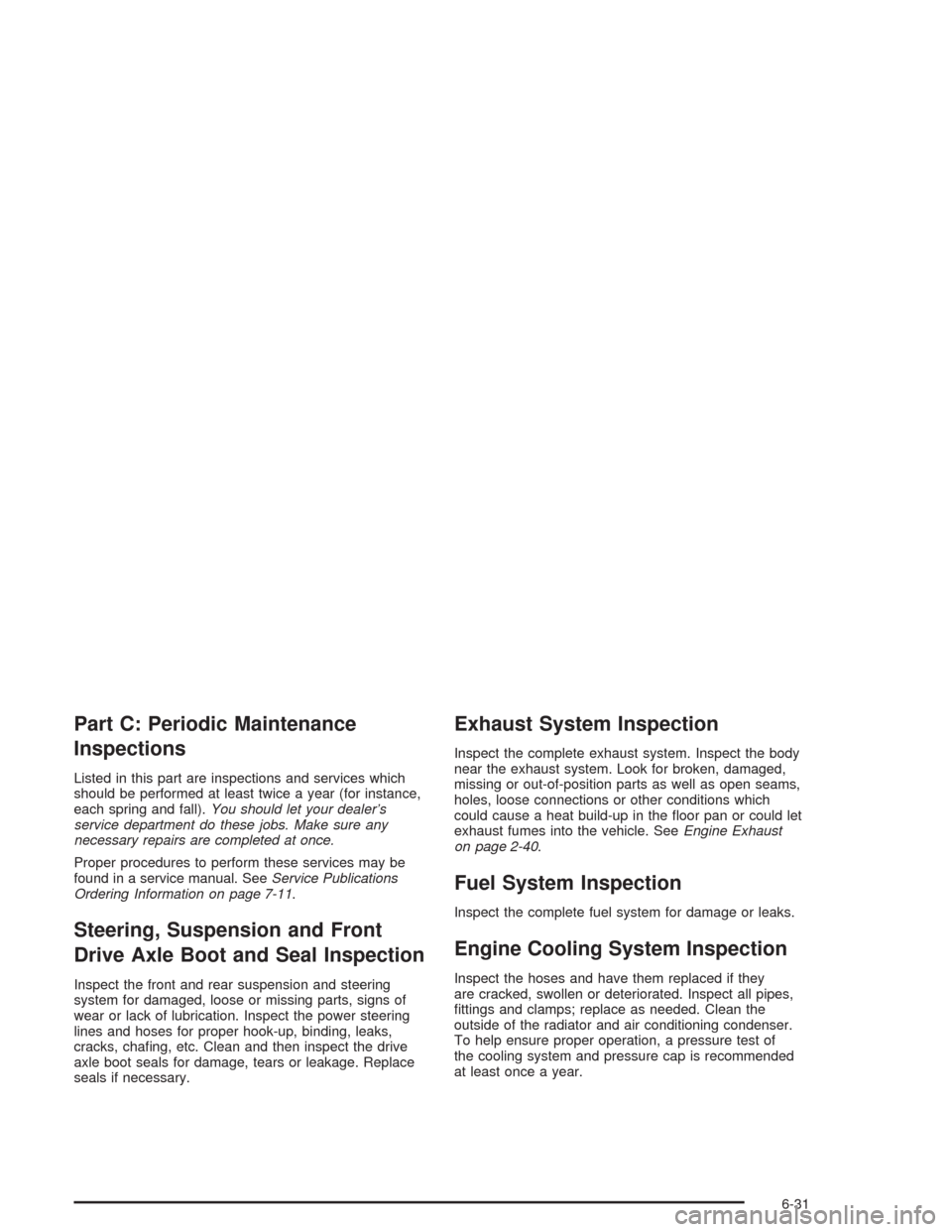
Part C: Periodic Maintenance
Inspections
Listed in this part are inspections and services which
should be performed at least twice a year (for instance,
each spring and fall).You should let your dealer’s
service department do these jobs. Make sure any
necessary repairs are completed at once.
Proper procedures to perform these services may be
found in a service manual. SeeService Publications
Ordering Information on page 7-11.
Steering, Suspension and Front
Drive Axle Boot and Seal Inspection
Inspect the front and rear suspension and steering
system for damaged, loose or missing parts, signs of
wear or lack of lubrication. Inspect the power steering
lines and hoses for proper hook-up, binding, leaks,
cracks, chang, etc. Clean and then inspect the drive
axle boot seals for damage, tears or leakage. Replace
seals if necessary.
Exhaust System Inspection
Inspect the complete exhaust system. Inspect the body
near the exhaust system. Look for broken, damaged,
missing or out-of-position parts as well as open seams,
holes, loose connections or other conditions which
could cause a heat build-up in the oor pan or could let
exhaust fumes into the vehicle. SeeEngine Exhaust
on page 2-40.
Fuel System Inspection
Inspect the complete fuel system for damage or leaks.
Engine Cooling System Inspection
Inspect the hoses and have them replaced if they
are cracked, swollen or deteriorated. Inspect all pipes,
ttings and clamps; replace as needed. Clean the
outside of the radiator and air conditioning condenser.
To help ensure proper operation, a pressure test of
the cooling system and pressure cap is recommended
at least once a year.
6-31
Page 424 of 446
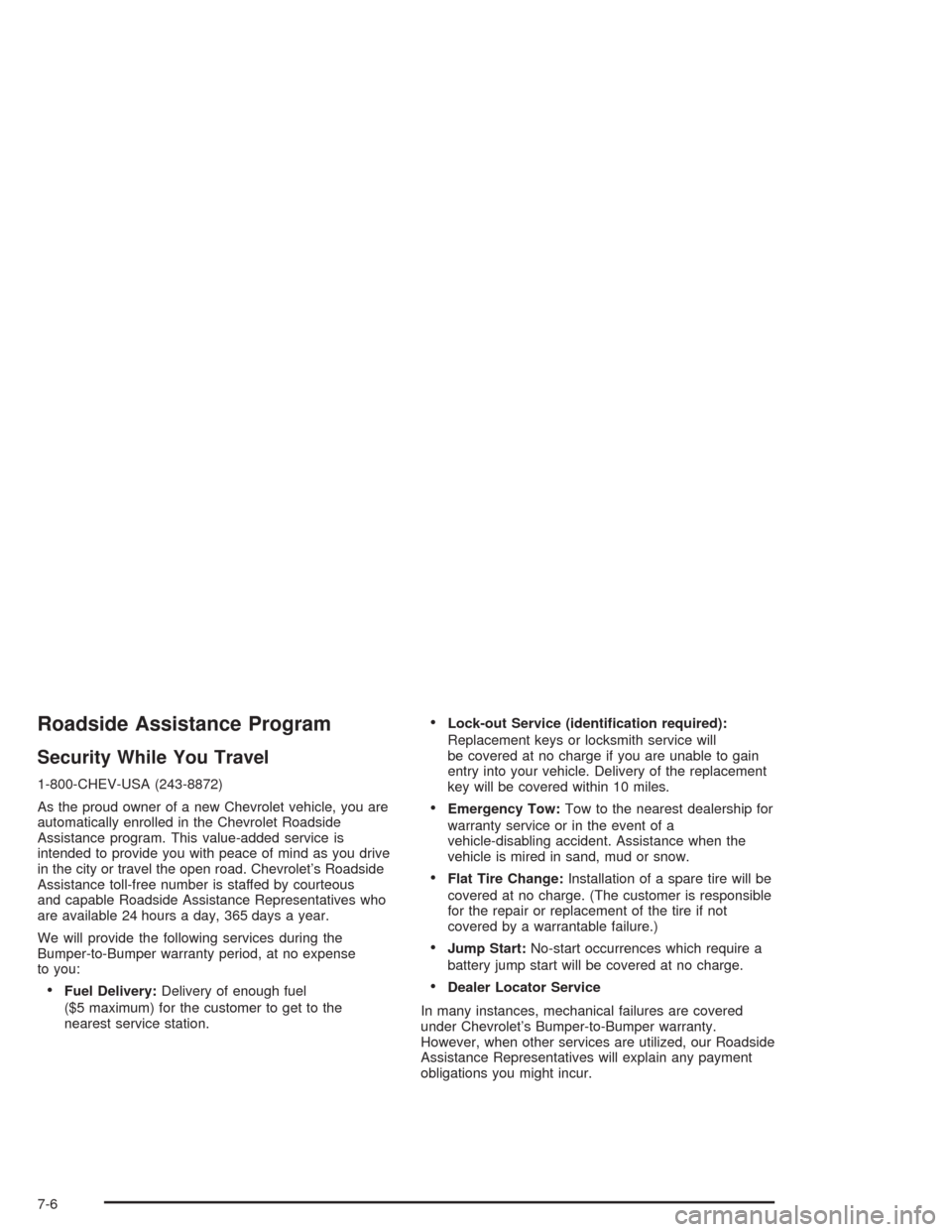
Roadside Assistance Program
Security While You Travel
1-800-CHEV-USA (243-8872)
As the proud owner of a new Chevrolet vehicle, you are
automatically enrolled in the Chevrolet Roadside
Assistance program. This value-added service is
intended to provide you with peace of mind as you drive
in the city or travel the open road. Chevrolet’s Roadside
Assistance toll-free number is staffed by courteous
and capable Roadside Assistance Representatives who
are available 24 hours a day, 365 days a year.
We will provide the following services during the
Bumper-to-Bumper warranty period, at no expense
to you:
Fuel Delivery:Delivery of enough fuel
($5 maximum) for the customer to get to the
nearest service station.
Lock-out Service (identication required):
Replacement keys or locksmith service will
be covered at no charge if you are unable to gain
entry into your vehicle. Delivery of the replacement
key will be covered within 10 miles.
Emergency Tow:Tow to the nearest dealership for
warranty service or in the event of a
vehicle-disabling accident. Assistance when the
vehicle is mired in sand, mud or snow.
Flat Tire Change:Installation of a spare tire will be
covered at no charge. (The customer is responsible
for the repair or replacement of the tire if not
covered by a warrantable failure.)
Jump Start:No-start occurrences which require a
battery jump start will be covered at no charge.
Dealer Locator Service
In many instances, mechanical failures are covered
under Chevrolet’s Bumper-to-Bumper warranty.
However, when other services are utilized, our Roadside
Assistance Representatives will explain any payment
obligations you might incur.
7-6
Page 432 of 446
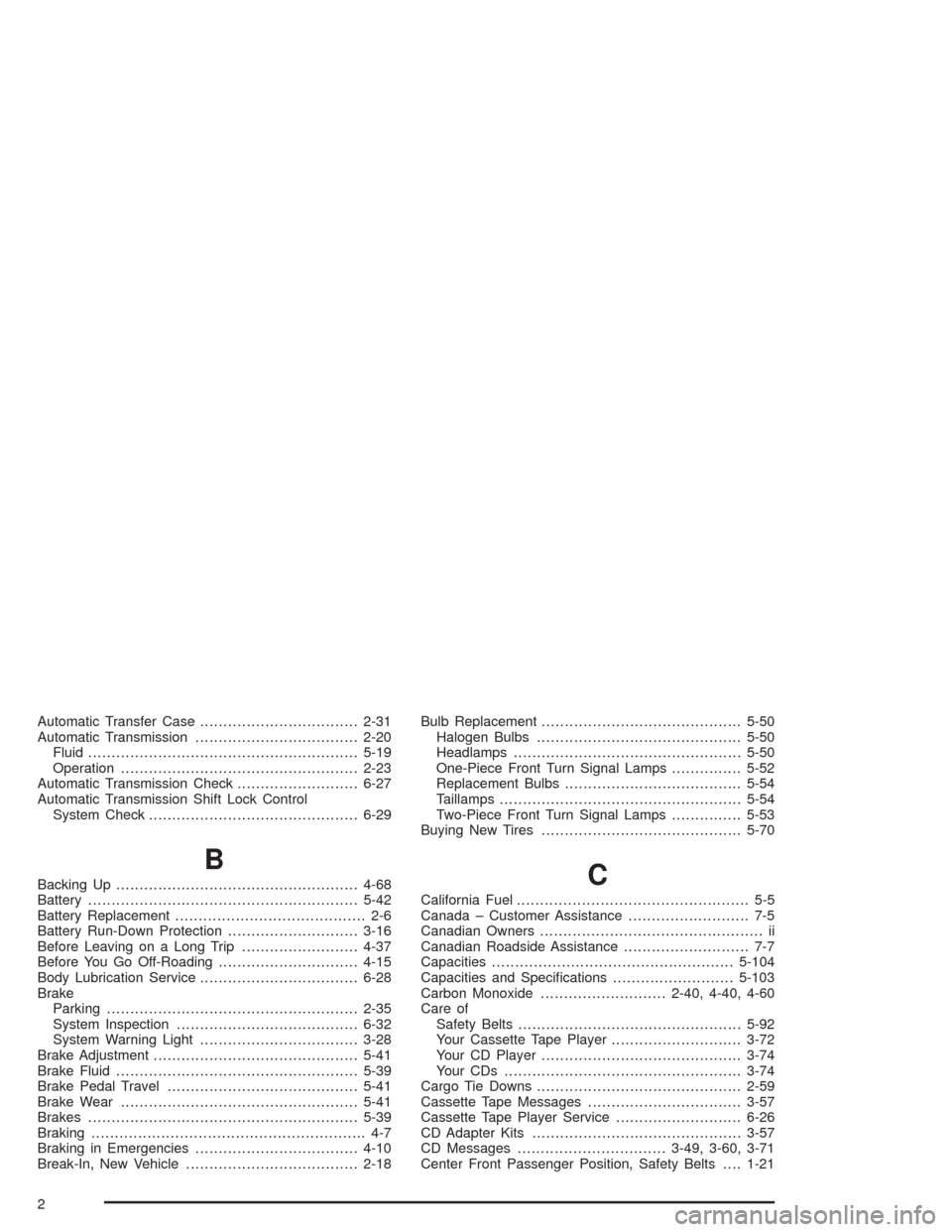
Automatic Transfer Case..................................2-31
Automatic Transmission...................................2-20
Fluid..........................................................5-19
Operation...................................................2-23
Automatic Transmission Check..........................6-27
Automatic Transmission Shift Lock Control
System Check.............................................6-29
B
Backing Up....................................................4-68
Battery..........................................................5-42
Battery Replacement......................................... 2-6
Battery Run-Down Protection............................3-16
Before Leaving on a Long Trip.........................4-37
Before You Go Off-Roading..............................4-15
Body Lubrication Service..................................6-28
Brake
Parking......................................................2-35
System Inspection.......................................6-32
System Warning Light..................................3-28
Brake Adjustment............................................5-41
Brake Fluid....................................................5-39
Brake Pedal Travel.........................................5-41
Brake Wear...................................................5-41
Brakes..........................................................5-39
Braking........................................................... 4-7
Braking in Emergencies...................................4-10
Break-In, New Vehicle.....................................2-18Bulb Replacement...........................................5-50
Halogen Bulbs............................................5-50
Headlamps.................................................5-50
One-Piece Front Turn Signal Lamps...............5-52
Replacement Bulbs......................................5-54
Taillamps....................................................5-54
Two-Piece Front Turn Signal Lamps...............5-53
Buying New Tires...........................................5-70C
California Fuel.................................................. 5-5
Canada – Customer Assistance.......................... 7-5
Canadian Owners................................................ ii
Canadian Roadside Assistance........................... 7-7
Capacities....................................................5-104
Capacities and Specications..........................5-103
Carbon Monoxide...........................2-40, 4-40, 4-60
Care of
Safety Belts................................................5-92
Your Cassette Tape Player............................3-72
Your CD Player...........................................3-74
Your CDs ...................................................3-74
Cargo Tie Downs............................................2-59
Cassette Tape Messages.................................3-57
Cassette Tape Player Service...........................6-26
CD Adapter Kits.............................................3-57
CD Messages................................3-49, 3-60, 3-71
Center Front Passenger Position, Safety Belts....1-21
2