horn CHEVROLET BLAZER 2005 2.G Owners Manual
[x] Cancel search | Manufacturer: CHEVROLET, Model Year: 2005, Model line: BLAZER, Model: CHEVROLET BLAZER 2005 2.GPages: 436, PDF Size: 2.55 MB
Page 72 of 436
Remote Keyless Entry System
Operation
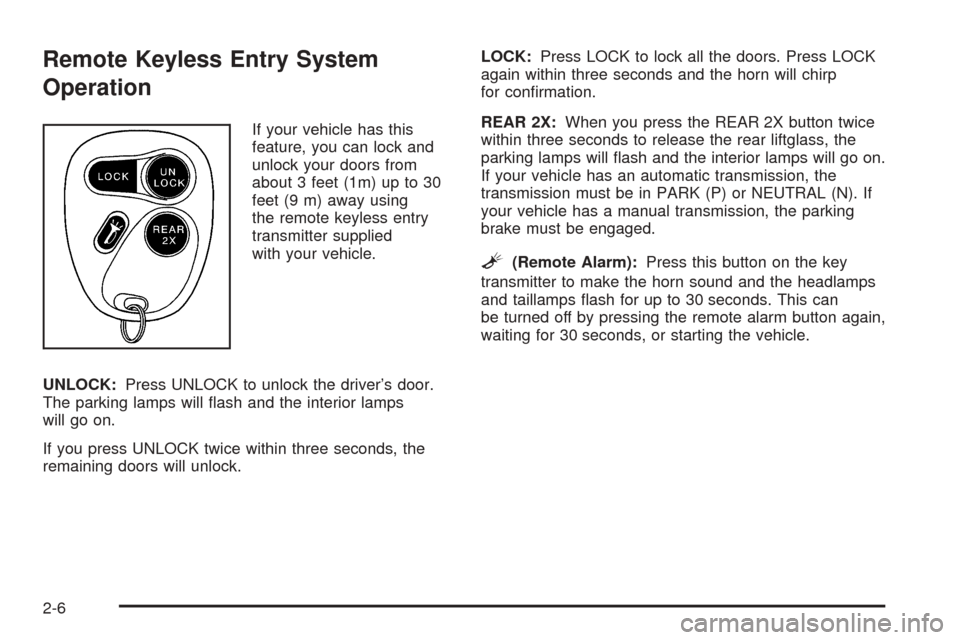
If your vehicle has this
feature, you can lock and
unlock your doors from
about 3 feet (1m) up to 30
feet (9 m) away using
the remote keyless entry
transmitter supplied
with your vehicle.
UNLOCK:Press UNLOCK to unlock the driver’s door.
The parking lamps will ash and the interior lamps
will go on.
If you press UNLOCK twice within three seconds, the
remaining doors will unlock.LOCK:Press LOCK to lock all the doors. Press LOCK
again within three seconds and the horn will chirp
for conrmation.
REAR 2X:When you press the REAR 2X button twice
within three seconds to release the rear liftglass, the
parking lamps will ash and the interior lamps will go on.
If your vehicle has an automatic transmission, the
transmission must be in PARK (P) or NEUTRAL (N). If
your vehicle has a manual transmission, the parking
brake must be engaged.
L(Remote Alarm):Press this button on the key
transmitter to make the horn sound and the headlamps
and taillamps ash for up to 30 seconds. This can
be turned off by pressing the remote alarm button again,
waiting for 30 seconds, or starting the vehicle.
2-6
Page 83 of 436
Swing-Out Windows
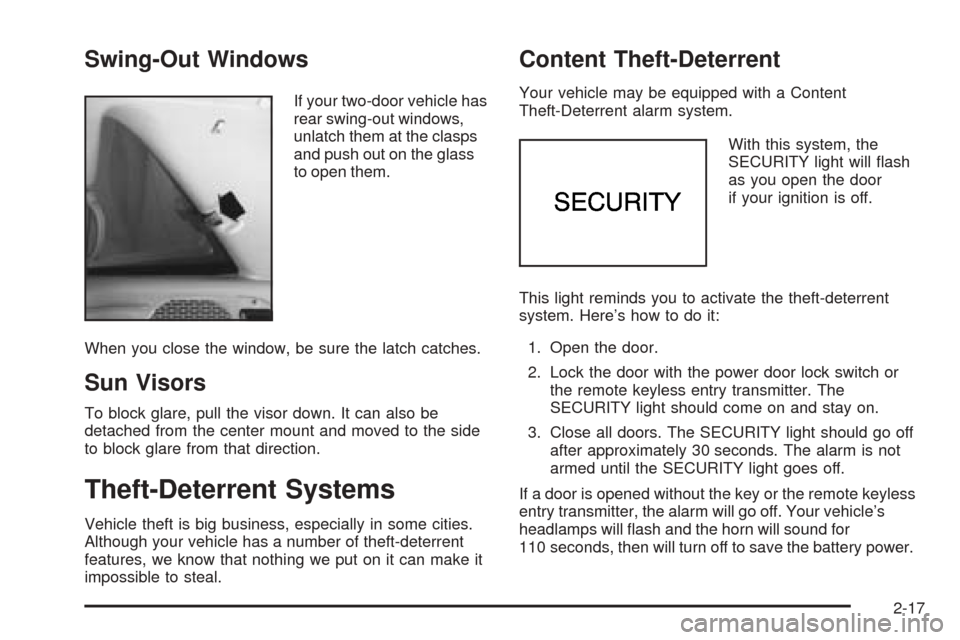
If your two-door vehicle has
rear swing-out windows,
unlatch them at the clasps
and push out on the glass
to open them.
When you close the window, be sure the latch catches.
Sun Visors
To block glare, pull the visor down. It can also be
detached from the center mount and moved to the side
to block glare from that direction.
Theft-Deterrent Systems
Vehicle theft is big business, especially in some cities.
Although your vehicle has a number of theft-deterrent
features, we know that nothing we put on it can make it
impossible to steal.
Content Theft-Deterrent
Your vehicle may be equipped with a Content
Theft-Deterrent alarm system.
With this system, the
SECURITY light will ash
as you open the door
if your ignition is off.
This light reminds you to activate the theft-deterrent
system. Here’s how to do it:
1. Open the door.
2. Lock the door with the power door lock switch or
the remote keyless entry transmitter. The
SECURITY light should come on and stay on.
3. Close all doors. The SECURITY light should go off
after approximately 30 seconds. The alarm is not
armed until the SECURITY light goes off.
If a door is opened without the key or the remote keyless
entry transmitter, the alarm will go off. Your vehicle’s
headlamps will ash and the horn will sound for
110 seconds, then will turn off to save the battery power.
2-17
Page 84 of 436
Remember, the theft-deterrent system won’t activate if
you lock the doors with a key or use the manual
door lock. It activates only if you use a power door lock
switch with the door open, or with the remote keyless
entry transmitter. You should also remember that
you can start your vehicle with the correct ignition key if
the alarm has been set off.
Here’s how to avoid setting off the alarm by accident:
If you don’t want to activate the theft-deterrent
system, the vehicle should be locked with the door
keyafterthe doors are closed.
Always unlock a door with a key, or use the remote
keyless entry transmitter. Unlocking a door any
other way will set off the alarm.
If you set off the alarm by accident, unlock any door
with the key. You can also turn off the alarm by pressing
UNLOCK on the remote keyless entry transmitter.
The alarm won’t stop if you try to unlock a door any
other way.
Testing the Alarm
The alarm can be tested by following these steps:
1. From inside the vehicle, lower the driver’s window
and open the driver’s door.
2. Activate the system by locking the doors with the
power door lock switch while the door is open, or
with the remote keyless entry transmitter.
3. Get out of the vehicle, close the door and wait for
the SECURITY light to go out.
4. Then reach in through the window, unlock the door
with the manual door lock and open the door. This
should set off the alarm.
If the alarm does not sound when it should but the
vehicle’s headlamps ash, check to see if the horn
works. The horn fuse may be blown. To replace
the fuse, seeFuses and Circuit Breakers on page 5-97.
If the alarm does not sound or the vehicle’s headlamps
do not ash, the vehicle should be serviced by an
authorized service center.
2-18
Page 127 of 436
Instrument Panel Overview...............................3-4
Hazard Warning Flashers................................3-5
Other Warning Devices...................................3-6
Horn.............................................................3-6
Tilt Wheel.....................................................3-6
Turn Signal/Multifunction Lever.........................3-6
Turn and Lane-Change Signals........................3-7
Headlamp High/Low-Beam Changer..................3-8
Flash-to-Pass.................................................3-8
Windshield Wipers..........................................3-9
Cruise Control..............................................3-10
Exterior Lamps.............................................3-13
Headlamps on Reminder................................3-13
Daytime Running Lamps (DRL).......................3-14
Automatic Headlamp System..........................3-15
Fog Lamps..................................................3-16
Instrument Panel Brightness...........................3-16
Dome Lamps...............................................3-16
Entry Lighting...............................................3-17
Exit Lighting.................................................3-17
Front Reading Lamps....................................3-17
Map Lamps.................................................3-17
Battery Run-Down Protection..........................3-17
Ashtrays and Cigarette Lighter........................3-18
Climate Controls............................................3-19
Climate Control System.................................3-19
Outlet Adjustment.........................................3-21Warning Lights, Gages, and Indicators............3-21
Instrument Panel Cluster................................3-22
Speedometer and Odometer...........................3-24
Trip Odometer..............................................3-24
Tachometer.................................................3-24
Safety Belt Reminder Light.............................3-24
Airbag Readiness Light..................................3-25
Charging System Light..................................3-26
Voltmeter Gage............................................3-26
Up-Shift Light...............................................3-27
Brake System Warning Light..........................3-28
Anti-Lock Brake System
Warning Light...........................................3-29
Engine Coolant Temperature Gage..................3-29
Malfunction Indicator Lamp.............................3-30
Oil Pressure Gage........................................3-32
Security Light...............................................3-33
Highbeam On Light.......................................3-34
Service Four-Wheel Drive
Warning Light...........................................3-34
Tow/Haul Mode Light....................................3-34
Check Gages Warning Light...........................3-35
Gate Ajar Light.............................................3-35
Fuel Gage...................................................3-36
Low Fuel Warning Light.................................3-36
Section 3 Instrument Panel
3-1
Page 131 of 436
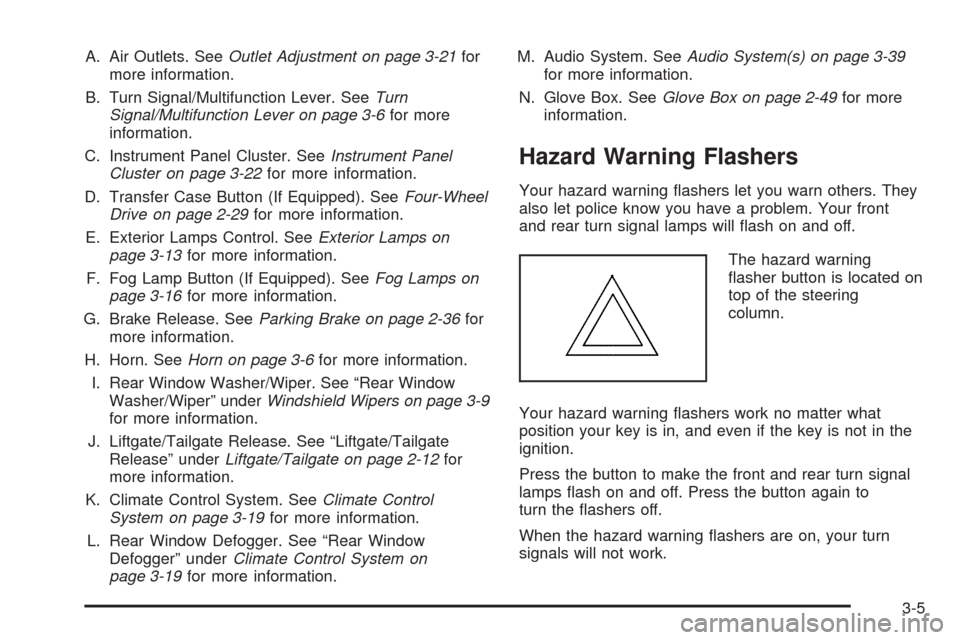
A. Air Outlets. SeeOutlet Adjustment on page 3-21for
more information.
B. Turn Signal/Multifunction Lever. SeeTurn
Signal/Multifunction Lever on page 3-6for more
information.
C. Instrument Panel Cluster. SeeInstrument Panel
Cluster on page 3-22for more information.
D. Transfer Case Button (If Equipped). SeeFour-Wheel
Drive on page 2-29for more information.
E. Exterior Lamps Control. SeeExterior Lamps on
page 3-13for more information.
F. Fog Lamp Button (If Equipped). SeeFog Lamps on
page 3-16for more information.
G. Brake Release. SeeParking Brake on page 2-36for
more information.
H. Horn. SeeHorn on page 3-6for more information.
I. Rear Window Washer/Wiper. See “Rear Window
Washer/Wiper” underWindshield Wipers on page 3-9
for more information.
J. Liftgate/Tailgate Release. See “Liftgate/Tailgate
Release” underLiftgate/Tailgate on page 2-12for
more information.
K. Climate Control System. SeeClimate Control
System on page 3-19for more information.
L. Rear Window Defogger. See “Rear Window
Defogger” underClimate Control System on
page 3-19for more information.M. Audio System. SeeAudio System(s) on page 3-39
for more information.
N. Glove Box. SeeGlove Box on page 2-49for more
information.
Hazard Warning Flashers
Your hazard warning ashers let you warn others. They
also let police know you have a problem. Your front
and rear turn signal lamps will ash on and off.
The hazard warning
asher button is located on
top of the steering
column.
Your hazard warning ashers work no matter what
position your key is in, and even if the key is not in the
ignition.
Press the button to make the front and rear turn signal
lamps ash on and off. Press the button again to
turn the ashers off.
When the hazard warning ashers are on, your turn
signals will not work.
3-5
Page 132 of 436
Other Warning Devices
If you carry reective triangles, you can set them up at
the side of the road about 300 feet (100 m) behind
your vehicle.
Horn
To sound the horn, press the horn symbol on the
steering wheel pad.
Tilt Wheel
A tilt wheel allows you to adjust the steering wheel before
you drive. You can raise it to the highest level to allow
more room for the driver to enter and exit the vehicle.
The tilt lever is located on
the driver’s side of the
steering column, under the
turn signal lever.To tilt, hold the steering wheel and pull the tilt lever
toward you. Move the wheel to a comfortable level, then
release the tilt lever to lock the wheel in place.
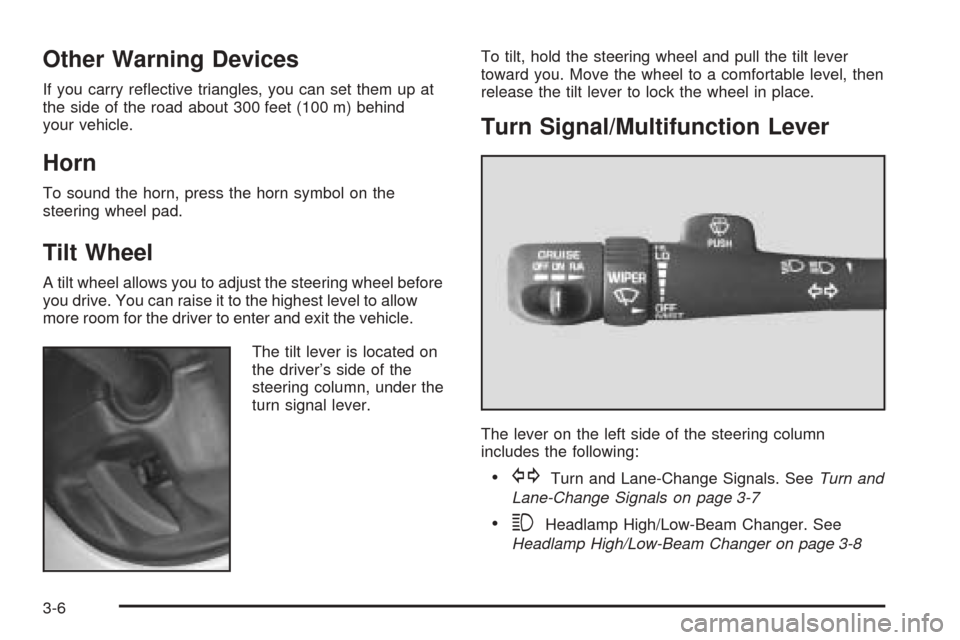
Turn Signal/Multifunction Lever
The lever on the left side of the steering column
includes the following:
GTurn and Lane-Change Signals. SeeTurn and
Lane-Change Signals on page 3-7
3Headlamp High/Low-Beam Changer. See
Headlamp High/Low-Beam Changer on page 3-8
3-6
Page 223 of 436
Driving Uphill
Once you decide you can safely drive up the hill, you
need to take some special steps.
Use a low gear and get a rm grip on the
steering wheel.
Get a smooth start up the hill and try to maintain
your speed. Do not use more power than you
need, because you do not want your wheels to start
spinning or sliding.
Try to drive straight up the hill if at all possible. If
the path twists and turns, you might want to nd
another route.
{CAUTION:
Turning or driving across steep hills can be
dangerous. You could lose traction, slide
sideways, and possibly roll over. You could be
seriously injured or killed. When driving up
hills, always try to go straight up.
Ease up on your speed as you approach the top of
the hill.
Attach a ag to the vehicle to make you more
visible to approaching traffic on trails or hills.
Sound the horn as you approach the top of the hill
to let opposing traffic know you are there.
Use your headlamps even during the day. They
make you more visible to oncoming traffic.
{CAUTION:
Driving to the top (crest) of a hill at full speed
can cause an accident. There could be a
drop-off, embankment, cliff, or even another
vehicle. You could be seriously injured or
killed. As you near the top of a hill, slow down
and stay alert.
4-21
Page 373 of 436
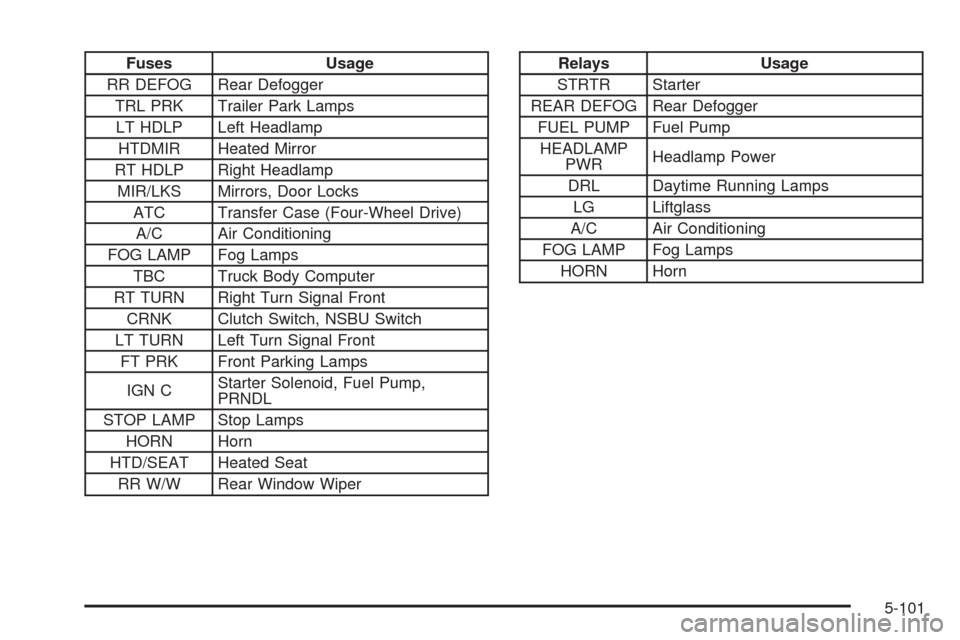
Fuses Usage
RR DEFOG Rear Defogger
TRL PRK Trailer Park Lamps
LT HDLP Left Headlamp
HTDMIR Heated Mirror
RT HDLP Right Headlamp
MIR/LKS Mirrors, Door Locks
ATC Transfer Case (Four-Wheel Drive)
A/C Air Conditioning
FOG LAMP Fog Lamps
TBC Truck Body Computer
RT TURN Right Turn Signal Front
CRNK Clutch Switch, NSBU Switch
LT TURN Left Turn Signal Front
FT PRK Front Parking Lamps
IGN CStarter Solenoid, Fuel Pump,
PRNDL
STOP LAMP Stop Lamps
HORN Horn
HTD/SEAT Heated Seat
RR W/W Rear Window WiperRelays Usage
STRTR Starter
REAR DEFOG Rear Defogger
FUEL PUMP Fuel Pump
HEADLAMP
PWRHeadlamp Power
DRL Daytime Running Lamps
LG Liftglass
A/C Air Conditioning
FOG LAMP Fog Lamps
HORN Horn
5-101
Page 428 of 436
Gasoline
Octane........................................................ 5-5
Specications............................................... 5-5
Gate Ajar Light...............................................3-35
Glove Box.....................................................2-49
GM Mobility Reimbursement Program.................. 7-5
H
Hazard Warning Flashers................................... 3-5
Head Restraints............................................... 1-6
Headlamps....................................................5-49
Automatic Headlamp System.........................3-15
Bulb Replacement.......................................5-49
Daytime Running Lamps...............................3-14
Electrical System.........................................5-96
Flash-to-Pass............................................... 3-8
Halogen Bulbs............................................5-49
High/Low Beam Changer................................ 3-8
On Reminder..............................................3-13
One-Piece Front Turn Signal Lamps...............5-51
Two-Piece Front Turn Signal Lamps...............5-52
Heated Seats................................................... 1-4
Heater...........................................................3-19
Highbeam On Light.........................................3-34
Highway Hypnosis...........................................4-37
Hill and Mountain Roads..................................4-38
HomeLink
®Transmitter....................................2-44
HomeLink®Transmitter, Programming................2-46Hood
Checking Things Under................................5-10
Release.....................................................5-11
Horn............................................................... 3-6
How to Use This Manual...................................... ii
How to Wear Safety Belts Properly...................1-13
Hydraulic Clutch.............................................5-24
I
Ignition Positions.............................................2-20
Infants and Young Children, Restraints...............1-32
Ination -- Tire Pressure..................................5-62
Inspection
Brake System.............................................6-31
Engine Cooling System................................6-30
Exhaust System..........................................6-30
Fuel System...............................................6-30
Part C - Periodic Maintenance.......................6-30
Steering, Suspension and Front Drive Axle
Boot and Seal.........................................6-30
Throttle System...........................................6-31
Transfer Case and Front Axle
(Four-Wheel Drive)...................................6-31
Instrument Panel
Brightness..................................................3-16
Cluster.......................................................3-22
Overview..................................................... 3-4
6