air condition CHEVROLET BOLT EV 2017 Owner's Guide
[x] Cancel search | Manufacturer: CHEVROLET, Model Year: 2017, Model line: BOLT EV, Model: CHEVROLET BOLT EV 2017Pages: 361, PDF Size: 4.89 MB
Page 288 of 361
Chevrolet Bolt EV Owner Manual (GMNA-Localizing-U.S./Canada/Mexico-
10122739) - 2017 - CRC - 10/3/16
Vehicle Care 287
Some aluminum wheels can be
repaired. See your dealer if any of
these conditions exist.
Your dealer will know the kind of
wheel that is needed.
Each new wheel should have the
same load-carrying capacity,
diameter, width, offset, and be
mounted the same way as the one it
replaces.
Replace wheels, wheel bolts, wheel
nuts, or Tire Pressure Monitor
System (TPMS) sensors with new
GM original equipment parts.
{Warning
Using the wrong replacement
wheels, wheel bolts, or wheel
nuts can be dangerous. It could
affect the braking and handling of
the vehicle. Tires can lose air,
and cause loss of control, causing
a crash. Always use the correct
wheel, wheel bolts, and wheel
nuts for replacement.
Caution
The wrong wheel can also cause
problems with bearing life, brake
cooling, speedometer or
odometer calibration, headlamp
aim, bumper height, vehicle
ground clearance, and tire or tire
chain clearance to the body and
chassis.
Used Replacement Wheels
{Warning
Replacing a wheel with a used
one is dangerous. How it has
been used or how far it has been
driven may be unknown. It could
fail suddenly and cause a crash.
When replacing wheels, use a
new GM original equipment
wheel.
Tire Chains
{Warning
Do not use tire chains. There is
not enough clearance. Tire chains
used on a vehicle without the
proper amount of clearance can
cause damage to the brakes,
suspension, or other vehicle
parts. The area damaged by the
tire chains could cause loss of
control and a crash.
Use another type of traction
device only if its manufacturer
recommends it for the vehicle's
tire size combination and road
conditions. Follow that
manufacturer's instructions. To
avoid vehicle damage, drive slow
and readjust or remove the
traction device if it contacts the
vehicle. Do not spin the wheels.
If traction devices are used, install
them on the front tires.
Page 304 of 361
Chevrolet Bolt EV Owner Manual (GMNA-Localizing-U.S./Canada/Mexico-
10122739) - 2017 - CRC - 10/3/16
Vehicle Care 303
.Do not use cleaners that are not
intended for automotive use.
. Use a nonabrasive wax on the
vehicle after washing to protect
and extend the molding finish.
Cleaning Exterior Lamps/
Lenses, Emblems, Decals, and
Stripes
Use only lukewarm or cold water, a
soft cloth, and a car washing soap
to clean exterior lamps, lenses,
emblems, decals and stripes. Follow
instructions under "Washing the
Vehicle" previously in this section.
Lamp covers are made of plastic,
and some have a UV protective
coating. Do not clean or wipe them
while they are dry.
Do not use any of the following on
lamp covers:
.Abrasive or caustic agents.
. Washer fluids and other cleaning
agents in higher concentrations
than suggested by the
manufacturer.
. Solvents, alcohols, fuels,
or other harsh cleaners. .
Ice scrapers or other hard items.
. Aftermarket appearance caps or
covers while the lamps are
illuminated, due to excessive
heat generated.
Caution
Failure to clean lamps properly
can cause damage to the lamp
cover that would not be covered
by the vehicle warranty.
Caution
Using wax on low gloss black
finish stripes can increase the
gloss level and create a
non-uniform finish. Clean low
gloss stripes with soap and
water only.
Air Intakes
Clear debris from the air intakes,
between the hood and windshield,
when washing the vehicle.
Windshield and Wiper Blades
Clean the outside of the windshield
with glass cleaner.
Clean rubber blades using a lint-free
cloth or paper towel soaked with
windshield washer fluid or a mild
detergent. Wash the windshield
thoroughly when cleaning the
blades. Bugs, road grime, sap, and
a buildup of vehicle wash/wax
treatments may cause wiper
streaking.
Replace the wiper blades if they are
worn or damaged. Damage can be
caused by extreme dusty
conditions, sand, salt, heat, sun,
snow, and ice.
Weatherstrips
Apply Dielectric silicone grease on
weatherstrips to make them last
longer, seal better, and not stick or
squeak. Lubricate weatherstrips at
least once a year. Hot, dry climates
may require more frequent
application. Black marks from
rubber material on painted surfaces
can be removed by rubbing with a
clean cloth.
Page 305 of 361
Chevrolet Bolt EV Owner Manual (GMNA-Localizing-U.S./Canada/Mexico-
10122739) - 2017 - CRC - 10/3/16
304 Vehicle Care
Tires
Use a stiff brush with tire cleaner to
clean the tires.
Caution
Using petroleum-based tire
dressing products on the vehicle
may damage the paint finish and/
or tires. When applying a tire
dressing, always wipe off any
overspray from all painted
surfaces on the vehicle.
Wheels and Trim—Aluminum
or Chrome
Use a soft, clean cloth with mild
soap and water to clean the wheels.
After rinsing thoroughly with clean
water, dry with a soft, clean towel.
A wax may then be applied.
Caution
Chrome wheels and other chrome
trim may be damaged if the
vehicle is not washed after driving
(Continued)
Caution (Continued)
on roads that have been sprayed
with magnesium, calcium,
or sodium chloride. These
chlorides are used on roads for
conditions such as ice and dust.
Always wash the chrome with
soap and water after exposure.
Caution
To avoid surface damage, do not
use strong soaps, chemicals,
abrasive polishes, cleaners,
brushes, or cleaners that contain
acid on aluminum or
chrome-plated wheels. Use only
approved cleaners. Also, never
drive a vehicle with aluminum or
chrome-plated wheels through an
automatic car wash that uses
silicone carbide tire cleaning
brushes. Damage could occur
and the repairs would not be
covered by the vehicle warranty.
Brake System
Visually inspect brake lines and
hoses for proper hook-up, binding,
leaks, cracks, chafing, etc. Inspect
disc brake pads for wear and rotors
for surface condition. Inspect drum
brake linings/shoes for wear or
cracks. Inspect all other brake parts.
Steering, Suspension, and
Chassis Components
Visually inspect steering,
suspension, and chassis
components for damaged, loose,
or missing parts or signs of wear at
least once a year.
Inspect power steering for proper
attachment, connections, binding,
leaks, cracks, chafing, etc.
Visually check constant velocity joint
boots and axle seals for leaks.
Body Component Lubrication
Lubricate all key lock cylinders,
hood hinges, liftgate hinges, steel
charge port door, and power assist
step hinges, unless the components
are plastic. Applying silicone grease
Page 308 of 361
Chevrolet Bolt EV Owner Manual (GMNA-Localizing-U.S./Canada/Mexico-
10122739) - 2017 - CRC - 10/3/16
Vehicle Care 307
using a commercial upholstery
cleaner or spot lifter. If ring
formation occurs, clean the entire
fabric or carpet.
After cleaning, use a paper towel to
blot excess moisture.
Cleaning High Gloss Surfaces
and Vehicle Information and
Radio Displays
Use a microfiber cloth on high gloss
surfaces or vehicle displays. First,
use a soft bristle brush to remove
dirt that can scratch the surface.
Then gently clean by rubbing with a
microfiber cloth. Never use window
cleaners or solvents. Periodically
hand wash the microfiber cloth
separately, using mild soap. Do not
use bleach or fabric softener. Rinse
thoroughly and air dry before
next use.
Caution
Do not attach a device with a
suction cup to the display. This
may cause damage and would
not be covered by the vehicle
warranty.
Instrument Panel, Leather,
Vinyl, Other Plastic Surfaces,
Low Gloss Paint Surfaces, and
Natural Open Pore Wood
Surfaces
Use a soft microfiber cloth
dampened with water to remove
dust and loose dirt. For a more
thorough cleaning, use a soft
microfiber cloth dampened with a
mild soap solution.
Caution
Soaking or saturating leather,
especially perforated leather, as
well as other interior surfaces,
may cause permanent damage.(Continued)
Caution (Continued)
Wipe excess moisture from these
surfaces after cleaning and allow
them to dry naturally. Never use
heat, steam, or spot removers. Do
not use cleaners that contain
silicone or wax-based products.
Cleaners containing these
solvents can permanently change
the appearance and feel of
leather or soft trim, and are not
recommended.
Do not use cleaners that increase
gloss, especially on the instrument
panel. Reflected glare can decrease
visibility through the windshield
under certain conditions.
Caution
Use of air fresheners may cause
permanent damage to plastics
and painted surfaces. If an air
freshener comes in contact with
any plastic or painted surface in (Continued)
Page 311 of 361
Chevrolet Bolt EV Owner Manual (GMNA-Localizing-U.S./Canada/Mexico-
10122739) - 2017 - CRC - 10/3/16
310 Service and Maintenance
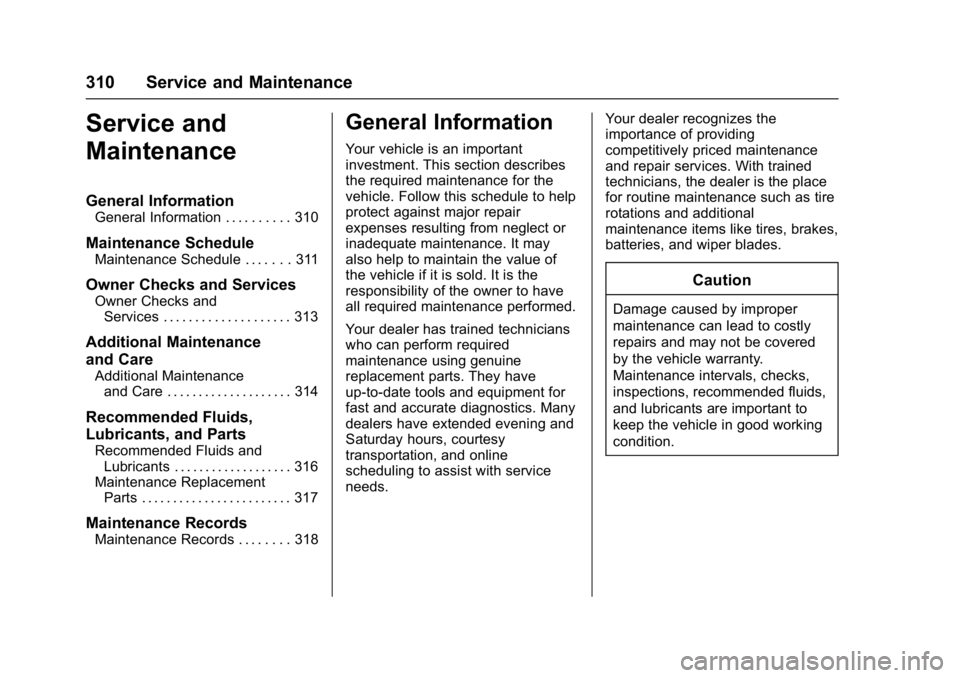
Service and
Maintenance
General Information
General Information . . . . . . . . . . 310
Maintenance Schedule
Maintenance Schedule . . . . . . . 311
Owner Checks and Services
Owner Checks andServices . . . . . . . . . . . . . . . . . . . . 313
Additional Maintenance
and Care
Additional Maintenanceand Care . . . . . . . . . . . . . . . . . . . . 314
Recommended Fluids,
Lubricants, and Parts
Recommended Fluids andLubricants . . . . . . . . . . . . . . . . . . . 316
Maintenance Replacement Parts . . . . . . . . . . . . . . . . . . . . . . . . 317
Maintenance Records
Maintenance Records . . . . . . . . 318
General Information
Your vehicle is an important
investment. This section describes
the required maintenance for the
vehicle. Follow this schedule to help
protect against major repair
expenses resulting from neglect or
inadequate maintenance. It may
also help to maintain the value of
the vehicle if it is sold. It is the
responsibility of the owner to have
all required maintenance performed.
Your dealer has trained technicians
who can perform required
maintenance using genuine
replacement parts. They have
up-to-date tools and equipment for
fast and accurate diagnostics. Many
dealers have extended evening and
Saturday hours, courtesy
transportation, and online
scheduling to assist with service
needs. Your dealer recognizes the
importance of providing
competitively priced maintenance
and repair services. With trained
technicians, the dealer is the place
for routine maintenance such as tire
rotations and additional
maintenance items like tires, brakes,
batteries, and wiper blades.
Caution
Damage caused by improper
maintenance can lead to costly
repairs and may not be covered
by the vehicle warranty.
Maintenance intervals, checks,
inspections, recommended fluids,
and lubricants are important to
keep the vehicle in good working
condition.
Page 315 of 361
Chevrolet Bolt EV Owner Manual (GMNA-Localizing-U.S./Canada/Mexico-
10122739) - 2017 - CRC - 10/3/16
314 Service and Maintenance
Additional
Maintenance and Care
Your vehicle is an important
investment and caring for it properly
may help to avoid future costly
repairs. To maintain vehicle
performance, additional
maintenance services may be
required. It is recommended that
your dealer perform these services
—their trained dealer technicians
know your vehicle best. Your dealer
can also perform a thorough
assessment with a multi-point
inspection to recommend when your
vehicle may need attention. The
following list is intended to explain
the services and conditions to look
for that may indicate services are
required.
Battery
The battery supplies power to
operate any additional electrical
accessories.
. To avoid break-down or failure,
maintain a battery with full
power. .
Trained dealer technicians have
the diagnostic equipment to test
the battery and ensure that the
connections and cables are
corrosion-free.
Brakes
Brakes stop the vehicle and are
crucial to safe driving.
. Signs of brake wear may include
chirping, grinding, or squealing
noises, or difficulty stopping.
. Trained dealer technicians have
access to tools and equipment
to inspect the brakes and
recommend quality parts
engineered for the vehicle.
Fluids
Proper fluid levels and approved
fluids protect the vehicle’s systems
and components. See
Recommended Fluids and
Lubricants 0316 for GM approved
fluids.
. Keep the windshield washer fluid
reservoir filled. .
Instrument cluster lights may
come on to indicate that fluids
may be low and need to be
filled.
Hoses
Hoses transport fluids and should
be regularly inspected to ensure
that there are no cracks or leaks.
With a multi-point inspection, your
dealer can inspect the hoses and
advise if replacement is needed.
Lamps
Properly working headlamps,
taillamps, and brake lamps are
important to see and be seen on
the road.
. Signs that the headlamps need
attention include dimming, failure
to light, cracking, or damage.
The brake lamps need to be
checked periodically to ensure
that they light when braking.
. With a multi-point inspection,
your dealer can check the lamps
and note any concerns.
Page 321 of 361
Chevrolet Bolt EV Owner Manual (GMNA-Localizing-U.S./Canada/Mexico-
10122739) - 2017 - CRC - 10/3/16
320 Technical Data
Vehicle Data
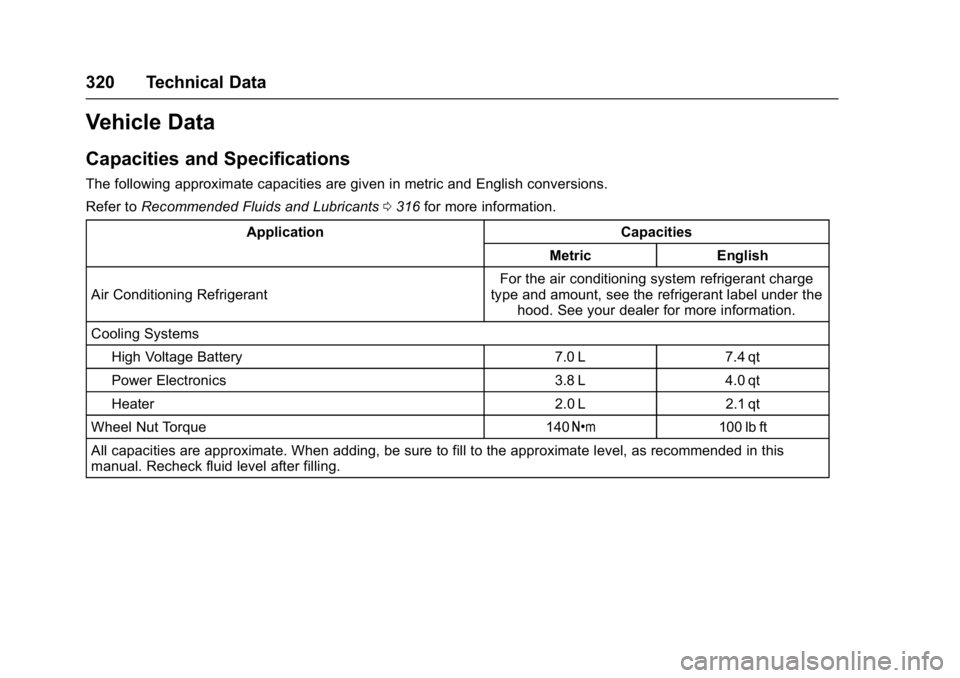
Capacities and Specifications
The following approximate capacities are given in metric and English conversions.
Refer toRecommended Fluids and Lubricants 0316 for more information.
Application Capacities Metric English
Air Conditioning Refrigerant For the air conditioning system refrigerant charge
type and amount, see the refrigerant label under the hood. See your dealer for more information.
Cooling Systems High Voltage Battery 7.0 L 7.4 qt
Power Electronics 3.8 L 4.0 qt
Heater 2.0 L 2.1 qt
Wheel Nut Torque 140 Y100 lb ft
All capacities are approximate. When adding, be sure to fill to the approximate level, as recommended in this
manual. Recheck fluid level after filling.
Page 322 of 361
Chevrolet Bolt EV Owner Manual (GMNA-Localizing-U.S./Canada/Mexico-
10122739) - 2017 - CRC - 10/3/16
Warranty Information 321
Warranty
Information
Warranty Information
New Vehicle LimitedWarranty . . . . . . . . . . . . . . . . . . . . 321
Warranty Information
New Vehicle Limited
Warranty
GM will cover repairs to the vehicle
during the warranty period in
accordance with the following terms,
conditions, and limitations.
Chevrolet Bolt EV
For vehicles sold in the United
States, in addition to the
Bumper-to-Bumper Coverage
described previously, Chevrolet will
warrant certain components for
each Bolt EV for 8 years or
100,000 miles (160 000 kilometers),
whichever comes first, from the
original in-service date of the
vehicle, against warrantable repairs
to the specific electric propulsion
components of the vehicle.
This warranty is for Chevrolet Bolt
EV vehicles registered and normally
operated in the United States or
Canada, respectively. In addition to
the initial owner of the vehicle, the
coverage described in this Bolt EV
warranty is transferable at no cost to any subsequent person(s) who
assumes ownership of the vehicle
within the 8 years or 100,000 miles
(160 000 kilometers) term. No
deductibles are associated with this
warranty.
This warranty is in addition to the
express conditions and warranties
described in the 2017 Chevrolet
Limited Warranty and Owner
Assistance Information Booklet. The
coverage and benefits described
under "New Vehicle Limited
Warranty" in the 2017 Chevrolet
Limited Warranty and Owner
Assistance Information Booklet are
not extended or altered because of
this special Hybrid Component
Warranty.
What Is Covered
This warranty covers repairs to
Hybrid specific component defect
related to materials or workmanship
occurring during the 8 years or
100,000 miles (160 000 kilometers)
term for the following:
Page 323 of 361
Chevrolet Bolt EV Owner Manual (GMNA-Localizing-U.S./Canada/Mexico-
10122739) - 2017 - CRC - 10/3/16
322 Warranty Information
Towing
During the 8 years or 100,000 miles
(160 000 kilometers) Hybrid
warranty period, towing is covered
to the nearest Chevrolet servicing
dealer if your vehicle cannot be
driven because of a warranted
Hybrid specific defect. Contact the
GM Roadside Assistance Center for
towing. SeeRoadside Assistance
Program 0327 orRoadside
Assistance Program 0329 for
details.
Drive Motor Battery Coverage
Propulsion Battery Warranty
Policy (Bolt EV)
Like all batteries, the amount of
energy that the high voltage
“propulsion” battery can store will
decrease with time and miles
driven. Depending on use, the
battery may degrade as little as
10% to as much as 40% of capacity
over the warranty period. If there
are questions pertaining to battery
capacity, a dealer service technician
could determine if the vehicle is
within parameters. Repair (If Necessary)
Chevrolet has a network of certified
dealers who are trained to perform
repairs on Bolt EV if your vehicle
needs battery service.
Replace (If Necessary)
If warranty repair requires
replacement, the high voltage
battery may be replaced with either
a new or factory refurbished high
voltage battery with an energy
capacity (kWh storage) level at or
within approximately 10% of that of
the original battery at the time of
warranty repair.
Your Electric Propulsion battery
warranty replacement may not
return your vehicle to an
“as new”
condition, but it will make your
vehicles fully operational
appropriate to its age and mileage.
Other Electric/Hybrid Components
High Voltage Wiring, Hybrid
Powertrain and Battery Control
Modules, Air Compressor Control
Module, Accessory DC Power
Control Module, High Voltage
Battery Disconnect Control Module, Drive Motor Generator Power
Invertor Module, Battery Charger
Control Module.
Brakes
Brake Modulator Assembly
Electric/Hybrid Drive Unit
Electric drive unit assembly electric
motors, and all internal components,
including the auxiliary fluid pump,
auxiliary pump controller, electric
motor, and 3-phase cables.
What Is Not Covered
In addition to the
”What is Not
Covered“ section of the 2017
Chevrolet Limited Warranty and
Owner Assistance Information, the
Chevrolet Bolt EV specific warranty
does not cover the following items:
Wear Items
Wear items, such as brake linings,
are not covered in the Chevrolet
Bolt EV specific warranty.
Page 330 of 361
Chevrolet Bolt EV Owner Manual (GMNA-Localizing-U.S./Canada/Mexico-
10122739) - 2017 - CRC - 10/3/16
Customer Information 329
Mechanical failures may be
covered, however any cost for
parts and labor for repairs not
covered by the warranty are the
owner's responsibility.
Roadside Assistance
Program
The Roadside Assistance program
is not available for any of the
countries in the Central American
and Caribbean region.
As a new owner, your vehicle is
automatically enrolled in the
Roadside Assistance program. The
services are available at no cost
under the terms and conditions of
the program. The Roadside
Assistance program is not part of,
or included, in the coverage
provided by the New Vehicle Limited
Warranty.
Roadside Assistance provides
assistance to the driver and
passengers while driving the vehicle
within your city of residence or on
any passable road in Mexico, the
United States, and Canada.
Services are subject to thelimitations described in the following
pages. Program coverage varies by
country.
Roadside Assistance is available
24 hours a day, 365 days of
the year.
This program expires two years
from the date of the invoice for the
vehicle, regardless of vehicle
mileage and changes in vehicle
ownership.
For more information about the
renewal of this program at the end
of its term, contact the Chevrolet
Customer Assistance Center at
01-800-466-0811.
Services Provided
.
Flat Tire Change: If unable to
change a flat tire, Roadside
Assistance will provide towing
service to the nearest authorized
Chevrolet dealership. It is the
owner's responsibility for the
repair or replacement of the tire.
This service is limited to the
transfer of the vehicle to the
repair facility. .
Lock-Out Service: Service to
unlock the vehicle if you are
locked out. A remote unlock may
be available if the vehicle has an
active OnStar subscription. For
security reasons, the driver must
present identification before this
service is provided.
. Battery Jump Start: Service to
jump start a dead battery.
. *Emergency Messages:
Transmission of urgent phone
messages.
. *Emergency Calls: Call for
emergency services.
. *Dealership Location
Assistance: Information
regarding addresses and
telephone numbers for Chevrolet
dealers.
. Emergency Towing: Tow to the
nearest dealer for warranty
service if the vehicle cannot be
driven.
If the vehicle is involved in an
accident during the commission
of a crime, administrative
violation, or breach of traffic