headlamp CHEVROLET C/K 1999 User Guide
[x] Cancel search | Manufacturer: CHEVROLET, Model Year: 1999, Model line: C/K, Model: CHEVROLET C/K 1999Pages: 440, PDF Size: 6.91 MB
Page 210 of 440
yellowblue
4-28 Night Vision
No one can see as well at night as in the daytime. But as
we get older these differences increase. A 50
-year-old
driver may require at least twice as much light to see the
same thing at night as a 20
-year-old.
What you do in the daytime can also affect your night
vision. For example, if you spend the day in bright
sunshine you are wise to wear sunglasses. Your eyes will
have less trouble adjusting to night. But if you're
driving, don't wear sunglasses at night. They may cut
down on glare from headlamps, but they also make a lot
of things invisible.
You can be temporarily blinded by approaching
headlamps. It can take a second or two, or even several
seconds, for your eyes to readjust to the dark. When
you are faced with severe glare (as from a driver who
doesn't lower the high beams, or a vehicle with
misaimed headlamps), slow down a little. Avoid
staring directly into the approaching headlamps.
Keep your windshield and all the glass on your vehicle
clean
-- inside and out. Glare at night is made much
worse by dirt on the glass. Even the inside of the glass
can build up a film caused by dust. Dirty glass makes
lights dazzle and flash more than clean glass would,
making the pupils of your eyes contract repeatedly.Remember that your headlamps light up far less of a
roadway when you are in a turn or curve. Keep your
eyes moving; that way, it's easier to pick out dimly
lighted objects. Just as your headlamps should be
checked regularly for proper aim, so should your eyes
be examined regularly. Some drivers suffer from night
blindness
-- the inability to see in dim light -- and
aren't even aware of it.
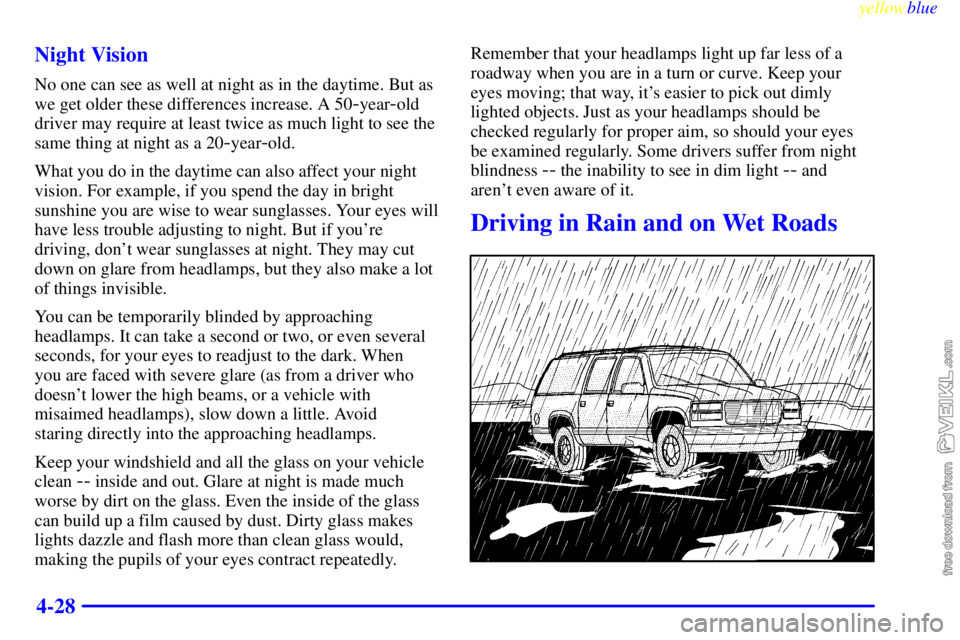
Driving in Rain and on Wet Roads
Page 222 of 440
yellowblue
4-40
CAUTION:
Snow can trap exhaust gases under your vehicle.
This can cause deadly CO (carbon monoxide) gas
to get inside. CO could overcome you and kill
you. You can't see it or smell it, so you might not
know it is in your vehicle. Clear away snow from
around the base of your vehicle, especially any
that is blocking your exhaust pipe. And check
around again from time to time to be sure snow
doesn't collect there.
Open a window just a little on the side of the
vehicle that's away from the wind. This will help
keep CO out.
Run your engine only as long as you must. This saves
fuel. When you run the engine, make it go a little faster
than just idle. That is, push the accelerator slightly. This
uses less fuel for the heat that you get and it keeps the
battery (or batteries) charged. You will need a
well
-charged battery (or batteries) to restart the vehicle,
and possibly for signaling later on with your headlamps.
Let the heater run for a while.
If you have a diesel engine, you may have to run it at a
higher speed to get enough heat. Then, shut the engine
off and close the window almost all the way to preserve
the heat. Start the engine again and repeat this only
when you feel really uncomfortable from the cold. But
do it as little as possible. Preserve the fuel as long as you
can. To help keep warm, you can get out of the vehicle
and do some fairly vigorous exercises every half hour or
so until help comes.
Page 321 of 440
yellowblue
6-39
Bulb Replacement
For any bulb changing procedure not listed in
this section, contact your GM dealership
Service Department.
Before you replace any bulbs, be sure that all the lamps
are off and the engine isn't running. See ªReplacement
Bulbsº in the Index for the proper types of bulbs to use.
Halogen Bulbs
CAUTION:
Halogen bulbs have pressurized gas inside and
can burst if you drop or scratch the bulb. You or
others could be injured. Be sure to read and
follow the instructions on the bulb package.
Headlamps
Sealed Beam Lamps
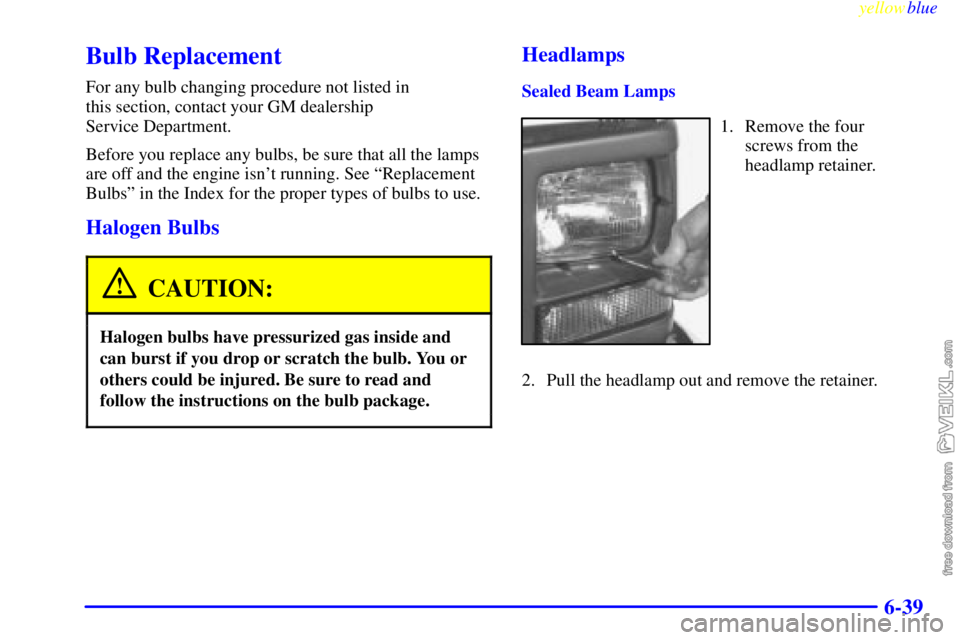
1. Remove the four
screws from the
headlamp retainer.
2. Pull the headlamp out and remove the retainer.
Page 322 of 440
yellowblue
6-40
3. Unplug and remove
the headlamp.
4. Plug in the new headlamp and put it in place.
5. Install the retainer to the headlamp and tighten
the screws.Composite Headlamps
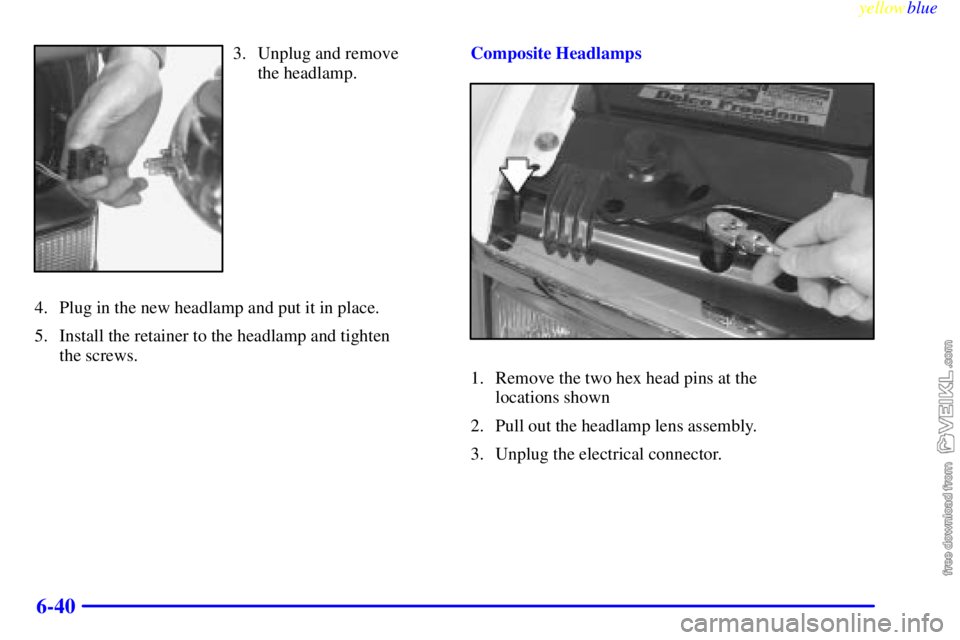
1. Remove the two hex head pins at the
locations shown
2. Pull out the headlamp lens assembly.
3. Unplug the electrical connector.
Page 323 of 440
yellowblue
6-41
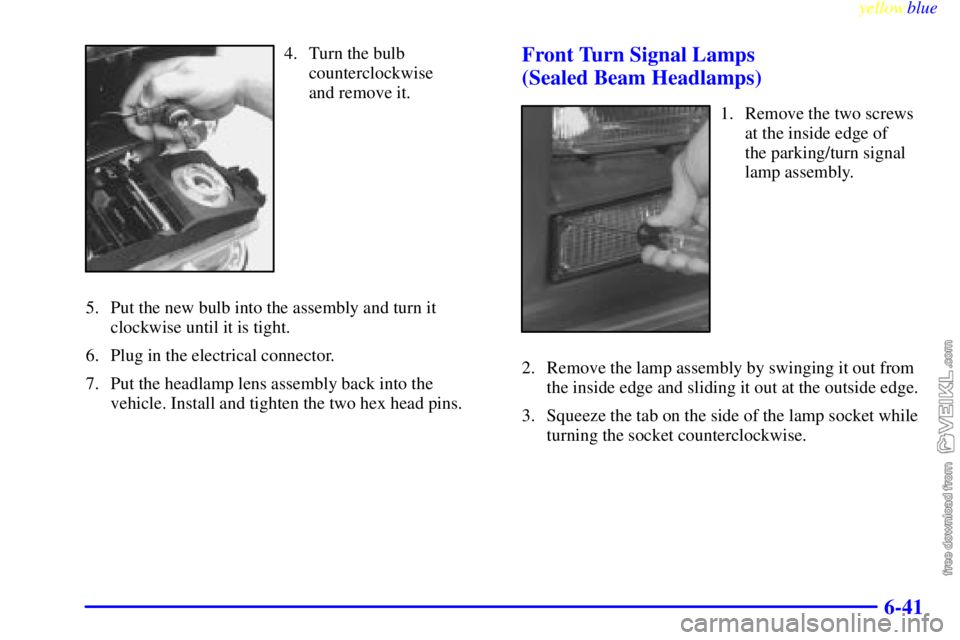
4. Turn the bulb
counterclockwise
and remove it.
5. Put the new bulb into the assembly and turn it
clockwise until it is tight.
6. Plug in the electrical connector.
7. Put the headlamp lens assembly back into the
vehicle. Install and tighten the two hex head pins.Front Turn Signal Lamps
(Sealed Beam Headlamps)
1. Remove the two screws
at the inside edge of
the parking/turn signal
lamp assembly.
2. Remove the lamp assembly by swinging it out from
the inside edge and sliding it out at the outside edge.
3. Squeeze the tab on the side of the lamp socket while
turning the socket counterclockwise.
Page 324 of 440
yellowblue
6-42
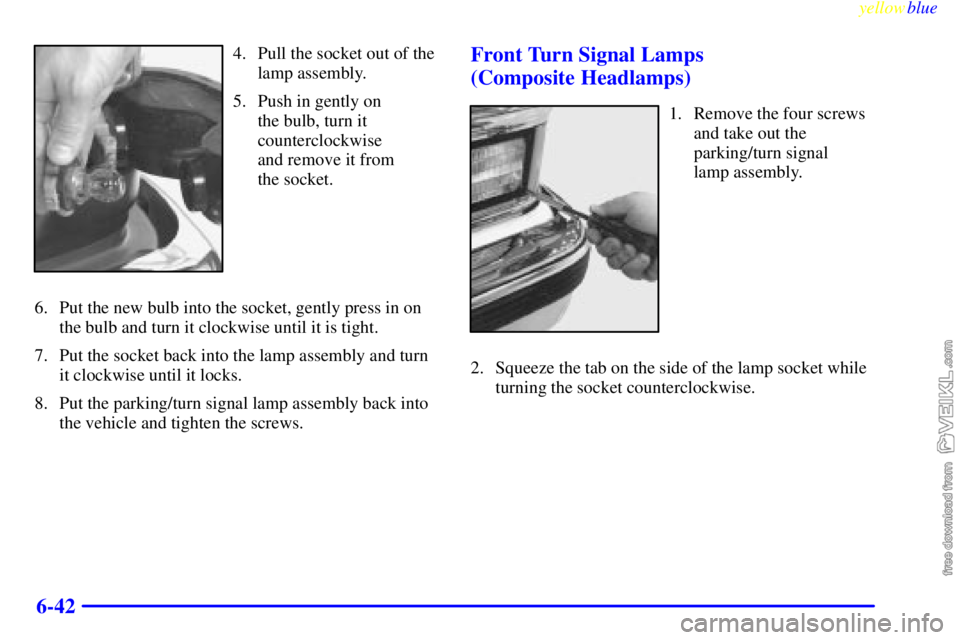
4. Pull the socket out of the
lamp assembly.
5. Push in gently on
the bulb, turn it
counterclockwise
and remove it from
the socket.
6. Put the new bulb into the socket, gently press in on
the bulb and turn it clockwise until it is tight.
7. Put the socket back into the lamp assembly and turn
it clockwise until it locks.
8. Put the parking/turn signal lamp assembly back into
the vehicle and tighten the screws.Front Turn Signal Lamps
(Composite Headlamps)
1. Remove the four screws
and take out the
parking/turn signal
lamp assembly.
2. Squeeze the tab on the side of the lamp socket while
turning the socket counterclockwise.
Page 325 of 440
yellowblue
6-43
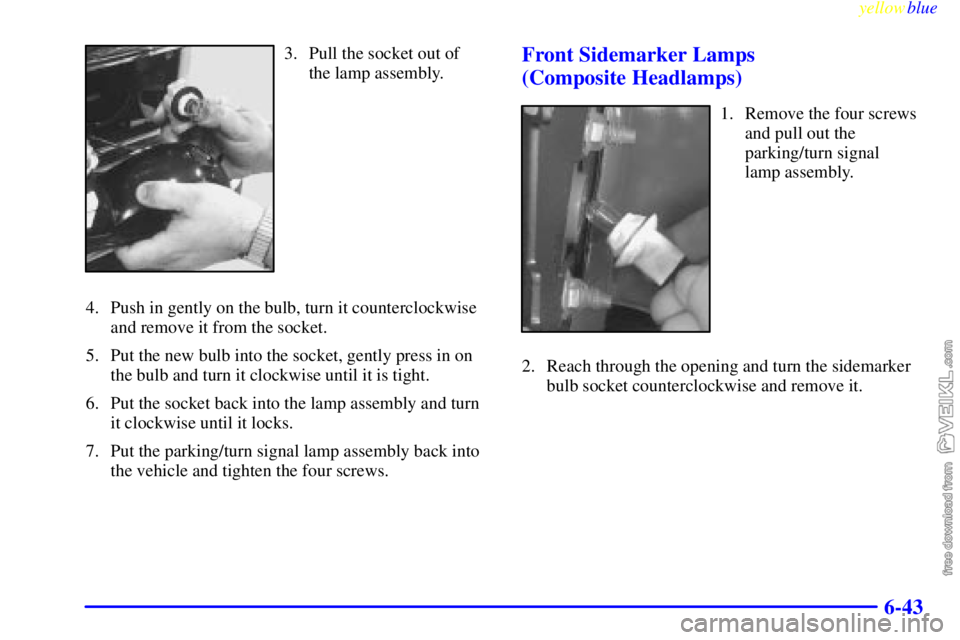
3. Pull the socket out of
the lamp assembly.
4. Push in gently on the bulb, turn it counterclockwise
and remove it from the socket.
5. Put the new bulb into the socket, gently press in on
the bulb and turn it clockwise until it is tight.
6. Put the socket back into the lamp assembly and turn
it clockwise until it locks.
7. Put the parking/turn signal lamp assembly back into
the vehicle and tighten the four screws.Front Sidemarker Lamps
(Composite Headlamps)
1. Remove the four screws
and pull out the
parking/turn signal
lamp assembly.
2. Reach through the opening and turn the sidemarker
bulb socket counterclockwise and remove it.
Page 341 of 440
yellowblue
6-59
NOTICE:
The wrong wheel can also cause problems with
bearing life, brake cooling, speedometer or
odometer calibration, headlamp aim, bumper
height, vehicle ground clearance and tire or tire
chain clearance to the body and chassis.
Whenever a wheel, wheel bolt or wheel nut is replaced
on a dual wheel setup, check the wheel nut torque after
100, 1,000 and 6,000 miles (160, 1 600 and 10 000 km)
of driving. For proper torque, see ªWheel Nut Torqueº
in the Index.
See ªChanging a Flat Tireº in the Index for
more information.Used Replacement Wheels
CAUTION:
Putting a used wheel on your vehicle is
dangerous. You can't know how it's been used or
how far it's been driven. It could fail suddenly
and cause an accident. If you have to replace a
wheel, use a new GM original equipment wheel.
Page 352 of 440

yellowblue
6-70 Headlamps
The headlamp wiring is protected by an internal circuit
breaker. An electrical overload will cause the lamps
to go on and off, or in some cases to remain off.
If this happens, have your headlamp wiring checked
right away.
Windshield Wipers
The windshield wiper motor is protected by a circuit
breaker and a fuse. If the motor overheats due to heavy
snow, etc., the wiper will stop until the motor cools. If
the overload is caused by some electrical problem and
not snow, etc., be sure to get it fixed.
Power Windows and Other Power Options
Circuit breakers protect the power windows and other
power accessories. When the current load is too heavy,
the circuit breaker opens and closes, protecting the
circuit until the problem is fixed or goes away.
Fuses and Circuit Breakers
The wiring circuits in your vehicle are protected from
short circuits by a combination of fuses, circuit breakers
and fusible thermal links. This greatly reduces the
chance of fires caused by electrical problems.
Look at the silver
-colored band inside the fuse. If the
band is broken or melted, replace the fuse. Be sure you
replace a bad fuse with a new one of the identical size
and rating.
If you ever have a problem on the road and don't have
a spare fuse, you can borrow one that has the same
amperage. Just pick some feature of your vehicle that
you can get along without
-- like the radio or cigarette
lighter
-- and use its fuse, if it is the correct amperage.
Replace it as soon as you can.
Page 354 of 440

yellowblue
6-72
Fuse/Circuit
Breaker Usage
3 Courtesy Lamps, Cargo Lamp,
Glove Box Lamp, Dome/Reading
Lamps, Vanity Mirrors,
Power Mirrors
4 Instrument Cluster, DRL Relay,
Lamp Switch, Keyless Entry,
Low Coolant Module, Illuminated
Entry Module,
DRAC (Diesel Engine)
5 Not Used
6 Cruise Control
7 Auxiliary Power Outlet
8 Crank
9 License Lamp, Parking Lamps,
Taillamps, Roof Marker Lamps,
Tailgate Lamps, Front
Sidemarkers, Fog Lamp Relay,
Door Switch Illumination,
Fender Lamps, Headlamp
Switch IlluminationFuse/Circuit
Breaker Usage
10 Not Used
11 Wiper Motor, Washer Pump
12 A/C, A/C Blower,
High Blower Relay
13 Power Amp, Cigarette Lighter,
Door Lock Relay,
Power Lumbar Seat
14 4WD Indicator, Cluster, Comfort
Controls, Instrument Switches,
Radio Illumination,
Chime Module
15 DRL Relay, Fog Lamp Relay
16 Front and Rear Turn Signals,
Back
-Up Lamps, BTSI Solenoid
17 Radio (Ignition)
18 4WAL/VCM, ABS,
Cruise Control
19 Radio (Battery)