clock CHEVROLET C/K 2003 User Guide
[x] Cancel search | Manufacturer: CHEVROLET, Model Year: 2003, Model line: C/K, Model: CHEVROLET C/K 2003Pages: 386, PDF Size: 5.79 MB
Page 266 of 386

6-12
5. Open the fuel filter vent
valve by turning the
screw counterclockwise
several full turns.
6. Repeatedly press down
on the fuel filter primer
pump with the palm
of your hand. Let the
pump return upward
between presses.7. Operate the priming pump until a small amount of
fuel seeps from the vent valve. When you see the
fuel, the filter is now full of fuel and the system
should be primed.
8. Close the vent valve.
9. Clean any fuel which accumulated on the fuel filter.
10. Start the engine and let it idle for a few minutes.
11. Check the filter for leaks.
Page 268 of 386
6-14 Fuel Filter Replacement (Diesel Engines)
If you want to change the fuel filter yourself, here's how
to do it:
CAUTION:
Diesel fuel is flammable. It could start a fire if
something ignites it, and you could be burned.
Don't let it get on hot engine parts, and keep
matches or other ignition sources away.
First, drain any water from the filter following the
procedure for draining water listed previously.
Your vehicle's engine should be off until the end of
this procedure.
The fuel filter is located in the engine compartment on
the passenger's side of the vehicle, or on the driver's
side frame rail in front of the fuel tank.
1. Apply the parking brake.
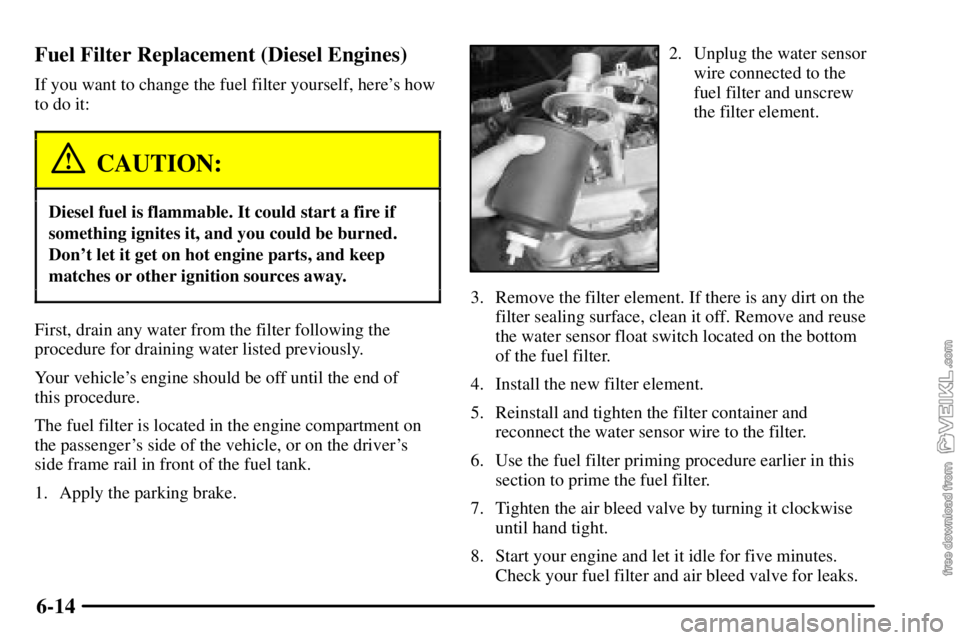
2. Unplug the water sensor
wire connected to the
fuel filter and unscrew
the filter element.
3. Remove the filter element. If there is any dirt on the
filter sealing surface, clean it off. Remove and reuse
the water sensor float switch located on the bottom
of the fuel filter.
4. Install the new filter element.
5. Reinstall and tighten the filter container and
reconnect the water sensor wire to the filter.
6. Use the fuel filter priming procedure earlier in this
section to prime the fuel filter.
7. Tighten the air bleed valve by turning it clockwise
until hand tight.
8. Start your engine and let it idle for five minutes.
Check your fuel filter and air bleed valve for leaks.
Page 270 of 386
6-16
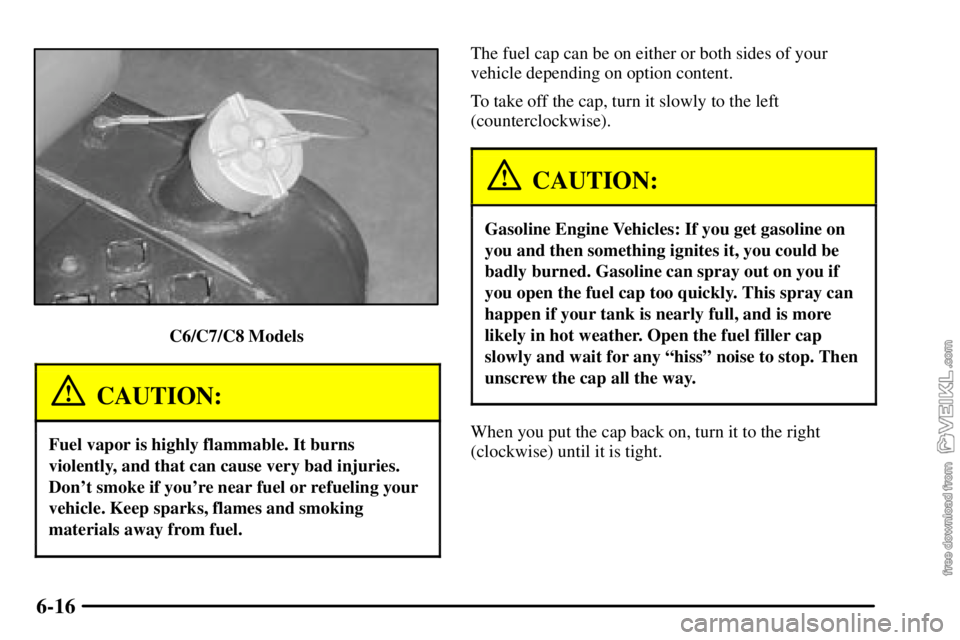
C6/C7/C8 Models
CAUTION:
Fuel vapor is highly flammable. It burns
violently, and that can cause very bad injuries.
Don't smoke if you're near fuel or refueling your
vehicle. Keep sparks, flames and smoking
materials away from fuel.
The fuel cap can be on either or both sides of your
vehicle depending on option content.
To take off the cap, turn it slowly to the left
(counterclockwise).
CAUTION:
Gasoline Engine Vehicles: If you get gasoline on
you and then something ignites it, you could be
badly burned. Gasoline can spray out on you if
you open the fuel cap too quickly. This spray can
happen if your tank is nearly full, and is more
likely in hot weather. Open the fuel filler cap
slowly and wait for any ªhissº noise to stop. Then
unscrew the cap all the way.
When you put the cap back on, turn it to the right
(clockwise) until it is tight.
Page 310 of 386
6-56 Automatic Ether Injection System
(If Equipped)
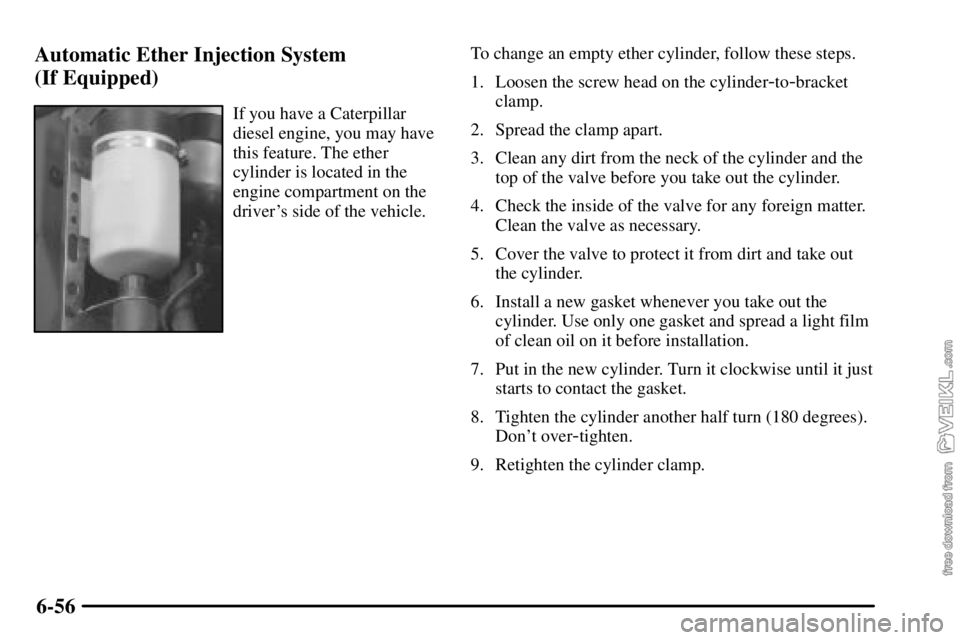
If you have a Caterpillar
diesel engine, you may have
this feature. The ether
cylinder is located in the
engine compartment on the
driver's side of the vehicle.To change an empty ether cylinder, follow these steps.
1. Loosen the screw head on the cylinder
-to-bracket
clamp.
2. Spread the clamp apart.
3. Clean any dirt from the neck of the cylinder and the
top of the valve before you take out the cylinder.
4. Check the inside of the valve for any foreign matter.
Clean the valve as necessary.
5. Cover the valve to protect it from dirt and take out
the cylinder.
6. Install a new gasket whenever you take out the
cylinder. Use only one gasket and spread a light film
of clean oil on it before installation.
7. Put in the new cylinder. Turn it clockwise until it just
starts to contact the gasket.
8. Tighten the cylinder another half turn (180 degrees).
Don't over
-tighten.
9. Retighten the cylinder clamp.
Page 317 of 386
6-63
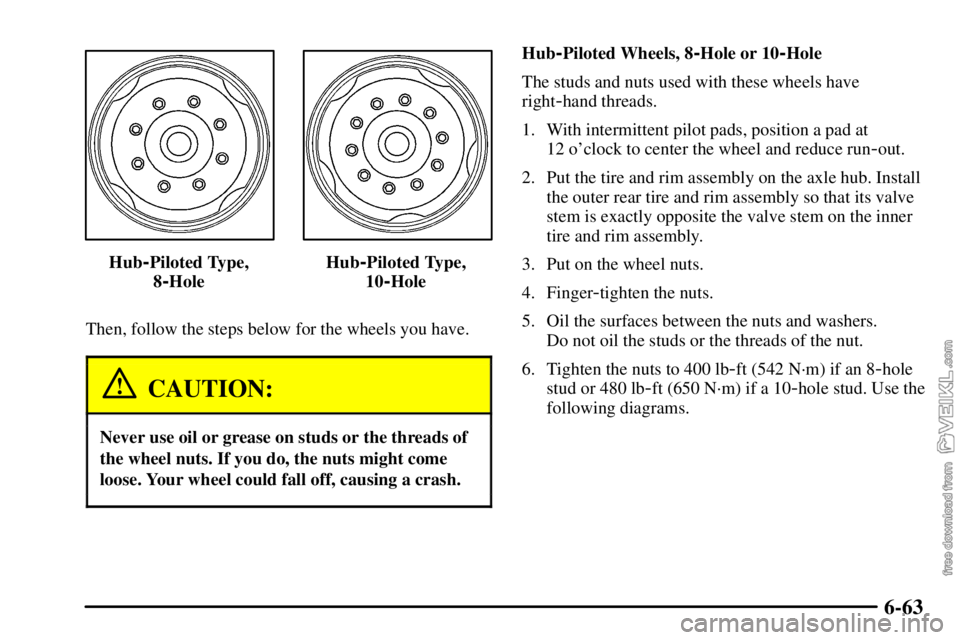
Hub-Piloted Type,
8
-HoleHub
-Piloted Type,
10
-Hole
Then, follow the steps below for the wheels you have.
CAUTION:
Never use oil or grease on studs or the threads of
the wheel nuts. If you do, the nuts might come
loose. Your wheel could fall off, causing a crash.
Hub-Piloted Wheels, 8-Hole or 10-Hole
The studs and nuts used with these wheels have
right
-hand threads.
1. With intermittent pilot pads, position a pad at
12 o'clock to center the wheel and reduce run
-out.
2. Put the tire and rim assembly on the axle hub. Install
the outer rear tire and rim assembly so that its valve
stem is exactly opposite the valve stem on the inner
tire and rim assembly.
3. Put on the wheel nuts.
4. Finger
-tighten the nuts.
5. Oil the surfaces between the nuts and washers.
Do not oil the studs or the threads of the nut.
6. Tighten the nuts to 400 lb
-ft (542 N´m) if an 8-hole
stud or 480 lb
-ft (650 N´m) if a 10-hole stud. Use the
following diagrams.