lock CHEVROLET CAMARO 1971 2.G User Guide
[x] Cancel search | Manufacturer: CHEVROLET, Model Year: 1971, Model line: CAMARO, Model: CHEVROLET CAMARO 1971 2.GPages: 88, PDF Size: 34.8 MB
Page 40 of 88
Downloaded from www.Manualslib.com manuals search engine lights, turn signals, backup lamps, and hazard
warning flashers. Have someone observe operation
of each light while you activate the controls.
• Starter Safety Switch (Automatic Transmis
sion Cars)
CAUTION: Before making the following check, be sure to have a clear distance ahead and behind the car, set the parking brake and firmly apply the foot brake. Do not depress accelerator pedal. Be prepared to turn ott ignition switch immediately if engine should start.
Check starter safety switch by placing the transmis
sion in each of the driving gears while attempting to
start the engine. The starter should operate only in the
Park ("P") or Neutral ("N") positions.
• Starter Interlock (Manual Transmission Cars)
-To check a manual transmission equipped car,
depress the clutch halfway, place the transmission
in neutral, and attempt to start.
The starter should
operate only when clutch
is fully depressed.
• Transmission Shift Indicator-Check to be sure
shift indicator accurately indicates the shift posi
tion selected.
• Horn-Blow the horn occasionally to be sure that
it works.
37
• Seat Back LatcheS-Check to see that seat bac k
latches are holding by pulling forward on the seat
back top.
• Rearview Mirrors and Sun Visors-Check that
friction joints are properly adjusted so mirrors and
sun visors stay in the selected position.
• Door LatcheS-Check for positive closing, la tch
ing and locking.
• Hood Latches-Check to make sure hood closes
firmly . Check also for broken , d amaged or missing
parts which might prevent secure latching.
• Fluid LeakS-Check for fuel, water, oil or other
fluid leaks by observing the ground beneath the
vehicle after it has been parked for a while . (Water
dripping from air conditioning system after use
is
normal). If gasoline fumes are noticed at any time,
the cause should be determined
and corrected with
out delay because of the possibility of fire.
• Exhaust System-See engine exhaust gas caution
at beginning of starting and operating section of
this manual for suggested driver observations and
checks.
Page 41 of 88
Downloaded from www.Manualslib.com manuals search engine I n Case of Emergency
Four Way Hazard
Warning
Flasher
• Use the warning flasher to warn
other drivers any time your
ve
hicle becomes a traffic hazard,
day or night.
• Avoid stopping on the roadway
if possible.
• Turn on the hazard warning
flasher, with engine ignition off
or on, by pushing in on the but
ton located just below the steer
ing wheel.
• If the brake pedal is depressed,
the lights will not flash
but will
glow continuously instead.
• To cancel the flasher, pull the
button outward.
"Rocking" Car
If it becomes necessary to rock
the car to free it from sand, mud or
snow, move the selector lever
from
"D" to "R" in a repeat pattern
while simultaneously applying
moderate pressure to the accelera
tor. Do not race engine. A void
spinning wheels when trying to free
car.
Towing
Proper lifting or towing equip
ment
is necessary to prevent dam
age to the vehicle during any tow
ing operation. Detailed towing in
formation is available at your
dealer and has been provided to
tow truck operators responsible for
movement of disabled or locked
ve
hicles. State and local laws appli
cable to vehicles in tow must also
be followed.
Your Camaro may be towed on
all four wheels, at speeds of less
than 35 MPH, for distances up to
38
50 miles, provided driveIine, axle
and transmission are otherwise nor
mally operable.
For such towing,
parking brake must be released,
and transmission must be in neu
tral (ignition lock turned to
OFF
position). Attachments must be to
main structural members of the car,
not to bumpers or bracketing,
Safety chains or cables should be
used. Remember that power steer
ing assist will not be available when
engine
is inoperative.
Emergency Starting
• Never tow the car to start
because the surge forward when
the engine starts could cause a
collision with the tow vehicle.
• Engines in vehicles with auto
matic transmissions cannot be
started by pushing the car.
Page 42 of 88
Downloaded from www.Manualslib.com manuals search engine • To. start the car when the Ener
gizer (battery)
is discharged,
use a single auxiliary battery
Qr
Energizer Qf the same vQltage as
the discharged battery, with suit
able jumper cables.
• Make cQnnectiQns detailed as
fQllQws:
Jump Starting with
Auxiliary (Booster) Battery
If booster battery is part Qf an
Qther vehicle's electrical system,
bQQster shQuld be treated carefully
when using jumper cables.
FQllQW
exactly the prQcedure Qutlined be
IQw, being careful nQt to. cause
sparks:
1. Set parking brake and place
autQmatic transmissiQn in
"PARK" ("NEUTRAL" fQr
manual transmissiQn).
2. Attach
Qne end of Qne jumper
cable
to. the PQsitive terminal Qf
the booster battery (identified by
"+" or "P" Qn the battery case,
PQst Qr clamp) and the Qther end
Qf same cable to. PQsitive ter
minal
Qf discharged battery.
3. Attach ene end ef the remain
ing cable
to. negative terminal
("-" er "N") ef booster battery,
and finally to. negative terminal
ef discharged battery -taking
i;cAufICsN}R.4btAl0W,CAP '!":;',';"S"!<"" .
···.···.T~·p,.v~ttt.,0 •• ot~~()l.nf.·#rii·j~6Itl t"~
'd.nger of being '. bu'n.d,~oo/.ntl.v.' .houldb.'ch.cked,.ndcoo/.nt .dd.4. only wh.n the .nglne/. cool.
'.Donot r.IJJov.radl.tbic.p whlj."'gln~ .ndradl.to,are.tlll hot, b.c.u ••. the
. cooling sVst.", will blow 'out .c.,dlng , fluid .nd st"m und.r pr.ssur ••
,
tol.mov. b"pWh.riengln./s
39
care that jumper clamps do. nQt
CQntact each ether,
Reverse this sequence exactly
when remeving the jumper cables.
CAUTION: Any proc~ur.~th.rt".n the'
.bove could r •• ult In person.' In/ury c.us.d by electrolyte .qulrtlng out .th. b.tt.ryvent., d.m.g. or In/ury due to b.tt.ry .xplo./on .ndlor d.m.g. to the charging sy.t.m of the boost., v.hlc/,'; or Immoblllz.d . v.hlcl.'. chargIng 'Y'tem. Do not .ttempt to lump .tart a c.r havIng • frozen battery b.cau •• the bit
t.ry mlY .xplod.. It • froz.n b.ttery I. su.pect.d, op.n .nd .x.mln •• 11 fill v.nt. , on the b.ttery. If Ie. c.n b •.. en, or the .,.ctrolyt. fluid c.nnotb •••• n, do not
att.mpt to .tart with /um".r c.bl ...
.'. $Iow~y ,otat • . c.p . count.rC/ockwl'~ .iQ ; d.terit(DO NOT PRESS DOWN WHILE
ROTATING).
•. Walt unt/f.ny ,e.ldu.' pressure I.re' lI.v.d-•• Indlc.t.d by • hissIng .ound.
• p,.ss down on c.p whll. continuing to rot.te counterclockwise.
Radl.tor pre.,ure cap. should b. check.d by • quallfl.d m.chanlc p.rlodlcally for proper op.ratlon and replaced .s r .. qulr.d with the .pplicabl.AC typ •.
Page 43 of 88
Downloaded from www.Manualslib.com manuals search engine · Changing Tires
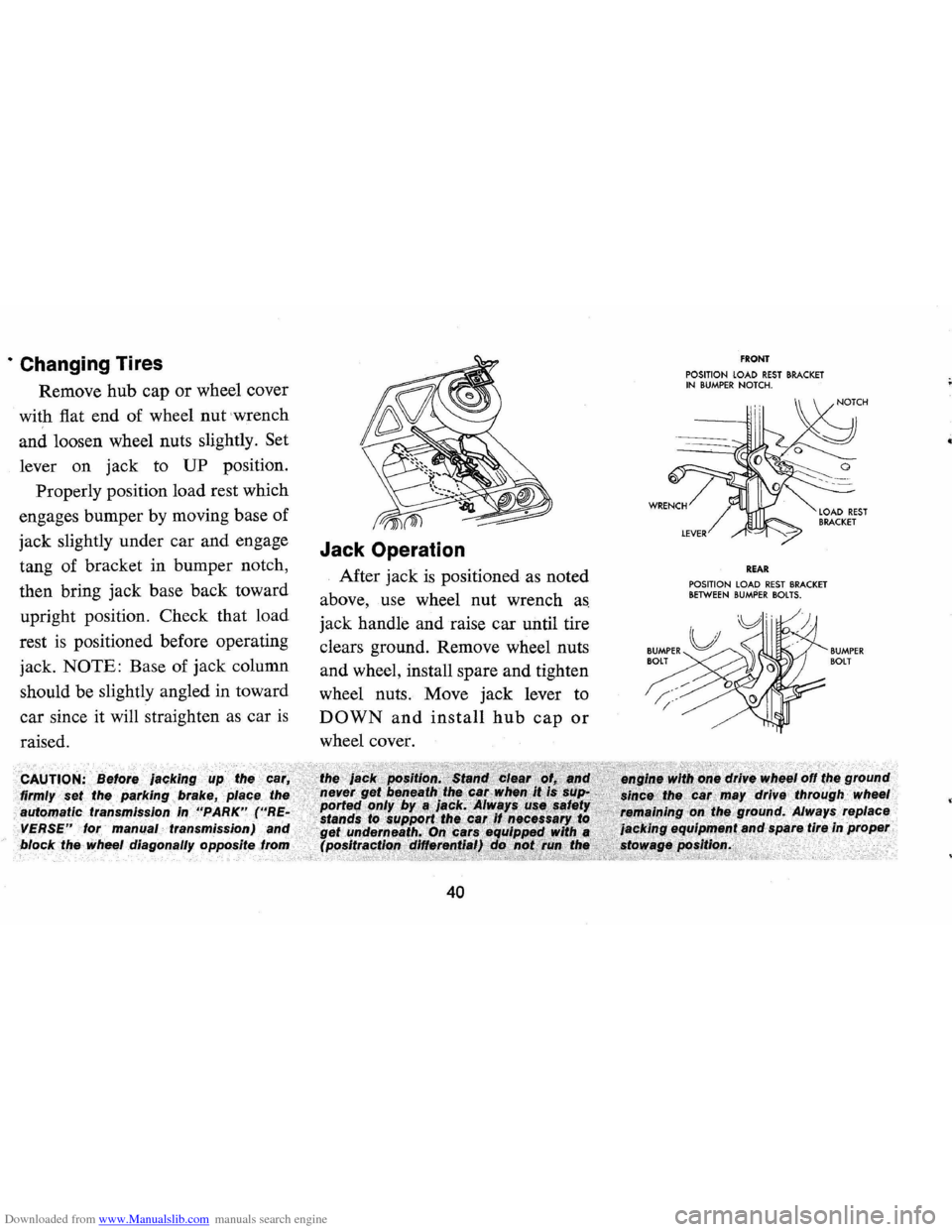
Remove hub cap or wheel cover
with fiat end of wheel
nut wrench
and loosen wheel nuts slightly.
Set
lever on jack to UP position.
Properly position load rest which
engages bumper by moving base of
jack slightly under car and engage
tang of bracket in bumper notch,
then bring jack base back toward
upright position. Check that load
rest is positioned before operating
jack.
NOTE: Base of jack column
should be slightly angled in toward
car since it will straighten as car
is
raised.
firmly
automatic rralrlSOIlSSlon
VERSE" lor manual transmission)
Jack Operation
After jack is positioned as noted
above, use wheel nut wrench
as
jack handle and raise car until tire
clears ground. Remove wheel nuts
and wheel, install spare and tighten
wheel nuts. Move jack lever to
DOWN and install hub cap or
wheel cover.
block the wheel diagonally opposite .. _.... .,.. __
40
FRONT POSITION LOAD REST BRACKET IN BUMPER NOTCH.
REAR POSITION LOAD REST BRACKET BETWEEN BUMPER BOLTS.
BUMPER BOlT
Page 54 of 88
Downloaded from www.Manualslib.com manuals search engine SERVICE AND MAINTENANCE
The time or mileage intervals on
the following pages are intended
as
a guide for establishing regular
maintenance and lubrication
periods for your car. Sustained
Fuel
Requirements
Your Camaro is designed to
operate efficiently on fuel of
ap
proximately 91 Research Octane
Number or higher, commonly sold
in the United
States and Canada.
Use of a fuel which is too low in
anti-knock quality will result in
"spark knock" and/or "after-run."
Since
the anti-knock quality of all
gasoline
is not the same and factors
such
as altitude, terrain, and air
temperature affect operating
effi-
heavy duty or high speed operations
or operation under adverse condi
tions may necessitate more frequent
servicing. To determine specific
recommendations for conditions
ciency, knocking
and/or after-run
may result even though you are
using the fuel recommended.
If
these conditions persist consult
your authorized Chevrolet Dealer.
In any case, continuous or
ex
cessive knocking may result in en
gine damage and constitutes mis
use of the engine for which Chev
rolet Division is not responsible
under the terms of the New Vehicle
Warranty.
NOTE: Read page 42 regarding
the importance
of using unleaded
or
low lead gasolines.
51
under which you use your car, con
sult your Authorized Chevrolet
Dealer.
Gas Cap-The fuel tank filler cap
has a new two-step removal and
installation procedure plus a
pres
sure-vacuum safety relief valve. It
is equipped with a double set of
locking tangs.
To remove:
• Rotate cap one-half turn coun
terclockwise to clear the first set
of tangs from the slots inside the
filler neck. This will allow any
residual pressure to escape.
• Pull the cap outward and rotate
one-quarter turn counterclock
wise to clear second set of tangs
and remove the cap.
• To install, reverse this procedure.
Page 62 of 88
Downloaded from www.Manualslib.com manuals search engine Standard Steering Gear
The steering gear is factory
filled with steering gear lubricant.
Seasonal change of this lubricant
should not be performed
and the
housing should
not be drained-no
lubrication
is required for the life
of the steering gear.
Every 36,000 miles, the gear
should be inspected for seal leak
age (actual solid
grease-not just
oily film).
If a seal is replaced or
the gear is overhauled, the gear
housing should be refilled with
Part No. 1051052 (13 oz. con
tainer)
Steering ' Gear Lubricant
which meets
GM Specification GM
4673M, or its equivalent.
NOTE: Do not use EP Chassis
Lube, meeting
GM Specification
GM 6031 M, to lubricate the gear.
DO NOT OVER-FILL the gear
housing.
Power Steering Pump
Every 6,000 miles or 4 months
Check level in pump reservoir. Fill
pump reservoir
as required with
GM Power Steering Fluid or, if
this
is not available, DEXRON®
Automatic Transmission fluid.
Oil
should be at operating tempera
ture
and wheels in straight ahead
position when checking
or filling
operation is performed to ensure
against over-filling.
Hood Latches
Every 4 months or 6,000 miles,
whichever occurs first, lubricate
hood latch assembly
and hood
hinge assembly as follows:
1. Wipe off any accumulation of
dirt
or contamination on latch
parts.
2. Apply Lubriplate
or equivalent
to latch pilot bolts
and latch
locking plate.
3. Apply light engine oil to
all
59
pivot points in release mecha
nism, as well as primary
and sec
ondary latch mechanisms.
4. Lubricate hood hinges.
5. Make hood hinge
and latch
mechanism functional check to
assure the assembly is working
correctly.
Air Conditioning
Have your Chevrolet Dealer
check your Air Conditioning sys
tem at some time during the winter
months to
be sure there has been
no loss in cooling output. During
the summer, see your Chevrolet
Dealer immediately if you suspect
the system is
not performing as it
should.
NOTE: On vehicles equipped with
a
Four Season Air Conditioning
System, the system will not operate
below ambient temperatures of
30oP. regardless of control posi
tion.
Page 73 of 88
Downloaded from www.Manualslib.com manuals search engine (E) If the car will start but stalls when hot or has a rough idle, you can suspect a faulty IDLE ADJUSTMENT, a malfunctioning AUTOMATIC CHOKE or an extremely dirty and blocked AIR CLEANER ELEMENT. Replace paper element air cleaner if necessary. Idle adjustment or automatic choke service (other than that outlined in paragraph D above) should be performed by your Chevrolet Dealer.
If the above Fuel System checks and the checks suggested under the Electrical System following do not correct the malfunction, it is recommended that you return to your Authorized Chevrolet Dealer for further checks, adjustments or repairs.
ELECTRICAL SYSTEM
If, when the ignition key is turned to "Start", the engine will not
turn over, you have good reason to suspect electrical trouble.
NOTE: Never remove Delcotron bat lead without first disconnecting battery ground cable.
(F) When there is no response at all to attempts to start the car, check the obvious-your AUTOMATIC TRANSMISSION SELECTOR LEVER must be in Neutral or Park position before the engine can be started. Turning the IGNITION SWITCH rapidly back and forth several times will sometimes correct a poor internal switch contact.
(G) The BATIERY may be discharged. If so, lights will be dim and the horn will have a poor tone if it will blow at all.
Usually
a garage recharge will be necessary to return the battery to operation. Occasionally, however, a long drive will recharge the battery.
NOTE: If the battery is determined to be dead, and for no apparent reason, have your Authorized Chevrolet Dealer check the
battery, the GENERATOR and the VOLTAGE REGULATOR. GENERATOR trouble should already have been indicated by the gene~ator indicator light on the instrument panel.
70
POOR BATIERY CONNECTIONS may be suspected if the car has operated properly a short time before and now not even the horn will operate. Check both ends of both battery cables. If the con
nections are corroded, a car may sometimes be restored to operation by removing all cable ends, scraping all contacting surfaces clean with a pen knife, and reassembling. If the cables are broken,
they must be replaced. The power supply should now be restored unless the battery is dead.
(H) If, however, the lights and horn work properly but the starter will still not turn over, check the STARTER connections. A "click" from the starter solenoid indicates that the wiring to the starter is properly installed. If the wiring seems to be clean and tightly installed, the trouble is probably in the starter itself and should be referred to your Authorized Chevrolet Dealer.
When the engine will "turn over" but will not start, the following items may be checked along with the Fuel Systems Checks listed
previously.
(I) With a clean dry cloth, wipe the ceramic portions of the spark plugs dry. In particularly damp or rainy weather dampness may be the cause of not starting, especially when the engine is cold.
(J) Check the cables at the top of the distributor and coil as well as each spark plug cable for tightness.
(K) If the car will still not start, check for spark at the spark plugs in the following manner:
Pull one of the spark plug wires off its spark plug. Insert a
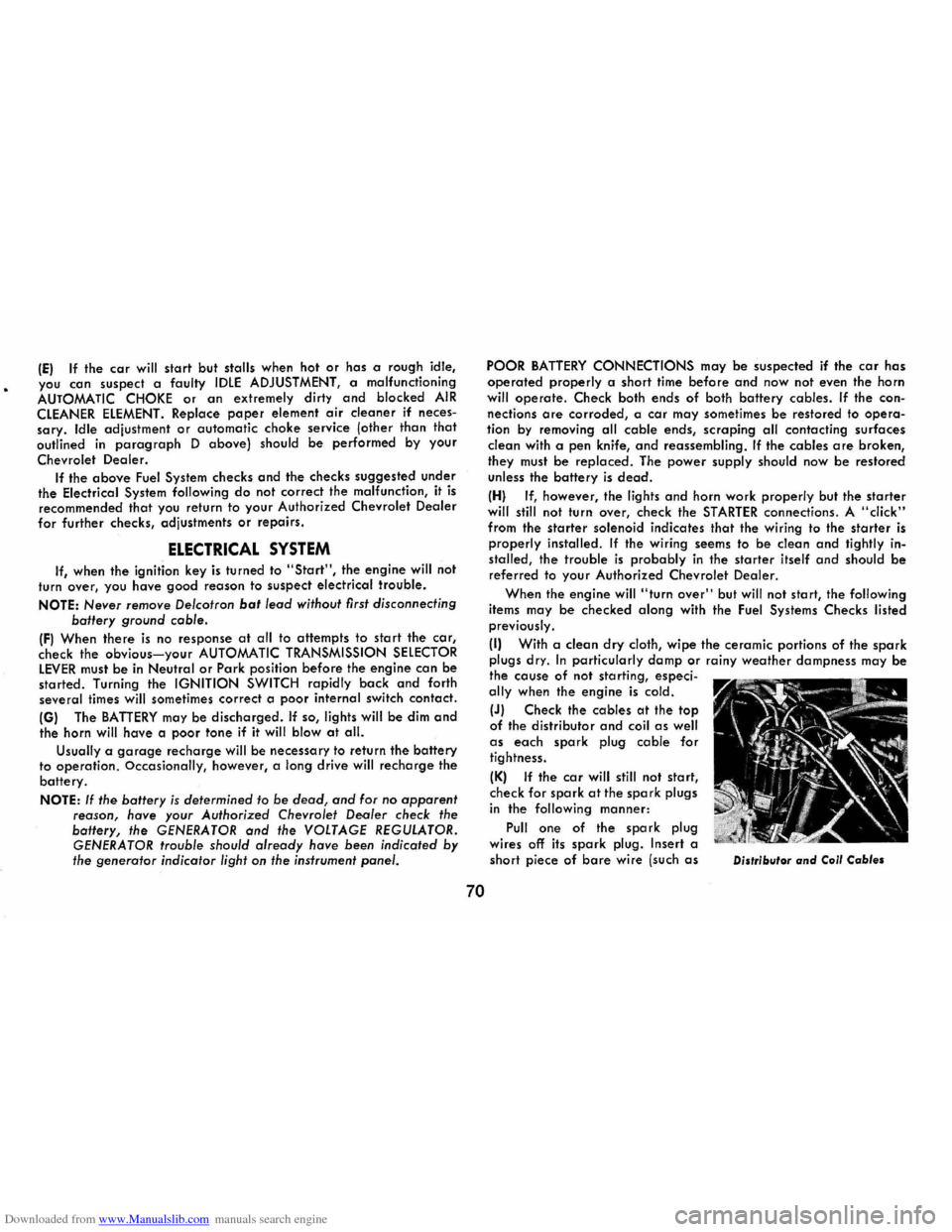
short piece of bare wire (such as Distributor and Coil Cables
Page 75 of 88
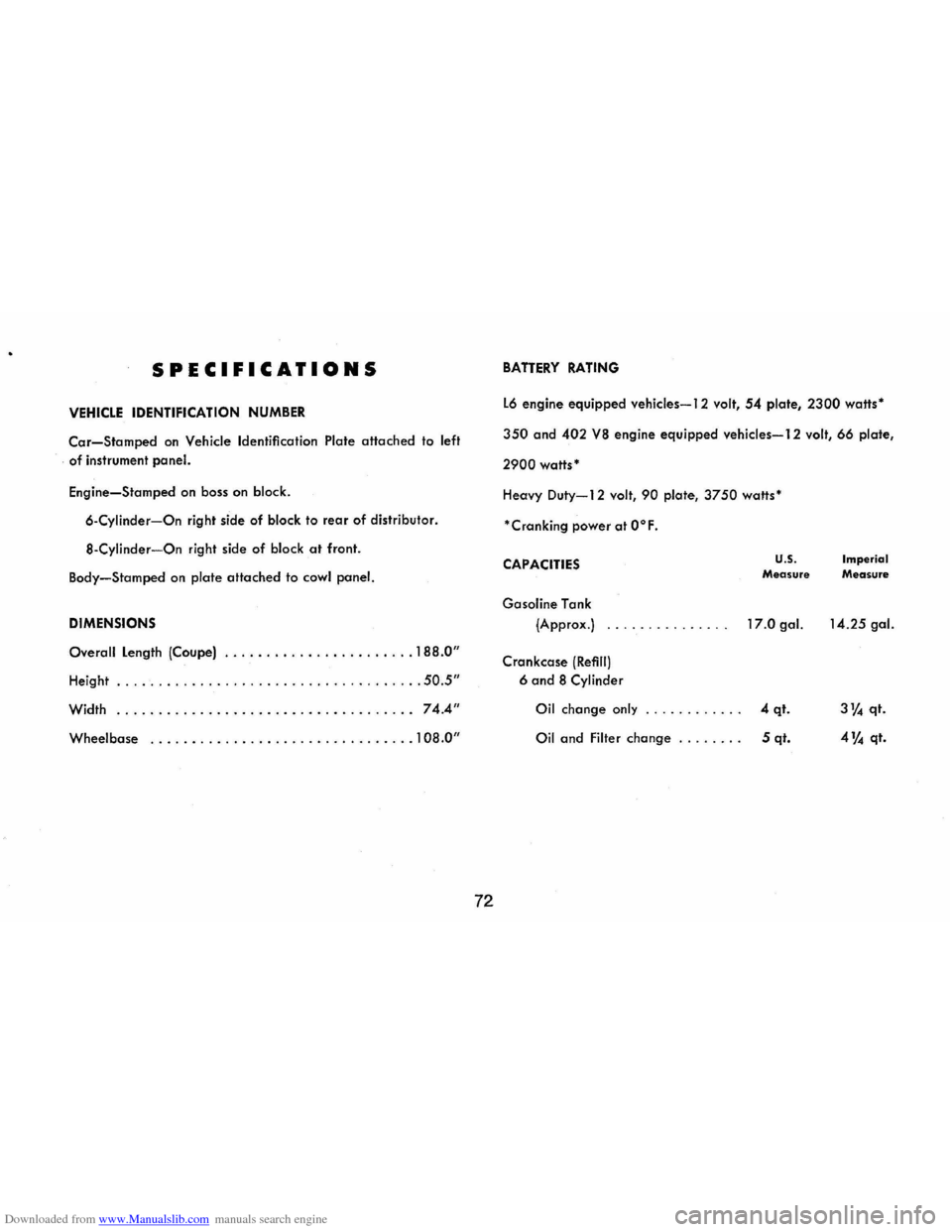
Downloaded from www.Manualslib.com manuals search engine SPECIFICATIONS
VEHICLE IDENTIFICATION NUMBER
Car-Stamped on Vehicle Identification Plate attached to left
of instrument panel.
Engine-Stamped on boss on block.
6-Cylinder-On right side of block to rear of distributor.
S-Cylinder-On right side of block at front.
Body-Stamped on plate attached to cowl panel.
DIMENSIONS
Overall Length (Coupe) ....................... 18S.0"
Height ..................................... 50.5"
Width .................................... 74.4"
Wheelbase ................................ 108.0"
72
BATTERY RATING
L6 engine equipped vehicles-12 volt, 54 plate, 2300 watts'
350 and 402 VS engine equipped vehicles-12 volt, 66 plate,
2900 watts'
Heavy Duty-12 volt, 90 plate, 3750 watts'
'Cranking power at O°F.
CAPACITIES
Gasoline Tank
(Approx.)
Crankcase
(Refill)
6 and S Cylinder
Oil change only
u.s. Measure
17.0 gal.
4 qt.
Oil and Filter change . . . . . . .. 5 qt.
Imperial Measure
14.25 gal.
3% qt.
4 % qt.
Page 79 of 88
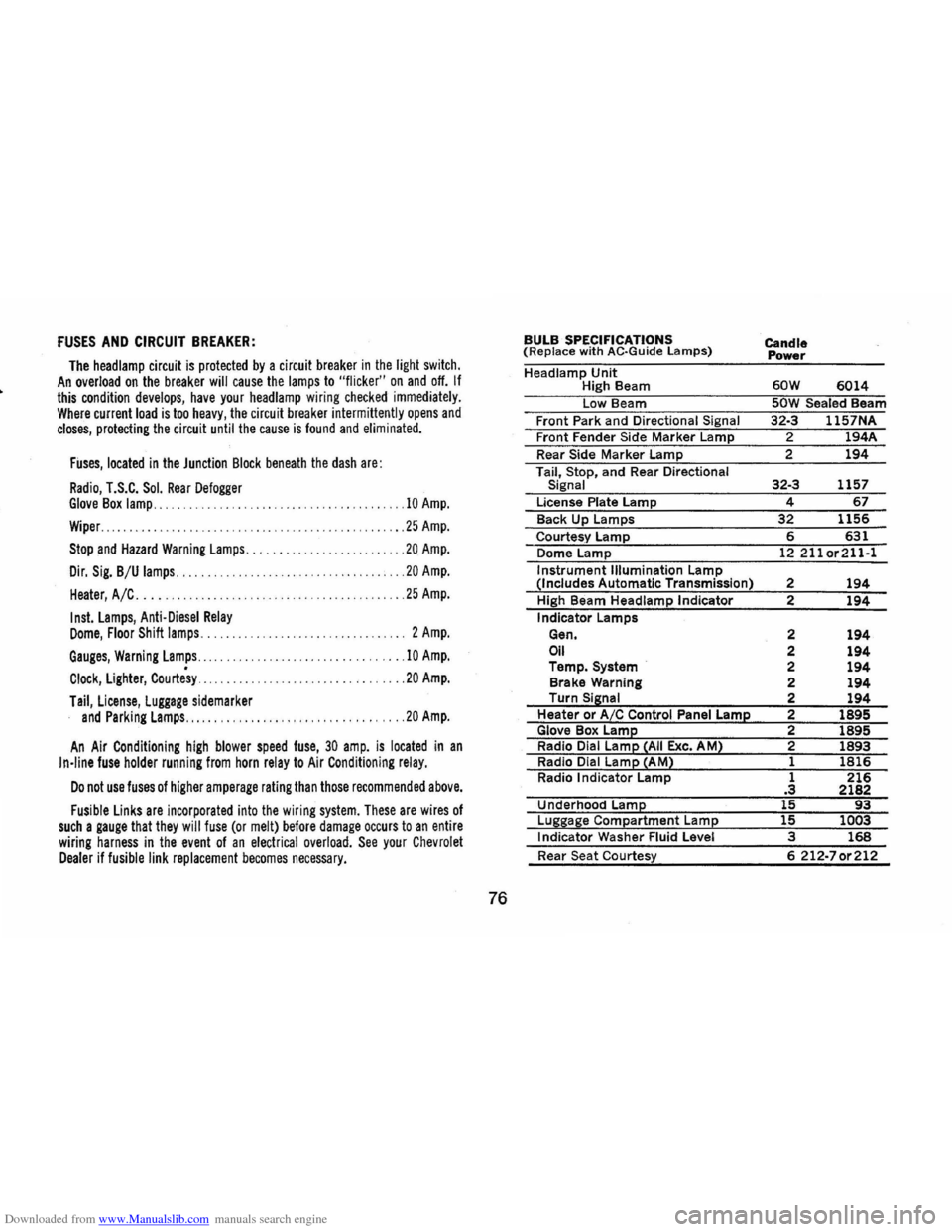
Downloaded from www.Manualslib.com manuals search engine FUSES AND CIRCUIT BREAKER:
The headlamp circuit is protected by a circuit breaker in the light switch. An overload on the breaker will cause the lamps to "flicker" on and off. If this condition develops, have your headlamp wiring checked immediately. Where current load is too heavy, the circuit breaker intermittently opens and closes, protecting the circuit until the cause is found and eliminated.
Fuses, located in the Junction Block beneath the dash are:
Radio, T.S.C. Sol. Rear Defogger Glove Box lamp .... .. ............. 10 Amp.
Wiper .................... . . . ............... 25 Amp.
Stop and Hazard Warning Lamps .. ...... ... .. ... ... ... .. . 20 Amp.
Dir. Sig. B/U lamps .. ......... . .
.. .. .. ....... 20 Amp.
Heater, A /C. . . . . . .. .. .. .. .. .. . .. .. . .. .. . .......... . . 25 Amp.
Inst. Lamps, Anti·Diesel Relay Dome, Floor Shift lamps ............. ..................... 2 Amp.
Gauges, Warning Lamps .... ................... ........... 10 Amp.
Clock, Lighter, Courtesy ......................... .... .. .. 20 Amp.
Tail, License, Luggage sidemarker and Parking Lamps ............... .................... 20 Amp.
An Air Conditioning high blower speed fuse, 30 amp. is located in an In·line fuse holder running from horn relay to Air Conditioning relay.
Do not use fuses of higher amperage rating than those recommended above.
Fusible Links are incorporated into the wiring system. These are wires of such a gauge that they will fuse (or melt) before damage occurs to an entire wiring harness in the event of an electrical overload. See your Chevrolet Dealer if fusible link replacement becomes necessary.
76
BULB SPECIFICATIONS (Replace with AC·Guide lamps)
Headlamp Unit High Beam
Low Beam
Front Park and Directional Signal
Front Fender Side Marker Lamp
Rear Side Marker Lamp
Tail, Stop, and Rear Directional
Signal
License Plate Lamp
Back Up Lamps
Courtesy Lamp
Dome Lamp
Instrument Illumination Lamp (Includes Automatic Transmission)
High Beam Headlamp Indicator
Indicator Lamps
Gen.
Oil Temp. System
Brake Warning
Turn
Sisnal Heater or A/C Control Panel Lame Glove Box Lame Radio Dial Lame ~AII Exc. AM2 Radio Dial Lame ~AM2 Radio Indicator Lamp
Underhood
Lame
Luggase Compartment Lame Indicator Washer Fluid Level
Rear Seat Courtesy Candle
Power
60W 6014 50W Sealed Beam
32·3 1157NA
2 194A
2
194
32·3 1157
4 67
32 1156
6 631 12211or211·1
2 194 2 194
2 194 2 194 2 194 2 194 2 194 2 1895 2 1895 2
1893
1 1816 1 216 .3 2182 15 93 15 1003 3 168
6 212·70r212
Page 86 of 88
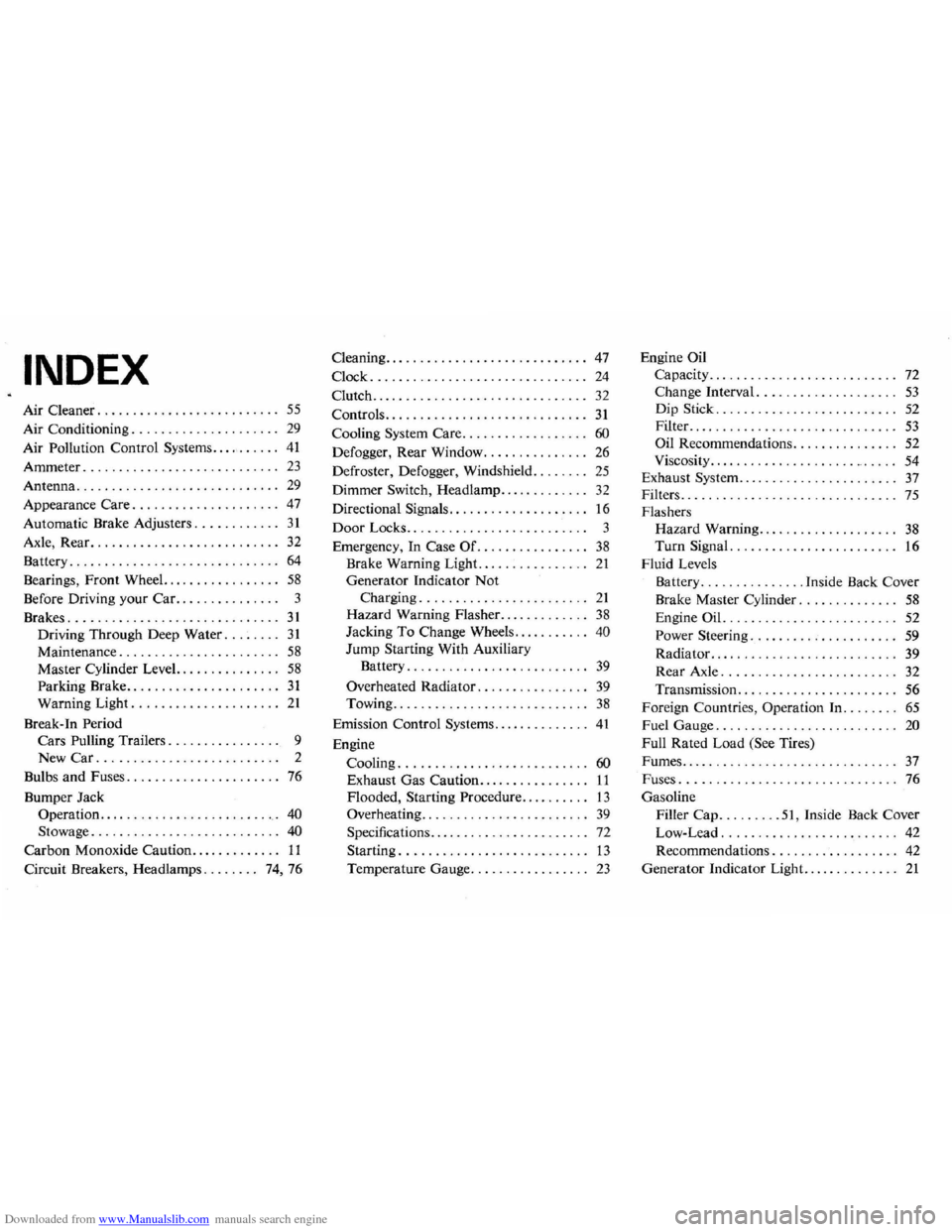
Downloaded from www.Manualslib.com manuals search engine INDEX
Air Cleaner. . . . . . . . . . . . . . . . . . . . . . . . .. 55
Air Conditioning. . . . . . . . . . . . . . . . . . . .. 29
Air Pollution Control Systems ...... .... 41
Ammeter ............................ 23
Antenna ............... .............. 29
Appearance Care ..................... 47
Automatic Brake Adjusters ............ 31
Axle, Rear. . . . . . . . . . . . . . . . . . . . . . . . . .. 32
Battery .. .................... ........ 64
Bearings, Front Wheel. . . . . . . . . . . . . . . .. 58
Before Driving your Car.. . . . . . . . . . . . .. 3
Brakes
................... ........... 31 Driving Through Deep Water ........ 31
Maintenance. . . . . . . . . . . . . . . . . . . . . .. 58
Master Cylinder Level. . . . . . . . . . . . . .. 58
Parking Brake ...................... 31
Warning Light. . . . . . . . . . . . . . . . . . . .. 21
Break-In Period Cars Pulling Trailers. . . . . . . . . . . . . . . . 9
New
Car . ......................... 2
Bulbs and Fuses .
..................... 76
Bumper Jack
Operation
......... . ................ 40 Stowage ........................... 40
Carbon Monoxide Caution ......... .... 11
Circuit Breakers, Headlamps. . . . . . .. 74, 76
Cleaning ............................. 47
Clock ..
............................. 24
Clutch ..................... .......... 32
Controls ....... .... ....... ........... 31
Cooling System Care. . . . . . . . . . . . . . . . .. 60
Defogger, Rear Window
............... 26
Defroster , Defogger, Windshield ........ 25
Dimmer Switch, Headlamp . . . . . . . . . . . .. 32
Directional Signals. . . . . . . . . . . . . . . . . . .. 16
Door Locks.. . . .. . . .. . . . . . . . . . . .. .. .. 3
Emergency, In Case
Of ................ 38
Brake Warning Light. . . . . . . . . . . . . . .. 21 Generator Indicator Not
Charging. . . . . . . . . . . . . . . . . . . . . . .. 21 Hazard Warning Flasher ........... .. 38
Jacking To Change Wheels ........... 40
Jump Starting With Auxiliary
Battery .......................... 39
Overheated Radiator. . . . . . . . . . . . . . .. 39
Towing ..................... ..... .. 38
Emission Control Systems .............. 41
Engine
Cooling
........................... 60
Exhaust Gas Caution ................ 11 Flooded, Starting Procedure . . . . . . . . .. 13
Overheating. . . . . . . . . . . . . . . . . . . . . . .. 39
Specifications . . . . . . . . . . . . . . . . . . . . . .. 72
Starting . . . . . . . . . . . . . . . . . . . . . . . . . .. 13
Temperature Gauge. . . . . . . . . . . . . . . .. 23
Engine Oil
Capacity. . . . . . . . . . . . . . . . . . . . . . . . . .. 72
Change Interval. . . . . . . . . . . . . . . . . . .. 53 Dip Stick. . . . . . . . . . . . . . . . . . . . . . . . . . 52
Filter .......... .................... 53
Oil Recommendations ............... 52
Viscosity
.............. ........ . .. .. 54
Exhaust
System .................... ... 37 Filters .................... ........... 75
Flashers
Hazard Warning
.................... 38 Turn Signal. ...................... , 16
Fluid Levels
Battery
............... Inside Back Cover
Brake Master Cylinder . . . . . . . . . . . .
.. 58
Engine Oil. . . . . . . . . . . . . . . . . . . . . . . .. 52
Power Steering. . . . . . . . . . . . . . . . . . . .. 59
Radiator. . . . . . . . . . . . . . . . . . . . . . . . . .. 39
Rear Axle. . . . . . . . . . . . . . . . . . . . . . .
.. 32
Transmission. . . . . . . . . . . . . . . . . . . . . .. 56
Foreign Countries, Operation In
...... .. 65
Fuel Gauge. . . . . . . . . . . . . . . . . . . . . . . . .. 20
Full Rated Load (See Tires)
Fumes ..
........ ..... ............ .. .. 37
Fuses ............................... 76
Gasoline Filler Cap
......... 51, Inside Back Cover
Low-Lead .
........................ 42
Recommendations. . . . . . . . . . . . . . . . ..
42
Generator Indicator Light. ............. 21