ECU CHEVROLET CAMARO 1971 2.G Owners Manual
[x] Cancel search | Manufacturer: CHEVROLET, Model Year: 1971, Model line: CAMARO, Model: CHEVROLET CAMARO 1971 2.GPages: 88, PDF Size: 34.8 MB
Page 7 of 88
Downloaded from www.Manualslib.com manuals search engine REMINDER: Always lock the
doors when driving, for greater
security in the event of an accident
and for security against unauthor
ized entries.
Seats
Folding seat backs are equipped
with self-latching mechanisms and
release controls designed for the
convenience of entering and exiting
passengers.
Back Locks
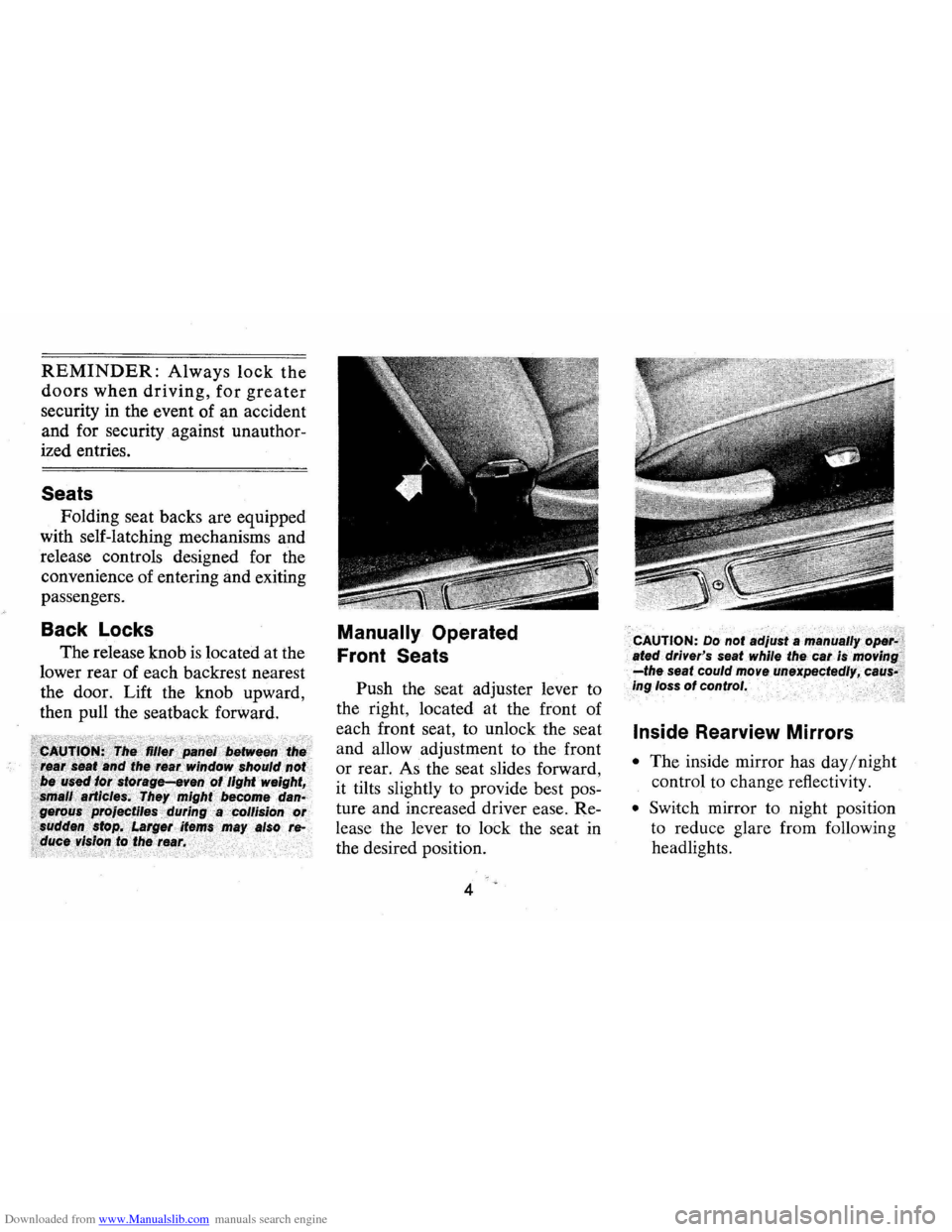
The release knob is located at the
lower rear of each backrest nearest
the door. Lift the knob upward,
then pull the seatback forward.
Manually Operated
Front
Seats
Push the seat adjuster lever to
the right, located
at the front of
each front seat, to unlock the seat
and allow adjustment to the front
or rear. As the seat slides forward,
it tilts slightly to provide best pos
ture and increased driver ease. Re
lease the lever to lock the seat in
the desired position.
4
CAUTION: Do not adjust a manually oper·< ated driver's seat while the car is movi -the seat could move unexpectedly, c
Ing loss at control.
Inside Rearview Mirrors
• The inside mirror has day/night
control to change reflectivity.
• Switch mirror to night position
to reduce glare from following
headlights.
Page 8 of 88
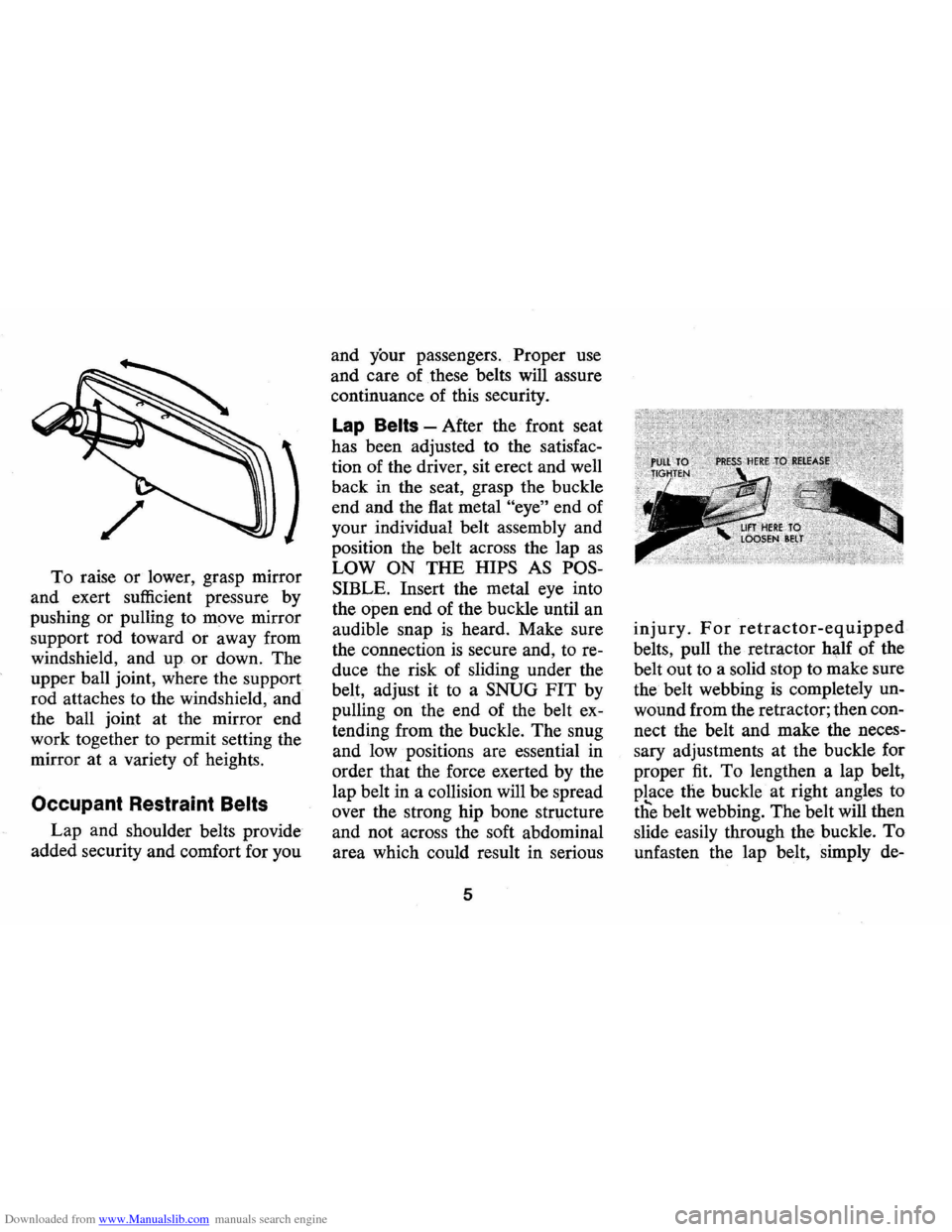
Downloaded from www.Manualslib.com manuals search engine To raise or lower, grasp mirror
and exert sufficient pressure by
pushing or pulling to move mirror
support rod toward
or away from
windshield, and up
or down. The
upper ball joint, where the support
rod attaches to the windshield, and
the ball joint at the mirror end
work together to permit setting the
mirror at a variety of heights.
Occupant Restraint Belts
Lap and shoulder belts provide
added security and comfort for you and
your passengers. Proper use
and care of these belts will assure
continuance of this security.
Lap Belts -After the front seat
has been adjusted to the satisfac
tion of the driver, sit erect and well
back in the seat, grasp the buckle
end and the flat metal
"eye" end of
your individual belt assembly and
position the belt across the lap
as
LOW ON THE HIPS AS POS
SIBLE. Insert the metal eye into
the open end of the buckle until an
audible snap
is heard. Make sure
the connection
is secure and, to re
duce the risk of sliding under the
belt, adjust it to a SNUG
FIT by
pulling on the end of the belt ex
tending from the buckle. The snug
and low positions are essential in
order that the force exerted by the
lap belt in a collision will be spread
over the strong hip bone structure
and not across the soft abdominal
area which could result in serious
5
injury. For retractor-equipped
belts, pull the retractor hl;tlf of the
belt out to a solid stop to make sure
the belt webbing
is completely un
wound from the retractor; then con
nect the belt and make the neces
sary adjustments at the buckle for
proper
fit. To lengthen a lap belt,
pLace the buckle at right angles to
the belt webbing. The belt will then
slide easily through the buckle.
To
unfasten the lap belt, simply de-
Page 9 of 88
Downloaded from www.Manualslib.com manuals search engine press the push button located in the
center of the buckle.
Automatic-locking lap belt re
tractors are provided for the added
convenience of the driver and out
board front seat passenger on all
Camaro cars
as an extra cost op
tion. The automatic-locking re
tractors adjust and lock the lap
belts into position automatically
after fastening.
When not in use, shoulder belts
should be secured in the special storage
convenience provision, to
reduce the danger of the metal end
striking an occupant
in a sudden
stop. When storage provisions are
not provided, the loose end
mounted on the upper structure
should be .fastened to the fioor
mounted end, and adjusted to re
move excess · slack.
Passengers in the rear seat of a
convertible must remove any shoul
der belts BEFORE the top
is low
ered. Rear shoulder belts require
readjustment after the top has been
either lowered or raised.
To fasten
a lap belt equipped
with an automatic-locking retrac
tor, pull the webbing across the lap
far enough to permit inserting the
fiat metal "eye" end into the buckle.
If the webbing is not initially pulled
out far enough to permit buckling,
release the webbing, allowing it to
6
rewind in the retractor and release
the locking mechanism,
so the web
bing can be pulled out to the proper
length.
Once the buckle is fastened,
pull the belt firmly across the lap in
the direction of the retractor to
ob.;.
tain a snug fit. The retractor will
automatically take up the excess
webbing.
Shoulder Belts -When properly
worn with a lap belt, a shoulder
belt can provide additional protec-
Page 11 of 88
Downloaded from www.Manualslib.com manuals search engine Child Restraint
Children in automobiles should
be restrained to lessen the risk of
injury in accidents, sudden
s~ops or
other driving conditions . General
Motors has designed an
"INFANT
SAFETY CARRIER" specifically
for infants and a
"CHILD SAFETY
SEAT"
specifically for small chil
dren which are available from your
Che~rolet dealer. The Carrier and
Child
Seat are designed to utilize
lap belts in your 1971 Camaro.
The General Motors Infant
Safety
Carrier and the Child Safety Seat
must be used only in passenger ve
hicle seats equipped with lap belts.
They
must be used only on front or
rear seats which do not fold or on
folding seats equipped with a latch
to hold the seat back upright
(Stan
dard on 1967 and later model GM
passenger vehicles) .
In using either
Carrier or Child
Seat, read and
comply with all installation and usage
instructions.
Do ?ot place
more than one child at a tIme In the
Carrier or Child
Seat. · The Carrier
is designed for use only with infants
weighing up to
20 pounds. The
Child
Seat is designed for use only
by children weighing up to 30
pounds and who are able to sit up
by themselves. All unused seat belts
near the Carrier or Child Seat
should be stowed properly to help
prevent them from striking the
child in the event of a sudden stop
or collision. Shoulder belts should
be stowed in any special storage
convenience provision provided.
Lap belts and shoulder belts
with
out storage provisions should have
buckles latched and belts adjusted
to remove slack.
Cars Not Equipped With
Special Child Restraints
If a child is traveling in a vehicle
not equipped with a General
8
Motors Infant Safety Carrier or
Child Safety Seat, the following
precautions should be taken:
1. Children should be placed in
the rear seat. Never allow a
child to stand
or kneel on any
seat.
2. Infants . unable to sit up by
themselves should be restrained
by placing them in a covered,
padded bassinet
whi~h is pl~ced
crossways in the vehlcle (wldth
wise) on the rear seat. The bas
sinet should be securely re
strained with the regular ve
hicle seat belts. An alternate
method
is to position the bas
sinet so that it rests against the
back of the front seat, again
crossways in the vehicle.
3. When a child
is old enough to
sit up by himself in a
~ar, he
should sit on a firm cushion and
use the conventional lap belt to
restrain him at the hips. The
Page 40 of 88
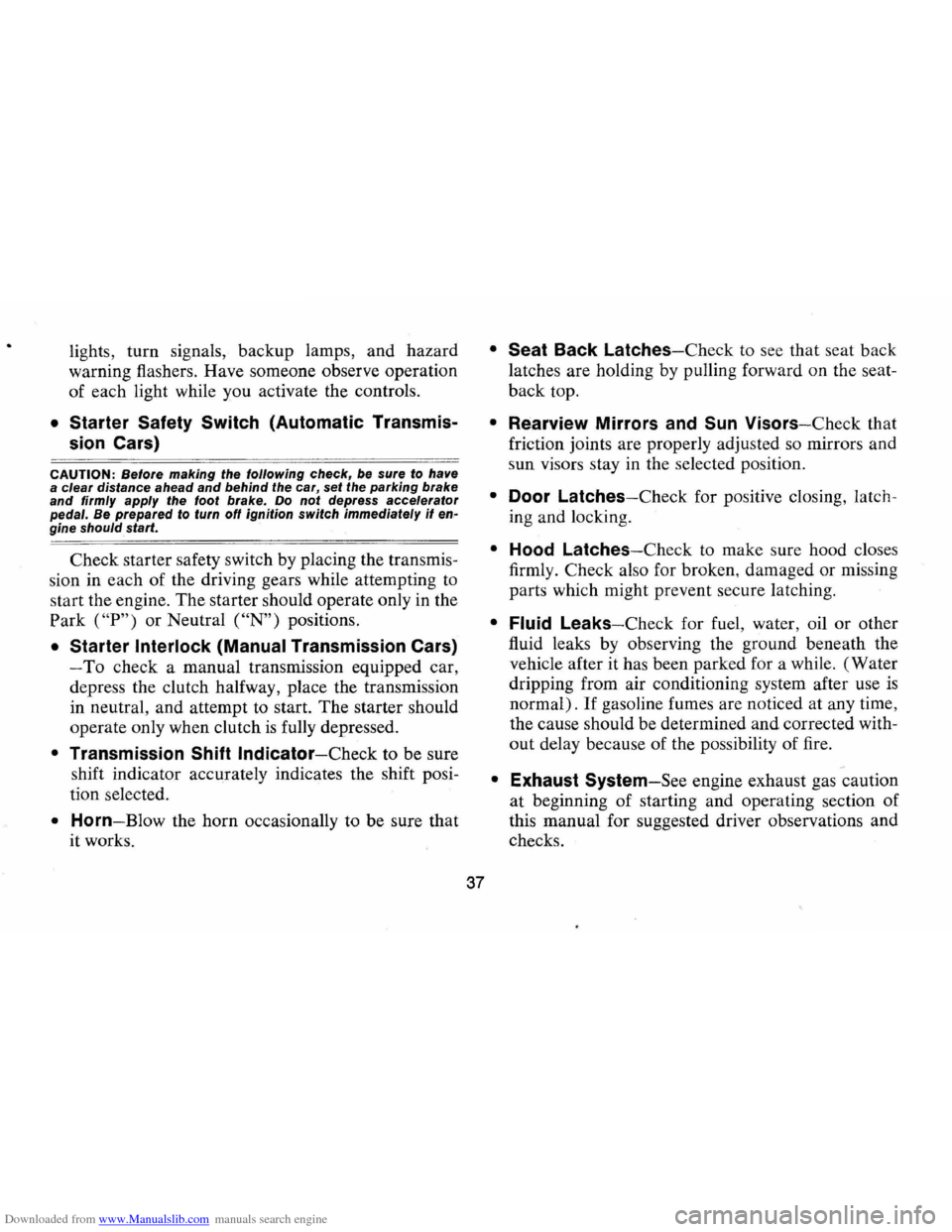
Downloaded from www.Manualslib.com manuals search engine lights, turn signals, backup lamps, and hazard
warning flashers. Have someone observe operation
of each light while you activate the controls.
• Starter Safety Switch (Automatic Transmis
sion Cars)
CAUTION: Before making the following check, be sure to have a clear distance ahead and behind the car, set the parking brake and firmly apply the foot brake. Do not depress accelerator pedal. Be prepared to turn ott ignition switch immediately if engine should start.
Check starter safety switch by placing the transmis
sion in each of the driving gears while attempting to
start the engine. The starter should operate only in the
Park ("P") or Neutral ("N") positions.
• Starter Interlock (Manual Transmission Cars)
-To check a manual transmission equipped car,
depress the clutch halfway, place the transmission
in neutral, and attempt to start.
The starter should
operate only when clutch
is fully depressed.
• Transmission Shift Indicator-Check to be sure
shift indicator accurately indicates the shift posi
tion selected.
• Horn-Blow the horn occasionally to be sure that
it works.
37
• Seat Back LatcheS-Check to see that seat bac k
latches are holding by pulling forward on the seat
back top.
• Rearview Mirrors and Sun Visors-Check that
friction joints are properly adjusted so mirrors and
sun visors stay in the selected position.
• Door LatcheS-Check for positive closing, la tch
ing and locking.
• Hood Latches-Check to make sure hood closes
firmly . Check also for broken , d amaged or missing
parts which might prevent secure latching.
• Fluid LeakS-Check for fuel, water, oil or other
fluid leaks by observing the ground beneath the
vehicle after it has been parked for a while . (Water
dripping from air conditioning system after use
is
normal). If gasoline fumes are noticed at any time,
the cause should be determined
and corrected with
out delay because of the possibility of fire.
• Exhaust System-See engine exhaust gas caution
at beginning of starting and operating section of
this manual for suggested driver observations and
checks.