lock CHEVROLET CAMARO 1973 2.G User Guide
[x] Cancel search | Manufacturer: CHEVROLET, Model Year: 1973, Model line: CAMARO, Model: CHEVROLET CAMARO 1973 2.GPages: 84, PDF Size: 32.64 MB
Page 40 of 84
Downloaded from www.Manualslib.com manuals search engine knowledgeable towing concern.
Your Camaro may be towed on
all four wheels, at speeds of
less
than 35 mph, for distances up to
50 miles, provided driveline, axle
and transmission are otherwise
normally operable. For such tow
ing, parking brake must be re
leased, transmission must be in
neutral
and ignition lock turned to
OFF position. Attachments must
be to main structural members of
the car, not to bumpers or brac
keting. Separate safety chains
or
cables should be used. Remember
that power brake and steering
as
sists will not be available when
engine
is inoperative.
Emergency Starting
• Never tow the car to start be
cause the surge forward when
the engine starts could cause a
collision with the tow vehicle.
• Engines in vehicles with auto
matic transmissions cannot be
started by (towing
or) pushing
the car.
• To start the car when the Ener
gizer (battery)
is discharged,
use a single auxiliary battery or
Energizer of the same nominal
voltage
(12 volts) as the dis
charged battery, with suitable
jumper cables.
• Make connections as set forth
below under
"Jump Starting
with Auxiliary (Booster) Bat
tery" to lessen the chance of
personal injury
or property
damage.
Jump Starting with
Auxiliary (Booster) Battery
Both booster and discharged
battery should be treated carefully
when using jumper cables. Follow
37
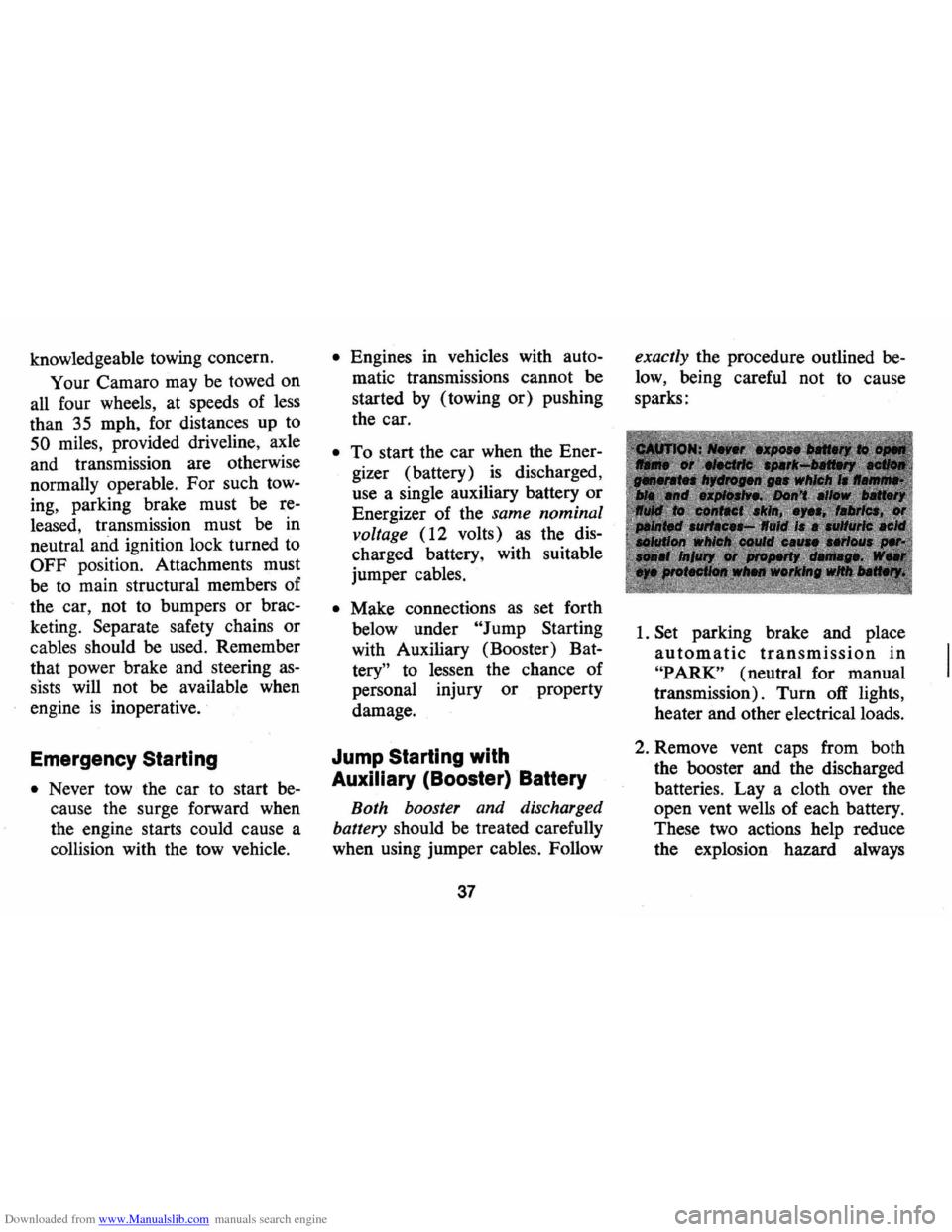
exactly the procedure outlined be
low, being careful not to cause
sparks:
1. Set parking brake and place
automatic transmission in
"PARK" (neutral for manual
transmission). Turn
off lights,
heater and other electrical loads.
2. Remove vent caps from both
the booster and the discharged
batteries. Lay a cloth over the
open vent wells of each battery.
These two actions help reduce
the explosion hazard always
Page 43 of 84

Downloaded from www.Manualslib.com manuals search engine • Activate hazard warning flasher.
• Block both the front and back
of the wheel diagonally opposite
the jack position.
Remove
hubcap or wheel cover
with flat end of wheel
nut wrench
and loosen wheel nuts slightly.
Set
lever on jack to UP position.
Properly position load rest which
engages bumper by moving base of
NOTE: Base of jack column
should be slightly angled in toward
car since it will straighteri
as car is
raised.
jack slightly under car and engage
tang of
bracket in bumper notch,
then bring jack base back toward
upright position. Check that
l~ad
rest is positioned before operatmg
jack.
40
Jack Operation
After jack is positioned as noted
above use
wheel nut wrench as . ,
jack handle and raise car until tire
clears ground. Remove wheel nuts
and wheel, install spare and tighten
wheel nuts. Move jack lever to
DOWN and install hub cap or
wheel cover.
Page 49 of 84
Downloaded from www.Manualslib.com manuals search engine to 0.5 grams per gallon) gasolines
to minimize emissions
or hydro
carbons and particulates.
If un
leaded or low-lead gasolines are
not available, gasolines containing
more than
0.5 grams per gallon
may be used.
In states using the Gasoline
Performance and Information
Sys
tem of fuel designation, unleaded
or low-lead fuels having an anti
knock designation of
"2" or higher
are recommended.
Gas Cap-The fuel tank filler cap
has a new two-step removal and
installation procedure plus a pres
sure-vacuum safety relief valve. It
is equipped with a double set of
locking tangs.
To remove:
• Rotate cap one-half turn coun
terclockwise to clear the first set
of tangs from the slots inside the
filler neck. This will allow any
residual pressure to escape.
• Pull the cap outward and rotate
one-quarter turn counterclock
wise to clear second set of tangs
and remove the cap.
• To install, reverse this procedure.
NOTE: If this cap requires a re
placement, only a cap with these
same features should be used. Fail
ure
to use the correct cap can re
sult in a serious malfunction of the
system. Correct replacement caps
may be obtained from your Au
thorized Chevrolet Dealer.
Engine Oil and Filter
Recommendations
• Use only SE engine oil.
• Change oil each 4 months or
6,000 miles. If more than 6,000
miles are driven in a 4-month
period, change oil each
6,000
miles.
46
• Change oil each 2 months or
3,000 miles, whichever occurs
first, under
th~ following con
ditions:
- driving in dusty conditions,
- trailer pulling,
- extensive idling,
- short-trip operation at freez-
ing temperatures (engine not
thoroughly warmed-up).
• Operation in dust storms may
require an immediate oil change.
• Replace the oil filter at the first
oil change, and every second oil
change thereafter. AC oil filters
provide excellent engine pro
tection.
See your Chevrolet dealer for ad
vice on the frequency of oil and
filter changes under unusual driv
ing conditions.
The above recommendations ap
ply to the first change
as well as
subsequent oil changes. The oil
change interval for your Camaro
Page 55 of 84
Downloaded from www.Manualslib.com manuals search engine Transmission Fluid) as necessary
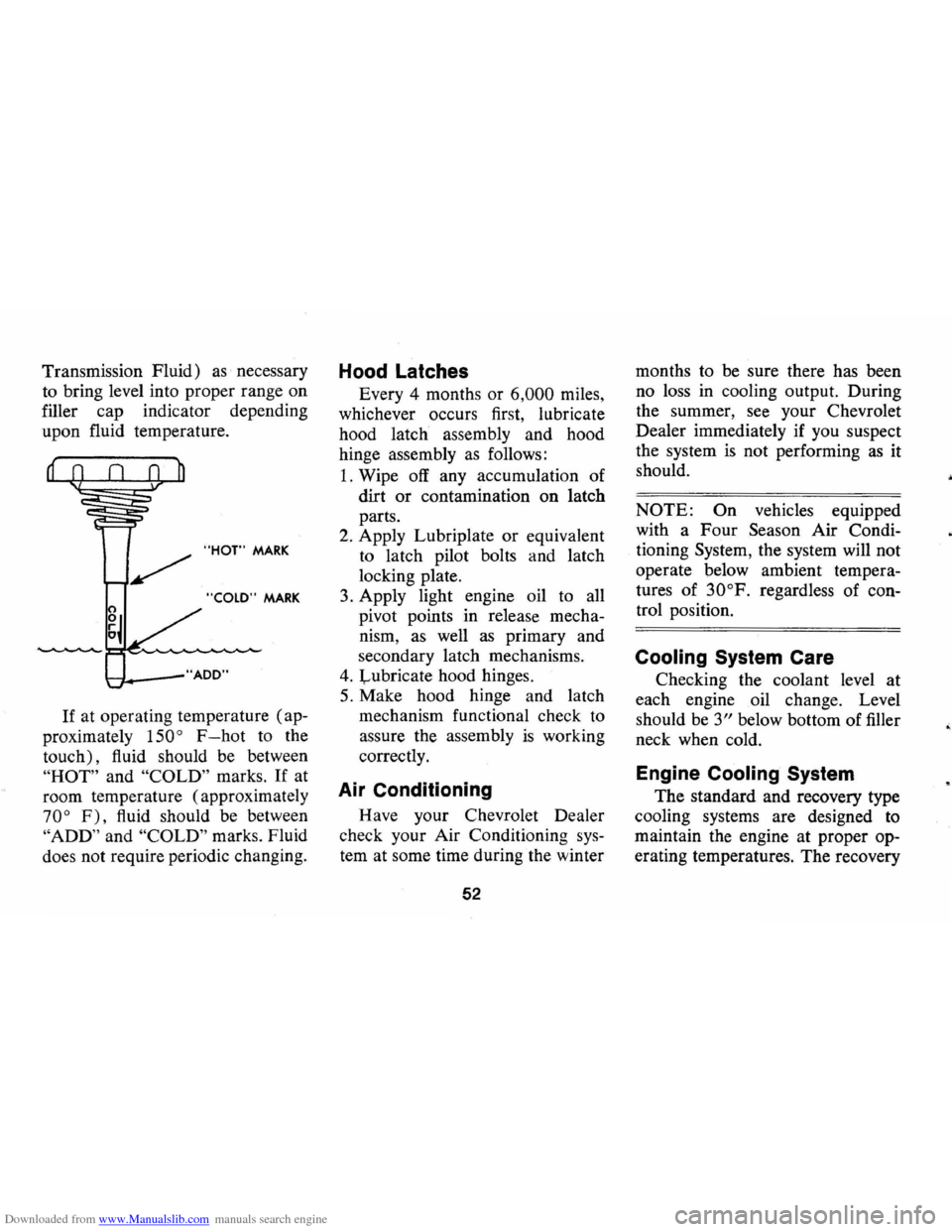
to bring level into proper range on
filler cap indicator depending
upon fluid temperature .
"HOT" MARK
"COLD" MARK
t-"f. __ -"AOO"
If at operating temperature (ap
proximately
150 ° F-hot to the
touch), fluid should be between
"HOT" and "COLD" marks. If at
room temperature (approximately
70° F), fluid should be between
"ADD" and "COLD" marks . Fluid
does not require periodic changing.
Hood Latches
Every 4 months or 6,000 miles,
whichever occurs first, lubricate
hood latch assembly and hood
hinge assembly
as follows:
1. Wipe off any accumulation of
dirt
or contamination on latch
parts.
2. Apply Lubriplate or equivalent
to latch pilot bolts and latch
locking plate.
3. Apply light engine oil to all
pivot points in release mecha
nism,
as well as primary and
secondary latch mechanisms.
4. Lubricate hood hinges.
5. Make hood hinge and latch
mechanism functional check to
assure the assembly
is working
correctly.
Air Conditioning
Have your Chevrolet Dealer
check your Air Conditioning
sys
tem at some time during the winter
52
months to be sure there has been
no loss
in cooling output. During
the summer,
see your Chevrolet
Dealer immediately if you suspect
the system
is not performing as it
should.
NOTE: On vehicles equipped
with a Four
Season Air Condi
tioning
System, the system will not
operate below ambient tempera
tures of
30°F. regardless of con
trol position.
Cooling System Care
Checking the coolant level at
each engine oil change. Level
should be
3" below bottom of filler
neck when cold.
Engine Cooling System
The standard and recovery type
cooling systems are designed
to
maintain the engine at proper op
erating temperatures. The recovery
•
Page 57 of 84
Downloaded from www.Manualslib.com manuals search engine Every two years or 24,000 miles,
whichever first occurs, the cooling
system should be drained by si
phoning
and refilled as follows :
1 . Run engine, with radiator cap
removed , until normal operat
ing temperature
is reached
and upper radiator
is hot (in
dicates thermostat
is open).
2. With engine stopped, insert
one end
of a 5-foot length of
¥s inch tubing into the filler
neck until it touches the bot
tom of the radiator.
3. Insert any type of large sy
ringe into the open end of the
tubing and initiate the siphon
ing process by squeezing and
releasing the ball.
4. Completely drain radiator
coolant through the siphon
tube.
(To speed this opera
. tion the drain plugs in block
can also be removed.)
4A. For recovery systems use
same method to siphon all
coolant from reservoir.
5. Remove tubing (install block
drain plugs, if removed) and
add sufficient water to fill
system.
6. Run engine, drain and refill
the system, as described in
steps
1 thru 5, a sufficient
number of times until the
drained liquid
is nearly color
less.
7. Allow system to drain com
pletely and install block drain
plugs, if removed.
8. Coolant Recovery Systems
Only
- Flush reservoir with
clean water,
and drain.
54
9. Add sufficient ethylene glycol
coolant, meeting
GM Specifi
cation 1899-M, to provide
the required freezing and
corrosion
protection-at least
a
44 percent solution (-200
F). For both standard and
recovery systems, fill radiator
to the cold fill level
(3" be
low bottom
of filler neck).
For recovery systems, add
sufficient coolant to reservoir
to raise level to
"Full Hot"
mark.
I O. Run engine, with radiator cap
removed, until normal oper
ating temperature
is reached.
(Radiator upper hose be
comes
hot.)
11. With engine idling, add cool
ant to within 1 V:z " below bot
tom of filler neck and install
radiator cap making certain
arrows line
up with overflow
tube.
Page 67 of 84
Downloaded from www.Manualslib.com manuals search engine IE) If the car will start but stalls when hot or has a rough idle,
you can suspect a faulty IDLE ADJUSTMENT, a malfunctioning AUTOMATIC CHOKE or an extremely dirty and blocked AIR CLEANER ELEMENT. Replace paper element air cleaner if necessary. Idle adjustment or automatic choke service (other than that outlined in paragraph 0 above) should be performed by your
Chevrolet Dealer.
If the above Fuel System checks and the checks suggested under the Electrical System following do not correct the malfunction, it is recommended that you return to your Authorized Chevrolet Dealer
for further checks, adjustments or repairs.
ELECTRICAL SYSTEM If, when the ignition key is turned to "Start", the engine will not
turn over, you have good reason to suspect electrical trouble. NOTE: Never remove Delcotron bat lead without first disconnecting
battery ground cable.
IF) When there is no response at all to attempts to start the car, check the obvious-your AUTOMATIC TRANSMISSION SELECTOR LEVER must be in Neutral or Park position (manual transmission
must have clutch depressed all the way to floor) before the engine can be started. Turning the IGNITION SWITCH rapidly back and forth several times will sometimes correct a poor internal switch
contact.
IG) The BATIERY may be discharged. If so, lights will be dim and the horn will have a poor tone if it will blow at all.
Usually a garage recharge will be necessary to return the battery to operation. Occasionally, however, a long drive will recharge the battery. NOTE: If the battery is determined to be dead, and for no apparent reason, have your Authorized Chevrolet Dealer check the
battery, the GENERATOR and the VOLTAGE REGULATOR.
GENERATOR trouble should already have been indicated by the generator indicator light on the instrument panel.
64
POOR BATIERY CONNECTIONS may be suspected if the car has operated properly a short time before and now not even the horn
will operate. Check both ends of both battery cables. If the connections are corroded, a car may sometimes be restored to operation by removing all cable ends, scraping all contacting surfaces
clean with a pen knife, and reassembling. If the cables are broken,
they must be replaced. The power supply should now be restored
unless the battery is dead.
IH) If, however, the lights and horn work properly but the starter will still not turn over, check the STARTER connections. A "click" from the starter solenoid indicates that the wiring to the starter is properly installed. If the wiring seems to be clean and tightly in
stalled, the trouble is probably in the starter itself and should be referred to your Authorized Chevrolet Dealer.
When the engine will
"turn over" but will not start, the foilowing
items may be checked along with the Fuel Systems Checks listed
previously.
II) With a clean dry cloth, wipe the ceramic portions of the spark plugs dry. In particularly damp or rainy weather dampness may be
the cause of not sta rting, especi
ally when the engine is cold.
IJ) Check the cables at the top of the distributor and coil as well as each spark plug cable for
tightness.
IK) If the co r will still not sta rt,
check for spark at the spark plugs in the following manner:
Pull one of the spark plug
wires off its spark plug. Insert a
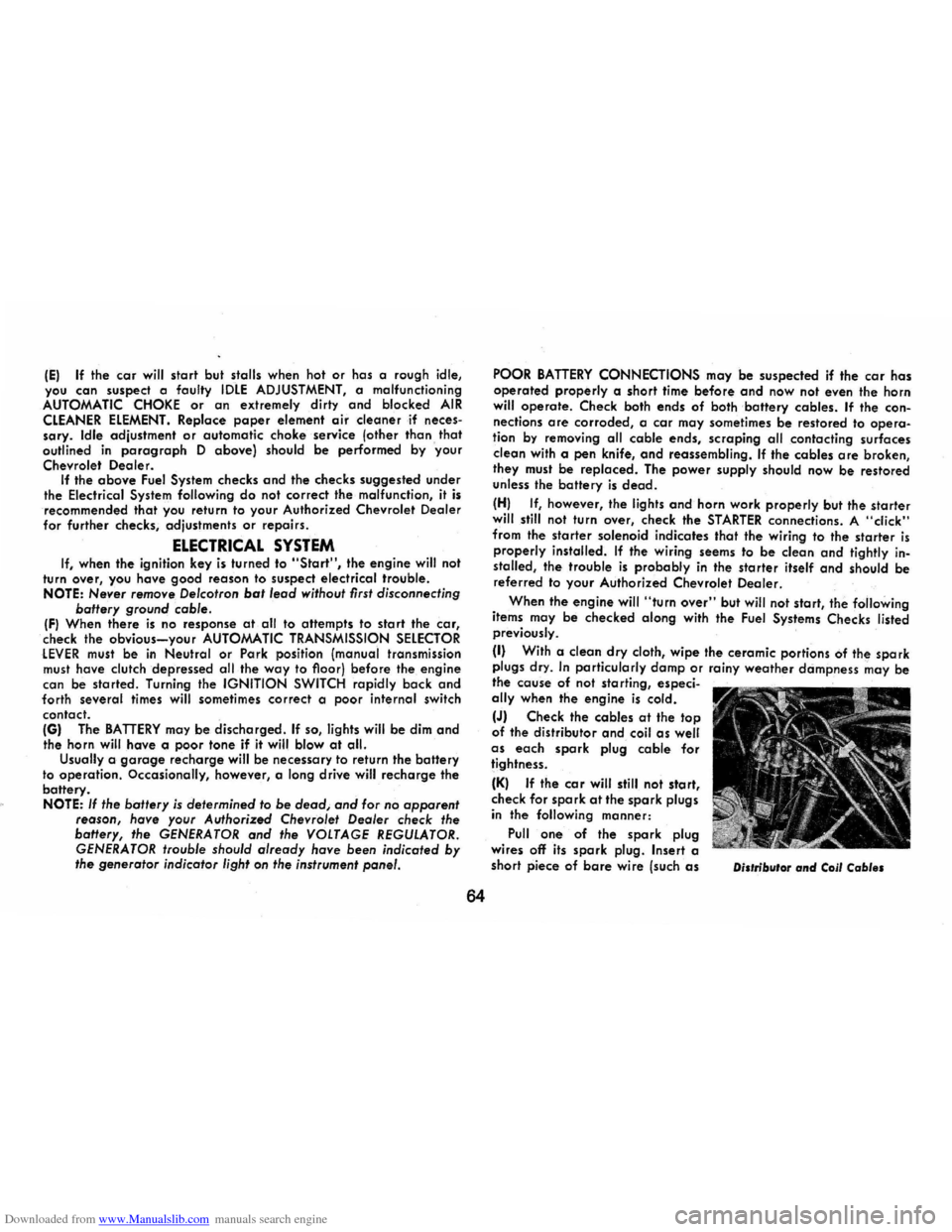
short piece of bare wire (such as Di.,ribu'or and Coil Cab I ••
Page 69 of 84
Downloaded from www.Manualslib.com manuals search engine SPECIFICATIONS
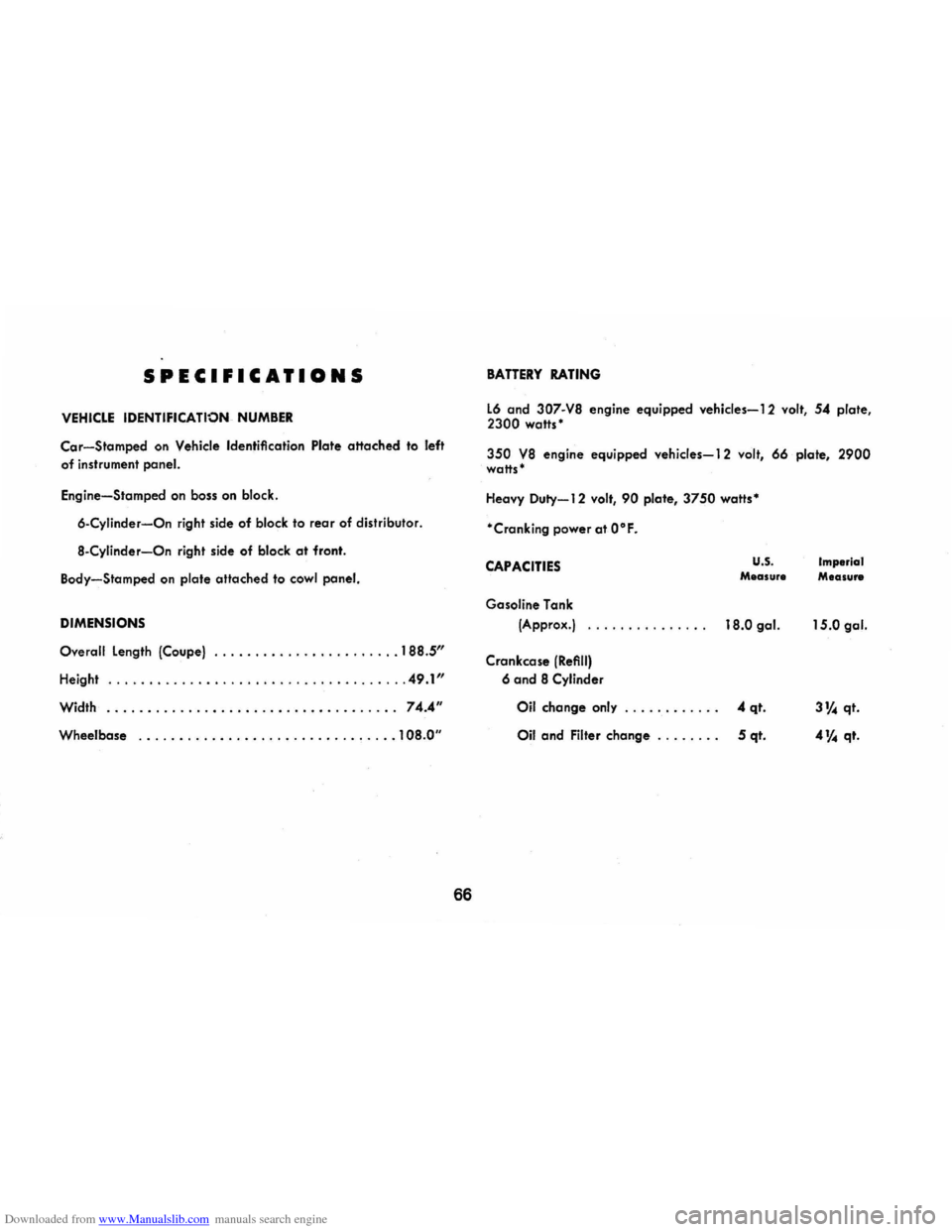
VEHICLE IDENTIFICATION NUMBER
Car-Stamped on Vehicle Identification Plate attached to left
of instrument panel.
Engine-Stamped on boss on block.
6-Cylinder-On right side of block to rear of distributor.
S-Cylinder-On right side of block at front.
Body-Stamped
on plate attached to cowl panel.
DIMENSIONS
Overall Length (Coupe) ....................... 1 SS.5"
Height ..................................... 49.1"
Width .............•............•......... 74.4"
Wheelbase ................................ 10S.0"
66
BATTERY RATING
L6 and 307-VS engine equipped vehicles-I 2 volt, 54 plate, 2300 watts'
350 VS engine equipped vehicles-12 volt, 66 plate, 2900 watts'
Heavy Duty-I 2 volt, 90 plate, 3750 watts'
'Cranking power at O°F.
CAPACITIES
Gasoline Tank
(Approx.)
Crankcase
(Refill)
6 and S Cylinder
U.S. Measure
IS.O gal.
Oil
change only . . . . . . . . . . .. 4 qt.
Oil and Filter change . . . . . . .. 5 qt.
Imperial Measure
15.0 gal.
3% qt.
4% qt.
Page 71 of 84
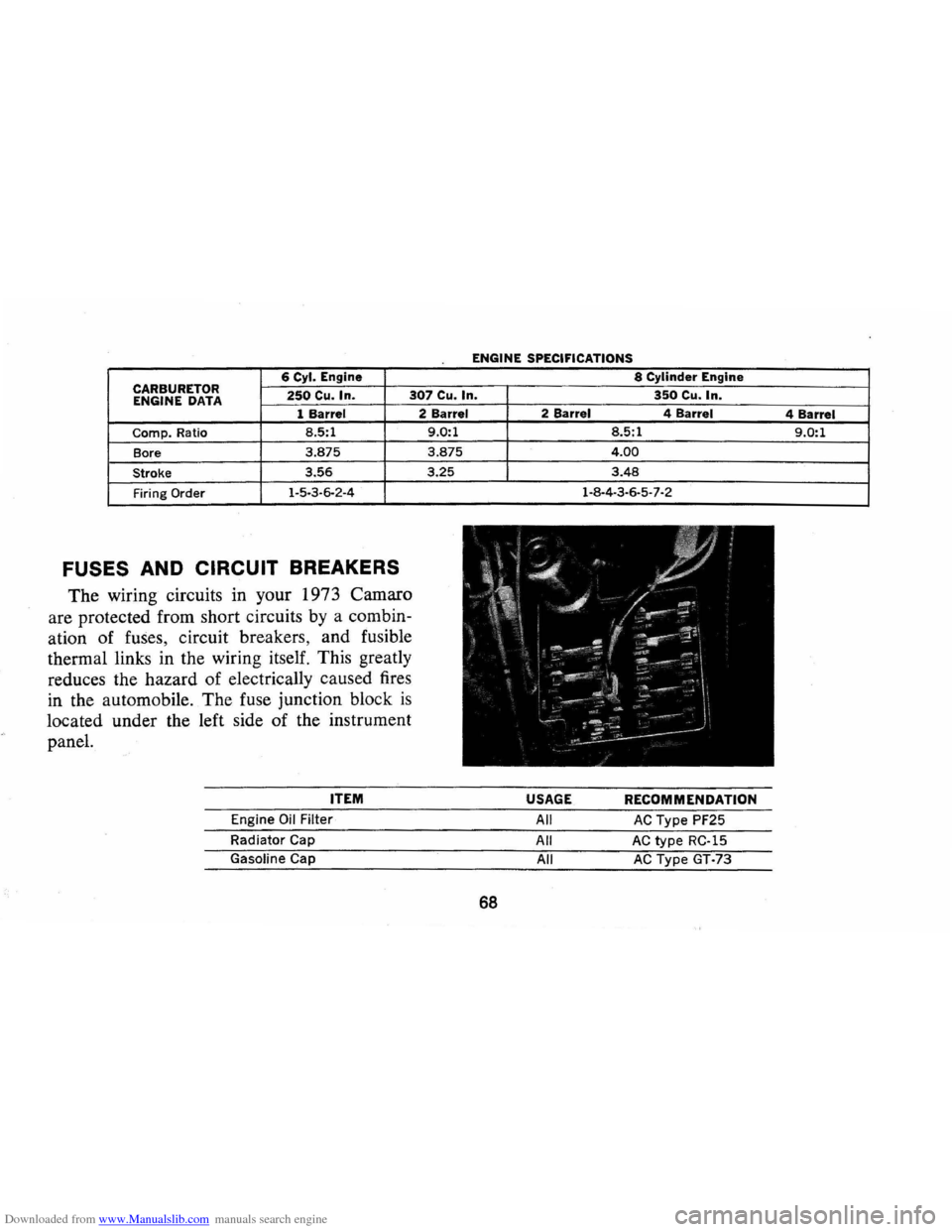
Downloaded from www.Manualslib.com manuals search engine ENGINE SPECIFICATIONS
6 Cyl. Engine 8 Cylinder Engine
CARBURETOR
250 Cu. In. 307 Cu. In. 350 Cu. In. ENGINE DATA 1 Barrel
Compo Ratio 8 .5:1
Bore 3.875
Stroke 3.56
Firing Order 1·5·3·6-2·4
FUSES AND CIRCUIT BREAKERS
The wiring circuits in your 1973 Camaro
are protected from short circuits by a
combin
ation of fuses , circuit breakers , and fusible
thermal links in the wiring itself. This greatly
reduces the hazard of electrically caused
fires
in the automobile. The fuse junction block is
located under the left side of the instrument
panel.
ITEM
Engine Oil Filter
Radiator Cap
Gasoline Cap
2 Barrel 2 Barrel 4 Barrel
9.0:1 8.5:1
3.875 4.00
3.25 3.48
1·8·4·3·6·5·7·2
USAGE RECOMMENDATION
All AC Type PF25
All AC type RC·15
All AC Type GT·73
68
4 Barrel
9.0:1
Page 72 of 84
Downloaded from www.Manualslib.com manuals search engine FUSES AND CIRCUIT BREAKER:
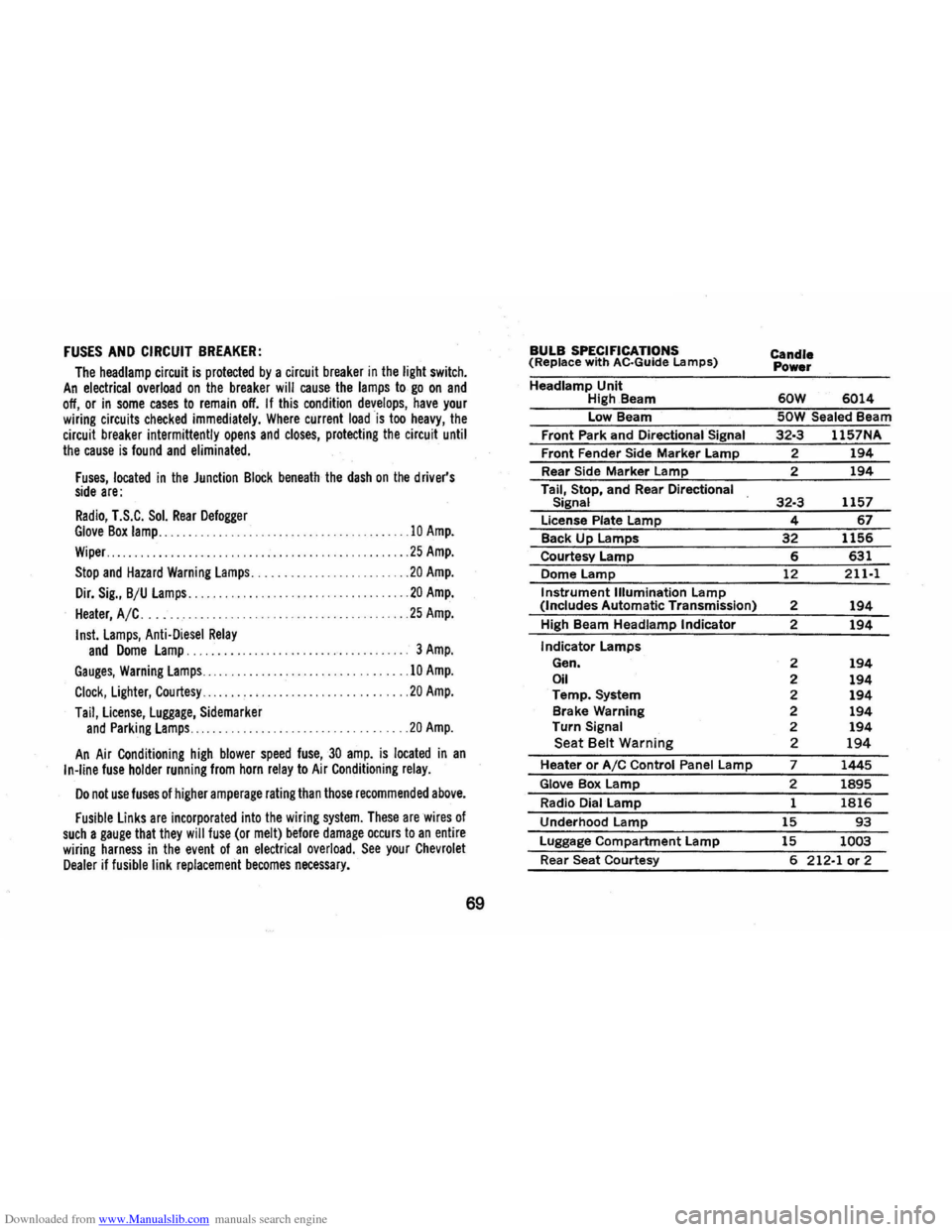
The headlamp circuit is protected by a circuit breaker in the light switch. An electrical overload on the breaker will cause the lamps to go on and off, or in some cases to remain off. If this condition develops, have your wiring circuits checked immediately. Where current load is too heavy, the circuit breaker intermittently opens and closes, protecting the circuit until the cause is found and eliminated.
Fuses, located in the Junction Block beneath the dash on the driver's side are:
Radio, T.S.C. Sol. Rear Defogger Glove Box lamp .......................... .
Wiper .................. . .
..
10 Amp.
25 Amp.
Stop and Hazard Warning lamps .................. ... ..... 20 Amp.
Dir. Sig., B/U lamps .................... ............ .... 20 Amp.
Heater, A/C. . . . .. .. . .. .. . .. . .. .. .. .. . . .. .. .. .. . .. ... 25 Amp.
Insl. lamps, Anti·Diesel Relay and Dome lamp. 3 Amp.
Gauges, Warning lamps.. .. .
. .. .. . .. .... . . .. . .. .. . . .. .. .10 Amp.
Clock, lighter, Courtesy.. .. .. . . . . .. . .. ... .. .. . .20 Amp.
Tail, license, luggage, Sidemarker and Parking lamps ...... . .20 Amp.
An Air Conditioning high blower speed fuse,30 amp. is located in an In·line fuse holder running from horn relay to Air Conditioning relay.
Do not use fuses of higher amperage rating than those recommended above.
Fusible links are incorporated into the wiring system. These are wires of such a gauge that they will fuse (or melt) before damage occurs to an entire wiring harness in the event of an electrical overload. See your Chevrolet Dealer if fusible link replacement becomes necessary.
69
BULB SPECIFICATIONS (Replace with AC·Guide Lamps)
Headlamp Unit High.Beam
Low Beam
Front Park and
Directional Signal
Front Fender Side Marker Lamp
Rear Side
Marker Lamp
Tail, Stop, and Rear
Directional
Signal
License Plate Lamp
Back Up Lamps
Courtesy Lamp
Dome
Lamp
Instrument Illumination Lamp (Includes Automatic Transmission)
High Beam
Headlamp Indicator
Indicator Lamps
Gen.
Oil Temp. System
Brake Warning
Turn
Signal Seat Belt Warning
Heater or AIC Control Panel Lamp
Glove Box Lamp
Radio Dial Lamp
Underhood
Lamp
Luggage Compartment Lamp
Rear Seat Courtesy
Candle Power
60W 6014
SOW Sealed Beam
32·3 1157NA
2 194
2 194
32·3 1157
4 67
32 1156
6 631
12
211·1
2 194
2 194
2 194 2 194 2 194 2 194 2 194 2 194
7 1445
2 1895
1 1816
15 93
15 1003
6 212·1 or 2
Page 77 of 84
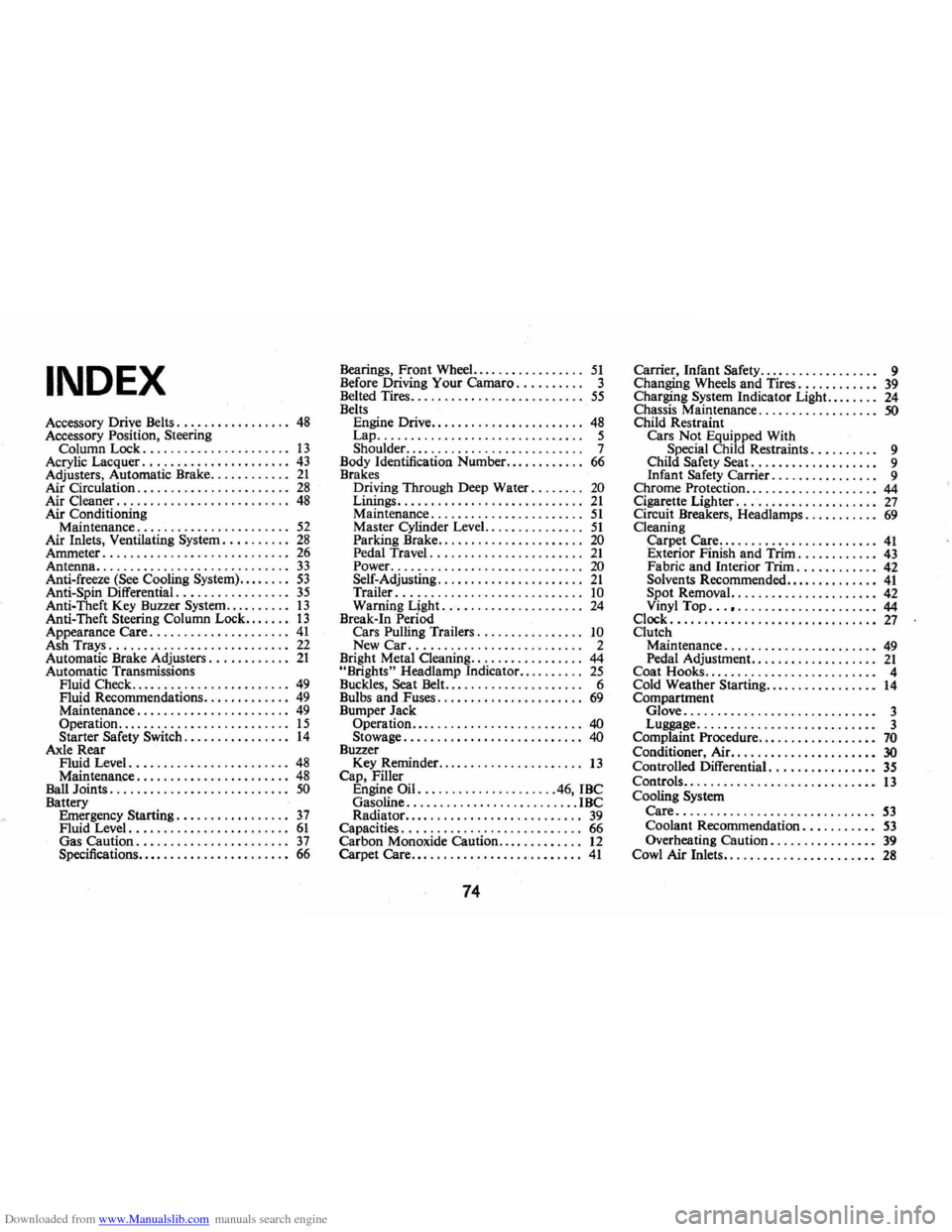
Downloaded from www.Manualslib.com manuals search engine INDEX
Accessory Drive Belts. . . . . . . . . . . . . . . .. 48 Accessory Position, Steering
Column Lock. .. . . . . .. . . .. . .. .. .... 13 Acrylic Lacquer. . . . . . . . . . . . . . . . . . . . .. 43 Adjusters, Automatic Brake ............ 21 Air Circulation . . . . . . . . . . . . . . . . . .. . ... 28 Air Cleaner. . . . . . . . . . . . . . . . . . . . . . . . .. 48 Air Conditioning
Maintenance. . . . . . . . . . . . . . . . . . . . . .. 52 Air Inlets, Ventilating System .......... 28 Ammeter ............................ 26 Antenna ................ ............. 33 Anti-freeze (See Cooling System). . . . . . .. 53 Anti-Spin Differential. . . . . . . . . . . . . . . .. 35 Anti-Theft Key Buzzer System .......... 13 Anti-Theft Steering Column Lock ....... 13 Appearance Care ..................... 41 Ash Trays. . . . . . . . . . . . . . . . . . . . . . . . . .. 22 Automatic Brake Adjusters. . . . . . . . . . .. 21 Automatic Transmissions
Fluid Check ........................ 49 Fluid Recommendations ............. 49 Maintenance. . . . . . . . . . . . . . . . . . . . . .. 49 Operation .......................... 15 Starter Safety Switch. . . . . . .. . . . . . ... 14 Axle Rear
Fluid Level. . . . . . . . . . . . . . . . . . . . . . .. 48 Maintenance. . . . . . . . . . . . . . . . . . . . . .. 48 Ball Joints ........................... 50 Battery
Emergency Starting. . . . . . . . . . . . . . . .. 37 Fluid Level. . . . . . . . . . . . . . . . . . . . . . .. 61 Gas Caution ....................... 37 Specifications. . . . . . . . . . . . . . . . . . . . . .. 66 Bearings,
Front Wheel.
................ 51 Before Driving Your Camaro . . . . . . . . . . 3
Belted Tires .......................... 55 Belts
Engine Drive. . . . . . . . . . . . . . . . . . . . . .. 48 Lap ................................ 5 Shoulder............ . .............. 7 Body Identification Number ............ 66 Brakes
D.riying Through Deep Water. . . . . . .. 20 Lmmgs ............................ 21 Maintenance ....................... 51 Master Cylinder Level. .............. 51 Parking Brake ...................... 20 Pedal Travel. . . . . . . . . . . . . . . . . . . . . .. 21 Power. .............. .............. 20 Self-Adjusting. . . . . . . . . . . . . . . . . . .. .. 21 Trailer ............................ 10 Warning Ljght. .. . . . . . . .. . . . . . . . . .. 24 Break-In Period Cars Pulling Trailers. . . . . . . . . . . . . . .. 10 New Car.......................... 2
Bright Metal Cleaning .......... '" .... 44 "Brights" Headlamp Indicator .......... 25 Buckles, Seat Belt.. . . . . . . . . . . . . . . . . . .. 6
Bulbs and Fuses . . . . . . . . . . . . . . . . . . . . .. 69 Bumper Jack
Operation ...... " .................. 40 Stowage ........................... 40 Buzzer Key Reminder.. .. .. .. .. .. . .. .. .. ... 13 Cap, Filler
Engine Oil. .................... 46, IBC
Gasoline .......................... IBC
Radiator. . . . . . . . . . . . . . . . . . . . . . . . . .. 39 Capacities. . . . . . . . . . . . . . . . . . . . . . . . . .. 66
Carbon Monoxide Caution ............. 12 Carpet Care .......................... 41
74
Carrier, Infant Safety.... . . . . . . .. .. . . .. 9
Changing Wheels and Tires. . . . . . . . . . .. 39 Charging System Indicator Light. . . . . . .. 24
Chassis Maintenance . . . . . . . . . . . . . . . . .. 50 Child Restraint
Cars Not Equipped With
Special Child Restraints. . . . . . . . . . 9
Child Safety Seat. . . . . . . . . . . . . . . . . . .
9 Infant Safety Carrier. . . . . . . . . . . . . . .. 9 Chrome Protection .................... 44
Cigarette Lighter. . . . . . . . . . . . . . . . . . . .. 27 Circuit Breakers, Headlamps. . . . . . . . . .. 69 Cleaning
Carpet Care. . . . . . . . . . . . . . . . . . . . . . .. 41 Exterior Finish and Trim. . . . . . . . . . .. 43 Fabric and Interior Trim ............ 42
Solvents Recommended .............. 41 Spot Removal. . . . . . . . . . . . . . . . . . . . .. 42 Vinyl Top ... , . . . . . . . . . . . . . . . . . . . .. 44
Clock ............................... 27 Clutch Maintenance. . . . . . . . . . . . . . . . . . . . . .. 49 Pedal Adjustment ................... 21 Coat Hooks........ ...... ........ .... 4
Cold Weather Starting ................. 14 Compartment
Glove ............................. 3
Luggage. .......... ................ 3
Complaint Procedure .................. 70 Conditioner, Air ...................... 30 Controlled Differential. . . . . . . . . . . . . . .. 35 Controls ............................. 13 Cooling System
Care ........... ................... 53 Coolant Recommendation. . . . . . . . . .. 53 Overheating Caution. . . . . . . . . . . . . . .. 39 Cowl Air Inlets ....................... 28