ECO mode CHEVROLET CAMARO 1973 2.G Owners Manual
[x] Cancel search | Manufacturer: CHEVROLET, Model Year: 1973, Model line: CAMARO, Model: CHEVROLET CAMARO 1973 2.GPages: 84, PDF Size: 32.64 MB
Page 5 of 84
Downloaded from www.Manualslib.com manuals search engine YOUR CAR'S FIRST
FEW HUNDRED MILES OF DRIVING
You can operate your new car from
its very first mile without adhering
to a formal
"break-in" schedule.
However, during the first
few hun
dred miles of driving you can, by
observing a few simple precautions,
add to the future performance and
economy of your car.
It is recommended that your speed
during the first
500 miles
be confined to a maximum of
60
M.P.H., but do not drive for ex
tended periods at
anyone constant
speed, either fast
or slow. Dur
ing this period, avoid full throttle
starts and, if possible, avoid hard
stops especially during the first
200
miles of operation since brake mis-
2 use
during this period will destroy
much future brake efficiency.
Always drive
at moderate speed
until the engine has completely
warmed up.
If you plan to use your new car
for trailer hauling see additional
information on page
10.
Page 17 of 84
Downloaded from www.Manualslib.com manuals search engine A starter safety switch prevents
starter operation while the trans
mission selector
is in any drive
position.
(If it is necessary to
re-start the engine with the car
moving, place the selector lever
in
"N".)
3. Depress accelerator pedal and
activate starter as outlined be
low for different conditions.
• Cold Engine -Fully depress
accelerator pedal and slowly
release.
With foot off the
pedal,
crank the engine by
turning the ignition key to the
Start position -release when
engine starts.
If engine starts, but fails to
run, repeat this procedure.
When engine is running
smoothly (approximately 30
seconds), the idle speed may
be reduced by slightly depress
ing the accelerator pedal and
then slowly releasing.
• Warm Engine -Depress ac
celerator
pedal about halfway
and hold while cranking the
engine.
• Extremely Cold Weather
(Below
ODF.) Or After Car
14
Has Been Standing Idle
Several Days-
Fully depress and release ac
celerator pedal two
or three
times before cranking the en
gine.
With foot off the accel
erator pedal,
crank the engine
by turning the key to the
Start position and release
when engine starts .
Manual Transmission Models
1. Apply parking brake and shift
transmission to neutral.
2.
Hold clutch pedal to floor
throughout the starting proce
dure. A starter interlock prevents
starter operation when clutch
is
not fully depressed. (Select the
Page 18 of 84
Downloaded from www.Manualslib.com manuals search engine proper gear position before re
leasing the clutch pedal.)
3.
Operate accelerator pedal and
starter
as outlined in step 3
(under Automatic Transmission
Models).
Engine Flooded
Depress accelerator pedal and
hold to floor while starting until
engine
is cleared of excess fuel and
is
running smoothly. Never
"pump" the accelerator pedal.
Warm-Up
Always let the engine idle for 20
to 30 seconds after starting and
drive at moderate speeds for several
miles, especially during cold
weather.
Driving with the Chevrolet Automatic Transmissions
The Turbo Hydra-Matic 350
and 400 are completely automatic
transmISSIons. All replace the
standard clutch and transmission.
Turbo Hydra-Malic 350
and 400
After starting the engine with the
selector lever in N (Neutral) or P
(Park) position select the range de
sired (see table) and depress the accelerator.
A gradual start with a
steady increase in accelerator pres
sure will result in best possible fuel
economy. Rapid acceleration for
fast starts will result in greater
fuel consumption.
Automatic transmission shift
quadrants of all GM cars continue
the uniform sequence of selector
positions. This particularly benefits
multicar families and those who
occasionally drive other cars. Shift
15
indicators are arranged with "Park"
position at one end, followed in se
quence by "Reverse", "Neutral"
and the forward driving ranges.
All automatic transmissions are
equipped with a starter safety
switch designed to permit starting
the engine only when the trans
mission
is in the "Park" or "Neu
tral"
position. For additional
engine braking effect,
as sometimes
needed in mountainous driving,
Page 20 of 84
Downloaded from www.Manualslib.com manuals search engine Driving with Manual Transmissions
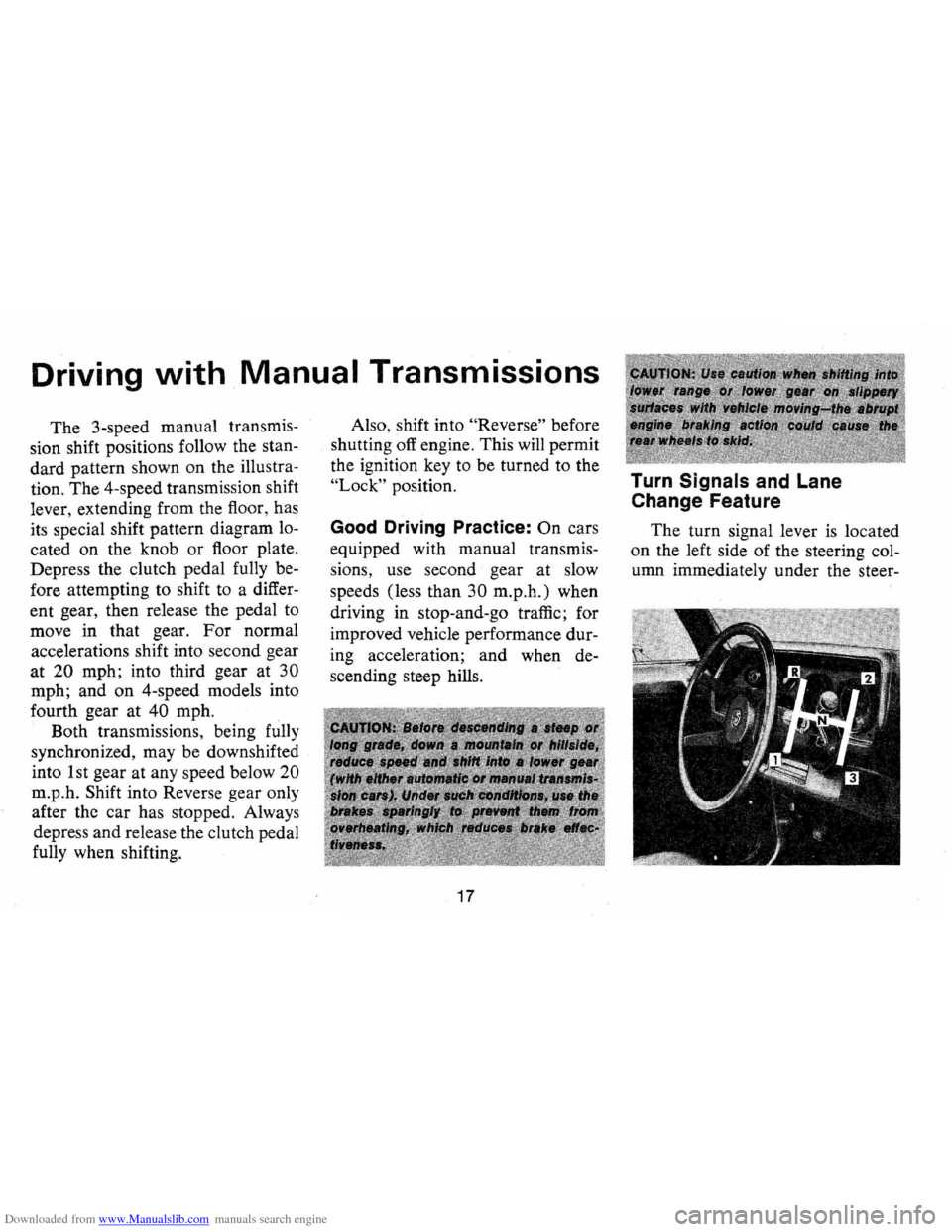
The 3-speed manual transmis
sion shift positions follow the stan
dard pattern shown on the illustra
tion. The 4-speed transmission shift
lever, extending from the floor, has
its special shift pattern diagram lo
cated on the knob or floor plate.
Depress the clutch pedal fully be
fore attempting to shift to a differ
ent gear, then release the pedal to
move in that gear.
For normal
accelerations shift into second gear
at 20 mph; into third gear at 30
mph; and on 4-speed models into
fourth gear at
40 mph.
Both transmissions , being fully
synchronized, may be downshifted
into 1 st gear at any speed below
20
m.p.h. Shift into Reverse gear only
after the car has stopped. Always
depress and release the clutch pedal
fully when shifting. Also,
shift into
"Reverse" before
shutting off engine. This will permit
the ignition key to be turned to the
"Lock" position.
Good Driving Practice: On cars
equipped with manual transmis
sions, use second gear at slow
speeds (less than
30 m.p.h.) when
driving in stop-and-go traffic; for
improved vehicle performance dur
ing acceleration; and when de
scending steep hills.
17
Turn Signals and Lane
Change Feature
The turn signal lever is located
on the left side of the steering col
umn immediately under the steer-
Page 34 of 84
Downloaded from www.Manualslib.com manuals search engine no matter which position the fan
switch
is in.
Temperature (Lower Level)
The temperature lever allows a
selection of air temperature from
Cold at the far left to Hot at the
far right. When the temperature
lever
is in the COLD position the
system will provide the coldest air
possible. When the temperature
lever
is moved to the right (toward
HOT), the system will operate on
outside air.
Selector (Upper Lever)
This lever provides a selection of
systems available to handle various
heating and cooling requirements
throughout the year. The Selector
lever has four
(4) major opera- tiona!
positions-"Off,"
"Air Con
ditioning," "Vent" and "Heating."
The "Air Conditioning" and "Heat
ing"
groups have several positions
which improve the effectiveness of
the system for various demands.
OFF-The system. operates on low
blower regardless of fan switch
position with air discharged into
vehicle through heater outlet.
A/C-Air from the passenger com
partment is recirculated through
the system with some outside air
and discharged from the upper
outlets when the temperature lever
is in Full COLD or extreme left. If
the Temperature lever is moved
right to the first stop or further,
the system will automatically go
on outside air. The
AIC position,
with Temp. lever in Full
COLD,
31
is used when maximum cooling is
required under conditions of high
temperature and humidity. High
fan speed
is automatically attained
in this position.
A/C(with Temp lever right to first
stop
)-Outside air is passed through
the system and discharged through
the upper outlets. This position
is
recommended for most air condi
tioning situations because of
re
duced blower noise and reduction
of cigarette smoke within the
vehicle.
Fan speed may be varied
as required.
VENT -Outside air is passed
through the system and discharged
from the upper and lower outlets.
This position
is provided for cool
to moderate weather when refrig
eration
is not required.
Page 39 of 84
Downloaded from www.Manualslib.com manuals search engine .1 n Case of Emergency
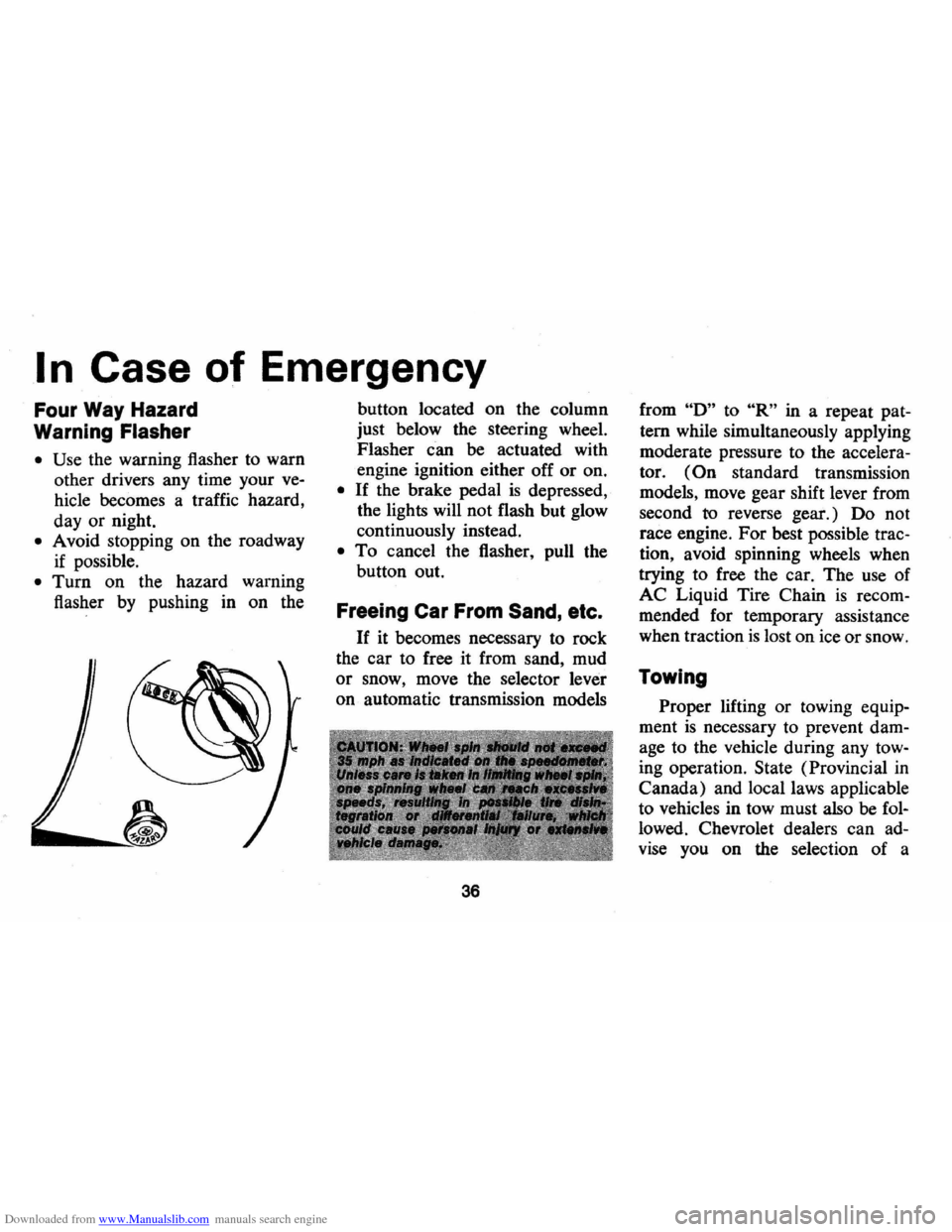
Four Way Hazard
Warning Flasher
• Use the warning flasher to warn
other drivers any time your
ve·
hicle becomes a traffic hazard,
day or night.
• Avoid stopping on the roadway
if possible.
• Turn on the hazard warning
flasher
by pushing in on the
.---~
button located on the column
just below the steering wheel.
Flasher can be actuated with
engine ignition either off or on.
• If the brake pedal is depressed,
the lights will not flash but glow
continuously instead.
• To cancel the flasher, pull the
button out.
Freeing Car From Sand, etc.
If it becomes necessary to rock
the car to free it from sand, mud
or snow, move the selector lever
on automatic transmission models
36
from "0" to "R" in a repeat pat·
tern while simultaneously applying
moderate pressure to the
accelera
tor. (On standard transmission
models, move gear shift lever from
second
to reverse gear.) 00 not
race engine.
For best possible trac
tion, avoid spinning wheels when
trying to free the car. The use of
AC Liquid Tire Chain is recom
mended for temporary assistance
when traction
is lost on ice or snow.
Towing
Proper lifting or towing equip
ment is necessary to prevent dam
age to the vehicle during any tow
ing operation. State (Provincial in
Canada) and local laws applicable
to vehicles in tow must also be
fol
lowed . Chevrolet dealers can ad
vise you on the selection of a
Page 56 of 84
Downloaded from www.Manualslib.com manuals search engine type cooling system is used on all
1973 Camaro air conditioned and
heavy duty cooling systems. It has
been filled at the factory with a
high-quality, inhibited, year-around
coolant that meets the standards
of General Motors Specification
1899-M. This coolant solution pro
vides freezing protection to
-20 0 F
(-32°F in Canada), and it has
been formulated to be used for
two full calendar years
or 24,000
miles, whichever first occurs, of
normal operation without draining,
provided the proper concentration
of coolant
is maintained.
• For Recovery Systems Only
Check the coolant level visually
at the see-through coolant reser
voir at each oil change interval
while the engine
is at normal
operating temperature. Do not
remove radiator cap except for
draining and refilling the system.
Coolant level should be at the
"Full Hot" mark on the reservoir.
If system is checked cold, the
coolant level should be at the
"Full Cold" mark on the reser
voir.
• For Other Than Recovery Sys
tems-Check the coolant level
only at oil change intervals, un
less there
is evidence of leaking
or overheating. Do not remove
radiator cap when solution
is
hot and under pressure. Coolant
level should be a maximum of
three inches below the level of
the filler neck when the engine
is cold.
• All Systems-Add a 50/50 mix
ture of high-quality ethylene
glycol antifreeze and water if
coolant additions are necessary.
Do not overfill.
NOTE: If recommended quality
antifreeze
is used, supplemental
inhibitors or additives claiming to
53
provide increased cooling capabil
ity are not necessary. They may be
detrimental to the efficient opera
tion of the system, and represent
an unnecessary operating expense.
Every year, the cooling system
should be serviced
as follows:
1. Wash radiator cap and filler
neck with clean water.
2. Check coolant for proper level
and freeze protection.
3. Pressure test system and radia
tor cap for proper pressure hold
ing capacity (15 psi).
If re
placement
of cap is required,
use the proper AC cap specified
for your car model.
4. Tighten hose clamps and inspect
all hoses. Replace hoses when
ever checked, swollen
or other
wise deteriorated.
5. Clean frontal area of radiator
core and air conditioning con
denser.
Page 58 of 84
Downloaded from www.Manualslib.com manuals search engine It is the owner's responsibility
to keep the freeze protection at a
level commensurate with the tem
peratures which may occur
in the
area of vehicle operation.
• Maintain cooling system freeze
protection at
_200 F or below
to ensure protection against cor
rosion and loss of coolant from
boiling, even though freezing
temperatures are not expected.
• Add ethylene glycol base cool
ant that meets GM Specification
1899-M when coolant additions
are required because of coolant
loss or to provide additional
protection against freezing at
temperatures lower than
_200
F (_320 F in Canada).
NOTE: Alcohol or methanol base
coolants
or plain water are not
recommended for your Camaro at
any time.
Radiator Pressure Cap
The radiator cap, a 15 lb. pres
sure type, must be installed tightly,
otherwise coolant may be lost and
damage to engine may result from
overheating. Radiator pressure
caps should be checked periodi
cally for proper operation.
If re
placement
is required specify AC.
Thermostat
The cooling system is protected
and controlled by a thennostat
in
stalled in the engine coolant outlet
to maintain a satisfactory operat
ing temperature of the engine. This
thermostat
is designed forcontinu
ous use through both winter and summer
and need not be changed
seasonally . When replacement
is
necessary, Delco parts are recom~
mended.
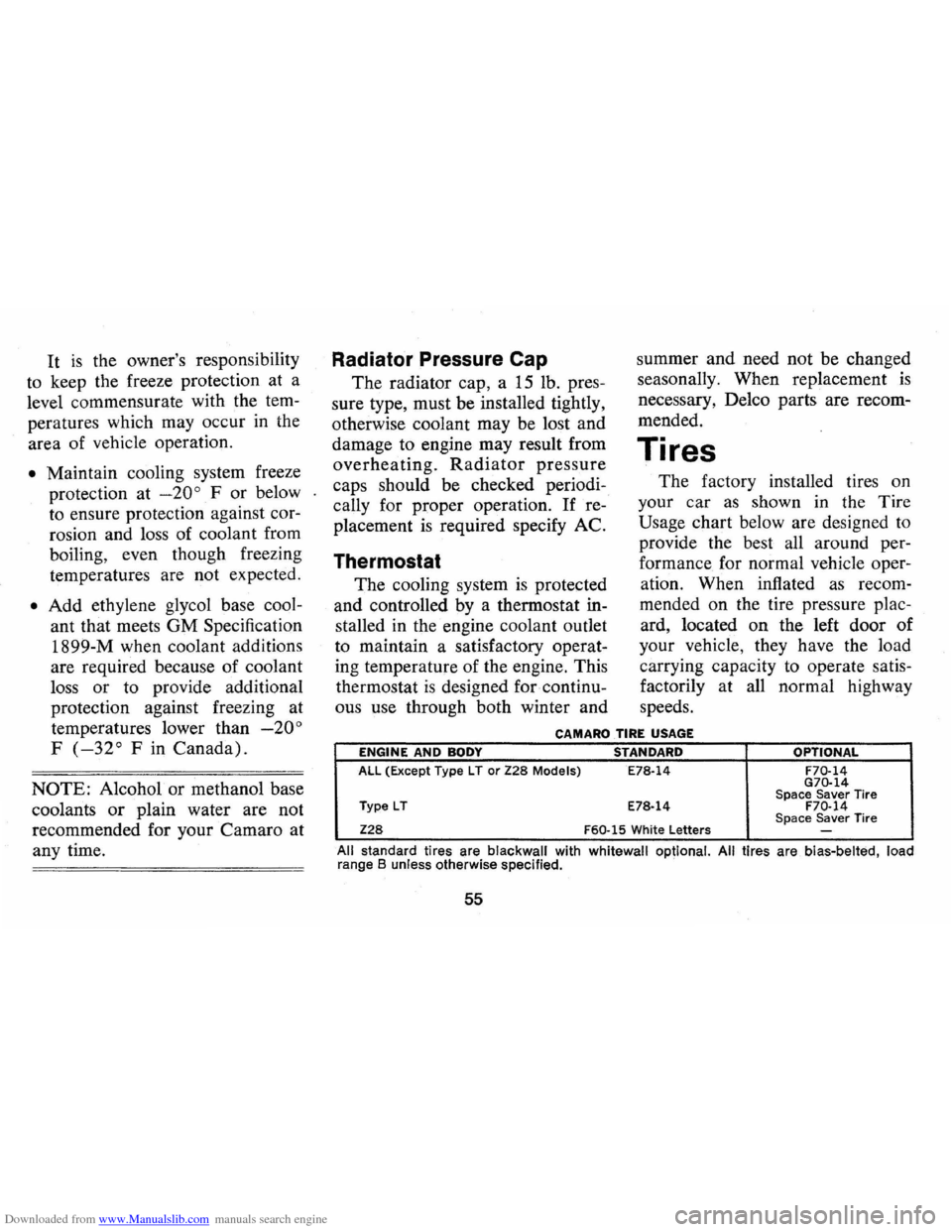
Tires
The factory installed tires on
your car
as shown in the Tire
Usage chart below are designed to
provide the best all around per
formance for normal vehicle oper
ation. When inflated
as recom
mended on the tire pressure plac
ard, located
on the left door of
your vehicle, they have the load
carrying capacity to operate satis
factorily at all normal highway
speeds.
CAMARO TIRE USAGE
ENGINE AND BODY STANDARD OPTIONAL
All (Except Type l T or Z28 Models) E78·14 F70·14 G70·14
Type lT Space Saver Tire E78·14 F70·14
Z28 F60·15 White letters Space Saver Tire -
All standard tires are blackwall with whitewall optional. All tires are bias-belted, load
range B unless otherwise specified. .
55
Page 84 of 84
Downloaded from www.Manualslib.com manuals search engine Refer to "Service and Maintenance"
Section for Further
Details. GAS STATION INFORMATION
Gas Cap -Located behind the
license plate on all models.
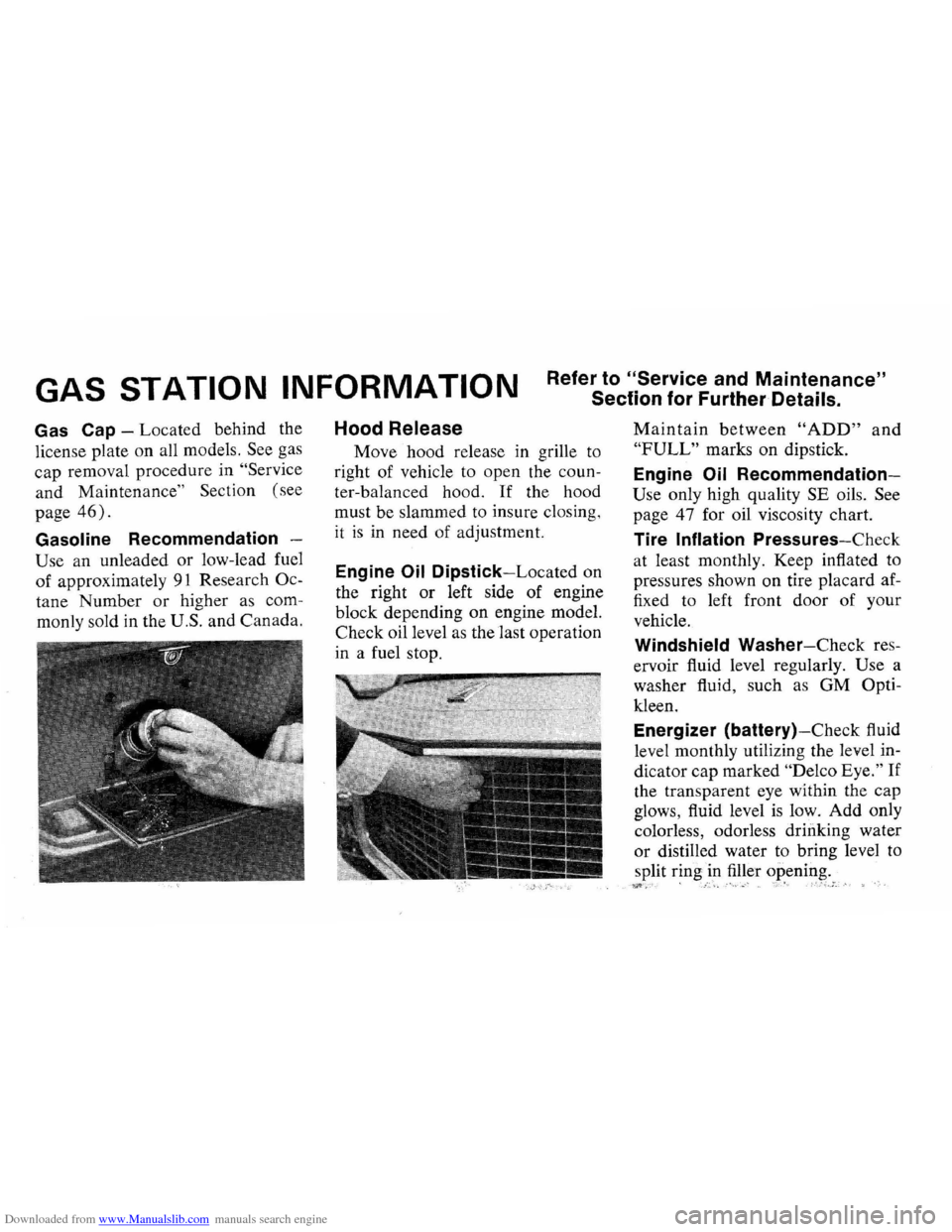
See gas
cap removal procedure in
"Service
and Maintenance " Section (see
page
46).
Gasoline Recommendation -
Use an unleaded or low-lead fuel
of approximately
91 Research Oc
tane Number or higher as com
monly sold in the
U.S. and Canada.
Hood Release
Move hood release in grille to
right of vehicle to open the coun
ter-balanced hood.
If the hood
must be slammed to insure closing,
it
is in need of adjustment.
Engine Oil Dipstick-Located on
the right
or left side of engine
block depending on engine model.
Check oil level
as the last operation
in a fuel stop.
Maintain between "ADD" and
"FULL" marks on dipstick.
Engine Oil Recommendation
Use only high quality SE oils. See
page 47 for oil viscosity chart.
Tire Inflation Pressures-Check
at least monthly. Keep inflated to
pressures shown on tire placard af
fixed to left front door of your
vehicle.
Windshield Washer-Check res
ervoir fluid level regularly.
Use a
washer fluid, such
as GM Opti
kleen.
Energizer (batterY)-Check fluid
level monthly utilizing the level in
dicator cap marked
"Delco Eye." If
the transparent eye within the cap
glows, fluid level
is low. Add only
colorless, odorless drinking water
or distilled water to bring level to
split ring in filler opening.
?1!C'~:" , './;.', _ _ o··,.,·- .. -~. '"):,'~ i<~~~ .. ;·_:"" .: ..