Knob CHEVROLET CAMARO 1973 2.G Owners Manual
[x] Cancel search | Manufacturer: CHEVROLET, Model Year: 1973, Model line: CAMARO, Model: CHEVROLET CAMARO 1973 2.GPages: 84, PDF Size: 32.64 MB
Page 7 of 84
Downloaded from www.Manualslib.com manuals search engine Door Locks
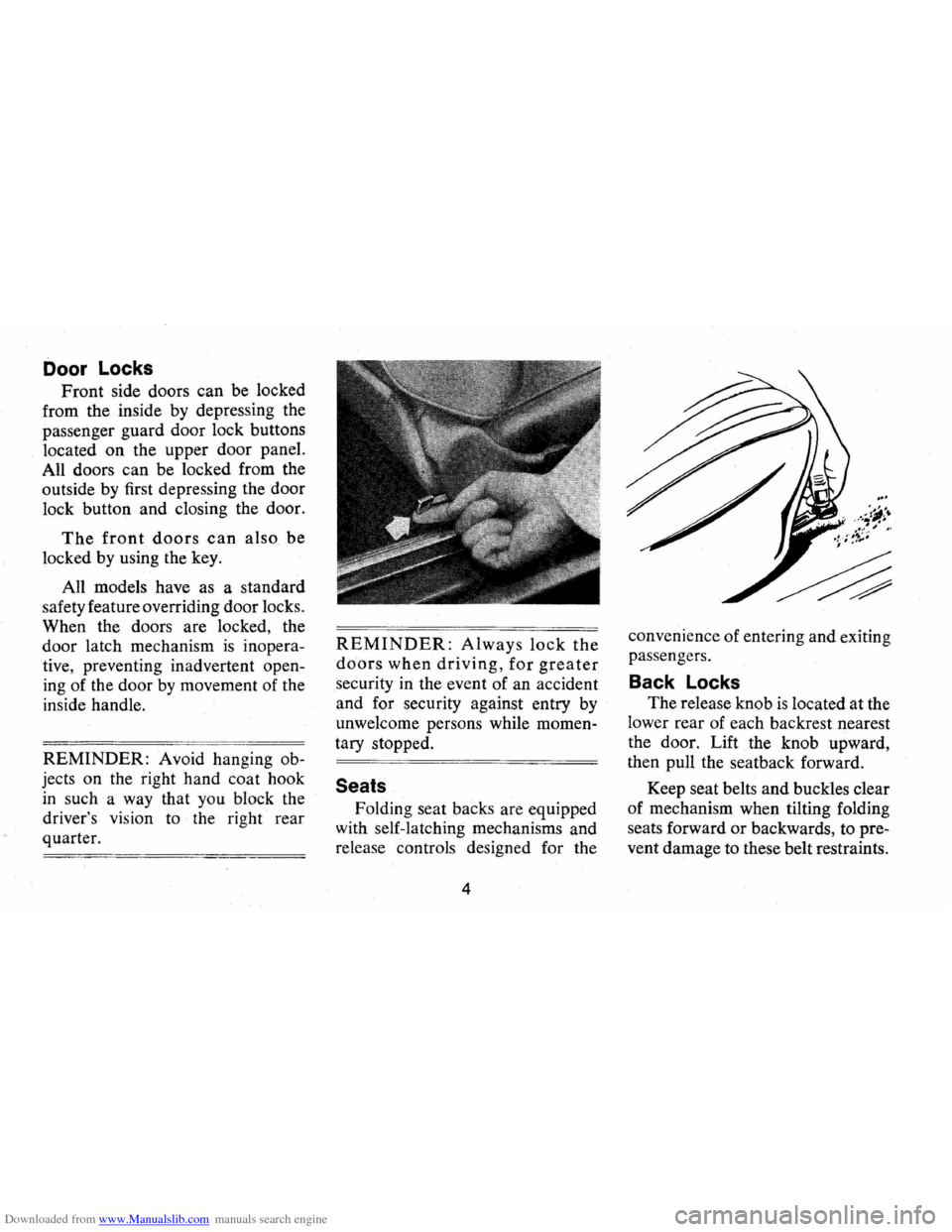
Front side doors can be locked
from the inside by depressing the
passenger guard door lock buttons
located
on the upper door panel.
All doors can be locked from the
outside by first depressing the door
lock button and closing the door.
The front doors can also be
locked by using the key.
All models have as a standard
safety feature overriding door locks.
When the doors are locked , the
door latch mechanism
is inopera
tive , preventing inadvertent open
ing of the door by movement of the
inside handle.
REMINDER: Avoid hanging ob
jects on the right hand coat hook
in such a way that you block the
driver 's
vis ion to the right rear
quarter.
REMINDER: Always lock the
doors when driving, for greater
security in the event of an accident
and for security against entry by
unwelcome persons while momen
tary stopped.
Seats
Folding seat backs are equipped
with self-latching mechanisms and
release controls designed for the
4 convenience
of entering and exiting
passengers .
Back Locks
The release knob is located at the
lower rear of each backrest nearest
the door. Lift the knob upward,
then pull the seatback forward.
Keep seat belts and buckles clear
of mechanism when tilting folding
seats forward
or backwards, to pre
vent damage to these belt restraints.
Page 10 of 84
Downloaded from www.Manualslib.com manuals search engine (those next to side windows)
are linked to a buzzer and light
which remind occupants to fas
ten seat belts.
• On cars with automatic trans
missions, or manual transmis
sions with steering column
mounted shift levers, the buzzer
and light are designed to come
on when the ignition switch
is
on, the transmission selector is
in a forward drive position, and
the driver's or right front pas
senger's lap belt
is not fastened.
• On manual transmission cars
with floor mounted shift con
trols the reminders are designed
to come on when the ignition
switch
is on, the driver's or
right front passenger's lap belt
is not fastened and the transmis
sion
is in any gear position, ex
cept that they do not come
on
when the parking brake is en
gaged.
NOTE: The right front seat con
tains a weight detector which
is
designed to activate the buzzer
and light whenever
a. nominal
weight
is placed on the seat. The
weight detector cannot distinguish
between a passenger and any item
of luggage or cargo, therefore such
items should be placed elsewhere
in the car, preferably
in the trunk.
If seat belt system or reminder
system does not work
as described,
see your dealer for information
and assistance.
Shoulder Belts
• When properly worn with a lap
belt, a shoulder belt can provide
important additional protection
against impact with the car in
terior by restraining forward
motion of the upper torso in a
collision. This
is particularly
true in the case of a frontal im
pact, which
is the most frequent
7 type
of accident.
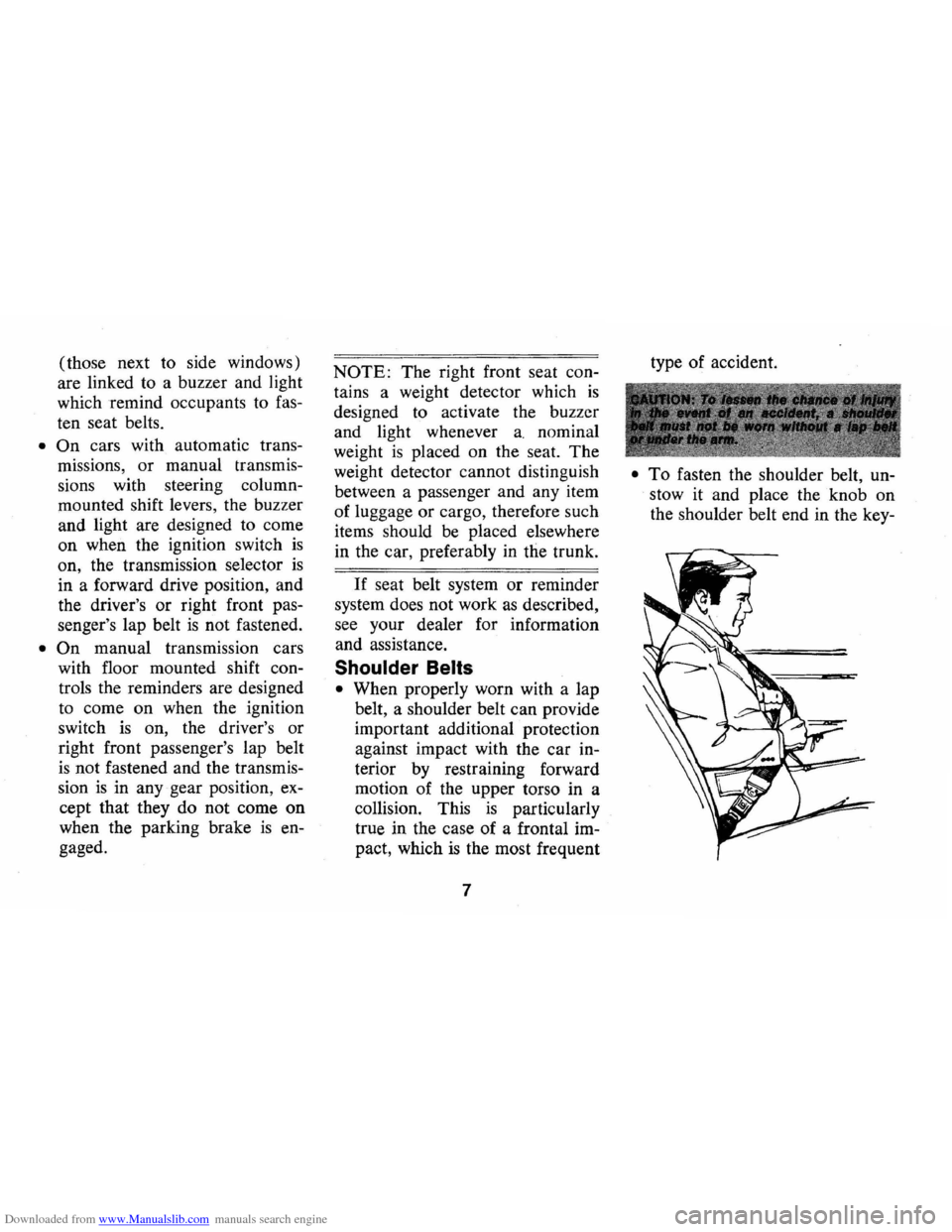
• To fasten the shoulder belt, un
stow it and place the knob on
the shoulder belt end in the key-
Page 11 of 84

Downloaded from www.Manualslib.com manuals search engine hole on the lap belt latch plate.
(The latch is designed so that
this attachment
can only be com
pleted before fastening the lap
belt.) Tilt the knob
as neces
sary, to pass it through the slot.
Pull the knob firmly upward to
seat it at the narrow end of the
keyhole, then fasten the lap
belt.
• Shoulder belts are lengthened
and shortened
in the same man
ner
as center seat lap belts.
• Shoulder belt should have suffi
cient slack to insert a fist's
width between your chest and
the belt. This can be checked
by inserting a clenched
fist be
tween the belt and your chest
with thumb against chest and
back of hand facing upward.
• When not in use, the shoulder
belt may be stowed by leaving
it attached to the lap belt and
allowing the lap belt to rewind into
its retractor. Take up re
maining slack using the shoul
der belt adjustment feature.
• To completely restow the shoul
der belt, .remove the belt knob
from the keyhole (tilting knob
as necessary). Then restow belt
along roof rail in accord with
illustration. .
When not in use, all loose lap
and shoulder belts should be se
cured to reduce the danger of
the
metal ends striking an occupant in
an accident. When special stowage
provisions are not provided, the
8 loose
ends should be attached to
each other and adjustment
made
to remove the slack in the belt sys
tem. Be sure that belts are not left
in a position where the webbing
or
hardware can be pinched in the
seat structure
or door, and thus
become damaged.
Seat Belt Inspection
• Periodically inspect belts, buc
kles, retractors, and anchors for
damage that could lessen the ef
fectiveness
of the restraint sys
tem.
SHOULDER BELT
STOWAGE
Page 20 of 84
Downloaded from www.Manualslib.com manuals search engine Driving with Manual Transmissions
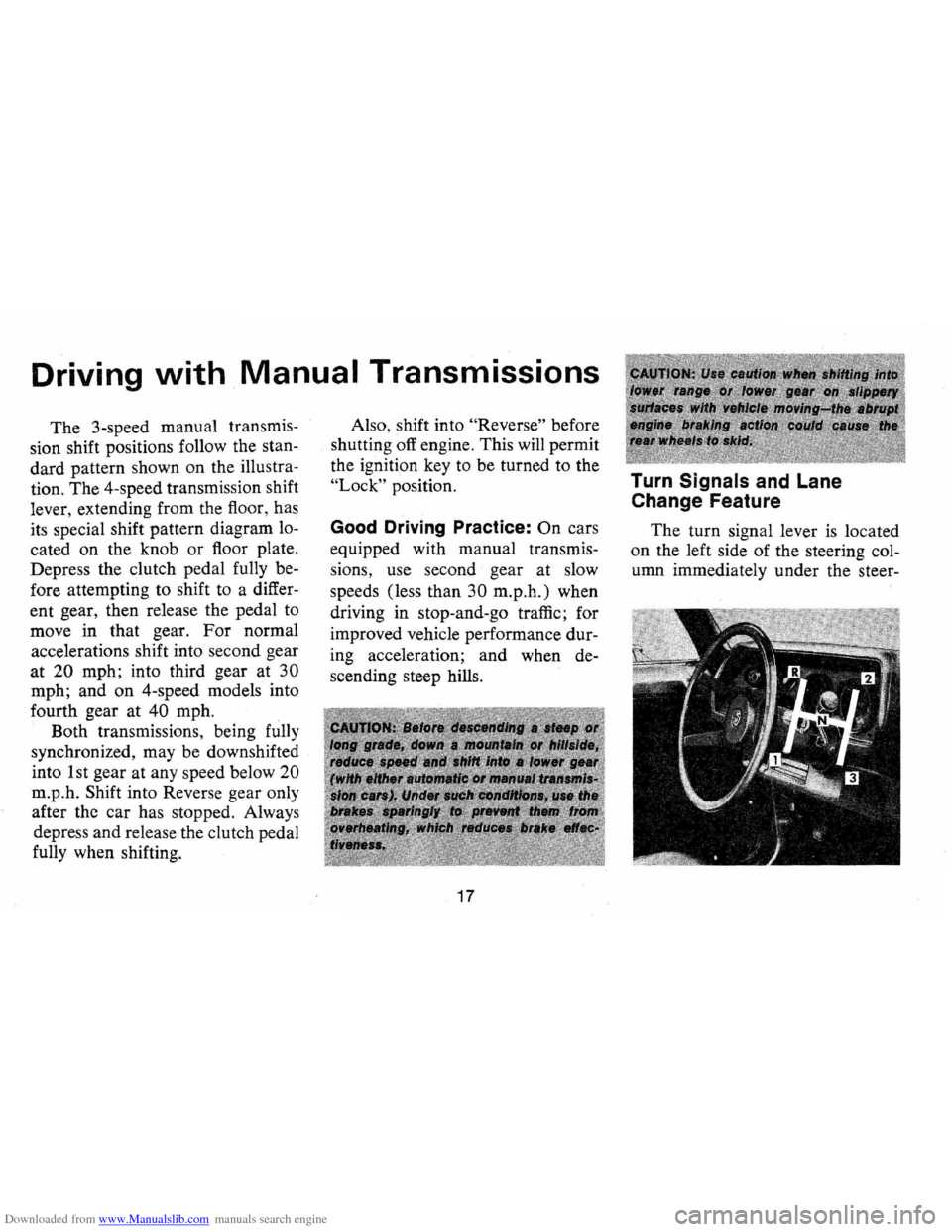
The 3-speed manual transmis
sion shift positions follow the stan
dard pattern shown on the illustra
tion. The 4-speed transmission shift
lever, extending from the floor, has
its special shift pattern diagram lo
cated on the knob or floor plate.
Depress the clutch pedal fully be
fore attempting to shift to a differ
ent gear, then release the pedal to
move in that gear.
For normal
accelerations shift into second gear
at 20 mph; into third gear at 30
mph; and on 4-speed models into
fourth gear at
40 mph.
Both transmissions , being fully
synchronized, may be downshifted
into 1 st gear at any speed below
20
m.p.h. Shift into Reverse gear only
after the car has stopped. Always
depress and release the clutch pedal
fully when shifting. Also,
shift into
"Reverse" before
shutting off engine. This will permit
the ignition key to be turned to the
"Lock" position.
Good Driving Practice: On cars
equipped with manual transmis
sions, use second gear at slow
speeds (less than
30 m.p.h.) when
driving in stop-and-go traffic; for
improved vehicle performance dur
ing acceleration; and when de
scending steep hills.
17
Turn Signals and Lane
Change Feature
The turn signal lever is located
on the left side of the steering col
umn immediately under the steer-
Page 30 of 84
Downloaded from www.Manualslib.com manuals search engine Clock Reset the clock, if your car is so
equipped, by pulling out the knob
and turning the hands clockwise if
slow, counterclockwise if fast. This
will, if the clock error
is five min
utes or more, automatically com
pensate for time gain
or lag. Sev
eral resettings, several days apart,
may be needed to properly adjust
the clock mechanism. Have your
clock cleaned and oiled by a com
petent clock serviceman at least
every two years.
Cigarette Lighter
The accessory cigarette lighter is
located on the instrument panel
face.
To operate, push it in. When
it becomes heated, it automatically
pops out ready for use.
Windshield Wiper
and Washer
The windshield wiping system
operates at two speeds and
is de
signed to wipe clear designated areas
of the windshield under most
inclement weather conditions. The
windshield wipers work electrically
and are not affected by engine op
eration. Push the control lever to the
right to start the electric windshield
wiper. The two-speed electric wiper
has both a
"low" and a "high" speed
position. Pressing the control will send a
measured amount of water or other
cleaning agent onto the windshield
and will also cause the wiper lever
to move, thus starting the wiper
motor. The wiper will then con
tinue to operate until manually
turned off at the wiper lever.
Fill the washer jar only
% full
during the winter to allow for ex
pansion if the temperature should
fall low enough to freeze the so
lution.
• Check washer fluid level regu
larly-do it frequently when the
weather is bad.
27
• Use fluid such as GM
OPTIKLEEN to prevent freez
ing damage, and to provide bet
ter cleaning.
• Do not use radiator anti-freeze in
windshield washer; it could
cause paint damage.
• In cold weather, warm the wind
shield with defrosters before us
ing
washer-to help prevent ic
fig that may seriously obscure
vision.
Ventilation System
Your Camaro incorporates a
ventilation system that provides
improved ventilation comfort,
made possible by the addition of
air vent provisions in the rear body
lock pillar. Another feature of the
system
is continuous low-speed
operation of the air conditioner
blower, resulting
in an uninter
rupted supply of outside air
flow
Page 31 of 84
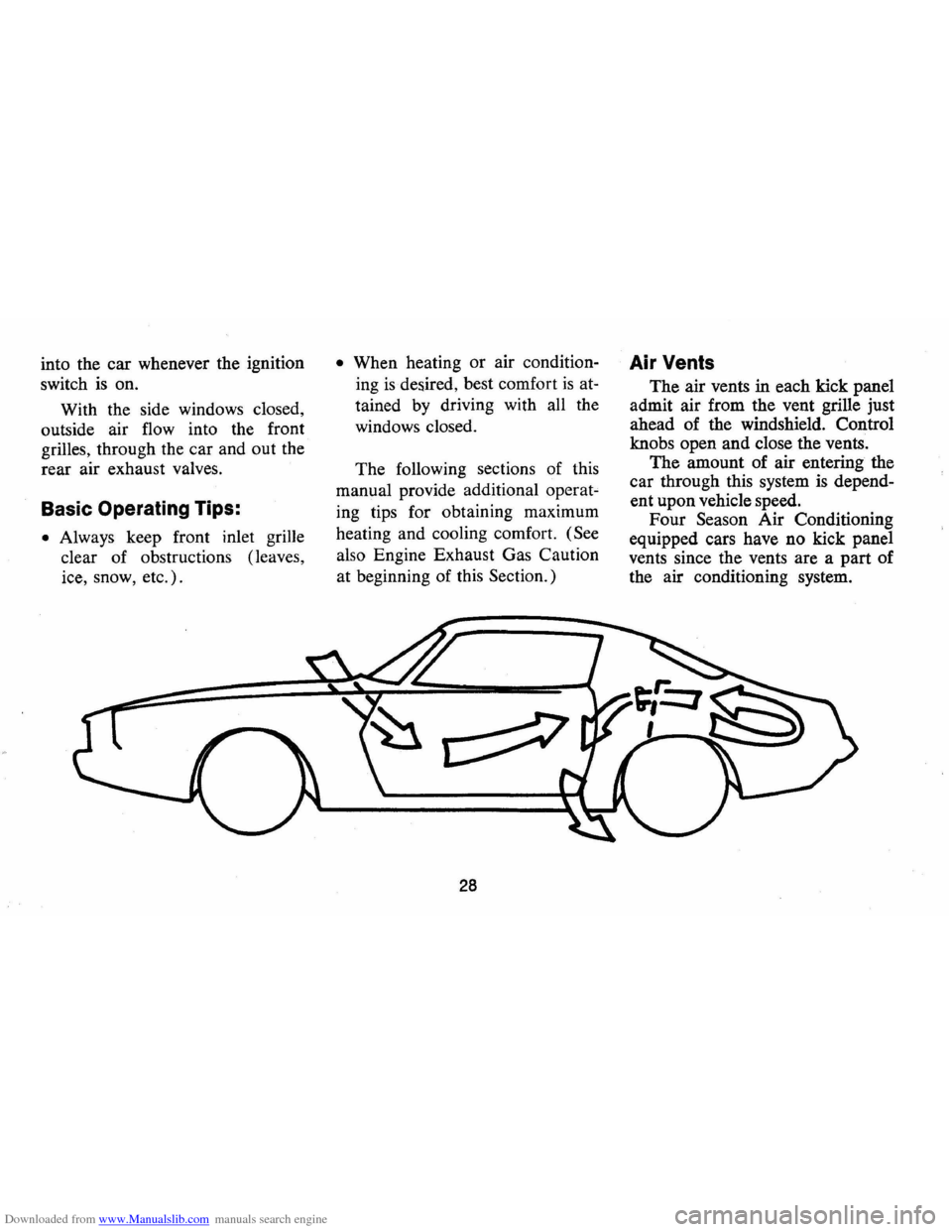
Downloaded from www.Manualslib.com manuals search engine into the car whenever the ignition
switch
is on.
With the side windows closed,
outside air flow into the front
grilles, through the car and out the
rear air exhaust valves.
Basic Operating Tips:
• Always keep front inlet grille
clear of obstructions (leaves,
ice, snow, etc.).
• When heating or air condition
ing
is desired, best comfort is at
tained by driving with all the
windows closed.
The following sections of this
manual provide additional operat
ing tips for obtaining maximum
heating and cooling comfort.
(See
also Engine Exhaust Gas Caution
at beginning of this Section.)
28
Air Vents
The air vents in each kick panel
admit air from the vent grille just
ahead of the windshield. Control
knobs open and close the vents.
The amount of air entering the
car through this system
is depend
ent upon vehicle speed.
Four Season Air Conditioning
equipped cars have no kick panel
vents since the vents are a part of
the air conditioning system.
Page 37 of 84
Downloaded from www.Manualslib.com manuals search engine Tape System
The optional Tape Player provides
prerecorded programs for your en
joyment.
To play, turn ignition switch to
"ON" or "AC" position and insert
cartridge through tape door with
label side up and open end
in first.
Tape will play through all four pro
grams in succession, then replay in
same sequence. Balancing the
speakers is not required as this ad
justment has been made at the fac
tory. Should it become necessary
to make this adjustment, see your
Chevrolet dealer.
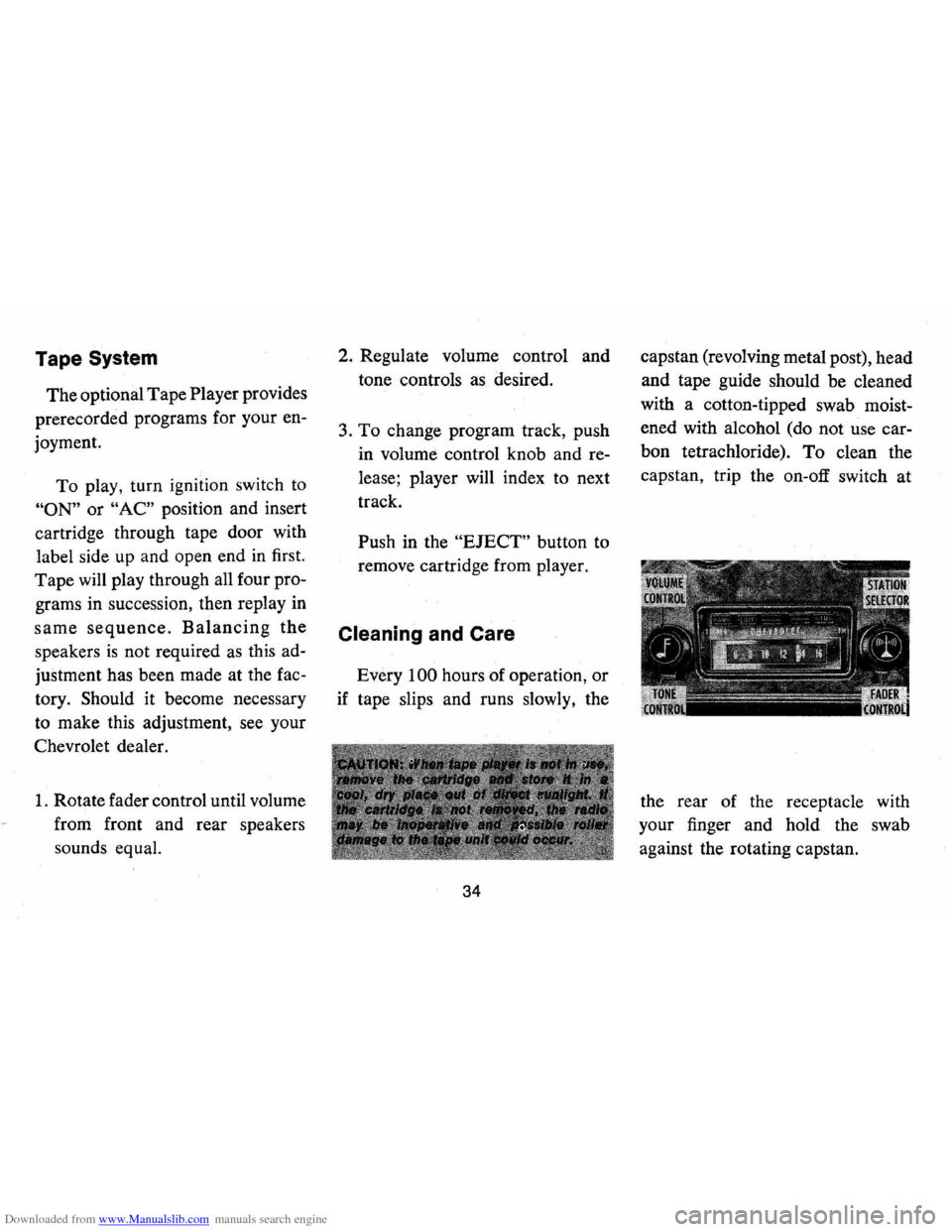
1. Rotate fader control until volume
from front and rear speakers
sounds eq ual. 2.
Regulate volume control and
tone controls
as desired.
3.
To change program track, push
in volume control knob and re
lease; player will index to next
track.
Push in the "EJECT" button to
remove cartridge from player.
Cleaning and Care
Every 100 hours of operation, or
if tape slips and runs slowly, the
34
capstan (revolving metal post), head
and tape guide should be cleaned
with a cotton-tipped swab moist
ened with alcohol (do not use car
bon tetrachloride).
To clean the
capstan, trip the on-off switch at
the rear of the receptacle with
your finger and hold the swab
against the rotating capstan.