belt CHEVROLET CAMARO 1973 2.G Owners Manual
[x] Cancel search | Manufacturer: CHEVROLET, Model Year: 1973, Model line: CAMARO, Model: CHEVROLET CAMARO 1973 2.GPages: 84, PDF Size: 32.64 MB
Page 6 of 84
Downloaded from www.Manualslib.com manuals search engine BEFORE DRIVING YOUR CAMAR 0
DRIVER CHECKLIST
Before Entering Car
1. See that windows, mirrors and
lights are clean.
2. Visually note inflation condition
of tires.
3. Check that area to rear is clear
if about to back up.
Before Driving Off
1. Lock all doors.
2. Position seat.
3 . Adjust inside and outside mirrors.
4. Fasten seat belts.
5. Check that warning bulbs light
when key
is turned to start
position.
6. Release parking brake (and
see
that brake warning light turns
off) .
7. Be sure you understand your car
and how to operate it safely.
Keys
Two separate keys are provided
for your car. Each key has a differ
ent cross section
so that it can be
inserted only in certain locks.
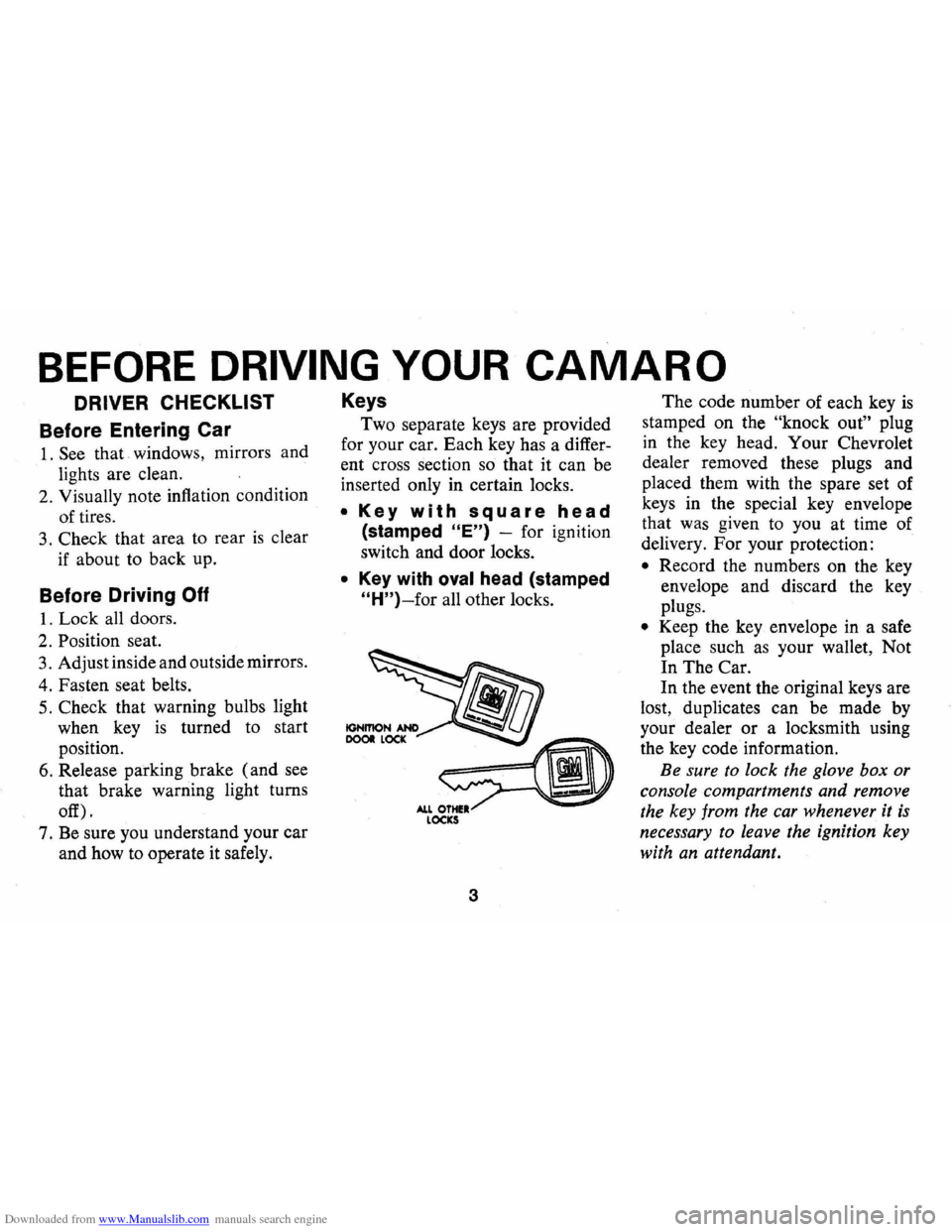
• Key with square head
(stamped "E") -for ignition
switch and door locks.
• Key with oval head (stamped
"H")-for all other locks.
3
The code number of each key is
stamped on the "knock out" plug
in the key head. Your Chevrolet
dealer removed these plugs and
placed them with the spare set of
keys in the special key envelope
that was given to you at time of
delivery. For your protection:
• Record the numbers on the key
envelope and discard the key
plugs.
• Keep the key envelope in a safe
place such
as your wallet, Not
In The Car.
In the event the original keys are
lost, duplicates can be made by
your dealer
or a locksmith using
the key code information.
Be sure
to lock the glove box or
console compartments and remove
the key from the car whenever it
is
necessary to leave the ignition key
with an attendant.
Page 7 of 84
Downloaded from www.Manualslib.com manuals search engine Door Locks
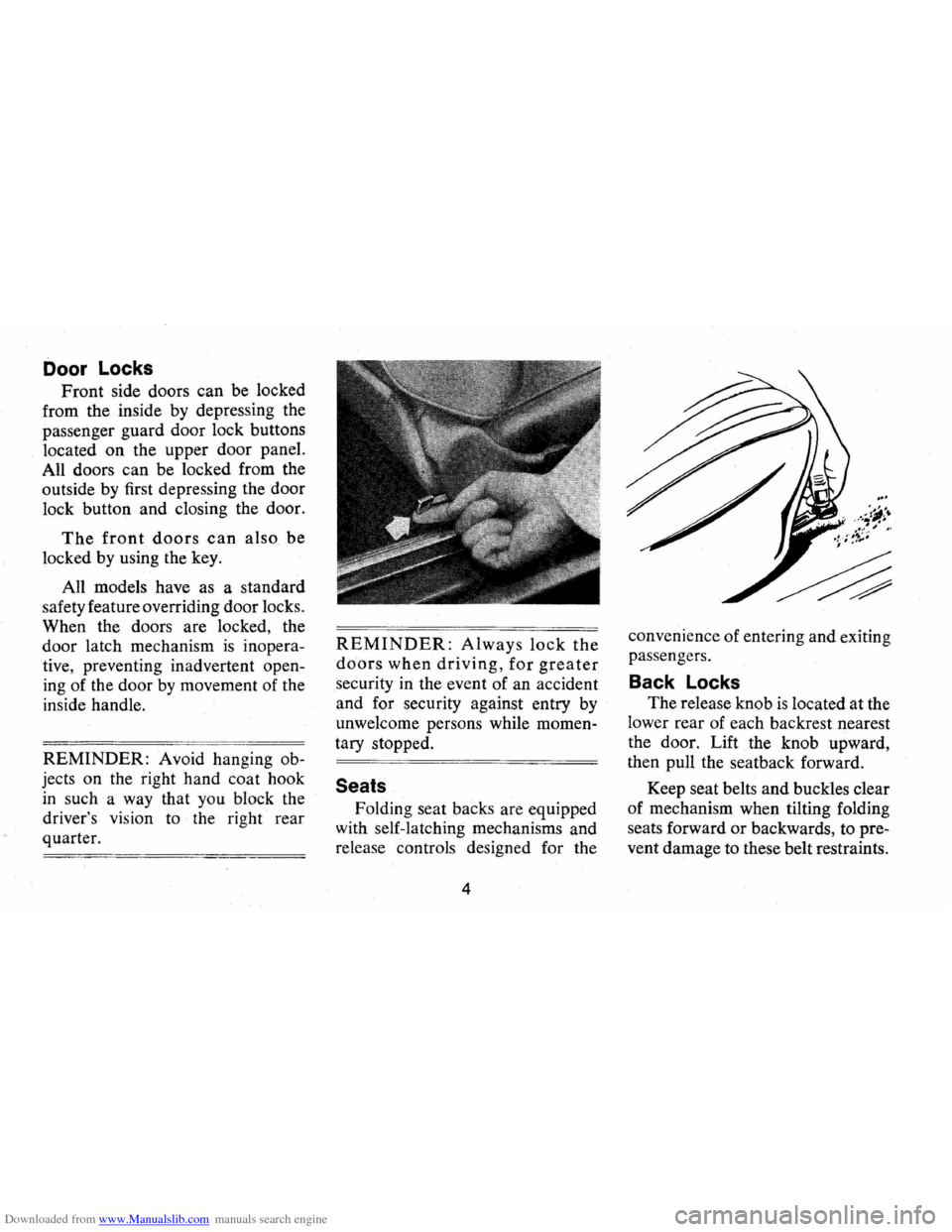
Front side doors can be locked
from the inside by depressing the
passenger guard door lock buttons
located
on the upper door panel.
All doors can be locked from the
outside by first depressing the door
lock button and closing the door.
The front doors can also be
locked by using the key.
All models have as a standard
safety feature overriding door locks.
When the doors are locked , the
door latch mechanism
is inopera
tive , preventing inadvertent open
ing of the door by movement of the
inside handle.
REMINDER: Avoid hanging ob
jects on the right hand coat hook
in such a way that you block the
driver 's
vis ion to the right rear
quarter.
REMINDER: Always lock the
doors when driving, for greater
security in the event of an accident
and for security against entry by
unwelcome persons while momen
tary stopped.
Seats
Folding seat backs are equipped
with self-latching mechanisms and
release controls designed for the
4 convenience
of entering and exiting
passengers .
Back Locks
The release knob is located at the
lower rear of each backrest nearest
the door. Lift the knob upward,
then pull the seatback forward.
Keep seat belts and buckles clear
of mechanism when tilting folding
seats forward
or backwards, to pre
vent damage to these belt restraints.
Page 8 of 84
Downloaded from www.Manualslib.com manuals search engine Manually Operated
Front Seats
The front seats may be adjusted
to suit an individual's preference.
Simply release the seat lock mech
anism located at the front of the
seat.
Once released, exert slight
body pressure in the direction de
sired. Release the lever
so the seat
will lock in the desired position.
Inside Rearview Mirrors
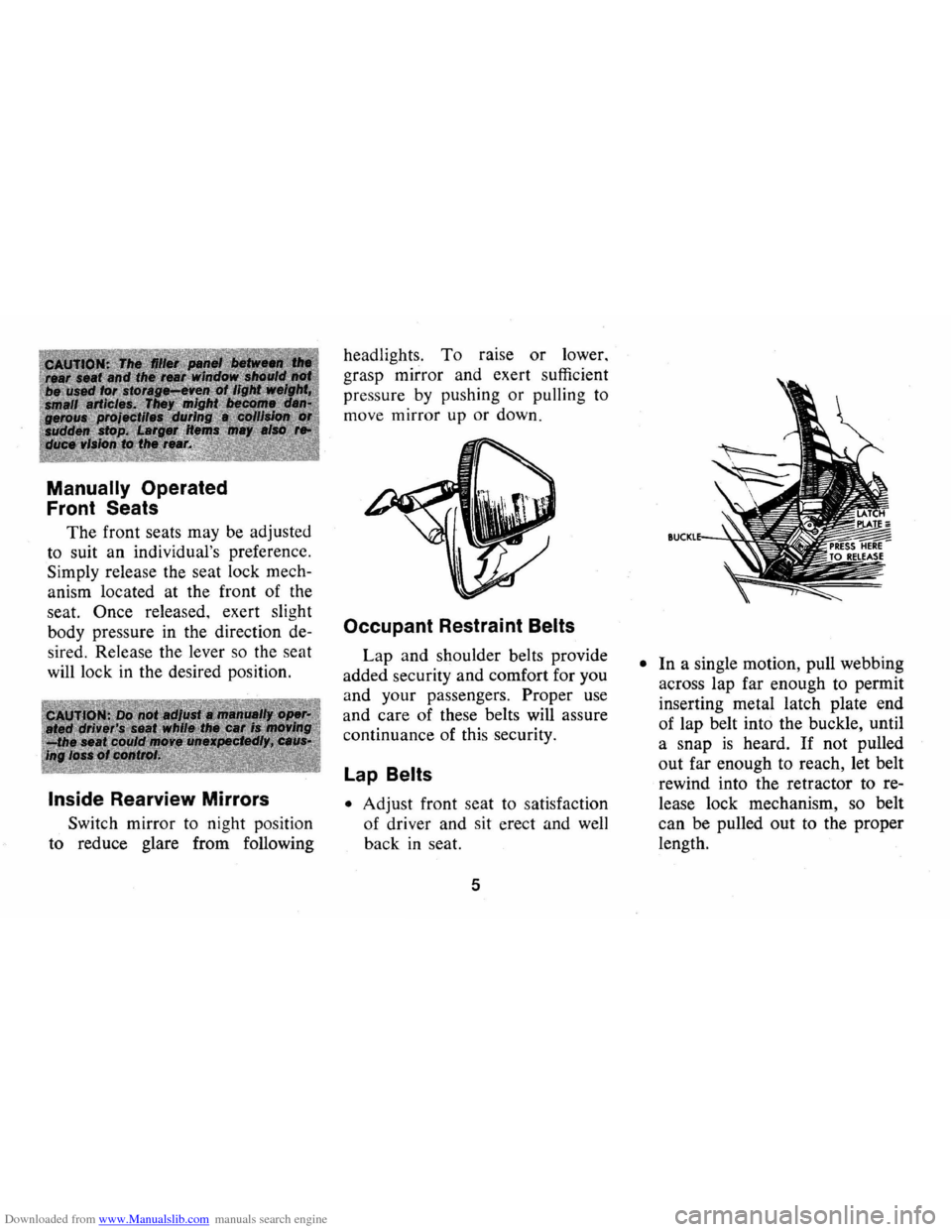
Switch mirror to night position
to reduce glare from following headlights.
To raise or lower,
grasp mirror and exert sufficient
pressure
by pushing or pulling to
move mirror up
or down.
Occupant Restraint Belts
Lap and shoulder belts provide
added security and comfort for you
and your passengers.
Proper use
and care of these belts will assure
continuance of this security.
Lap Belts
• Adjust front seat to satisfaction
of driver and sit erect and
well
back in seat.
5
• In a single motion, pull webbing
across lap far enough to permit
inserting metal latch plate end
of lap belt into the buckle, until
a snap
is heard. If not pulled
out far enough to reach, let belt
rewind into the retractor to re
lease lock mechanism, so belt
can be pulled out to the proper
length.
Page 9 of 84
Downloaded from www.Manualslib.com manuals search engine • Position belt across lap as
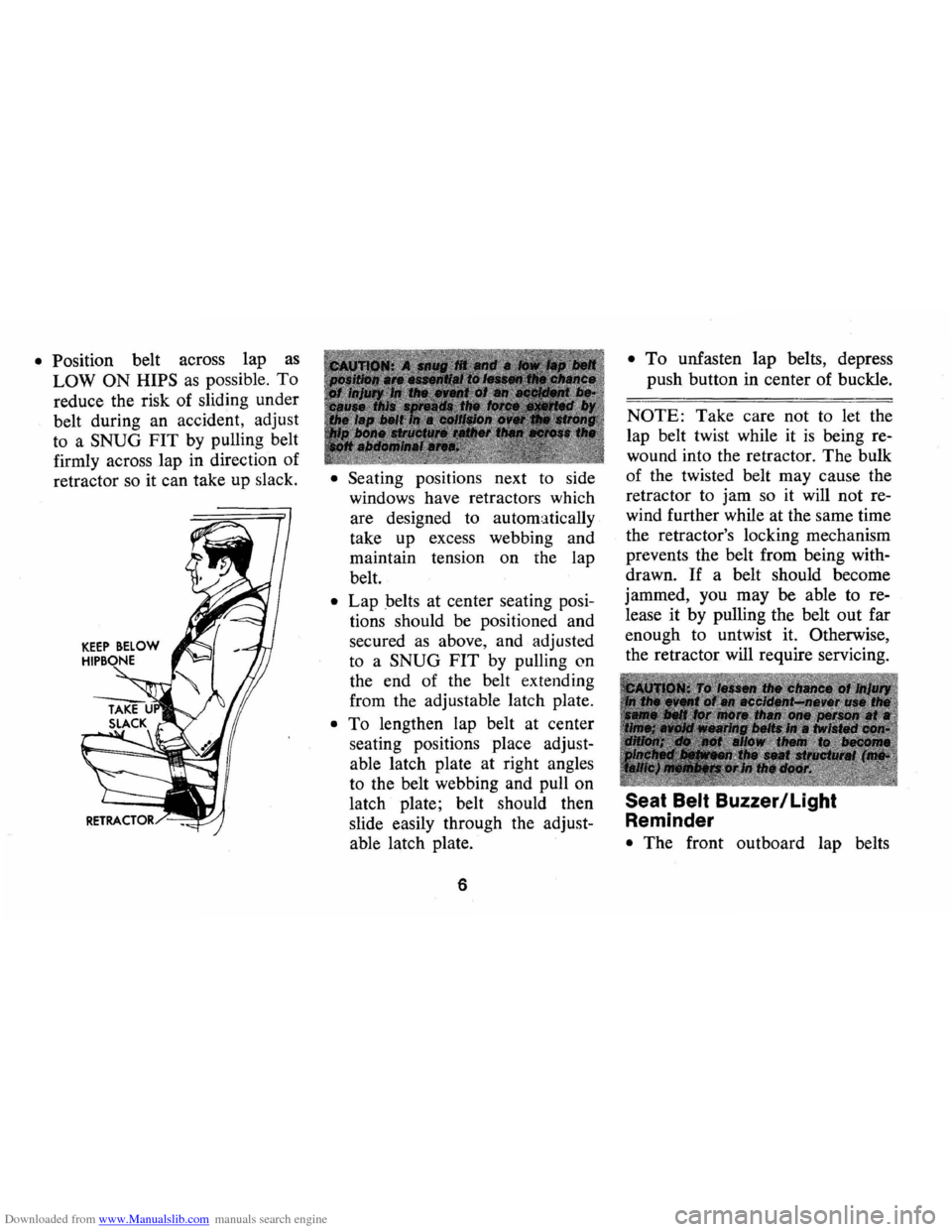
LOW ON HIPS as possible. To
reduce the risk of sliding under
belt during an accident, adjust
to a
SNUG FIT by pulling belt
firmly across lap in direction
of
retractor so it can take up slack. • Seating posItIOns next to side
windows have retractors which
are designed to automatically
take up excess webbing and
maintain tension on the lap
belt.
• Lap belts at center seating posi
tions should be positioned and
secured as above, and adjusted
to a
SNUG FIT by pulling on
the end of the belt extending
from the adjustable latch plate.
• To lengthen lap belt at center
seating positions place adjust
able latch plate at right angles
to the belt webbing and pull on
latch plate; belt should then
slide easily through the adjust
able latch plate.
6
• To unfasten lap belts, depress
push button
in center of buckle.
NOTE: Take care not to let the
lap belt twist while it
is being re
wound into the retractor.
The bulk
of the twisted belt may cause the
retractor to jam so it will not re
wind further while at the same time
the retractor's locking mechanism
prevents the belt from being with
drawn.
If a belt should become
jammed, you may be able to re
lease
it by pulling the belt out far
enough to untwist it. Otherwise,
the retractor will require servicing.
Seat Belt Buzzer/Light
Reminder
• The front outboard lap belts
Page 10 of 84
Downloaded from www.Manualslib.com manuals search engine (those next to side windows)
are linked to a buzzer and light
which remind occupants to fas
ten seat belts.
• On cars with automatic trans
missions, or manual transmis
sions with steering column
mounted shift levers, the buzzer
and light are designed to come
on when the ignition switch
is
on, the transmission selector is
in a forward drive position, and
the driver's or right front pas
senger's lap belt
is not fastened.
• On manual transmission cars
with floor mounted shift con
trols the reminders are designed
to come on when the ignition
switch
is on, the driver's or
right front passenger's lap belt
is not fastened and the transmis
sion
is in any gear position, ex
cept that they do not come
on
when the parking brake is en
gaged.
NOTE: The right front seat con
tains a weight detector which
is
designed to activate the buzzer
and light whenever
a. nominal
weight
is placed on the seat. The
weight detector cannot distinguish
between a passenger and any item
of luggage or cargo, therefore such
items should be placed elsewhere
in the car, preferably
in the trunk.
If seat belt system or reminder
system does not work
as described,
see your dealer for information
and assistance.
Shoulder Belts
• When properly worn with a lap
belt, a shoulder belt can provide
important additional protection
against impact with the car in
terior by restraining forward
motion of the upper torso in a
collision. This
is particularly
true in the case of a frontal im
pact, which
is the most frequent
7 type
of accident.
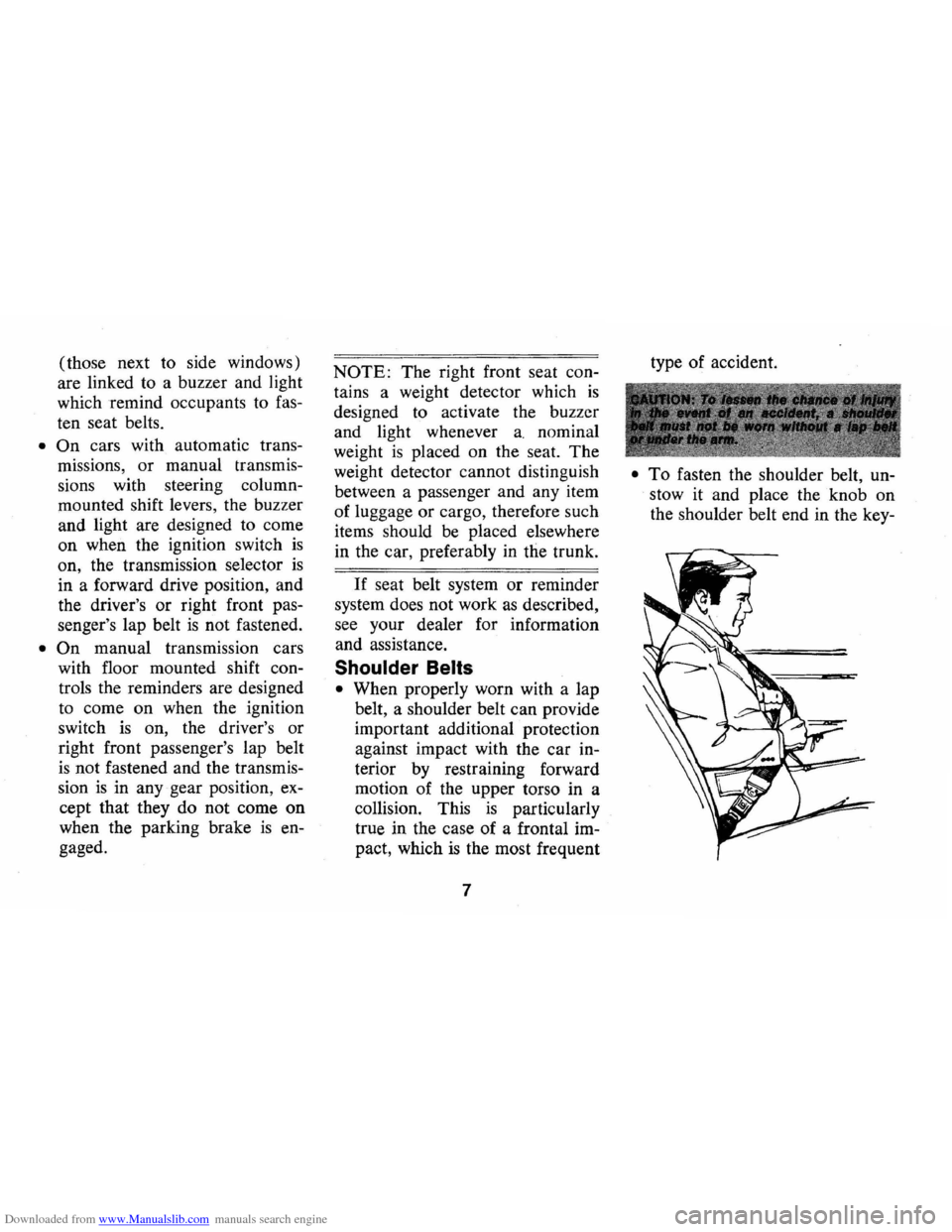
• To fasten the shoulder belt, un
stow it and place the knob on
the shoulder belt end in the key-
Page 11 of 84

Downloaded from www.Manualslib.com manuals search engine hole on the lap belt latch plate.
(The latch is designed so that
this attachment
can only be com
pleted before fastening the lap
belt.) Tilt the knob
as neces
sary, to pass it through the slot.
Pull the knob firmly upward to
seat it at the narrow end of the
keyhole, then fasten the lap
belt.
• Shoulder belts are lengthened
and shortened
in the same man
ner
as center seat lap belts.
• Shoulder belt should have suffi
cient slack to insert a fist's
width between your chest and
the belt. This can be checked
by inserting a clenched
fist be
tween the belt and your chest
with thumb against chest and
back of hand facing upward.
• When not in use, the shoulder
belt may be stowed by leaving
it attached to the lap belt and
allowing the lap belt to rewind into
its retractor. Take up re
maining slack using the shoul
der belt adjustment feature.
• To completely restow the shoul
der belt, .remove the belt knob
from the keyhole (tilting knob
as necessary). Then restow belt
along roof rail in accord with
illustration. .
When not in use, all loose lap
and shoulder belts should be se
cured to reduce the danger of
the
metal ends striking an occupant in
an accident. When special stowage
provisions are not provided, the
8 loose
ends should be attached to
each other and adjustment
made
to remove the slack in the belt sys
tem. Be sure that belts are not left
in a position where the webbing
or
hardware can be pinched in the
seat structure
or door, and thus
become damaged.
Seat Belt Inspection
• Periodically inspect belts, buc
kles, retractors, and anchors for
damage that could lessen the ef
fectiveness
of the restraint sys
tem.
SHOULDER BELT
STOWAGE
Page 12 of 84

Downloaded from www.Manualslib.com manuals search engine • Keep sharp edges and damaging
objects away from belts.
• Replace belts if cut, weakened,
frayed, or subjected to collision
loads.
• Check that anchor mounting
bolts are tight.
• Have questionable parts re
placed.
• Keep seat belts clean and dry.
• Clean only with mild soap solu
tion and lukewarm water.
• Do not bleach or dye belts since
this may severely weaken belts.
Child Restraint
Children in automobiles · should
be restrained to lessen the risk of
injury in accidents, sudden stops
or other hazardous situations.
General Motors dealers offer re
straint systems designed specific
ally for use with infants. In using
any infant or child restraint
sys
tem, read and comply with all in- stallation
and usage instructions.
All unused seat belts near the
child should be stowed properly to
help prevent them from striking
him in the event of an accident.
Lap belts and shoulder belts with
out storage provisions should have
buckles latched and belts adjusted
to remove slack.
Cars Not Equipped With
Special Child Restraints
If a child is traveling in a vehi
cle not equipped with a General
Motors
inf~mt restraint or other
safe infant or child restraint
sys
tem, . the following precautions
should be taken:
1. Infants unable to sit up by
themselves should be restrained
by placing them in a covered,
padded bassinet which
is placed
crossways in the vehicle (width
wise) on the rear seat. The bas
sinet should be securely re
strained with the regular vehi-
9
cle seat belts. An alternate me
thod
is to position the bassinet
so that it rests against the back
of the front seat, again cross
ways in the vehicle.
2. Children able to sit up by them
selves should be placed on a
seat and lap belted, preferably
in the rear seat. Never allow a
child to stand or kneel on any
seat.
If the child cannot see out
the car windows he should sit
on a firm cushion with the reg
ular lap belt restraining him at
the hips. The cushion should be
as firm as practical and just
high enough to enable the child
to look horizontally out of the
car windows. The use of the
cushion should be discontinued
as soon as the child is old
enough to see out of the car
windows without it.
3. General Motors recommends
that children be restrained
Page 45 of 84
Downloaded from www.Manualslib.com manuals search engine Cleaning Fabrics with
Cleaning
Fluid
This type of cleaner should be
used for cleaning stains containing
grease, oil or fats. Exces s stain
should be gently scraped off with
a clean dull knife
or scraper. Use
very little cleaner, light pressure,
and clean cloths (preferably cheese
cloths) . Cleaning action with cloth
should be from outside of stain to
wards center and constantly chang
ing to a clean section of cloth.
When stain
is cleaned from fabric,
immediately wipe
area briskly with
a clean absorbent towel or cheese
cloth to help dry area and prevent
a cleaning ring.
If ring forms, im
mediately clean entire area or panel
section of the trim assembly.
NOTE: Sometimes a difficult spot
may require a second application
of cleaning fluid followed immedi- ately
by a soft brush to completely
remove the spot.
Cleaning Fabrics with
Detergent Foam Cleaners
This type of cleaner is excellent
for cleaning general soilage from
fabrics and for cleaning a panel sec
tion where a minor cleaning ring
may be left from spot cleaning.
Vacuum area to remove excess
loose dirt. Always clean at least a
full trim panel or section of trim.
Mask adjacent trim along stitch or
weld lines. Mix detergent type foam
cleaners in strict accordance with
directions on label of container.
Use
foam only on a clean sponge or
soft bristle brush -Do not wet
fabric excessively or rub harshly
with brush. Wipe clean with a
slightly damp absorbent towel
or
cloth. Imm~diately after cleaning
fabric, dry fabric with a dry towel
42
or hair dryer. Rewipe fabric with
dry absorbent towel
or cloth to re
store the luster of the trim and to
eliminate any dried residue.
Seat Belt Care
• Clean only with mild soap solu
tion and lukewarm water.
• Do not bleach or dye belts since
this may severely weaken belts.
Removal of Specific Stains
Candy -Chocolate, use cloth
soaked in lukewarm water; other
than chocolate, use very hot water.
Dry.
If necessary, clean lightly with
fabric cleaning fluid.
Chewing Gum-Harden gum with
ice cube and scrape off with dull
knife. Moisten with fabric cleaning
fluid and scrape again.
Page 51 of 84
Downloaded from www.Manualslib.com manuals search engine sert it firmly for an accurate read
ing. The oil gauge rod
is marked
"FULL" and "ADD." The oil level
should be maintained in the safety
margin, neither going above the
"FULL" line nor below the "ADD"
line. Reseat the gauge firmly after
taking the reading.
NOTE: The oil gauge rod is also
marked
"Use SE Engine Oil" as a
reminder to use only
SE oils.
Supplemental Engine Oil
Additives
The regular use of supplemental
additives
is specifically not recom
mended and will increase operat
ing costs. However, supplemental
additives are available that can
effectively and economically solve
certain specific problems without
causing other difficulties. For ex
ample,
if higher detergency is re
quired to reduce varnish and sludge
deposits resulting from
some unusual operational diffi
culty, a thoroughly tested and ap
proved additive -
"Super Engine
Oil Supplement" -is available at
your Chevrolet dealer.
In the event
of an operational problem, consult
your dealer for advice before
us
ing supplemental additives.
Drive Belts
Every 6,000 miles or 4 months
inspect drive belts for wear, fray
ing, cracking, and tension. Belts
which are in poor condition should
be replaced immediately.
Check tension by applying mod
erate thumb pressure midway be
tween pulleys.
If the center-to
center distance between pulleys
is
13 to 16 inches, the belt should
deflect
Y2 inch . If the center-to
center distance
is7 to 10 inches,
the belt should deflect
1.4 inch.
Loose belts should be retensioned
48
to give the correct deflection.
Air Cleaner
Flame Arrester -Every 12,000
miles-Clean the arrester (located
in the base of the air cleaner) with
kerosene
or a suitable solvent. Dry
with compressed air.
Rear Axle
Standard -Every 4 months or
6,000 miles, whichever occurs
first, check lubricant level and add
lubricant, if necessary, to fill to
level of filler plug hole.
Use SAE
80 or SAE 90 GL-5 Gear Lubri
cant.
(For vehicles normally oper
ated in Canada use SAE 80 GL-5
Gear Lubricant.)
Page 58 of 84
Downloaded from www.Manualslib.com manuals search engine It is the owner's responsibility
to keep the freeze protection at a
level commensurate with the tem
peratures which may occur
in the
area of vehicle operation.
• Maintain cooling system freeze
protection at
_200 F or below
to ensure protection against cor
rosion and loss of coolant from
boiling, even though freezing
temperatures are not expected.
• Add ethylene glycol base cool
ant that meets GM Specification
1899-M when coolant additions
are required because of coolant
loss or to provide additional
protection against freezing at
temperatures lower than
_200
F (_320 F in Canada).
NOTE: Alcohol or methanol base
coolants
or plain water are not
recommended for your Camaro at
any time.
Radiator Pressure Cap
The radiator cap, a 15 lb. pres
sure type, must be installed tightly,
otherwise coolant may be lost and
damage to engine may result from
overheating. Radiator pressure
caps should be checked periodi
cally for proper operation.
If re
placement
is required specify AC.
Thermostat
The cooling system is protected
and controlled by a thennostat
in
stalled in the engine coolant outlet
to maintain a satisfactory operat
ing temperature of the engine. This
thermostat
is designed forcontinu
ous use through both winter and summer
and need not be changed
seasonally . When replacement
is
necessary, Delco parts are recom~
mended.
Tires
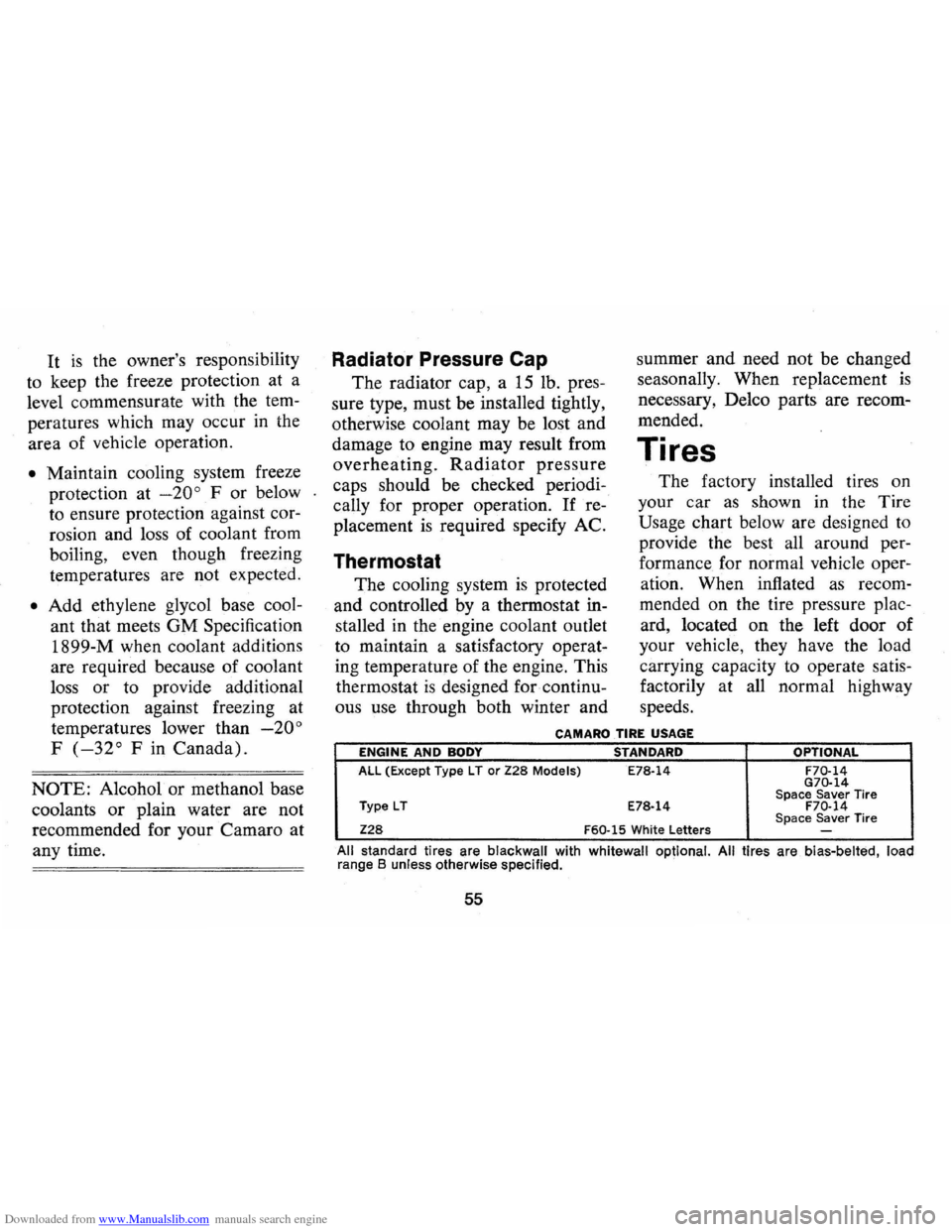
The factory installed tires on
your car
as shown in the Tire
Usage chart below are designed to
provide the best all around per
formance for normal vehicle oper
ation. When inflated
as recom
mended on the tire pressure plac
ard, located
on the left door of
your vehicle, they have the load
carrying capacity to operate satis
factorily at all normal highway
speeds.
CAMARO TIRE USAGE
ENGINE AND BODY STANDARD OPTIONAL
All (Except Type l T or Z28 Models) E78·14 F70·14 G70·14
Type lT Space Saver Tire E78·14 F70·14
Z28 F60·15 White letters Space Saver Tire -
All standard tires are blackwall with whitewall optional. All tires are bias-belted, load
range B unless otherwise specified. .
55