brake light CHEVROLET CAMARO 1973 2.G Owners Manual
[x] Cancel search | Manufacturer: CHEVROLET, Model Year: 1973, Model line: CAMARO, Model: CHEVROLET CAMARO 1973 2.GPages: 84, PDF Size: 32.64 MB
Page 6 of 84
Downloaded from www.Manualslib.com manuals search engine BEFORE DRIVING YOUR CAMAR 0
DRIVER CHECKLIST
Before Entering Car
1. See that windows, mirrors and
lights are clean.
2. Visually note inflation condition
of tires.
3. Check that area to rear is clear
if about to back up.
Before Driving Off
1. Lock all doors.
2. Position seat.
3 . Adjust inside and outside mirrors.
4. Fasten seat belts.
5. Check that warning bulbs light
when key
is turned to start
position.
6. Release parking brake (and
see
that brake warning light turns
off) .
7. Be sure you understand your car
and how to operate it safely.
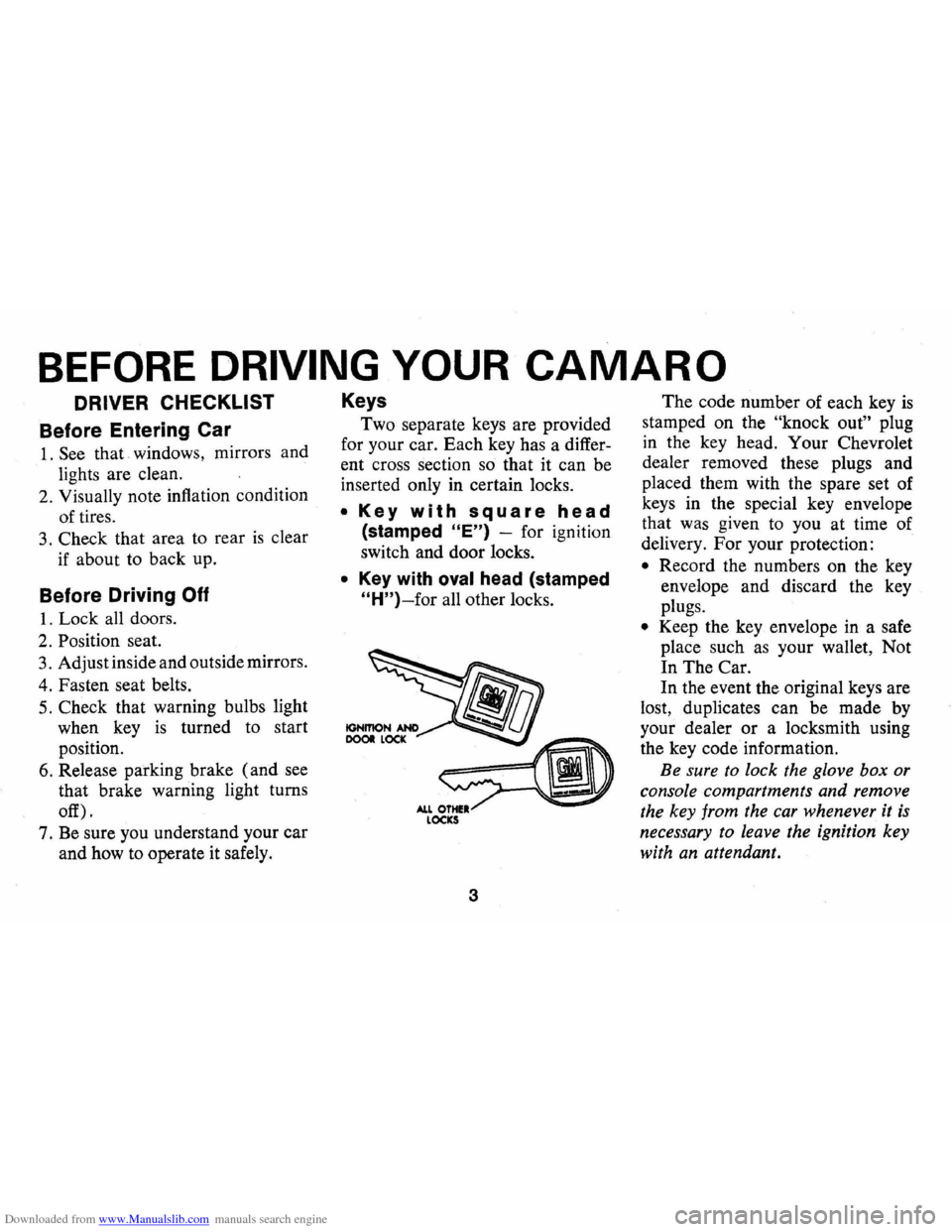
Keys
Two separate keys are provided
for your car. Each key has a differ
ent cross section
so that it can be
inserted only in certain locks.
• Key with square head
(stamped "E") -for ignition
switch and door locks.
• Key with oval head (stamped
"H")-for all other locks.
3
The code number of each key is
stamped on the "knock out" plug
in the key head. Your Chevrolet
dealer removed these plugs and
placed them with the spare set of
keys in the special key envelope
that was given to you at time of
delivery. For your protection:
• Record the numbers on the key
envelope and discard the key
plugs.
• Keep the key envelope in a safe
place such
as your wallet, Not
In The Car.
In the event the original keys are
lost, duplicates can be made by
your dealer
or a locksmith using
the key code information.
Be sure
to lock the glove box or
console compartments and remove
the key from the car whenever it
is
necessary to leave the ignition key
with an attendant.
Page 10 of 84
Downloaded from www.Manualslib.com manuals search engine (those next to side windows)
are linked to a buzzer and light
which remind occupants to fas
ten seat belts.
• On cars with automatic trans
missions, or manual transmis
sions with steering column
mounted shift levers, the buzzer
and light are designed to come
on when the ignition switch
is
on, the transmission selector is
in a forward drive position, and
the driver's or right front pas
senger's lap belt
is not fastened.
• On manual transmission cars
with floor mounted shift con
trols the reminders are designed
to come on when the ignition
switch
is on, the driver's or
right front passenger's lap belt
is not fastened and the transmis
sion
is in any gear position, ex
cept that they do not come
on
when the parking brake is en
gaged.
NOTE: The right front seat con
tains a weight detector which
is
designed to activate the buzzer
and light whenever
a. nominal
weight
is placed on the seat. The
weight detector cannot distinguish
between a passenger and any item
of luggage or cargo, therefore such
items should be placed elsewhere
in the car, preferably
in the trunk.
If seat belt system or reminder
system does not work
as described,
see your dealer for information
and assistance.
Shoulder Belts
• When properly worn with a lap
belt, a shoulder belt can provide
important additional protection
against impact with the car in
terior by restraining forward
motion of the upper torso in a
collision. This
is particularly
true in the case of a frontal im
pact, which
is the most frequent
7 type
of accident.
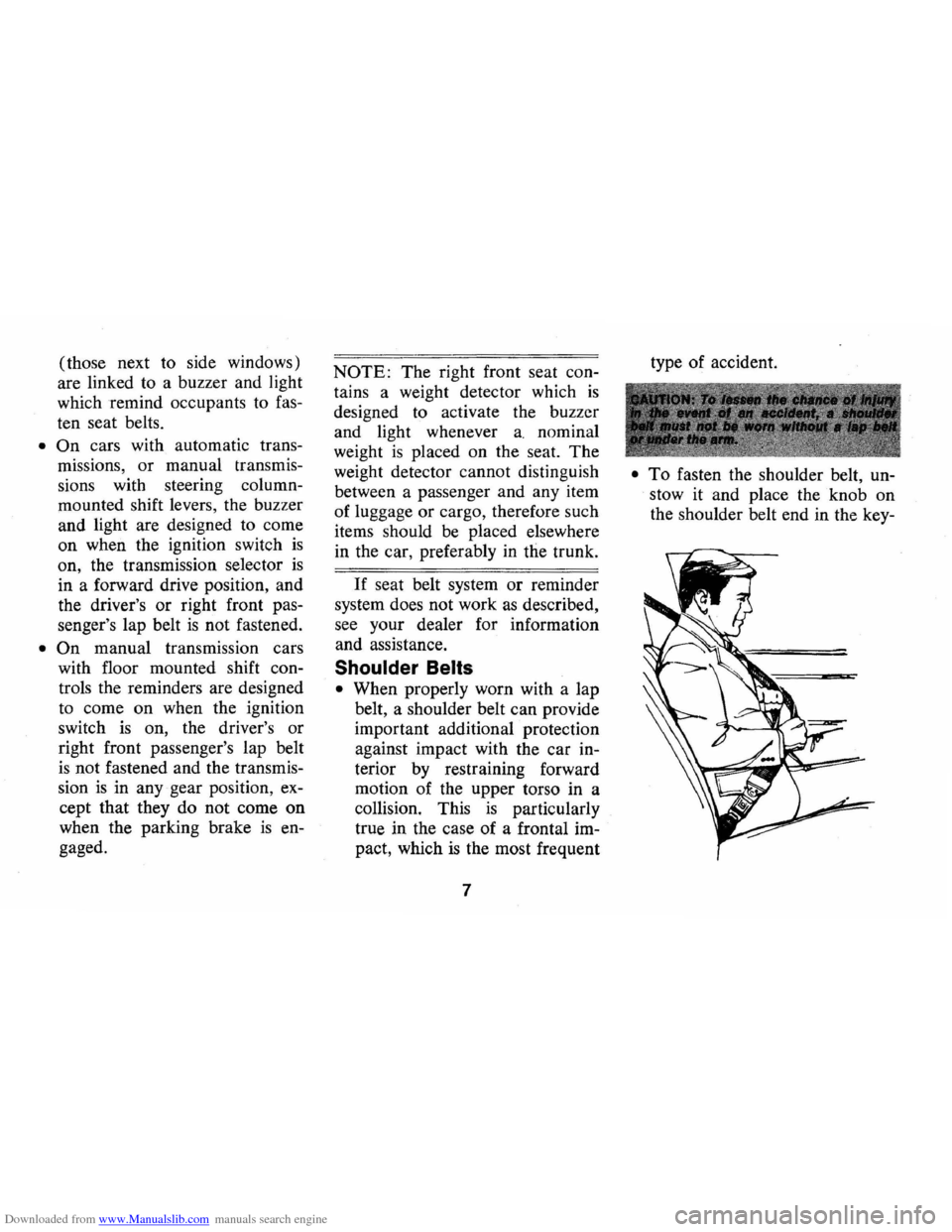
• To fasten the shoulder belt, un
stow it and place the knob on
the shoulder belt end in the key-
Page 17 of 84
Downloaded from www.Manualslib.com manuals search engine A starter safety switch prevents
starter operation while the trans
mission selector
is in any drive
position.
(If it is necessary to
re-start the engine with the car
moving, place the selector lever
in
"N".)
3. Depress accelerator pedal and
activate starter as outlined be
low for different conditions.
• Cold Engine -Fully depress
accelerator pedal and slowly
release.
With foot off the
pedal,
crank the engine by
turning the ignition key to the
Start position -release when
engine starts.
If engine starts, but fails to
run, repeat this procedure.
When engine is running
smoothly (approximately 30
seconds), the idle speed may
be reduced by slightly depress
ing the accelerator pedal and
then slowly releasing.
• Warm Engine -Depress ac
celerator
pedal about halfway
and hold while cranking the
engine.
• Extremely Cold Weather
(Below
ODF.) Or After Car
14
Has Been Standing Idle
Several Days-
Fully depress and release ac
celerator pedal two
or three
times before cranking the en
gine.
With foot off the accel
erator pedal,
crank the engine
by turning the key to the
Start position and release
when engine starts .
Manual Transmission Models
1. Apply parking brake and shift
transmission to neutral.
2.
Hold clutch pedal to floor
throughout the starting proce
dure. A starter interlock prevents
starter operation when clutch
is
not fully depressed. (Select the
Page 21 of 84

Downloaded from www.Manualslib.com manuals search engine ing wheel. The lever is moved up
ward to signal a right turn and
downward
to signal a left turn.
Lamps on the front and rear of the
car transmit this signal to other
motorists and pedestrians. The
ig
nition switch must be in the "ON"
position in order for the turn sig
nals to be operational. This feature
prevents battery drain
if the lever
is left in an "ON" position when
your car
is not in use.
In a normal turning situation
such
as turning a corner, the turn
signal
is cancelled automatically
after the turn
is completed. How
ever, in some driving maneuvers
such as changing lanes
on an ex
pressway, the steering wheel
is not
turned back sufficiently after com
pleting the turn to automatically
cancel the turn signal. For con
venience in such maneuvers, the
driver can flash the
tum signals by moving
the turn signal lever part
way (to the first stop) and holding
it there. The lever returns to the
neutral
or cancelled position when
the driver releases his hold on the
lever.
A green light on the instrument
cluster flashes to indicate proper
operation of the front and rear turn
signal lamps.
If the indicator lamp
18
remains on and does not flash,
check for a defective lamp bulb.
If
the indicator fails to light when the
lever
is moved, check the fuse and
indicator bulb.
Power Steering
If the steering system power as
sist fails due to some malfunction,
or because the engine has stalled,
the car can still be steered.
How
ever, much greater effort is re
quired, particularly in sharp turns.
Holding Car on an Upgrade
When stopped on an upgrade,
maintain your position by applying
the brakes. Never hold the car in
place
by accelerating engine with
transmission in gear. This could
cause damage by overheating the
transmission (automatic) or clutch
(manual).
Page 23 of 84
Downloaded from www.Manualslib.com manuals search engine FLOOR CONTROLS
Braking System
The service brake system is de
signed for braking performance
under a wide range of driving con
ditions even when the vehicle
is
loaded to its full rated vehicle load.
Power Brakes
On cars with power brakes if
power assist to the brakes
is inter
rupted due to a stalled engine
or
some malfunction, two or more
brake applications can be made
using reserve power.
• If the brake pedal is held down.
the system
is designed to bring
the
car to a full stop on reserve
power. However, the reserve
power
is partially depleted each
time the brake pedal
is applied
and released.
• When reserve power is exhausted,
vehicle
can still be stopped by ap
plying greater force to the pedal.
Parking Brake
• To set parking brake, fully de
press foot pedal
at far left side.
• For maximum holding power.
depress regular brake pedal with
the other foot at the same time.
• To release parking brake, pull
"BRAKE RELEASE" lever on
lower left instrument panel.
• As a reminder, the brake system
warning light
is designed to glow
whenever the parking brake con
trol ·
is not fully released , and the
ignition
is on.
• Never drive car with parking
20
brake set as this may overheat or
otherwise damage rear brakes.
NOTE: "Riding the brake" by rest
ing your foot on the brake pedal
when not intending to brake can
cause abnormally high brake tem
peratures, excessive lining wear
and possible damage to the brakes.
Page 24 of 84

Downloaded from www.Manualslib.com manuals search engine REMINDER: Brake linings should
be inspected for wear by a qualified
mechanic at least once a year
or
every 12,000 miles, whichever oc
curs first (disc brake pads should
be visually inspected for wear each
time the wheels and tires are ro
tated at
6,000 mile intervals).
More frequent inspections should
be made if driving conditions in
your area, such as traffic or terrain
or techniques of individual
driver~
result in frequent brake applica
tions. Your Chevrolet dealer
is best
qualified to advise you
as to how
often this inspection should be per
formed. When brakes require re
lining, use those Genuine General
Motors
Parts specified for your car,
and Delco, brake fluid
as required.
Automatic Brake Adjusters
• Brakes on this car (except for
the parking brake) are self- adjusting,
designed to eliminate
periodic brake adjustments.
• Drum brake adjustment is made
automatically
as the brakes are
applied while car
is moving
backwards.
• Disc brake adjustment is made
automatically with each brake
application.
• If excess brake pedal travel de
velops, drive alternately back
ward and forward several times
and apply brakes firmly in each
direction.
• See your dealer if normal pedal
travel
is not restored, or if there
is a rapid increase in pedal travel,
which could be a sign of other
brake trouble.
Clutch Adjustment
Clutch adjustment should be
checked and adjusted periodically
as necessary to compensate for
21
clutch facing wear. To check, de
press pedal by hand until resistance
is felt. Free travel of pedal should
~e approximately one inch; if very
httle
or no free travel is evident
clutch adjustment
is required. '
Headlight Beam Switch
"High" and "low" headlight
beams are controlled by the floor
button at your left foot. The indi
cator, located in the speedometer
dial, will light up when the high
beams are in use.
I
Page 27 of 84

Downloaded from www.Manualslib.com manuals search engine Generator Indicator Light
The red light will go on when
the ignition key
is in the "on" posi
tion, but before the engine
is
started. After the engine starts, the
light should go out and remain out.
If the light remains on when engine
is running, have your Authorized
Chevrolet Dealer locate and correct
the trouble as soon
as possible.
Engine Temperature
Indicator Light
This indicator light is provided
in the instrument cluster to quickly
warn of an overheated engine. With
,the ignition switch in the START
position, the red
TEMP indicator
will light to let you know that it
is
operating properly.
When the engine
is started, the
red light will go out immediately.
It will light up at no other time
unless for some reason the engine reaches
a dangerously high oper
ating temperature.
If the red light
should come on, the engine must be
stopped until the cause of the over
heating
is corrected. Glance at in
strument cluster frequently
as you
drive to see if this light
is on.
Brake System Warning
Light
The service brake system is de
signed
so that half of the brake sys
tem will provide some braking ac
tion in the event of a hydraulic leak
in the other half of the system.
If
the warning light located at lower
left of instrument cluster (speed
ometer face), glows continuously
when the ignition
is on and after
the brakes have been firmly applied
it may indicate that there
is a mal
function in one half of the brake
hydraulic system.
On cars equipped
with front drum brakes, the light
24
will go out when foot is removed
from brake pedal.
• As a check on bulb condition
the light should glow with the
parking brake applied and the
ignition on. (Light
is also a re
minder to release parking brake.)
• Have system repaired if light
does not come
on during check.
• This warning light is. not a' sub
stitute for the visual check of
brake fluid level required
as part
of normal maintenance.
If the light glows red:
• The parking brake control is not
fully released or,
• The service brake system is par
tially inoperative.
What to do:
1. Check that the parking brake is
released. If it is ...
2. Pull off the road and stop, care
fully-remembering that:
Page 28 of 84

Downloaded from www.Manualslib.com manuals search engine • Stopping distances may be
greater.
• Greater pedal effort may be re
quired .
• Pedal travel may be greater.
3.
Tryout brake operation by
starting and stopping on road
shoulder-then:
• If you judge such operation to
be safe, proceed cautiously at a
safe speed to nearest dealer for
repair.
• Or have car towed to dealer for
repair.
Continued operation of the car
in this condition
is dangerous.
Headlight Beam Indicator
Light
The headlights of your car have
high and low
beams to provide you with
proper night-time visibility
for most driving conditions. The
"low" beams are used during most
city driving. The
"high" beams are
especially useful when driving on
dark roads since
they' provide ex
cellent long range illumination.
The headlight beam indicator will
be on whenever the high beams
or
"brights" are in use. The Headlight
Beam Switch controls the headlight
beams (see Page
21).
Light Switch
The three position light switch
controls the headlights, taillights,
parking lights, side marker lights,
instrument lights and dome lights
as shown. The headlamp circuit is
protected by a circuit breaker in the
light switch.
An overload on the
breaker will cause the lamps to
"flicker" on and off. If this condi
tion develops, have your headlamp
wiring checked immediately.
PARKING LAMPS MARKER LAMPS TAIL AND INSTRUMENT LIGHTS
TURN KN08 TO VARY INSTRUMENT LIGHTS FUll Y COUNTER CLOCKWISE FOR DOME LIGHTS
25
HEADLIGHTS
PARKING LAMPS MARKER LAMPS
Page 39 of 84
Downloaded from www.Manualslib.com manuals search engine .1 n Case of Emergency
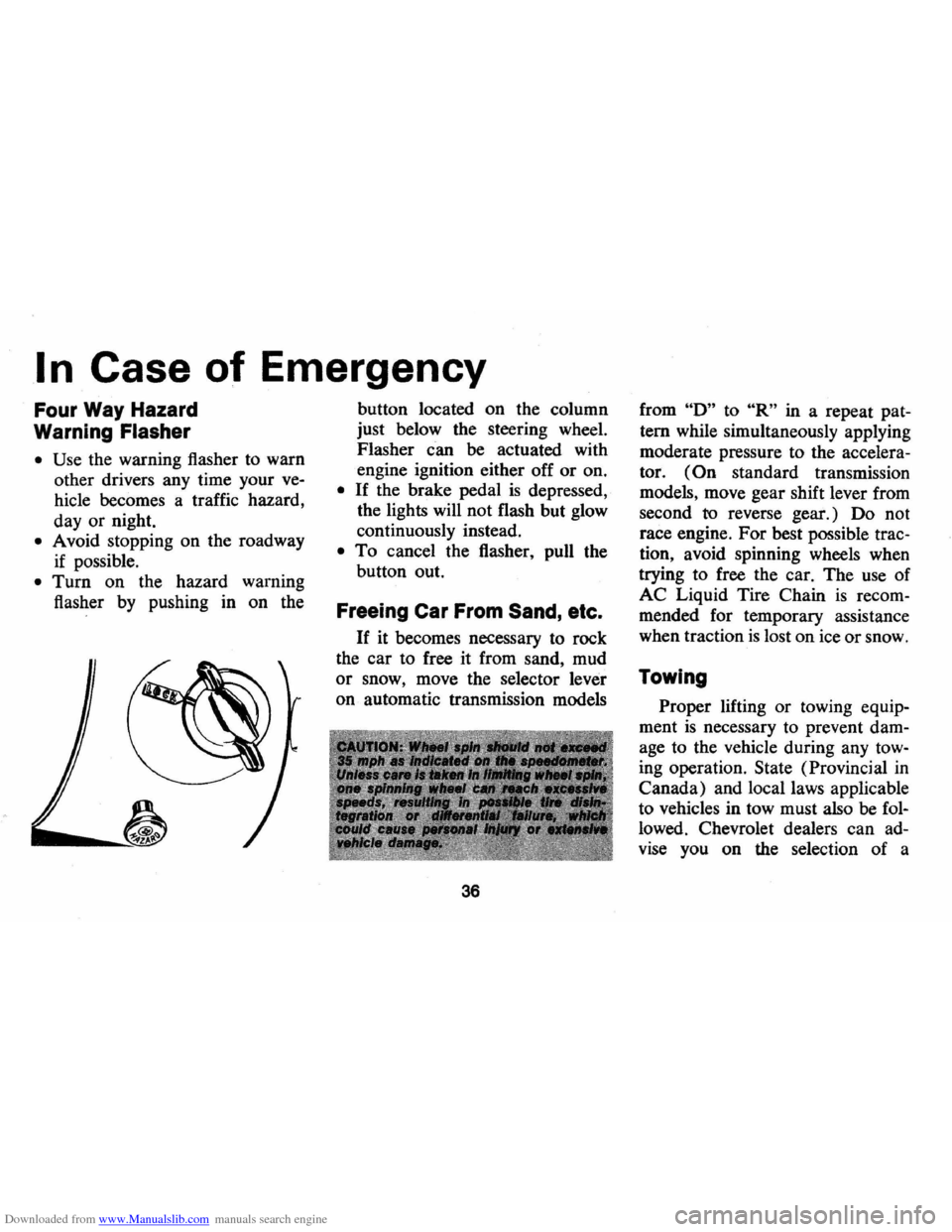
Four Way Hazard
Warning Flasher
• Use the warning flasher to warn
other drivers any time your
ve·
hicle becomes a traffic hazard,
day or night.
• Avoid stopping on the roadway
if possible.
• Turn on the hazard warning
flasher
by pushing in on the
.---~
button located on the column
just below the steering wheel.
Flasher can be actuated with
engine ignition either off or on.
• If the brake pedal is depressed,
the lights will not flash but glow
continuously instead.
• To cancel the flasher, pull the
button out.
Freeing Car From Sand, etc.
If it becomes necessary to rock
the car to free it from sand, mud
or snow, move the selector lever
on automatic transmission models
36
from "0" to "R" in a repeat pat·
tern while simultaneously applying
moderate pressure to the
accelera
tor. (On standard transmission
models, move gear shift lever from
second
to reverse gear.) 00 not
race engine.
For best possible trac
tion, avoid spinning wheels when
trying to free the car. The use of
AC Liquid Tire Chain is recom
mended for temporary assistance
when traction
is lost on ice or snow.
Towing
Proper lifting or towing equip
ment is necessary to prevent dam
age to the vehicle during any tow
ing operation. State (Provincial in
Canada) and local laws applicable
to vehicles in tow must also be
fol
lowed . Chevrolet dealers can ad
vise you on the selection of a
Page 40 of 84
Downloaded from www.Manualslib.com manuals search engine knowledgeable towing concern.
Your Camaro may be towed on
all four wheels, at speeds of
less
than 35 mph, for distances up to
50 miles, provided driveline, axle
and transmission are otherwise
normally operable. For such tow
ing, parking brake must be re
leased, transmission must be in
neutral
and ignition lock turned to
OFF position. Attachments must
be to main structural members of
the car, not to bumpers or brac
keting. Separate safety chains
or
cables should be used. Remember
that power brake and steering
as
sists will not be available when
engine
is inoperative.
Emergency Starting
• Never tow the car to start be
cause the surge forward when
the engine starts could cause a
collision with the tow vehicle.
• Engines in vehicles with auto
matic transmissions cannot be
started by (towing
or) pushing
the car.
• To start the car when the Ener
gizer (battery)
is discharged,
use a single auxiliary battery or
Energizer of the same nominal
voltage
(12 volts) as the dis
charged battery, with suitable
jumper cables.
• Make connections as set forth
below under
"Jump Starting
with Auxiliary (Booster) Bat
tery" to lessen the chance of
personal injury
or property
damage.
Jump Starting with
Auxiliary (Booster) Battery
Both booster and discharged
battery should be treated carefully
when using jumper cables. Follow
37
exactly the procedure outlined be
low, being careful not to cause
sparks:
1. Set parking brake and place
automatic transmission in
"PARK" (neutral for manual
transmission). Turn
off lights,
heater and other electrical loads.
2. Remove vent caps from both
the booster and the discharged
batteries. Lay a cloth over the
open vent wells of each battery.
These two actions help reduce
the explosion hazard always