ECU CHEVROLET CAMARO 1974 2.G Owners Manual
[x] Cancel search | Manufacturer: CHEVROLET, Model Year: 1974, Model line: CAMARO, Model: CHEVROLET CAMARO 1974 2.GPages: 85, PDF Size: 32.84 MB
Page 7 of 85
Downloaded from www.Manualslib.com manuals search engine Door Locks
Front side doors can be locked
from the inside by depressing the
passenger guard door lock buttons
located on the upper door panel.
All doors can be locked from the
outside by first depressing the door
lock button and closing the door.
The front doors can also be
locked by using the key.
All models have as a standard
safety feature overriding door locks.
When the doors are locked, the
door latch mechanism
is inopera
tive, preventing inadvertent open
ing of the door
by movement of the
inside handle.
REMINDER: Avoid hanging ob
jects on the right hand coat hook
in such a way that you block the
driver's vision to the right rear
quarter.
"
REMINDER: Always lock the
doors when driving, for greater
security in the event of an accident,
to help keep children from opening
door, and for greater security
against entry
by unwelcome per
sons while momentarily stopped.
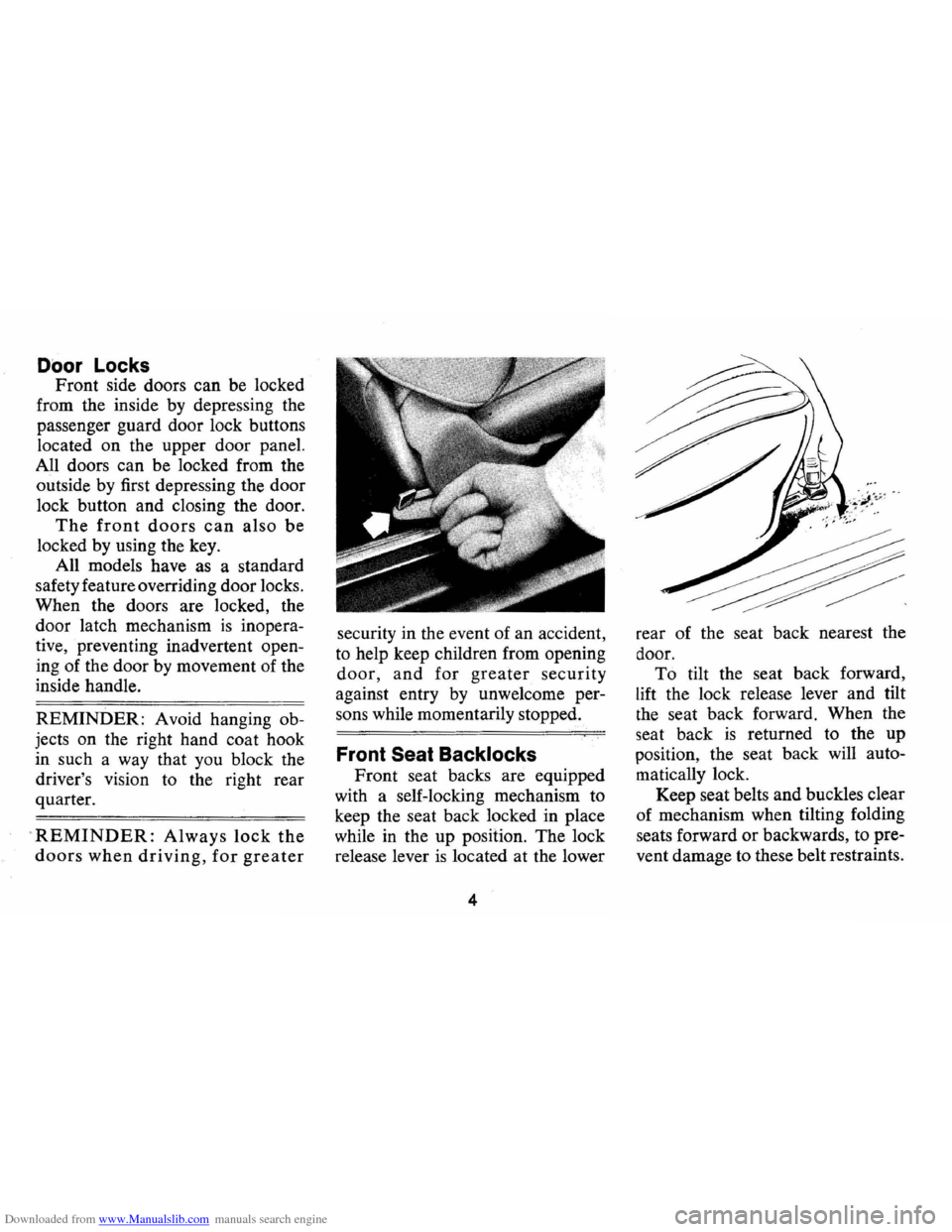
Front Seat Backlocks
Front seat backs are equipped
with a
self, locking mechanism to
keep the seat back locked in place
while
in the up position. The lock
release lever
is located at the lower
4
rear of the seat back nearest the
door. To tilt the seat back forward,
lift the lock release lever and tilt
the seat back forward. When the
seat back
is returned to the up
position, the seat back will auto
matically lock.
Keep seat belts and buckles clear
of mechanism when tilting folding
seats forward or backwards, to pre
vent damage to these belt restraints.
Page 8 of 85
Downloaded from www.Manualslib.com manuals search engine Manually Operated
Front
Seats
The front seats may be adjusted
forward or rearward by moving the
control lever at the front of the
seat to the right. Move control
lever to the right to release the
locking
mechanism; then exert
slight body pressure to move seat
to desired position. · Release con
trol lever to lock seat in desired
position.
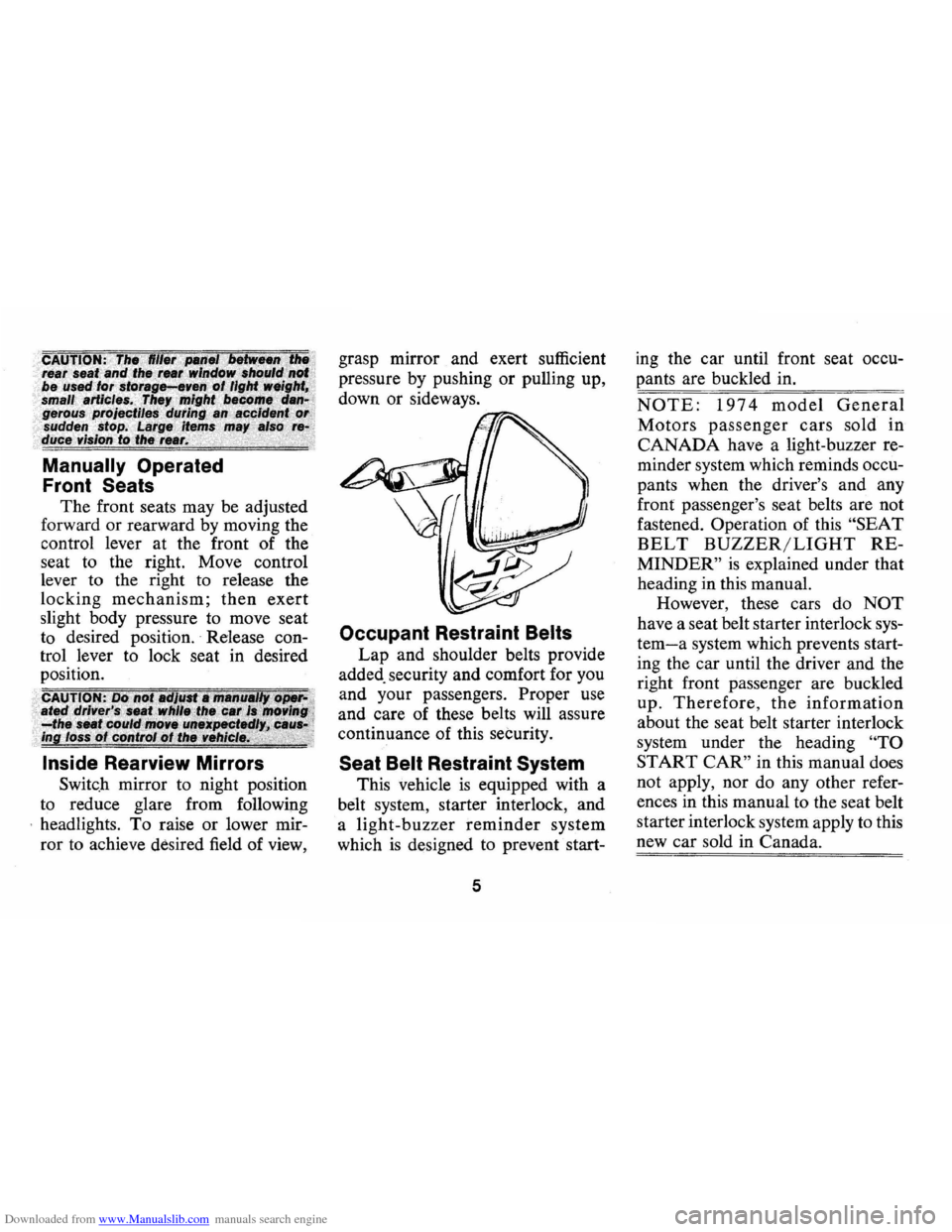
Inside Rearview Mirrors
Switc.h mirror to night position
to reduce glare from following
, headlights.
To raise or lower mir
ror
to achieve desired field of view, grasp
mirror and exert sufficient
pressure by pushing or pulling up,
down or sideways.
Occupant Restraint Belts
Lap and shoulder belts provide
added. security and comfort for you
and your passengers. Proper
use
and care of these belts will assure
continuance of this security.
Seat Belt Restraint System
This vehicle is equipped with a
belt system, starter interlock, and
a light-buzzer
reminder system
which
is designed to prevent · start-
5
ing the car until front seat occu
pants are buckled in.
NOTE: 1974 model General
Motors passenger cars sold in
CANADA have a light-buzzer re
minder system which reminds occu
pants when the driver's and any
front passenger's seat belts are not
fastened. Operation of this
"SEAT
BELT BUZZER/LIGHT RE
MINDER" is explained under that
heading in this manual.
However, these cars do
NOT
have a seat belt starter interlock sys
tem-a system which prevents start
ing the car until the driver and the
right front passenger are buckled
up.
Therefore, the information
about the seat belt starter interlock
system under the heading
"TO
START CAR"
in this manual does
not apply, nor do any other refer
ences in this manual to the seat belt
starter interlock system apply to this
new car sold in Canada.
Page 12 of 85
Downloaded from www.Manualslib.com manuals search engine Seat Belt Buzzer/Light
Reminder
• The front seat belts are linked to
a buzzer and light which remind
occupants to fasten their belts.
• The buzzer and light are de
signed to come on when any
outboard front seat occupant's
belt
is not fastened, while at
tempting to start the engine; or
if any front seat belt
is un
fastened while driving in any
forward gear.
• The reminders do not come on
when the engine
is running and
a front belt
is unbuckled if the
transmission
is in Park or neu
tral (automatic and column
shift transmission cars), or if the
parking brake
is engaged (floor
shift transmission cars).
If seat belt system , ignition in
terlock system, or reminder system
does not work
as described , see
your dealer for information and assistance.
Lap Belts (For
Rear Seat
Passengers)
• Seating positions next to side
windows have retractors which
are designed to automatically
take up excess webbing and
maintain tension on the lap belt.
These belts should be positioned
and secured
as described above
under
"Lap-Shoulder Belt Com
bination.
"
Seat Belt Inspection
• Periodically inspect belts,
buckles, adjustable latch plates,
retractors, interlock and re
minder systems, guide loops,
clips, and anchors for damage
that could lessen the effective
ness of the restraint system.
• Keep sharp edges and damaging
objects away from belts, and
other parts of restraint system.
• Replace belts if cut, weakened,
9
frayed, or subjected to collision
loads.
• Check that anchor mounting
bolts are tight.
• Have questionable parts re
placed.
• Keep seat belts clean and dry.
• Clean only with mild soap solu
tion and lukewarm water.
• Do not bleach or dye belts since
this may severely weaken belts.
Child Restraint
Children in automobiles should
be restrained to lessen the risk of
injury in accidents, sudden stops
or other hazardous situations. Gen
eral Motors dealers offer restraint
systems designed specifically for
use with infants and with small
children. The GM
"Infant Love
Seat" is designed for babies up to
20 pounds. The GM "Child Love
Seat" is designed for children
weighing 20 to 40 pounds, up to 3
Page 13 of 85
Downloaded from www.Manualslib.com manuals search engine feet-4 inches in height, who are
able to sit up alone.
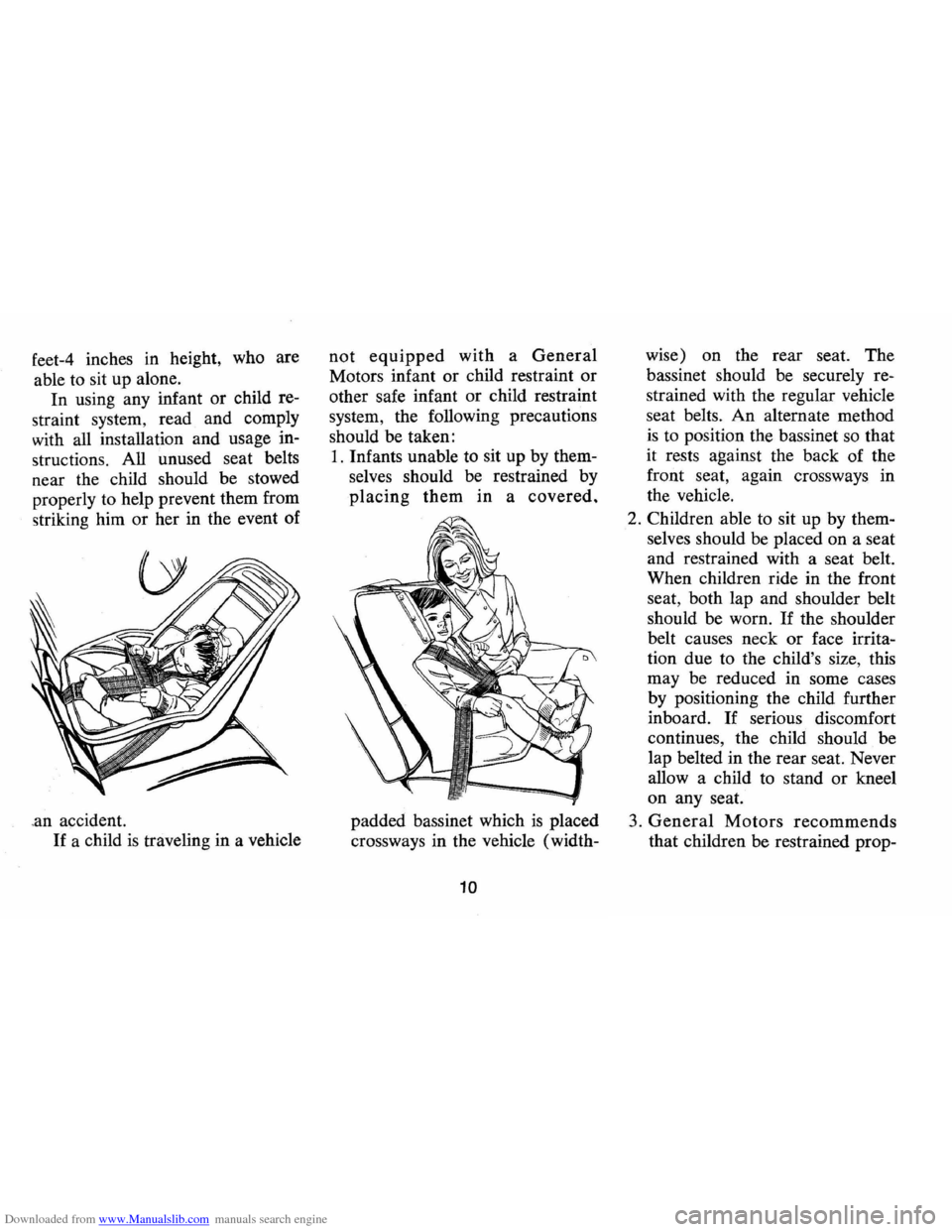
In using any infant or child re
straint system, read and comply
with all installation and usage in
structions. All unused seat belts
near the child should be stowed
properly to help prevent them from
striking him
or her in the event of
.an accident.
If a child is traveling in a vehicle
not equipped with a General
Motors infant or child restraint or
other safe infant or child restraint
system, the following precautions
should be taken:
1 . Infants unable to sit up by them
selves should be restrained by
placing them in a covered.
padded bassinet which is placed
crossways in the vehicle (width-
10
wise) on the rear seat. The
bassinet should be securely re
strained with the regular vehicle
seat belts. An alternate method
is to position the bassinet so that
it rests against the back of the
front seat, again crossways in
the vehicle .
2. Children able to sit up by them
selves should be placed on a seat
and restrained with a seat belt.
When children ride in the front
seat , both lap and shoulder belt
should be worn.
If the shoulder
belt causes neck
or face irrita
tion due to the child's size, this
may be reduced in some cases
by positioning the child further
inboard.
If serious discomfort
continues, the child should be
lap belted in the rear seat. Never
allow a child to stand or kneel
on any seat.
3 .
General Motors recommends
that children be restrained prop-