load capacity CHEVROLET CAMARO 1974 2.G Owners Manual
[x] Cancel search | Manufacturer: CHEVROLET, Model Year: 1974, Model line: CAMARO, Model: CHEVROLET CAMARO 1974 2.GPages: 85, PDF Size: 32.84 MB
Page 54 of 85
Downloaded from www.Manualslib.com manuals search engine (such as taxicab, limousine or pa
trol car service) where the engine
idles for long periods, should
change fluid every
12,000 miles.
Changing Fluid-For Turbo Hy
dra-Matic
350, remove fluid from
the transmission sump and add ap
proximately 2.5 quarts
U.S. Mea
sure
(2.0 quarts Imperial Mea
sure). Operate transmission
through all shift ranges and re
check fluid level as described
above.
Turbo Hydra-Matic 400-Lubri
cation of your Turbo Hydra-matic
400 will, except for fluid capacity
and filter change listed below, fol
low previously stated automatic
transmission recommendations.
After checking transmission fluid
level it
is important that the dip
stick be pushed all the way into
the filler tube.
Every 24,000 miles -After re- moving
fluid from the transmission
sump, approximately
7V2 pints
U.S. measure (6 pints Imperial
measure) of fresh fluid will be re
quired to return level to proper
mark on the dipstick.
Every 24,000 miles the transmis
sion sump filter should be re
placed.
Transmission Shift and Back
drive Linkage (Manual and
Automatic) -
Every 6,000 miles
or 4 months lubricate shift link
age and on manual transmission
floor controls lever contacting
faces with water resistant
EP chas
sis lubricant which meets GM
Specification 6031M.
Transmission Shift Linkage
(Manual and Automatic)
Every 6,000 miles or 4 months
lubriCate shift linkage and on man
ual transmission floor controls
lever contacting faces with water
51
resistant EP chassis lubricant
which meets GM Specification
6031M.
Chassis
Front Suspension
Every 6,000 miles or 4 months
-Lubricate 4 fittings with water
resistant
EP Chassis Lubricant
which meets GM Specification
6031M.
Ball jOints should not be lu
bricated unless their tempera
ture
is 10°F. or higher. During
colder weather, they should be
allowed to warm up as neces
sary before
lubricaJion.
Steering Linkage
Every 6,000 miles or 4 months
-Lubricate 7 fittings, one at each
end of each tie rod, one at each
end of relay rod, and one at idler
lever with water resistant
EP Chas
sis Lubricant which meets GM
Specification
6031 M.
Page 57 of 85
Downloaded from www.Manualslib.com manuals search engine tory with a high-quality, inhibited,
year-around coolant that meets the
standards of General Motors
Spe
cification 1899-M. This coolant
solution provides freezing protec
tion to
-20oP (-35°P in Can
ada), and it has been formulated to
be used for two full calendar years
or
24,000 miles, whichever first
occurs, of normal operation with
out replacement, provided the
proper concentration of coolant is
maintained.
Cooling System Care
The radiator cap should not be
removed to check coolant level.
Check the coolant level visually in
the 'see thru' coolant recovery tank
at least
as frequently as engine oil
changes. Level should be at the
"full cold" mark on the recovery
tank when the system
is cold. At
normal operating temperature the
coolant should be at the
"full hot"
mark on the recovery tank. Add sufficient
coolant to the recovery
tank.
Use a 50/50 mixture of high
quality ethylene glycol antifreeze
and water for coolant additions.
If
regular additions are required, see
your dealer for a cooling system
check.
NOTE: If recommended quality
antifreeze
is used, supplemental in
hibitors or additives claiming to
provide increased capability are
not necessary. They may be detri
mental to the efficient operation of
the system, and represent an un
necessary operating expense.
Every year, the cooling system
should be serviced
as follows:
1. Wash
radiator cap and filler
neck with clean water.
2. Check coolant for proper level
and freeze protection.
3. Pressure test system and radia-
54
tor cap for proper pressure hold
ing capacity (15 psi) .
If re
placement of cap
is required, use
the special AC cap designed for
coolant recovery systems, speci
fied for your model.
4. Tighten hose clamps and inspect
all hoses. Replace hoses when
ever swollen, checked or other
wise deteriorated.
5. Clean frontal area of radiator
core and air conditioning con
denser.
Replace hoses every 24 months
or 24,000 miles or earlier if
checked, swollen or otherwise de
teriorated. Every two years
or 24,-
000 miles, whichever first occurs,
the cooling system should be
flushed and refilled using the fol
lowing recommended procedure:
1. Remove radiator cap when
engine is cool by:
• Slowly rotating cap counter-
Page 60 of 85
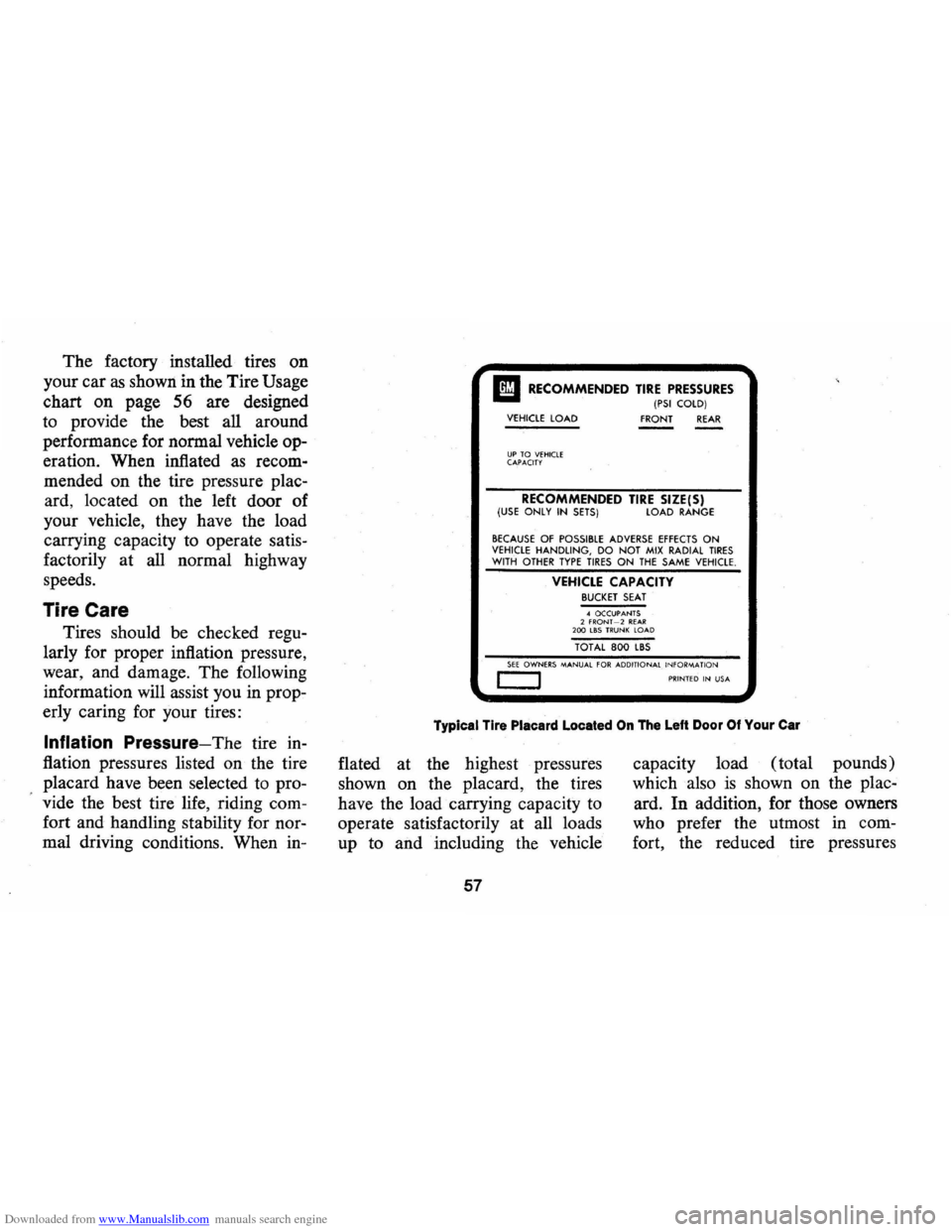
Downloaded from www.Manualslib.com manuals search engine The factory installed tires on
your car as shown in the Tire Usage
chart
on page 56 are designed
to provide the best all around
performance for normal vehicle op
eration. When inflated as recom
mended on the tire pressure plac
ard, located
on the left door of
your vehicle, they have the load
carrying capacity to operate satis
factorily at all normal highway
speeds.
Tire Care
Tires should be checked regu
larly for proper inflation pressure,
wear, and damage. The following
information will assist you in prop
erly caring for your tires:
Inflation Pressure-The tire in
flation pressures listed on the tire
placard have been selected to pro
vide the best tire life, riding com
fort and handling stability for nor
mal driving conditions. When in-
I! RECOMMENDED TIRE PRESSURES (PSI COlD) VEHICLE LOAD
FRONT REAR
UP TO VEHiClE CAPACITY
RECOMMENDED TIRE SIZE(S) (USE ONLY IN SETS) LOAD RANGE
BECAUSE OF POSSIBLE ADVERSE EFFECTS ON VEHICLE HANDLING, DO NOT MIX RADIAL TIRES WITH OTHER TYPE TIRES ON THE SAME VEHICLE.
VEHICLE CAPACITY BUCKET SEAT .. OCCUPANTS 2 fRONf -2 Rf.A.R 200 LBS TRUNK LOAD
TOT AL 800 L8S
SEE OWNERS MANUAL FOR ADDITIONAL INFORM-A nON c:::::J PRINTED IN USA
Typical Tire Placard Located On The Left Door Of Your Car
flated at the highest pressures
shown
on the placard, the tires
have the load carrying capacity to
operate satisfactorily at all loads
up to and including the vehicle
57
capacity load (total pounds)
which also
is shown on the plac
ard.
In addition, for those owners
who prefer the utmost in com
fort, the reduced tire pressures
Page 61 of 85
Downloaded from www.Manualslib.com manuals search engine listed on the placard may be used
when loads of
4 occupants or less
are carried.
The use of improper tire
infla
tion pressures can adversely affect
tire life and vehicle performance:
• Too little air pressure can result
in excessive tire heat, abnormal
tire wear, adverse handling and
reduced fuel economy.
• Too much air pressure can re
sult in abnormal tire wear, ad
verse vehicle ride and handling,
and increased susceptibility to
damage by road impacts.
Tire pressures should be
checked when the tires are "cold"
at least once a month (and pref
erably oftener) or before long
trips or when heavily loaded. The
following points should
be ob
served when checking and setting
tire pressures:
1. Cold tire pressure ratings are applicable when a vehicle has been Inoperative for 3 hours or more, or driven less
than 1 mile.
2. Tire Inflation pressure may Increase as
much as 6 pounds per square inch (psi)
when hot (aHer vehicle has been driven
10 miles or at speeds of more than 60 miles per hour). Do not "bleed" or reduce pressures when tires are hot from
driving.
3. For continuous high speed operation
(over 75 mph), Increase tire inflation
pressure 4 psi above the recommended
pressures up
to a maximum of 32 psi
cold pressure for load range B tires, 36
psi for load range C tires, or 40 psi for D load range tires. Sustained speeds
above 75 mph are not recommended
when the 4 psi adjustment would require pressures greater than the above
maximum pressures.
4. Always use a tire pressure gauge when
checking pressures as the appearance
of a tire can be deceiving. For example,
radial ply fires, In comparison with bias
ply tires at the same pressure, may have
the appearance of being under-inflated.
Vehicle Loading -Do not load
your vehicle beyond the vehicle
capacity (total pounds) shown on
the tire placard. This figure
repre
sents the design capacity of the ve
hicle, not merely of the tires.
58
When towmg trailers, the allow
able pasenger and cargo load
must be reduced by an amount
equal to the trailer tongue load on
the trailer hitch.
(See "Trailer
Hauling"
in Section 1 of this man
ual.) Station wagon loads should
be distributed
as far forward as
possible. Vehicles equipped with
luggage racks do not have a
ve
hicle load capacity greater than
specified on the tire placard.
Tire Wear and Rotation -Un
even or abnormal tire wear is usu
ally the result of incorrect inflation
pressure, improper wheel
align
ment, wheels being out-of-balance,
or poor driving habits.
Underin
flation, incorrect toe or camber
and fast cornering produce
differ
ent types of abnormal wear which
can be diagnosed by your dealer.
The original equipment tires
in
corporate built-in tread wear in
dicators to assist you in determin-
Page 74 of 85
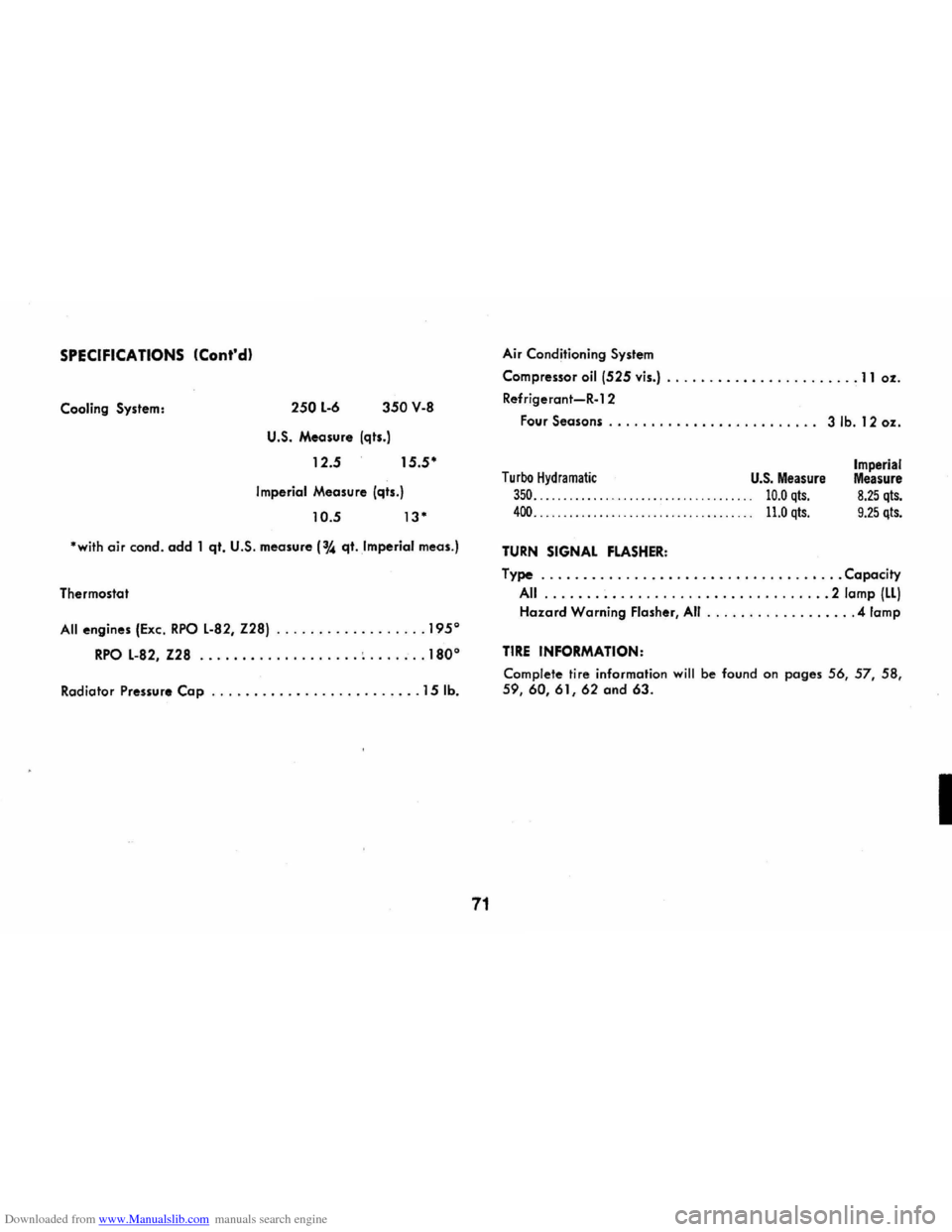
Downloaded from www.Manualslib.com manuals search engine SPECIFICATIONS (Cont'd)
Cooling System: 250 L-6 350 V-8
U.S. Measure (qts.)
12.5 15.5"
Imperial Measure (qts.)
10.5 13·
·with air condo add 1 qt. U.S. measure (3A qt. ,Imperial meas.)
Thermostat
All engines (Exc. RPO L-82, Z28) .................. 1950
RPO L-82, Z28 ................... ~ . . ..... 1800
Radiator Pressure Cap ......................... 15 lb.
71
Air Conditioning System
Compressor oil (525 vis.) ....................... 11 oz.
Refrigerant-R-1 2
Four
Seasons. . . . . . . . . . . . . . . . . . . . . . . .. 3 lb. 12 oz.
Turbo Hydramatic U.S. Measure
350............. ....................... 10.0 qts. 400. . . . . . . . . . . . . . . . . . . . . . . . . . . . . . . . . . . . . 11.0 qts.
TURN SIGNAL FLASHER:
Imperial Measure 8.25 qts. 9.25 qts.
Type .................................... Capacity
All .................................. 2 lamp (LL)
Hazard Warning Flasher, All .................. 4 lamp
TIRE INFORMATION:
Complete tire information will be found on pages 56, 57, 58, 59,60,61,62 and 63.
I
Page 82 of 85
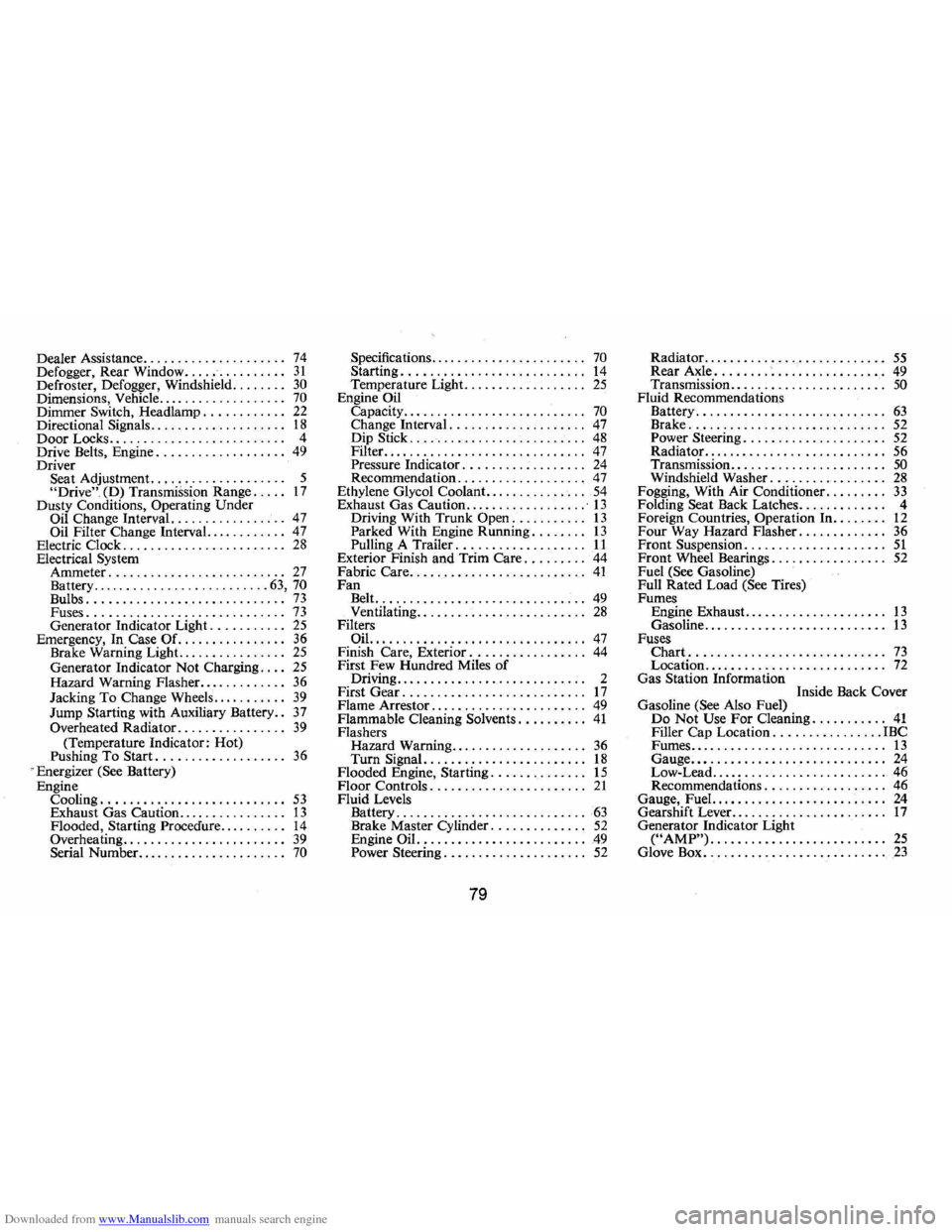
Downloaded from www.Manualslib.com manuals search engine Dealer Assistance ..................... 74 Defogger, Rear Window ............... 31 Defroster, Defogger, Windshield ........ 30 Dimensions, Vehicle ................... 70 Dimmer Switch, Headlamp. . . . . . . . . . .. 22 Directional Signals.. . . . . . . . . . . . . . . . . .. 18 Door Locks. . . . . . . . . . . . . . . . . . . . . . . . .. 4
Drive Belts, Engine. . . . . . . . . . . . . . . . . .. 49 Driver Seat Adjustment. . . . . . . . . . . . . . . . . . . . 5 "Drive". (D) Transmission Range. . . .. 17 Dusty Conditions, Operating Under Oil Change Interval. ................ 47 Oil Filter Change IntervaL ........... 47 Electric Clock. . .. .. . . . . .. .. . .. . .. . . .. 28 Electrical System Ammeter .......................... 27 Battery .......................... 63, 70 Bulbs ............................. 73 Fuses ............................. 73 Generator Indicator Light. . . . . . . . . .. 25 Emergency, In case Of. ............... 36 Brake Warning Light ................ 25 Generator Indicator Not Charging. . .. 25 Hazard Warning Flasher ............. 36 Jacking To Change Wheels ........... 39 Jump Starting with Auxiliary Battery .. 37 Overheated Radiator. . . . . . . . . . . . . . .. 39 (Temperature Indicator: Hot)
Pushing To Start. . . . . . . . . . . . . . . . . .. 36 ' Energizer (See Battery)
Engine Cooling
........................... 53 Exhaust Gas Caution ........ , . . . . . .. 13 Flooded, Starting Procedure .......... 14 Overheating. . . . . . . . . . . . . . . . . . . . . . .. 39 Serial Number ...................... 70
Specifications ................. , . . . .. 70 Starting ........................... 14 Temperature Light. . . . . . . . . . . . . . . . .. 25 Engine Oil Capacity ..... , . . . . . . . . . . . . . . . . . . . .. 70 Change Interval. ................... 47 Dip Stick. . . . . . . . . . . . . . . . . . . . . . . . .. 48 Filter .............................. 47 Pressure Indicator. . . . . . . . . . . . . . . . .. 24 Recommendation ............... ' ... 47 Ethylene Glycol Coolant. . . . . . . . . . . . . .. 54 Exhaust Gas Caution ............ ' ..... ' 13 Driving With Trunk Open. . . . . . . . . .. 13 Parked With Engine Running. . . . . . .. 13 Pulling A Trailer. . . . . . . . . . . . . . . . . .. 11 Exterior Finish and Trim care. . . . . . . .. 44
Fabric Care .......................... 41 Fan Belt. .............................. 49 Ventilating ......................... 28 Filters OiL ............................... 47 Finish Care, Exterior. . . . . . . . . . . . . . . .. 44 First Few Hundred Miles of Driving............................ 2 First Gear. . . . . . . . . . . . . . . . . . . . . . . . . .. 17 Flame Arrestor ......... , . . . . . . . . . . . .. 49 Flammable Cleaning Solvents .......... 41 Flashers
Hazard Warning .................... 36 Turn Signal. . . . . . . . . . . . . . . . . . . . . . .. 18 Flooded Engine, Starting. . . . . . . . . . . . .. 15 Floor Controls ....................... 21 Fluid Levels
Battery ............................ 63 Brake Master Cylinder. . . . . . . . . . . . .. 52 Engine Oil. ........................ 49 Power Steering ..................... 52
79
Radiator ........................... 55 Rear Axle. . . . . . . . . . . . . . . . . . . . . . . .. 49 Transmission ....................... 50 Fluid Recommendations
Battery ......................... , .. 63 Brake ............................. 52 Power Steering. . . . . . . . . . . . . . . . . . . .. 52 Radiator. . . . . . . . . . . . . . . . . . . . . . . . . .. 56
Transmission ....................... 50 Windshield Washer. . . . . . . . . . . . . . . .. 28 Fogging, With Air Conditioner. . . . . . . .. 33 Folding Seat Back Latches. . . . . . . . . . . .. 4 Foreign Countries, Operation In ........ 12 Four Way Hazard Flasher ............. 36 Front Suspension ..................... 51 Front Wheel Bearings. . . . . . . . . . . . . . . .. 52 Fuel (See Gasoline)
Full Rated Load (See Tires)
Fumes Engine Exhaust. . . . . . . . . . . . . . . . . . .
.. 13 Gasoline. . . . . . . . . . . . . . . . . . . . . . . . . .. 13 Fuses Chart. ............................ 73 Location ........................... 72 Gas Station Information
Inside Back Cover
Gasoline
(See Also Fuel) Do Not Use For Cleaning ........... 41 Filler Cap Location ................ IBC
Fumes ............................. 13 Gauge ............................. 24 Low-Lead .......................... 46 Recommendations. . . . . . . . . . . . . . . . .. 46 Gauge, FueL... . . . . . . . . . . . . . . . . . . . . .. 24 Gearshift Lever.. . . . . . . . . . . . . . . . . . . . .. 17 Generator Indicator Light ' ("AMP") .......................... 25 Glove Box. . . . . . . . . . . . . . . . . . . . . . . . . .. 23