octane CHEVROLET CAMARO 1974 2.G Owners Manual
[x] Cancel search | Manufacturer: CHEVROLET, Model Year: 1974, Model line: CAMARO, Model: CHEVROLET CAMARO 1974 2.GPages: 85, PDF Size: 32.84 MB
Page 15 of 85
Downloaded from www.Manualslib.com manuals search engine Break-in Schedule
In addition to the new car
break-in instructions in this man
ual, it
is recommended that your
new Camaro be operated for
500
miles before trailer towing. If it is
necessary to tow during this period,
avoid speeds over
50 MPH and full throttle
starts. The same precau
tions should be observed whenever
a new engine, transmission
or axle
is installed in your car.
Operation in Foreign Countries
Your Camaro is designed to op
erate on fuel of approximately
91
research octane number or higher,
sold in the United States and Can
ada.
If you plan to operate your
Camaro outside the continental
limits of the United States
or Can
ada, there
is a possibility that the
best fuels available in some coun
tries are so low in anti-knock
quality that excessive knocking
and serious engine damage may
. result from their use. To obtain
information on the quality of fuels available
in the countries in which
you plan to travel , write to Chevro
let Motor Division, Service Depart
ment, Detroit, Michigan
48202,
(or in Canada write to General
Motors of Canada Limited,
Owner
Relations Department , Oshawa,
Ontario),
giving:
• The vehicle identification num
ber ( on plate on instrument
panel ahead of the steering
wheel and visible through the
windshield , or from registration
slip or title).
• The country or countries in
12
which you plan to travel.
It
is recommended that you not
operate your Camaro in any coun
try not having fuels meeting the
requirements of
your Camaro
engine. Engine modifications are
not available to compensate for
low anti-knock quality fuels. Op
eration of your car under condi
tions of continuous
or excessive
knocking constitutes misuse of the
engine and may cause engine dam
age for which the Chevrolet Divi
sion
is not responsible under the
terms
of the Chevrolet New
Vehicle Warranty.
Page 49 of 85
Downloaded from www.Manualslib.com manuals search engine SERVICE AND MAINTENANCE
The time or mileage intervals on
the following pages are intended
as
a guide for establishing regular
maintenance and lubrication
periods for your car. Sustained
heavy duty or high speed operations
or operation under adverse condi
tions may necessitate more frequent
servicing. To determine specific
recommendations for conditions
under which you use your car, con-
Fuel
Requirements
. Your Camaro is designed to op
erate on unleaded
or low lead fuels
of at least
91 Research Octane.
These fuels will minimize spark
plug fouling and emission control suIt
your Authorized Chevrolet
Dealer.
Maintenance Schedule
For owner convenience, a sep
arate maintenance folder has been
provided with your car which con
tains a complete schedule and
brief explanation of the safety,
emission control, lubrication and
system
deterioration. Fuels with
Regular grade octane quality
should be used only when needed
to eliminate
knock-a metallic rap
ping noise generated during the
combustion process. The engine
does not require
Premium fuel.
Therefore, its use would be an un
necessary additional expense.
If
knocking persists, consult your
46
general maintenance it requires.
The maintenance folder informa
tion
is supplemented by this sec
tion of the
Owner's Manual, as
well as the separate emission con
trol systems folder also furnished
with your car. Read all three pub
lications for a full understanding
of vehicle maintenance require
ments.
authorized Chevrolet dealer.
In
any case, continuous or excessive
knocking may result in engine
damage and constitutes misuse of
the engine for which Chevrolet
Motor Division
is not responsible
under the terms of the New Vehicle
Warranty.
If the service station gas pump
has a symbol similar to the samples
Page 50 of 85
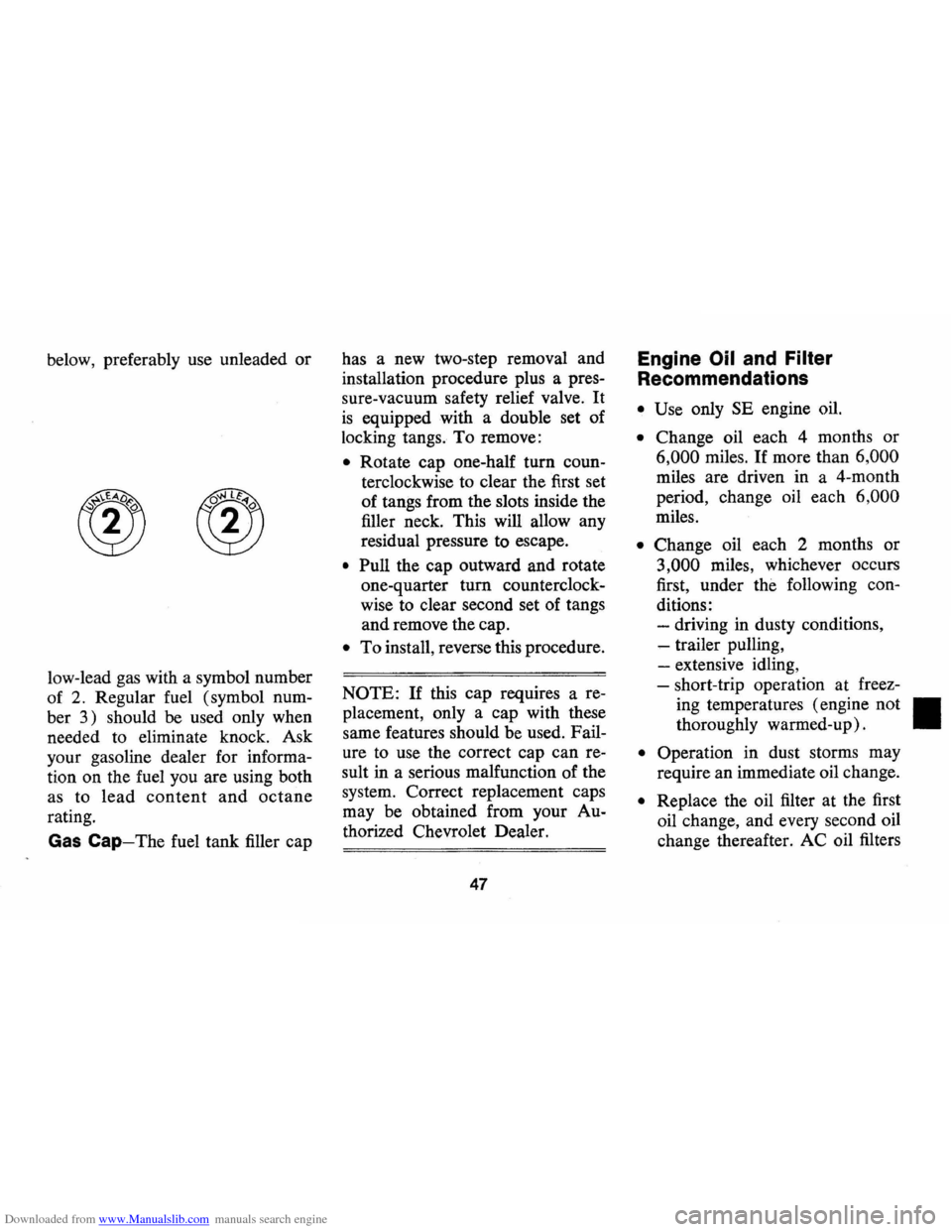
Downloaded from www.Manualslib.com manuals search engine below, preferably use unleaded or
low-lead gas with a symbol number
of
2. Regular fuel (symbol num
ber
3) should be used only when
needed to eliminate knock. Ask
your gasoline dealer for informa
tion on the fuel you are using both
as to
lead content and octane
rating.
Gas Cap-The fuel tank filler cap has
a new two-step removal and
installation procedure plus a pres
sure-vacuum safety relief valve. It
is equipped with a double set of
locking tangs. To remove:
• Rotate cap one-half turn coun
terclockwise to clear the first set
of tangs from the slots inside the
filler neck. This will allow any
residual pressure to escape.
• Pull the cap outward and rotate
one-quarter turn counterclock
wise to clear second set of tangs
and remove the cap.
• To install, reverse this procedure.
NOTE: If this cap requires a re
placement, only a cap with these
same features should be used. Fail
ure to use the correct cap can re
sult in a serious malfunction of the
system. Correct replacement caps
may be obtained from your Au
thorized Chevrolet Dealer.
47
Engine Oil and Filter
Recommendations
• Use only SE engine oil.
• Change oil each 4 months or
6,000 miles. If more than 6,000
miles are driven in a 4-month
period, change oil each
6,000
miles.
• Change oil each 2 months or
3,000 miles, whichever occurs
first, under the following con
ditions: - driving in dusty conditions,
-trailer pulling,
- extensive idling,
- short-trip operation at freez-
ing temperatures (engine not
II
thoroughly warmed-up).
• Operation in dust storms may
require an immediate oil change.
• Replace the oil filter at the first
oil change, and every second oil
change thereafter. AC oil filters
Page 67 of 85
Downloaded from www.Manualslib.com manuals search engine Important Facts You Should
Know About Gasoline
Mileage and How to
Improve It
How you drive, where you drive,
and when you drive
all have an
effect on how many miles you can
get from a gallon of gasoline. The
careful attention you give your car
as far as maintenance and repairs
are concerned will also contribute
importantly to fuel economy.
Fuel Selection
Your vehicle is designed to op
erate on unleaded or low-lead fuels
>of at least 91 Research Octane.
These fuels minimize spark plug
fouling and emission system
de
terioration. Your engine does not
require premium fuel. Therefore,
its use would be an unnecessary
additional expense.
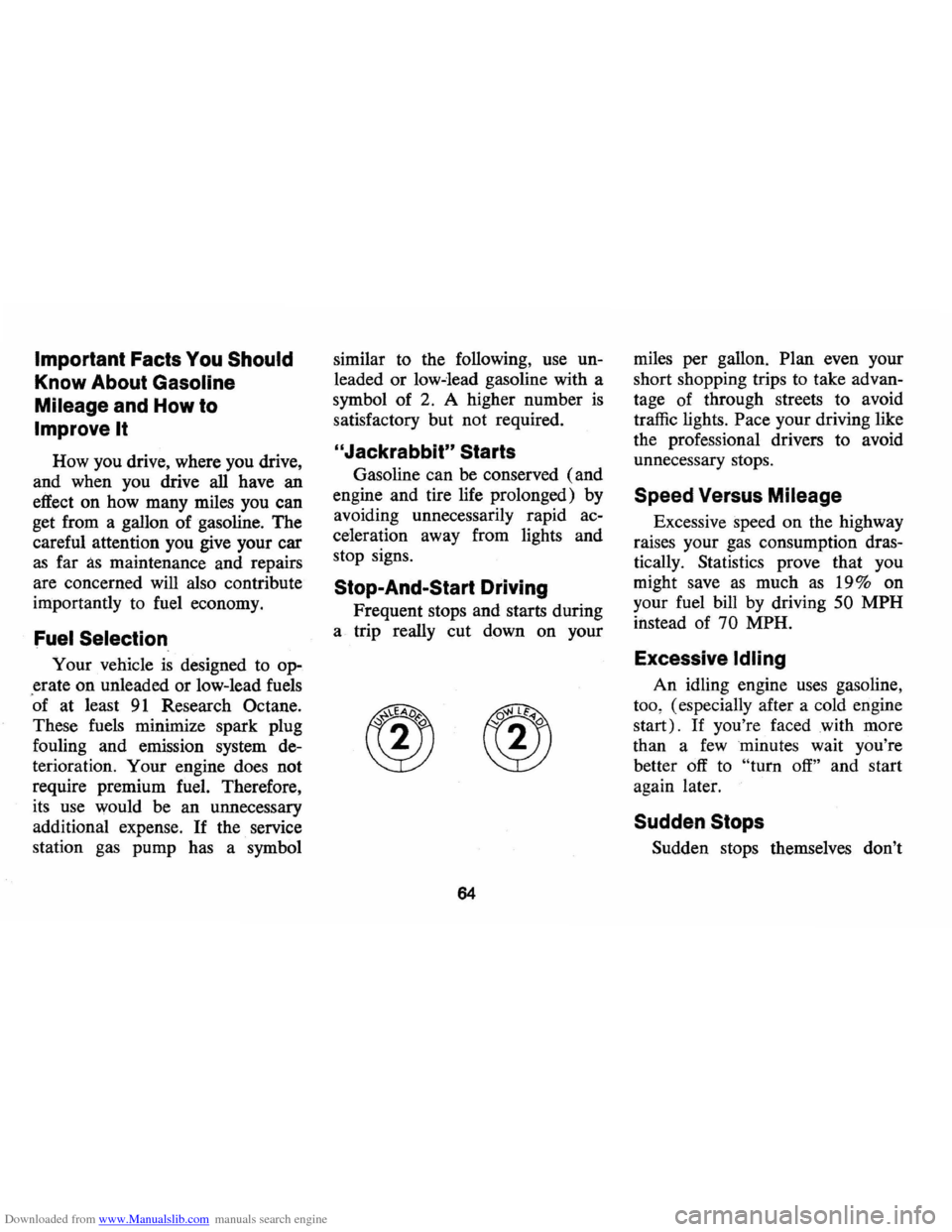
If the service
station gas pump has a symbol similar
to the following, use
un
leaded or low-lead gasoline with a
symbol of 2. A higher number
is
satisfactory but not required.
"Jackrabbit" Starts
Gasoline can be conserved (and
engine and tire life prolonged) by
avoiding unnecessarily rapid
ac
celeration away from lights and
stop signs.
Stop-And-Start Driving
Frequent stops and starts during
a. trip really cut down on your
64
miles per gallon. Plan even your
short shopping trips to take
advan
tage of through streets to avoid
traffic lights.
Pace your driving like
the professional drivers to avoid
unnecessary stops.
Speed Versus Mileage
Excessive speed on the highway
raises your gas consumption
dras
tically. Statistics prove that you
might save
as much as 19% on
your fuel bill by driving
50 MPH
instead of 70 MPH.
Excessive Idling
An idling engine uses gasoline,
too, (especially after a cold engine
start).
If you're faced with more
than a
few minutes wait you're
better
off to "turn off" and start
again later.
Sudden Stops
Sudden stops themselves don't