spark plugs CHEVROLET CAMARO 1982 Repair Guide
[x] Cancel search | Manufacturer: CHEVROLET, Model Year: 1982, Model line: CAMARO, Model: CHEVROLET CAMARO 1982Pages: 875, PDF Size: 88.64 MB
Page 640 of 875

GM – CAMARO 1982-1992 – Repair Guide (Checked by WxMax) 640
The tachometer terminal should never
be allowed to touch ground, as damage
to the computer control module and/or ignition coil assembly can result.
CONNECTORS
When disengaging connectors, do not use a screw driver or other tool to release
the locking tab, as this mi ght break the connector.
SYSTEM TESTERS
Instruments designed specific ally for testing HEI or C
3I systems are available
from several tool manufactur ers. Some of these will even test the module itself.
However, the tests given in the followin g section will require only an ohmmeter
and a voltmeter.
TESTING
The symptoms of a defective component within the HEI or C
3I system are
exactly the same as those you woul d encounter in a conventional system.
Some of these symptoms are:
• Hard or no starting
• Rough Idle
• Poor fuel economy
• Engine misses under load or while accelerating
PRELIMINARY CHECKS
If you suspect a problem in your igniti on system, there are certain preliminary
checks which you should carry out befor e you begin to check the electronic
portions of the system. First, it is extrem ely important to make sure the vehicle
battery is in a good state of charge. A defective or poorly charged battery will
cause the various components of the ignition system to read incorrectly when
they are being tested. Second, make su re all wiring connections are clean and
tight, not only at the battery, but also at the distributor cap (if so equipped),
ignition coil, camshaft and/or crankshaft sensors (if so equipped) and at the
control module.
Since the only difference between these ignition systems lies before the spark
plug wiring, it is important to check the secondary ig nition circuit first. If the
secondary circuit checks out properly (ther e is spark), then the engine condition
is probably not the fault of the ignition system. To check the secondary ignition
system, perform a simple spark test. Remove one of the plug wires and insert
some sort of extension in the plug socket. An old spark plug with the ground
electrode removed makes a good extension. Hold the wire and extension using
an insulated tool (NOT BY HAND) about
1/4 in. (6mm) away from the block and
crank the engine. If a normal spark occurs, then the problem is most likely not in
the ignition system. Check for fuel system problems, or fouled spark plugs.
Page 641 of 875

GM – CAMARO 1982-1992 – Repair Guide (Checked by WxMax) 641
If, however, there is no spark or a weak
spark, then further ignition system
testing will have to be done. Troubleshooting techniques fall into various
categories, depending on t he nature of the problem and the system being
tested. Categories will include symptom s such as the engine cranks, but will not
start or the engine runs rough.
HEI SYSTEM
When testing the HEI system, there are 2 major categories of problems, (1)
Engine cranks, but will not star t or (2) Engine runs, but runs rough or cuts out.
If the engine will not start, perform a spar k test as described earlier. This will
narrow the problem area down considerab ly. If no spark occurs, check for the
presence of normal battery voltage at the battery ( BAT) terminal on the ignition
coil. The ignition switch must be in the ON position for this test. Either a
voltmeter or a test light wire may be us ed for this test. Connect the test light
wire to ground and the probe end to the BAT terminal at the coil. If the light
comes on, you have voltage to the distribut or and/or spark plug wires. If the light
fails to come on, this indicates an open circuit in the ignition primary wiring
leading to the distributor. In this case , you will have to check wiring continuity
back to the ignition switch using a test li ght. If there is battery voltage at the BAT
terminal, but no spark at the plugs, t hen the problem probably lies within the
distributor assembly.
If, on the other hand, the engine starts, but runs roughly or cuts out, make sure
the plug wires are in good shape first. There should be no obvious cracks or
breaks. You can check the plug wires with an ohmmeter, but do not pierce the
wires with a probe. Check the chart for th e correct plug wire resistance. If the
plug wires are OK, remove the cap asse mbly and check for moisture, cracks,
chips, or carbon tracks, or any other hi gh voltage leads or failures. Replace the
cap if any defects are found. Make su re the timer wheel rotates when the
engine is cranked.
If the trouble has been narrowed down to t he units within the distributor, the
following tests can help pinpoint the defective component. An ohmmeter with
both high and low ranges shou ld be used. These tests are made with the cap
assembly removed and the battery wir e disconnected. If a tachometer is
connected to the TACH terminal, disconnect it before making these tests.
IGNITION COIL
EXTERNALLY MOUNTED 1. Disconnect the coil wires and se t the ohmmeter on the high scale.
2. Connect the ohmmeter to the ignition co il as illustrated in Step 1 of the
accompanying figure.
3. The ohmmeter should read near infinite or very high.
Page 653 of 875
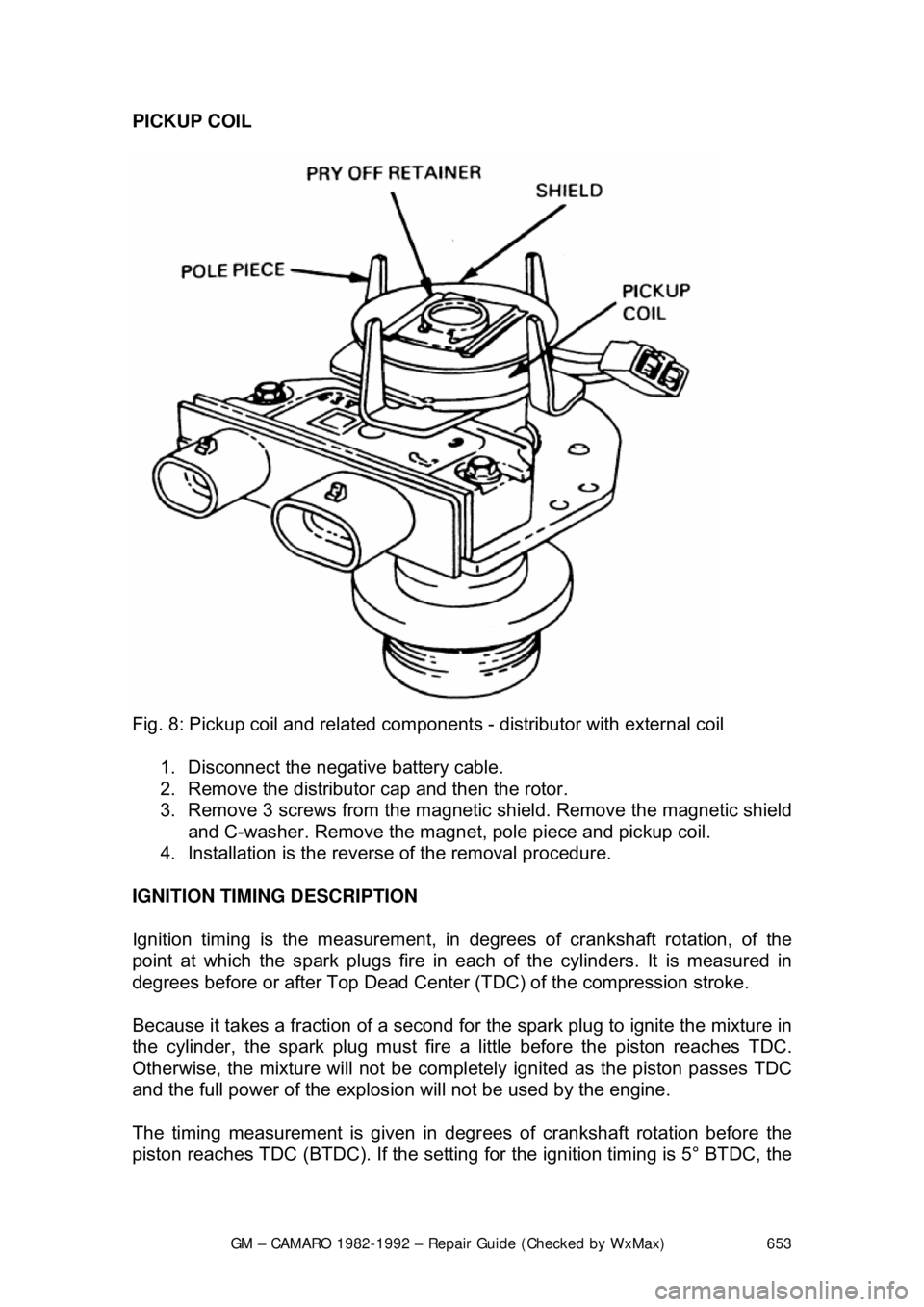
GM – CAMARO 1982-1992 – Repair Guide (Checked by WxMax) 653
PICKUP COIL
Fig. 8: Pickup coil and related component s - distributor with external coil
1. Disconnect the negative battery cable.
2. Remove the distributor cap and then the rotor.
3. Remove 3 screws from the magnetic shield. Remove the magnetic shield
and C-washer. Remove the magnet, pole piece and pickup coil.
4. Installation is the revers e of the removal procedure.
IGNITION TIMING DESCRIPTION
Ignition timing is the measurement, in de grees of crankshaft rotation, of the
point at which the spark plugs fire in eac h of the cylinders. It is measured in
degrees before or after Top Dead Center (TDC) of the compression stroke.
Because it takes a fraction of a second for the spark plug to ignite the mixture in
the cylinder, the spark plug must fire a little before the piston reaches TDC.
Otherwise, the mixture will not be complete ly ignited as the piston passes TDC
and the full power of the explosion will not be used by the engine.
The timing measurement is given in degr ees of crankshaft rotation before the
piston reaches TDC (BTDC). If the setting fo r the ignition timing is 5° BTDC, the
Page 654 of 875

GM – CAMARO 1982-1992 – Repair Guide (Checked by WxMax) 654
spark plug must fire 5° before each pist
on reaches TDC. This only holds true,
however, when the engine is at idle speed.
As the engine speed increases, the pist ons go faster. The spark plugs have to
ignite the fuel even sooner if it is to be completely ignited when the piston
reaches TDC.
If the ignition is set too far advanced (B TDC), the ignition and expansion of the
fuel in the cylinder will occu r too soon and try to force the piston down while it is
still traveling up. This causes engine ping. If the ignition spark is set too far
retarded, after TDC (ATDC), the pi ston will have already passed TDC and
started on its way down when the fuel is igni ted. This will cause the piston to be
forced down for only a portion of its trav el, resulting in poor engine performance
and lack of power.
When timing the engine, the Number 1 pl ug wire should be used to trigger the
timing light. On engines where timing is adjustable, the notch for the No. 1
cylinder is usually scribed across all th ree edges of the double sheaf pulley.
Another notch located 180° away from t he No. 1 cylinder notch is scribed only
across the center section of the pulley to make it distinguishable from the No. 1
cylinder notch.
There are two basic types of timing light s available. The first type of light
operates from the car's battery. Two al ligator clips connect to the battery
terminals, while a third wire connects to the spark plug with an adapter or to the
spark plug wire with an inductive pickup. This type of light is more expensive,
but the xenon bulb provides a nice bright flash which can even be seen in
sunlight. The second type replaces the battery source with 110-volt house
current. Some timing lights have other func tions built into them, such as dwell
meters, tachometers, or re mote starting switches. These are convenient, in that
they reduce the tangle of wires under t he hood, but may duplicate the functions
of tools you already have.
Because this car uses electronic ignition, you should use a timing light with an
inductive pickup. This pickup simply cl amps around the Number 1 spark plug
wire (in this case, the coil wire), elimin ating the adapter. It is not susceptible to
crossfiring or false triggering, which ma y occur with a conventional light due to
the greater voltages produc ed by these systems.
ADJUSTMENT
When adjusting the timing, refer to the instructions on the emission control
sticker inside the engine compartment. If th e instructions on the label disagree
with the procedure listed below, follo w the instructions on the label.
1982-87 VEHICLES 1. Locate the timing marks on the cran kshaft pulley and the front of the
engine.
Page 760 of 875

GM – CAMARO 1982-1992 – Repair Guide (Checked by WxMax) 760
GENERAL INFORMATION & MAINTENANCE
HOW TO USE THIS INFORMATION
The introductory part of this repair gui de is intended to help you learn more
about the inner workings of your Camaro while saving you money on its upkeep
and operation.
The beginning of the repair guide will likely be referred to the most, since that is
where you will find information for maintenance and tune-up. The other
information deals with the more complex systems of your vehicle. Systems
(from engine through brakes) are covered to the extent that the average do-it-
yourselfer can attempt. This repair guide will not explain such things as
rebuilding a differential because the ex pertise required and the special tools
necessary make this uneconomical. It will, however, give you detailed
instructions to help you change your own brake pads and shoes, replace spark
plugs, and perform many more jobs that can save you money and help avoid
expensive problems.
A secondary purpose of this repair guide is a reference for owners who want to
understand their vehicle and/or their mechanics better.
WHERE TO BEGIN
Before removing any bolts, read through t he entire procedure. This will give you
the overall view of what tools and supplies will be required. So read ahead and
plan ahead. Each operation should be approached logically and all procedures
thoroughly understood before attempting any work.
If repair of a component is not considered practical, we tell you how to remove
the part and then how to insta ll the new or rebuilt replacement. In this way, you
at least save labor costs.
AVOIDING TROUBLE
Many procedures in this repair guide r equire you to "label and disconnect ..." a
group of lines, hoses or wires. Don't be think you can remember where
everything goes - you won't. If you hook up va cuum or fuel lines incorrectly, the
vehicle may run poorly, if at all. If you hook up electrical wiring incorrectly, you
may instantly learn a very expensive lesson.
You don't need to know the proper name for each hose or line. A piece of
masking tape on the hose and a piece on its fitting will allow you to assign your
own label. As long as you remember your own code, the lines can be
reconnected by matching your tags. Re member that tape will dissolve in
gasoline or solvents; if a part is to be washed or cleaned, use another method
of identification. A permanent felt-tipped marker or a metal scribe can be very
handy for marking metal parts. Remove any tape or paper labels after
assembly.