tow CHEVROLET CAMARO 1982 Repair Guide
[x] Cancel search | Manufacturer: CHEVROLET, Model Year: 1982, Model line: CAMARO, Model: CHEVROLET CAMARO 1982Pages: 875, PDF Size: 88.64 MB
Page 124 of 875

GM – CAMARO 1982-1992 – Repair Guide (Checked by WxMax) 124
BRAKE LEVER
REMOVAL & INSTALLATION
1982-89 MODELS
1. Raise and safely support the vehicle.
2. Remove the adjusting nut
at the equalizer and remove the front cable from
the equalizer and bracket.
3. Lower the vehicle.
4. Remove the upper console and lower c onsole rear screws. Lift the rear of
the lower console to gain access to the parking brake control.
5. Remove the pin and retainer from t he control assembly and front cable.
6. Remove the cable and casing from the control assembly and bracket then
remove the cable and grommet from the vehicle. Remove the parking brake
lever mounting bolts and remove the assembly.
7. Installation is the reverse of t he removal procedure. Adjust the parking
brake.
1990-92 MODELS
1. Remove the carpet finish molding.
2. Remove the console assembly.
3. With the parking brake lever in the do wn position, rotate the arm toward the
front of the vehicle until a 3mm metal pen can be inserted into the hole.
Insert the metal pin into the hole, locking out the self adjuster.
4. Raise and safely support the vehicle.
5. Disconnect the rear cables from the equalizer.
6. Lower the vehicle.
7. Remove the barrel-shaped butt on from the adjuster track.
8. Remove the parking brake lever mounting bolts.
9. Remove the front cable and casing from the control assembly using a
fabricated parking brake cable retainer compressor tool.
10. Installation is the reverse of the removal procedure. Cycle the lever to set
the parking lever and cables in there proper location.
Page 136 of 875
GM – CAMARO 1982-1992 – Repair Guide (Checked by WxMax) 136
accidental grounding. It is al
so advisable to include a standard automotive fuse
in any jumper wire. This is commonly referred to as a "fused jumper". By
inserting an in-line fuse holder between a set of test leads, a fused jumper wire
can be used for bypassing open circuits. Use a 5 amp fuse to provide protection
against voltage spikes.
Jumper wires are used primarily to locate open electrical circuits, on either the
ground (—) side of the circuit or on the power (+) side. If an electrical
component fails to operate, connect t he jumper wire between the component
and a good ground. If the component operates only with the jumper installed,
the ground circuit is open. If the ground circuit is good, but the component does
not operate, the circuit between the power feed and component may be open.
By moving the jumper wire successively back from the component toward the
power source, you can isolate the area of the circuit where the open is located.
When the component stops func tioning, or the power is cut off, the open is in
the segment of wire between the jumper and the point previously tested.
You can sometimes connect the jumper wir e directly from the battery to the
"hot" terminal of the component, but firs t make sure the component uses 12
volts in operation. Some electrical components, such as fuel injectors or
sensors, are designed to operate on about 4 to 5 volts, and running 12 volts
directly to these components will cause damage.
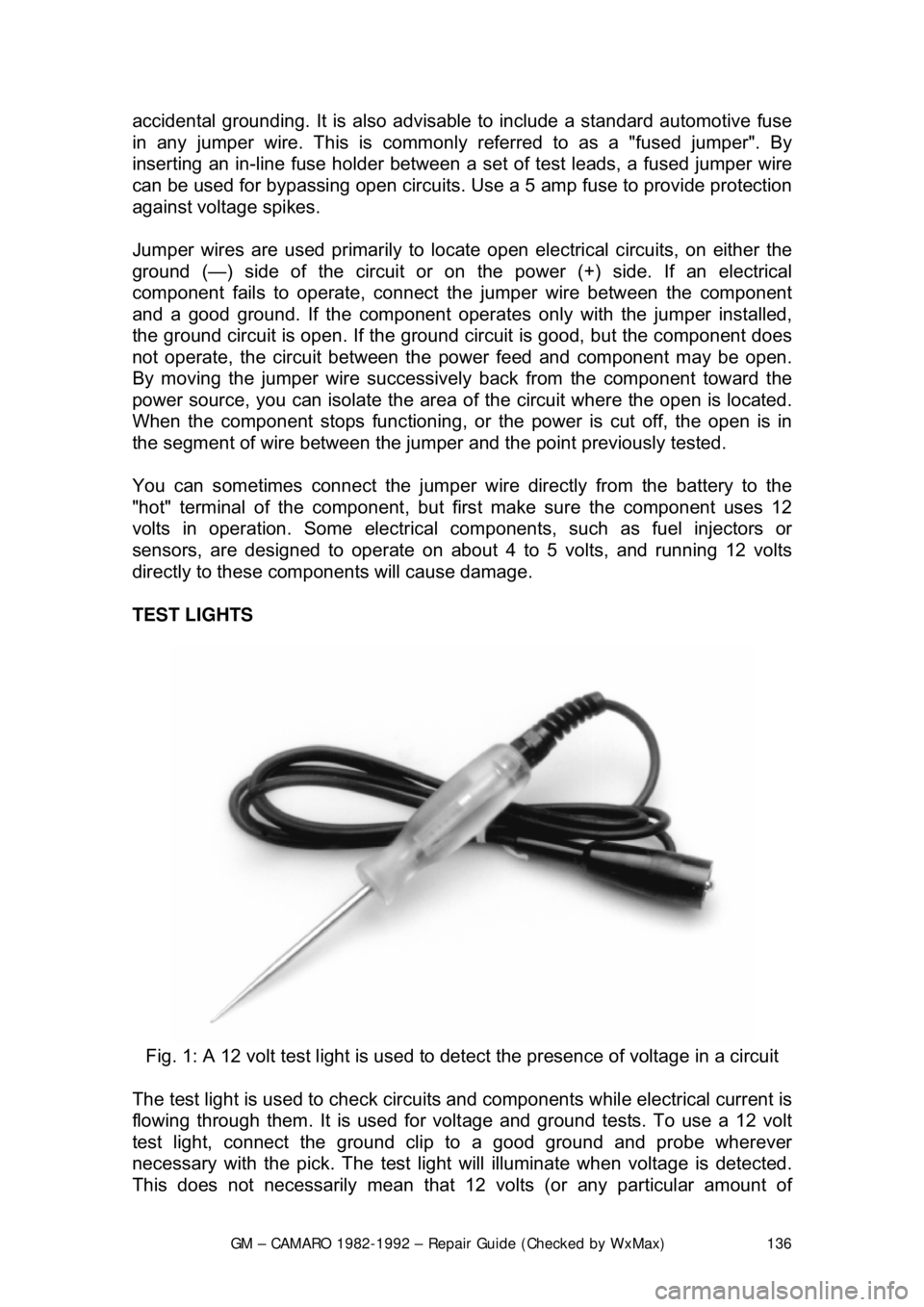
TEST LIGHTS
Fig. 1: A 12 volt test light is used to detect the presence of voltage in a circuit
The test light is used to check circuits and components while electrical current is
flowing through them. It is used for volt age and ground tests. To use a 12 volt
test light, connect the ground clip to a good ground and probe wherever
necessary with the pick. The test light will illuminate when voltage is detected.
This does not necessarily mean that 12 volts (or any particular amount of
Page 137 of 875

GM – CAMARO 1982-1992 – Repair Guide (Checked by WxMax) 137
voltage) is present; it only means that so
me voltage is present. It is advisable
before using the test light to touch its ground clip and probe across the battery
posts or terminals to make sure the light is operating properly.
WARNING - Do not use a test light to probe electronic ignition, spark plug or
coil wires. Never use a pick-type test light to probe wiring on computer
controlled systems unless spec ifically instructed to do so. Any wire insulation
that is pierced by the test light pr obe should be taped and sealed with silicone
after testing
Like the jumper wire, the 12 volt test li ght is used to isolate opens in circuits.
But, whereas the jumper wire is used to bypass the open to operate the load,
the 12 volt test light is us ed to locate the presence of voltage in a circuit. If the
test light illuminates, there is power up to t hat point in the circuit; if the test light
does not illuminate, there is an open circui t (no power). Move the test light in
successive steps back toward the power source until the light in the handle
illuminates. The open is between the pr obe and a point which was previously
probed.
The self-powered test light is similar in design to the 12 volt test light, but
contains a 1.5 volt penlight battery in the handle. It is most often used in place
of a multimeter to check for open or shor t circuits when power is isolated from
the circuit (continuity test).
The battery in a self-powered test light does not provide much current. A weak
battery may not provide enough power to illuminate the test light even when a
complete circuit is made (especially if there is high resistance in the circuit).
Always make sure that the test battery is strong. To check the battery, briefly
touch the ground clip to the pr obe; if the light glows brightly, the battery is strong
enough for testing.
A self-powered test light should not be used on any co mputer controlled system
or component. The small amount of electr icity transmitted by the test light is
enough to damage many electr onic automotive components.
MULTIMETERS
Multimeters are an extremely useful tool for troubleshooting electrical problems.
They can be purchased in either analog or digital form and have a price range
to suit any budget. A multimeter is a voltmeter, ammeter and ohmmeter (along
with other features) combined into one instrument. It is often used when testing
solid state circuits because of its hi gh input impedance (usually 10 megaohms
or more). A brief description of the mult imeter main test functions follows:
• Voltmeter - the voltmeter is used to measure voltage at any point in a
circuit, or to measure the voltage drop across any part of a circuit.
Voltmeters usually have various scales and a selector switch to allow the
reading of different volt age ranges. The voltmeter has a positive and a
negative lead. To avoid damage to the meter, always connect the
negative lead to the negative (—) side of the circ uit (to ground or nearest
Page 140 of 875
GM – CAMARO 1982-1992 – Repair Guide (Checked by WxMax) 140
TESTING
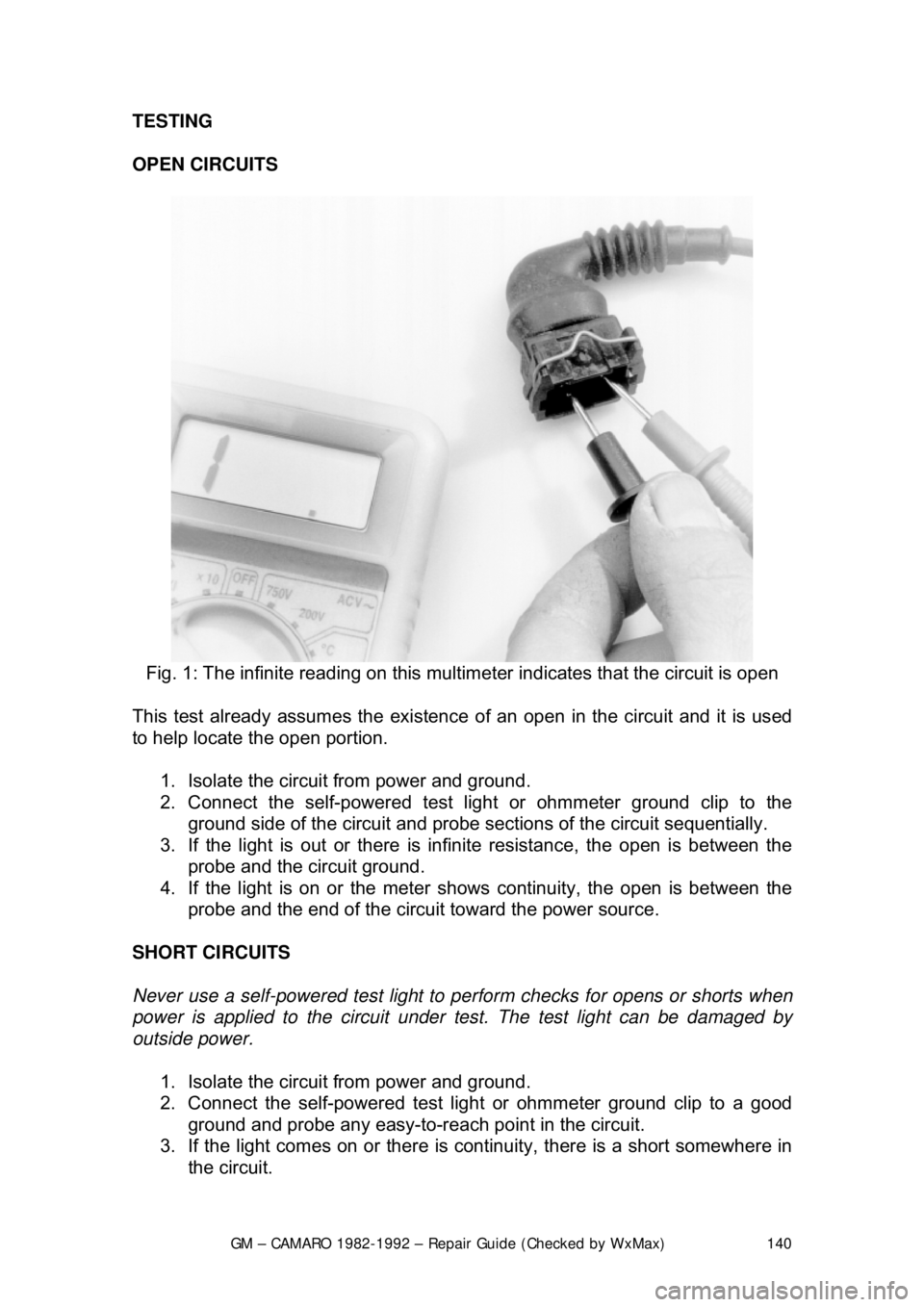
OPEN CIRCUITS
Fig. 1: The infinite reading on this mult imeter indicates that the circuit is open
This test already assumes the existence of an open in the circuit and it is used
to help locate the open portion.
1. Isolate the circuit from power and ground.
2. Connect the self-powered test light or ohmmeter ground clip to the
ground side of the circuit and probe sect ions of the circuit sequentially.
3. If the light is out or there is infinite resistanc e, the open is between the
probe and the circuit ground.
4. If the light is on or the meter s hows continuity, the open is between the
probe and the end of the circuit toward the power source.
SHORT CIRCUITS
Never use a self-powered test light to per form checks for opens or shorts when
power is applied to the circuit under te st. The test light can be damaged by
outside power.
1. Isolate the circuit from power and ground.
2. Connect the self-powered test light or ohmmeter ground clip to a good
ground and probe any easy-to-reach point in the circuit.
3. If the light comes on or there is cont inuity, there is a short somewhere in
the circuit.
Page 174 of 875
GM – CAMARO 1982-1992 – Repair Guide (Checked by WxMax) 174
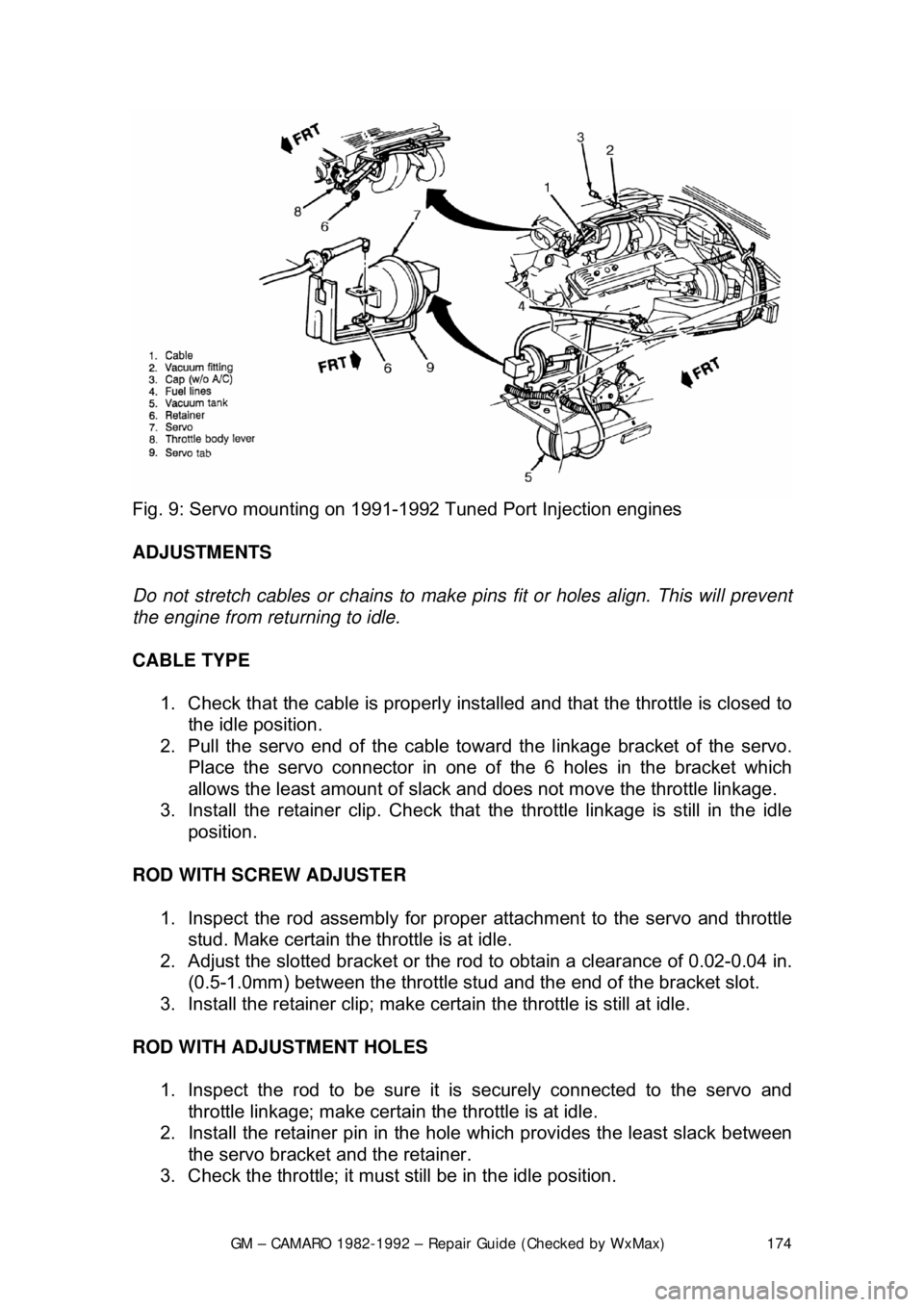
Fig. 9: Servo mounting on 1991-1992 Tuned Port Injection engines
ADJUSTMENTS
Do not stretch cables or chains to make pins fit or holes align. This will prevent
the engine from returning to idle.
CABLE TYPE 1. Check that the cable is properly installed and that the throttle is closed to
the idle position.
2. Pull the servo end of the cable towa rd the linkage bracket of the servo.
Place the servo connector in one of the 6 holes in the bracket which
allows the least amount of slack and does not move the throttle linkage.
3. Install the retainer clip. Check that the throttle linkage is still in the idle
position.
ROD WITH SCREW ADJUSTER 1. Inspect the rod assembly for proper attachment to the servo and throttle\
stud. Make certain the throttle is at idle.
2. Adjust the slotted bra cket or the rod to obtain a clearance of 0.02-0.04 in.
(0.5-1.0mm) between the throttle stud and the end of the bracket slot.
3. Install the retainer clip; make certain the throttle is still at idle.
ROD WITH ADJUSTMENT HOLES 1. Inspect the rod to be sure it is securely connected to the servo and
throttle linkage; make certain the throttle is at idle.
2. Install the retainer pin in the hole which provides the least slack between
the servo bracket and the retainer.
3. Check the throttle; it must still be in the idle position.
Page 181 of 875
GM – CAMARO 1982-1992 – Repair Guide (Checked by WxMax) 181
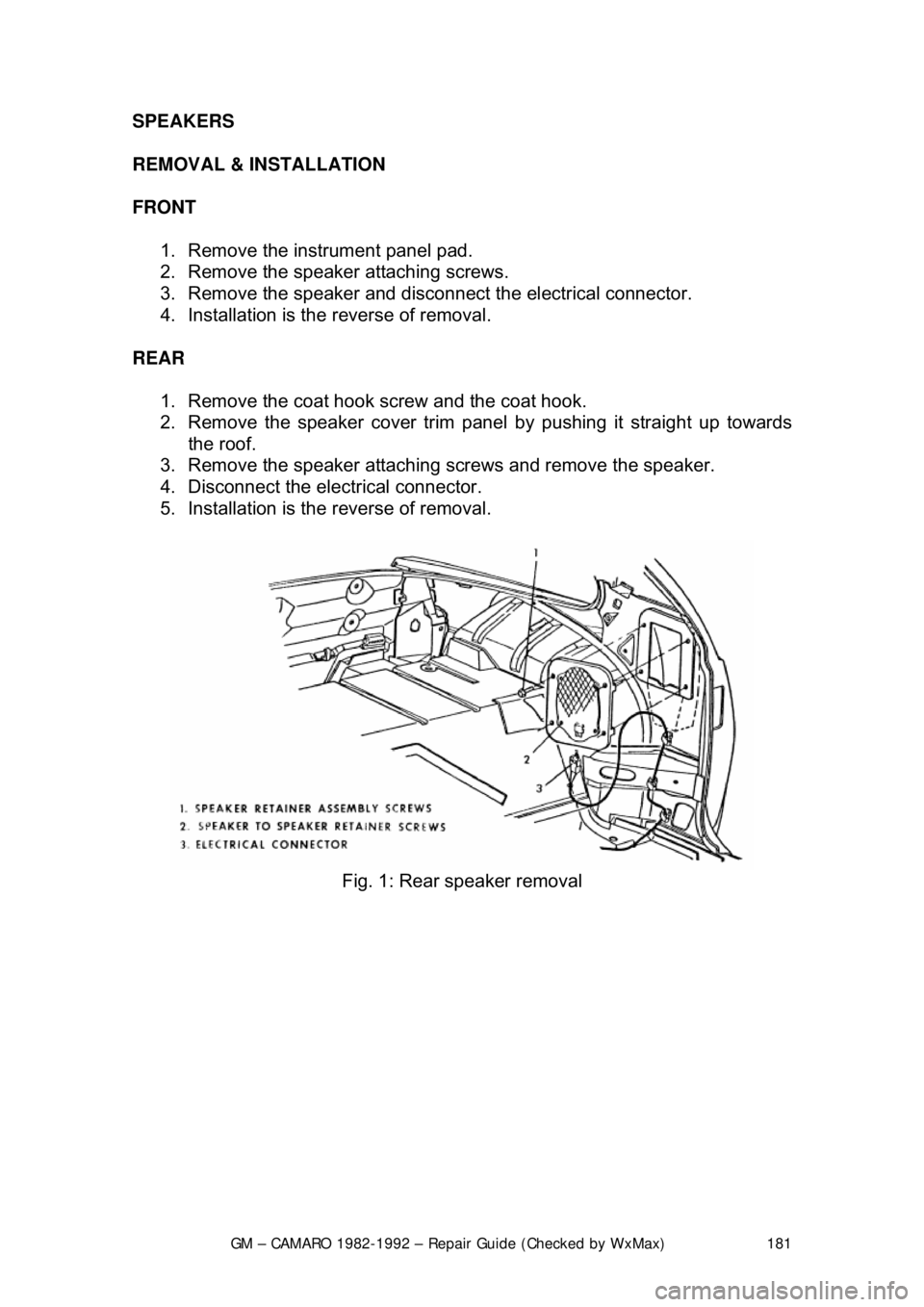
SPEAKERS
REMOVAL & INSTALLATION
FRONT
1. Remove the instrument panel pad.
2. Remove the speaker attaching screws.
3. Remove the speaker and disconnect the electrical connector.
4. Installation is the reverse of removal.
REAR 1. Remove the coat hook screw and the coat hook.
2. Remove the speaker cover trim panel by pushing it straight up towards
the roof.
3. Remove the speaker attaching screws and remove the speaker.
4. Disconnect the electrical connector.
5. Installation is the reverse of removal.
Fig. 1: Rear speaker removal
Page 294 of 875

GM – CAMARO 1982-1992 – Repair Guide (Checked by WxMax) 294
25. Connect the negative battery cable at the battery.
CLUTCH
UNDERSTANDING THE CLUTCH
The purpose of the clutch is to disconnect and connect engine power at the
transmission. A vehicle at rest requires a lot of engine torque to get all that
weight moving. An internal combustion engine does not develop a high starting
torque (unlike steam engines) so it must be allowed to operate without any load
until it builds up enough torque to move the vehicle. To a point, torque
increases with engine rpm. The clutch a llows the engine to build up torque by
physically disconnecting t he engine from the transmission, relieving the engine
of any load or resistance.
The transfer of engine power to the tr ansmission (the load) must be smooth and
gradual; if it weren't, driv e line components would wear out or break quickly.
This gradual power transfer is made possi ble by gradually releasing the clutch
pedal. The clutch disc and pressure plat e are the connecting link between the
engine and transmission. When the clutch pedal is released, the disc and plate
contact each other (the clutch is engag ed) physically joining the engine and
transmission. When the pedal is pushed in, the disc and plate separate (the
clutch is disengaged) disconnecting the engine from the transmission.
Most clutch assemblies consists of t he flywheel, the clutch disc, the clutch
pressure plate, the throw out bearing and fork, the actuating linkage and the
pedal. The flywheel and clutch pressure plate (driving members) are connected
to the engine crankshaft and rotate with it. The clutch disc is located between
the flywheel and pressure plate, and is splined to the transmission shaft. A
driving member is one that is attached to the engine and transfers engine power
to a driven member (clutch disc) on t he transmission shaft. A driving member
(pressure plate) rotates (drives) a driv en member (clutch disc) on contact and,
in so doing, turns the transmission shaft.
There is a circular di aphragm spring within th e pressure plate cover
(transmission side). In a relaxed state (w hen the clutch pedal is fully released)
this spring is convex; that is, it is dished outward toward the transmission.
Pushing in the clutch peda l actuates the attached linkage. Connected to the
other end of this is the throw out fork, which hold the throw out bearing. When
the clutch pedal is depre ssed, the clutch linkage pushes the fork and bearing
forward to contact the diaphragm spring of the pressure plate. The outer edges
of the spring are secured to the pressure plate and are pivoted on rings so that
when the center of the spring is compre ssed by the throw out bearing, the outer
edges bow outward and, by so doing, pu ll the pressure plate in the same
direction - away from the clutch disc. This action se parates the disc from the
plate, disengaging the clutch and allowing the transmission to be shifted into
another gear. A coil type clutch return sp ring attached to the clutch pedal arm
permits full release of the pedal. Releasing the pedal pulls the throw out bearing
away from the diaphragm spring resulting in a reversal of spring position. As
bearing pressure is gradually released from the spring center, the outer edges
Page 305 of 875
GM – CAMARO 1982-1992 – Repair Guide (Checked by WxMax) 305
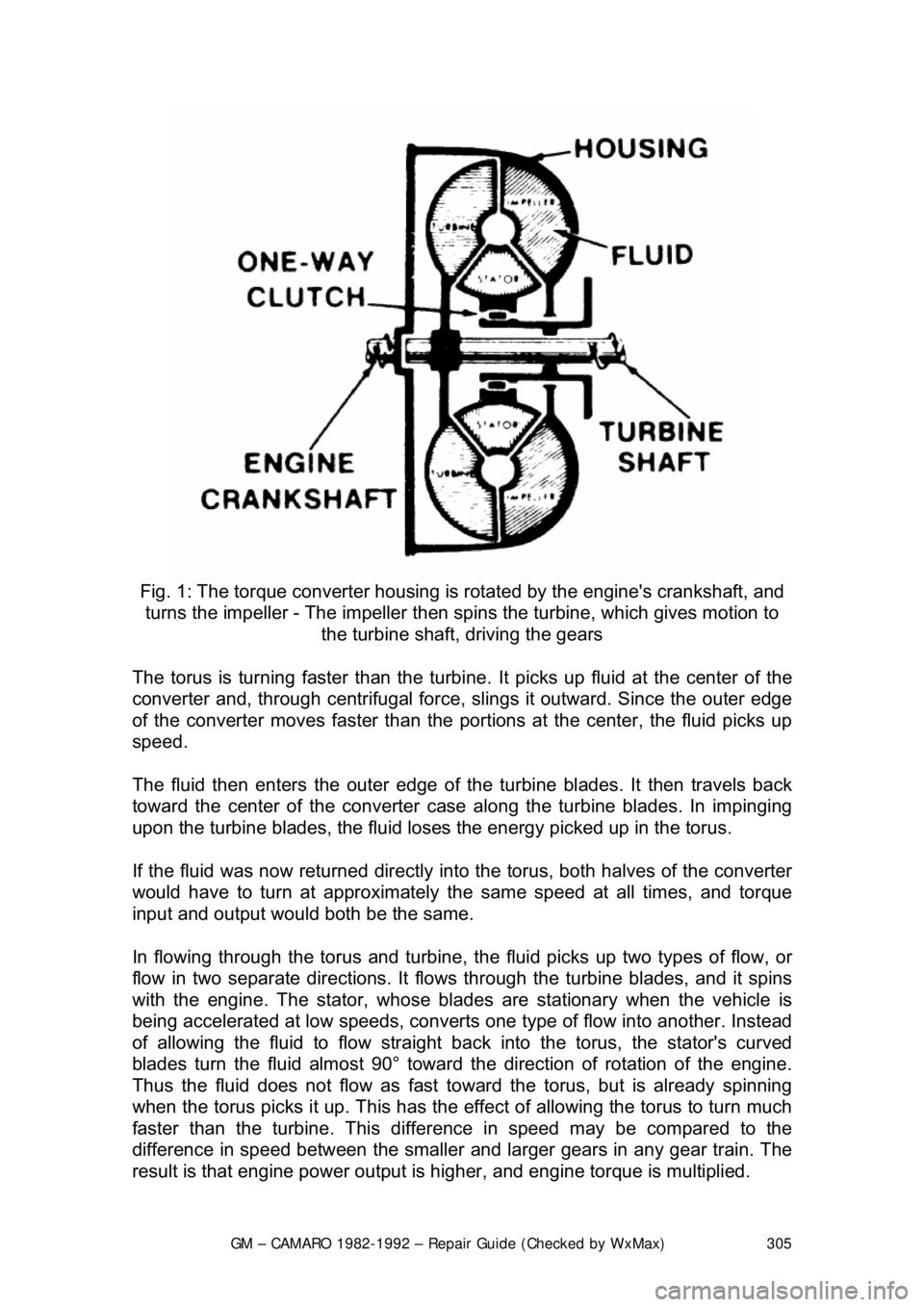
Fig. 1: The torque converter housing is rotated by the engine's crankshaft, and
turns the impeller - The impeller then spin s the turbine, which gives motion to
the turbine shaft, driving the gears
The torus is turning faster than the turbi ne. It picks up fluid at the center of the
converter and, through centrifugal force, slings it outward. Since the outer edge
of the converter moves faster than the portions at the center, the fluid picks up
speed.
The fluid then enters the outer edge of th e turbine blades. It then travels back
toward the center of the converter case along the turbine blades. In impinging
upon the turbine blades, the fluid loses the energy picked up in the torus.
If the fluid was now returned directly into the torus, both halves of the converter
would have to turn at approximately t he same speed at all times, and torque
input and output would both be the same.
In flowing through the torus and turbine, the fluid picks up two types of flow, or
flow in two separate directions. It flow s through the turbine blades, and it spins
with the engine. The stator, whose blades are stationary when the vehicle is
being accelerated at low speeds, converts one type of flow into another. Instead
of allowing the fluid to flow straight back into the torus, the stator's curved
blades turn the fluid almost 90° toward the direction of rotation of the engine.
Thus the fluid does not flow as fast to ward the torus, but is already spinning
when the torus picks it up. This has the effe ct of allowing the torus to turn much
faster than the turbine. This differ ence in speed may be compared to the
difference in speed between the smaller and larger gears in any gear train. The
result is that engine powe r output is higher, and engine torque is multiplied.
Page 316 of 875
GM – CAMARO 1982-1992 – Repair Guide (Checked by WxMax) 316
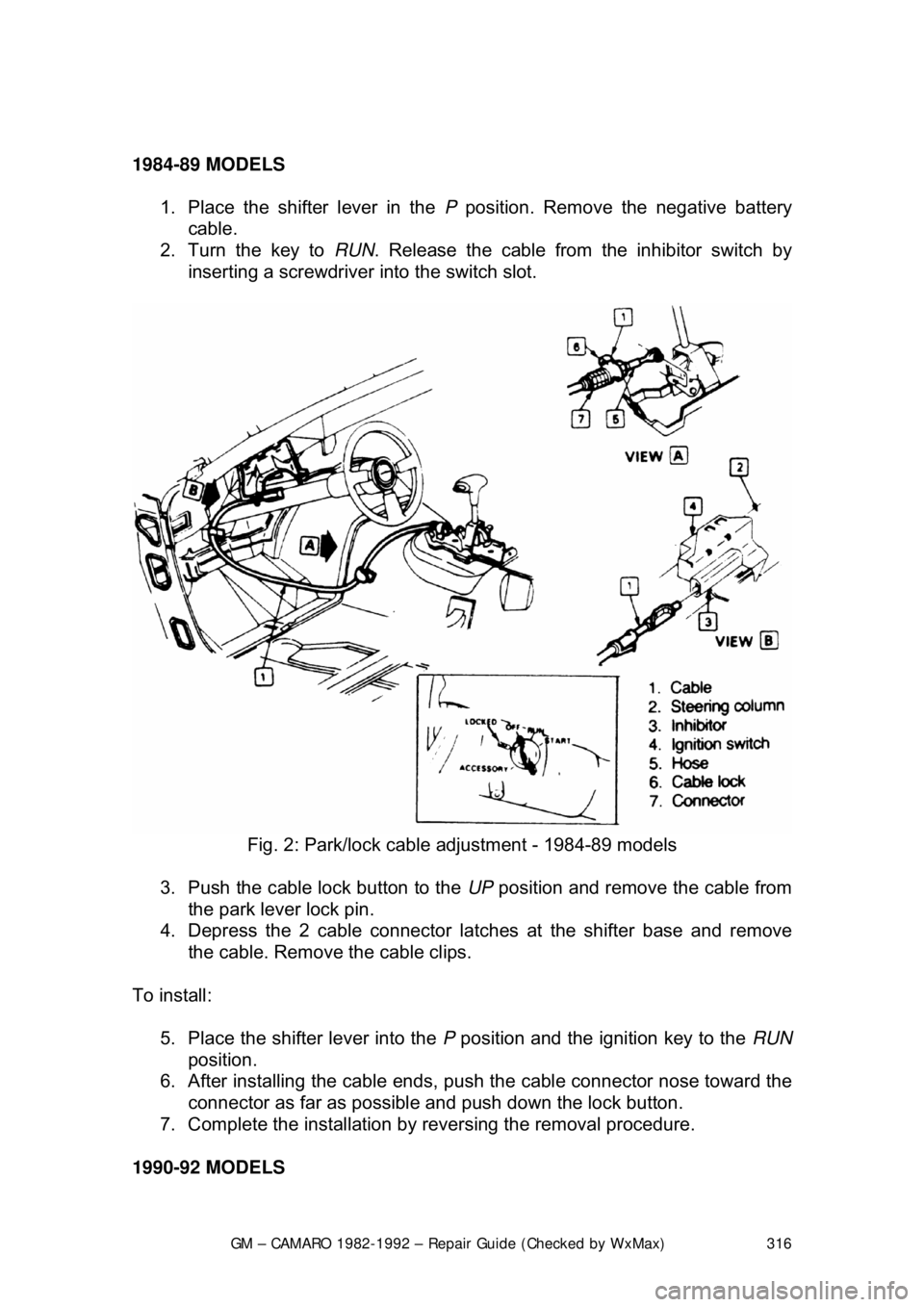
1984-89 MODELS
1. Place the shifter lever in the P position. Remove the negative battery
cable.
2. Turn the key to RUN. Release the cable from the inhibitor switch by
inserting a screwdriver into the switch slot.
Fig. 2: Park/lock cable adjustment - 1984-89 models
3. Push the cable lock button to the UP position and remove the cable from
the park lever lock pin.
4. Depress the 2 cable connector latc hes at the shifter base and remove
the cable. Remove the cable clips.
To install: 5. Place the shifter lever into the P position and the ignition key to the RUN
position.
6. After installing the cable ends, push the cable connector nose toward th\
e connector as far as possible and push down the lock button.
7. Complete the installation by reversing the removal procedure.
1990-92 MODELS
Page 317 of 875

GM – CAMARO 1982-1992 – Repair Guide (Checked by WxMax) 317
1. Place the shifter lever in the
P position. Remove the negative battery
cable.
2. Turn the key to RUN.
3. Remove the left side instrument panel sound insulator and kick panels.
4. Remove the floor console.
5. Remove the cable nut and clip. Remove the cable from the bracket, move the button to the UP position and unsnap the cable end from the
lever lock pin.
6. Lower the steering column. Remove the cable clips.
To install: 7. Place the shifter lever into the P position and the ignition key to the RUN
position.
8. After installing the cable ends, push the cable connector nose toward th\
e connector as far as possible and push down the lock button.
9. Complete the installation by reversing the removal procedure.
EXTENSION HOUSING SEAL (IN VEHICLE)
REMOVAL & INSTALLATION
This seal controls transmission oil leakage around the driveshaft. Continued
failure of this seal usually indicates a worn output shaft bushing. If so, there will
be signs of the same wear on the driveshaft where it contacts the seal and
bushing. The seal is available and is fairly simple to install, with the proper tool.
1. Raise and safely support rear of t he vehicle to minimize transmission oil
loss when the driveshaft is removed.
2. Unbolt the driveshaft fr om the differential and center support bearing, if
equipped. Wrap tape around the bearing cu ps to keep them in place on
the universal joint and slide the sh aft out of the transmission.
3. Use a small pry tool to carefully pr y out the old seal. Be careful not to
insert the tool too far into the hous ing or the bushing will be damaged.
4. Use an oil seal installation tool to evenly drive the new seal into the
housing. Make sure the tool only cont acts the outer metal portion of the
seal.
5. Install the driveshaft. Torque the uni versal bearing cup retainer bolts to
15 ft. lbs. (20 Nm). Recheck fluid level.
TRANSMISSION
REMOVAL & INSTALLATION 1. Disconnect the negative batte ry cable at the battery.
2. Remove the air cleaner assembly.
3. Disconnect the throttle valve (TV) control cable at the carburetor.