oil pan CHEVROLET CAMARO 1982 Repair Guide
[x] Cancel search | Manufacturer: CHEVROLET, Model Year: 1982, Model line: CAMARO, Model: CHEVROLET CAMARO 1982Pages: 875, PDF Size: 88.64 MB
Page 317 of 875

GM – CAMARO 1982-1992 – Repair Guide (Checked by WxMax) 317
1. Place the shifter lever in the
P position. Remove the negative battery
cable.
2. Turn the key to RUN.
3. Remove the left side instrument panel sound insulator and kick panels.
4. Remove the floor console.
5. Remove the cable nut and clip. Remove the cable from the bracket, move the button to the UP position and unsnap the cable end from the
lever lock pin.
6. Lower the steering column. Remove the cable clips.
To install: 7. Place the shifter lever into the P position and the ignition key to the RUN
position.
8. After installing the cable ends, push the cable connector nose toward th\
e connector as far as possible and push down the lock button.
9. Complete the installation by reversing the removal procedure.
EXTENSION HOUSING SEAL (IN VEHICLE)
REMOVAL & INSTALLATION
This seal controls transmission oil leakage around the driveshaft. Continued
failure of this seal usually indicates a worn output shaft bushing. If so, there will
be signs of the same wear on the driveshaft where it contacts the seal and
bushing. The seal is available and is fairly simple to install, with the proper tool.
1. Raise and safely support rear of t he vehicle to minimize transmission oil
loss when the driveshaft is removed.
2. Unbolt the driveshaft fr om the differential and center support bearing, if
equipped. Wrap tape around the bearing cu ps to keep them in place on
the universal joint and slide the sh aft out of the transmission.
3. Use a small pry tool to carefully pr y out the old seal. Be careful not to
insert the tool too far into the hous ing or the bushing will be damaged.
4. Use an oil seal installation tool to evenly drive the new seal into the
housing. Make sure the tool only cont acts the outer metal portion of the
seal.
5. Install the driveshaft. Torque the uni versal bearing cup retainer bolts to
15 ft. lbs. (20 Nm). Recheck fluid level.
TRANSMISSION
REMOVAL & INSTALLATION 1. Disconnect the negative batte ry cable at the battery.
2. Remove the air cleaner assembly.
3. Disconnect the throttle valve (TV) control cable at the carburetor.
Page 323 of 875
GM – CAMARO 1982-1992 – Repair Guide (Checked by WxMax) 323
Replacement kits include new bearing
cups and conventional snaprings to
replace the original nylon rings. These replacement rings must go inboard of the
yoke in contrast to outboard mounting of the Dana and Cleveland designs.
Previous service to the Saginaw U-joints can be recognized by the presence of
snaprings inboard of the yoke.
Bad U-joints, requiring replacement, will produce a clunking sound when the car
is put into gear. This is due to worn needle bearings or a scored trunnion end
possibly caused by improper lubricati on during assembly. Camaro U-joints
require no periodic maintenance and theref ore have no lubrication fittings.
DRIVESHAFT
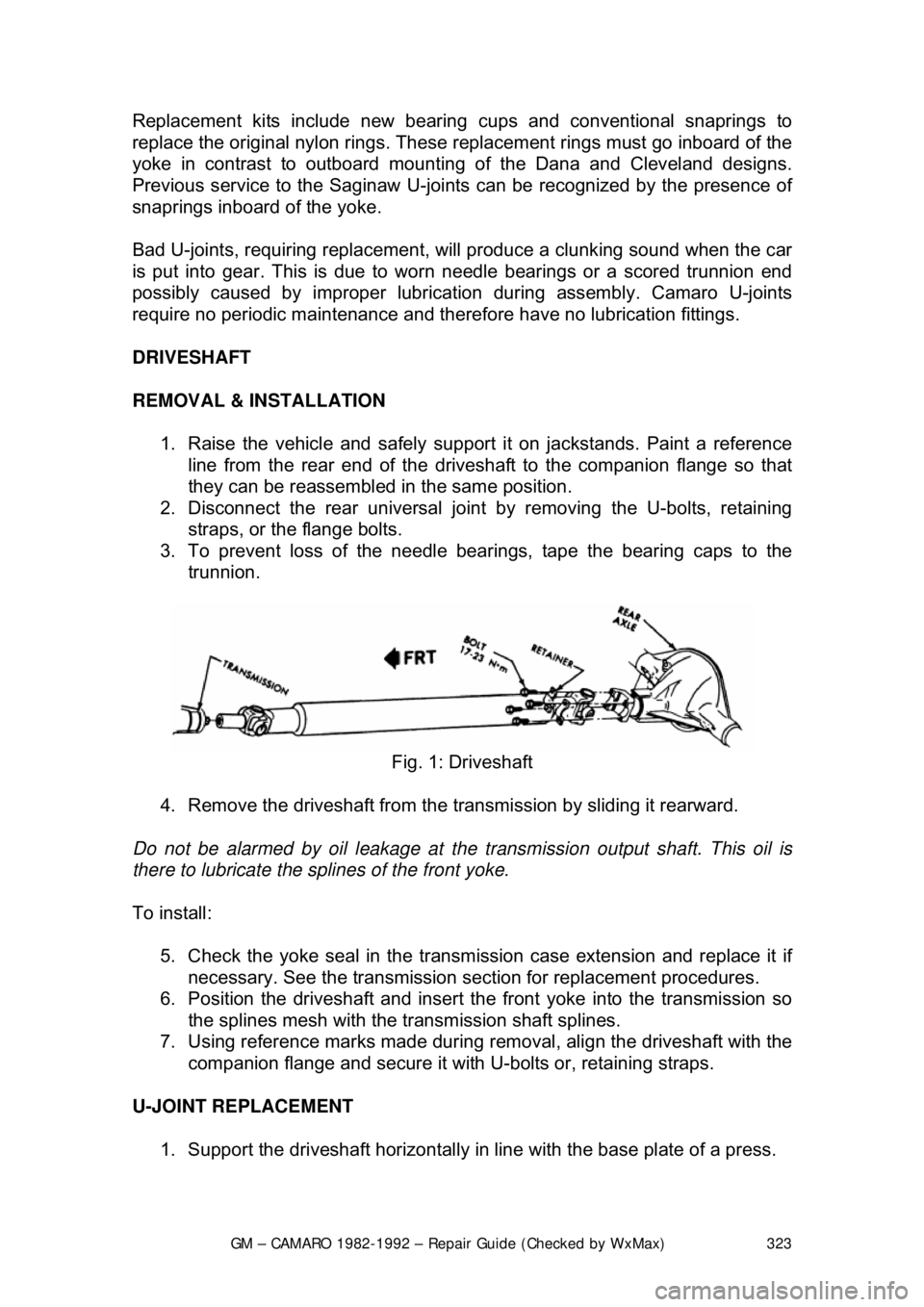
REMOVAL & INSTALLATION 1. Raise the vehicle and safely su pport it on jackstands. Paint a reference
line from the rear end of the drives haft to the companion flange so that
they can be reassembled in the same position.
2. Disconnect the rear universal join t by removing the U-bolts, retaining
straps, or the flange bolts.
3. To prevent loss of the needle bear ings, tape the bearing caps to the
trunnion.
Fig. 1: Driveshaft
4. Remove the driveshaft from the tr ansmission by sliding it rearward.
Do not be alarmed by oil l eakage at the transmission output shaft. This oil is
there to lubricate the sp lines of the front yoke.
To install: 5. Check the yoke seal in the transmi ssion case extension and replace it if
necessary. See the transmission sect ion for replacement procedures.
6. Position the driveshaft and insert t he front yoke into the transmission so
the splines mesh with the transmission shaft splines.
7. Using reference marks made during re moval, align the driveshaft with the
companion flange and secure it with U-bolts or, retaining straps.
U-JOINT REPLACEMENT 1. Support the driveshaft horizontally in line with the base plate of a press.
Page 351 of 875

GM – CAMARO 1982-1992 – Repair Guide (Checked by WxMax) 351
alternating current developed
within the stator windings to a direct (DC) current
at the output (BAT) terminal. Three of these diodes are negative and are
mounted flush with the end frame while t he other three are positive and are
mounted into a strip called a heat sink. The positive diodes are easily identified
as the ones within small cavities or depressions.
The alternator charging system is a negative (-) ground system which consists
of an alternator, a regulat or, a charge indicator, a storage battery and wiring
connecting the components, and fuse link wire.
The alternator is belt-driven from t he engine. Energy is supplied from the
alternator/regulator system to the rotati ng field through two brushes to two slip-
rings. The slip-rings are mounted on the rotor shaft and are connected t\
o the
field coil. This energy supplied to the ro tating field from the battery is called
excitation current and is used to init ially energize the field to begin the
generation of electricity. Once the alter nator starts to generate electricity, the
excitation current comes from its ow n output rather than the battery.
The alternator produces power in the form of alternating current. The alternating
current is rectified by 6 diodes into dire ct current. The direct current is used to
charge the battery and power the rest of the electrical system.
When the ignition key is turned ON, current flows from the battery, through the
charging system indicator light on the in strument panel, to the voltage regulator,
and to the alternator. Since the alternat or is not producing any current, the
alternator warning light comes on. When the engine is started, the alternator
begins to produce current and turns the alte rnator light off. As the alternator
turns and produces current, the current is divided in two ways: part to the
battery(to charge the battery and power the electrical components of the
vehicle), and part is returned to the alte rnator (to enable it to increase its
output). In this situation, the alternator is receiving current from the battery and
from itself. A voltage regulat or is wired into the current supply to the alternator
to prevent it from receiving too much cu rrent which would cause it to put out too
much current. Conversely, if the voltage regulator does not allow the alternator
to receive enough current, the battery will not be fully charged and will
eventually go dead.
The battery is connected to the alternator at all times, whether the ignition key is
turned ON or not. If the battery were shorted to ground, the alternator would
also be shorted. This woul d damage the alternator. To prevent this, a fuse link
is installed in the wiring between the battery and the alternator. If the battery is
shorted, the fuse link melts, protecting the alternator.
An alternator is better that a convent ional, DC shunt generator because it is
lighter and more compact, because it is designed to supply the battery and
accessory circuits through a wide range of engine speeds, and because it
eliminates the necessary maintenance of replacing brushes and servicing
commutators.
PRECAUTIONS
Page 362 of 875

GM – CAMARO 1982-1992 – Repair Guide (Checked by WxMax) 362
OIL PRESSURE SENDING UNIT
Replace the sending unit by disconnecting
the electrical connector and using a
special socket to remove it.
ENGINE
MECHANICAL ENGINE
REMOVAL & INSTALLATION
In the process of removing the engine, you will come across a number of steps
which call for the removal of a separ ate component or system, such as
"disconnect the exhaust system " or "remove the radiator." In most instances, a
detailed removal procedure can be found elsewhere in this repair guide.
It is virtually impossible to list each individual wire and hose which must be
disconnected, simply because so many different model and engine
combinations have been manufactured. Careful observation and common
sense are the best possible approaches to any repair procedure.
Removal and installation of the engine ca n be made easier if you follow these
basic points:
• If you have to drain any of the fl uids, use a suitable container.
• Always tag any wires or hoses and, if possible, the components they
came from before disconnecting them.
• Because there are so many bolts and fasteners involved, store and label
the retainers from com ponents separately in muffin pans, jars or coffee
cans. This will prevent conf usion during installation.
• After unbolting the transmission or trans axle, always make sure it is
properly supported.
• If it is necessary to disconnect t he air conditioning system, have this
service performed by a qualified tec hnician using a recovery/recycling
station. If the system does not have to be disconnected, unbolt the
compressor and set it aside.
• When unbolting the engine mounts, a lways make sure the engine is
properly supported. When removing t he engine, make sure that any
lifting devices are properly attached to the engine. It is recommended
that if your engine is supplied with lifting hooks, your lifting apparatus be
attached to them.
• Lift the engine from its compartment sl owly, checking that no hoses,
wires or other component s are still connected.
• After the engine is clear of the compar tment, place it on an engine stand
or workbench.
• After the engine has been removed, y ou can perform a partial or full
teardown of the engine using the procedur es outlined in this repair guide.
Page 365 of 875
GM – CAMARO 1982-1992 – Repair Guide (Checked by WxMax) 365
31. Connect the bulkhead harness connec
tor, wires and hoses. Reroute the
ECM harness in its original location. Install the hush panel and fenderwell
splash panel.
32. Install the radiator, fan and fan sh roud. Connect the radiator and heater
hoses, along with the transmission cooler lines.
33. Connect the vacuum brake booster li ne, the throttle linkage and cruise
control cable. Install the distributor cap.
34. Fill the cooling system with the proper type and amount of coolant and
the crankcase with the proper type of oil to the correct level.
35. Install the water pump drive bel t, the air cleaner duct and the hood.
36. Connect the negative battery cable, st art the engine and check for leaks.
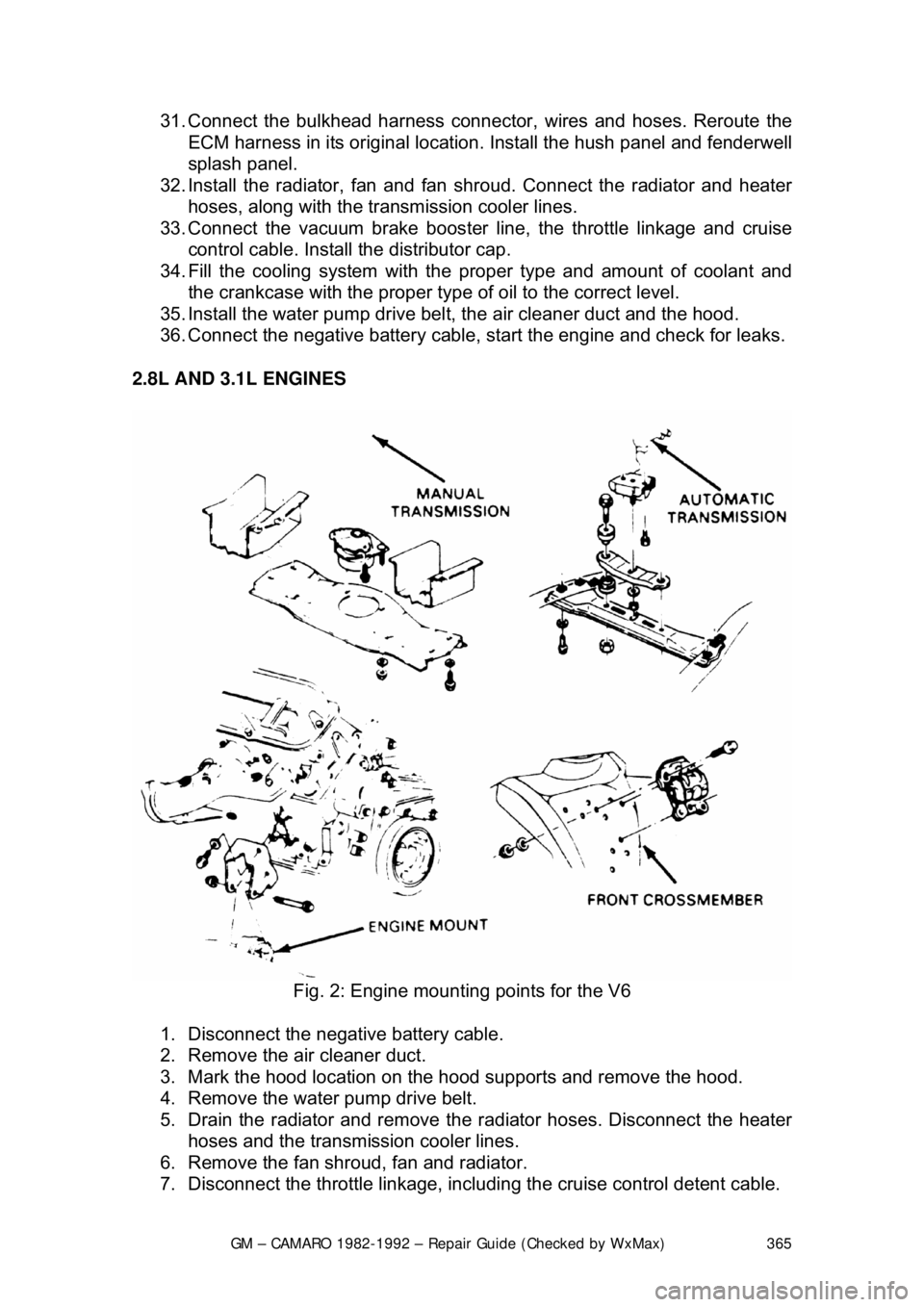
2.8L AND 3.1L ENGINES
Fig. 2: Engine mountin g points for the V6
1. Disconnect the negative battery cable.
2. Remove the air cleaner duct.
3. Mark the hood location on the hood supports and remove the hood.
4. Remove the water pump drive belt.
5. Drain the radiator and remove t he radiator hoses. Disconnect the heater
hoses and the transmission cooler lines.
6. Remove the fan shroud, fan and radiator.
7. Disconnect the throttle linkage, includi ng the cruise control detent cable.
Page 377 of 875
GM – CAMARO 1982-1992 – Repair Guide (Checked by WxMax) 377
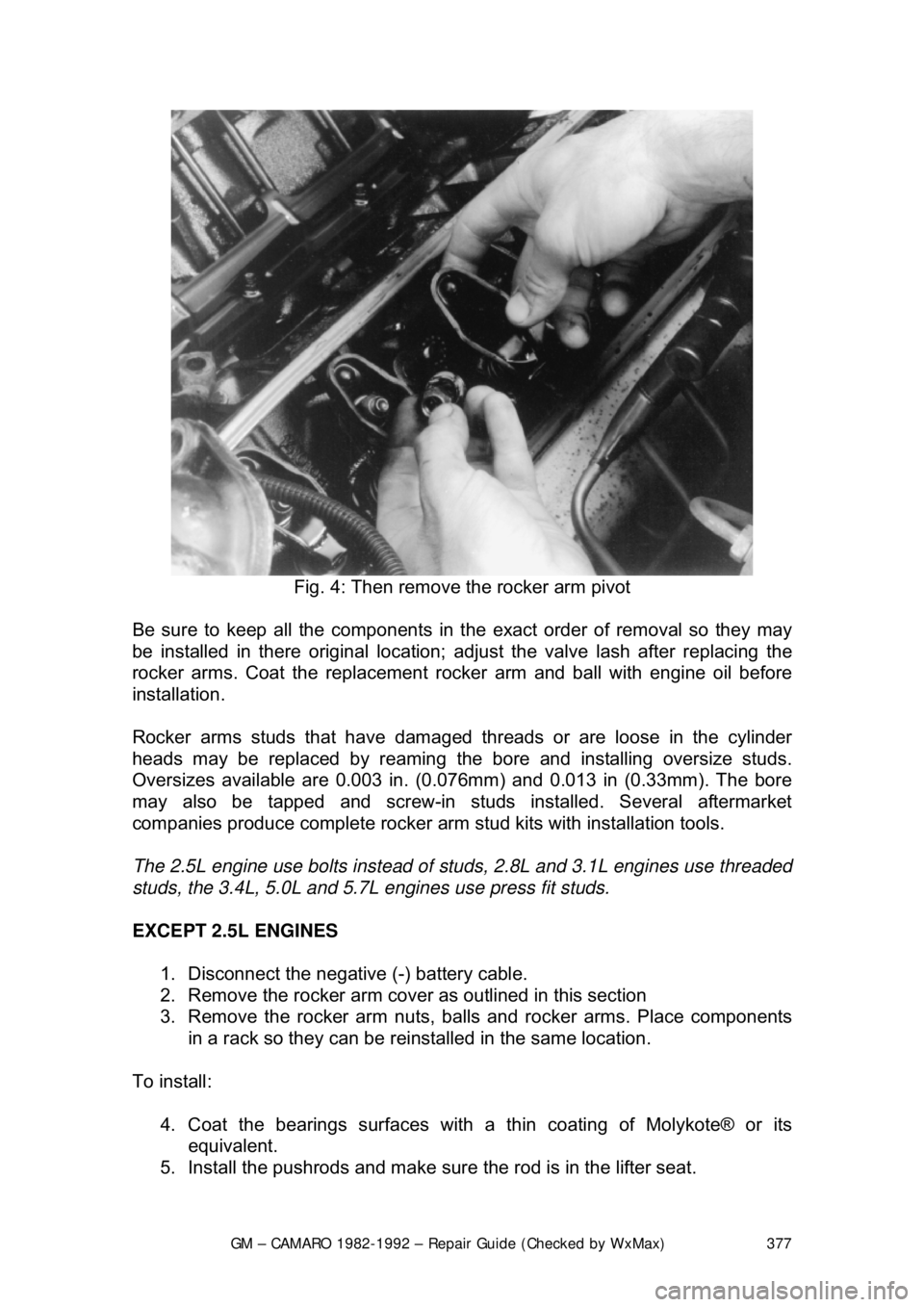
Fig. 4: Then remove the rocker arm pivot
Be sure to keep all the components in t he exact order of removal so they may
be installed in there original location; adjust the valve lash after replacing the
rocker arms. Coat the replacement ro cker arm and ball with engine oil before
installation.
Rocker arms studs that have damaged thr eads or are loose in the cylinder
heads may be replaced by reaming the bore and installing oversize studs.
Oversizes available are 0.003 in. (0. 076mm) and 0.013 in (0.33mm). The bore
may also be tapped and screw-in studs installed. Several aftermarket
companies produce complete rocker arm st ud kits with installation tools.
The 2.5L engine use bolts instead of studs, 2.8L and 3.1L engines use threaded
studs, the 3.4L, 5.0L and 5.7L engines use press fit studs.
EXCEPT 2.5L ENGINES 1. Disconnect the negative (-) battery cable.
2. Remove the rocker arm cover as outlined in this section
3. Remove the rocker arm nuts, balls and rocker arms. Place components
in a rack so they can be reinstalled in the same location.
To install: 4. Coat the bearings surf aces with a thin coating of Molykote® or its
equivalent.
5. Install the pushrods and make sure the rod is in the lifter seat.
Page 417 of 875
GM – CAMARO 1982-1992 – Repair Guide (Checked by WxMax) 417
16. Fill the cooling syst
em with the proper type and amount of coolant.
Connect the negative battery cable.
17. Raise and support the vehicle safely . Install a new oil filter, lower the
vehicle. Fill the crankcase with the proper type and quantity of engine oil.
18. Start the engine, check for lea ks and check the ignition timing.
OIL PAN
REMOVAL & INSTALLATION
CAUTION - The EPA warns that prolonged contact with used engine oil may
cause a number of skin disorders, incl uding cancer! You should make every
effort to minimize your exposure to used engine oil. Pr otective gloves should be
worn when changing the oil. Wash y our hands and any other exposed skin
areas as soon as possible after exposure to used engine oil. Soap and water, or
waterless hand cleaner should be used.
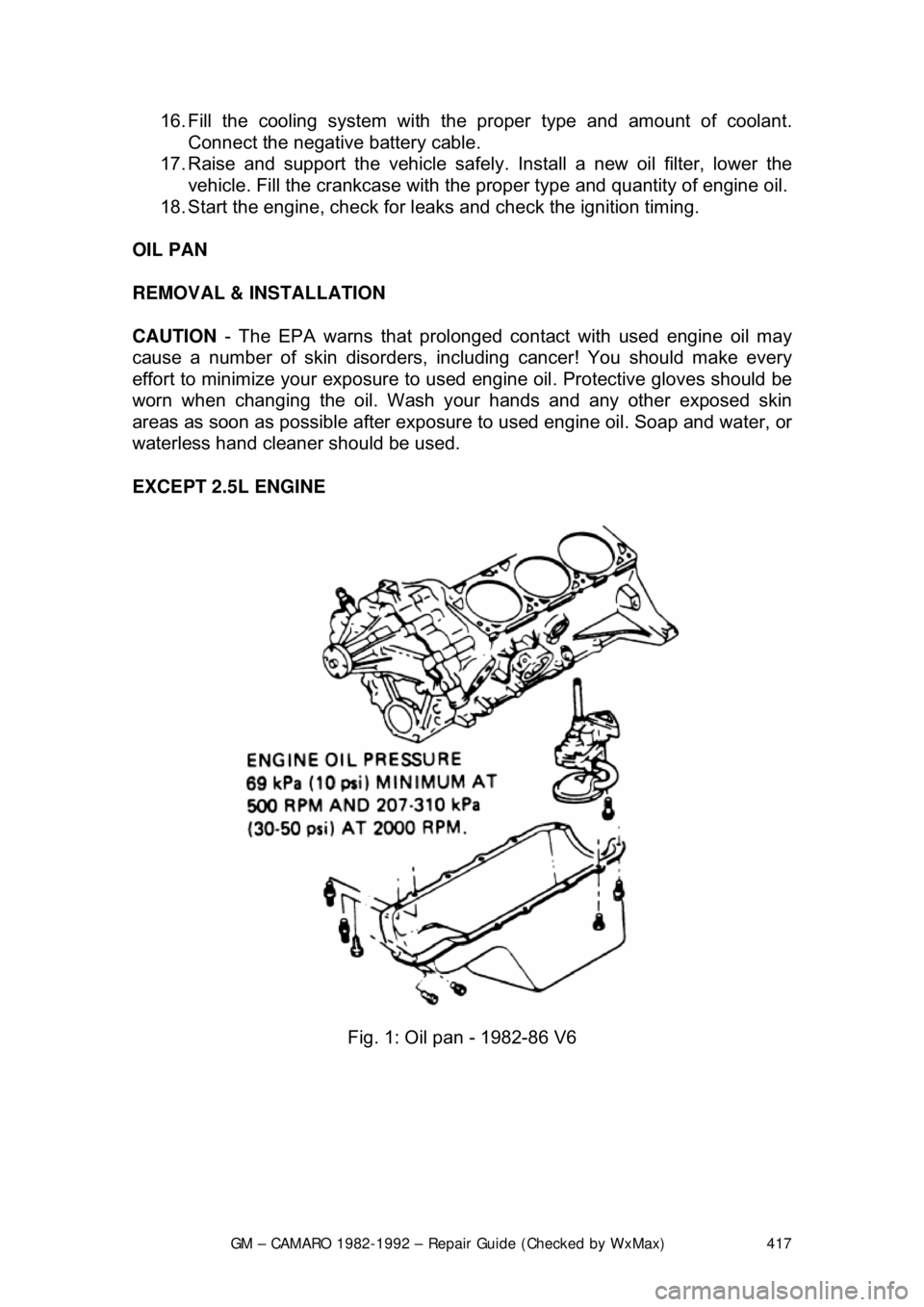
EXCEPT 2.5L ENGINE
Fig. 1: Oil pan - 1982-86 V6
Page 418 of 875
GM – CAMARO 1982-1992 – Repair Guide (Checked by WxMax) 418
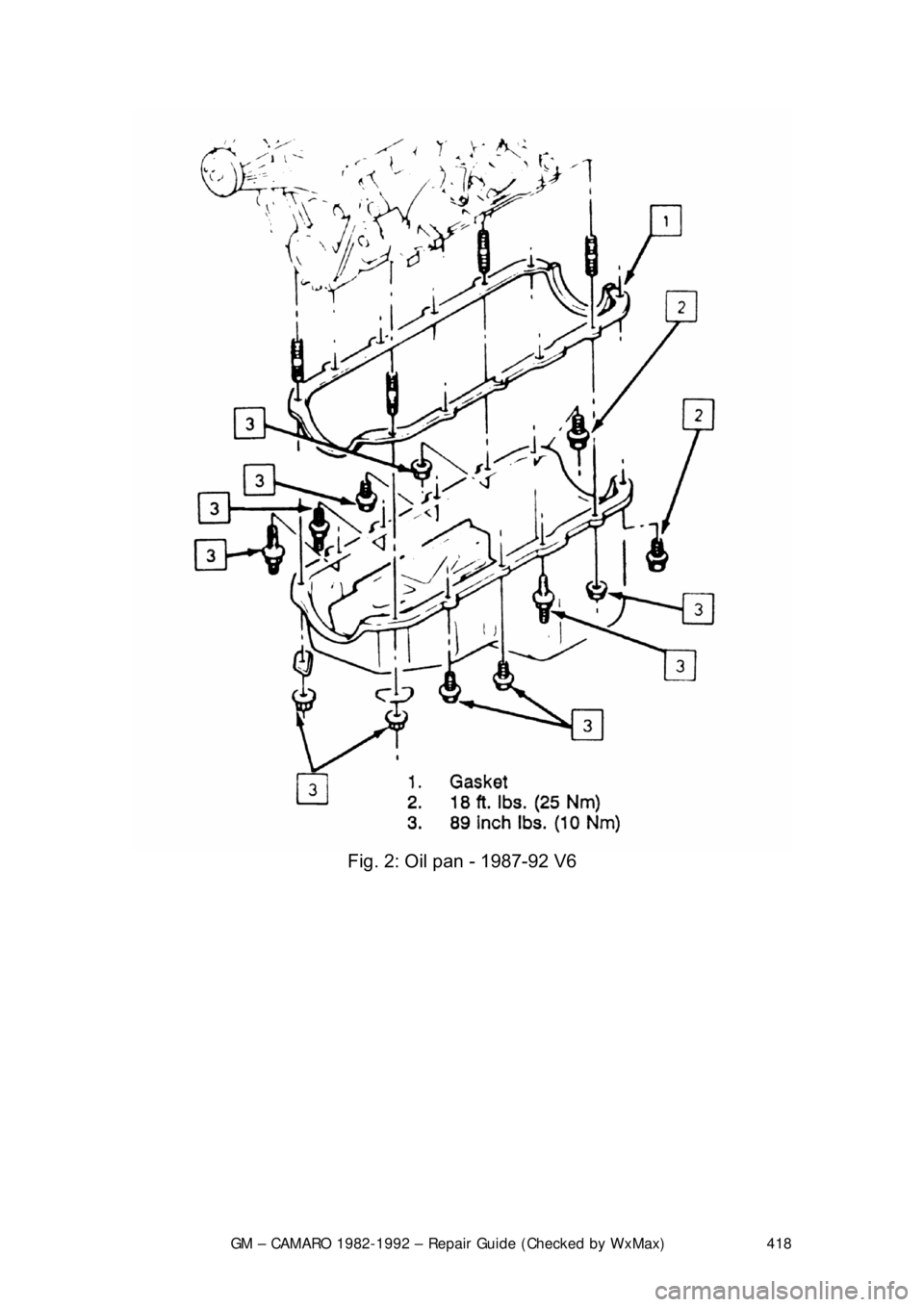
Fig. 2: Oil pan - 1987-92 V6
Page 419 of 875
GM – CAMARO 1982-1992 – Repair Guide (Checked by WxMax) 419
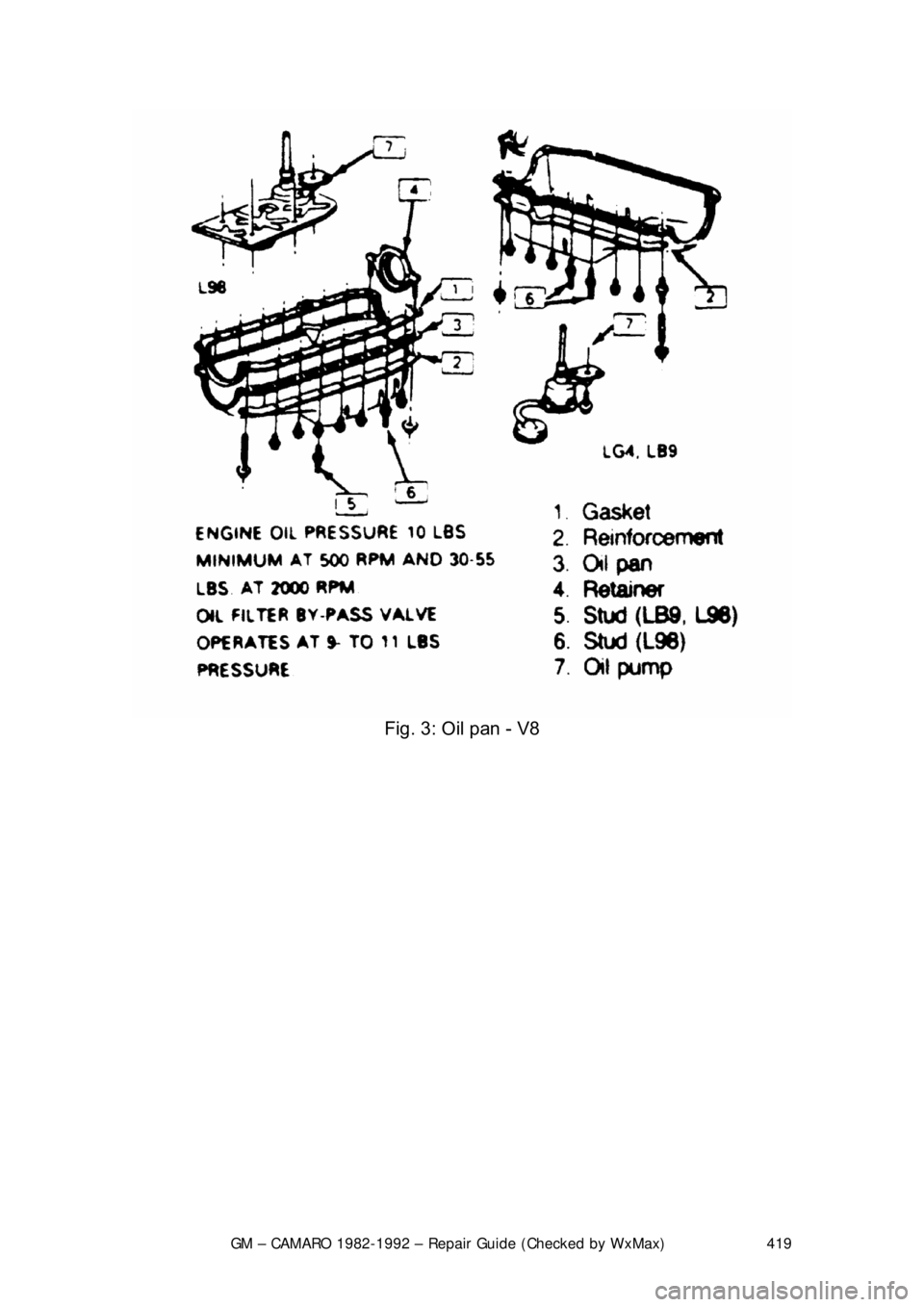
Fig. 3: Oil pan - V8
Page 420 of 875
GM – CAMARO 1982-1992 – Repair Guide (Checked by WxMax) 420
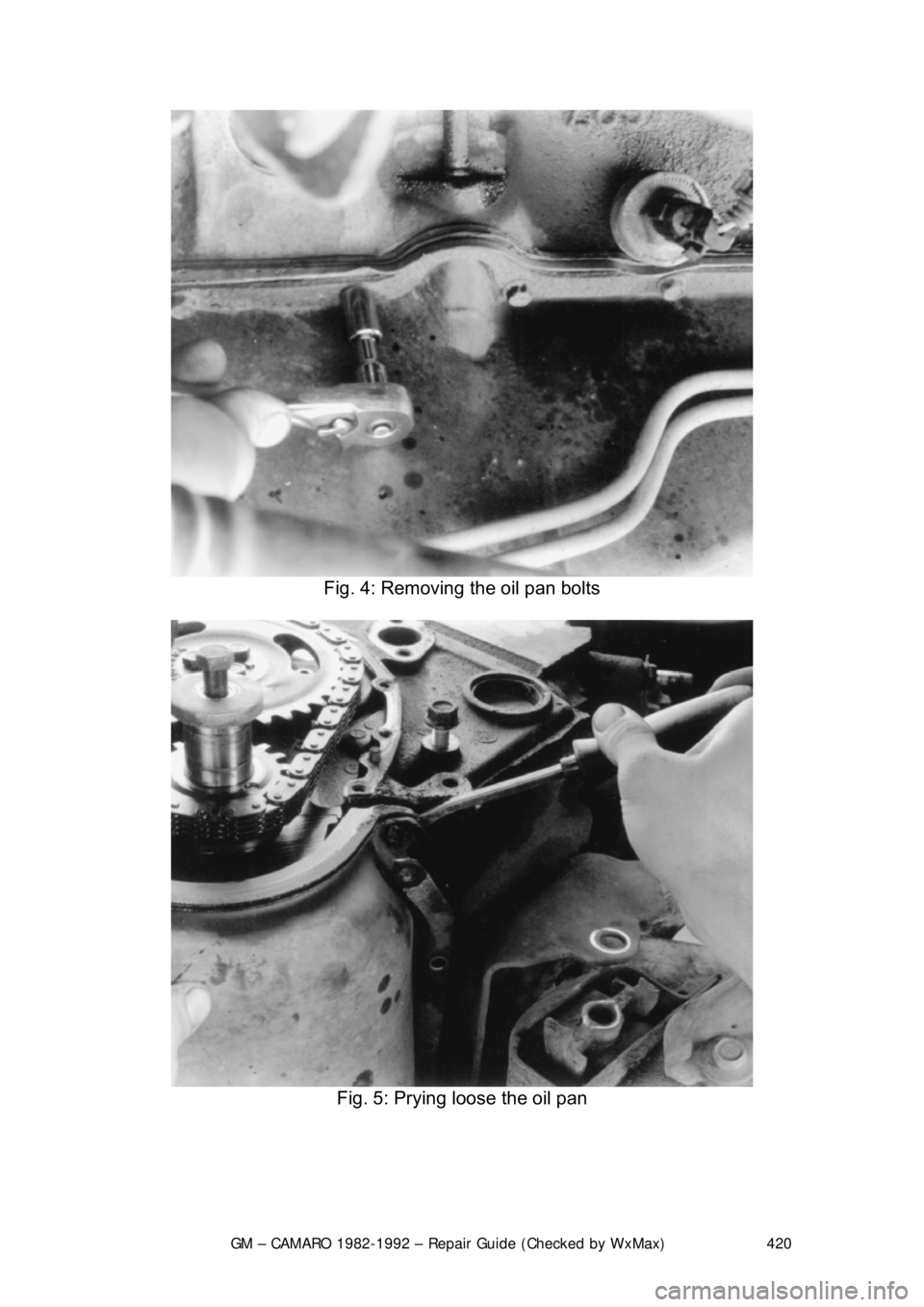
Fig. 4: Removing the oil pan bolts
Fig. 5: Prying loose the oil pan