engine overheat CHEVROLET CAMARO 1993 User Guide
[x] Cancel search | Manufacturer: CHEVROLET, Model Year: 1993, Model line: CAMARO, Model: CHEVROLET CAMARO 1993Pages: 358, PDF Size: 15.6 MB
Page 198 of 358
Problems on the Road
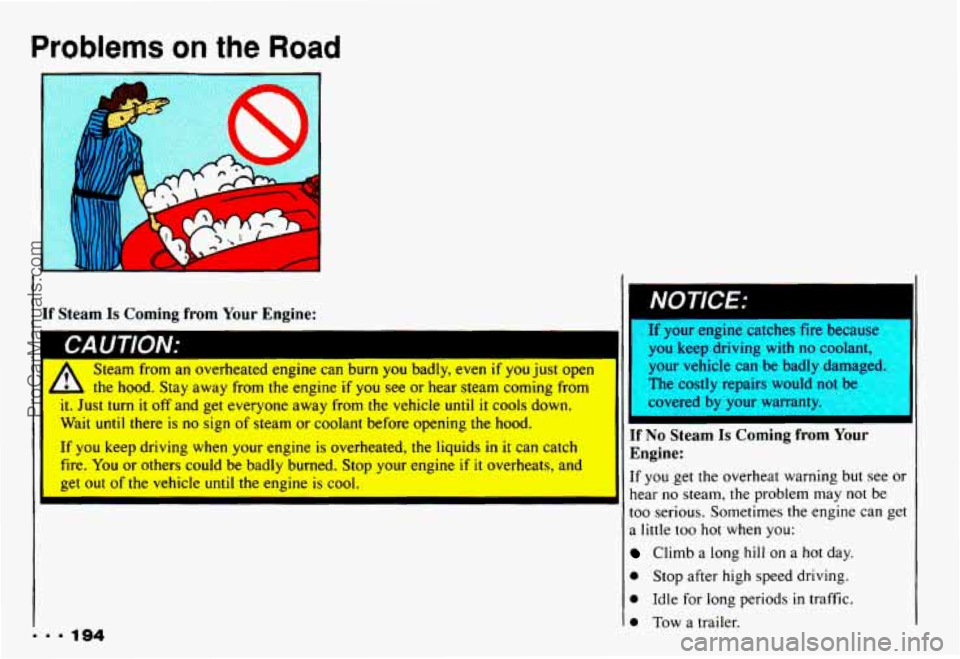
If Steam Is Coming from Your Engine:
W1Ldr-W II LUU I ILJN.'
Steam from an overheated engine can bum you badly, even if you just open
k the hood. Stay away from the engine if you see or hear steam coming from
x. Just turn it off and get everyone away from the vehicle until it cools down.
Wait
until there is no sign of steam or coolant before opening the hood.
If you keep driving when your engine is overheated, the liquids in it can catch
fire. You or others could be badly burned. Stop your engine if it overheats, and
get out of the vehicle until the engine is cool,
... 194
11 your engine catches fire because
I you keep driving with no coolant,
I1
E
I1
h
tC
a
0
a
a
your vehicle can be badly damaged
The
costly repairs would not be
covered by your warranty.
F No Steam Is Coming from Your
hgine:
'you get the overheat warning but see or
ear
no steam, the problem may not be
)o serious. Sometimes the engine can get
little too
hot when you:
Climb a long hill on a hot day.
Stop after high speed driving.
1 Idle for long periods in traffic.
1 Tow a trailer.
ProCarManuals.com
Page 199 of 358
If you get the overheat warning with no
sign of steam,
try this for a minute or so:
1. If you have an air conditioner, turn it
2. Turn on your heater to full hot at the
off.
highest fan speed and open
the
window
as necessary.
3. Try to keep your engine under load (in
a drive gear where the engine runs
slower).
If you no longer have the overheat
warning, you can drive. Just
to be safe,
drive slower for about
ten minutes. If the
warning doesn’t come back on,
you can
drive normally. If
the warning
continues, pull over, stop,
and park your vehicle right away.
If there’s
still no sign of steam, you can
idle
the engine for two or three minutes
while you’re parked, to see
if the warning
stops.
But then, if you still have the
warning, TURN
OFF THE ENGINE
AND GET EVERYONE OUT
OF THE
VEHICLE
until it cools down.
You may decide not to
lift the hood but to
get service help right away.
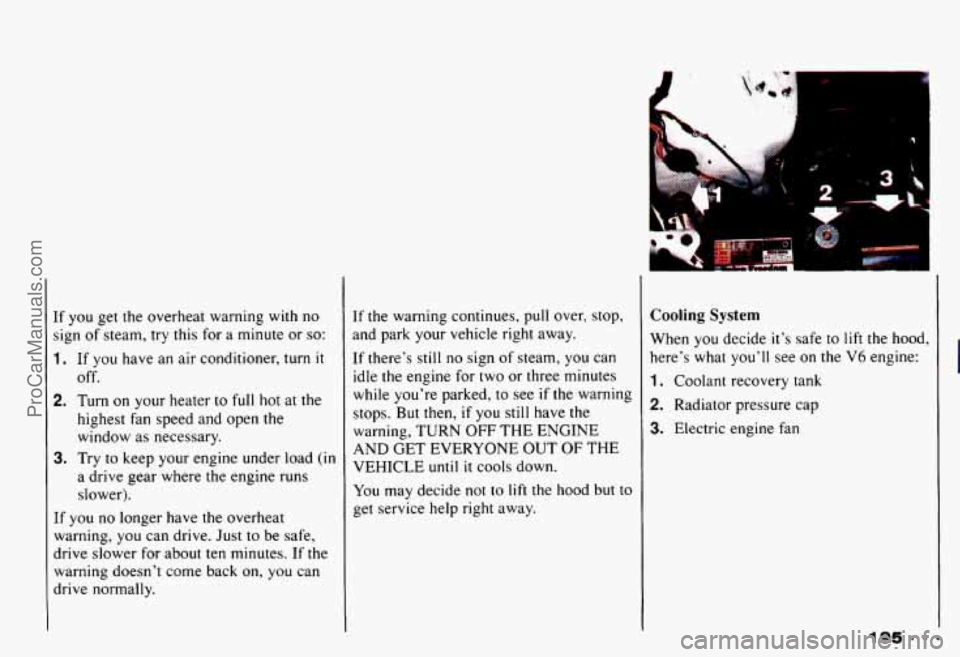
Cooling System
When you decide it’s safe to lift the hood,
here’s what you’ll see on the V6 engine:
1.
2.
3.
Coolant recovery tank
Radiator pressure cap
Electric engine
fan
ProCarManuals.com
Page 201 of 358
eng~ witho
r
u -.. .
tolar .-
[f there seems to be no leak, check to see
f the electric engine fan is running. If the
:ngine is overheating, the fan should be
-unning.
If it isn’t, your vehicle needs
iervice.
I I
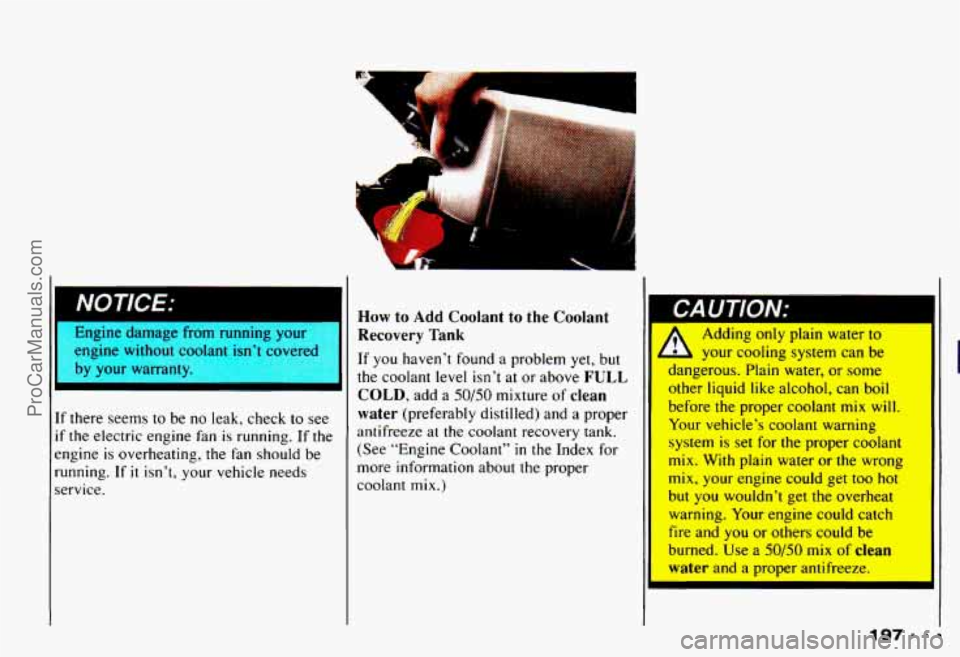
How to Add Coolant to the Coolant
Recovery Tank
If you haven’t found a problem yet, but
the coolant level isn’t
at or above FULL
COLD,
add a 50/50 mixture of clean
water
(preferably distilled) and a proper
antifreeze at the coolant recovery tank.
(See “Engine Coolant”
in the Index for
more information about the proper
coolant
mix.)
A Adding only plain water to
L your cooling system can be
dangerous. Plain water, or some
I
other liquid like alcohol, can boil
before the proper coolant
mix will.
Your vehicle’s coolant warning
system
is set for the proper coolant
mix. With plain water or the wrong
mix, your engine could get too hot
but you wouldn’t get the overheat
warning. Your engine could catch
fire and you or others could
be
burned. Use a 50/50 mix of clean
water
and a proper antifreeze.
197-
ProCarManuals.com
Page 202 of 358
Problems on the Road
and crack the engine, radiator,
heater core and other parts.
Use the
recommended coolant.
‘I
A You can be burne4 if you spill
- L coolant on hot engine parts.
Coolant contains ethylene glycol
and
it will burn if the engine parts
are hot enough. Don’t spill coolant
on
a hot engine.
9.198
When the coolant in the coolant recovery
tank is at or above
FULL COLD, start
your vehicle.
If the overheat warning continues, there’s
one more thing you can
try. You can add
the proper coolant
mix directly to the
radiator, but be sure the cooling system is
cool before you do
it.
I
CAUTION:
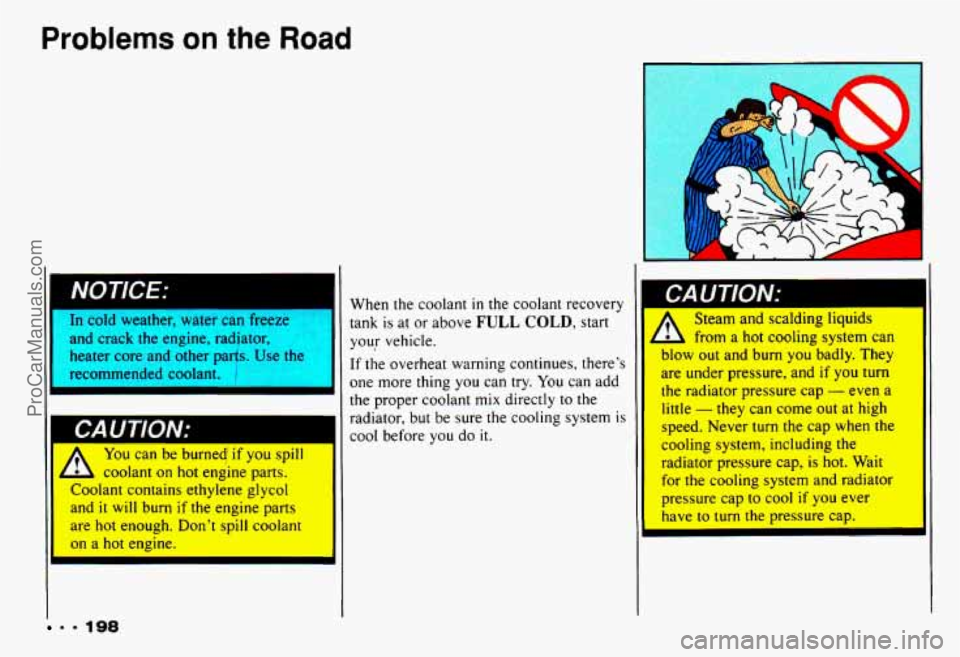
Steam and scalding liquids
from a hot cooling system can
blow out and burn you badly. They
are under pressure, and
if you turn
the radiator pressure cap
- even a
little
- they can come out at high
speed. Never
turn the cap when the
cooling system, including the
radiator pressure cap,
is hot. Wait
for the cooling system and radiator
pressure cap to cool
if you ever
have to turn the pressure cap.
ProCarManuals.com
Page 220 of 358
Problems on the Road
If you let your tires spin at high
speed, they can explode and
you or others could be injured. And,
the transmission or other partsof the
vehicle can overheat. That could
II I
I
cause an engine compartment fire or
other damage. When you’re stuck,
spin the wheels as little as possible.
Don’t spin the wheels above
35 mph
(55 km/h) as shown on the
speedometer.
I
Spinning your wheels can destroy
parts of your vehicle as well as the
.ires. If you spin the wheels too fast
Nhile shifting your transmission
aack and
forth, you can destro!,
your transmission.
Rocking your vehicle to get it out:
First, turn your steering wheel left and
right. That will clear the area around your
front wheels. Then shift back and forth
between
R (Reverse) and a forward gear
(or with a manual transmission, between
First or Second gear and Reverse),
spinning the wheels as little as possible.
Release the accelerator pedal while you
shift, and press lightly on
the accelerator
pedal when the transmission is
in gear. If
that doesn’t get you out after a few tries,
you may need to be towed out. If you do
need to be towed out, see “Towing Your
Vehicle”
in the Index.
... 21 6
ProCarManuals.com
Page 242 of 358
Service & Appearance Care
What to Use:
Standard and Limited-Slip Differential
Use Axle Lubricant (GM Part No.
1052271) or SAE 8OW-90 GL-5 gear
lubricant.
Engine Coolant
The following explains your cooling
system and how
to add coolant when it
is low. If
you have a problem with
engine overheating or if you need to add
coolant to your radiator, see “Engine
Overheating”
in the Index.
I
The proper coolant for your Chevrolet
will:
0
0
0
0
0
Give freezing protection down to
-34°F (-37°C).
Give boiling protection up to 262°F
(128°C).
Protect against rust and corrosion.
Help keep the proper engine
temperature.
Let
the warning lights work as they
should.
ProCarManuals.com
Page 243 of 358
What to Use:
Use a mixture of one-half clean water
(preferably distilled) and one-half
antifreeze that meets
“GM Specification
1825M,” which won’t damage aluminum
parts. You can also use a recycled coolant
conforming to
GM Specification 1825M
with a complete coolant flush and refill.
If you use this mixture, you don’t need to
add anything else.
Adding only plain water to
- b your coding system can be
dangerous. Plain water, or some
other liquid like alcohol, can boil
before the proper coolant mix will.
Your vehicle’s coolant warning
system is set for the proper coolant I
mix. With plain water or the wrong
mix, your engine could get too hot
but you wouldn’t get the overheat
warning. Your
engine could catch
fire and YOU or others could be
burned. Use a 50/50 mix of clean
water and a proper antifreeze.
--
I If you use an improper coolant mix,
your engine could overheat and be
badly damaged. The repair cost
wouldn’t be covered by your
warranty.
Too much water in 1-
mix can freeze and crack the engine,
radiator, heater core and other parts.
239
ProCarManuals.com
Page 244 of 358
Service & Appearance Care
1
Adding Coolant
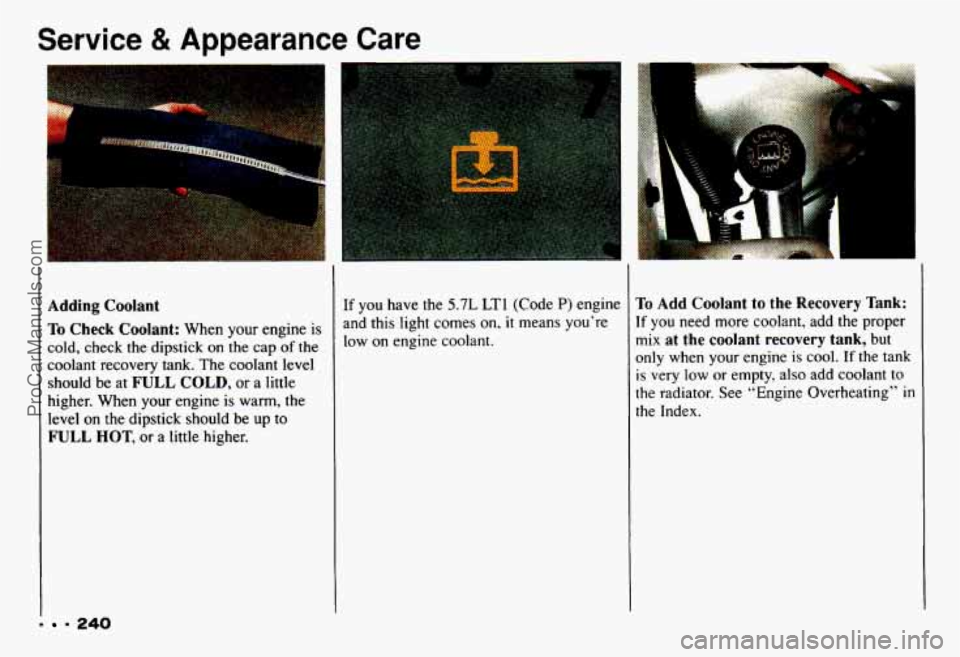
To Check Coolant: When your engine is
cold, check the dipstick on the cap of the
coolant recovery tank. The coolant level
should be at
FULL COLD, or a little
higher. When your engine is warm, the
level on the dipstick should be up to
FULL HOT, or a little higher.
If you have the 5.7L LTl (Code P) engine
and this light comes on,
it means you’re
low on engine coolant.
To Add Coolant to the Recovery Tank:
If you need more coolant, add the proper
mix
at the coolant recovery tank, but
only when your engine
is cool. If the tank
is very low or empty, also add coolant to
the radiator. See “Engine Overheating” in
the Index.
9 240
ProCarManuals.com
Page 245 of 358
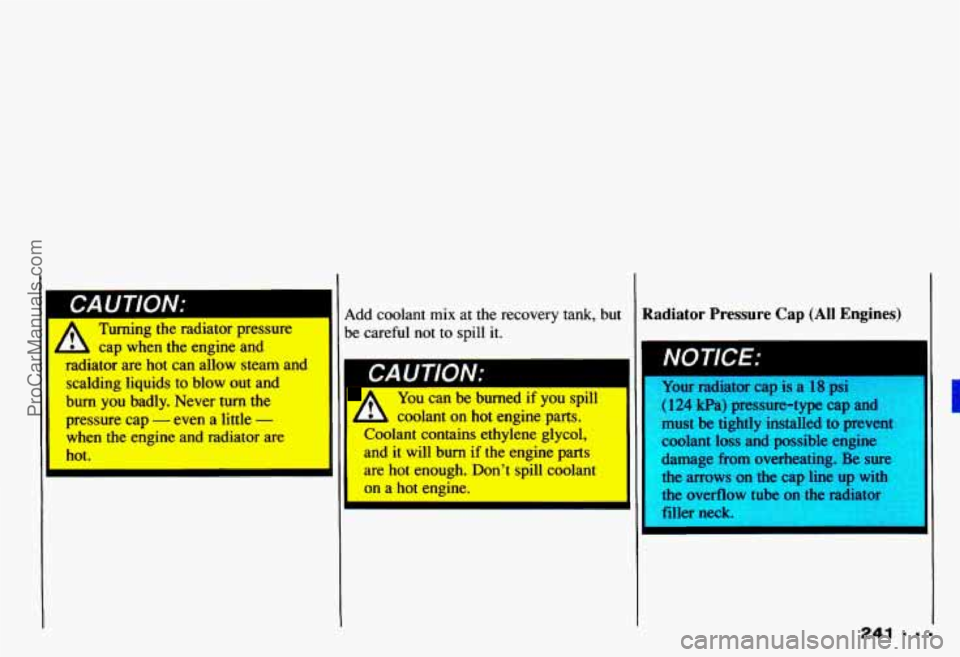
Turning the radiator pressure
L cap when the engine and
radiator
are hot can allow steam and
scalding liquids to blow out and
burn you badly. Never turn the
pressure
cap - even a little -
when the engine and radiator are
,dd coolant mix at the recovery tank, but
e careful not to spill it.
CA U TION:
I
I
You can be burned if you spill
coolant on hot engine parts.
Coolant contains ethylene glycol,
and it will burn
if the engine parts
are hot enough. Don’t spill coolant
on a hot engine.
Radiator Pressure Cap (All Engines)
~ NOTICE:
Your radiator cap is a 18 psi
(124 kPa) pressure-type cap and
must be tightly installed to prevent
coolant loss and possible engine
damage from overheating. Be sure
the arrows on the cap line
up with
the ovefflow tube on the radiator
filler neck.
ProCarManuals.com
Page 280 of 358
Service & Appearance Care
9 276
Fuses and Circuit
Breakers
The wiring circuits in your vehicle are
protected from short circuits by a
combination of fuses, circuit breakers,
and fusible thermal links in the wiring itself. This greatly reduces the chance of
fires caused by electrical problems.
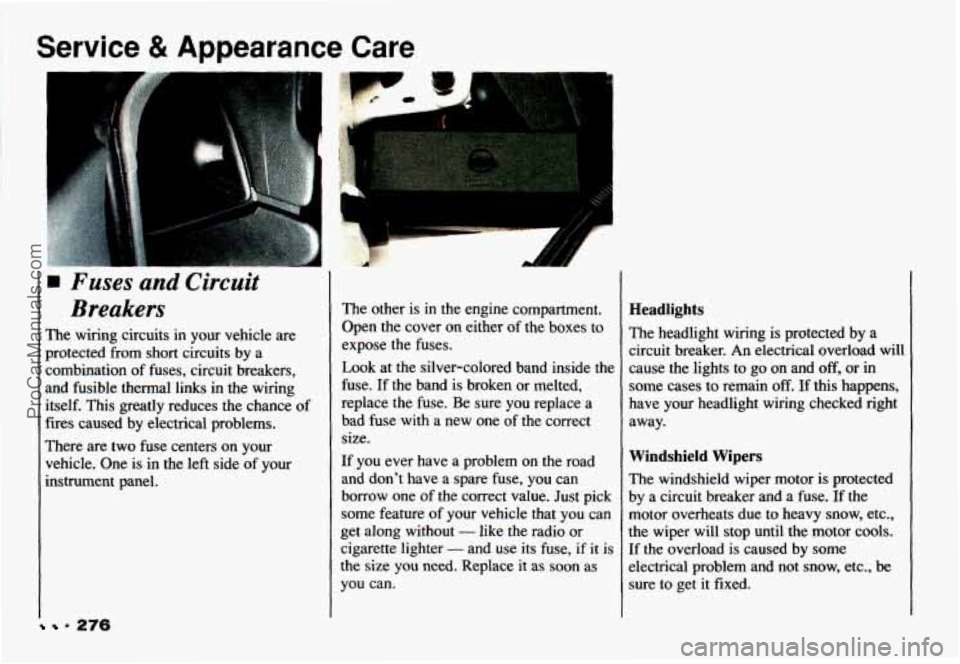
There are
two fuse centers on your
vehicle. One is
in the left side of your
instrument panel.
The other is in the engine compartment.
Open the cover on either of the boxes to
expose the fuses.
Look at the silver-colored band inside the
fuse. If the band
is broken or melted,
replace the fuse. Be sure you replace a
bad fuse with a new one
of the correct
size.
If you ever have a problem on the road
and don’t have a spare fuse, you can
borrow one
of the correct value. Just pick
some feature of your vehicle that you can
get along without
- like the radio or
cigarette lighter
- and use its fuse, if it is
the size you need. Replace
it as soon as
you can.
Headlights
The headlight wiring is protected by a
circuit breaker.
An electrical overload will
cause the lights to go on and off, or in
some cases to remain
off. If this happens,
have your headlight wiring checked right
away.
Windshield Wipers
The windshield wiper motor is protected
by a circuit breaker and a fuse.
If the
motor overheats due to heavy snow, etc.,
the wiper will stop until the motor cools.
If the overload is caused by some
electrical problem and not snow, etc., be
sure to get it fixed.
ProCarManuals.com