fuel CHEVROLET CAMARO 1993 User Guide
[x] Cancel search | Manufacturer: CHEVROLET, Model Year: 1993, Model line: CAMARO, Model: CHEVROLET CAMARO 1993Pages: 358, PDF Size: 15.6 MB
Page 104 of 358
Features & Controls
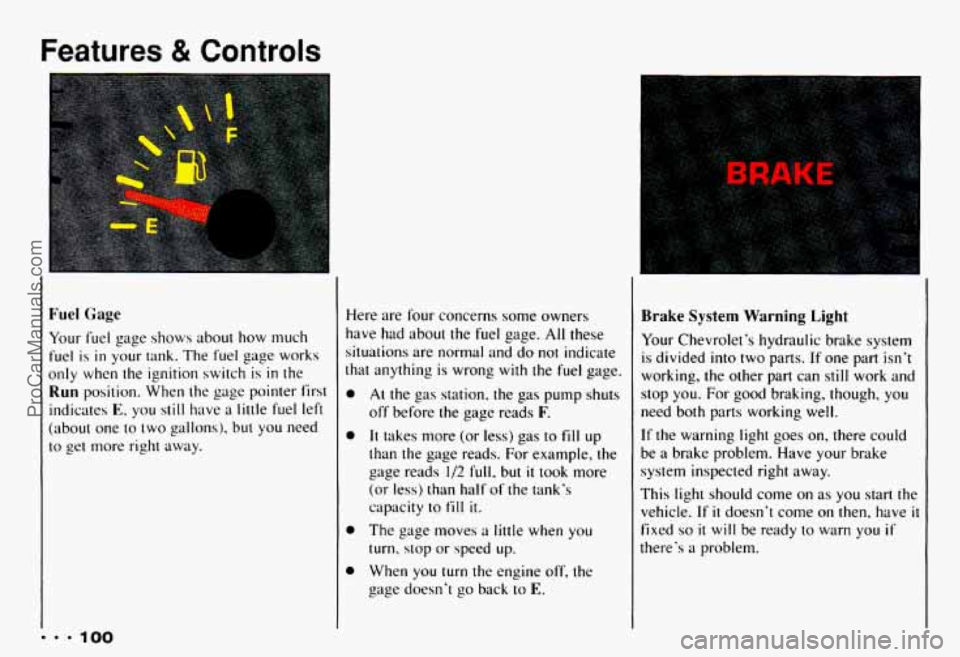
Fuel Gage
... 100
Your fuel page shows about how much
fuel
is in your tank. The fuel gage works
only when the ignition switch is
in the
Run position. When the gage pointer first
indicates
E, you still have a little fuel left
(about one to two gallons),
but you need
to get more right away. Here
are four concerns some owners
have had about the fuel gage.
All these
e
situations are normal and do not indicate
that anything
is wrong with the fuel gage.
e
0
0
At the gas station, the gas pump shuts
off before the gage reads
F.
It takes more (or less) gas to fill up
than the gage reads. For example, the
gage reads
1/2 full, but it took more
(or
less) than half of the tank's
capacity
to fill it.
The gage moves a little when you
turn, stop or speed up.
When you
turn the engine off, the
c gage doesn't go back to E.
Brake System Warning Light
Your Chevrolet's hydraulic brake system
is divided into two parts. If one part isn't
working, the other part can still work and
stop you. For good braking, though, you
need both parts working well.
If the warning light goes on, there could
be a brake problem. Have your brake
system inspected right away.
This light should come on as you start the
vehicle.
If it doesn't come on then, have it
fixed so it will be ready to warn you if
there's a problem.
ProCarManuals.com
Page 107 of 358
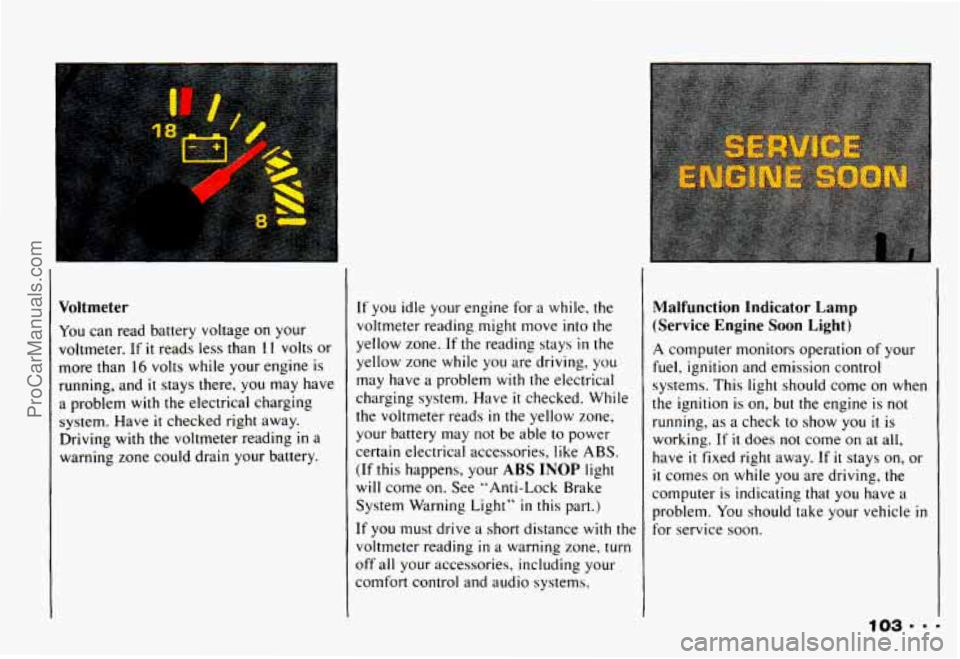
Voltmeter
You can read battery voltage on your
voltmeter. If
it reads less than 1 I volts or
more than
16 volts while your engine is
running, and
it stays there, you may have
a problem with the electrical charging
system. Have
it checked right away.
Driving with the voltmeter reading
in a
warning zone could drain your battery.
If you idle your engine for a while, the
voltmeter reading might move into the
yellow zone.
If the reading stays in the
yellow zone while you are driving, you
may have a problem with
the electrical
charging system. Have
it checked. While
the voltmeter reads
in the yellow zone,
your battery may
not be able to power
certain electrical accessories, like ABS.
(If this happens, your ABS INOP light
will come
on, See "Anti-Lock Brake
System Warning Light"
in this part.)
It' you must drive a short distance with the
voltmeter reading
in a warning zone. turn
off all your accessories, including your
comfort control and audio systems.
Malfunction Ind-kator Lamp
(Service Engine Soon Light)
A computer monitors operation of your
fuel, ignition and emission control
systems. This light should come on when
the ignition is
on, but the engine is not
running, as a check
to show you il is
working.
If it does not come on at all,
have
it fixed right away. If it stays on, or
it comes on while you are driving, the
computer is indicating that you have
a
problem. You should take your vehicle in
for service soon.
ProCarManuals.com
Page 108 of 358
Features & Controls
It you keep driving your vehicle
with this
fight on, after a while
emission controls won’t work
well, your fuel economy won’t be
good and your engine may
not rul
as smoothly. This could lead tc
costly repairs not covered by y
warranty.
... 104
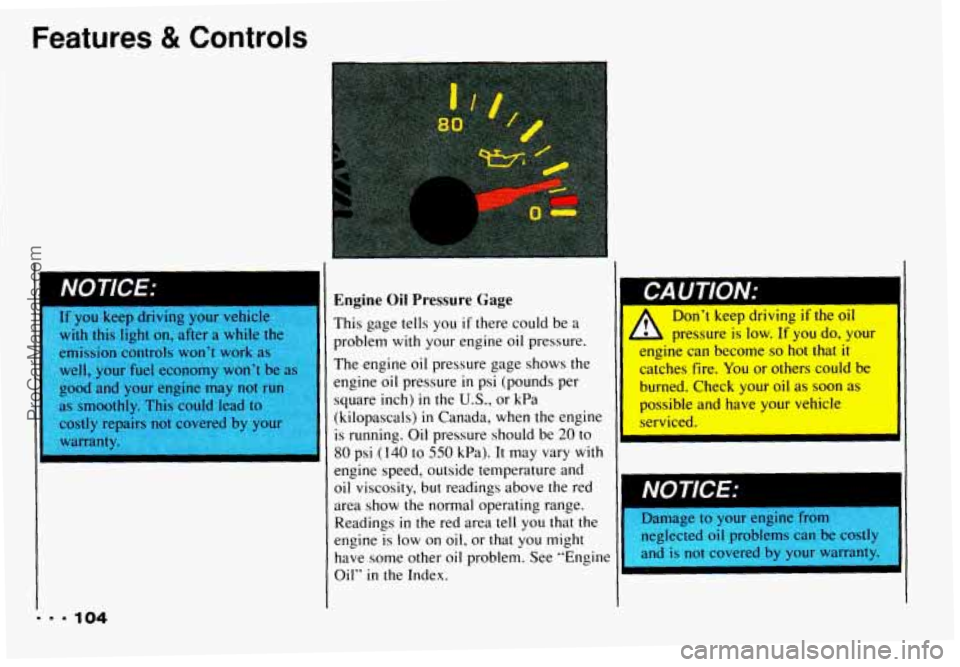
Engine Oil Pressure Gage
This gage tells you if there could be a
problem with your engine oil pressure.
The engine oil pressure gage shows the
engine oil pressure
in psi (pounds per
square inch)
in the U.S., or kPa
(kilopascals)
in Canada, when the engine
is running. Oil pressure should be 20 to
80 psi (140 to 550 kPa). It may vary with
engine speed, outside temperature and
oil viscosity, but readings above the red
area show the normal operating range.
Readings
in the red area tell you that the
engine is
low on oil, or that you might
have some other oil problem. See “Engine
Oil”
in the Index.
Don’t keep driving if the oil
h pressure is low. If you do, your
cllgine can become
so hot that it
I catches fire. You or others could be
burned. Check your
oil as soon as
possible and have your vehicle
serviced.
I NOTICE:
‘I
3
Damage your engine from
neglected oil problems can be costl)
ProCarManuals.com
Page 117 of 358
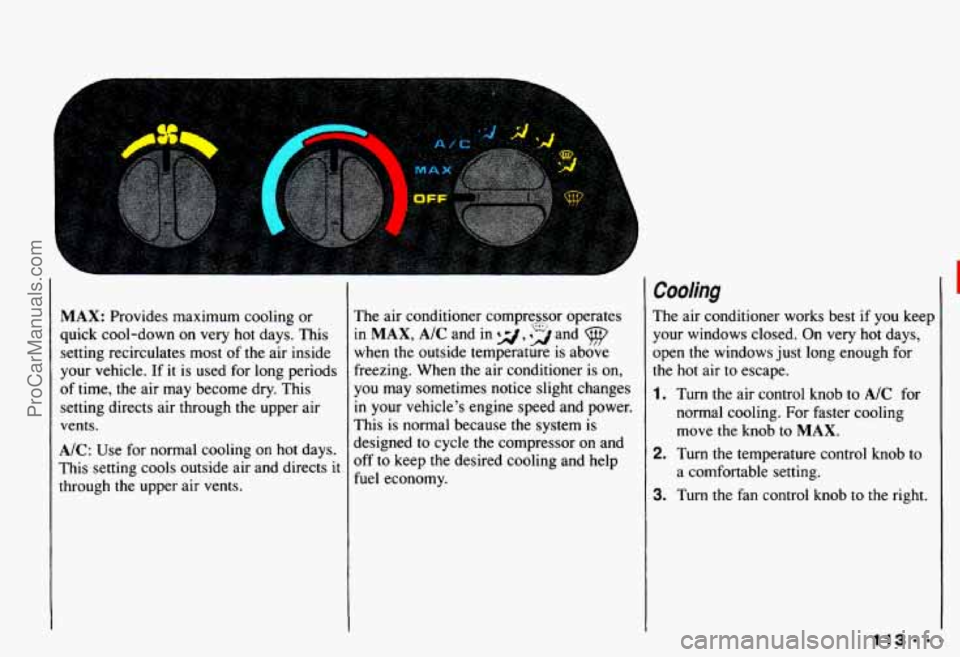
MAX: Provides maximum cooling or
quick cool-down
on very hot days. This
setting recirculates most of
the air inside
your vehicle. If it is used for long periods
of time, the air may become dry. This
setting directs air through the upper air
vents.
A/C: Use for normal cooling on hot days.
This setting cools outside air and directs
it
through the upper air vents.
The air conditioner compressor operates
in MAX, A/C and in 9, t2 and 9
when the outside temperature is above
freezing. When the air conditioner is on,
you may sometimes notice slight changes
in your vehicle’s engine speed and power.
rhis is normal because the system is
designed to cycle the compressor on and
Dff to keep the desired cooling and help
fuel economy.
Cooling
The air conditioner works best if you keep
your windows closed. On very hot days,
open
the windows just long enough for
the hot air to escape.
1. Turn the air control knob to A/C for
normal cooling. For faster cooling
move
the knob to MAX.
2. Turn the temperature control knob to
3. Turn the fan control knob to the right.
a comfortable setting.
ProCarManuals.com
Page 146 of 358
Your Driving and the Road
I
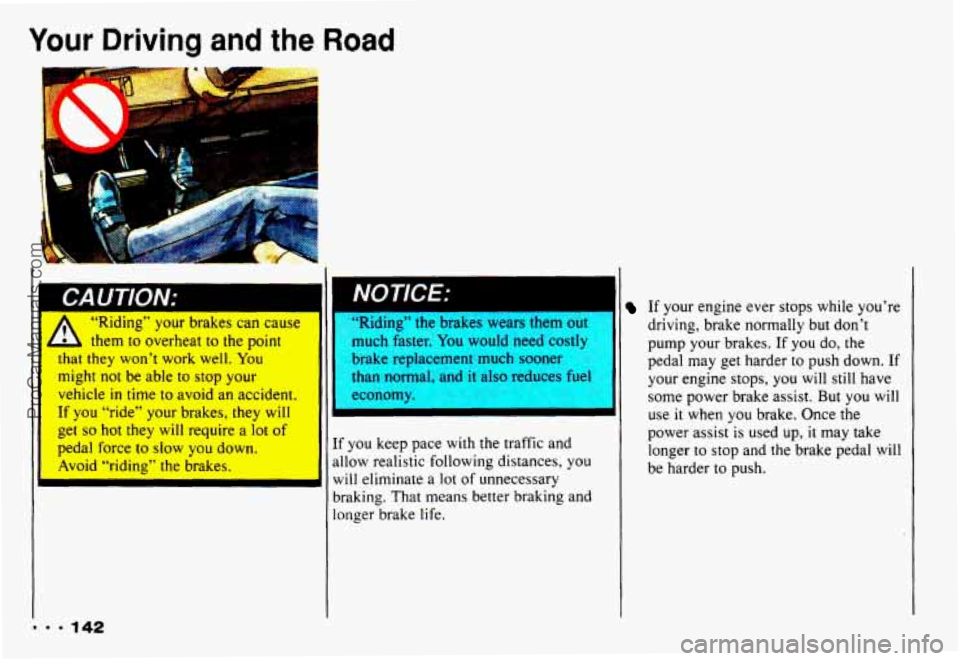
CAUTION: - A 66. nlulllg YVUl UlaKGS Cdn Cause
them to overheat to the point
that they won’t work well. You
might
not be able to stop your
vehicle
in time to avoid an accident.
If you “ride” your brakes, they
will
get so hot they will require a lot of
pedal force to slow you down.
Avoid “riding” the brakes. Klamg-.
me DraaKes wears
tnern 01
lnuch faster. You would need costly
brake replacement much sooner
than normal, and
it also reduces fuel
economy.
If you keep pace
with the traffic and
allow realistic following distances, you
will eliminate a lot of unnecessary
braking. That means better braking and
longer brake life.
I
If your engine ever stops while you’re
driving, brake normally
but don’t
pump your brakes. If you do,
the
pedal may get harder to push down. If
your engine stops, you
will still have
some power brake assist.
But you will
use it when you brake. Once the
power assist is used up, it may take
longer to stop and the brake pedal
will
be harder to push.
ProCarManuals.com
Page 167 of 358
Driving a Long
Distance
Although most long trips today are made
on freeways, there are
still many made on
regular highways.
Long-distance driving on freeways and
regular highways
is the same in some
ways. The
trip has to be planned and the
vehicle prepared, you drive at
higher-than-city speeds, and there are
longer turns behind the wheel. You’ll
enjoy your trip more
if you and your
vehicle are
in good shape. Here are some
:ips for a successful long trip.
Before Leaving on a Long Trip
Make sure you’re ready. Try to be well
rested. If you must start when you’re not
fresh
- such as after a day’s work -
don’t plan to make too many miles that
first part of the journey. Wear comfortable
clothing and shoes you can easily drive
in.
Is your vehicle ready for a long trip? If
you keep
it serviced and maintained, it’s
ready to go. If
it needs service, have it
done before starting out. Of course, you’ll
find experienced and able service experts
in Chevrolet dealerships all across North
America. They’ll be ready and willing to
help
if you need it. Here
are some things you can check
before a trip:
0
0
0
0
0
Windshield Washer Fluid: Is the
reservoir
full? Are all windows clean
inside and outside?
Wiper Blades: Are they in good
shape?
Fuel, Engine Oil, Other Fluids:
Have you checked all levels?
Lights: Are they all working? Are the
lenses clean?
Tires: They are vitally important to a
safe, trouble-free trip.
Is the tread
good enough for long-distance
driving? Are the tires all inflated to
the recommended pressure?
163 -
ProCarManuals.com
Page 177 of 358
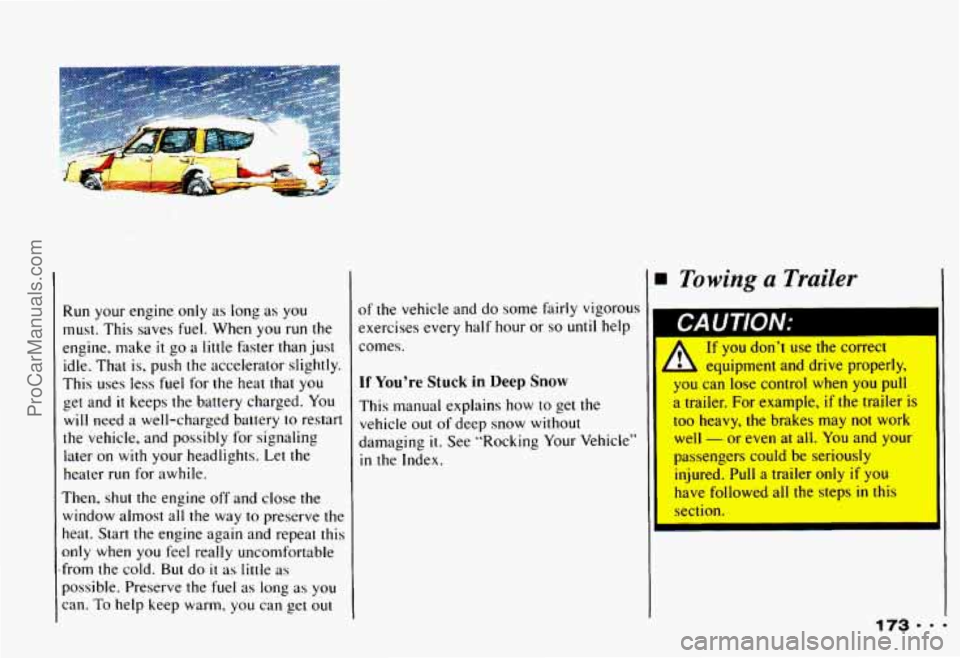
Run your engine only as long as you
must. This saves fuel. When you
run the
engine, make
it go a little faster than just
idle. That is, push the accelerator slightly.
This uses less fuel for the heat that you
get and
it keeps the battery charged. You
will need a well-charged battery to restart
the vehicle, and possibly for signaling
later on
with your headlights. Let the
heater
run for awhile.
Then. shut the engine off and close the
window almost all the way to preserve the
heat. Start the engine again and repeat this
only when you feel really uncomfortable
from the cold.
But do it as little as
possible. Preserve the fuel as long as you
can.
To help keep warm. you can get out
3f the vehicle and do some fairly vigorous
zxercises every half hour or
so until help
Zomes.
If You're Stuck in Deep Snow
This manual explains how to get the
vehicle
out of deep snow without
damaging it. See "Rocking Your Vehicle"
in the Index.
Towing a Trailer
you can lose control when you pull
a trailer. For example, if the trailer is
too heavy, the brakes may not work
well - or even at all. You and your
passengers could be seriously
injured. Pull a trailer only if you
have followed all the steps in this
section.
ProCarManuals.com
Page 178 of 358
Your Driving and the Road
I NOTICE:
AAtnage your vehicle and result i~
jtly repairs not covered by you.
warranty.
To pull a trailer correctly,
follow the advice
in this section.
I
Your vehicle can tow a trailer if it is
equipped
with the proper trailer towing
equipment.
To identify what the vehicle
trailering capacity
is for your vehicle, you
should read the information in “Weight
of the Trailer” that appears later
in this
section. But trailering is different than just
driving your vehicle by itself. Trailering
means changes
in handling, durability, and fuel economy.
Successful, safe
trailering takes correct equipment, and
it has to be used properly.
That’s the reason for this section, In it are
many time-tested, important trailering
tips and safety rules. Many of these are
important for your safety and that of your
passengers.
So please read this section
carefully before you pull a trailer.
Load-pulling components such as the
engine, transmission, wheel assemblies,
and tires are forced to work harder against
the drag of the added weight. The engine
is required to operate at relatively higher
speeds and under greater loads, generating extra
heat. What’s more,
the
trailer adds considerably to wind
resistance, increasing the pulling
requirements.
If You Do Decide to Pull a Trailer
If you do, here are some important points.
There are many different laws having
to do
with trailering. Make sure your
rig
will be legal, not only where you
live but also where you’ll be driving.
A good source for this information
can be state or provincial police.
ProCarManuals.com
Page 221 of 358
Part b
Here you will find information
about the care
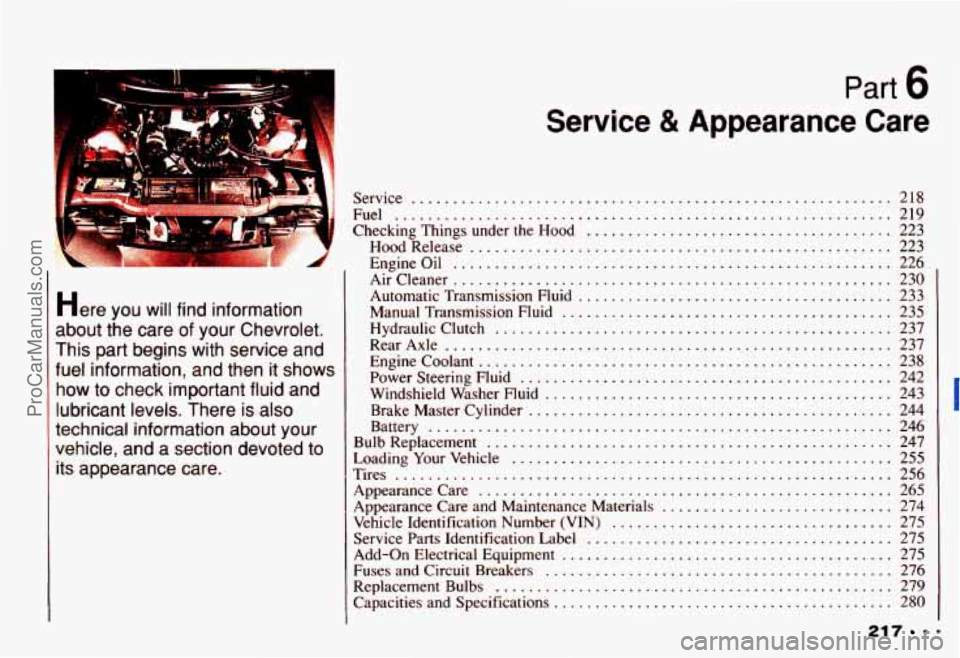
of your Chevrolet .
This part begins with service and
fuel information. and then it shows
how
to check important fluid and
lubricant levels
. There is also
technical information about your
vehicle. and a section devoted to
its appearance care
.
Service & Appearance Care
Service .......................................................... 218
Fuel
............................................................ 219
Checking Things under the Hood
..................................... 223
HoodRelease
................................................... 223
Engineoil
...................................................... 226
Aircleaner
..................................................... 230
Automatic Transmission Fluid
...................................... 233
Manual Transmission Fluid
........................................ 235
Hydraulicclutch
................................................ 237
RearAxle
...................................................... 237
Enginecoolant
.................................................. 238
Power Steering Fluid
............................................. 242
Windshield Washer Fluid
.......................................... 243
Brake Master Cylinder
............................................ 244
Battery
........................................................ 246
Bulb Replacement
................................................. 247
Loading Your Vehicle
.............................................. 255
Appearance Care and Maintenance Materials
............................ 274
Vehicle Identification Number (VIN)
.................................. 275
Service Parts Identification Label
..................................... 275
Add-on Electrical Equipment
........................................ 275
Fuses and Circuit Breakers
.......................................... 276
Replacement Bulbs
................................................ 279
Capacities and Specifications
......................................... 280
Tires
............................................................ 256
Appearancecare
.................................................. 265
217
ProCarManuals.com
Page 223 of 358
NOTICE:
Fuel
The 8th digit of your Vehicle
Identification Number (VIN) shows
the code letter for your engine.
You will
find the VIN at the top left
of your
instrument panel. (See “Vehicle
Identification Number” in the Index.)
3.4L L32 (Code S)
Use regular unleaded gasoline rated at
87 octane or higher. It should meet
specifications ASTM
D4814 in the U.S.
and CGSB 3.5-92 in Canada. These fuels
should have the proper additives,
so you
should not have to add anything to the
fuel.
In the U.S. and Canada, it’s easy to
be
sure you get the right kind of gasoline
(unleaded). You’ll see
UNLEADED right
In the pump. And only unleaded nozzles
will
fit into your vehicle’s filler neck.
Be sure the posted octane is at least 87.
:f the octane is less than 87, you may get
sl heavy knocking noise when you drive.
If it’s bad enough, it can damage your
engine.
If you’re using fuel rated at
87 octane or
higher and you still hear heavy knocking,
your engine needs service. But don’t
worry if you hear a little pinging noise
when you’re accelerating or driving up a
hill. That’s normal, and you don’t have to
buy a higher octane fuel to get rid of
pinging. It’s the heavy, constant knock
that means you have a problem.
ProCarManuals.com