belt CHEVROLET CAMARO 1993 Owner's Manual
[x] Cancel search | Manufacturer: CHEVROLET, Model Year: 1993, Model line: CAMARO, Model: CHEVROLET CAMARO 1993Pages: 358, PDF Size: 15.6 MB
Page 34 of 358
Seats & Safety Belts
CAUTlON;
on’t attach anything to
~ :e steering wheel pad. It
0
0
0
-* 9 30
might injure thedriver if the
air bag inflates.
Don’t set anything on or attach
anything
to the instrument
panel.
It might injure the
passenger
if the air bag
inflates.
The air bags are designed
to
inflate only once. After they
inflate, you’ll need some new
parts for your air bag system.
If you don’t get them, the air
bag system won’t be there
to
help protect you in another
crash.
A new system will
include air bag modules and
possibly other parts.
Let only qualified technicians
work on you# air bag system.
Improper service can mean
that your air bag system
won’t
work properly. See your dealer
for service.
I
may not work properly. You may
have
to replace both the air bag a
%ak the air bag cover.
: instrument panel. Don’ pen or
Servicing Your Chevrolet with the Air
Bag System
Please tell or remind anyone who works
on your Chevrolet that it has the air bag
system. There are parts of the air bag
system
in several places around your
vehicle. You don’t want the system to
inflate while someone is working on your
vehicle. The air bag system does not need regular maintenance.
Your Chevrolet
dealer and the
1993 Camaro Service
Manual have information about the air
bag system, including repair
or disposal.
I A For up to 2 minutes after the
L ignition key is turned off and
the battery disconnected, an air bag
can still inflate during improper
service.
You can be injured if you
are close to an air bag when it
inflates. Be sure to follow the proper
service procedures.
ProCarManuals.com
Page 35 of 358
When electrical work is done under the
hood or inside your vehicle, the ignition
should be in
LOCK if possible. Avoid
wires wrapped with yellow tape, or yellow
connectors. They are probably part
of the
air bag system.
Your vehicle has a driver’s air bag and a
right-front passenger’s air bag. Both bags
must
be disconnected if the ignition has to
be on for electrical work or if the steering
column is to be disassembled. First,
disconnect the driver’s air bag like this:
1. Turn off the ignition.
2. Remove the SIR (air bag) fuse.
(See “Fuses and Circuit Breakers”
in the Index.)
3. Disconnect the yellow connector at the
base
of the steering column. After
you follow this procedure for the
jriver
’s air bag, then disconnect the
right-front passenger’s air bag like this:
1. Remove the cover under the instrument
2. Disconnect the small yellow connector
When the work is complete, if the air bag
system was disconnected, be sure to
reattach everything and replace
the fuse
before turning the ignition on. When you
turn the ignition key on, be sure you see
the air bag readiness light on the
instrument panel.
If you don’t see this lighl
flash and then go out as usual, have your
air bag system repaired.
panel.
below the glove box.
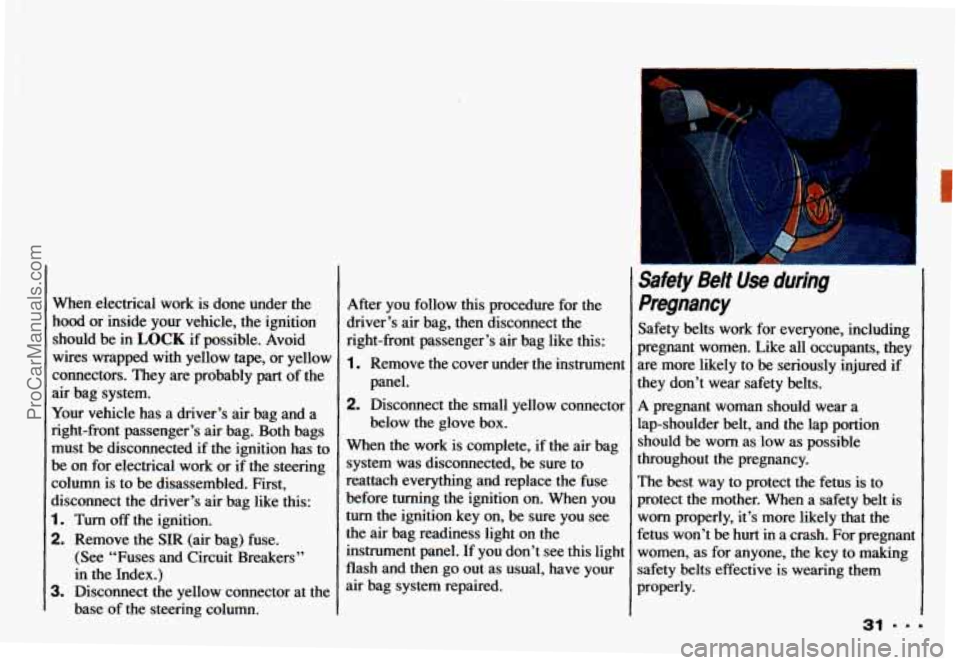
Safety Belt Use dumg
Pregnancy
Safety belts work for everyone, including
pregnant women. Like all occupants, they
are more likely to be seriously injured if
they don’t wear safety belts.
A pregnant woman should wear a
lap-shoulder belt, and the lap portion
should be worn as low as possible
throughout the pregnancy.
The best way to protect the fetus is to
protect the mother. When a safety belt is
worn properly, it’s more likely that the
fetus won’t be hurt in a crash. For pregnant
women, as for anyone, the key to making
safety belts effective is wearing them
properly.
31 ===
ProCarManuals.com
Page 36 of 358
Seats 8t Safety Belts
Passenger Positions
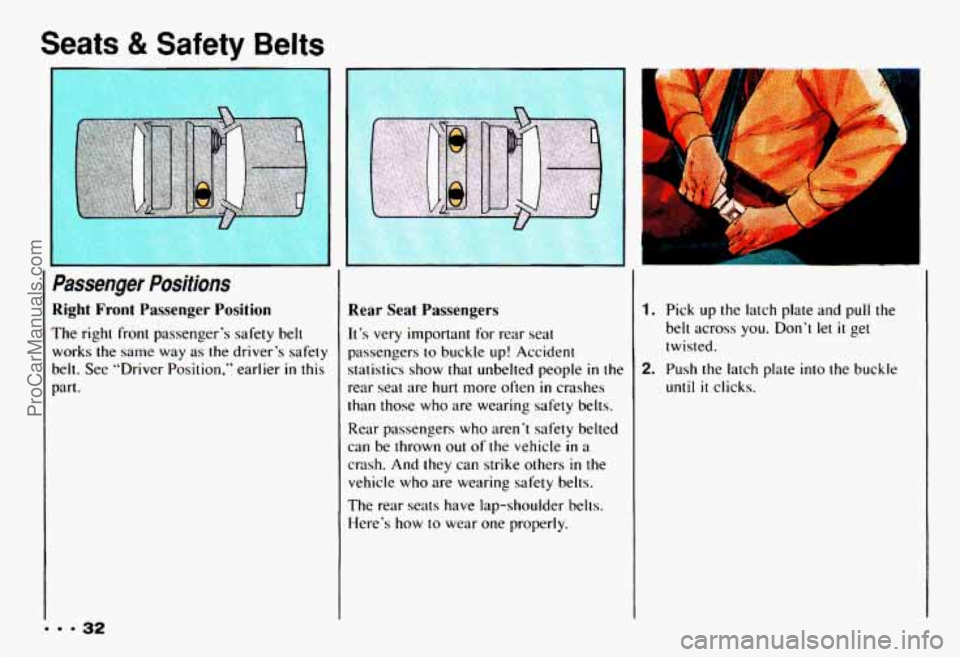
Right Front Passenger Position
The right front passenger’s safety belt
works the same way as
the driver’s safety
belt. See “Driver Position,” earlier
in this
part.
Rear Seat Passengers
It’s very important for rear seat
passengers
to buckle up! Accident
statistics show that unbelted people
in the
rear seal are hurt more often in crashes
than those who are wearing safety belts.
Rear passengers who aren’t safety belted
can be thrown out
of the vehicle in a
crash. And they can strike others in the
vehicle who are wearing safety belts.
The rear seats
have lap-shoulder belts.
Here’s
how to wear one properly.
1.
2.
Pick up the latch plate and pull the
belt across
you. Don’t let it get
twisted.
Push the latch plate into the buckle
until it clicks.
ProCarManuals.com
Page 37 of 358
>ai
r’
If the belt stops before it reaches the
buckle,
tilt the latch plate and keep
pulling
until you can buckle it.
If
the belt is not long enough, see
“Safety Belt Extender” at
the end of
this section.
Make sure the release button
on the
buckle Paces upward or outward so
you would be able to unbuckle it
quickly if you ever had to.
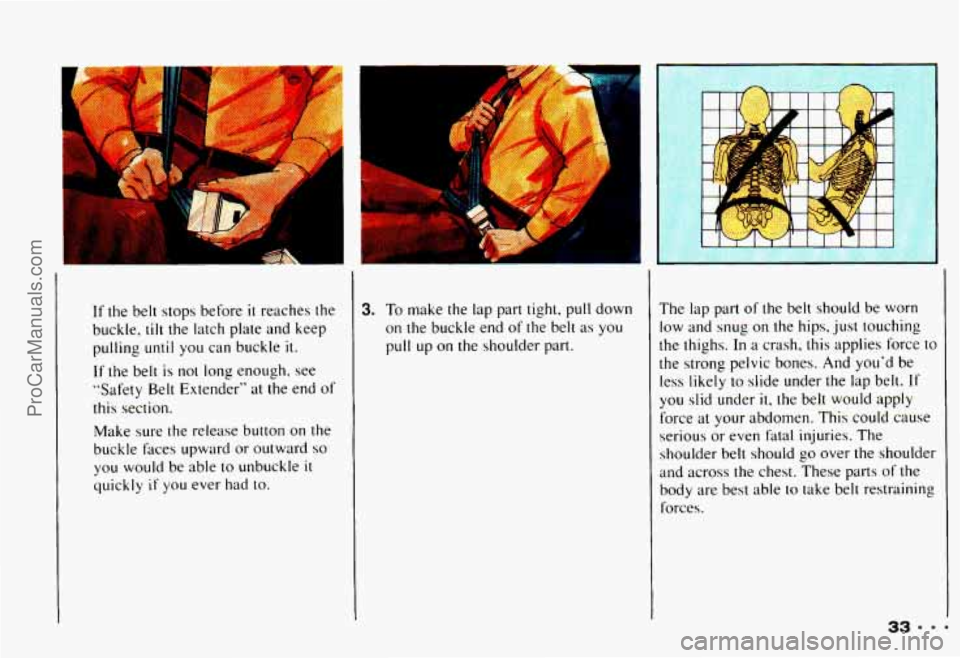
3. To make the lap part tight, pull down
on the buckle end
of the belt as you
pull up
on the shoulder part. The lap
part
of the belt should be worn
low and snug
on the hips, just touching
the thighs. In a crash, this applies force to
the strong pelvic bones. And you‘d be
less
likely to slide under the lap belt. If
you slid under it, the belt would apply
force at your abdomen.
This could cause
serious
or even fatal injuries. The
shoulder belt should go over the shoulder
and across the chest. These parts
of the
body are best able to take belt restraining
forces.
33.
ProCarManuals.com
Page 38 of 358
Seats & Safety Belts
r
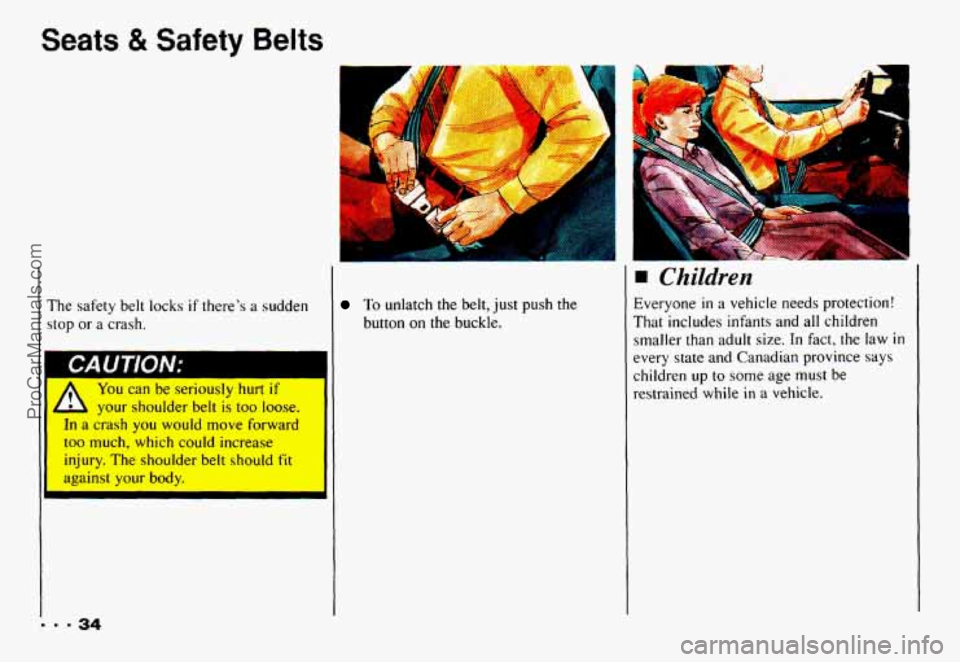
The safety belt locks if there's a sudden
stop or a crash.
You can be seriously
hurt if
1 4 your shoulder belt is too loose.
I In a crash you would move forward
3 much, which could increase
I InJury. The shoulder belt should fit
To unlatch the belt, just push the
button on the buckle.
children
Everyone in a vehicle needs protection!
That includes infants and all children
smaller than adult size. In fact, the law
in
every state and Canadian province says
children up to some age must be
restrained while
in a vehicle.
ProCarManuals.com
Page 39 of 358
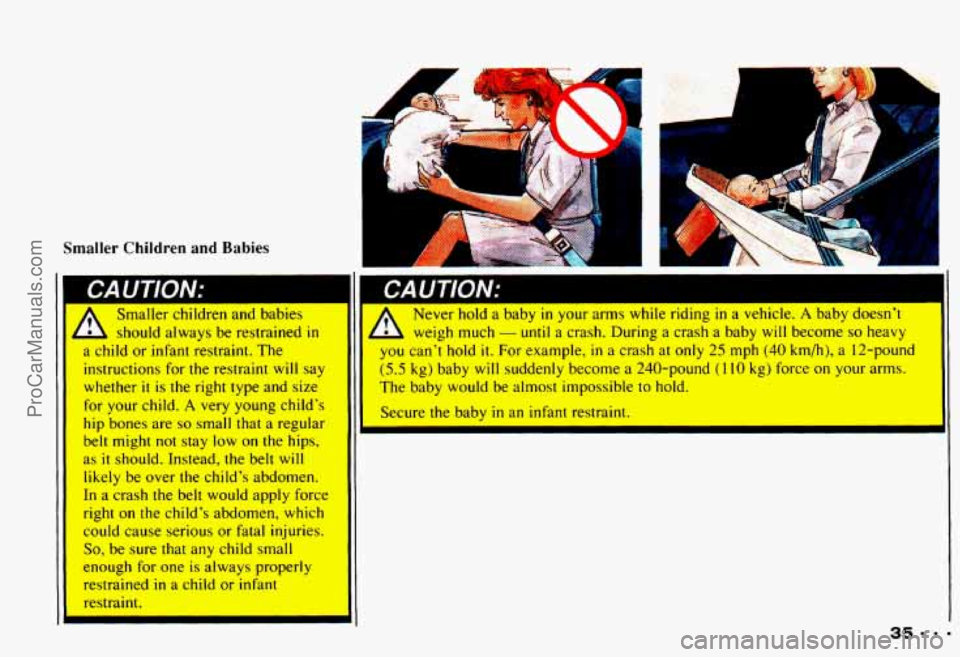
Smaller Children and Babies
Smaller children and babies
should always
be restrained in
a child or infant restraint. The
instructions for the restraint will say
whether
it is the right type and size
for your child. A very young child’s
hip bones are so small that a regular
h-lt might not stay low on the hips,
uu it should. Instead, the belt will
likely be over the child’s abdomen.
In a crash the belt would apply force
right
on the child3 abdomen, which
could
cause serious or fatal injuries.
So, be sure that any child small
enough for one is always properly
itrained
in a child or infant
ldraint.
I I,
A
Never hold a baby in your arms while riding in a vehicle. A baby doesn’t
weigh much - until a crash. During a crash a baby will become so heavy
you can’t hold it. For example, in a crash at only 25 mph (40 km/h>, a I2-pound
(5.5 kg) baby will suddenly become a 240-pound (I 10 kg) force on your arms.
The baby
would be almost impossible to hold.
Secure the baby in an infant restraint.
I
ProCarManuals.com
Page 40 of 358
Seats & Safety Belts
CAUTION: I
Child Restraints
Be sure to follow the instructions for the
restraint.
You may find these instructions
on the restraint itself or
in a booklet, or
both. These restraints use the belt system
in your vehicle, but the child also has to
be secured within
the restraint to help
reduce the chance of personal injury. The
instructions that come with
the infant or
child restraint
will show you how to do
that.
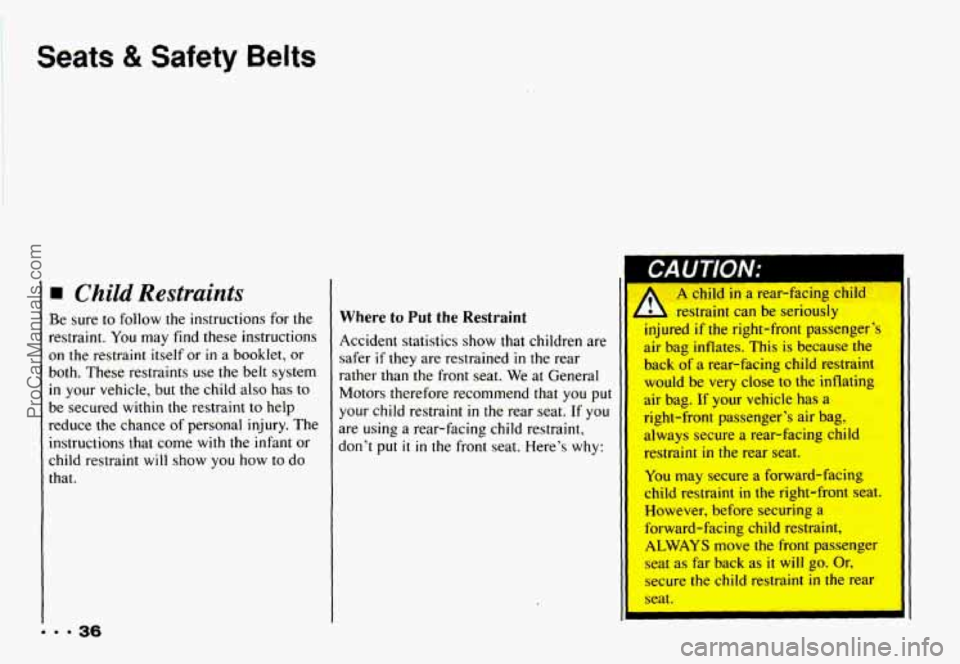
Where to Put the Restraint
Accident statistics show that children are
safer
if they are restrained in the rear
rather than the front seat.
We at General
Motors therefore recommend that you put
your child restraint
in the rear seat. If you
are using a rear-facing child restraint,
don’t put
it in the front seat. Here’s why:
I
ProCarManuals.com
Page 42 of 358
Seats & Safety Belts
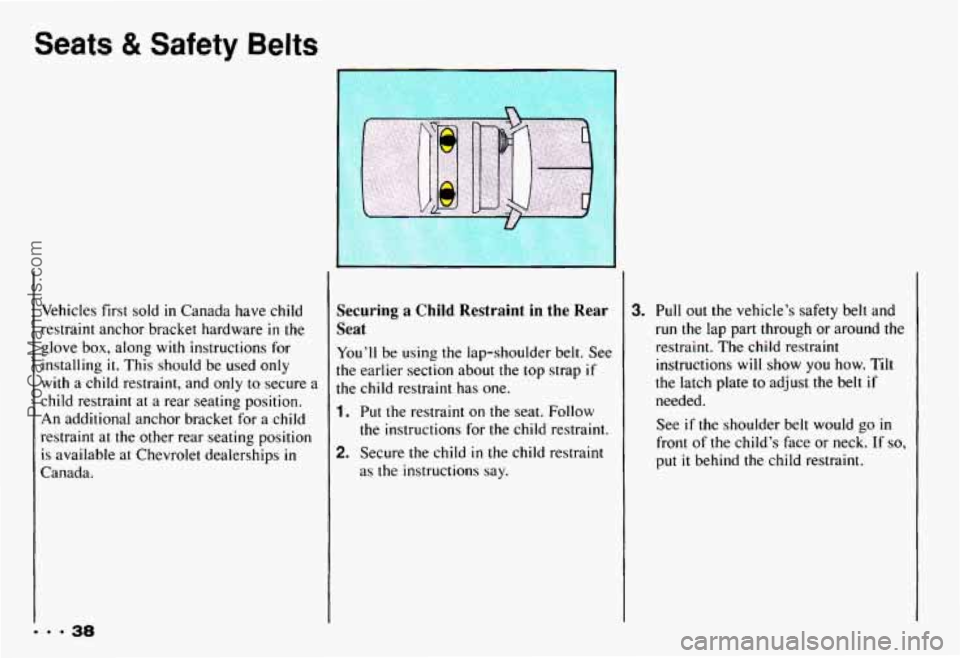
Vehicles first sold in Canada have child
restraint anchor bracket hardware
in the
glove box, along
with instructions for
installing
it. This should be used only
with a child restraint, and only to secure a
child restraint at a rear seating position.
An additional anchor bracket for a child
restraint at the other rear seating position
is available at Chevrolet dealerships
in
Canada.
Securing a Child Restraint in the Rear
Seat
You’ll be using the lap-shoulder belt. See
the earlier section about the top strap
if
the child restraint has one.
1. Put the restraint on the seat. Follow
the instructions for the child restraint.
2. Secure the child in the child restraint
as the instructions say.
3. Pull out the vehicle’s safety belt and
run the lap part through or around the
restraint. The child restraint
instructions
will show you how. Tilt
the latch plate to adjust the belt if
needed.
See
if the shoulder belt would go in
front of the child’s face or neck. If so,
put it behind the child restraint.
ProCarManuals.com
Page 43 of 358
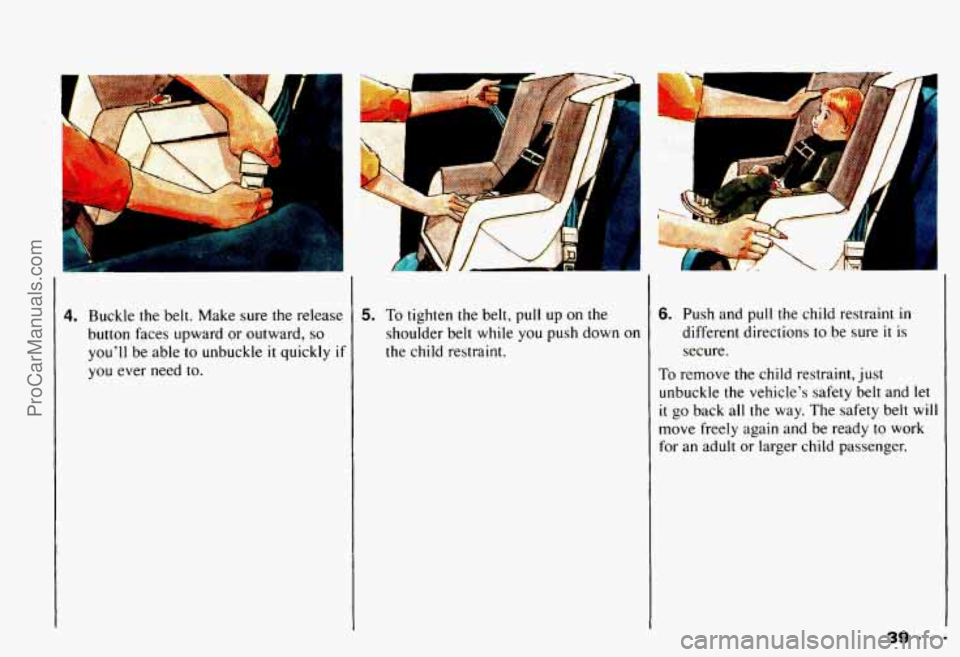
4. Buckle the belt. Make sure the release
button faces upward or outward,
so
you'll be able to unbuckle it quickly if
you ever need to.
I
I
5. To tighten the belt, pull up on the
shoulder belt while you push down on
the child restraint. 6. Push and pull the child restraint in
different directions to be sure it is
secure.
To remove the child restraint, just
unbuckle the vehicle's safety belt and let
it go back all the way. The safety belt will
move freely again and be ready
to work
for an adult or larger child passenger.
ProCarManuals.com
Page 44 of 358
Seats & Safety Belts
Securing a Child Restraint in the Right
Front Seat
Your vehicle has a right-front passenger’s
air bag.
NEVER put a rear-facing child
restraint
in this position. Here’s why:
* A rear-facing child restraint in
You’ll be using the lap-shoulder belt. See
the earlier section about
the top strap if
the child restraint has one.
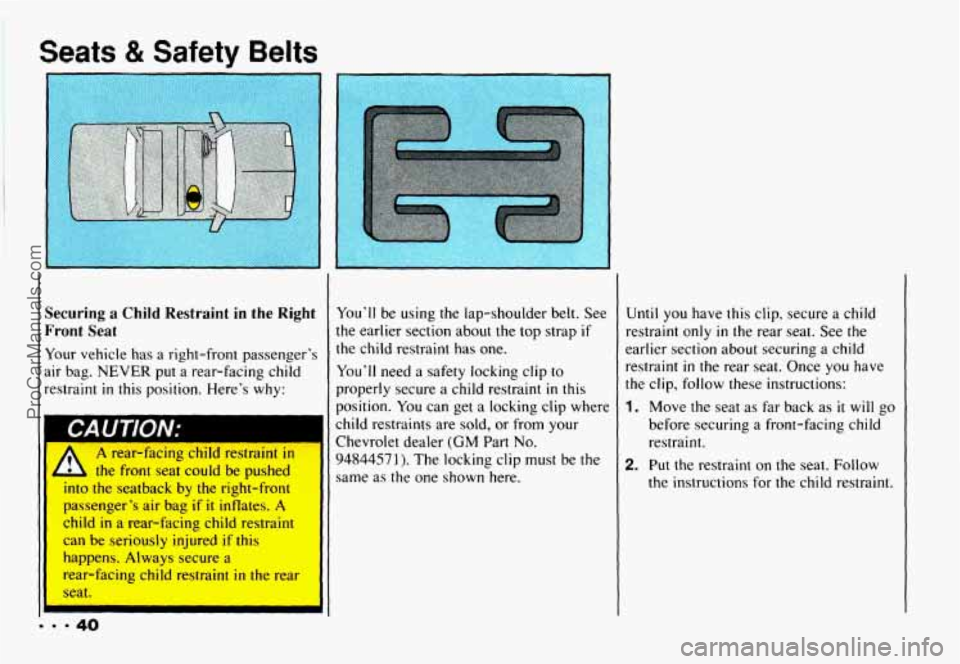
You’ll need a safety locking clip to
properly secure a child restraint
in this
position. You can get a locking clip where
child restraints are sold, or from your
Chevrolet dealer
(GM Part No.
1 the front seat could be pushed 94844571). The locking clip must be the
same as the one shown here.
into the seatback
by the right-front I I
passenger’s air bag if it inflates. A
child in a rear-facing child restraint
can be seriously injured if this
happens. Always secure a
atat.
rr-facing child restraint in the rear
99940
Until you have this clip, secure a child
restraint only
in the rear seat. See the
earlier section about securing a child
restraint
in the rear seat. Once you have
the clip, follow these instructions:
1. Move the seat as far back as it will go
before securing a front-facing child
restraint.
2. Put the restraint on the seat. Follow
the instructions for the child restraint.
ProCarManuals.com