check transmission fluid CHEVROLET CAMARO 1993 Owners Manual
[x] Cancel search | Manufacturer: CHEVROLET, Model Year: 1993, Model line: CAMARO, Model: CHEVROLET CAMARO 1993Pages: 358, PDF Size: 15.6 MB
Page 169 of 358
What can you do about highway
hypnosis'? First, be aware that
it can
happen.
Then here are some tips:
Make sure your vehicle is well
ventilated,
with a comfortably cool
interior.
Keep your eyes moving. Scan the road
ahead and
to the sides. Check your
rearview mirrors frequently and your
instruments from time
to time. This
can help you avoid a fixed stare. Wear
good sunglasses
in bright light.
Glare can cause drowsiness.
But don't
wear sunglasses
at night. They will
drastically reduce your overall vision
at
the very time you need all the
seeing power you have.
If you get sleepy,
pull off the road into
a rest, service, or parking area and
take a nap, get some exercise, or both.
For safety, treat drowsiness on the
highway as an emergency.
As in any driving situation. keep pace
with traffic and allow adequate following
distances.
Hill and Mountain
Roads
Driving on steep hills or mountains is
different from driving
in flat or rolling
terrain. If you drive regularly
in steep
country. or
if you're planning to visit
there, here are some tips that can make
your trips safer and more enjoyable.
0 Keep your vehicle in good shape.
Check all fluid levels and also the
brakes, tires, cooling system and
transmission. These parts can work
hard on mountain roads.
1659 *
ProCarManuals.com
Page 185 of 358
Maintenance When Trailer Towing
Your vehicle will need service more often
when you're pulling a trailer. See the
Maintenance Schedule for more on this.
Things that are especially important
in
trailer operation are automatic
transmission
fluid (don't overfill), engine
oil, axle lubricant. belts. cooling system,
and brake adjustment. Each of these is
covered
in this manual, and the Index will
help you find them quickly. If you're
trailering, it's
a good idea to review these
sections before
you start your trip.
Check periodically to see that all hitch
nuts
and bolts are tight.
ProCarManuals.com
Page 221 of 358
Part b
Here you will find information
about the care
of your Chevrolet .
This part begins with service and
fuel information. and then it shows
how
to check important fluid and
lubricant levels
. There is also
technical information about your
vehicle. and a section devoted to
its appearance care
.
Service & Appearance Care
Service .......................................................... 218
Fuel
............................................................ 219
Checking Things under the Hood
..................................... 223
HoodRelease
................................................... 223
Engineoil
...................................................... 226
Aircleaner
..................................................... 230
Automatic Transmission Fluid
...................................... 233
Manual Transmission Fluid
........................................ 235
Hydraulicclutch
................................................ 237
RearAxle
...................................................... 237
Enginecoolant
.................................................. 238
Power Steering Fluid
............................................. 242
Windshield Washer Fluid
.......................................... 243
Brake Master Cylinder
............................................ 244
Battery
........................................................ 246
Bulb Replacement
................................................. 247
Loading Your Vehicle
.............................................. 255
Appearance Care and Maintenance Materials
............................ 274
Vehicle Identification Number (VIN)
.................................. 275
Service Parts Identification Label
..................................... 275
Add-on Electrical Equipment
........................................ 275
Fuses and Circuit Breakers
.......................................... 276
Replacement Bulbs
................................................ 279
Capacities and Specifications
......................................... 280
Tires
............................................................ 256
Appearancecare
.................................................. 265
217
ProCarManuals.com
Page 237 of 358
Automatic Transmission Fluid
When to Check and Change:
A good time to check your automatic
transmission fluid level is when the
engine oil is changed. Refer
to the
Maintenance Schedule
to determine when
to change your fluid. See “Scheduled
Maintenance Services” in the Index.
How to Check:
Because this operation can be a little
difficult, you may choose to have this
done at a Chevrolet dealership Service
Department.
If you do it yourself, be sure to follow all
the instructions here,
or you could get a
false reading
on the dipstick. damage
your transmission.
Too
much can mean that some of thr
fluid could come
out and fall on hc
~.: engine parts, starting a fire. Be sure
to get an accurate reading if you ~“* check your transmission fluid. ~, \- ~
%it at least 30 minutes before checking
he transmission fluid level
if you have
>een driving:
D When outside temperatures are above
At high speed for quite a while.
0 In heavy traffic - especially in hot
While pulling a trailer.
90°F (32°C).
weather. To
get the right reading, the fluid should
be at normal operating temperature,
which is 180°F to 200°F
(82°C to 93°C).
To check transmission fluid hot: Get
the vehicle warmed up by driving
about
15 miles (24 km) when outside
temperatures are above
50°F (10OC). If
it’s colder than
50°F (lO”C), drive the
vehicle in
D (Third Gear) until the engine
temperature gage moves and then remains
steady for ten minutes. Then follow the
hot check procedures.
To check transmission fluid cold: A cold
check is made after the vehicle has been
sitting for eight hours
or more with the
engine off and
is used only as a reference.
Let the engine run at idle for five minutes
233 = =
ProCarManuals.com
Page 239 of 358
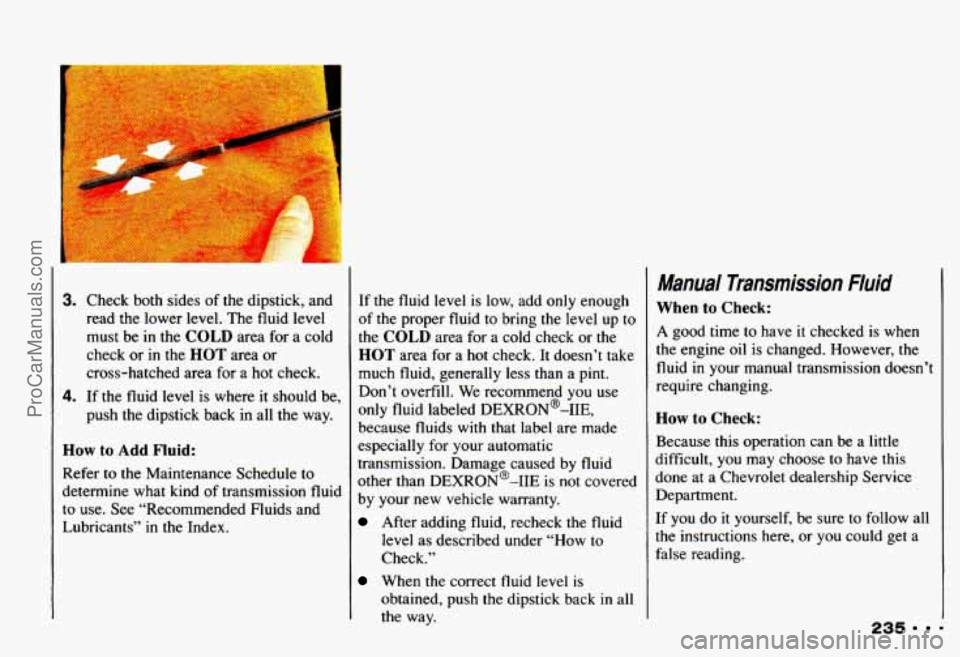
3. Check both sides of the dipstick, and
read the lower level. The fluid level
must be
in the COLD area for a cold
check or in the
HOT area or
cross-hatched area for a
hot check.
4. If the fluid level is where it should be,
push the dipstick back
in all the way.
How to Add Fluid:
Refer to the Maintenance Schedule to
determine what kind of transmission fluid
to use. See “Recommended Fluids and
Lubricants” in the Index. If the fluid level is low, add only enough
of the proper fluid to bring the level up to
the COLD area for
a cold check or the
HOT area for a hot check. It doesn’t take
much fluid, generally less than a pint.
Don’t overfill. We recommend you use
only fluid labeled
DEXRON@-IIE,
because fluids with that label are made
especially for your automatic
transmission. Damage caused by
fluid
other than DEXRON@-IIE is not covered
by your new vehicle warranty.
After adding fluid, recheck the fluid
level as described under “How to
Check.”
obtained, push the dipstick back
in all
the way.
When the correct fluid level is
Manual Transmission Fluid
When to Check:
A good time to have it checked is when
the engine oil is changed. However, the
fluid in your manual transmission doesn’t
require changing.
How to Check:
Because this operation can be a little
difficult, you may choose to have this
done at a Chevrolet dealership Service
Department.
If
you do it yourself, be sure to follow all
the instructions here, or you could get a
false reading.
235 9
ProCarManuals.com
Page 240 of 358
Service & Appearance Care
~1 NOTICE: Ill Then, follow these steps:
100 mucn or too mtIe nula can
damage your transmission.
Too
much can mean that some of the
fluid could come out and fall on hn
engine parts, starting a fire. Be s
to get an accurate reading if you
check your transmission
fluid
1. Remove the filler plug.
2. Check that the lubricant level is up to
the bottom of the filler plug hole.
11 3. If the fluid level is good, install the
plug and be sure
it is fully seated. If
the fluid level is low, add more fluid
as described in the next steps.
II
Check the fluid level only when your
engine is
off, the vehicle is parked on a
level place and the transmission is cool
enough for you to rest your fingers on the
transmission case.
How to Add Fluid:
Here’s how to add fluid. Refer to the
Maintenance Schedule to determine what
kind
of fluid to use. See “Recommended
Fluids and Lubricants”
in the Index.
1. Remove the filler plug.
2. Add fluid at the filler plug hole. Add
only enough fluid to bring the fluid
level
up to the bottom of the filler
plug hole.
3. Install the filler plug. Be sure the plug
is fully seated.
... 236
ProCarManuals.com
Page 286 of 358
Service & Appearance Care
Capacities (Approximate)
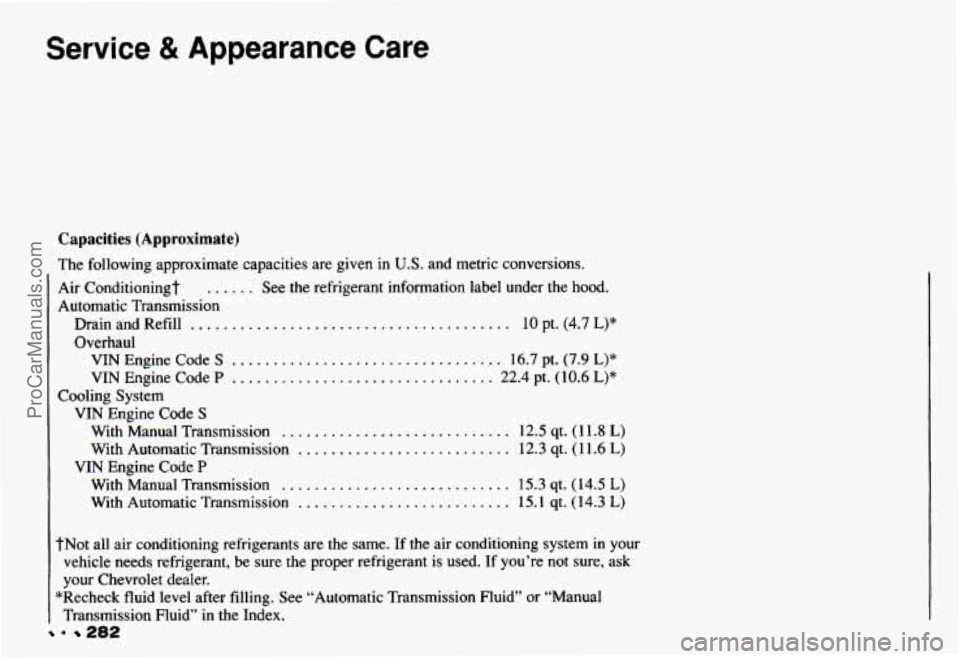
The following approximate capacities are given in U.S. and metric conversions.
Air Conditioningt
...... See the refrigerant information label under the hood.
Automatic Transmission
Drain and Refill
....................................... 10 pt. (4.7 L)*
Overhaul VIN Engine Code
S ................................. 16.7 pt. (7.9 L)*
VIN Engine Code P ................................ 22.4 pt. (10.6 L)*
Cooling System
VIN Engine Code
S
With Manual Transmission ............................ 12.5 qt. (11.8 L)
With Automatic Transmission .......................... 12.3 qt. ( 11.6 L)
With Manual Transmission ............................ 15.3 qt. ( 14.5 L)
With Automatic Transmission .......................... 15.1 qt. (14.3 L)
VIN Engine Code P
tNot all air conditioning refrigerants are the same. If the air conditioning system in your
vehicle needs refrigerant, be sure the proper refrigerant is us\
ed. If you’re not sure, ask
your Chevrolet dealer.
Transmission Fluid” in the Index.
*Recheck fluid level
after filling. See “Automatic Transmission Fluid” or “Manual
. 282
ProCarManuals.com
Page 287 of 358
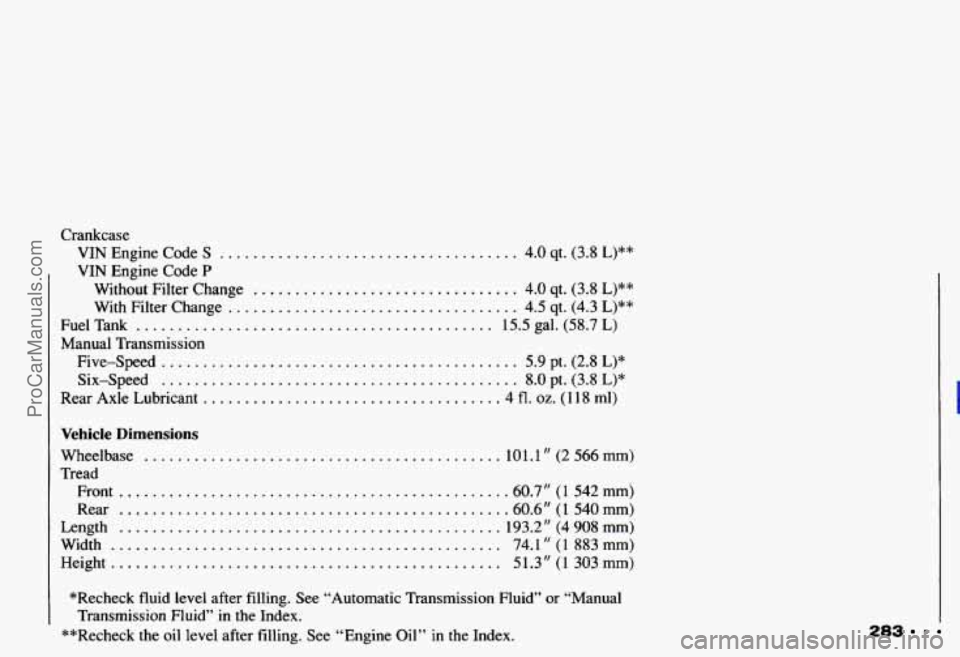
Crankcase VIN Engine Code
S .................................... 4.0 qt. (3.8 L)**
VIN Engine Code
P
Without Filter Change ................................ 4.0 qt. (3.8 L)**
With Filter Change
................................... 4.5 qt. (4.3 L)**
Fuel Tank
........................................... 15.5 gal. (58.7 L)
Manual Transmission Five-Speed
........................................... 5.9 pt. (2.8 L)*
Six-Speed ........................................... 8.0 pt. (3.8 L)*
Rear Axle Lubricant .................................... 4 fl. 02. (1 18 ml)
Vehicle Dimensions
Wheelbase ........................................... 101.1 “ (2 566 mm)
Tread Front
.............................................. .60.7“ (1 542 mmj
Rear
.............................................. .60.6” (1 540 mm)
Length
.............................................. 193.2” (4 908 mm)
Width
............................................... 74.1 “ (1 883 mm)
Height
............................................... 5 1.3“ (1 303 mm)
*Recheck fluid level after filling. See “Automatic Transmissio\
n Fluid”
or “Manual
Transmission Fluid” in the Index.
**Recheck the oil level after filling. See “Engine Oil” in the Index.
I
283
ProCarManuals.com
Page 298 of 358
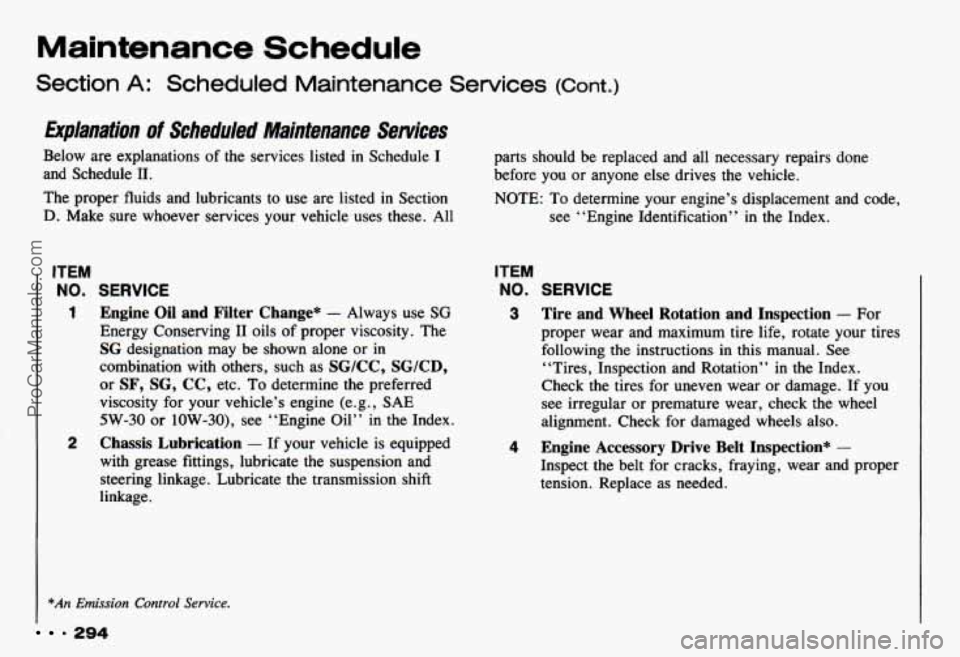
Maintenance Schedule
Section A: Scheduled Maintenance Services (Cont.)
Eirplanation of Scheduled Maintenance Semices
Below are explanations of the services listed in Schedule I
and Schedule 11.
The proper fluids and lubricants
to use are listed in Section
D. Make sure whoever services your vehicle uses these. All
ITEM
NO. SERVICE
1 Engine Oil and Filter Change* - Always use SG
Energy Conserving I1 oils of proper viscosity. The
SG designation may be shown alone or in
combination with others, such as
SGKC, SG/CD,
or SF, SG, CC, etc. To determine the preferred
viscosity for your vehicle’s engine (e.g., SAE
5W-30 or 10W-30), see “Engine Oil” in the Index.
2 Chassis Lubrication - If your vehicle is equipped
with grease fittings, lubricate the suspension and
steering linkage. Lubricate the transmission shift
linkage. parts should be replaced and all necessary repairs done
before
you or anyone else drives the vehicle.
NOTE: To determine your engine’s displacement and code, see ‘‘Engine Identification” in the Index.
ITEM
NO. SERVICE
3 Tire and Wheel Rotation and Inspection - For
proper wear and maximum tire life, rotate your tires
following the instructions in this manual. See “Tires, Inspection and Rotation’’
in the Index.
Check the tires for uneven wear or damage. If
you
see irregular or premature wear, check the wheel
alignment. Check for damaged wheels also.
Inspect the belt for cracks, fraying, wear and proper
tension. Replace
as needed.
4 Engine Accessory Drive Belt Inspection* -
I
*An Emission Control Service.
9 294
ProCarManuals.com
Page 300 of 358
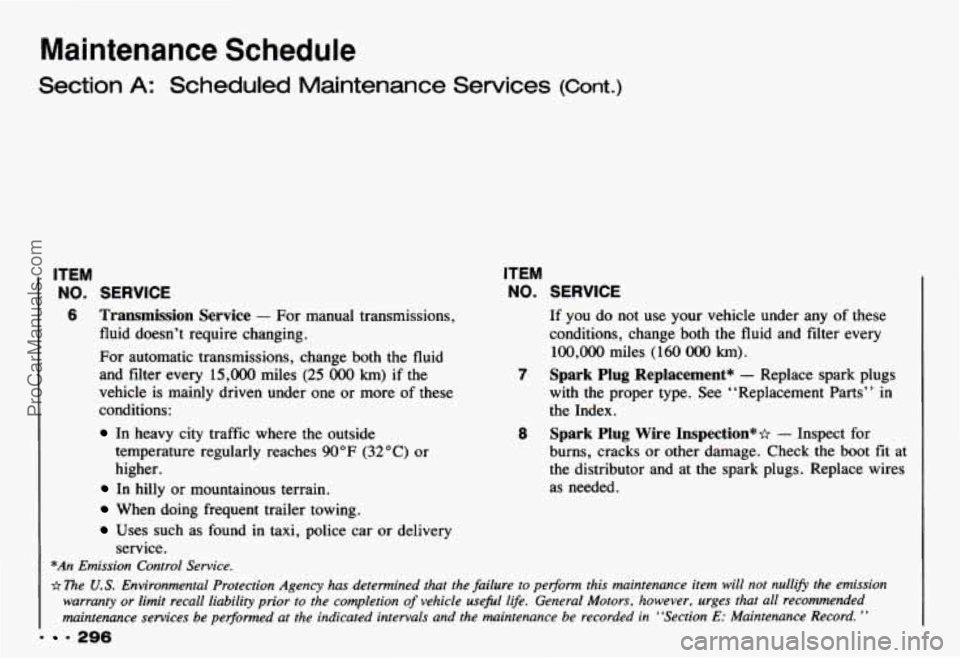
Maintenance Schedule
aection A: Scheduled Maintenance Services (Cont.)
ITEM
NO. SERVICE
6 Transmission Service - For manual transmissions,
fluid doesn’t require changing.
For automatic transmissions, change both the fluid
and filter every
15,000 miles (25 OOO km) if the
vehicle is mainly driven under one
or more of these
conditions:
ITEM
NO. SERVICE
If you do not use your vehicle under any of these
conditions, change both the fluid and filter every
100,OOO miles (160 O00 km).
7 Spark Plug Replacement* - Replace spark plugs
with the proper type. See “Replacement Parts” in
the Index.
burns, cracks or other damage. Check
the boot fit at
the distributor and at
the spark plugs. Replace wires
as needed.
8 Spark Plug Wire Inspection** - Inspect for In heavy city traffic where the outside
temperature regularly reaches
90°F (32°C) or
higher.
In hilly or mountainous terrain.
When doing frequent trailer towing.
Uses such as found in taxi, police car or delivery
service.
*An Emission Control Service.
The
U. 5’. Environmental Protection Agency has determined that the failure to perform this maintenance item will not nullify the emission
warranty or limit recall liability prior to the completion
of vehicle useful life. General Motors, however, urges that all recommended
maintenance services be performed at the indicated intervals and the maintenance be recorded in “Section
E: Maintenance Record. ”
= 296
ProCarManuals.com