warning light CHEVROLET CAMARO 1994 4.G User Guide
[x] Cancel search | Manufacturer: CHEVROLET, Model Year: 1994, Model line: CAMARO, Model: CHEVROLET CAMARO 1994 4.GPages: 292, PDF Size: 15.35 MB
Page 102 of 292
Downloaded from www.Manualslib.com manuals search engine Features and Controls
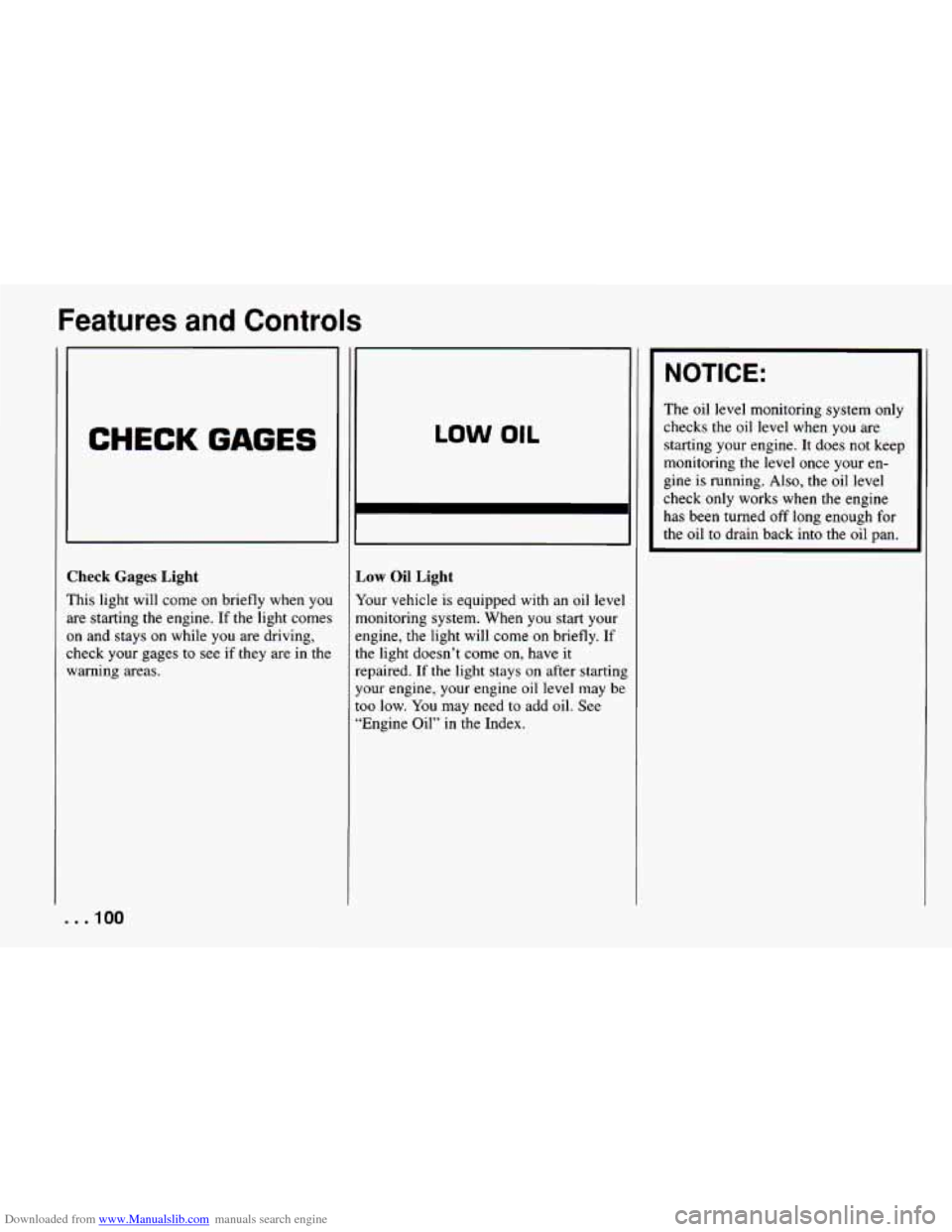
CHECK GAGES
Check Gages Light
This light will come on briefly when you
are starting the engine.
If the light comes
on and stays on while you are driving,
check your gages to see if they are in the
warning areas.
LOW OIL
,ow Oil Light
‘our vehicle is equipped with an oil level
lonitoring system. When you start your
ngine, the light will come
on briefly. If
le light doesn’t come on, have it
:paired. If the light stays on after starting
our engine, your engine oil level may be
10 low. You may need to add oil. See
Engine Oil” in the Index.
NOTICE:
The oil level monitoring system only
checks the oil level
when you are
starting your engine. It does not keep
monitoring the level once your en-
gine is running.
Also, the oil level
check only works when the engine
has been turned off long enough for
the oil to drain back into the oil pan.
. . .IO0
Page 129 of 292
Downloaded from www.Manualslib.com manuals search engine This is a mistake. Your brakes may not
have time to cool between hard stops.
Your brakes will wear out much faster if
you do a lot of heavy braking. If you keep
pace with the traffic and allow realistic
following distances, you will eliminate a
lot of unnecessary braking. That means
better braking and longer brake life.
If your engine ever stops while you’re
driving, brake normally but don’t pump
your brakes. If you
do, the pedal may
get harder to push down. If your engine
stops, you will still have some power
brake assist. But you will use
it when
you brake. Once the power assist is used
up, it may take longer to stop and the
brake pedal
will be harder to push.
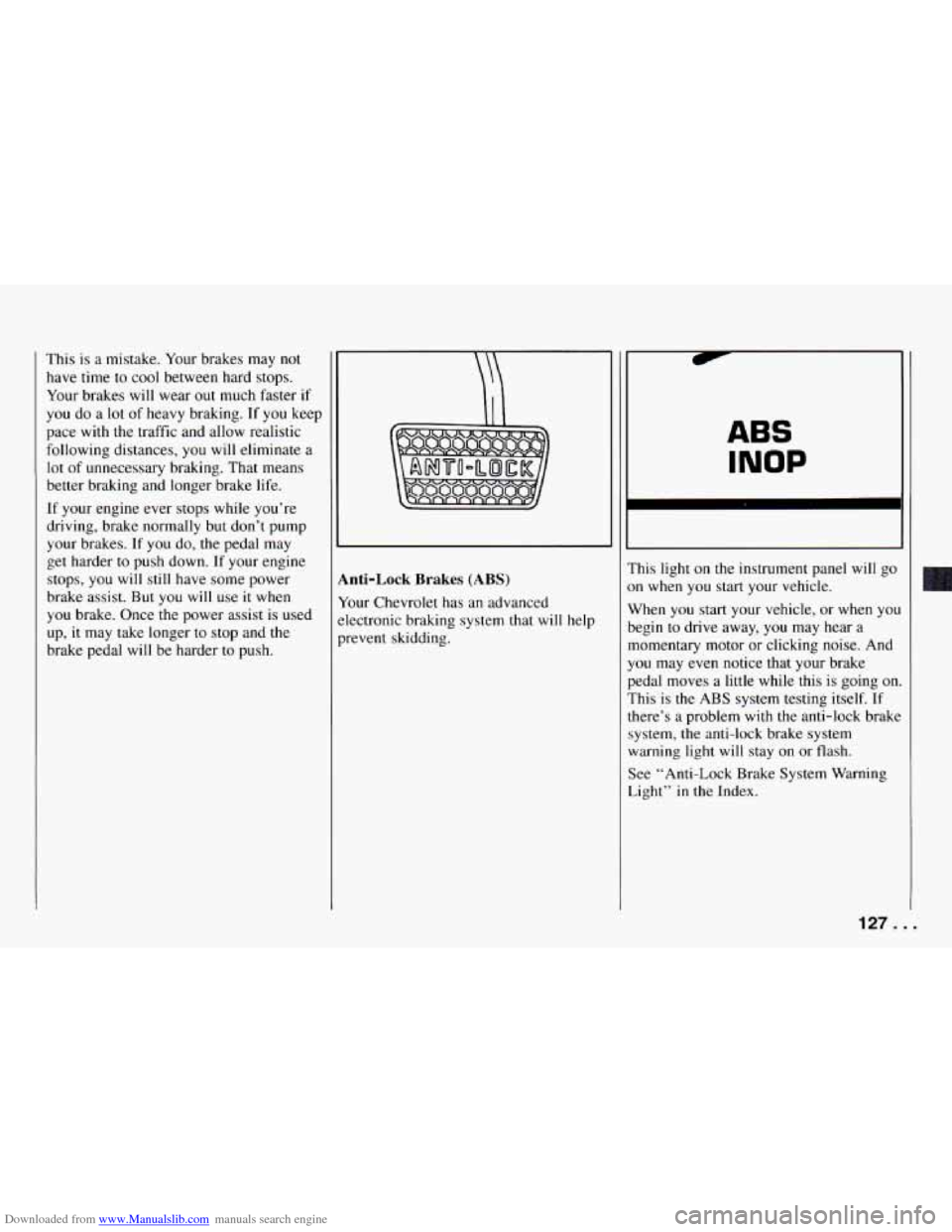
inti-Lock Brakes (ABS)
tour Chevrolet has an advanced
klectronic braking system that
will help
- revent sludding.
ABS
INOP
?his light on the instrument panel will go
m when you start your vehicle.
Nhen you start your vehicle, or when yo1
)egin to drive away, you may hear a
nomentary motor or clicking noise. And
’ou may even notice that your brake
bedal moves a little while
this is going on
:his
is the ABS system testing itself. If
here’s a problem with the anti-lock brake
ystem, the anti-lock brake system
varning light will stay
on or flash.
;ee “Anti-Lock Brake System Warning
ight” in the Index.
1
127 ...
Page 131 of 292
Downloaded from www.Manualslib.com manuals search engine ‘I i
If your vehicle is in cruise control when
the ASR system begins
to limit wheel
spin, the cruise control will automaticallq
disengage. When road conditions allow
you to safely use it again, you may
re-engage the cruise control. (See
“Cruise Control” in the Index.)
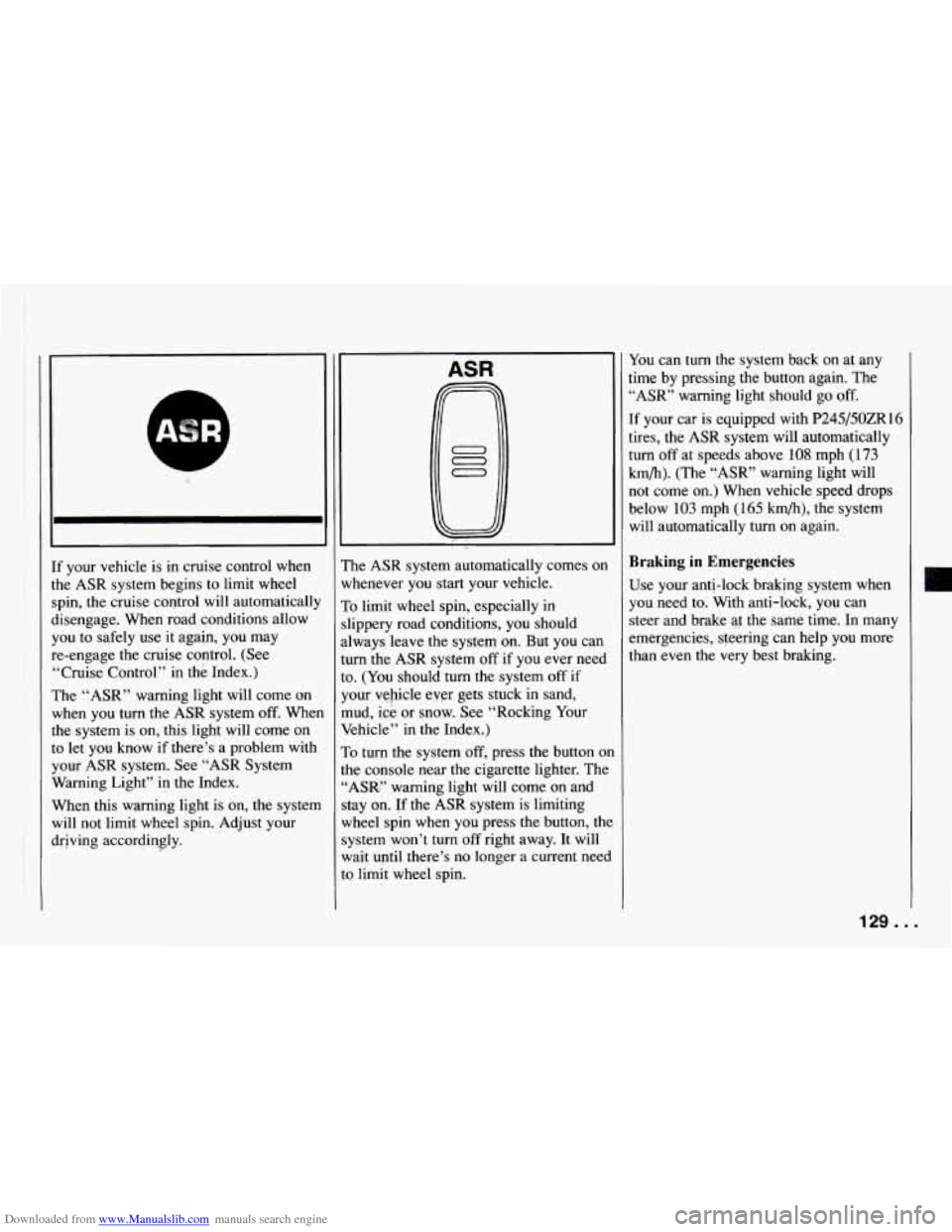
The “ASR” warning light will come on
when you tu-n the ASR system off. Whe~
the system is on, this light will come on
to let you know if there’s a problem with
your ASR system.
See “ASR System
Warning Light” in the Index.
When this warning light is on, the system
will not limit wheel spin. Adjust your
drjving accordingly.
ASR
The ASR system automatically comes on
whenever you start your vehicle.
To limit wheel spin, especially in
slippery road conditions, you should
always leave the system on. But you can
turn the ASR system
off if you ever need
to. (You should turn the system
off if
your vehicle ever gets stuck in sand,
mud, ice or snow.
See “Rocking Your
Vehicle” in the Index.)
To turn the system
off, press the button on
the console near the cigarette lighter. The
“ASIC” warning light will come on and
stay on. -If the ASR system is limiting
wheel spin when you press the button, the
system won’t turn off right away. It will
wait until there’s no longer a current need
to limit wheel spin. You
can turn the system back on at any
time by pressing the button again. The
*‘ASR’ warning light should go
off.
[f your car is equipped with P245/50ZR16
tires, the ASR system will automatically
turn
off at speeds above 108 mph (173
km/h). (The “ASR” warning light will
not come on.) When vehicle speed drops
below
103 mph (165 km/h), the system
will automatically turn on again.
Braking in Emergencies
Use your anti-lock braking system when
you need to. With anti-lock, you can
steer and brake
a1 the same time. In many
emergencies, steering can help you more
than even the very best braking.
129 ...
Page 135 of 292
Downloaded from www.Manualslib.com manuals search engine much throttle causes the driving wheels to
spin.
A cornering skid is best handled by
easing your foot
off the accelerator pedal.
If you have the ASR system, remember: It
helps avoid only the acceleration skid. If
you do not have traction control, or
if the
system is
off, then an acceleration skid is
also best handled by easing your foot
off
the accelerator pedal.
If your vehicle starts to slide, ease your
foot
off the accelerator pedal and quickly
steer the way you want the vehicle to go.
If you start steering quickly enough, your
vehicle may straighten out. Always be
ready for a second skid if it occurs.
Of course, traction is reduced when water,
snow, ice, gravel, or other material is on
the road. For safety, you’ll want to slow
down and adjust your driving
to these
conditions. It is important to slow down
on slippery surfaces because stopping distance will be longer and vehicle
control more limited. While
driving on a surface with reduced
traction, try
your best to avoid sudden
steering, acceleration,
or braking
(including engine bralung by shifting to a
lower gear). Any sudden changes could
cause the tires to slide. You may not
realize the surface is slippery until your
vehicle is skidding. Learn to recognize
warning clues
- such as enough water,
ice or packed snow on the road to make
a .“mirrored surface”
- and slow down
when you have any doubt.
Remember: Any anti-lock braking system
(ABS) helps avoid only the braking skid.
. ..
I
4
Driving at Night
\Tight driving is more dangerous than day
hiving. One reason is that some drivers
tre likely to be impaired
- by alcohol or
lrugs, with night vision problems, or by
atigue.
lere
are some tips on night driving.
Drive defensively.
Don’t drink and drive.
Adjust your inside rearview mirror to
reduce the glare from headlights
behind you.
Since you can’t see as well, you may
need to slow down and keep more
space between
you and other vehicles.
133 ...
Page 138 of 292
Downloaded from www.Manualslib.com manuals search engine Your Driving and the Road
Hydroplaning usually happens at higher
speeds. There just isn’t
a hard and fast
rule about hydroplaning. The best advice
is to slow down when it is raining.
Some Other Rainy Weather Tips
0
0
0
Turn on your low-beam headlights -
not just your parking lights - to help
make you more visible to others.
Besides slowing down, allow some
extra following distance. And be
especially careful
when you pass
another vehicle. Allow yourself more
clear room ahead, and be prepared to
have your view restricted by road
spray.
Have good tires with proper tread
depth. (See “Tires”
in the Index.)
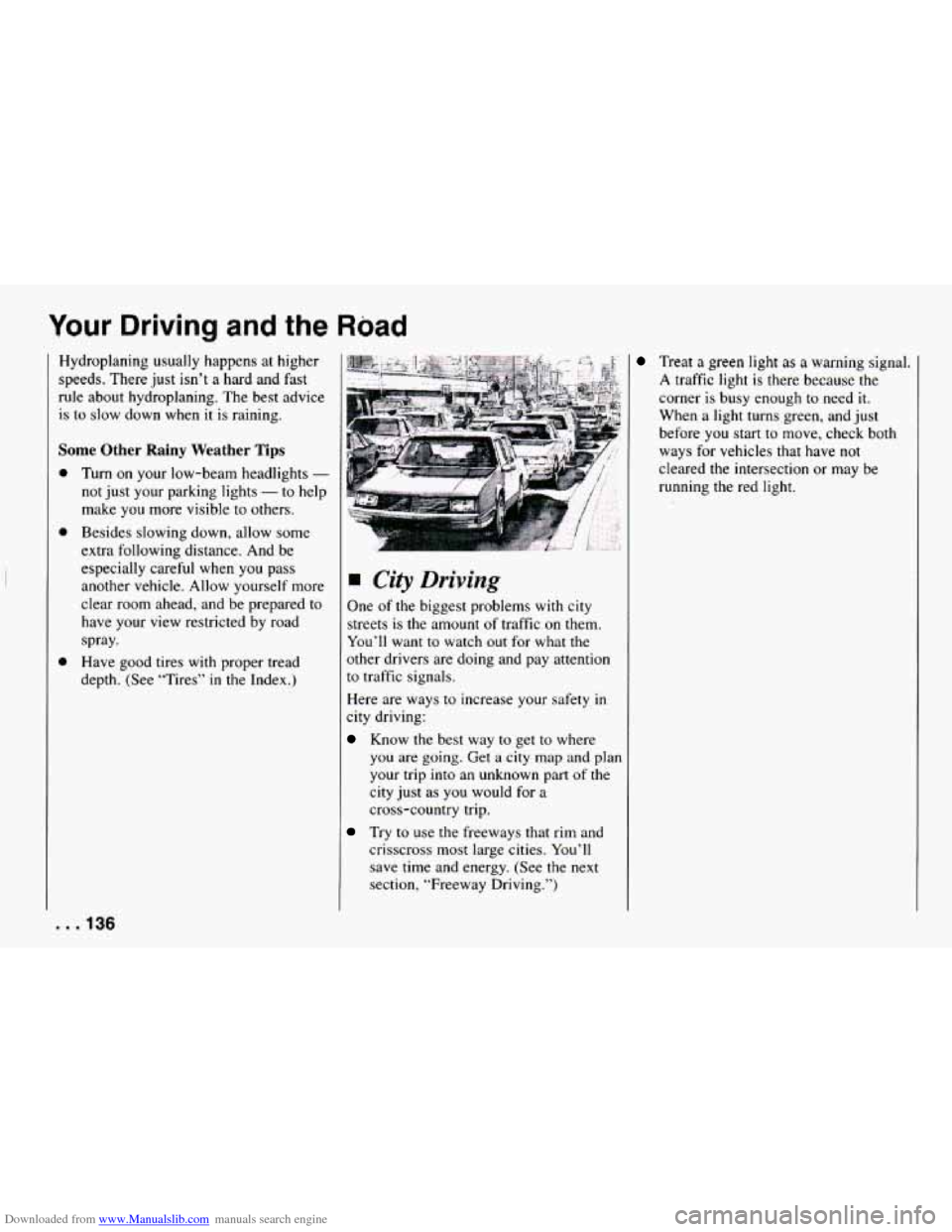
City Driving
One of the biggest problems with city
streets is the amount
of traffic on them.
You’ll want to watch out for what the
other drivers are doing and pay attention
to traffic signals.
Here are ways to increase your safety
in
city driving:
Know the best way to get to where
you are going.
Get a city map and plan
your trip into an unknown part of the
city just as you would for a
cross-country trip.
Try to use the freeways that rim and
crisscross most large cities. You’ll
save time and energy. (See the next
section, “Freeway Driving.”)
Treat a green light as a warning signal.
A traffic light
is there because the
corner
is busy enough to need it.
When a light turns green, and just
before you start to move, check both
ways for vehicles that have not
cleared the intersection or may be
running the red light.
. . .136
Page 142 of 292
Downloaded from www.Manualslib.com manuals search engine Your Driving and the Road
I
;i”iii’ i ;i7: ,,:: : . .
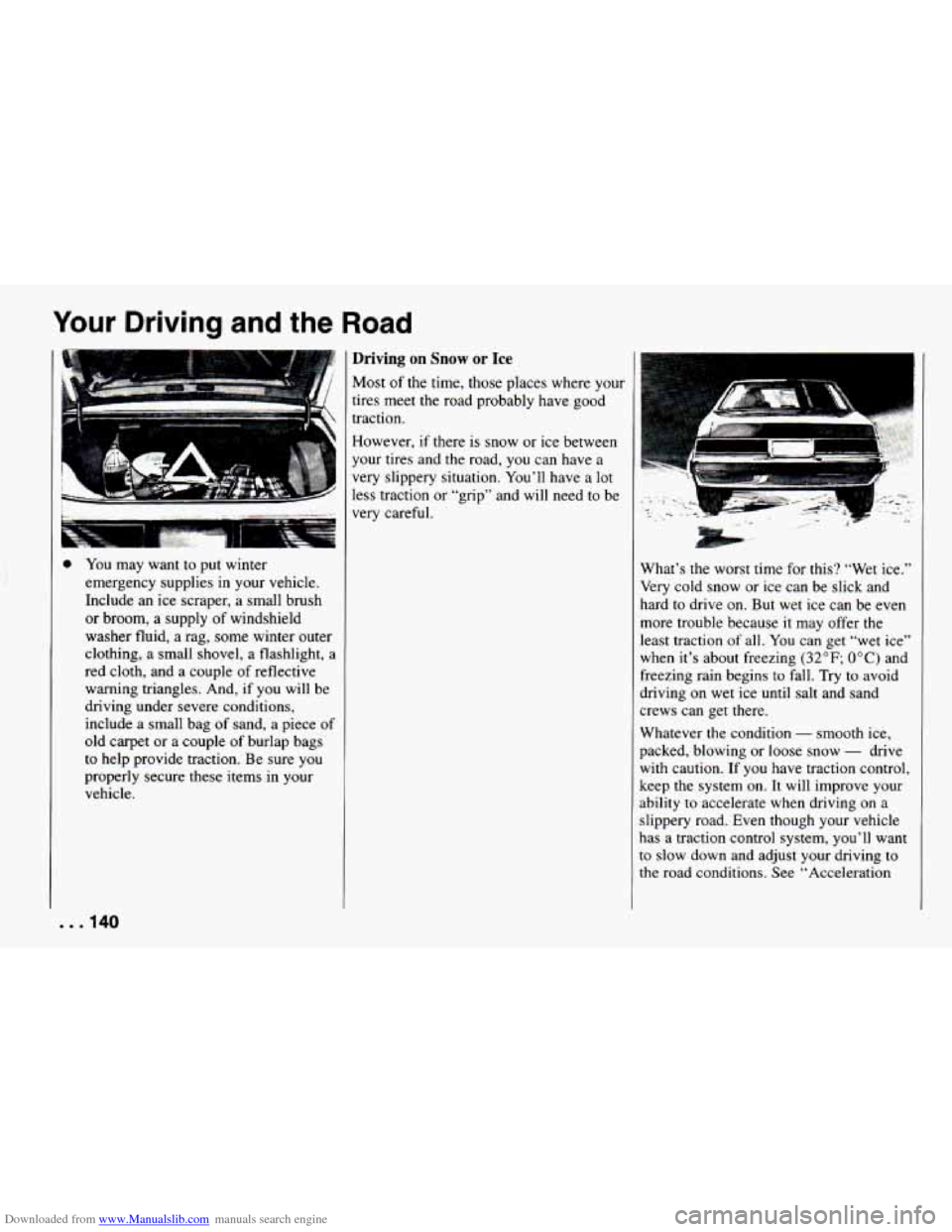
0 You may want to put winter
emergency supplies in your vehicle.
Include an ice scraper, a small brush
or broom, a supply of windshield
washer
fluid, a rag, some winter outer
clothing, a small shovel,
a flashlight, a
red cloth, and a couple of reflective
warning triangles. And, if you
will be
driving under severe conditions,
include a small bag of sand, a piece of
old carpet or a couple of burlap bags
to help provide traction. Be sure you
properly secure these items
in your
vehicle.
Driving on Snow or Ice
Most of the time, those places where your
tires meet the road probably have good
traction.
However, if there is snow or ice between
your tires and the road, you can have a
very slippery situation. You’ll have a lot
less traction
or “grip” and will need to be
very careful. P. :’
$;.,
What’s the worst time for this? “Wet ice.”
Very cold snow or ice can be slick and
hard to drive on. But wet ice can be even
more trouble because
it may offer the
least traction of all.
You can get “wet ice”
when it’s about freezing
(32°F; OOC) and
freezing rain begins to fall. Try to avoid
driving on wet ice until salt and sand
crews can get there.
Whatever the condition
- smooth ice,
packed, blowing or loose snow
- drive
with caution.
If you have traction control,
keep the system on.
It will improve your
ability to accelerate when driving on a
slippery road. Even though your vehicle
has a traction control system, you’ll want
to slow down and adjust your driving to
the road conditions. See “Acceleration
. . .I40
Page 150 of 292
Downloaded from www.Manualslib.com manuals search engine Problems on the Road
Hazard Warning
Flashers
Your hazard warning flashers let you
warn others. They also
let police know
you have a problem. Your front and rear
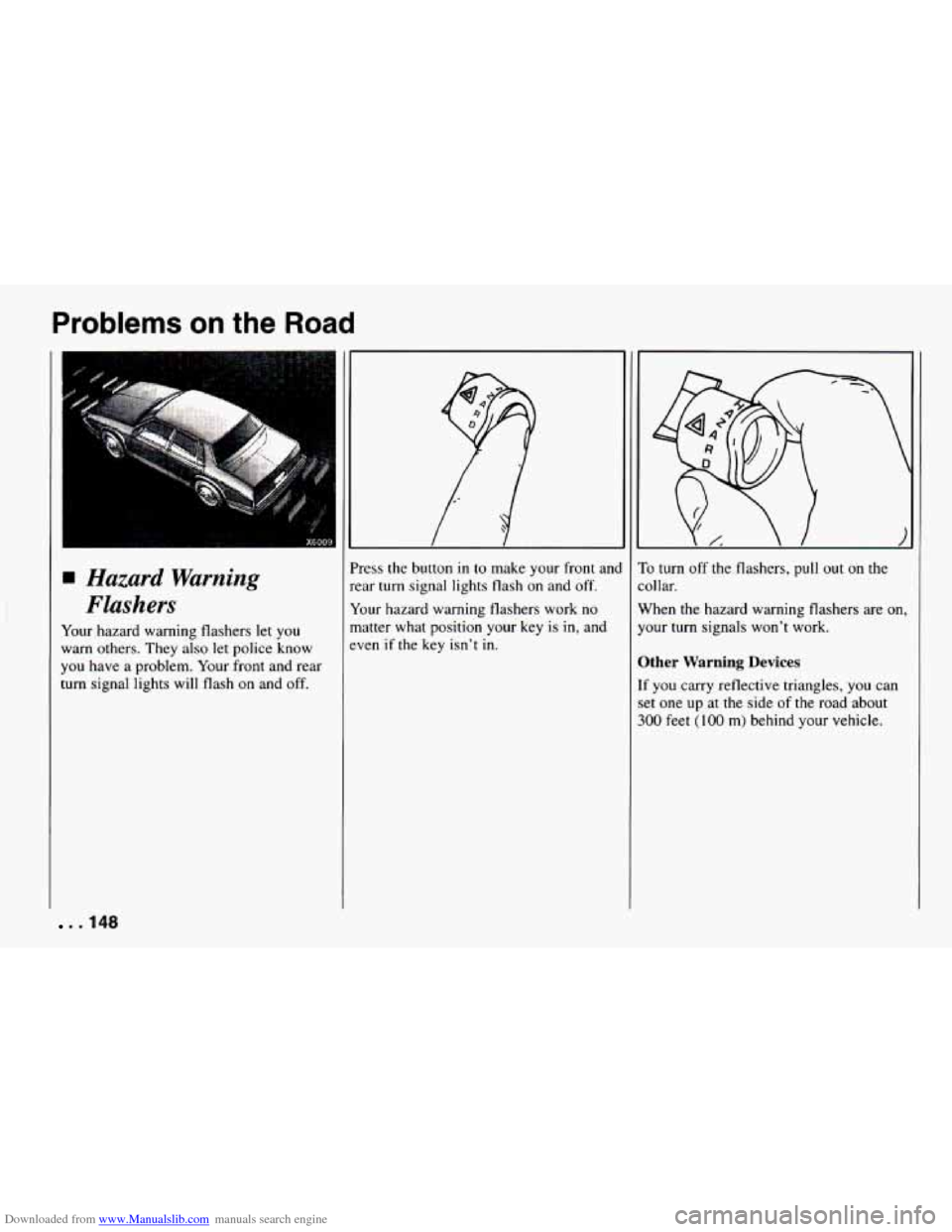
turn signal lights will flash on and off. ’ress the button
in to make your front ant
ear turn signal lights
flash on and off.
(our hazard warning flashers work no
natter
what position your key is in, and
ven
if the key isn’t in.
i’I
C
V
Y
C
11
3
SI
b turn off the flashers, pull out on the
ol
1 ar.
Vhen the hazard warning flashers are on,
our turn signals won’t work.
Ither Warning Devices
f you carry reflective triangles, you can
et one up at the side of the road about
00 feet (100 m) behind your vehicle.
. ,148
Page 159 of 292
Downloaded from www.Manualslib.com manuals search engine NOTICE:
Towing a vehicle over rough
surfaces could damage
a vehicle.
Damage can occur from
vehicle-
to-ground or vehicle-to-wheel-lift-
equipment contact.
To help avoid
damage, install a towing dolly
and raise vehicle
until adequate
clearance
is obtained between the
ground and/or wheel-lift equipment.
Engine Overheating
You will find a coolant temperature gage
Dn your Chevrolet’s instrument panel.
You may also find a low coolant warning
light on your Chevrolet instrument panel.
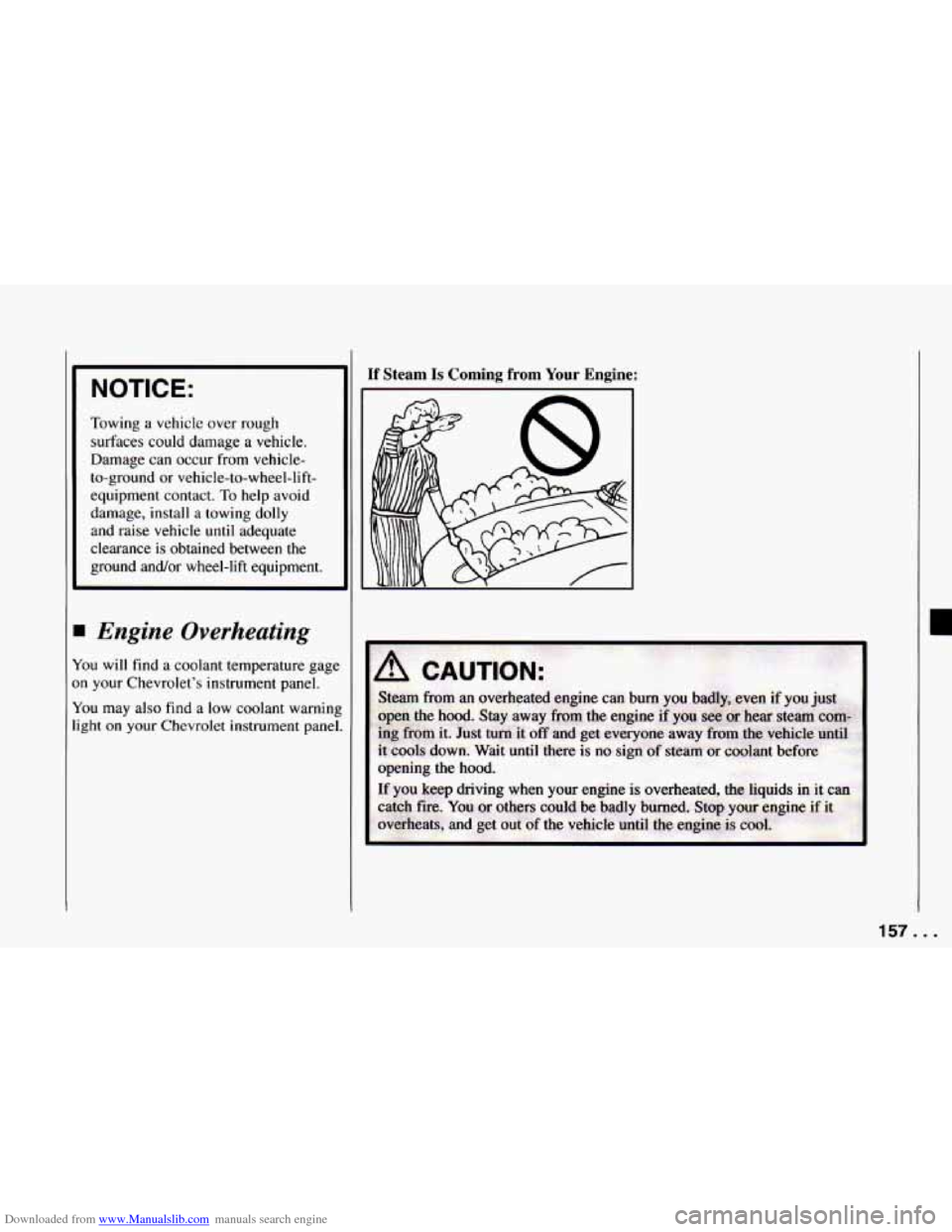
If Steam Is Coming from Your Engine:
157.. .
Page 200 of 292
Downloaded from www.Manualslib.com manuals search engine Service and Appearance Care
Engine Coolant
The following explains your cooling
system and how to add coolant when
it
is low. If you have a problem with
engine overheating or if you need
to add
coolant to your radiator, see “Engine
Overheating” in the Index.
The proper coolant for your Chevrolet
will:
0 Give freezing protection down to
Give boiling protection up to 262°F
Protect against rust and corrosion.
0 Help keep the proper engine
Let the warning lights work as they
-34°F (-37°C).
(128°C).
temperature.
should.
What to Use:
Use a mixture of one-half clean water
(preferably distilled) and one-half
antifreeze that meets “GM Specification
1825M,” which won’t damage aluminum
parts.
You can also use a recycled coolant
conforming to GM Specification
1825M
with a complete coolant flush and refill. If
you use
this mixture, you don’t need to
add anything else.
NOTICE:
If you use an improper coolant mix,
your engine could overheat and be
badly damaged. The repair cost
wouldn’t be covered by your war-
ranty.
Too much water in the mix can
freeze and crack the engine, radiator,
heater core and other parts.
. . .I98
Page 205 of 292
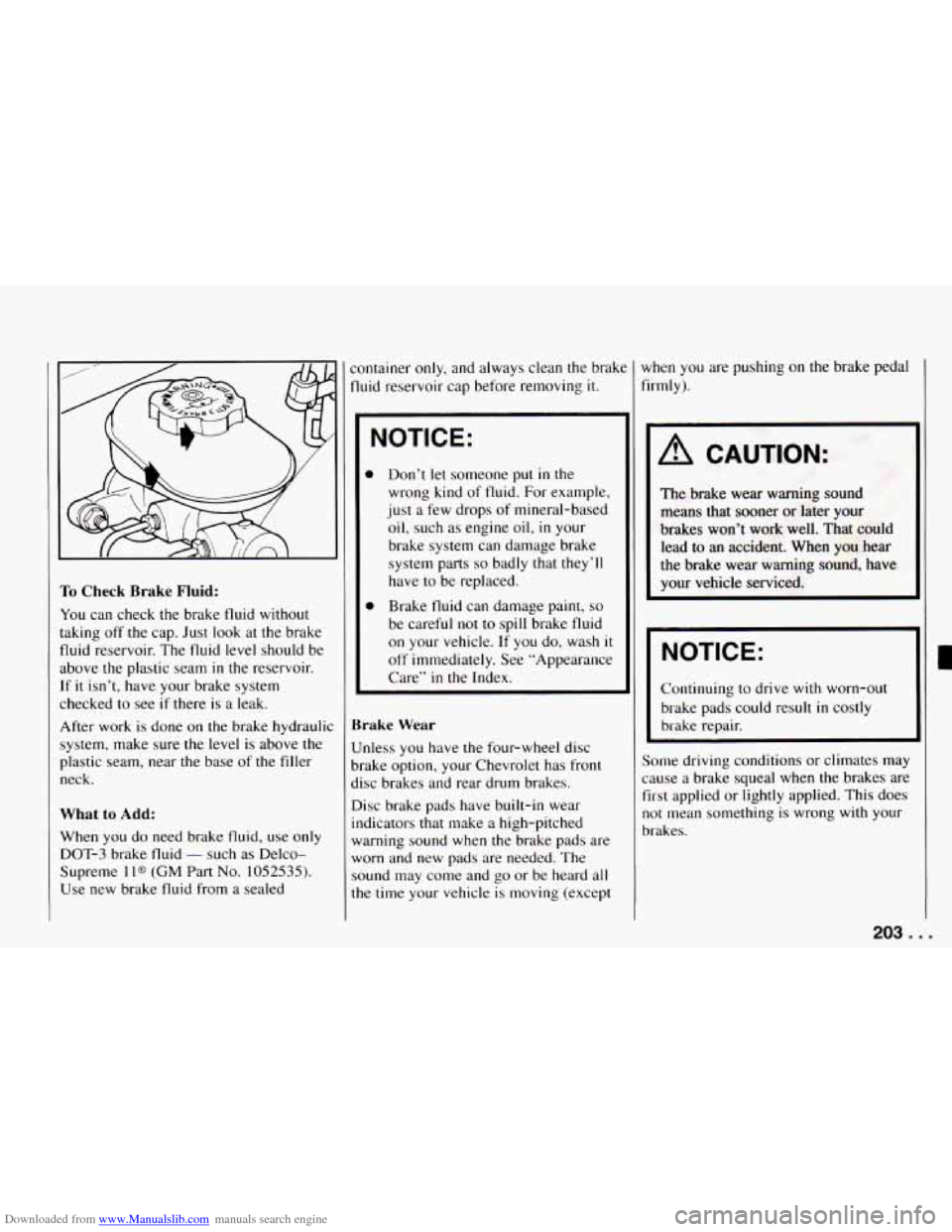
Downloaded from www.Manualslib.com manuals search engine To Check Brake Fluid:
You can check the brake fluid without
taking off the cap. Just look at the brake
fluid reservoir. The fluid level should be
above the plastic seam
in the reservoir.
If it isn’t, have your brake system
checked to see
if there is a leak.
After work is done on the brake hydraulic
system, make sure the level
is above the
plastic seam, near the base of the filler
neck.
What to Add:
When you do need brake fluid, use only
DOT-3 brake fluid
- such as Delco-
Supreme 1 l@ (GM Part No. 1052535).
Use new brake fluid from a sealed container
only, and always clean the brakt
fluid reservoir cap before removing it.
NOTICE:
0 Don’t let someone put in the
wrong kind
of fluid. For example,
just a few drops
of mineral-based
oil, such as engine oil, in your
brake system can damage brake
system parts
so badly that they’ll
have to be replaced.
0 Brake fluid can damage paint, so
be careful not to spill brake fluid
on your vehicle.
If you do, wash it
off immediately. See ”Appearance
Care”
in the Index.
Brake Wear
Unless you have the four-wheel disc
brake option, your Chevrolet has front
disc brakes and rear drum brakes.
Disc brake pads have built-in wear
indicators that make
a high-pitched
warning sound when the brake pads are
worn and new pads are needed. The
sound may come and go or be heard all
the time your vehicle is moving (except when
you are
pushing on the brake pedal
firmly).
A CAUTION:
The brake wear warning sound
means that sooner or later your
brakes won’t work well. That could
lead to an accident. When you hear
the brake wear warning sound, have
your vehicle serviced.
NOTICE:
Continuing to drive with worn-out
brake pads could result in costly
brake repair.
Some driving conditions or climates may
cause
a brake squeal when the brakes are
first applied or lightly applied. This does
not mean something is wrong
with your
brakes.
203. I