service CHEVROLET CAMARO 1994 4.G Owner's Manual
[x] Cancel search | Manufacturer: CHEVROLET, Model Year: 1994, Model line: CAMARO, Model: CHEVROLET CAMARO 1994 4.GPages: 292, PDF Size: 15.35 MB
Page 161 of 292
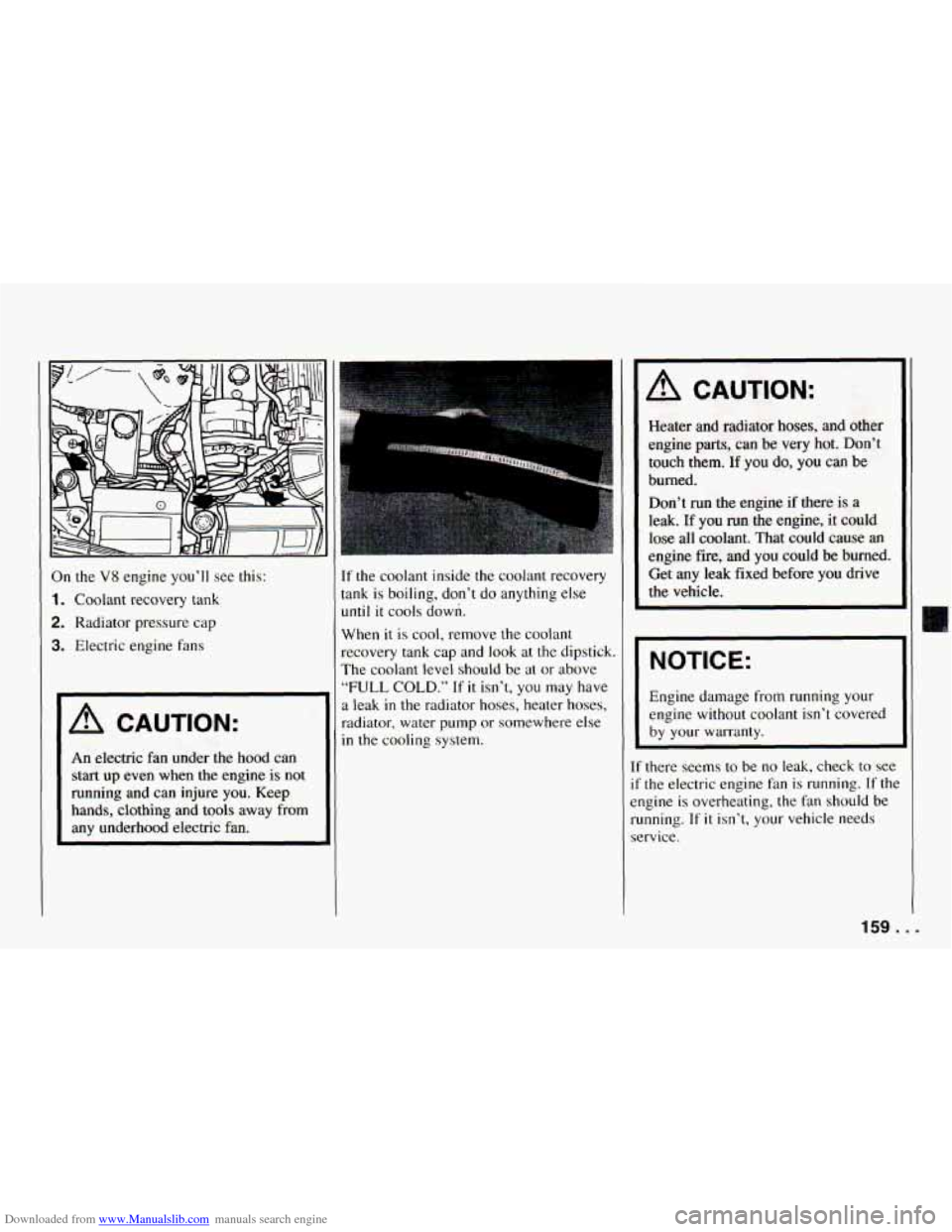
Downloaded from www.Manualslib.com manuals search engine On the V8 engine you’ll see this:
1. Coolant recovery tank
2. Radiator pressure cap
3. Electric engine fans
A CAUTION:
An electric fan under the hood can
start up even when the engine is not
running and can injure
you. Keep
hands, clothing and tools
away from
any underhood electric fan.
II
If the coolant inside the coolant recovery
tank is boiling, don’t do anything else
until it cools down.
When
it is cool, remove the coolant
recovery tank cap and look at
the dipstick.
The coolant level should be at or above
“FULL COLD.” If it isn’t, you may have
a leak
in the radiator hoses, heater hoses,
radiator,
water pump or somewhere else
in the cooling system.
A CAUTION:
Heater and radiator hoses, and other
engine parts, can be very hot. Don’t
touch them. If you do, you can be
burned.
Don’t
run the engine if there is a
leak. If you run the engine, it could
lose all coolant. That could
cause an
engine fire, and you could be burned.
Get any leak fixed before you drive
the vehicle.
NOTICE:
Engine damage from running your
engine without coolant isn’t covered
by your warranty. I
If there seems to be no leak, check to see
if the electric engine fan is running. If the
engine
is overheating, the fan should be
running.
If it isn’t, your vehicle needs
service.
159. I
Page 168 of 292
Downloaded from www.Manualslib.com manuals search engine Problems on the Road
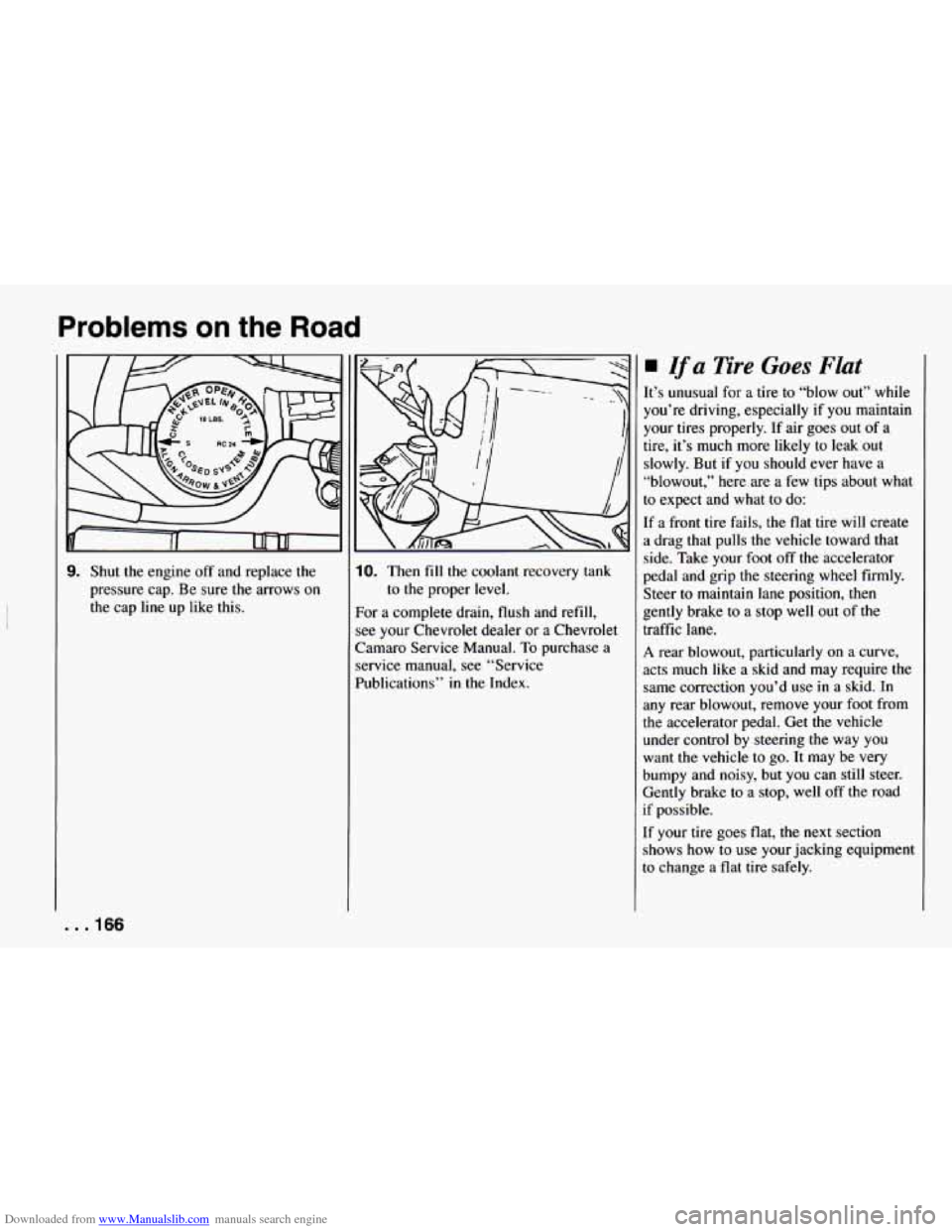
3. Shut the engine off and replace the
pressure cap. Be sure the arrows on
the cap line up like this. 10. Then fill the coolant recovery tank
For
a complete drain, flush and refill,
see your Chevrolet dealer or a Chevrolet
Camaro Service Manual.
To purchase a
service manual, see “Service
Publications’’ in the Index.
to
the proper level.
If Q Tire Goes Flat
It’s unusual for a tire to “blow out” while
you’re driving, especially if you maintain
your tires properly. If air goes out of a
tire, it’s much more likely to leak out
slowly. But if
you should ever have a
“blowout,’’ here are a few tips about what
to expect and what to do:
If a front tire fails, the flat tire will create
a drag that pulls the vehicle toward that
side. Take your foot off the accelerator
pedal and grip the steering wheel firmly.
Steer to maintain lane position, then
gently brake to a stop well out of the
traffic lane.
A rear blowout, particularly on a curve,
acts much like
a skid and may require the
same correction you’d use in a skid. In
any rear blowout, remove your foot from
the accelerator pedal. Get the vehicle
under control by steering the way
you
want the vehicle to go. It may be very
bumpy and noisy, but you can still steer.
Gently brake to
a stop, well off the road
if possible.
If your tire goes flat,
the next section
shows how to use your jacking equipment
to change a flat tire safely.
. . ,166
Page 181 of 292
Downloaded from www.Manualslib.com manuals search engine Here you will find information
about the care of your
Chevrolet
. This part begins with
service and fuel information.
and then
it shows how to check
important fluid and lubricant
levels
. There is also technical
information about your vehicle.
and a section devoted to its
appearance care
.
Part 0
Service & Appearance Care
Service .........................................................
Fuel ...........................................................
Checking Things under the Hood ....................................
HoodRelease ..................................................
EngineOil ....................................................
Aircleaner ...................................................
Automatic Transmission Fluid .....................................
Manual Transmission Fluid .......................................
Hydraulic Clutch ...............................................
RearAxle .....................................................
Enginecoolant ................................................
Power Steering Fluid ............................................
Windshield Washer Fluid .........................................
Brake Master Cylinder ...........................................
Battery .......................................................
Bulb Replacement ................................................
LoadingYourVehicle .............................................
Tires ...........................................................
Appearancecare .................................................
Appearance Care and Maintenance Materials ...........................
Vehicle Identification Number (VIN) .................................
Service Parts Identification Label ....................................
Add-on Electrical Equipment .......................................
Fuses and Circuit Breakers .........................................
Replacement Bulbs ...............................................
Capacities and Specifications .......................................
180
181
184
184
187 191
194
196
197
197
198
200
201
202
204
205
212
214
220
226
227
227
227
227
231
232
179 ...
Page 182 of 292
Downloaded from www.Manualslib.com manuals search engine Service and Appearance Care
AC1 GM -
Service
Your Chevrolet dealer knows your vehicll
best and wants you to be happy with it.
We hope you’ll
go to your dealer for all
your service needs. You’ll get genuine
GM parts and GM-trained and supported
service people.
We hope you’ll want to keep your
GM
vehicle all GM. Genuine GM parts have
one of these marks.
Doing Your Own Service Work
If you want to do some of your own
service work, you’ll want to get
the
proper Chevrolet Service Manual. It tells
you much more about how to service your
Chevrolet than this manual can.
To order
the proper service manual, see “Service
Publications” in the Index.
Your vehicle has an air bag system.
Before attempting to do your own service
work, see “Servicing Your Air Bag
-
Equipped Chevrolet” in the Index.
You should keep a record with all parts
receipts and list
the mileage and the date
of any service work you perform. See
“Maintenance Record” in the Index.
. . .I80
Page 183 of 292
Downloaded from www.Manualslib.com manuals search engine I NOTICE:
I
If you try to do your own service
work without knowing enough about
it, your vehicle could be damaged.
I
Fuel
The 8th digit of your Vehicle
Identification Number (VIN) shows the code letter for your engine. You will
find the VIN at the top left of your
instrument panel. (See “Vehicle
Identification Number” in the Index.)
3.4L L32 (Code S)
Use regular unleaded gasoline rated at 87
octane or higher. It should meet
specifications
ASTM D4814 in the U.S.
and CGSB 3.5-92
in Canada. These fuels
should have the proper additives,
so you
should not have to add anything to the
fuel.
In the U.S. and Canada, it’s easy to be
sure you get the right kind
of gasoline
(unleaded). You’ll see “UNLEADED’
right on
the pump. And only unleaded
nozzles will
fit into your vehicle’s filler
neck. Be
sure the posted octane is at least
87. If
the octane is less than
87, you may get a
heavy knocking noise when you drive. If
it’s bad enough, it can damage your
engine.
If you’re using fuel rated at
87 octane or
higher and you still hear heavy knocking,
your engine needs service. But don’t
worry
if you hear a little pinging noise
when you’re accelerating or driving up a
hill. That’s normal, and you don’t have to
buy a higher octane fuel to get rid of
pinging. It’s the heavy, constant knock
that means you have a problem.
5.7L LT1 (Code P)
Use premium unleaded gasoline rated at
91 octane or higher.
You may use middle
grade or regular unleaded gasolines, but
your vehicle may not accelerate as well.
The gasoline you use should meet
specifications ASTM D4814 in the U.S.
and CGSB 3.5-92 in Canada. These fuels
should have the proper additives,
so you
should not have to add anything to the
fuel. [n
the U.S. and Canada, it’s easy to be
sure you get the right kind of gasoline
(unleaded). You
’ 11 see “UNLEADED’
right on the pump. And only unleaded
nozzles will fit into
your vehicle’s filler
neck.
Be sure the posted octane for premium is
at least 91 (at least 89 for middle grade
and
87 for regular). If the octane is less
than
87, you may get a heavy knocking
noise when you drive. If it’s bad enough,
it can damage your engine.
If you’re using fuel rated at 91 octane or
higher and you still hear heavy knocking,
your engine needs service. But don’t
worry if you hear a little pinging noise
when you’re accelerating or driving up a
hill. That’s normal and you don’t have to
buy a higher octane fuel to get rid of
pinging. It’s the heavy, constant knock
that means you have a problem.
181 ...
Page 184 of 292
Downloaded from www.Manualslib.com manuals search engine e
Service and Appearance Care
1
All Engines
What about gasoline with blending
materials that contain oxygen
(oxygenates), such as MTBE or alcohol?
MTBE is “methyl tertiary-butyl ether.”
Fuel that is no more than
15% MTBE is
fine for your vehicle.
Ethanol is ethyl or grain alcohol.
Properly-blended fuel that is no more
than
10% ethanol is fine for your vehicle
Methanol is methyl or wood alcohol.
NOTICE:
Fuel that is more than 5% methanol
is bad for your vehicle. Don’t use it.
It can corrode metal parts in your fuel
system and also damage plastic and
rubber parts. That damage wouldn’t
be covered under your warranty. And
even at
5% or less, there must be
“cosolvents” and corrosion prevent-
ers in this fuel to help avoid these
problems.
Gasolines for Cleaner Air
Your use of gasoline with deposit control
additives will help prevent deposits from
forming in your engine and fuel system.
That helps keep your engine in tune and
your emission control system working
properly. It’s good for your vehicle, and
you’ll be doing your part for cleaner air.
Many gasolines are now blended with
oxygenates. General Motors recommends
that you use gasolines with these blending
materials, such as MTBE and ethanol. By
doing
so, you can help clean the air,
especially in those parts of the country
that have high carbon monoxide levels.
In addition, some gasoline suppliers are
now producing reformulated gasolines.
These gasolines are specially designed to
reduce vehicle emissions. General Motors
recommends that you use reformulated
zasoline. By doing
so, you can help clean
:he air, especially in those parts of the
:ountry that have high ozone levels.
You should ask your service station
lperators if their gasolines contain deposit
:ontrol additives and oxygenates, and
if
:hey have been reformulated to reduce
iehicle emissions.
Fuels in Foreign Countries
If you plan on driving in another country
outside the
U.S. or Canada, unleaded fuel
may be hard to find.
Do not use leaded
gasoline. If
you use even one tankful,
your emission controls won’t work well
or at all. With continuous use, spark plugs
can get fouled, the exhaust system can
corrode, and your engine oil can
deteriorate quickly. Your vehicle’s oxygen
sensor will be damaged. All
of that means
costly repairs that wouldn’t be covered by
your warranty.
To check on fuel availability, ask an auto
club, or contact a major oil company that
does business in the country where you’ll
be driving.
You can also write
us at the following
address for advice. Just tell
us where
you’re going and give your Vehicle
Identification Number (VIN).
Seneral Motors Overseas Distribution
Vorth American Export Sales (NAES)
1908 Colonel Sam Drive
Dshawa, Ontario
L1H 8P7
Zanada Corporation
. . .I82
Page 186 of 292
Downloaded from www.Manualslib.com manuals search engine Service and Appearance Care
~~
Checking Things under
the
Hood
Hood Release
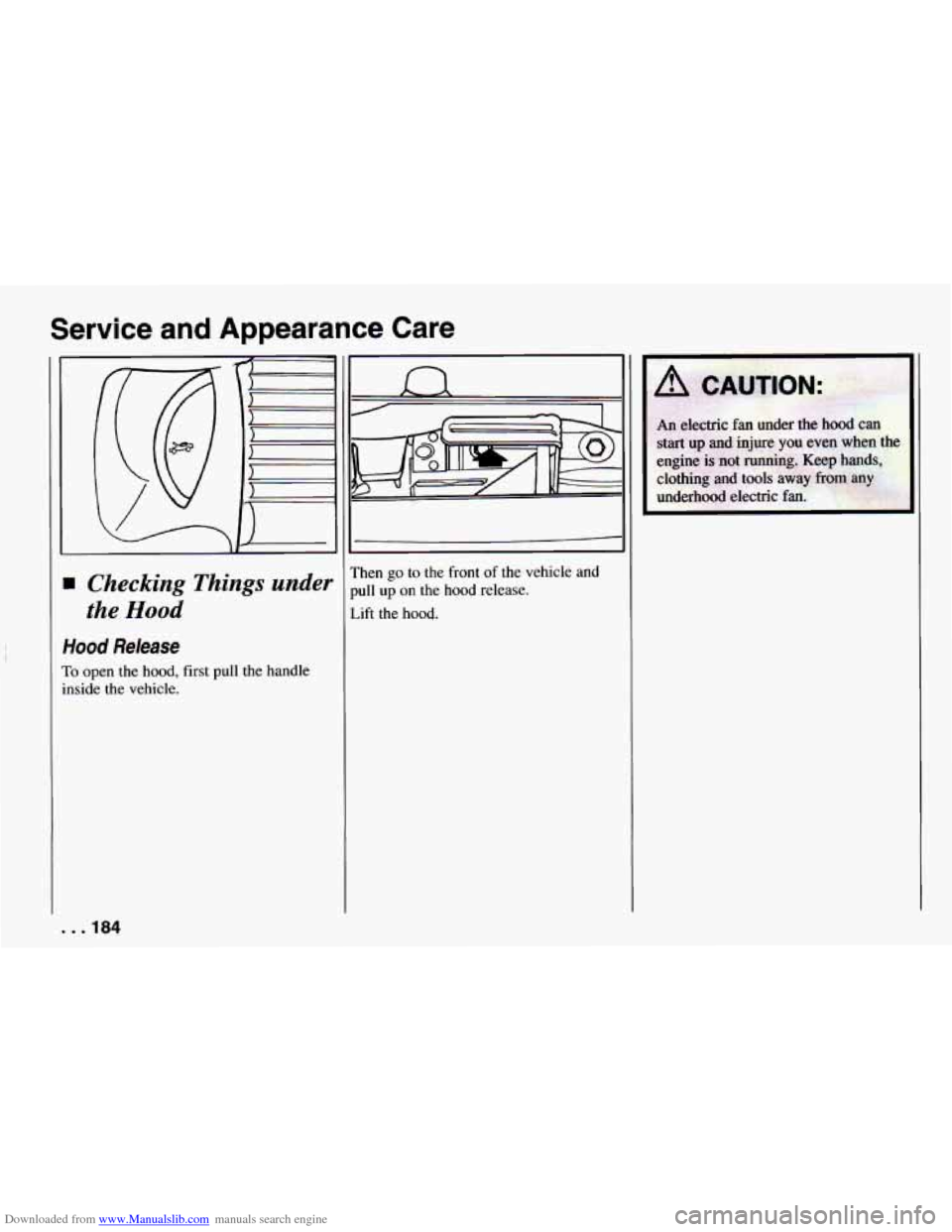
To open the hood, first pull the handle
inside the vehicle.
In
Then go to the front of the vehicle and
pull up on the hood release.
Lift the hood.
. . .I84
Page 188 of 292
Downloaded from www.Manualslib.com manuals search engine Service and Appearance Care
5.7L LT1 (Code P)
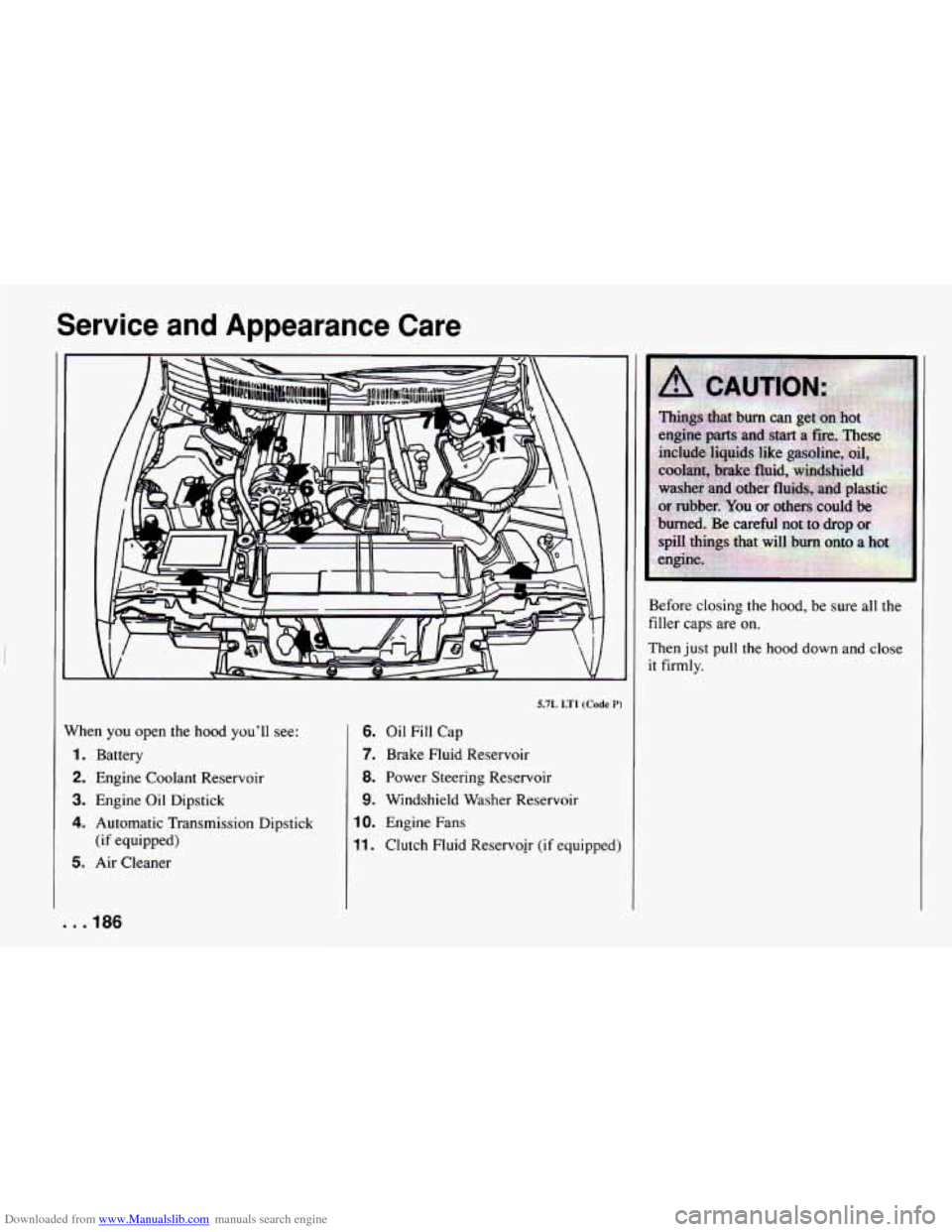
Vhen you open the hood you’ll see:
1. Battery
2. Engine Coolant Reservoir
3. Engine Oil Dipstick
4. Automatic Transmission Dipstick
5. Air Cleaner
(if equipped)
6. Oil Fill Cap
7. Brake Fluid Reservoir
8. Power Steering Reservoir
9. Windshield Washer Reservoir
10. Engine Fans
11. Clutch Fluid Reservoir (if equipped) Before
closing the hood, be sure all the
filler
caps are on.
Then just pull the hood down and close
it firmly.
. . .186
Page 190 of 292
Downloaded from www.Manualslib.com manuals search engine Service and Appearance Care
”,
d
4
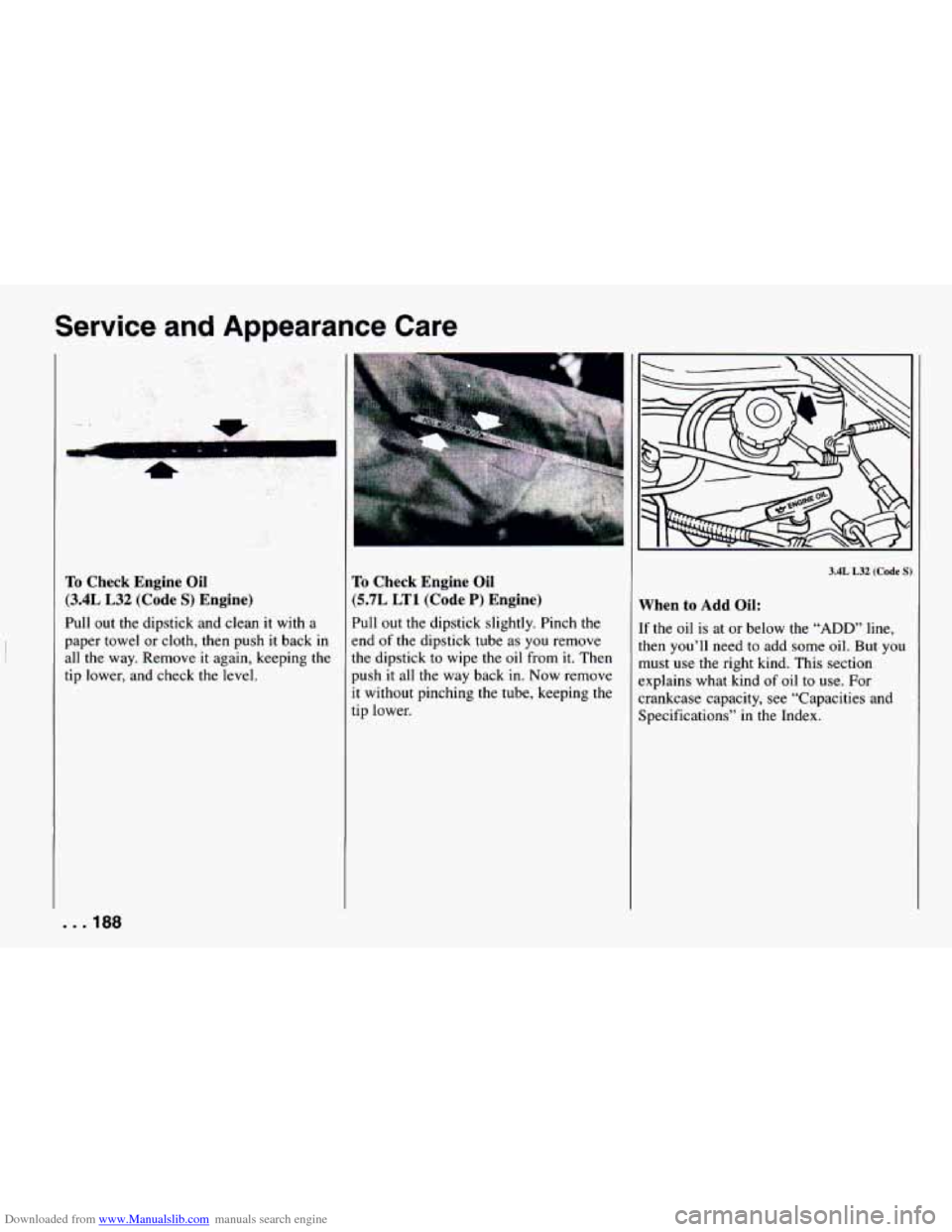
To Check Engine Oil
(3.4L L32 (Code S) Engine)
Pull out the dipstick and clean it with a
paper towel or cloth, then push it back in
all the way. Remove it again, keeping the
tip lower, and check the level.
IC
To Check Engine Oil
(5.7L LTl (Code P) Engine)
Pull out the dipstick slightly. Pinch the
end
of the dipstick tube as you remove
the dipstick to wipe the oil from it. Then
push it all the way back in. Now remove
it without pinching the tube, keeping the
tip lower.
3.4L L32 (Code S)
When to Add Oil:
f the oil is at or below the “ADD” line,
hen you’ll need to add some oil. But you
nust use the right kind. This section
:xplains what kind
of oil to use. For
:rankcase capacity, see “Capacities and
ipecifications” in the Index.
. . .I88
Page 192 of 292
Downloaded from www.Manualslib.com manuals search engine Service ad Appearance Care
Recommended SAE Viscosity
Grade Engine Oils
For best fuel economy and cold starting,
select the lowest SAE viscosity grade oil
for the expected temperature range.
HOT
WEATHER
-
I
u)oKFoR
ONE OF THESE
LABELS
SAE CW-30 PREFERRED
COLD
WEATHER
IF NEITHER SAE 5W-M NOR SAL 10W.30
ORADE OIU ARE A E, ME 30 GRADE
40 DEGREES F (4 DEGREES C).
DO NOT USE SAE 1OW-40, SAE 2OW-50 OR ANY OTHER GRADE OIL NOT RECOMMENDED.
MAY BE USED AT Ttmr~nnTURES ABWE
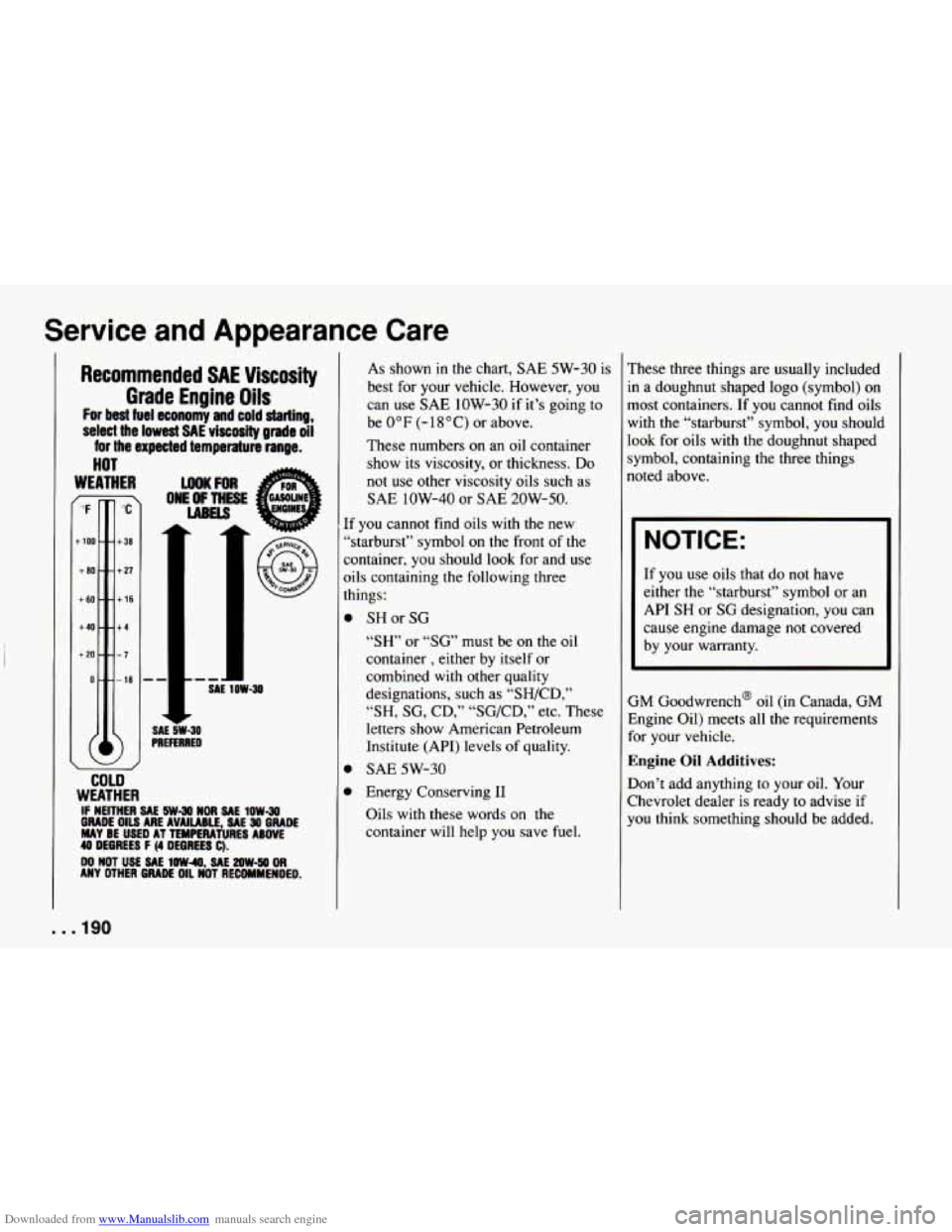
As shown in the chart, SAE 5W-30 is
best for your vehicle. However, you
can use SAE
1OW-30 if it’s going to
be
0°F (-18°C) or above.
These numbers on an oil container
show
its viscosity, or thickness. Do
not use other viscosity oils such as
SAE 1OW-40 or SAE 20W-50.
[f you cannot find oils with the new
‘starburst” symbol on the front of the
;ontainer, you should look for and use
3ils containing the following three
:hings:
SH or SG
“SH’ or “SG” must be on the oil
container
, either by itself or
combined with other quality
designations, such as “SH/CD,”
“SH, SG, CD,” “SG/CD,” etc. These
letters show American Petroleum
Institute
(API) levels of quality.
SAE
5W-30
Energy Conserving I1
Oils
with these words on the
container will help you save fuel. These
three things are usually included
in a doughnut shaped logo (symbol) on
most containers.
If you cannot find oils
with the “starburst” symbol, you should
look for oils with the doughnut shaped
symbol, containing the three things
noted above.
NOTICE:
If you use oils that do not have
either the “starburst” symbol or an
API SH or SG designation, you can
cause engine damage not covered
by your warranty.
GM Goodwrench@ oil (in Canada, GM
Engine Oil) meets all the requirements
for your vehicle.
Engine Oil Additives:
Don’t add anything to your oil. Your
Chevrolet dealer
is ready to advise if
you
think something should be added.
. . .I90