steering CHEVROLET CAMARO 1994 4.G Owner's Manual
[x] Cancel search | Manufacturer: CHEVROLET, Model Year: 1994, Model line: CAMARO, Model: CHEVROLET CAMARO 1994 4.GPages: 292, PDF Size: 15.35 MB
Page 187 of 292
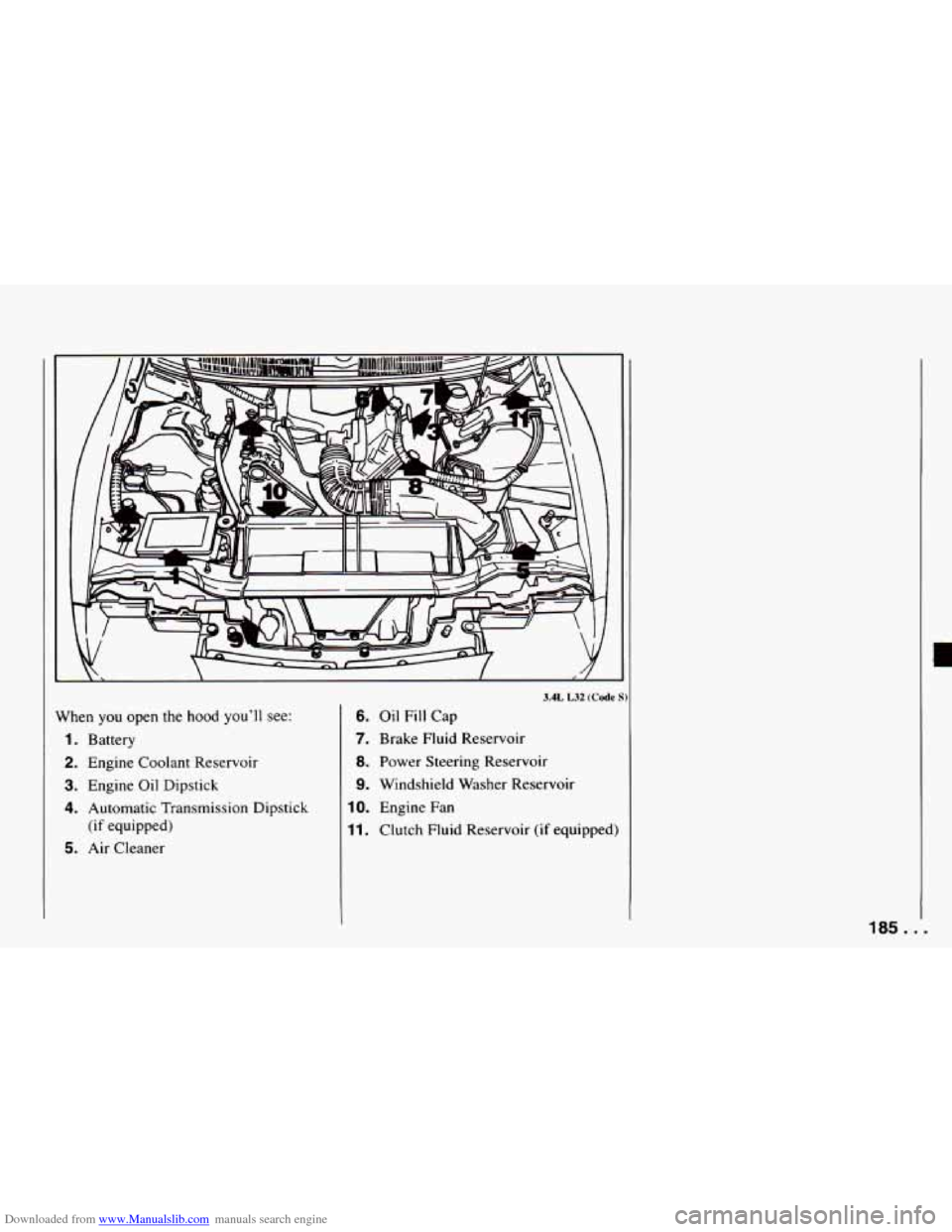
Downloaded from www.Manualslib.com manuals search engine When you open the hood you'll see:
1. Battery
2. Engine Coolant Reservoir
3. Engine Oil Dipstick
4. Automatic Transmission Dipstick
5. Air Cleaner (if equipped)
3.4L L32 (Code S
6. Oil Fill Cap
7. Brake Fluid Reservoir
8. Power Steering Reservoir
9. Windshield Washer Reservoir
10. Engine Fan
11. Clutch Fluid Reservoir (if equipped)
L
185 ...
Page 188 of 292
Downloaded from www.Manualslib.com manuals search engine Service and Appearance Care
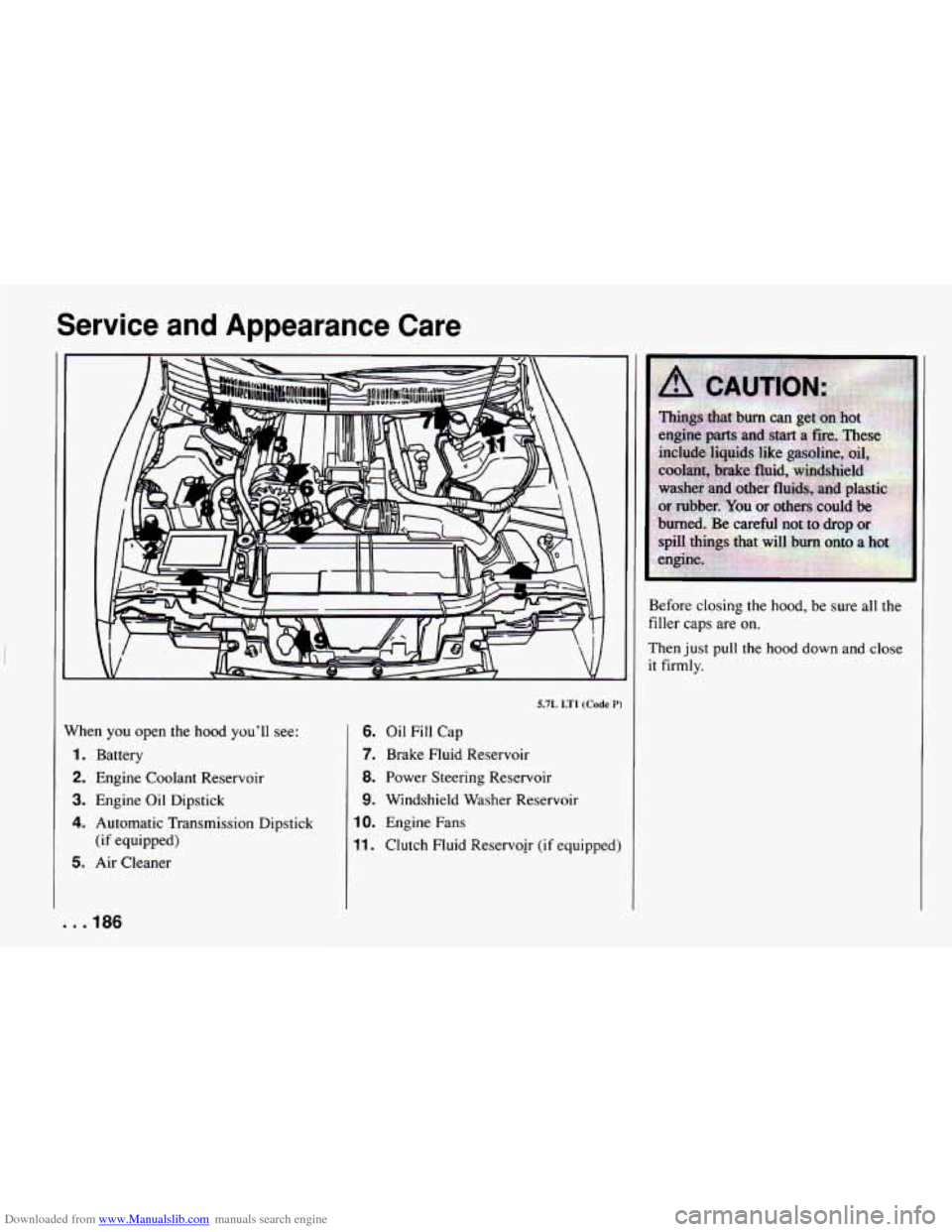
5.7L LT1 (Code P)
Vhen you open the hood you’ll see:
1. Battery
2. Engine Coolant Reservoir
3. Engine Oil Dipstick
4. Automatic Transmission Dipstick
5. Air Cleaner
(if equipped)
6. Oil Fill Cap
7. Brake Fluid Reservoir
8. Power Steering Reservoir
9. Windshield Washer Reservoir
10. Engine Fans
11. Clutch Fluid Reservoir (if equipped) Before
closing the hood, be sure all the
filler
caps are on.
Then just pull the hood down and close
it firmly.
. . .186
Page 202 of 292
Downloaded from www.Manualslib.com manuals search engine Service and Appearance Care
e CAUTION:
Turning the radiator pressure cap when the engine and radiator
are hot
can allow steam and scalding liquids
to
blow out and burn you badly.
Never
turn the pressure cap - even a
little
- when the engine and radiator
are hot.
Add coolant mix at the recovery tank, bul
be careful not to spill
it.
A CAUTION:
You can be burned if you spill
coolant on hot engine parts. Coolant
contains ethylene glycol,
and it will
bum if the engine parts are hot
enough. Don't spill coolant
on a
hot engine.
Radiator Pressure Cap (All Engines)
NOTICE:
Your radiator cap is a 18 psi
(1 24 kPa) pressure-type cap and
must be tightly installed to prevent
coolant
loss and possible engine
damage from overheating. Be sure
the arrows
on the cap line up with
the overflow tube on the radiator
filler neck.
When you replace your radiator pressure
cap, an
AC@ cap is recommended.
Thermostat
Engine coolant temperature is controlled
by a thermostat in the engine coolant
system. The thermostat stops the flow of
coolant through the radiator until the
coolant reaches a preset temperature.
When
you replace your thermostat, an
AC@ thermostat is recommended.
f
I I
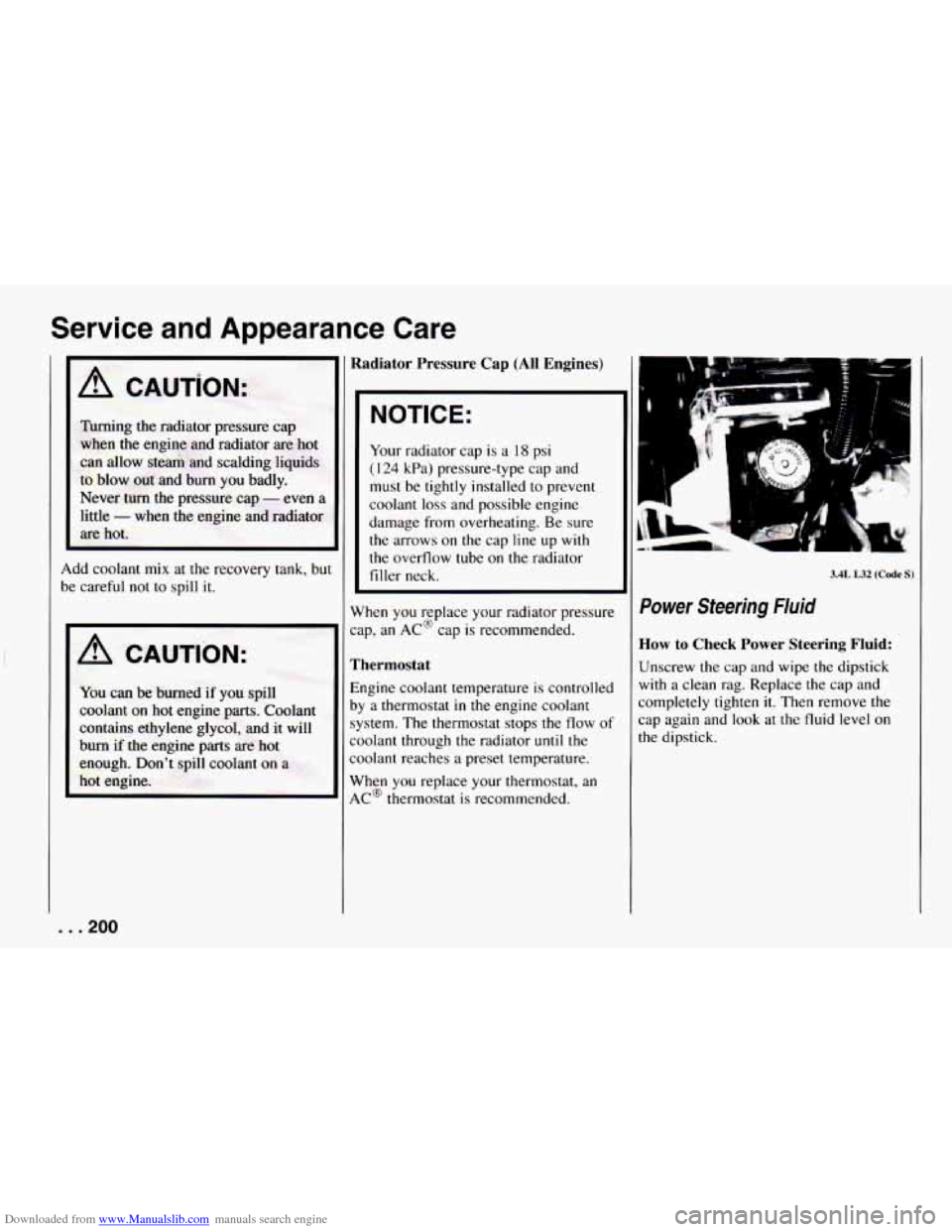
3.4L L32 (Code S)
Power Steering Fluid
How to Check Power Steering Fluid:
Unscrew the cap and wipe the dipstick
with a clean rag. Replace the cap and
completely tighten it. Then remove the
cap again and look
at the fluid level on
the dipstick.
. . .200
Page 203 of 292
Downloaded from www.Manualslib.com manuals search engine 0
0
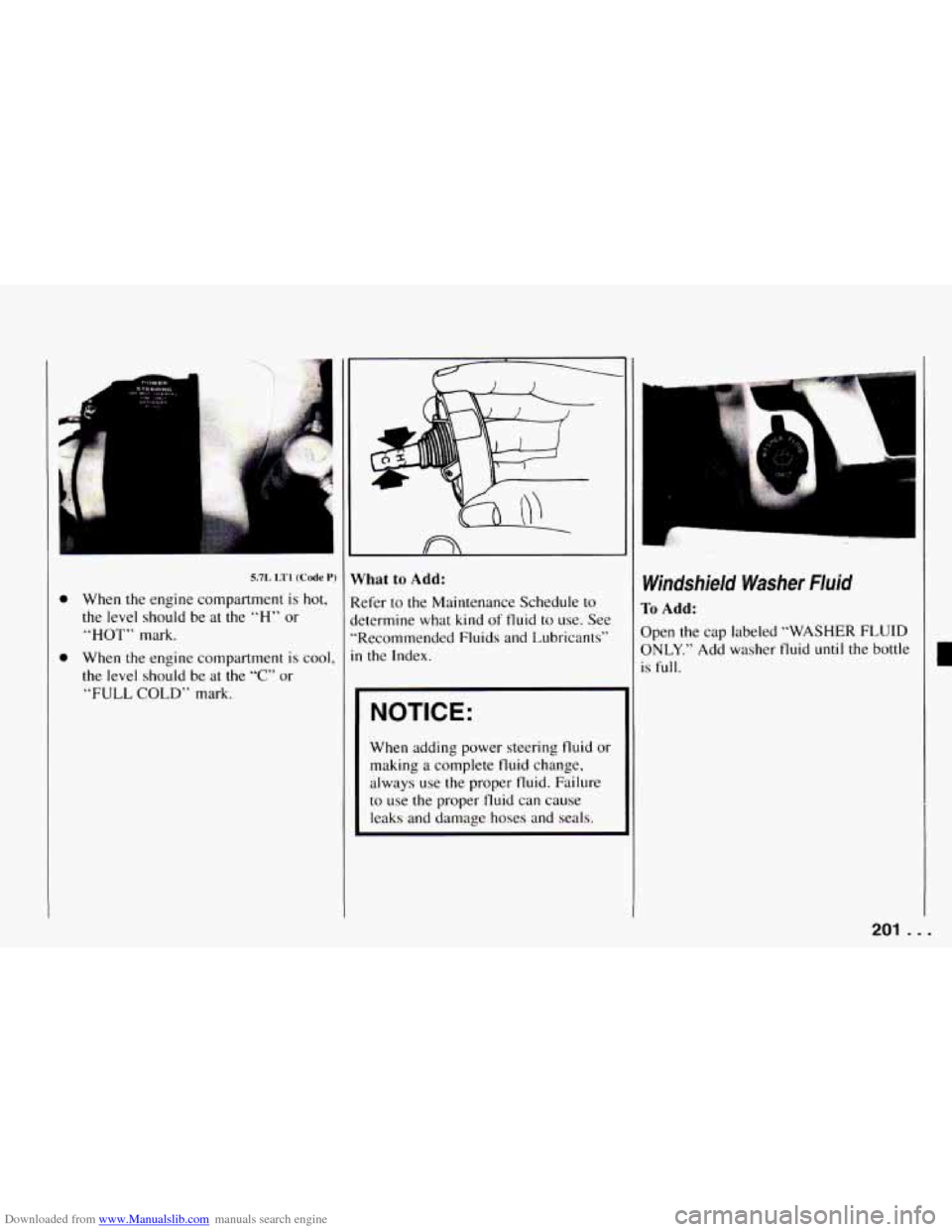
5.7L LTl (Code P)
When the engine compartment is hot,
the level should be at the
“H” or
“HOT” mark.
When the engine compartment is cool,
the level should be at
the “C” or
“FULL COLD” mark.
w1
Re
del
“R
in
n
hat to Add:
fer to the Maintenance Schedule to
:ermine what kind of fluid to use. See
ecommended Fluids and Lubricants”
the Index.
NOTICE:
When adding power steering fluid or
making a complete fluid change,
always use the proper fluid. Failure
to use the proper fluid can cause
leaks and damage hoses and seals.
I
/intishield Washer Fluid
3 Add:
pen the cap labeled “WASHER FLUID
NLY.” Add washer fluid until the bottle
full.
201 . . .
Page 246 of 292
Downloaded from www.Manualslib.com manuals search engine Maintenance Schedule
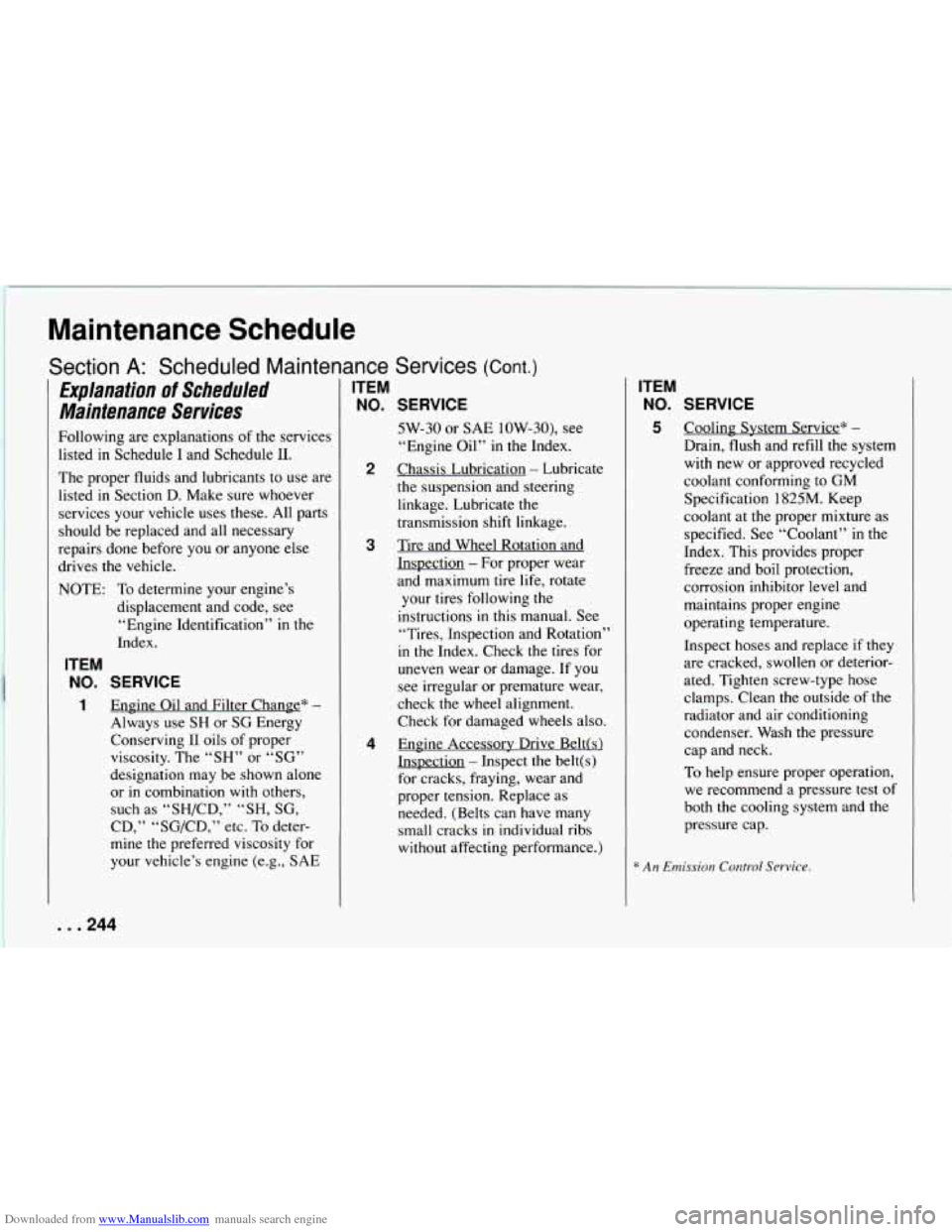
Section A: Scheduled Maintenance Services (cont.)
Explanation of Scheduled
Maintenance Services
Following are explanations of the services
listed in Schedule
I and Schedule 11.
The proper fluids and lubricants to use are
listed
in Section D. Make sure whoever
services your vehicle uses these. All parts
should be replaced and all necessary
repairs done before you or anyone else
drives the vehicle.
NOTE: To determine your engine’s
displacement and code, see
“Engine Identification”
in the
Index.
ITEM
NO. SERVICE
1 Engine Oil and Filter Change” -
Always use SH or SG Energy
Conserving I1 oils of proper
viscosity. The
“SH” or “SG”
designation may be shown alone
or
in combination with others,
such as “SH/CD,”
“SH, SG,
CD,” “SG/CD,” etc. To deter-
mine the preferred viscosity for
your vehicle’s engine (e.g., SAE
ITEM
NO.
2
3
4
SERVICE
5W-30 or SAE 1OW-30)’ see
“Engine Oil”
in the Index.
Chassis Lubrication
- Lubricate
the suspension and steering
linkage. Lubricate the
transmission shift linkage.
Tire and Wheel Rotation and
InsDection
- For proper wear
and maximum tire life, rotate
your tires following the
instructions
in this manual. See
“Tires, Inspection and Rotation”
in the Index. Check the tires for
uneven wear or damage. If you
see irregular or premature wear,
check the wheel alignment.
Check for damaged wheels also.
Engine Accessory Drive Belt(s)
Inspection
- Inspect the belt(s)
for cracks, fraying, wear and
proper tension. Replace as needed. (Belts can have many
small cracks
in individual ribs
without affecting performance.)
ITEM
NO. SERVICE
5 Cooling System Service* -
Drain, flush and refill the system
with new or approved recycled
coolant conforming to
GM
Specification 1825M. Keep
coolant at the proper mixture as
specified. See “Coolant”
in the
Index. This provides proper
freeze and boil protection,
corrosion inhibitor level and
maintains proper engine
operating temperature.
Inspect hoses and replace
if they
are cracked, swollen or deterior-
ated. Tighten screw-type hose
clamps. Clean the outside
of the
radiator and air conditioning
condenser. Wash the pressure
cap and neck.
To help ensure proper operation,
we recommend a pressure test of
both the cooling system and the
pressure cap.
* An Emission Control Service.
. . .244
Page 250 of 292
Downloaded from www.Manualslib.com manuals search engine Maintenance Schedule
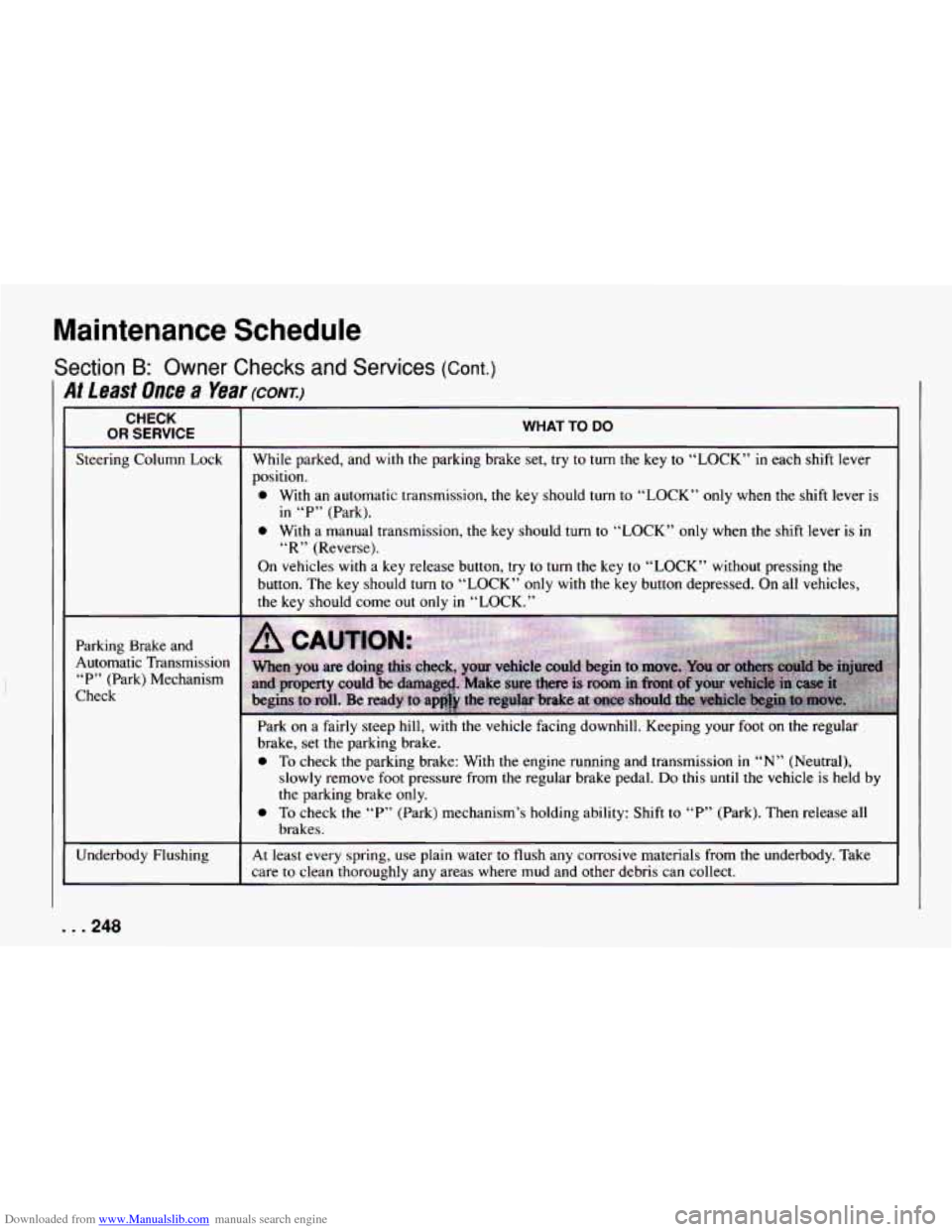
Section B: Owner Checks and Services (Cont.)
At Least Once a Year (CONT.)
CHECK
OR SERVICE
Steering Column Lock
Parking Brake and
Automatic Transmission “P” (Park) Mechanism
Check
Underbody Flushing
WHAT TO DO
While parked, and with the parking brake set, try to turn the key to “LOCK” in each shift lever
position.
0 With an automatic transmission, the key should turn to “LOCK” only when the shift lever is
0 With a manual transmission, the key should turn to “LOCK” only when the shift lever is in
On vehicles
with a key release button, try to turn the key to “LOCK” without pressing the
button. The key should turn to “LOCK” only with the key button depressed. On all vehicles,
the
key should come out only in “LOCK.”
in “P” (Park).
“R” (Reverse).
Park on a fairly steep hill, with the vehicle facing downhill. Keeping your foot on the regular
brake, set the parking brake.
0 To check the parking brake: With the engine running and transmission in “N” (Neutral),
slowly remove foot pressure from the regular brake pedal.
Do this until the vehicle is held by
the parking brake only.
brakes.
0 To check the “P” (Park) mechanism’s holding ability: Shift to “P” (Park). Then release all
At least every spring, use plain water to flush any corrosive materials from the underbody. Take
care to clean thoroughly any areas where mud and other debris can collect.
. . .248
Page 251 of 292
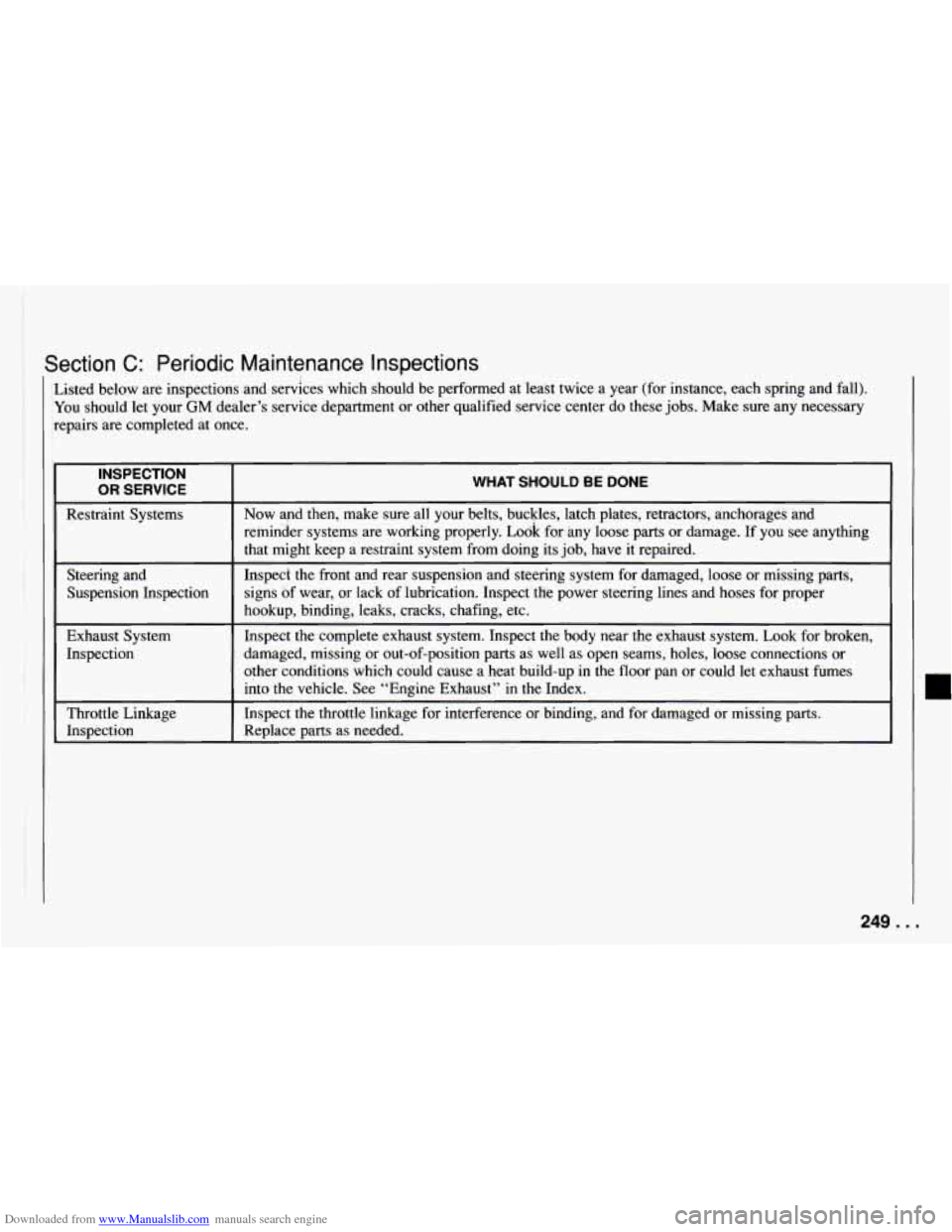
Downloaded from www.Manualslib.com manuals search engine ~ Section C: Periodic Maintenance Inspections
Listed below
are inspections and services which should be performed at least twice a year (for instance, each spring and fall).
You should let your
GM dealer’s service department or other qualified service center do these jobs. Make sure any necessary
repairs are completed at once.
INSPECTION
1 OR SERVICE WHAT
SHOULD BE DONE
Restraint Systems Now and then, make sure all your belts, buckles, latch plates, retractors, anchorages and
reininder systems are working properly. Lodk for any loose parts or damage.
If you see anything
that might keep a restraint system from doing its job, have it repaired.
Steering and Insped the front and rear suspension and steering system for damaged, loose or missing parts,
Suspension Inspection signs of wear, or lack of lubrication. Inspect the power steering lines and hoses for proper
Exhaust System Inspect the complete exhaust system. Inspect the body near the exhaust system. Look for broken,
Inspection damaged, missing or out-of-position parts as well as open seams, holes, loose connections or
hookup, binding, leaks,
cracks, chafing, etc.
other conditions which could cause a heat build-up in the floor pan or could let exhaust fumes
into the vehicle. See “Engine Exhaust” in the Index.
Throttle Linkage Inspect the throttle linkage for interference or binding, and for damaged
or missing parts.
Inspection Replace parts as needed.
L
249.. .
Page 253 of 292
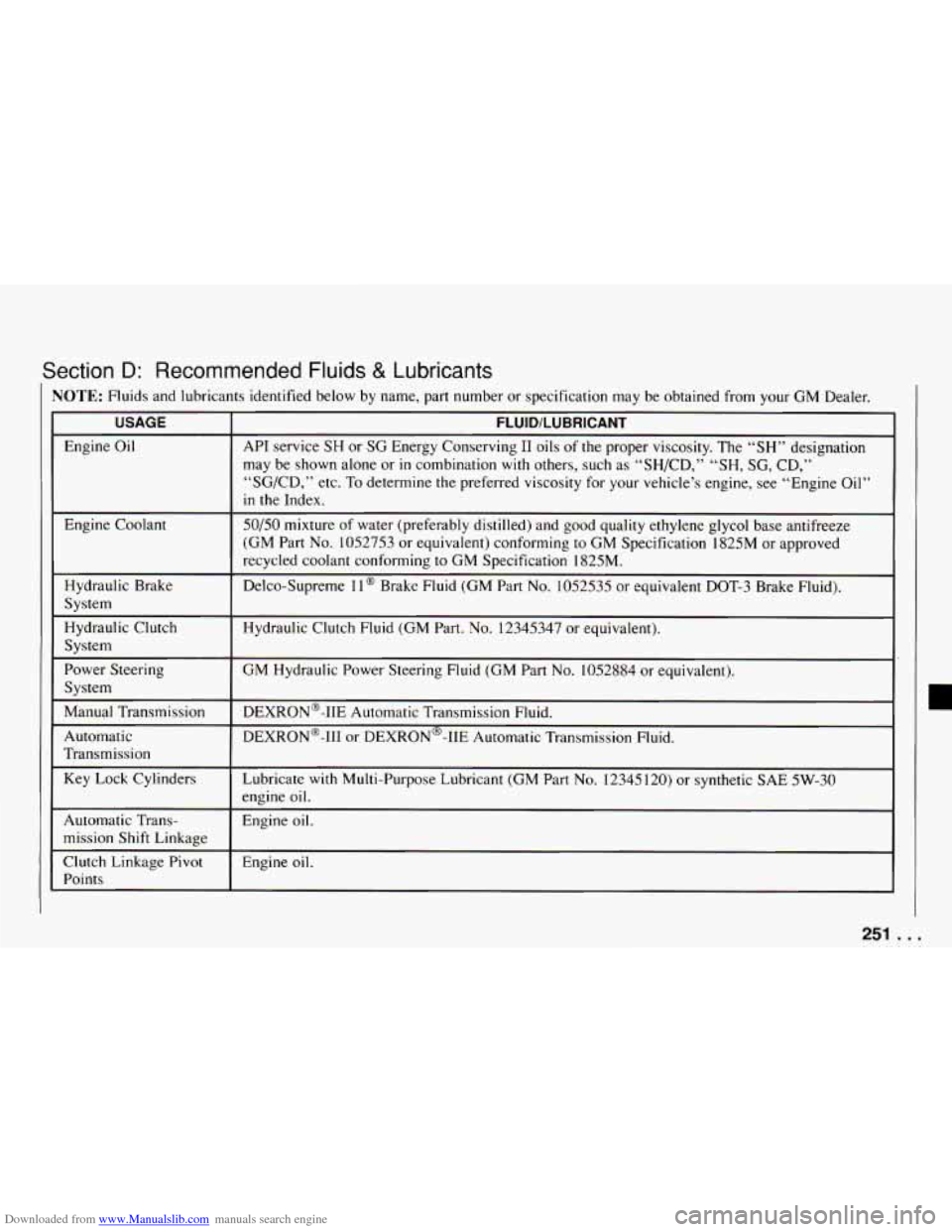
Downloaded from www.Manualslib.com manuals search engine Section D: Recommended Fluids & Lubricants
I NOTE: Fluids and lubricants identified below by name, part number or specification may be obtained from your GM Dealer.
USAGE
Engine Oil
Engine Coolant
Hydraulic Brake
System
Hydraulic Clutch
System
Power Steering
System
Manual Transmission
Automatic
Transmission
Key Lock Cylinders
Automatic Trans-
mission Shift Linkage
Clutch Linkage Pivot
Points
FLUID/LUBRICANT
API service SH or SG Energy Conserving I1 oils of the proper viscosity. The “SH” designation
may be shown alone
or in combination with others, such as “SH/CD,” “SH, SG, CD,”
“SG/CD,” etc.
To determine the preferred viscosity for your vehicle’s engine, see “Engine Oil”
in the Index.
50/50 mixture of water (preferably distilled) and good quality ethylene glycol base antifreeze
(GM Part No. 1052753 or equivalent) conforming to GM Specification 1825M or approved
recycled coolant conforming to GM Specification 1825M.
Delco-Supreme
11 @ Brake Fluid (GM Part No. 1052535 or equivalent DOT-3 Brake Fluid).
Hydraulic Clutch Fluid (GM Part.
No. 12345347 or equivalent).
- ~- -~~ --
~ M Hydraulic Power Steering Fluid (GM Part No. 1052884 or equivalent).
DEXRON@-IIE Automatic Transmission Fluid.
DEXRON@-111 or DEXRON@-IIE Automatic Transmission Fluid.
Lubricate with Multi-Purpose Lubricant (GM Part No. 12345
120) or synthetic SAE 5W-30
engine oil.
Engine oil.
Engine
oil.
251 . . .
Page 271 of 292
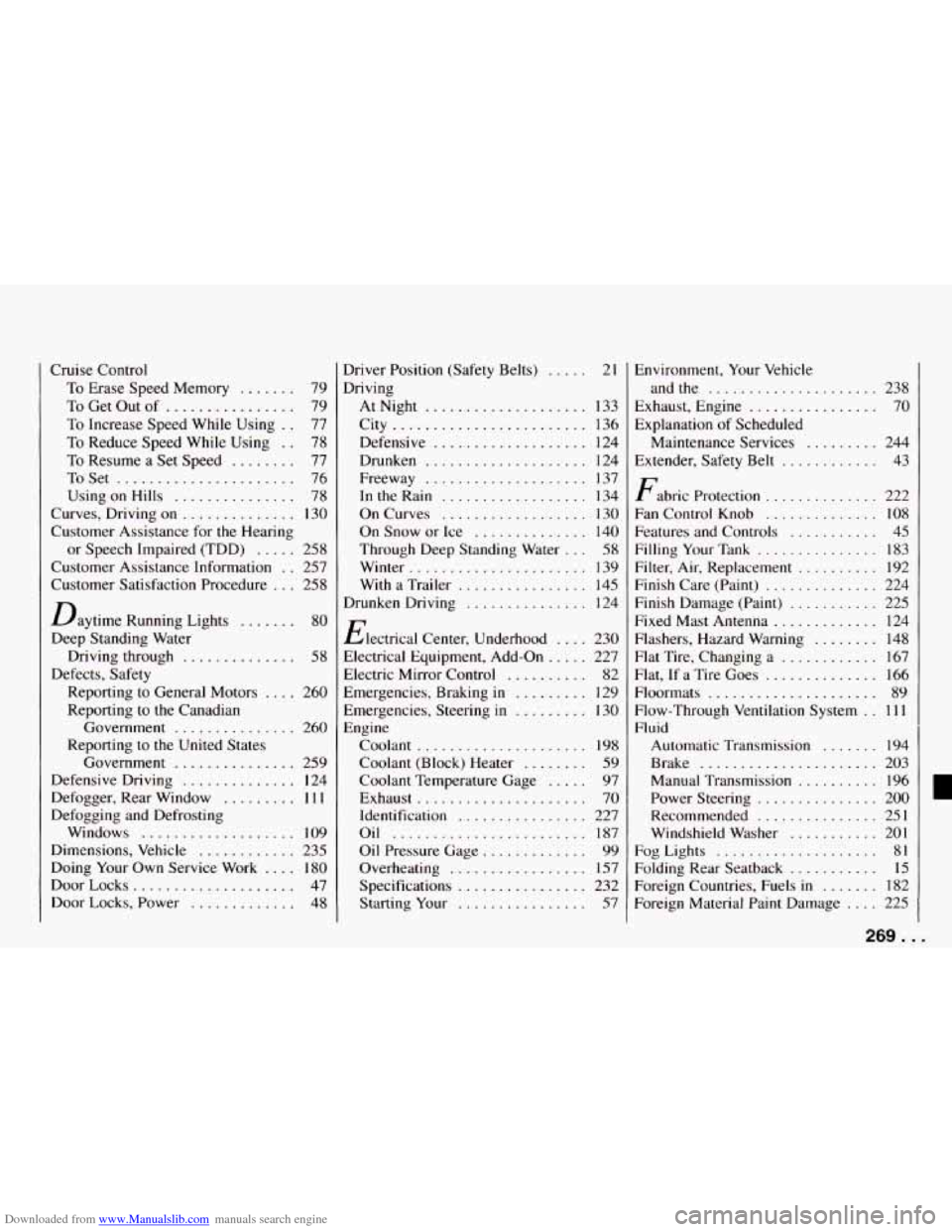
Downloaded from www.Manualslib.com manuals search engine Cruise Control To Erase Speed Memory
....... 79
To Get Out of
................ 79
To Increase Speed While Using
. . 77
To Reduce Speed While Using
. . 78
To Resume a Set Speed ........ 77
ToSet
...................... 76
Using on Hills
............... 78
Curves. Driving on
.............. 130
Customer Assistance for the Hearing
or Speech Impaired (TDD)
..... 258
Customer Assistance Information
. . 257
Customer Satisfaction Procedure
... 258
Daytime Running Lights
....... 80
Deep Standing Water
Driving through
.............. 58
Defects. Safety
Reporting to General Motors
.... 260
Reporting to the Canadian
Government
............... 260
Reporting to the United States
Government
............... 259
Defensive Driving
.............. 124
Defogger. Rear Window
......... 1 I1
Defogging and Defrosting
Windows
................... 109
Dimensions. Vehicle
............ 235
Doing Your Own Service Work
.... 180
Door Locks
.................... 47
Door Locks. Power
............. 48 Driver Position (Safety
Belts)
..... 21
Driving
AtNight
.................... 133
City
........................ 136
Defensive
................... 124
Drunken
.................... 124
Freeway
.................... 137
In the Rain .................. 134
On Curves
.................. 130
On Snow or Ice
.............. 140
Through Deep Standing Water
... 58
Winter
...................... 139
With a Trailer
................ 145
Drunken Driving
............... 124
Electrical Center. Underhood
.... 230
Electrical Equipment. Add-on
..... 227
Electric Mirror Control
.......... 82
Emergencies. Braking in
......... 129
Emergencies. Steering in
......... 130
Engine
Coolant
..................... 198
Coolant (Block) Heater
........ 59
Coolant Temperature Gage
..... 97
Exhaust
..................... 70
Identification
................ 227
Oil
........................ 187
Oil Pressure Gage
............. 99
Overheating
................. 157
Specifications
................ 232
Starting Your
................ 57 Environment.
Your Vehicle
andthe
..................... 238
Exhaust. Engine
................ 70
Explanation of Scheduled
Maintenance Services
......... 244
Extender. Safety Belt
............ 43
Fabric Protection
.............. 222
Fan Control Knob
.............. 108
Features and Controls
........... 45
Filling Your Tank
............... 183
Filter.
Air. Replacement .......... 192
Finish Care (Paint)
.............. 224
Finish Damage (Paint)
........... 225
Fixed Mast Antenna
............. 124
Flashers. Hazard Warning
........ 148
Flat Tire. Changing a ............ 167
Flat. If a Tire Goes
.............. 166
Floormats
..................... 89
Flow-Through Ventilation System . . I1 1
Fluid
Automatic Transmission
....... 194
Brake
...................... 203
Manual Transmission
.......... 196
Power Steering
............... 200
Recommended
............... 251
Windshield Washer
........... 201
FogLights
.................... 81
Folding Rear Seatback
........... 15
Foreign Countries. Fuels in ....... 182
Foreign Material Paint Damage
.... 225
269 . .
Page 274 of 292
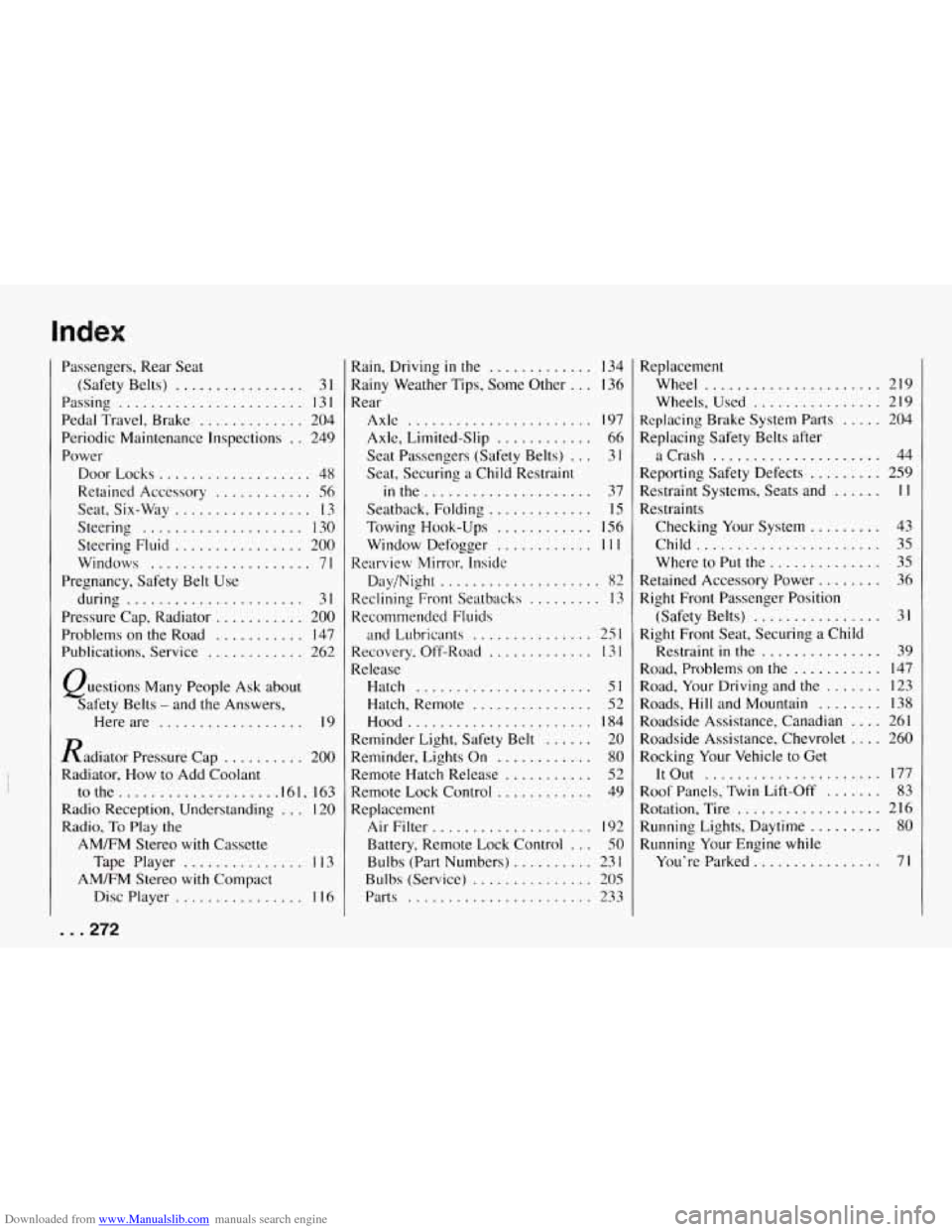
Downloaded from www.Manualslib.com manuals search engine Passengers. Rear Seat
(Safety Belts)
................ 3 I
Passing ....................... 13 I
Pedal Travel. Brake ............. 204
Periodic Maintenance Inspections
. . 249
Power
Door Locks
................... 48
Retained Accessory
............ 56
Seat. Six-Wdy ................. 13
Steering
.................... 130
Steering Fluid
................ 200
Windows
.................... 7 1
Pregnancy. Safety Belt Use during
...................... 31
Pressure Cap. Radiator
........... 200
Problems on the Road ........... 147
Publications. Service
............ 262
Questions
Many People Ask about
Safety Belts
- and the Answers.
Here are
.................. 19
Radiator Pressure Cap
.......... 200
Radiator. How to Add Coolant
to the
.................... 16 1. 163
Radio Reception. Understanding ... 120
Radio.
To Play the
AM/FM Stereo
with Cassette
AM/FM Stereo with Compact
Tape Player
............... 1 13
Disc Player
................ I I6
... 272
Rain. Driving in the ............. 134
Rainy Weather Tips. Some Other
... I36
Rear Axle
....................... 197
Axle. Limited-Slip ............ 66
Seat Passengers (Safety Belts) ... 31
Seat. Securing
a Child Restraint
in the ..................... 37
Seatback. Folding
............. 15
Towing Hook-Ups ............ 156
Window Defogger
............ I I1
Rearview Mirror? Inside
Day/Night
.................... 82
Reclining Front Seatbacks ......... 13
Recommended Fluids
and Lubricants
............... 251
Recovery. Off-Road ............. 13 1
Release Hatch
...................... 51
Hatch. Remote ............... 52
Hood
....................... 184
Reminder Light. Safety Belt
...... 20
Reminder. Lights On
............ 80
Remote Hatch Release
........... 52
Remote Lock Control ............ 49
Replacement
Air Filter .................... 192
Battery. Remote Lock Control
... 50
Bulbs (Part Numbers) .......... 23 1
Bulbs (Service) ............... 205
Parts ....................... 233
Replacement
Wheel
...................... 219
Wheels. Used
................ 219
Replacing
Brake System Parts ..... 204
Replacing Safety Belts after
a Crash ..................... 44
Reporting Safety Defects ......... 259
Restraint Systems. Seats and
...... 11
Restraints
Checking Your System
......... 43
Child
....................... 35
Where
to Put the .............. 35
Retained Accessory Power
........ 36
Right Front Passenger Position
(Safety Belts)
................ 31
Right Front Seat. Securing
a Child
Restraint
in the ............... 39
Road. Problems on the ........... 147
Road. Your Driving and the ....... 123
Roads.
Hill and Mountain ........ 138
Roadside Assistance. Canadian
.... 261
Roadside Assistance. Chevrolet .... 260
Rocking Your Vehicle to Get
It out ...................... 177
Roof Panels. Twin Lift-off
....... 83
Rotation. Tire
.................. 216
Running Lights. Daytime ......... 80
Running Your Engine while
You’re Parked
................ 71