coolant temperature CHEVROLET CAMARO 1994 4.G Owners Manual
[x] Cancel search | Manufacturer: CHEVROLET, Model Year: 1994, Model line: CAMARO, Model: CHEVROLET CAMARO 1994 4.GPages: 292, PDF Size: 15.35 MB
Page 11 of 292
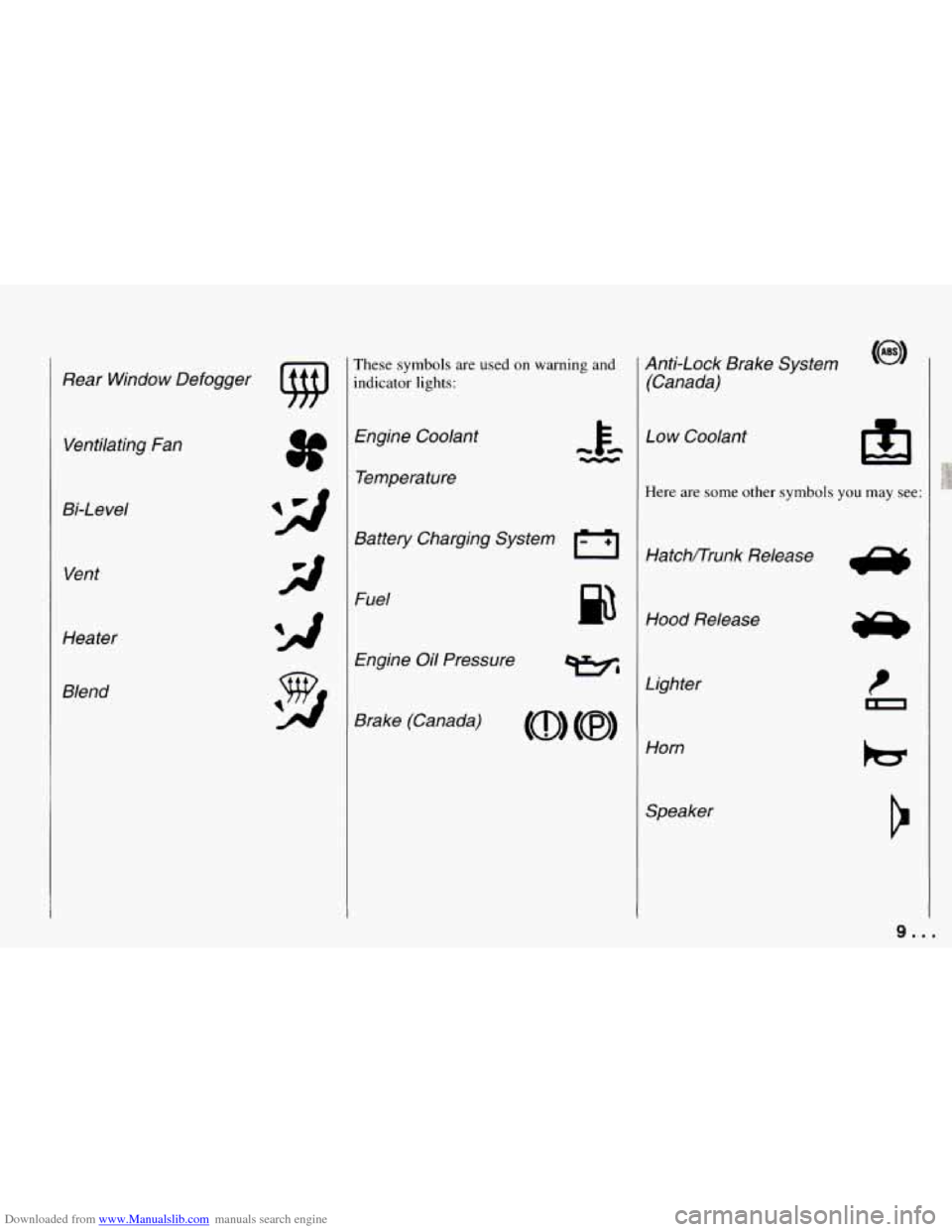
Downloaded from www.Manualslib.com manuals search engine Rear Window Defogger Ventilating Fan
Bi-Level Vent
Heater
Blend
These symbols are used on warning and
indicator lights:
Engine Coolant
Temperature
Battery Charging System
El
Fuel
Engine Oil Pressure
Brake (Canada) Anti-Lock Brake System
(Canada)
Low Coolant
m
Here are some other symbols you may see:
Hatchflrunk Release
Hood Release
Lighter Horn
B
k3
Speaker
9..
Page 66 of 292
Downloaded from www.Manualslib.com manuals search engine Features and Controls
a
a
0
0
0
2 (Second Gear) - Press the clutch
pedal as you let up on the accelerator
pedal and shift into
“2.” Then, slowly
let up on the clutch pedal as you
press the accelerator pedal.
3,4,5 and 6 (Third, Fourth, Fifth
and Sixth Gears)
- Shift into “3,”
“4,” “5” and “6” the same way you do
for
“2.” Slowly let up on the clutch
pedal
as you press the accelerator
pedal.
To Stop - Let up on the accelerator
pedal and press the brake pedal. Just
before the vehicle stops, press
the
clutch pedal and the brake pedal, and
shift to “Neutral.”
Neutral - Use this position when
you start or idle your engine.
R (Reverse) - To back up, press
down the clutch pedal and shift into
“R.” Let
up on the clutch pedal slowly
while pressing the accelerator pedal.
If you shift from
“6” into “R,” the
shift lever must be first placed in the
“Neutral” position centered between
“2” and “3” prior to shifting into “R.”
Your six-speed manual transmission has a
feature that allows you to safely shift into
“R’ (Reverse) while the vehicle is rolling
(at less than
5 mph). You will be
“locked-out”
if you try to shift into “R’
(Reverse) while your vehicle is moving
faster than
5 mph.
If
you have turned your ignition off and
wish to park your vehicle
in Reverse, you
will have to move the shift lever quickly
to the right, “crashing” through the high
load spring and then into gear.
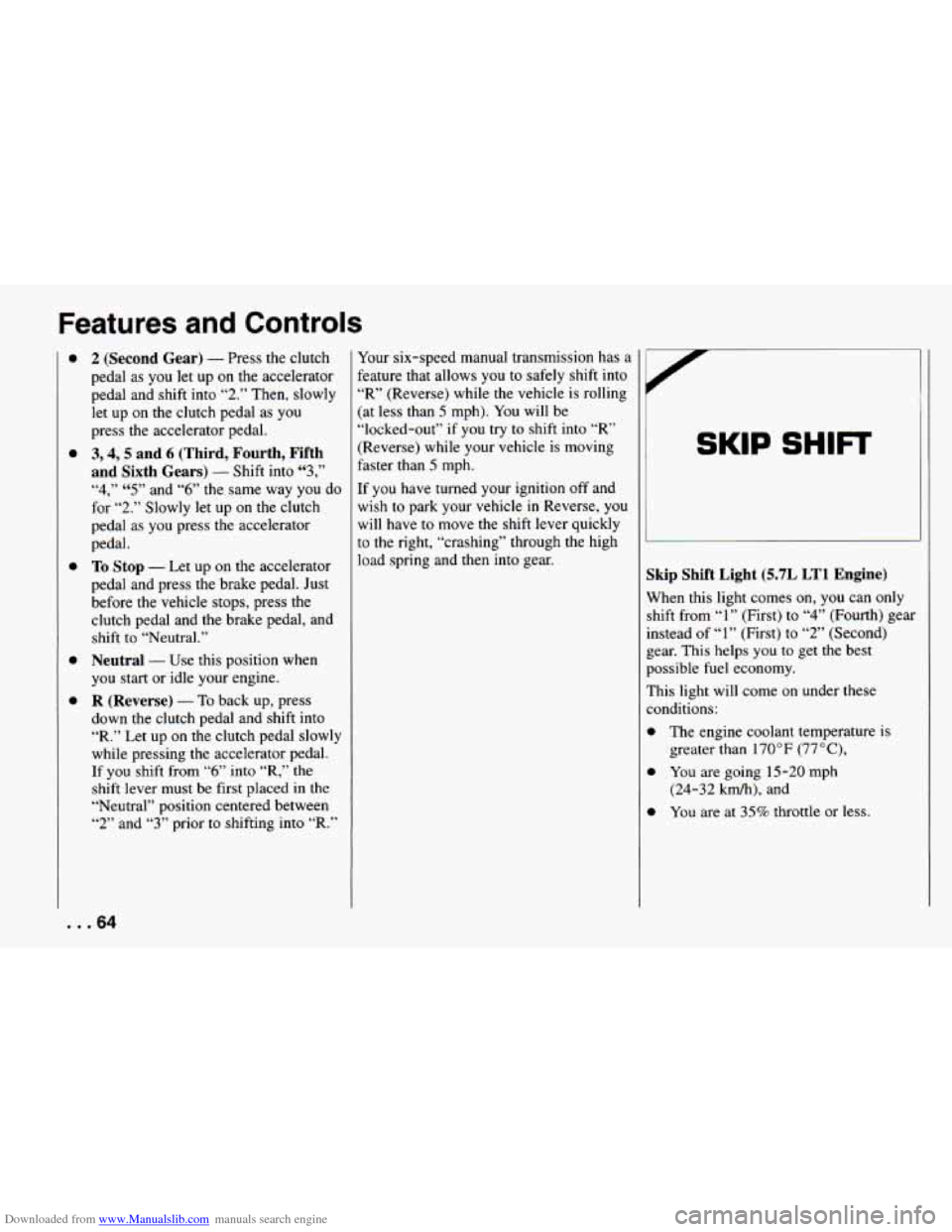
SKIP SHIFT
Skip Shift Light (5.7L LT1 Engine)
When this light comes on, you can only
shift from “1” (First) to
“4” (Fourth) gear
instead of
“1” (First) to “2” (Second)
gear. This helps you
to get the best
possible fuel economy.
This light will come on under these
conditions:
0 The engine coolant temperature is
0 You are going 15-20 mph
0 You are at 35% throttle or less.
greater than
170°F
(77”C),
(24-32 km/h), and
... 64
Page 99 of 292
Downloaded from www.Manualslib.com manuals search engine When this warning light is on, the system
will not limit wheel spin. Adjust your
driving accordingly.
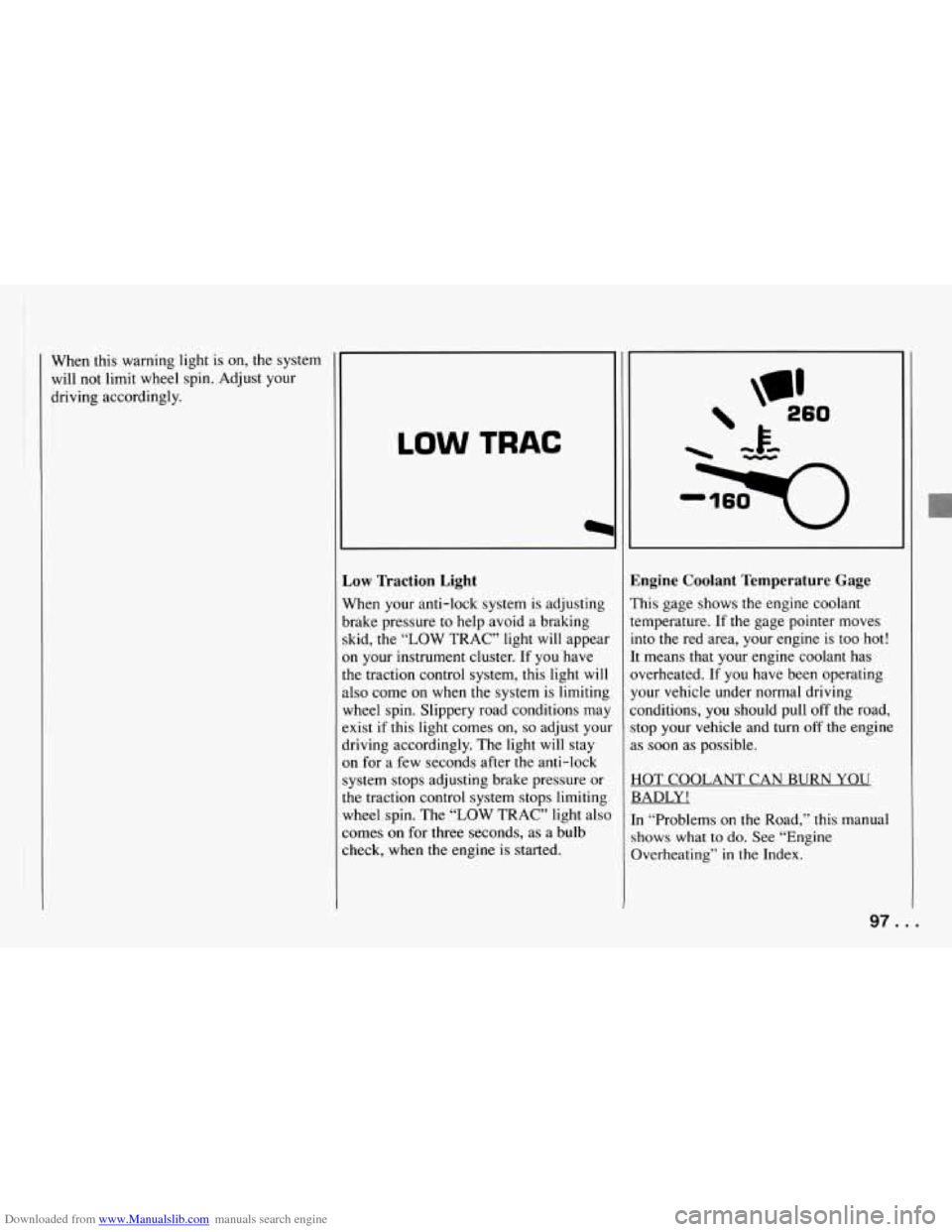
LOW TRAC
Low Traction Light
When your anti-lock system is adjusting
brake pressure to help avoid a braking
skid, the “LOW TRAC” light will appear
on your instrument cluster. If you have
the traction control system, this light
will
also come on when the system is limiting
wheel spin. Slippery road conditions may
exist if this light comes on,
so adjust your
driving accordingly. The light
will stay
on for a few seconds after the anti-lock
system stops adjusting brake pressure or
the traction control system stops limiting
wheel spin. The “LOW TRAC” light also
comes
on for three seconds, as a bulb
check, when
the engine is started.
hgine Coolant Temperature Gage
?his gage shows the engine coolant
emperature. If the gage pointer moves
nto the red area, your engine is too hot!
t means that your engine coolant has
jverheated. If you have been operating
’our vehicle under normal driving
:onditions, you should pull off
the road,
top your vehicle and turn
off the engine
IS soon as possible.
IOT COOLANT CAN BURN YOU
3ADLY!
n “Problems on the Road,” this manual
#bows what to do. See “Engine
herheating”
in the Index.
97 ...
Page 111 of 292
Downloaded from www.Manualslib.com manuals search engine During initial start-up only, if your
vehicle is equipped with an optional
engine coolant heater, you can
use it in
cold weather (around +2OoF/-8”C or
lower) to heat the passenger area better
than without
it. Because an engine coolant
heater warms the engine coolant, your
vehicle’s heating system can more
efficiently provide heat for the passenger
area of your vehicle. See “Engine Coolant
Heater’’
in the Index.
Bi-Level Heating
You may want to use bi-level heating on
cool, but sunny days. This setting directs
cool air toward
your body and warmer air
toward your feet.
1. Turn the air control knob to *g .
2. Turn the temperature control knob to
3. Turn the fan control knob to the right.
a comfortable setting.
Ventilation
For mild outside temperatures when little
neating or cooling is needed, you can still
iirect outside air through your vehicle.
1. Turn the air control knob to 9 .
2. Turn the temperature control knob to a
3. Turn the fan control knob to the right.
comfortable setting.
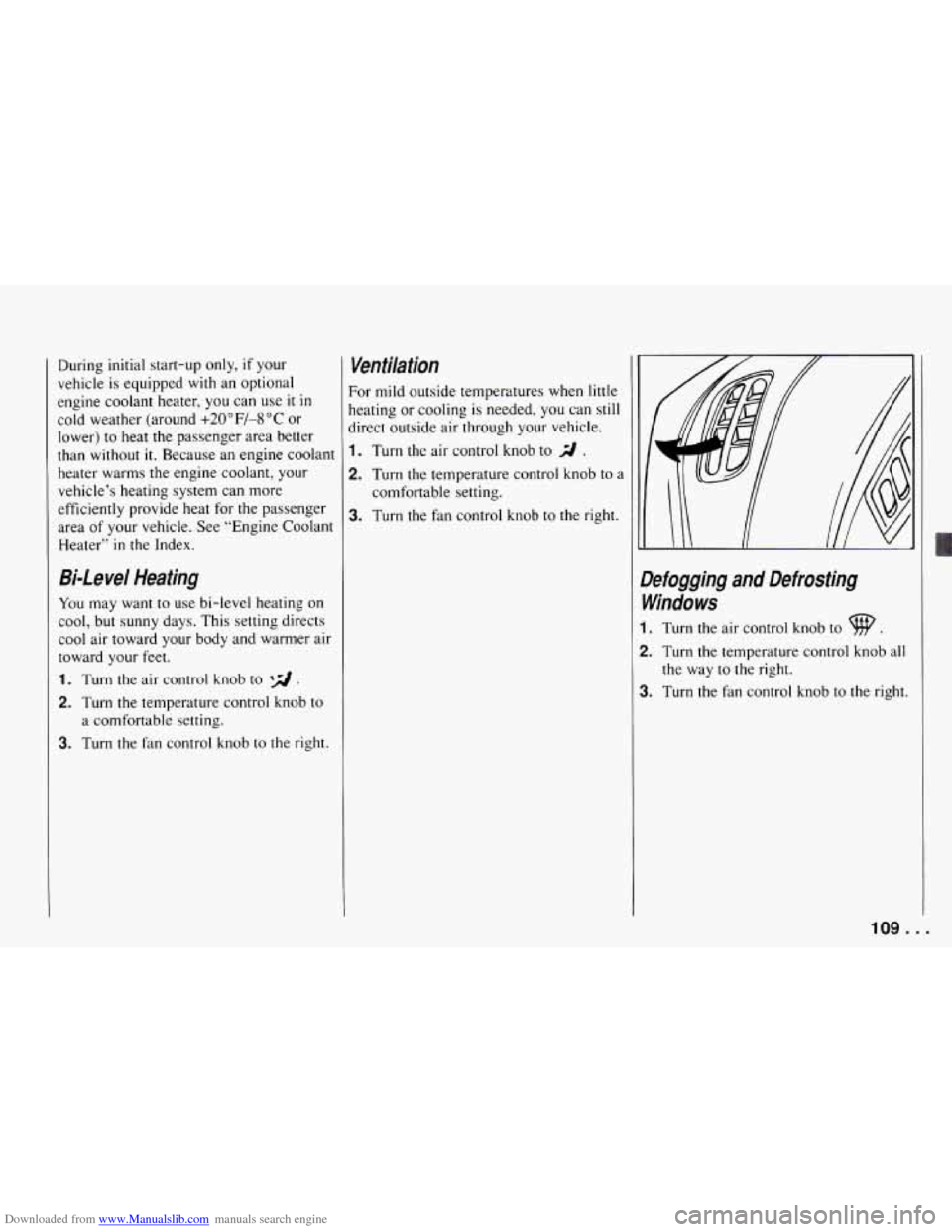
7efogging and Defrosting
Nindo
ws
. Turn the air control knob to 9.
!. Turn the temperature control knob all
1. Turn the fan control knob to the right.
the
way to
the right.
109. I
Page 159 of 292
Downloaded from www.Manualslib.com manuals search engine NOTICE:
Towing a vehicle over rough
surfaces could damage
a vehicle.
Damage can occur from
vehicle-
to-ground or vehicle-to-wheel-lift-
equipment contact.
To help avoid
damage, install a towing dolly
and raise vehicle
until adequate
clearance
is obtained between the
ground and/or wheel-lift equipment.
Engine Overheating
You will find a coolant temperature gage
Dn your Chevrolet’s instrument panel.
You may also find a low coolant warning
light on your Chevrolet instrument panel.
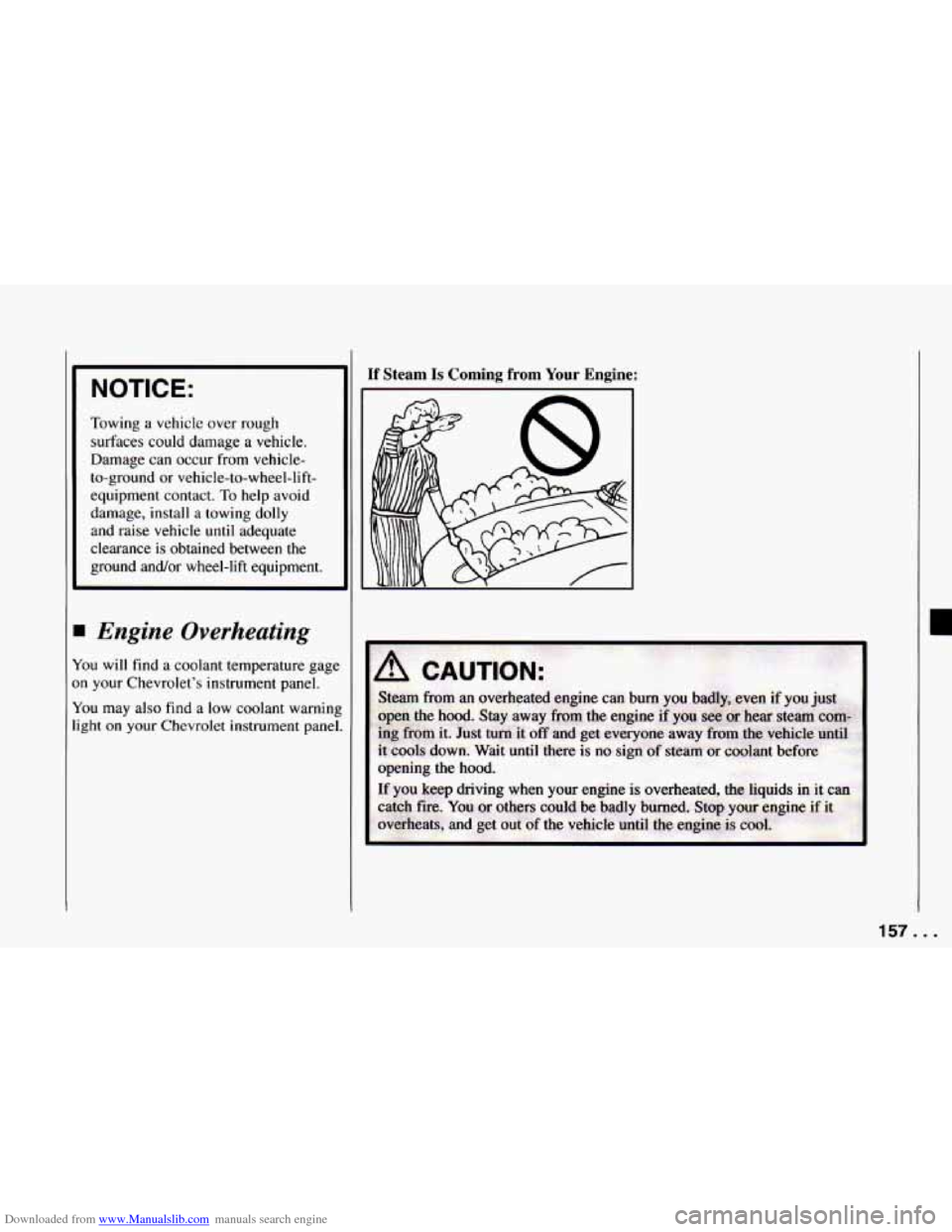
If Steam Is Coming from Your Engine:
157.. .
Page 200 of 292
Downloaded from www.Manualslib.com manuals search engine Service and Appearance Care
Engine Coolant
The following explains your cooling
system and how to add coolant when
it
is low. If you have a problem with
engine overheating or if you need
to add
coolant to your radiator, see “Engine
Overheating” in the Index.
The proper coolant for your Chevrolet
will:
0 Give freezing protection down to
Give boiling protection up to 262°F
Protect against rust and corrosion.
0 Help keep the proper engine
Let the warning lights work as they
-34°F (-37°C).
(128°C).
temperature.
should.
What to Use:
Use a mixture of one-half clean water
(preferably distilled) and one-half
antifreeze that meets “GM Specification
1825M,” which won’t damage aluminum
parts.
You can also use a recycled coolant
conforming to GM Specification
1825M
with a complete coolant flush and refill. If
you use
this mixture, you don’t need to
add anything else.
NOTICE:
If you use an improper coolant mix,
your engine could overheat and be
badly damaged. The repair cost
wouldn’t be covered by your war-
ranty.
Too much water in the mix can
freeze and crack the engine, radiator,
heater core and other parts.
. . .I98
Page 202 of 292
Downloaded from www.Manualslib.com manuals search engine Service and Appearance Care
e CAUTION:
Turning the radiator pressure cap when the engine and radiator
are hot
can allow steam and scalding liquids
to
blow out and burn you badly.
Never
turn the pressure cap - even a
little
- when the engine and radiator
are hot.
Add coolant mix at the recovery tank, bul
be careful not to spill
it.
A CAUTION:
You can be burned if you spill
coolant on hot engine parts. Coolant
contains ethylene glycol,
and it will
bum if the engine parts are hot
enough. Don't spill coolant
on a
hot engine.
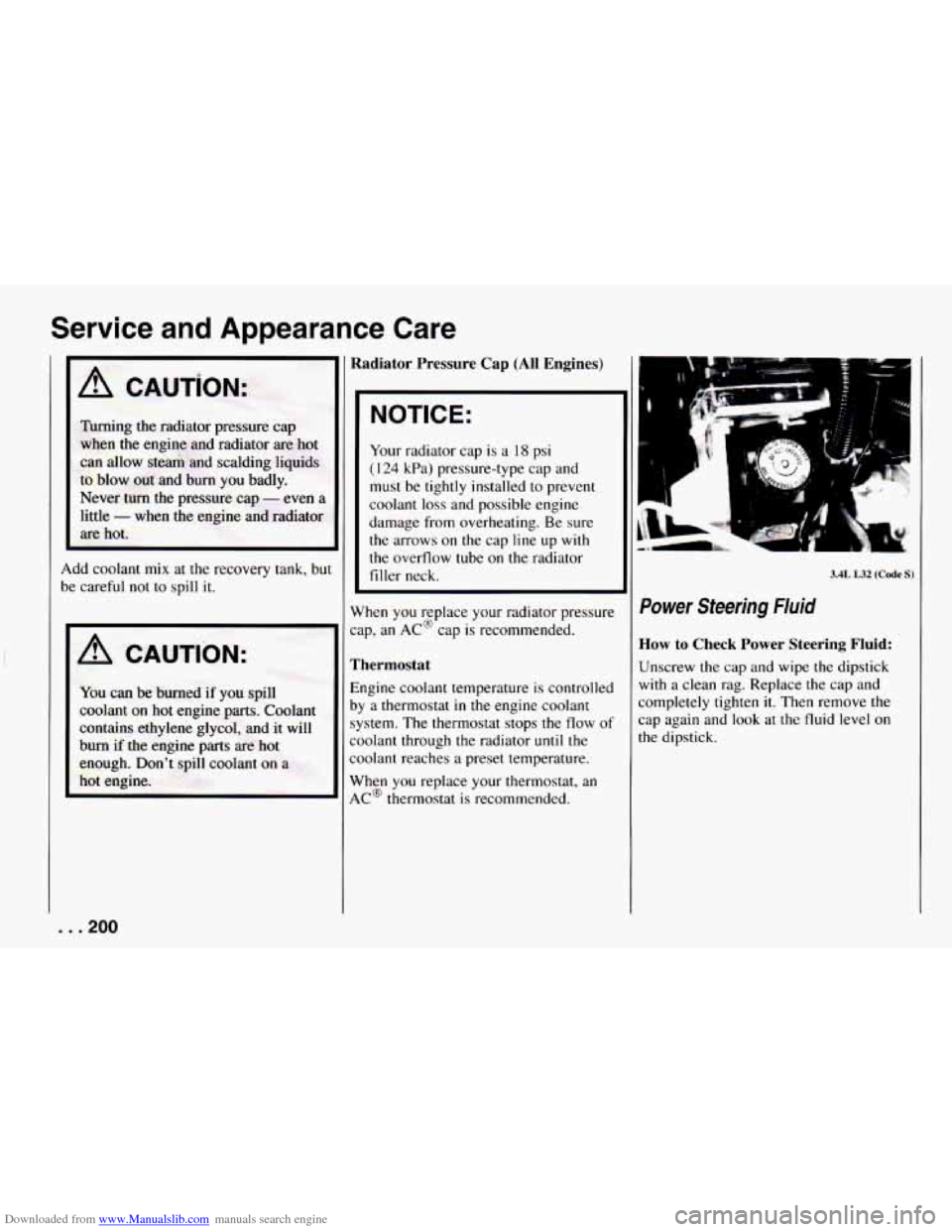
Radiator Pressure Cap (All Engines)
NOTICE:
Your radiator cap is a 18 psi
(1 24 kPa) pressure-type cap and
must be tightly installed to prevent
coolant
loss and possible engine
damage from overheating. Be sure
the arrows
on the cap line up with
the overflow tube on the radiator
filler neck.
When you replace your radiator pressure
cap, an
AC@ cap is recommended.
Thermostat
Engine coolant temperature is controlled
by a thermostat in the engine coolant
system. The thermostat stops the flow of
coolant through the radiator until the
coolant reaches a preset temperature.
When
you replace your thermostat, an
AC@ thermostat is recommended.
f
I I
3.4L L32 (Code S)
Power Steering Fluid
How to Check Power Steering Fluid:
Unscrew the cap and wipe the dipstick
with a clean rag. Replace the cap and
completely tighten it. Then remove the
cap again and look
at the fluid level on
the dipstick.
. . .200
Page 246 of 292
Downloaded from www.Manualslib.com manuals search engine Maintenance Schedule
Section A: Scheduled Maintenance Services (cont.)
Explanation of Scheduled
Maintenance Services
Following are explanations of the services
listed in Schedule
I and Schedule 11.
The proper fluids and lubricants to use are
listed
in Section D. Make sure whoever
services your vehicle uses these. All parts
should be replaced and all necessary
repairs done before you or anyone else
drives the vehicle.
NOTE: To determine your engine’s
displacement and code, see
“Engine Identification”
in the
Index.
ITEM
NO. SERVICE
1 Engine Oil and Filter Change” -
Always use SH or SG Energy
Conserving I1 oils of proper
viscosity. The
“SH” or “SG”
designation may be shown alone
or
in combination with others,
such as “SH/CD,”
“SH, SG,
CD,” “SG/CD,” etc. To deter-
mine the preferred viscosity for
your vehicle’s engine (e.g., SAE
ITEM
NO.
2
3
4
SERVICE
5W-30 or SAE 1OW-30)’ see
“Engine Oil”
in the Index.
Chassis Lubrication
- Lubricate
the suspension and steering
linkage. Lubricate the
transmission shift linkage.
Tire and Wheel Rotation and
InsDection
- For proper wear
and maximum tire life, rotate
your tires following the
instructions
in this manual. See
“Tires, Inspection and Rotation”
in the Index. Check the tires for
uneven wear or damage. If you
see irregular or premature wear,
check the wheel alignment.
Check for damaged wheels also.
Engine Accessory Drive Belt(s)
Inspection
- Inspect the belt(s)
for cracks, fraying, wear and
proper tension. Replace as needed. (Belts can have many
small cracks
in individual ribs
without affecting performance.)
ITEM
NO. SERVICE
5 Cooling System Service* -
Drain, flush and refill the system
with new or approved recycled
coolant conforming to
GM
Specification 1825M. Keep
coolant at the proper mixture as
specified. See “Coolant”
in the
Index. This provides proper
freeze and boil protection,
corrosion inhibitor level and
maintains proper engine
operating temperature.
Inspect hoses and replace
if they
are cracked, swollen or deterior-
ated. Tighten screw-type hose
clamps. Clean the outside
of the
radiator and air conditioning
condenser. Wash the pressure
cap and neck.
To help ensure proper operation,
we recommend a pressure test of
both the cooling system and the
pressure cap.
* An Emission Control Service.
. . .244
Page 270 of 292
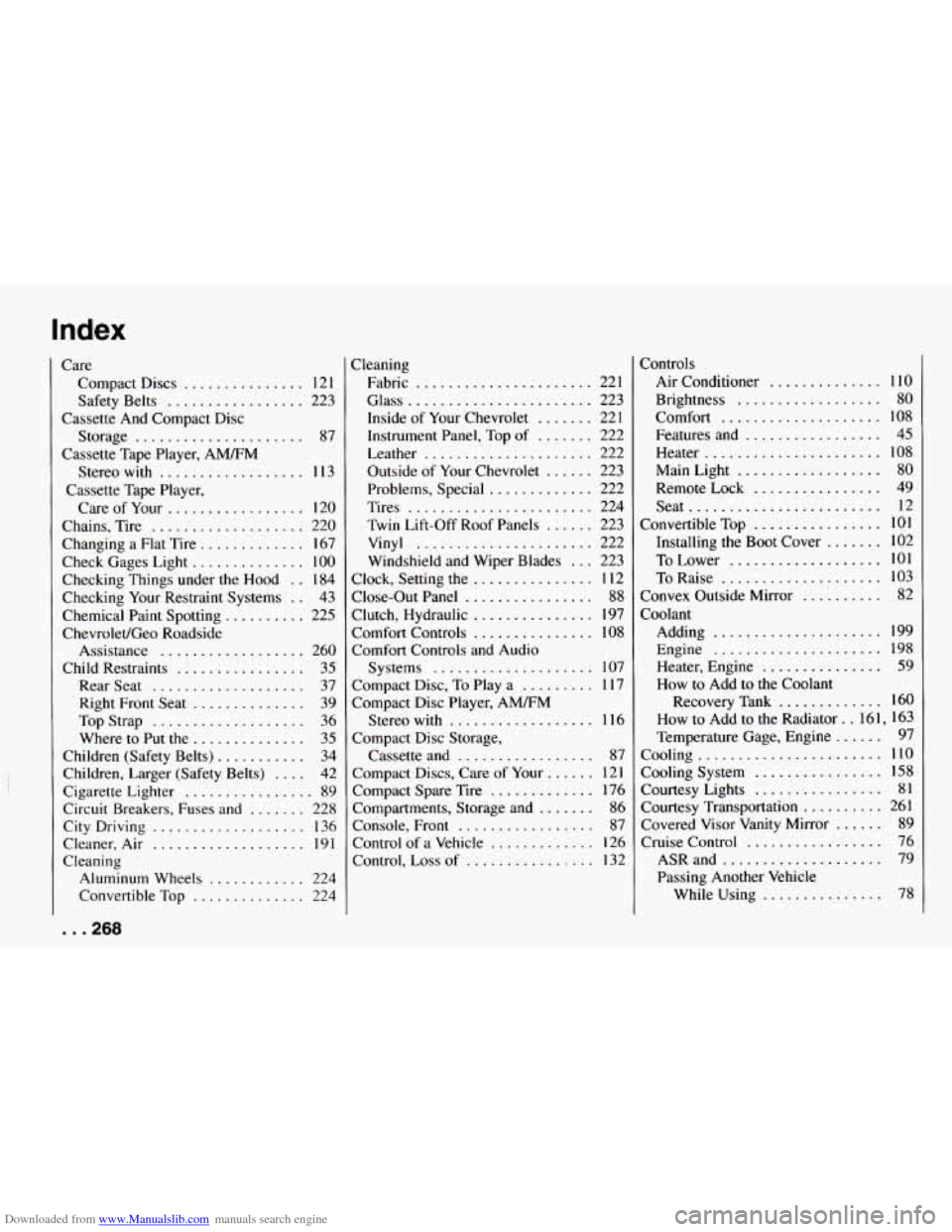
Downloaded from www.Manualslib.com manuals search engine Index
Care Compact Discs
............... 121
Safety Belts
................. 223
Cassette And Compact Disc
Storage
..................... 87
Cassette Tape Player. AMFM
Stereo
with .................. 1 13
Cassette Tape Player.
Care of Your
................. 120
Chains. Tire
................... 220
Changing a Flat Tire ............. 167
Check Gages Light
.............. 100
Checking Things under
the Hood . . 184
Checking Your Restraint Systems
. . 43
Chemical Paint Spotting
.......... 225
Chevrolet/Geo Roadside Assistance
.................. 260
Child Restraints
................ 35
Rear Seat
................... 37
Right Front Seat
.............. 39
Top Strap
................... 36
Where to Put the
.............. 35
Children (Safety Belts) ........... 34
Children. Larger (Safety Belts)
.... 42
Cigarette Lighter
................ 89
Circuit Breakers. Fuses and ....... 228
City Driving
................... 136
Cleaner. Air ................... 191
Cleaning
Aluminum Wheels
............ 224
Convertible Top
.............. 224 Cleaning
Fabric
...................... 221
Glass
....................... 223
Inside
of Your Chevrolet ....... 221
Instrument Panel. Top
of ....... 222
Leather
..................... 222
Outside of Your Chevrolet
...... 223
Problems. Special
............. 222
Tires
....................... 224
Twin Lift-off Roof Panels
...... 223
Vinyl ...................... 222
Windshield and Wiper Blades
... 223
Clock. Setting the
............... 112
Close-Out Panel
................ 88
Clutch. Hydraulic ............... 197
Comfort Controls
............... 108
Comfort Controls and Audio
Systems
.................... 107
Compact Disc. To Play a
......... 1 17
Compact
Disc Player. AMFM
Stereo
with .................. 116
Compact Disc Storage.
Cassette and
................. 87
Compact Discs. Care
of Your ...... 121
Compact Spare Tire
............. 176
Compartments. Storage and
....... 86
Console. Front
................. 87
Control of a Vehicle
............. 126
Control.
Loss of ................ 132 Controls
Air Conditioner
.............. 110
Brightness .................. 80
Comfort .................... 108
Features and
................. 45
Heater
...................... 108
Main Light
.................. 80
Remote Lock ................ 49
Seat
........................ 12
Convertible Top
................ 101
Installing the Boot Cover ....... 102
To Lower
................... 101
To Raise .................... 103
Convex Outside Mirror
.......... 82
Coolant Adding
..................... 199
Engine
..................... 198
Heater. Engine ............... 59
How to Add to the Coolant
Recovery Tank
............. 160
How to Add to the Radiator
. . 161. 163
Temperature Gage. Engine
...... 97
Cooling
....................... 110
Cooling System ................ 158
Courtesy Lights
................ 81
Courtesy Transportation .......... 261
Covered Visor Vanity Mirror
...... 89
Cruise Control
................. 76
ASR and
.................... 79
Passing Another Vehicle
While Using
............... 78
... 268
Page 271 of 292
Downloaded from www.Manualslib.com manuals search engine Cruise Control To Erase Speed Memory
....... 79
To Get Out of
................ 79
To Increase Speed While Using
. . 77
To Reduce Speed While Using
. . 78
To Resume a Set Speed ........ 77
ToSet
...................... 76
Using on Hills
............... 78
Curves. Driving on
.............. 130
Customer Assistance for the Hearing
or Speech Impaired (TDD)
..... 258
Customer Assistance Information
. . 257
Customer Satisfaction Procedure
... 258
Daytime Running Lights
....... 80
Deep Standing Water
Driving through
.............. 58
Defects. Safety
Reporting to General Motors
.... 260
Reporting to the Canadian
Government
............... 260
Reporting to the United States
Government
............... 259
Defensive Driving
.............. 124
Defogger. Rear Window
......... 1 I1
Defogging and Defrosting
Windows
................... 109
Dimensions. Vehicle
............ 235
Doing Your Own Service Work
.... 180
Door Locks
.................... 47
Door Locks. Power
............. 48 Driver Position (Safety
Belts)
..... 21
Driving
AtNight
.................... 133
City
........................ 136
Defensive
................... 124
Drunken
.................... 124
Freeway
.................... 137
In the Rain .................. 134
On Curves
.................. 130
On Snow or Ice
.............. 140
Through Deep Standing Water
... 58
Winter
...................... 139
With a Trailer
................ 145
Drunken Driving
............... 124
Electrical Center. Underhood
.... 230
Electrical Equipment. Add-on
..... 227
Electric Mirror Control
.......... 82
Emergencies. Braking in
......... 129
Emergencies. Steering in
......... 130
Engine
Coolant
..................... 198
Coolant (Block) Heater
........ 59
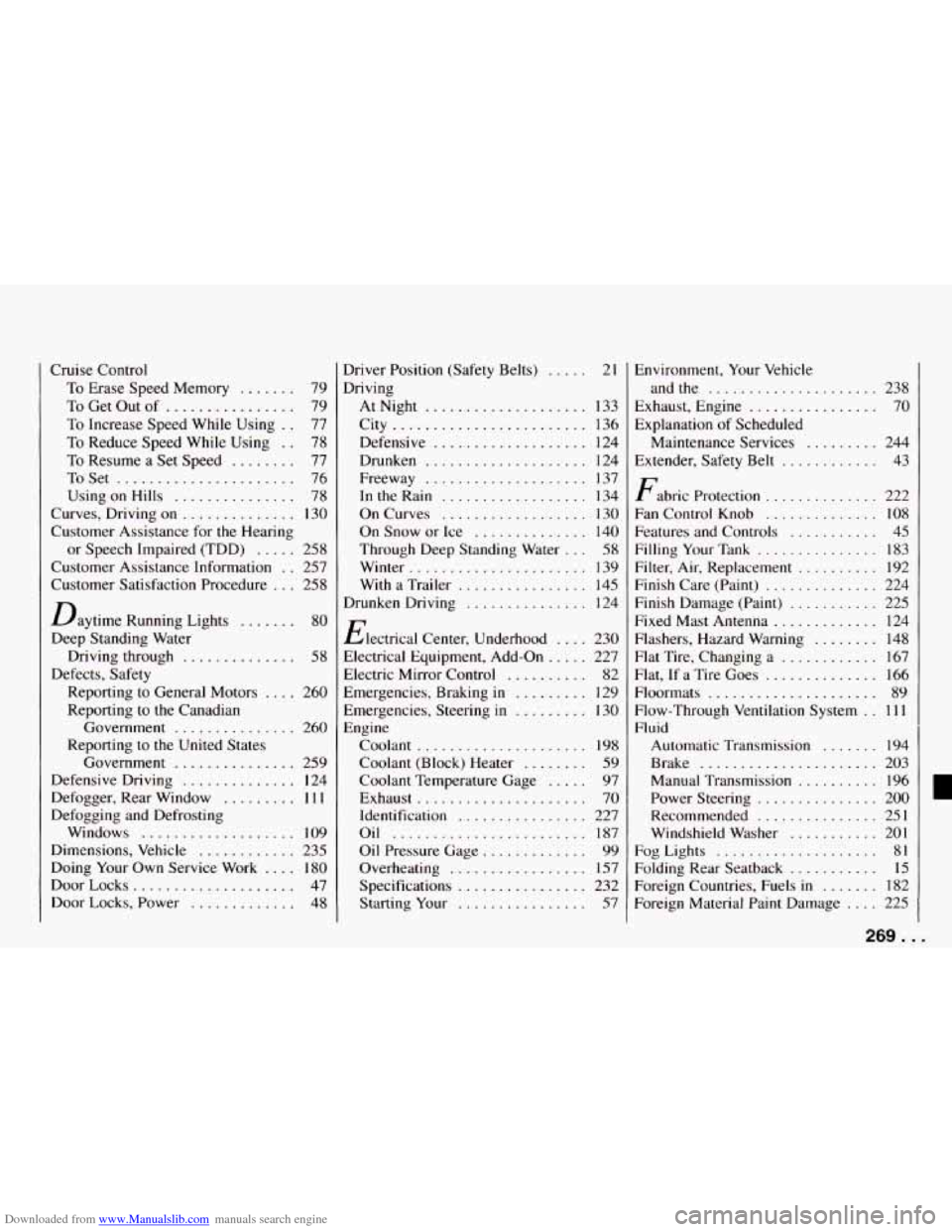
Coolant Temperature Gage
..... 97
Exhaust
..................... 70
Identification
................ 227
Oil
........................ 187
Oil Pressure Gage
............. 99
Overheating
................. 157
Specifications
................ 232
Starting Your
................ 57 Environment.
Your Vehicle
andthe
..................... 238
Exhaust. Engine
................ 70
Explanation of Scheduled
Maintenance Services
......... 244
Extender. Safety Belt
............ 43
Fabric Protection
.............. 222
Fan Control Knob
.............. 108
Features and Controls
........... 45
Filling Your Tank
............... 183
Filter.
Air. Replacement .......... 192
Finish Care (Paint)
.............. 224
Finish Damage (Paint)
........... 225
Fixed Mast Antenna
............. 124
Flashers. Hazard Warning
........ 148
Flat Tire. Changing a ............ 167
Flat. If a Tire Goes
.............. 166
Floormats
..................... 89
Flow-Through Ventilation System . . I1 1
Fluid
Automatic Transmission
....... 194
Brake
...................... 203
Manual Transmission
.......... 196
Power Steering
............... 200
Recommended
............... 251
Windshield Washer
........... 201
FogLights
.................... 81
Folding Rear Seatback
........... 15
Foreign Countries. Fuels in ....... 182
Foreign Material Paint Damage
.... 225
269 . .