engine coolant CHEVROLET CAMARO 1995 4.G Owner's Manual
[x] Cancel search | Manufacturer: CHEVROLET, Model Year: 1995, Model line: CAMARO, Model: CHEVROLET CAMARO 1995 4.GPages: 388, PDF Size: 19.69 MB
Page 242 of 388
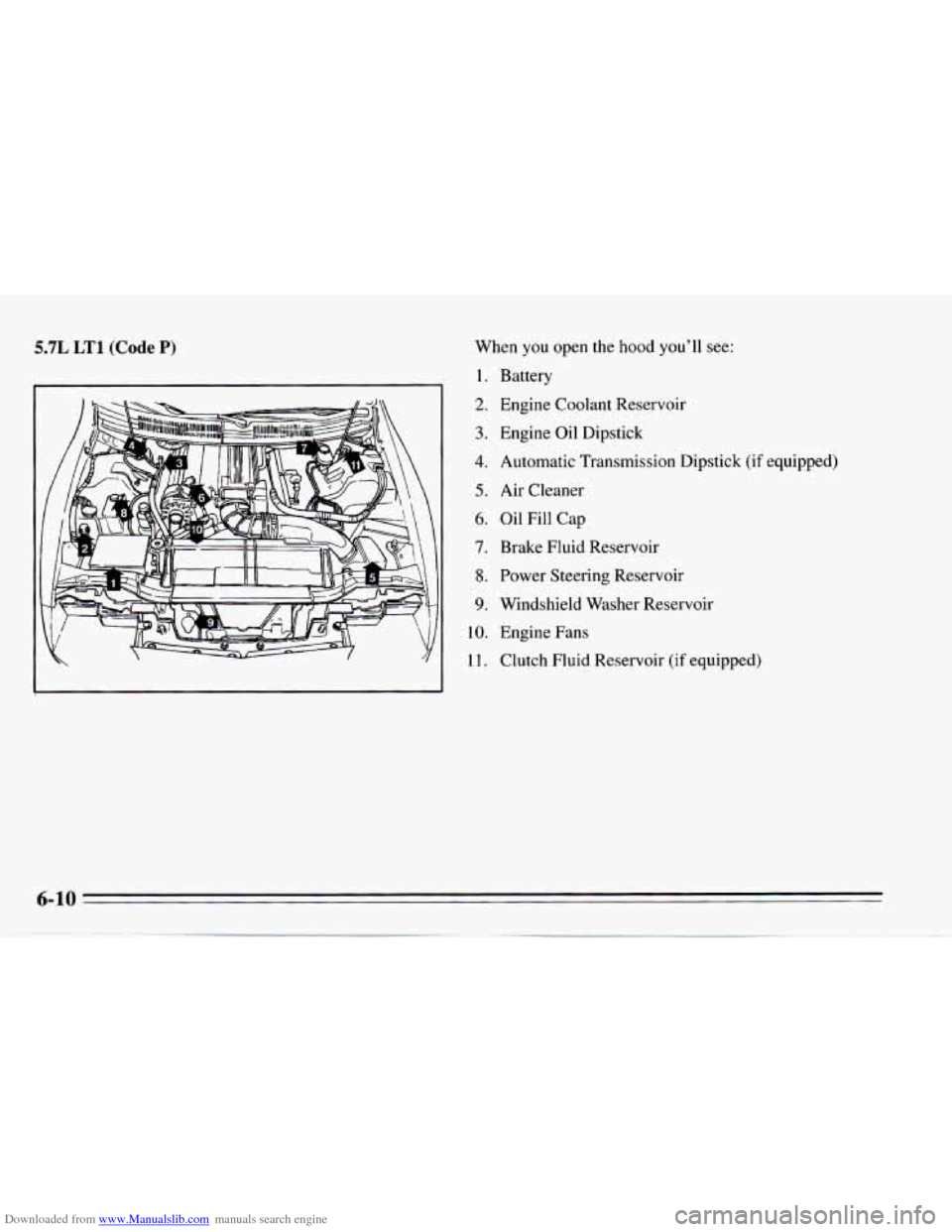
Downloaded from www.Manualslib.com manuals search engine 5.7L LT1 (Code P) When you open the hood you’ll see:
1.
2.
3.
4.
5.
6.
7.
8.
9.
10.
11.
Battery
Engine Coolant Reservoir
Engine Oil Dipstick
Automatic Transmission Dipstick (if equipped)
Air Cleaner
Oil Fill Cap
Brake Fluid Reservoir
Power Steering Reservoir
Windshield Washer Reservoir
Engine Fans
Clutch
Fluid Reservoir (if equipped)
Page 249 of 388
Downloaded from www.Manualslib.com manuals search engine Engine Oil Additives
Don’t add anything to your oil. Your Chevrolet dealer is
ready to advise if you think something should be added.
When to Change Engine Oil
See if any one of these is true for you:
0
0
0
Most trips are less than 5 to 10 miles (8 to 16 km).
This is particularly important when outside
temperatures are below freezing.
Most trips include extensive idling (such as frequent
driving
in stop and go traffic).
Most trips are through dusty areas.
You frequently tow a trailer or use a carrier on top
of
your car.
If any one of these is true for your vehicle, then you
need to change your oil and filter every
3,000 miles
(5 000 km) or 3 months -- whichever comes first.
If none of them is true, change the oil and filter every
7,500 miles (12 500 km) or 12 months -- whichever
comes first.
Engine Coolant Heater
An engine coolant heater can be a big help if you have
to park outside in very cold weather,
0°F (- 18 “C) or
colder.
If your vehicle has this option, see “Engine
Coolant Heater” in the Index.
What to Do with Used Oil
Did you know that used engine oil contains certain
elements that may be unhealthy for your skin and could
even cause cancer? Don’t let used oil stay on your skin
for very long. Clean your skin and nails with soap and
water, or a good hand cleaner. Wash or properly throw
away clothing or rags containing used engine oil. (See
the manufacturer’s warnings about the use and disposal
of oil products.)
Used oil can be a real threat to the environment.
If you
change your own oil, be sure to drain all free-flowing oil
from the filter before disposal. Don’t ever dispose of oil
by putting it in the trash, pouring it on the ground, into
sewers, or into streams
or bodies of water. Instead,
recycle it by taking
it to a place that collects used oil. If
you have a problem properly disposing of your used oil,
ask your dealer, a service station or a local recycling
center for help.
6-17
Page 260 of 388
Downloaded from www.Manualslib.com manuals search engine Engine Coolant
The following explains your cooling system and how to
add coolant when it
is low. If you have a problem with
engine overheating or if you need to add coolant to your
radiator, see “Engine Overheating”
in the Index.
The proper coolant for your Chevrolet will:
Give freezing protection down to -34°F (-37°C).
Give boiling protection up to 262” F ( 128 * C).
Protect against rust and corrosion.
0 Help keep the proper engine temperature.
0 Let the warning lights work as they should.
What to Use
Use a mixture of one-half clean water (preferably
distilled) and one-half antifreeze that meets
“GM
Specification 1825-M,” which won’t damage aluminum
parts.
You can also use a recycled coolant conforming to
GM Specification 1825-M with a complete coolant flush
and refill. If you use this mixture, you don’t need to add
anything else.
I NOTICE:
If you use an improper coolant mix, your engine
could overheat and
be badly damaged. The
repair
cost wouldn’t be covered by your
warranty.
Too much water in the mix can freeze
and crack the engine, radiator, heater core and
other parts.
6-28
Page 261 of 388
Downloaded from www.Manualslib.com manuals search engine Adding Coolant
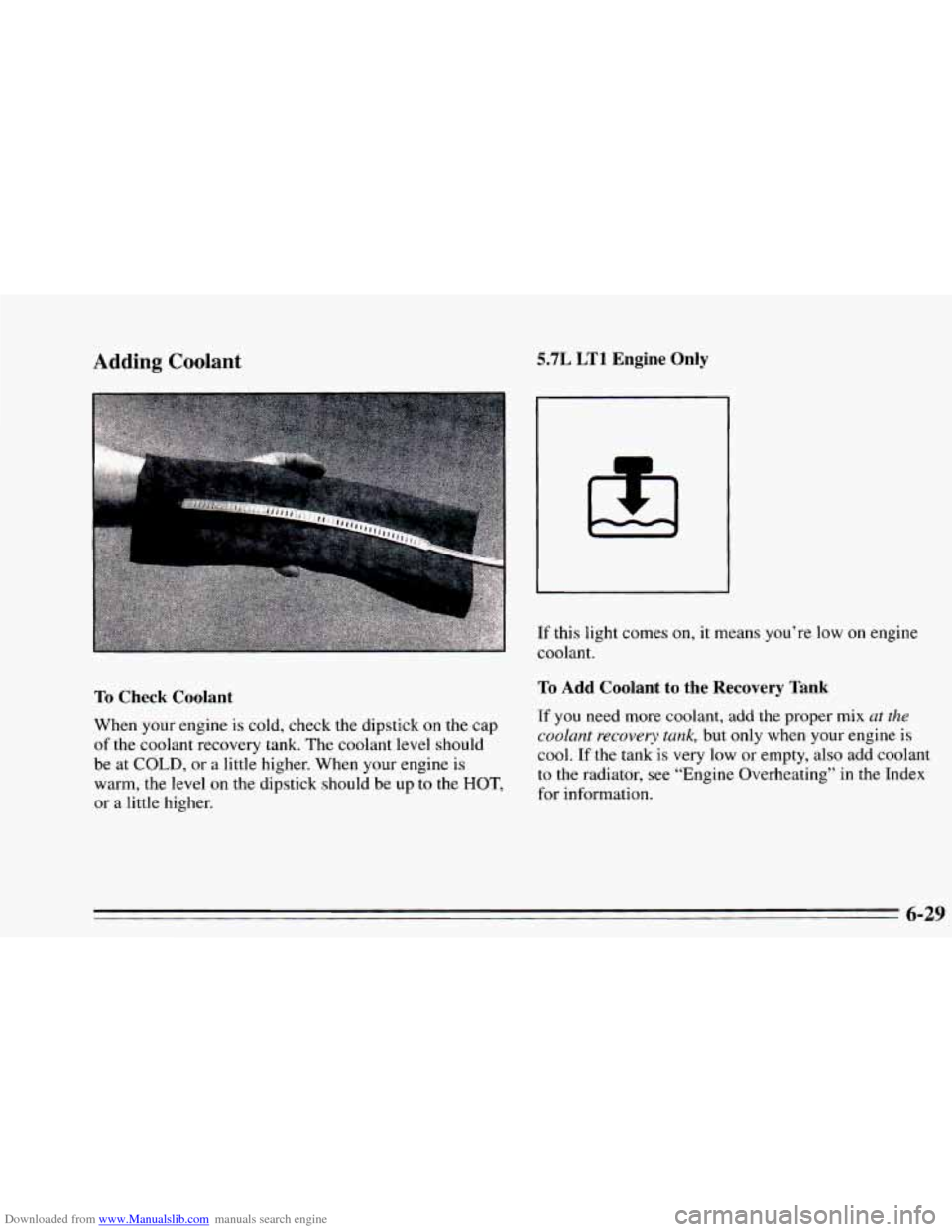
To Check Coolant
When your engine is cold, check the dipstick on the cap
of the coolant recovery tank. The coolant level should
be at
COLD, or a little higher. When your engine is
warm, the level on the dipstick should be up to the HOT,
or a little higher.
5.7L LT1 Engine Only
If this light comes on, it means you’re low on engine
coolant.
To Add Coolant to the Recovery Tank
If you need more coolant, add the proper mix ut the
coolant
recovery tank, but only when your engine is
cool. If the tank is very low or empty, also add coolant
to the radiator, see “Engine Overheating” in the Index
for information.
6-29
Page 262 of 388
Downloaded from www.Manualslib.com manuals search engine I
I
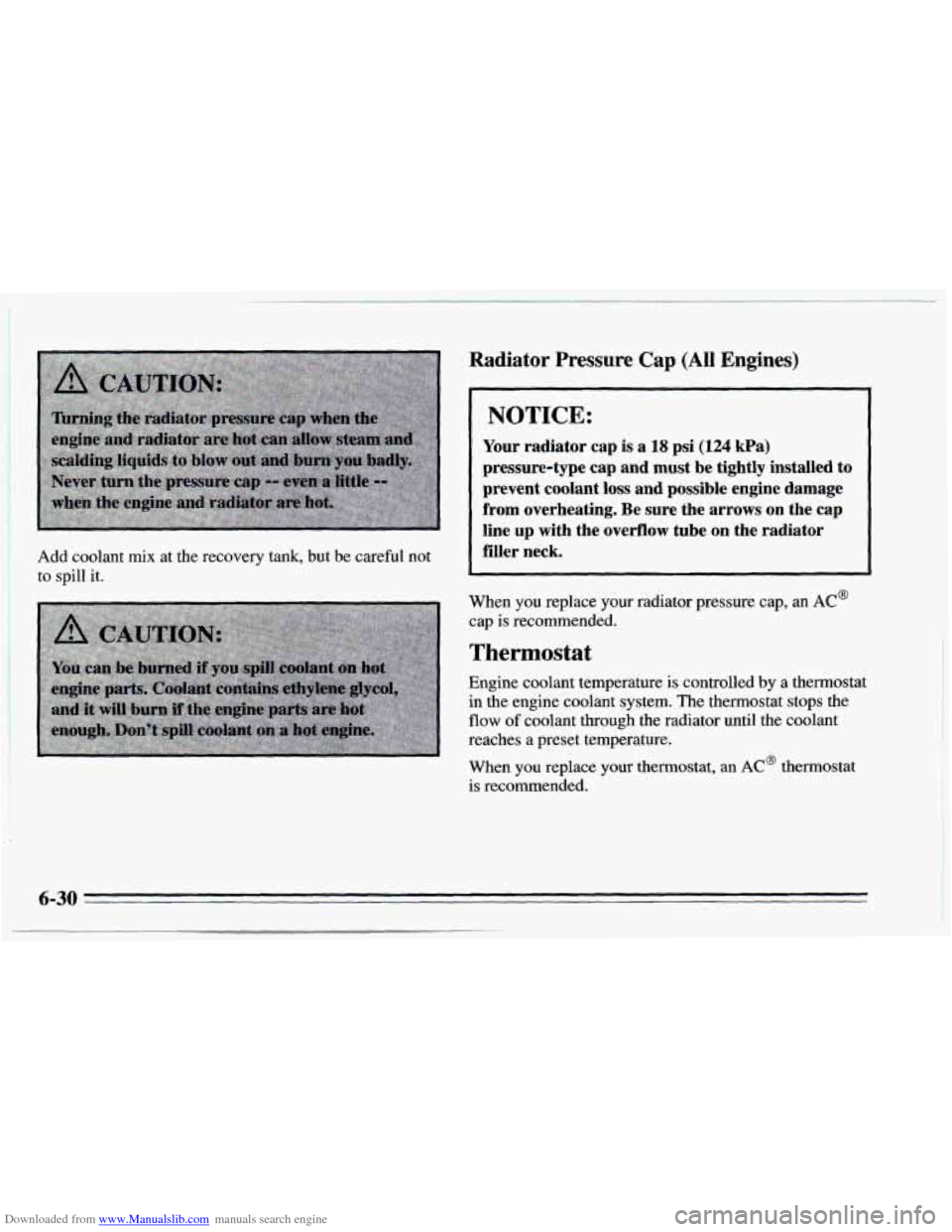
1 Add coolant mix at the recovery tank, but be careful not
, to spill it.
Radiator Pressure Cap (All Engines)
NOTICE:
Your radiator cap is a 18 psi (124 kPa)
pressure-type cap and must be tightly installed to
prevent coolant loss and possible engine damage from overheating. Be sure the arrows on the cap
line
up with the overflow tube on the radiator
filler neck.
When you replace your radiator pressure cap, an AC@
cap is recommended.
Thermostat
Engine coolant temperature is controlled by a thermostat
in the engine coolant system. The thermostat stops the
flow of coolant through the radiator until the coolant
reaches
a preset temperature.
When you replace your thermostat, an
AC@ thermostat
is recommended.
6-30
Page 303 of 388
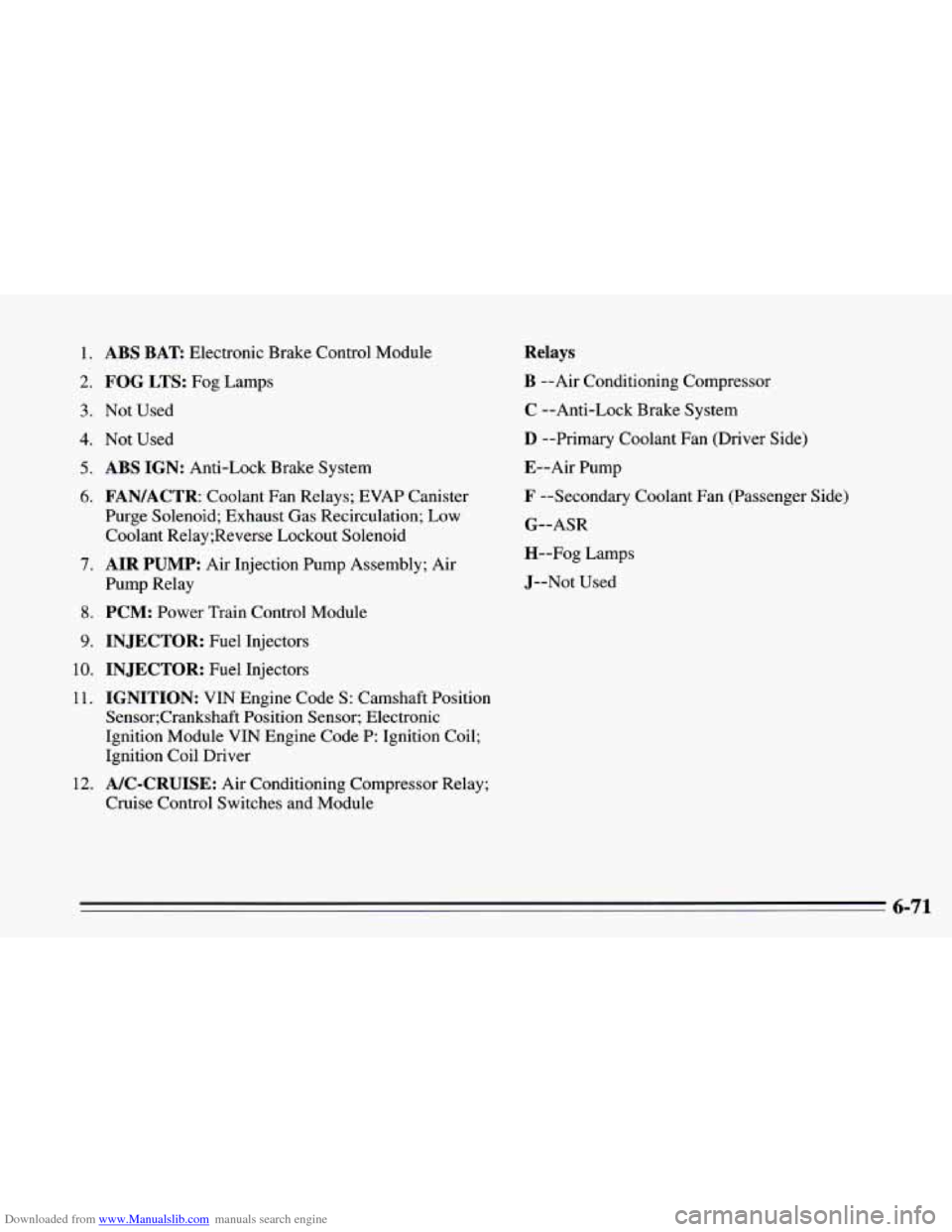
Downloaded from www.Manualslib.com manuals search engine 1. ABS BAT Electronic Brake Control Module
2. FOG LTS: Fog Lamps
3. Not Used
4. Not Used
5. ABS IGN: Anti-Lock Brake System
6. FAN/ACTR: Coolant Fan Relays; EVAP Canister
Purge Solenoid; Exhaust Gas Recirculation; Low
Coolant Re1ay;Reverse Lockout Solenoid
7. AIR PUMP: Air Injection Pump Assembly; Air
8. PCM: Power Train Control Module
Pump
Relay
9. INJECTOR: Fuel Injectors
10. INJECTOR: Fuel Injectors
11. IGNITION: VIN Engine Code S: Camshaft Position
Sensor;Crankshaft Position Sensor; Electronic
Ignition Module VIN Engine Code P: Ignition Coil; Ignition Coil Driver
Cruise Control Switches and Module
12. A/C-CRUISE: Air Conditioning Compressor Relay;
Relays
B --Air Conditioning Compressor
C --Anti-Lock Brake System
D --Primary Coolant Fan (Driver Side)
E--Air Pump
F --Secondary Coolant Fan (Passenger Side)
G--ASR
H--Fog Lamps
J--Not Used
6-71
Page 320 of 388
Downloaded from www.Manualslib.com manuals search engine I Maintenance Schedule I I
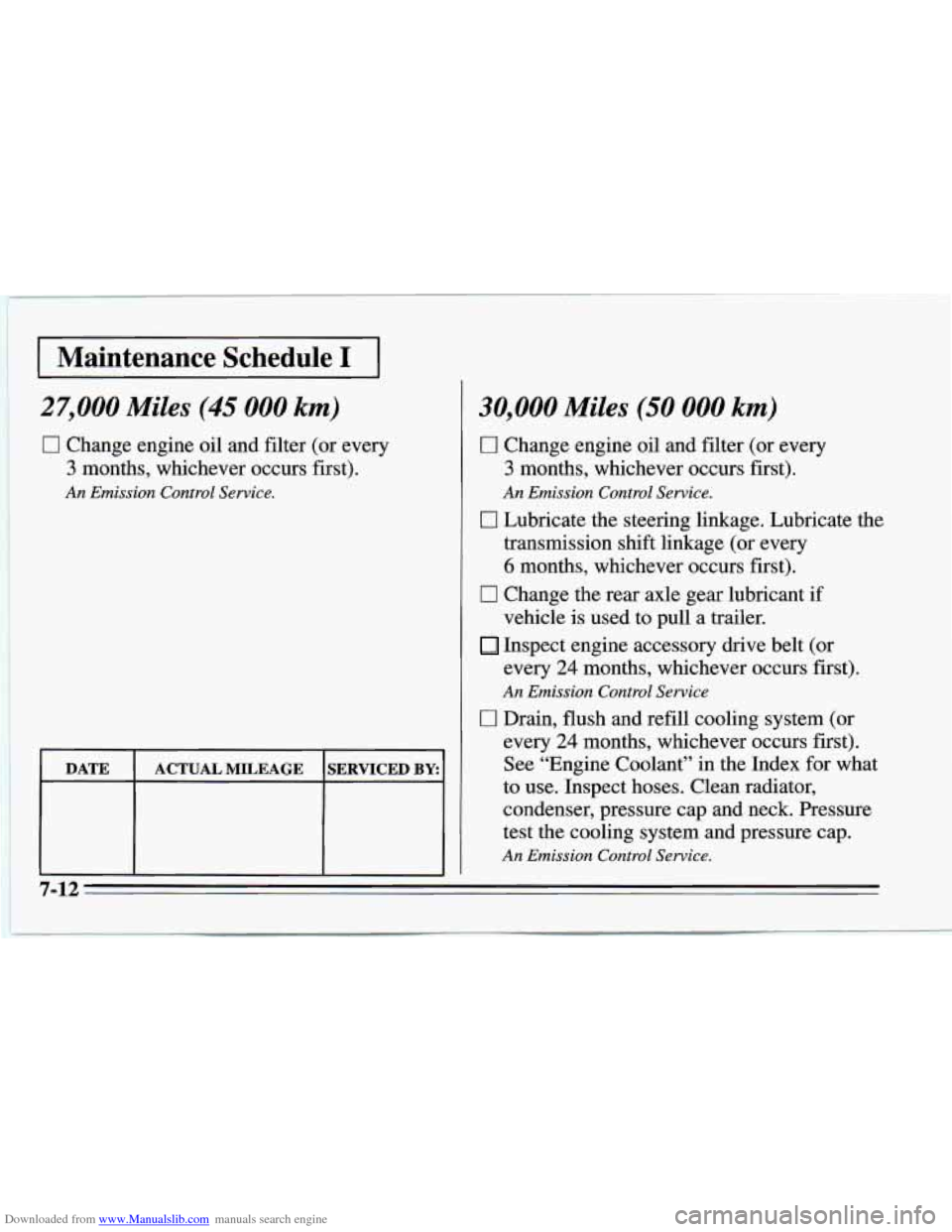
27,000 Miles (45 000 km)
0 Change engine oil and filter (or every
3 months, whichever occurs first).
An Emission Control Service.
30,000 Miles (50 000 km)
0 Change engine oil and filter (or every
3 months, whichever occurs first).
An Emission Control Sewice.
0 Lubricate the steering linkage. Lubricate the
transmission shift linkage (or every
6 months, whichever occurs first).
0 Change the rear axle gear lubricant if
vehicle is used to pull a trailer.
Inspect engine accessory drive belt (or
every
24 months, whichever occurs first).
An Emission Control Service
0 Drain, flush and refill cooling system (or
every
24 months, whichever occurs first).
See “Engine Coolant” in the Index for what
to use. Inspect hoses. Clean radiator,
condenser, pressure cap and neck. Pressure
test the cooling system and pressure cap.
An Emission Control Service.
7-12
Page 328 of 388
Downloaded from www.Manualslib.com manuals search engine Maintenance Schedule I
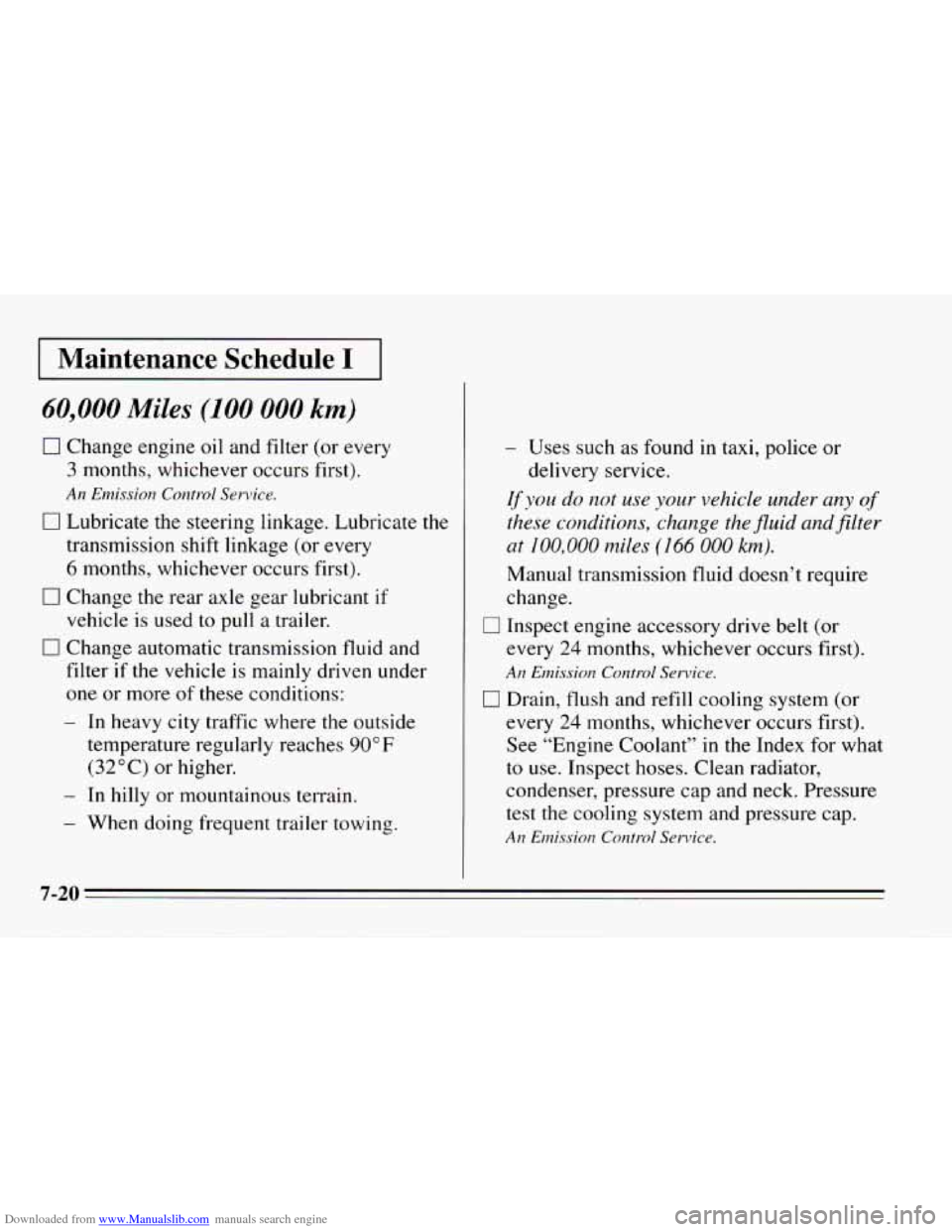
60,000 Miles (100 000 km)
0 Change engine oil and filter (or every
3 months, whichever occurs first).
An Emission Control Service.
0 Lubricate the steering linkage. Lubricate the
transmission shift linkage (or every
6 months, whichever occurs first).
0 Change the rear axle gear lubricant if
vehicle is used to pull a trailer.
0 Change automatic transmission fluid and
filter
if the vehicle is mainly driven under
one or more
of these conditions:
- In heavy city traffic where the outside
temperature regularly reaches
90 OF
(32°C) or higher.
- In hilly or mountainous terrain.
- When doing frequent trailer towing.
- Uses such as found in taxi, police or
Ifyou do not use your vehicle under any of
these conditions, change the fluid and filter
at 100,000 miles (I 66 000 km).
Manual transmission fluid doesn’t require
change.
every 24 months, whichever occurs first).
c] Drain, flush and refill cooling system (or
every 24 months, whichever occurs first).
See “Engine Coolant”
in the Index for what
to
use. Inspect hoses. Clean radiator,
condenser, pressure cap and neck. Pressure
test the cooling system and pressure cap.
delivery service.
0 Inspect
engine accessory drive belt (or
An E1nissi01.1 Control Service.
An Elnissiorz Control Service.
7-20
Page 336 of 388
Downloaded from www.Manualslib.com manuals search engine -
Maintenance Schedule I
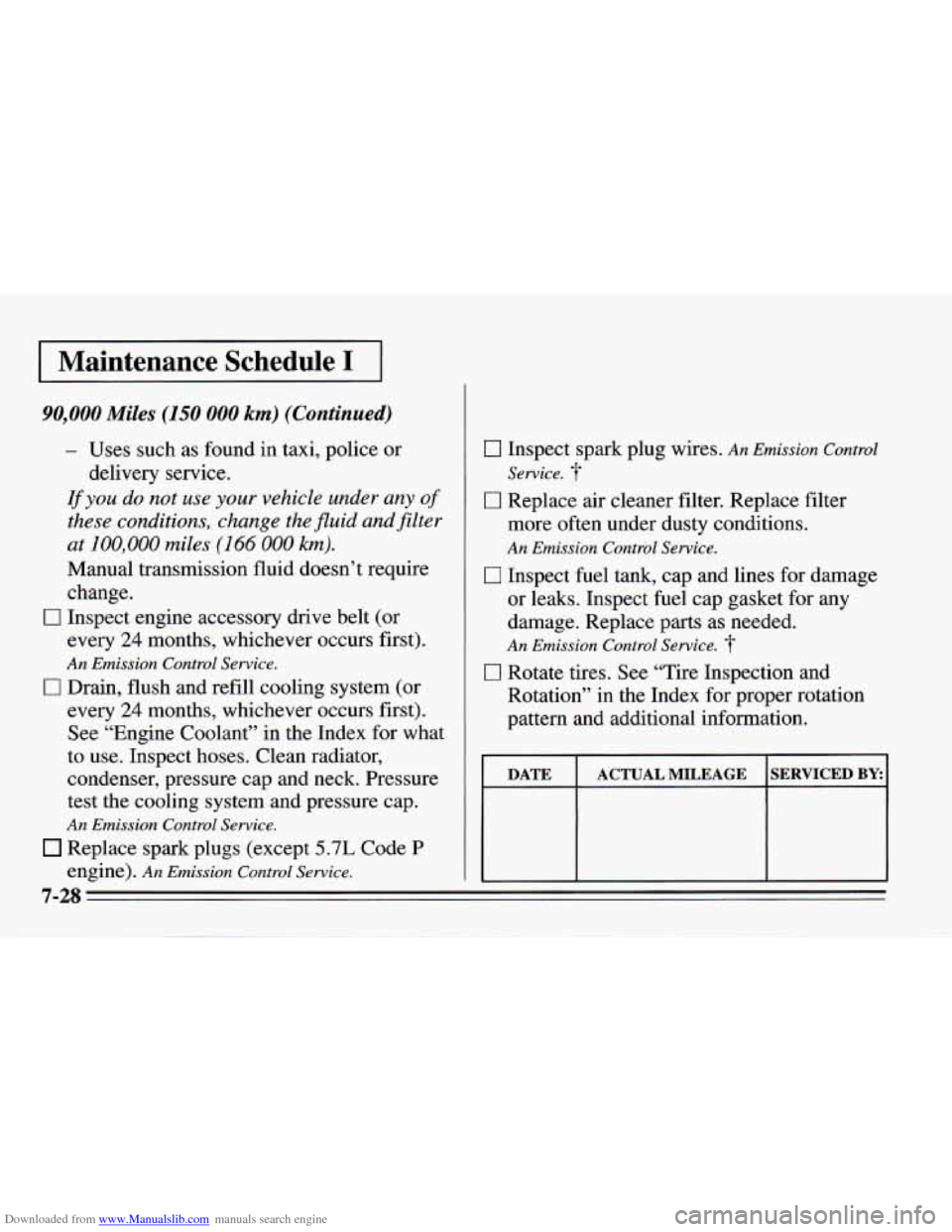
90,000 Miles (150 000 km) (Continued)
- Uses such as found in taxi, police or
If you do not use your vehicle under any of
these conditions, change the fluid and filter
at
lO0,OOO miles (166 000 km).
Manual transmission fluid doesn’t require
change.
every
24 months, whichever occurs first).
An Emission Control Service.
0 Drain, flush and refill cooling system (or
every
24 months, whichever occurs first).
See “Engine Coolant” in the Index for what
to use. Inspect hoses. Clean radiator,
condenser, pressure cap and neck. Pressure
test the cooling system and pressure cap.
An Emission Control Service.
Replace spark plugs (except 5.7L Code P
delivery service.
0 Inspect engine accessory drive belt (or
engine).
An Emission Control Service.
0 In SP ect sp
Service.
arle Pl .ug wires. An Emission Control
0 Replace air cleaner filter. Replace filter
more often under dusty conditions.
An Emission Control Service.
0 Inspect fuel tank, cap and lines for damage
or leaks. Inspect fuel cap gasket for any
damage. Replace parts as needed.
El Rotate tires. See “Tire Inspection and
Rotation”
in the Index for proper rotation
pattern and additional information.
An Emission Control Service.
Page 343 of 388
Downloaded from www.Manualslib.com manuals search engine Maintenance Schedule I1
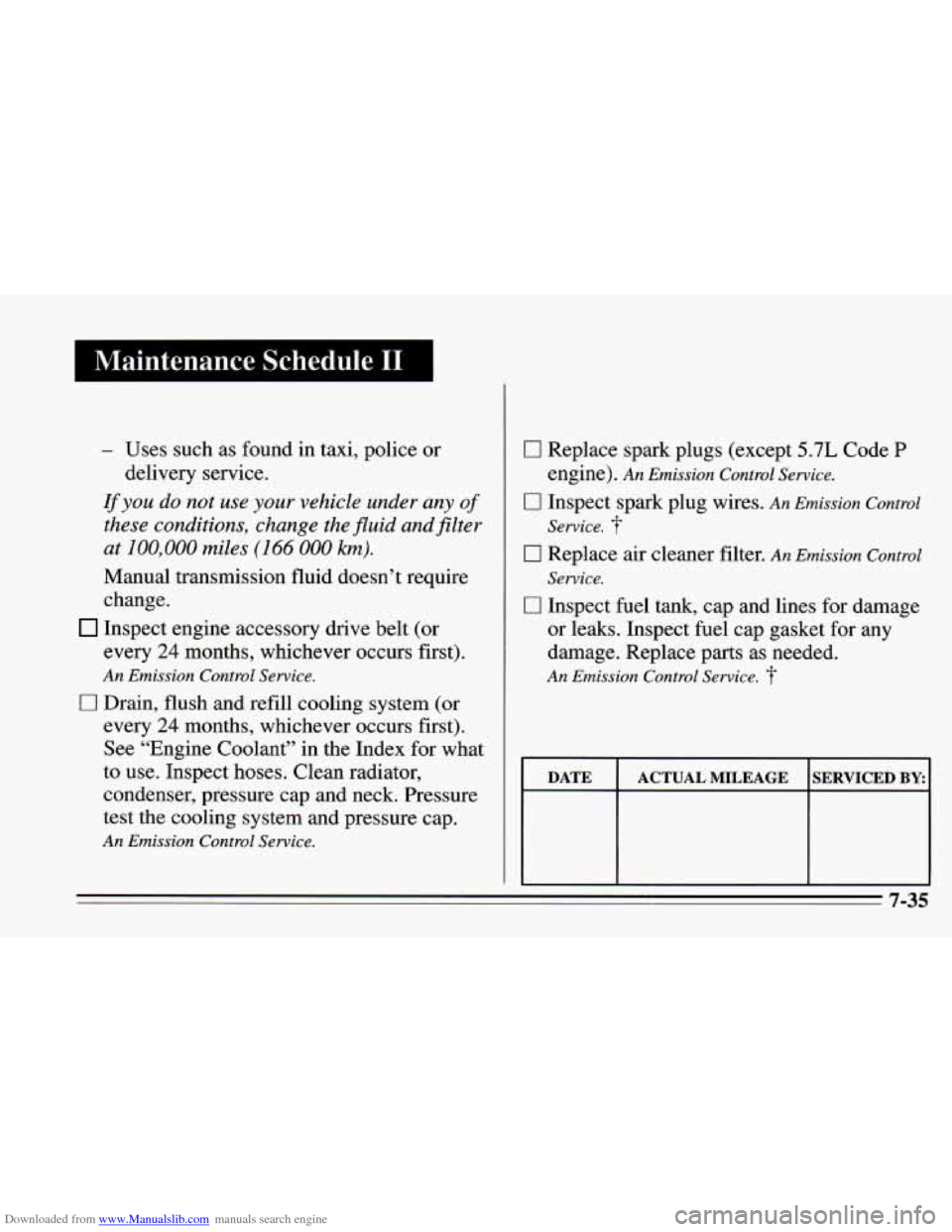
- Uses such as found in taxi, police or
If you do not use your vehicle under any of
these conditions, change the fluid and filter
at 100,000 miles (1 66 000 km).
Manual transmission fluid doesn’t require
change.
every
24 months, whichever occurs first).
0 Drain, flush and refill cooling system (or every
24 months, whichever occurs first).
See “Engine Coolant’’ in the Index for what
to use. Inspect hoses. Clean radiator,
condenser, pressure cap and neck. Pressure
test the cooling system and pressure cap.
An Emission Control Service.
delivery service.
Inspect engine accessory drive belt (or
An Emission Control Service.
0 Replace spark plugs (except 5.7L Code P
0 Inspect spark plug wires. An Emission Control
0 Replace air cleaner filter. An Emission Control
0 Inspect fuel tank, cap and lines for damage
or leaks. Inspect fuel cap gasket for any
damage. Replace
parts as needed.
engine).
An
Emission Control Service.
Service.
Service.
An Emission Control Sewice.
7-35