ABS CHEVROLET CAMARO 1995 4.G Owners Manual
[x] Cancel search | Manufacturer: CHEVROLET, Model Year: 1995, Model line: CAMARO, Model: CHEVROLET CAMARO 1995 4.GPages: 388, PDF Size: 19.69 MB
Page 130 of 388
Downloaded from www.Manualslib.com manuals search engine Voltmeter
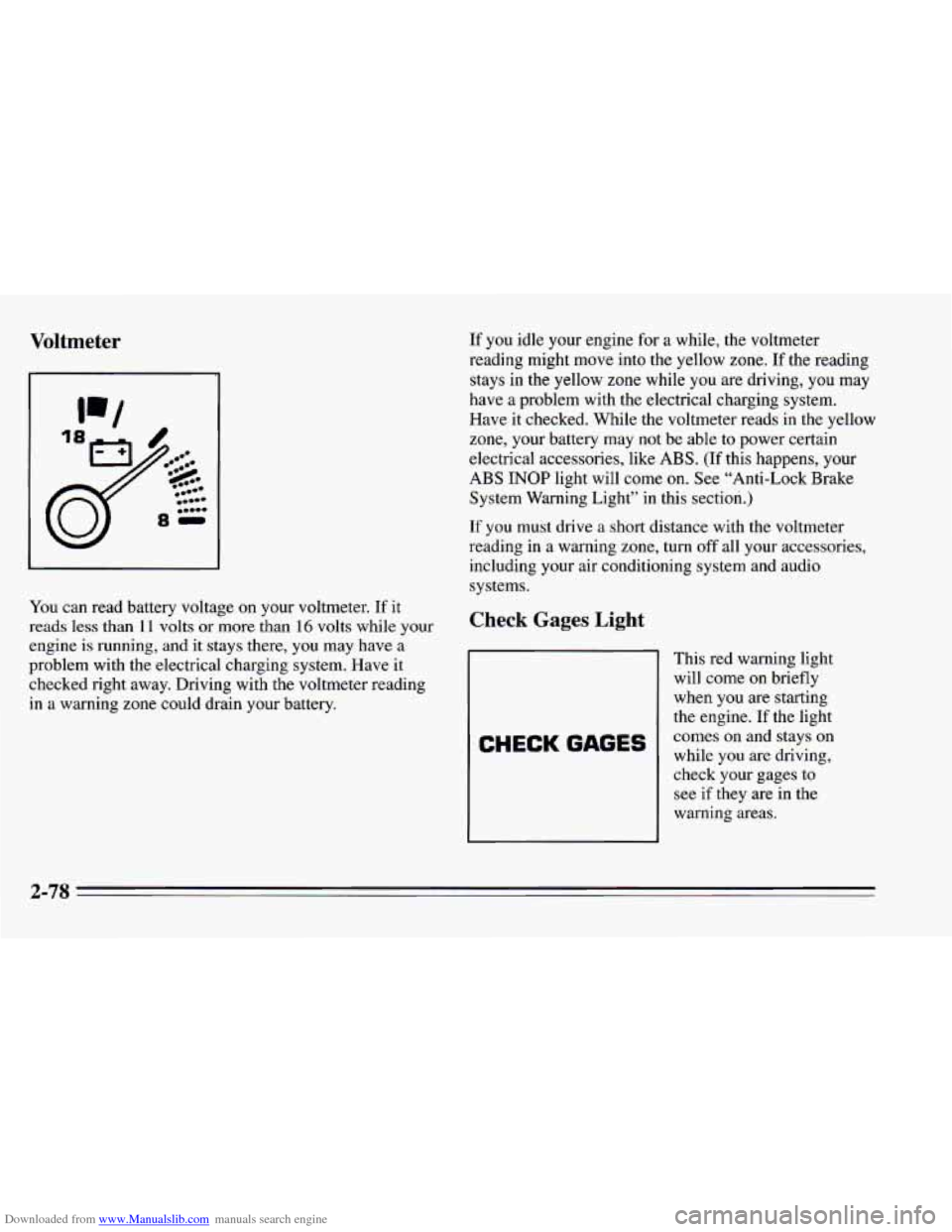
You can read battery voltage on your voltmeter. If it
reads less than
11 volts or more than 16 volts while your
engine is running, and
it stays there, you may have a
problem with the electrical charging system. Have it
checked right away. Driving with the voltmeter reading
in a warning zone could drain your battery.
If you idle your engine for a while, the voltmeter
reading might move into the yellow zone.
If the reading
stays in the yellow zone while you are driving, you may
have a problem with the electrical charging system.
Have it checked. While the voltmeter reads in the yellow
zone, your battery may
not be able to power certain
electrical accessories, like ABS.
(If this happens, your
ABS INOP light will come on. See “Anti-Lock Brake
System Warning Light” in this section.)
If you must drive a short distance with the voltmeter
reading in a warning zone, turn
off all your accessories,
including your air conditioning system and audio
systems.
Check Gages Light
CHECK GAGES
This red warning light
will come
on briefly
when you are starting
the engine.
If the light
comes on and stays on
while you are driving,
check your gages to
see if they are in the
warning areas.
2-78
Page 134 of 388
Downloaded from www.Manualslib.com manuals search engine Installing the Boot Cover
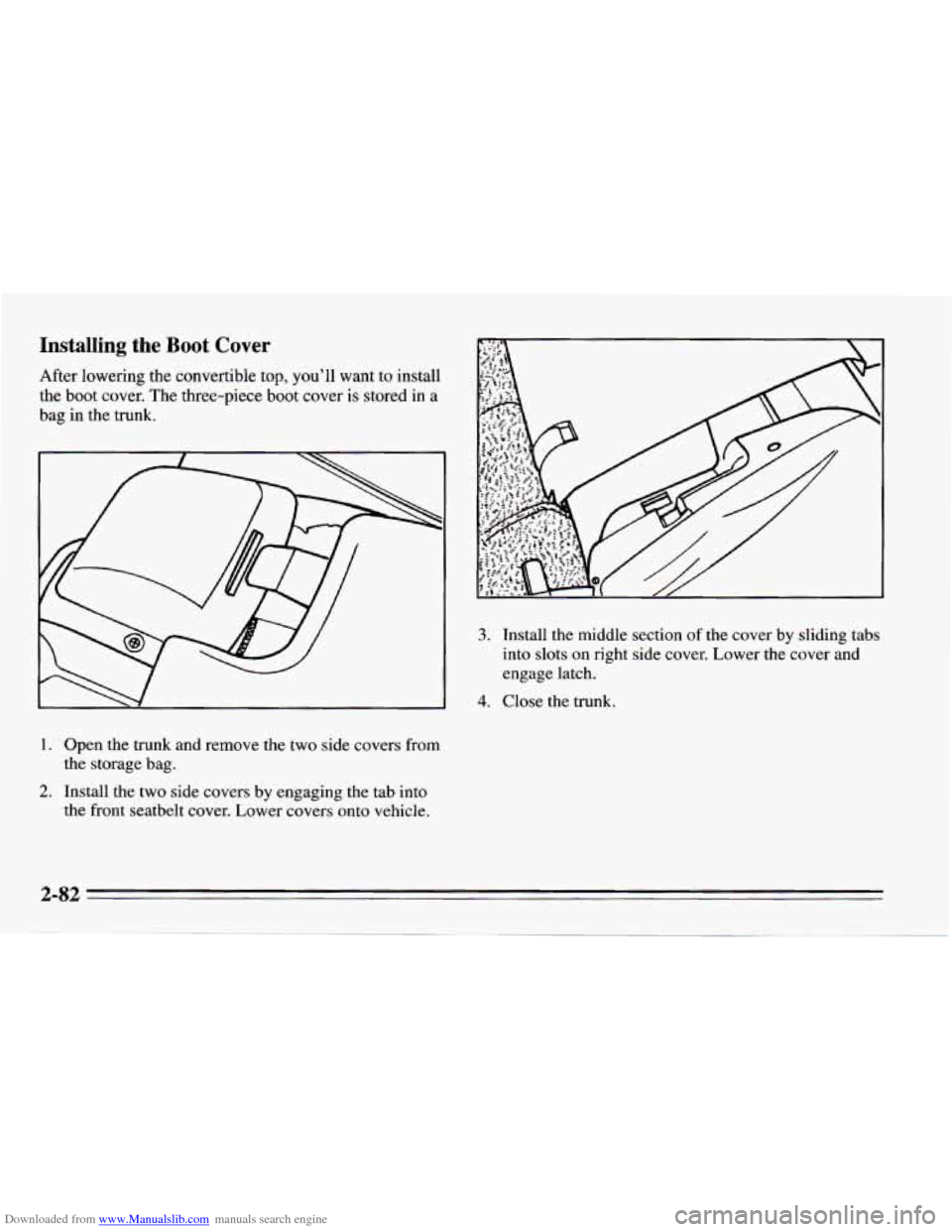
After lowering the convertible top, you’ll want to install
the boot cover. The three-piece boot cover
is stored in a
bag in the trunk.
3. Install the middle section of the cover by sliding tabs
into slots
on right side cover. Lower the cover and
engage latch.
1. Open the trunk and remove the two side covers from
the storage bag.
2. Install the two side covers by engaging the tab into
the front seatbelt cover. Lower covers onto vehicle.
4. Close the trunk.
2-82
Page 162 of 388
Downloaded from www.Manualslib.com manuals search engine Avoid needless heavy braking. Some people drive in
spurts
-- heavy acceleration followed by heavy braking
-- rather than keeping pace with traffic. This is a
mistake. Your brakes may
not have time to cool between
hard stops. Your brakes will wear out much faster if
you
do a lot of heavy braking. If you keep pace with the
traffic and allow realistic following distances, you will
eliminate a lot
of unnecessary braking. That means
better braking and longer brake life.
If your engine ever stops while you’re driving, brake
normally but don’t pump your brakes.
If you do, the
pedal may get harder to push down. If your engine
stops, you will still have some power brake assist. But
you will
use it when you brake. Once the power assist is
used up, it may take longer to stop and the brake pedal
will be harder
to push.
Anti-Lock Brakes (ABS)
Your Chevrolet has an advanced electronic braking
system that will help prevent a braking
skid.
ABS
INOP
This light on the
instrument panel will
come on briefly when
you start your vehicle.
When
you start your vehicle, or when you begin to drive
away, you may hear a momentary motor or clicking
noise. And you may even notice that your brake pedal
moves a little while this is going on. This is the ABS
system testing itself. If there’s a problem with the
anti-lock brake system, the anti-lock brake system
warning light will stay
on or flash.
See “Anti-Lock Brake System Warning Light”
in the
Index.
Page 163 of 388
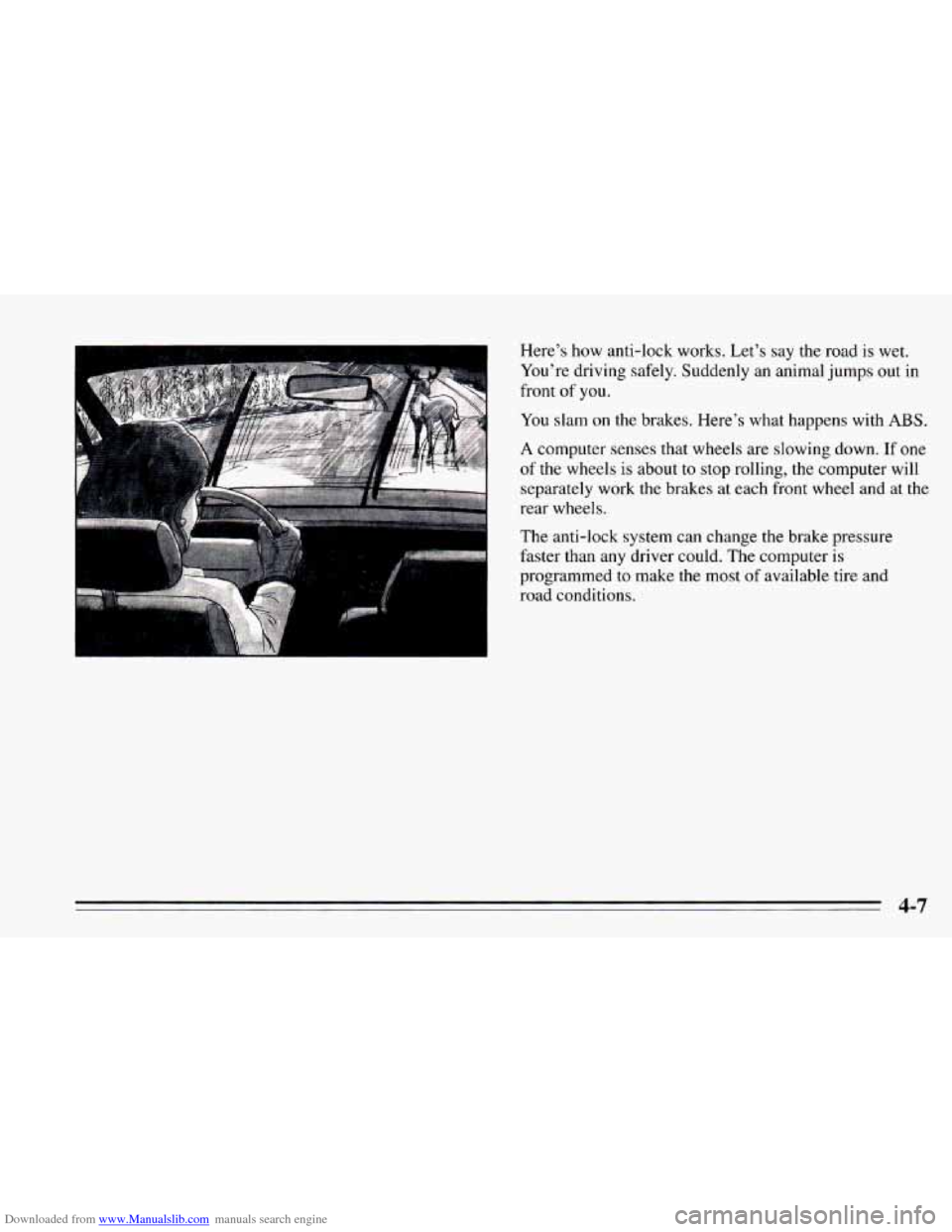
Downloaded from www.Manualslib.com manuals search engine Here’s how anti-lock works. Let’s say the road is wet.
You’re driving safely. Suddenly an animal jumps out in
front of you.
You slam
on the brakes. Here’s what happens with ABS.
A computer senses that wheels are slowing down. If one
of the wheels is about to stop rolling, the computer will
separately work the brakes at each front wheel and at the
rear wheels.
The anti-lock system can change the brake pressure
faster than any driver could. The computer
is
programmed to make the most of available tire and
road conditions.
4-7
Page 171 of 388
Downloaded from www.Manualslib.com manuals search engine Loss of Control
Let’s review what driving experts say about what
happens when the three control systems (brakes, steering
and acceleration) don’t
have enough friction where the
tires meet the road to do what the driver has asked.
In
any emergency, don’t give up. Keep trying to steer and
constantly seek an escape route or area of less danger.
Skidding
In a skid, a driver can lose control of the vehicle.
Defensive drivers avoid most skids by taking reasonable
care suited
to existing conditions, and by not
“overdriving” those conditions. But skids are always
possible.
The three types of skids correspond to your Chevrolet’s
three control systems.
In the braking skid your wheels
aren’t rolling. In the steering or cornering skid, too
much speed
or steering in a curve causes tires to slip and
lose cornering force. And
in the acceleration skid too
much throttle causes the driving wheels to spin.
A cornering skid is best handled by easing your foot off
the accelerator pedal.
If you have the
ASR system, remember: It helps avoid
only the acceleration skid. If you
do not have ASR, or
if the system is off, then an
acceleration skid
is also best handled by easing your
foot off the accelerator pedal.
If your vehicle starts to slide,
ease your foot off the
accelerator pedal and quickly steer the way
you want the
vehicle to go.
If you start steering quickly enough, your
vehicle may straighten out. Always be ready for a
second skid if it occurs.
Of course, traction is reduced when water, snow, ice,
gravel, or other material is on the road. For safety, you’ll
want to slow down and adjust your driving to these
conditions. It is important to slow down on slippery
surfaces because stopping distance will be longer and
vehicle control more limited.
While driving on
a surface with reduced traction, try
your best to avoid sudden steering, acceleration, or
braking (including engine braking by shifting to
a lower
gear).
Any sudden changes could cause the tires to slide.
You may not realize the surface is slippery until your
vehicle is skidding. Learn to recognize warning clues
--
such as enough water, ice or packed snow on the road to
make a “mirrored surface’’ -- and slow down when you
have any doubt.
Remember: Any anti-lock brake system
(ABS) helps
avoid only the braking skid.
4-15
Page 193 of 388
Downloaded from www.Manualslib.com manuals search engine Parking on Hills
You really should not park your vehicle, with a trailer
attached,
on a hill. If something goes wrong, your rig
could start to move. People can be injured, and both
your vehicle and the trailer can be damaged.
But if you ever have to park your rig on a hill, here’s
how
to do it:
1.
2.
3.
4.
5.
Apply your regular brakes, but don’t shift into
PARK (P)
yet, or into gear for a manual
transmission.
Have someone place chocks under the trailer wheels.
When the wheel chocks
are in place, release the
regular brakes. Then apply your parking brakes until
the chocks absorb the load.
Reapply the regular brakes. Then apply your parking
brake and then shift
to PARK(P) or REVERSE (R)
for a manual transmission.
Release the regular brakes.
When You Are Ready to Leave After
Parking on a
Hill
1. Apply your regular brakes and hold the pedal down
while you:
0 Start your engine;
0 Shift into a gear; and
0 Release the parking brake.
2. Let up on the brake pedal.
3. Drive slowly until the trailer is clear of the chocks.
4. Stop and have someone pick up and store the chocks.
Maintenance When Trailer Towing
Your vehicle will need service more often when you’re
pulling a trailer. See the Maintenance Schedule for more
on this. Things that are especially important in trailer
operation are automatic transmission fluid (don’t
overfill), engine oil, axle lubricant, cooling system, and
brake adjustment. Each
of these is covered in this
manual, and the Index will help you find them quickly.
If you’re trailering, it’s a good idea
to review these
sections before you start your trip.
Check periodically
to see that all hitch nuts and bolts are
tight.
4-37
Page 204 of 388
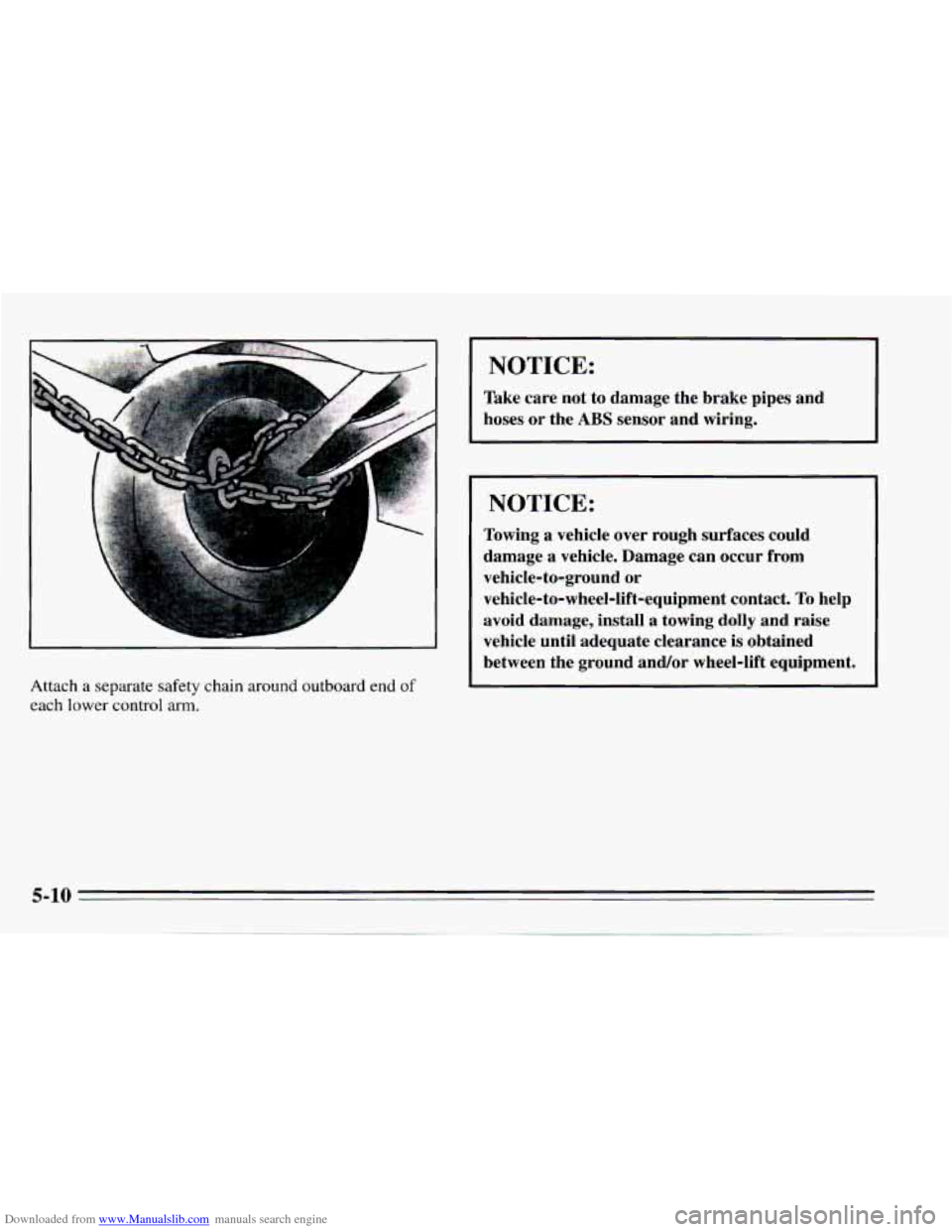
Downloaded from www.Manualslib.com manuals search engine Attach a separate safety chain around outboard end of
each lower control arm.
NOTICE:
Take care not to damage the brake pipes and
hoses or the
ABS sensor and wiring.
NOTICE:
Towing a vehicle over rough surfaces could
damage
a vehicle. Damage can occur from
vehicle-to-ground or
vehicle-to-wheel-lift-equipment contact. To help
avoid damage, install
a towing dolly and raise
vehicle until adequate clearance is obtained
between the ground and/or wheel-lift equipment.
5-10
Page 275 of 388
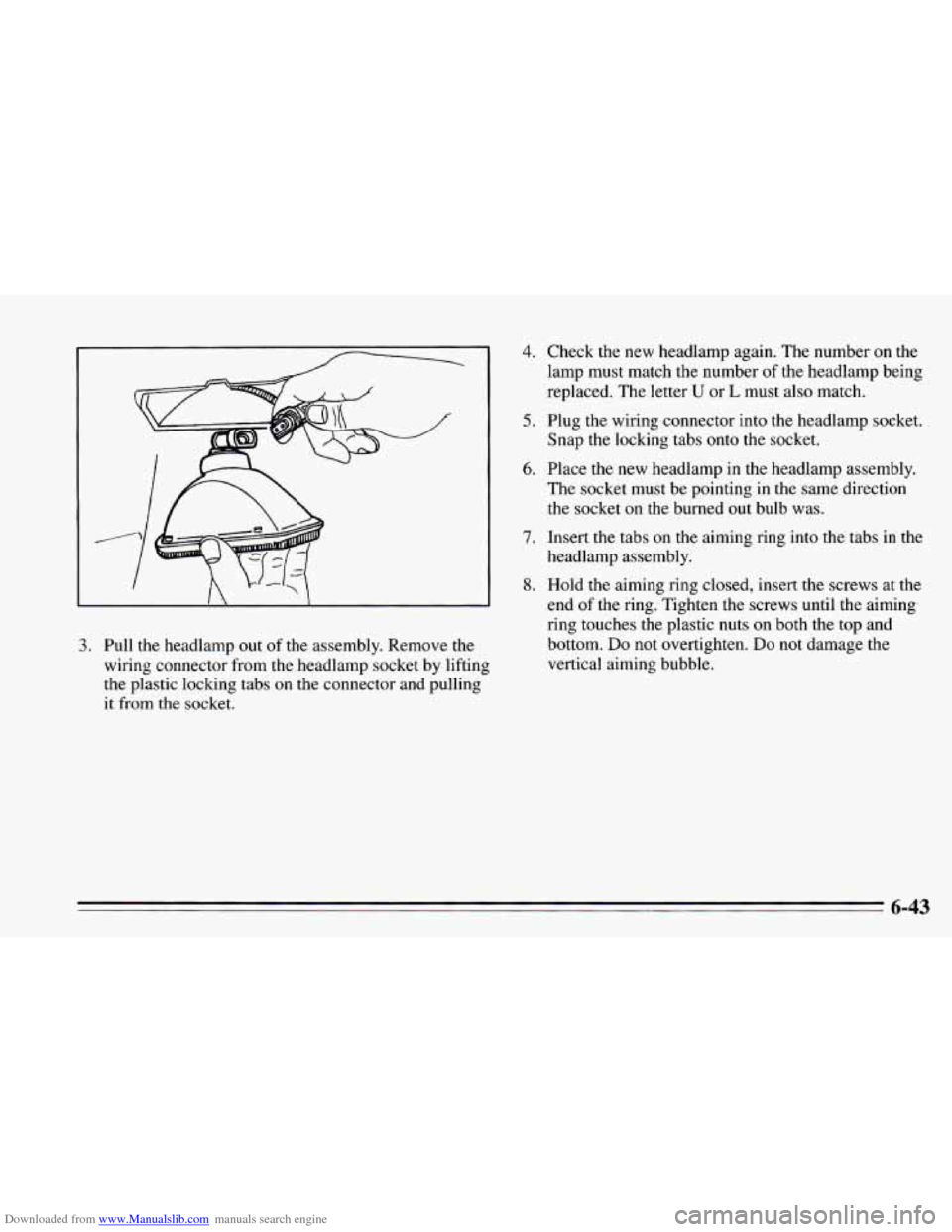
Downloaded from www.Manualslib.com manuals search engine 3. Pull the headlamp out of the assembly. Remove the
wiring connector from the headlamp socket by lifting
the plastic locking tabs
on the connector and pulling
it
from the socket.
4. Check the new headlamp again. The number on the
lamp must match the number of the headlamp being
replaced. The letter
U or L must also match.
5. Plug the wiring connector into the headlamp socket.
Snap the locking tabs onto the socket.
6. Place the new headlamp in the headlamp assembly.
The socket must be pointing in the same direction
the socket on the burned out bulb was.
7. Insert the tabs on the aiming ring into the tabs in the
headlamp assembly.
8. Hold the aiming ring closed, insert the screws at the
end
of the ring. Tighten the screws until the aiming
ring touches the plastic nuts
on both the top and
bottom.
Do not overtighten. Do not damage the
vertical aiming bubble.
6-43
Page 302 of 388

Downloaded from www.Manualslib.com manuals search engine Underhood Electrical Center Fuses
czb ABS IGN
FANSIACTR
PCM F G
INJECTOR
INJECTOR
IGNITION
A/C-
CRUISE I
I I I I I I I I
6-70
Page 303 of 388
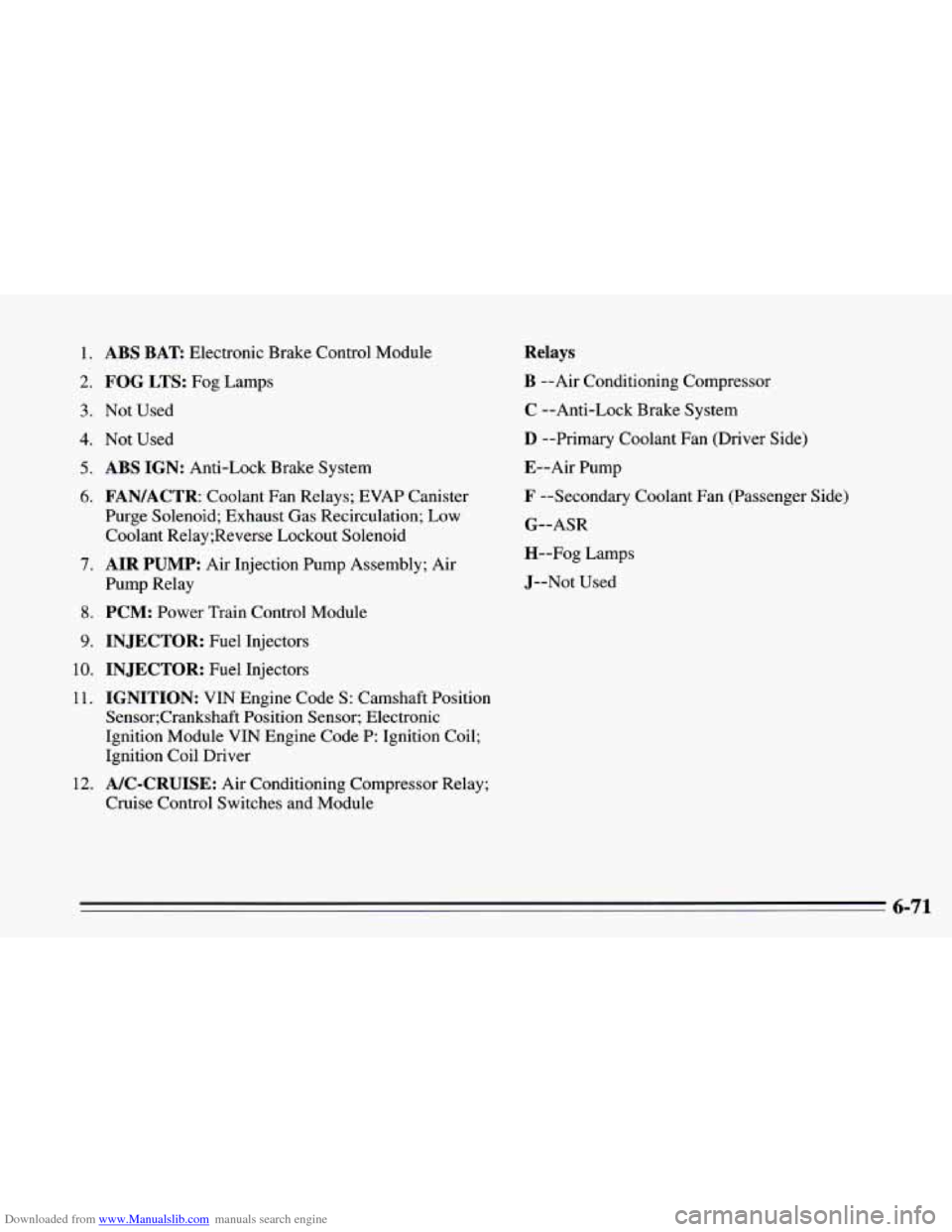
Downloaded from www.Manualslib.com manuals search engine 1. ABS BAT Electronic Brake Control Module
2. FOG LTS: Fog Lamps
3. Not Used
4. Not Used
5. ABS IGN: Anti-Lock Brake System
6. FAN/ACTR: Coolant Fan Relays; EVAP Canister
Purge Solenoid; Exhaust Gas Recirculation; Low
Coolant Re1ay;Reverse Lockout Solenoid
7. AIR PUMP: Air Injection Pump Assembly; Air
8. PCM: Power Train Control Module
Pump
Relay
9. INJECTOR: Fuel Injectors
10. INJECTOR: Fuel Injectors
11. IGNITION: VIN Engine Code S: Camshaft Position
Sensor;Crankshaft Position Sensor; Electronic
Ignition Module VIN Engine Code P: Ignition Coil; Ignition Coil Driver
Cruise Control Switches and Module
12. A/C-CRUISE: Air Conditioning Compressor Relay;
Relays
B --Air Conditioning Compressor
C --Anti-Lock Brake System
D --Primary Coolant Fan (Driver Side)
E--Air Pump
F --Secondary Coolant Fan (Passenger Side)
G--ASR
H--Fog Lamps
J--Not Used
6-71