change time CHEVROLET CAMARO 1995 4.G Owners Manual
[x] Cancel search | Manufacturer: CHEVROLET, Model Year: 1995, Model line: CAMARO, Model: CHEVROLET CAMARO 1995 4.GPages: 388, PDF Size: 19.69 MB
Page 4 of 388
Downloaded from www.Manualslib.com manuals search engine GENERAL MOTORS, GM and the GM Emblem,
CHEVROLET and the Chevrolet Emblem and the name
Camaro are registered trademarks of General Motors
Corporation.
This manual includes the latest information at the time it
was printed. We reserve the right to make changes
in the
product after that time without further notice. For
vehicles first sold in Canada, substitute the name
“General Motors
of Canada Limited” for Chevrolet
Motor Division whenever it appears in this manual.
Please keep this manual in your Chevrolet,
so it will be
there if
you ever need it when you’re on the road. If you
sell the vehicle, please leave this manual in it so the new
owner can use it.
Litho in
U.S.A.
Part No. 10254415 B Second Printing
WE SUPPORT VOLUNTARY TECHNICIAN
CERTIFICATION THROUGH
AUTOMOTIVE
Yalonal Instittlw for
SERVICE EXCELLENCE
We support voluntary
technician certification.
For Canadian Owners Who Prefer a
French Language Manual:
Aux proprietaires canadiens: Vous pouvez vous procurer
un exemplaire de ce guide en frangais chez votre
concessionaire ou au DGN Marketing Services Ltd.,
1500 Bonhill Rd., Mississauga, Ontario L5T lC7.
@Copyright General Motors Corporation
1994
All Rights Reserved
11
Page 60 of 388
Downloaded from www.Manualslib.com manuals search engine 4 8
1
c
c
-w
I
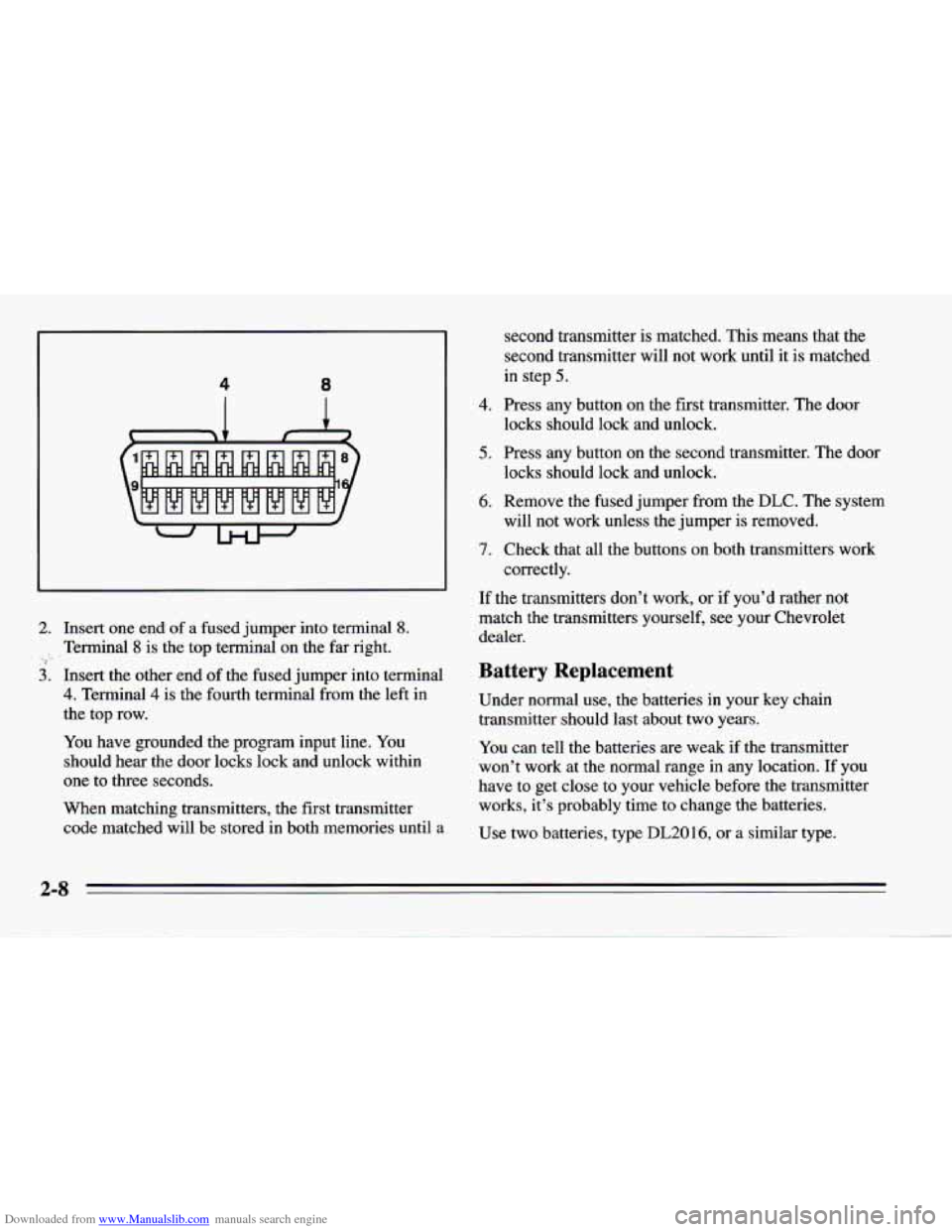
2. Insert one end of a fused jumper into terminal 8.
, Terminal 8 is the top terminal on the far right. ,> ,_ .
3. Insert the other end of the fused jumper into terminal
4. Terminal 4 is the fourth terminal from the left in
the top row.
You have grounded the program input line. You
should hear the door locks lock and unlock within
one to three seconds.
When matching transmitters, the first transmitter
code matched will be stored in both memories until a second
transmitter is matched.
This means that the
second transmitter will not work until it is matched
in step
5.
4. Press any button on the first transmitter. The door
locks should lock and unlock.
5. Press any button on the second transmitter. The door
locks should lock and unlock.
6. Remove the fused jumper from the
DLC. The system
7. Check that all the buttons on both transmitters work
will not work unless the
jumper is removed.
correctly.
If the transmitters don’t work,
or if you’d rather not
match the transmitters yourself, see your Chevrolet
dealer.
Battery Replacement
Under normal use, the batteries in your key chain
transmitter should last about two years.
You can tell the batteries are weak if the transmitter
won’t work at the normal range
in any location. If you
have to get close to your vehicle before the transmitter
works, it’s probably time to change the batteries.
Use two batteries, type
DL20 16, or a similar type.
Page 70 of 388
Downloaded from www.Manualslib.com manuals search engine NOTICE:
Your engine is designed to work with the
electronics in your vehicle.
If you add electrical
parts or accessories, you could change the way
the fuel injection system operates. Before adding
electrical equipment, check with your dealer.
If
you don’t, your engine might not perform
properly.
If you ever have to have your vehicle towed, see
the part of this manual that tells how to do
it
without damaging your vehicle. See “Towing
Your Car” in the Index.
To start your 5.7 Liter LT1 engine:
1. Without pushing the accelerator pedal, turn the
ignition key to START. When the engine starts, let
go
of the key. The idle speed will go down as your
engine gets warm.
NOTICE:
Holding your key in START for longer than
15 seconds at a time will cause your battery to be
drained much sooner. And the excessive heat can
damage your starter motor.
2. If it doesn’t start within 10 seconds, push the
accelerator pedal all the way to the
floor, while you
hold the ignition key in
START. When the engine
starts, let
go of the key and let up on the accelerator
pedal. Wait about 15 seconds between each
try to
help avoid draining your battery.
When starting your engine in very
cold weather (below
0°F or -18”C), do this:
1. With your foot
off the accelerator pedal, turn the
ignition key to
START and hold it there. When the
engine starts, let
go of the key. Use the accelerator
pedal
to maintain engine speed, if you have to, until
your engine has run for a while.
2-1s
Page 71 of 388
Downloaded from www.Manualslib.com manuals search engine 2. If your engine still won’t start (or starts but then
stops), it could be flooded with too much gasoline.
Try pushing your accelerator pedal all the way to the
floor and holding it there as
you hold the key in
START
for about three seconds. If the car starts
briefly but then stops again,
do the same thing, but
this time keep the pedal down
for five or six seconds.
This clears the extra gasoline from the engine.
NOTICE:
Your engine is designed to work with the
electronics in your vehicle. If you add electrical
parts or accessories, you could change the
way
the fuel injection system operates. Before adding
electrical equipment, check with your dealer.
If
you don’t, your engine might not perform
properly.
If you ever have to have your vehicle towed, see
the part of this manual that tells how to do it
without damaging your vehicle. See “Towing
Your Car” in the Index.
Driving Through Deep Standing
Water
NOTICE:
If you drive too quickly through deep puddles or
standing water, water can come in through your
engine’s
air intake and badly damage your
engine. Never drive through water that
is slightly
lower than the underbody of your vehicle.
If you
can’t avoid deep puddles or standing water, drive
through them very slowly.
2-19
Page 142 of 388
Downloaded from www.Manualslib.com manuals search engine A/C: Use for normal cooling on hot days. This setting
cools outside air and directs it through the upper air
vents.
The air conditioner compressor operates in
MAX, NC,
BI-LEVEL, BLEND and DEFROST when the outside
temperature
is above freezing. When the air conditioner
is on, you may sometimes notice slight changes in your
vehicle’s engine speed and power. This is normal,
because the system is designed to cycle the compressor
on and
off to keep the desired cooling and help fuel
economy.
Cooling
The air conditioner works best if you keep your
windows closed. On very hot days, open the windows
just long enough for the hot air to escape.
1. Turn the air control knob to A/C for normal coolinn.
For faster cooling move the knob to
MAX.
setting.
2. Turn the temperature control knob to a comfortable
3. Turn the fan control knob to the desired speed.
Rear Window Defogger (Option)
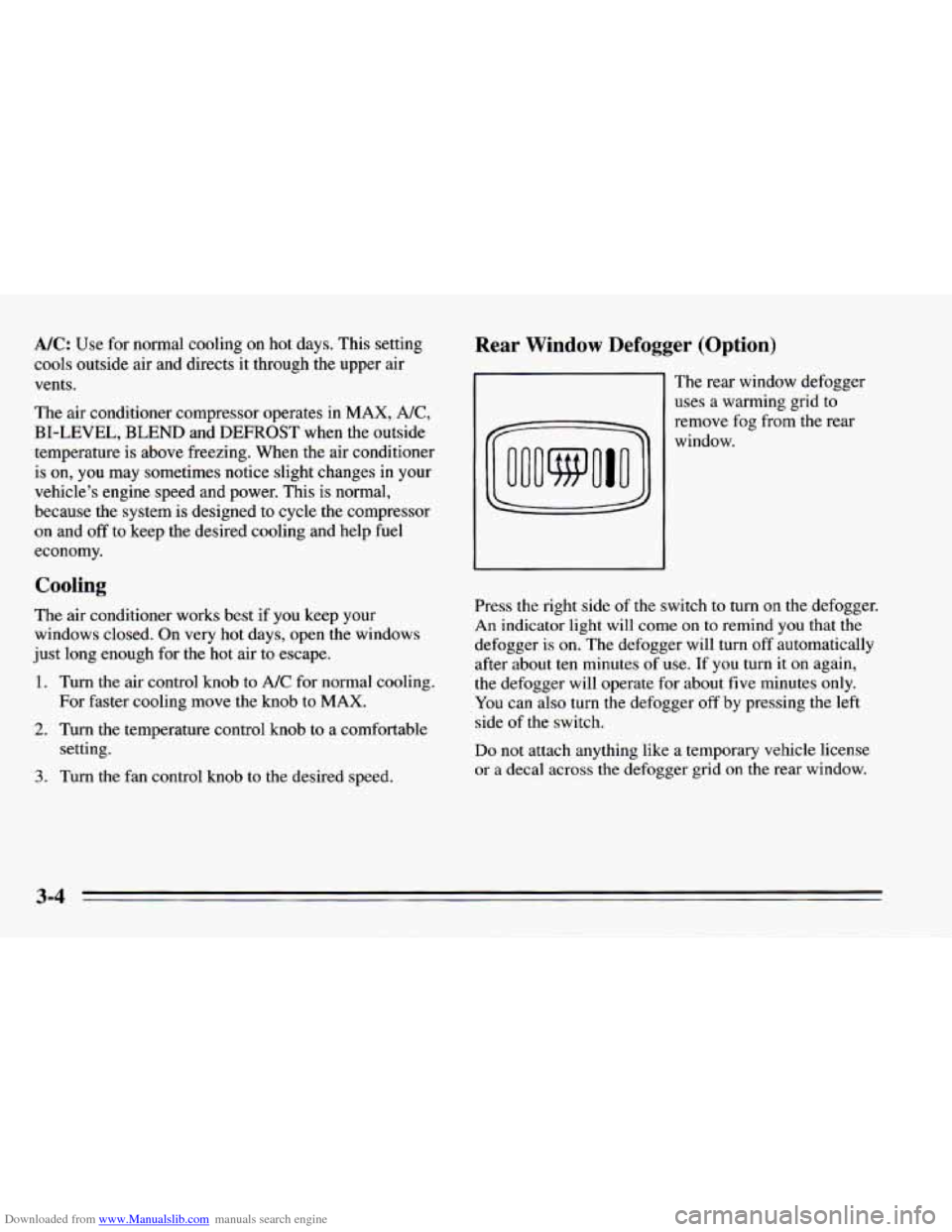
The rear window defogger
uses a warming grid to
remove fog
from the rear
window.
Press the right side of the switch to turn
on the defogger.
An indicator light will come on to remind you that the
defogger is on. The defogger will
turn off automatically
after about ten minutes of use.
If you turn it on again,
the defogger will operate for about five minutes only.
You can also turn the defogger
off by pressing the left
side of the switch.
Do not attach anything like a temporary vehicle license
or a decal across the defogger grid on the rear window.
3-4
Page 164 of 388
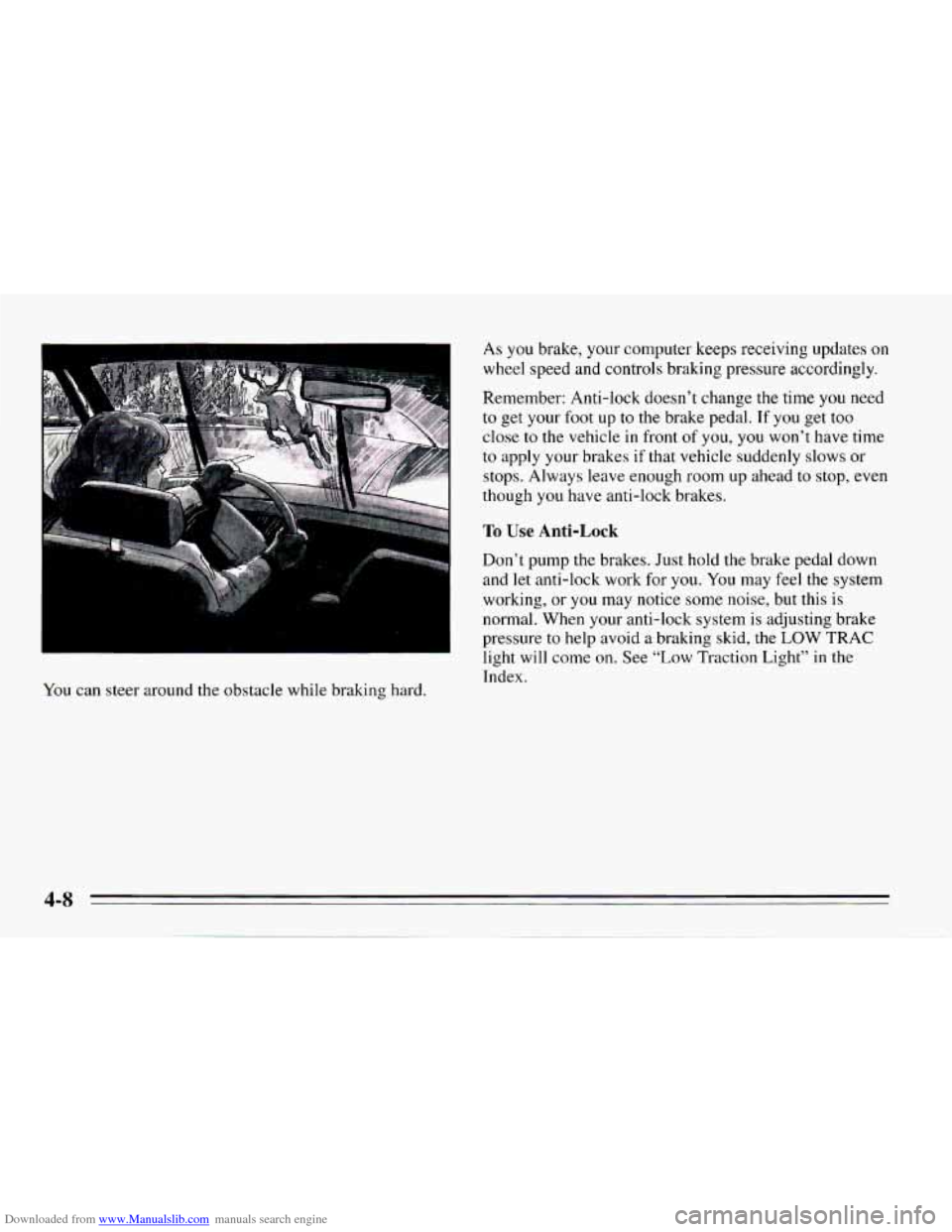
Downloaded from www.Manualslib.com manuals search engine You can steer around the obstacle while braking hard. As you brake, your
computer keeps receiving updates
on
wheel speed and controls braking pressure accordingly.
Remember: Anti-lock doesn’t change the time
you need
to get your foot up to the brake pedal. If you get too
close
to the vehicle in front of you, you won’t have time
to apply your brakes if that vehicle suddenly slows or
stops. Always leave enough room up ahead to stop, even
though you have anti-lock brakes.
To Use Anti-Lock
Don’t pump the brakes. Just hold the brake pedal down
and let anti-lock work
for you. You may feel the system
working, or you may notice
some noise, but this is
normal. When your anti-lock system is adjusting brake
pressure to help avoid
a braking skid, the LOW TRAC
light will come on. See
“Low Traction Light” in the
Index.
Page 170 of 388
Downloaded from www.Manualslib.com manuals search engine Do not get too close to the vehicle you want to pass
while you’re awaiting
an opportunity. For one thing,
following
too closely reduces your area of vision,
especially if you’re following a larger vehicle. Also,
you won’t have adequate space if the vehicle ahead
suddenly slows or stops. Keep back a reasonable
distance.
0 When it looks like a chance to pass is coming up,
start to accelerate but stay in the right lane and don’t
get too close. Time your move
so you will be
increasing speed as the time comes to move into the
other lane.
If the way is clear to pass, you will have a
“running start’’ that more than makes up for the
distance you would lose by dropping back. And if
something happens to cause you
to cancel your pass,
you need only slow down and drop back again and
wait for another opportunity.
0 If other cars are lined up to pass a slow vehicle, wait
your turn. But take care that someone isn’t trying to
pass you as you pull out
to pass the slow vehicle.
Remember
to glance over your shoulder and check
the blind spot.
Check your mirrors, glance over your shoulder, and
start your left lane change signal before moving out
of the right lane
to pass. When you are far enough
ahead of the passed vehicle to see its front in your
inside mirror, activate your right lane change signal
and move back into the right lane. (Remember that
your right outside mirror is convex. The vehicle you
just passed may seem to be farther away from
you
than it really is.)
0 Try not to pass more than one vehicle at a time on
two-lane roads. Reconsider before passing the next
vehicle.
0 Don’t overtake a slowly moving vehicle too rapidly.
Even though the brake lights are
not flashing, it may
be slowing down or starting to turn.
following driver to get ahead of
you. Perhaps you
can ease a little to the right.
0 If you’re being passed, make it easy for the
Page 187 of 388
Downloaded from www.Manualslib.com manuals search engine Towing a Trailer
NOTICE:
Pulling a trailer improperly can damage your
vehicle and result in costly repairs not covered
by
your warranty. To pull a trailer correctly, follow
the advice in this part, and see your Chevrolet
dealer for important information about towing a
trailer with your vehicle.
Your car can tow a trailer if it is equipped with the
proper trailer towing equipment. To identify what the
vehicle trailering capacity is for your vehicle,
you
should read the information in “Weight of the Trailer”
that appears later
in this section. But trailering is
different than just driving your vehicle by itself.
Trailering means changes in handling, durability, and
fuel economy. Successful, safe trailering takes correct
equipment, and
it has to be used properly.
That’s the reason for this part. In
it are many
time-tested, important trailering tips and safety rules.
Many of these are important for your safety and that
of
your passengers. So please read this section carefully
before you pull a trailer.
Load-pulling components such as the engine,
transmission, rear axle, wheel assemblies, and tires are
forced to work harder against the drag
of the added
weight. The engine
is required to operate at relatively
higher speeds and under greater loads, generating extra
heat. What’s more, the trailer adds considerably
to wind
resistance, increasing the pulling requirements.
4-31
Page 253 of 388
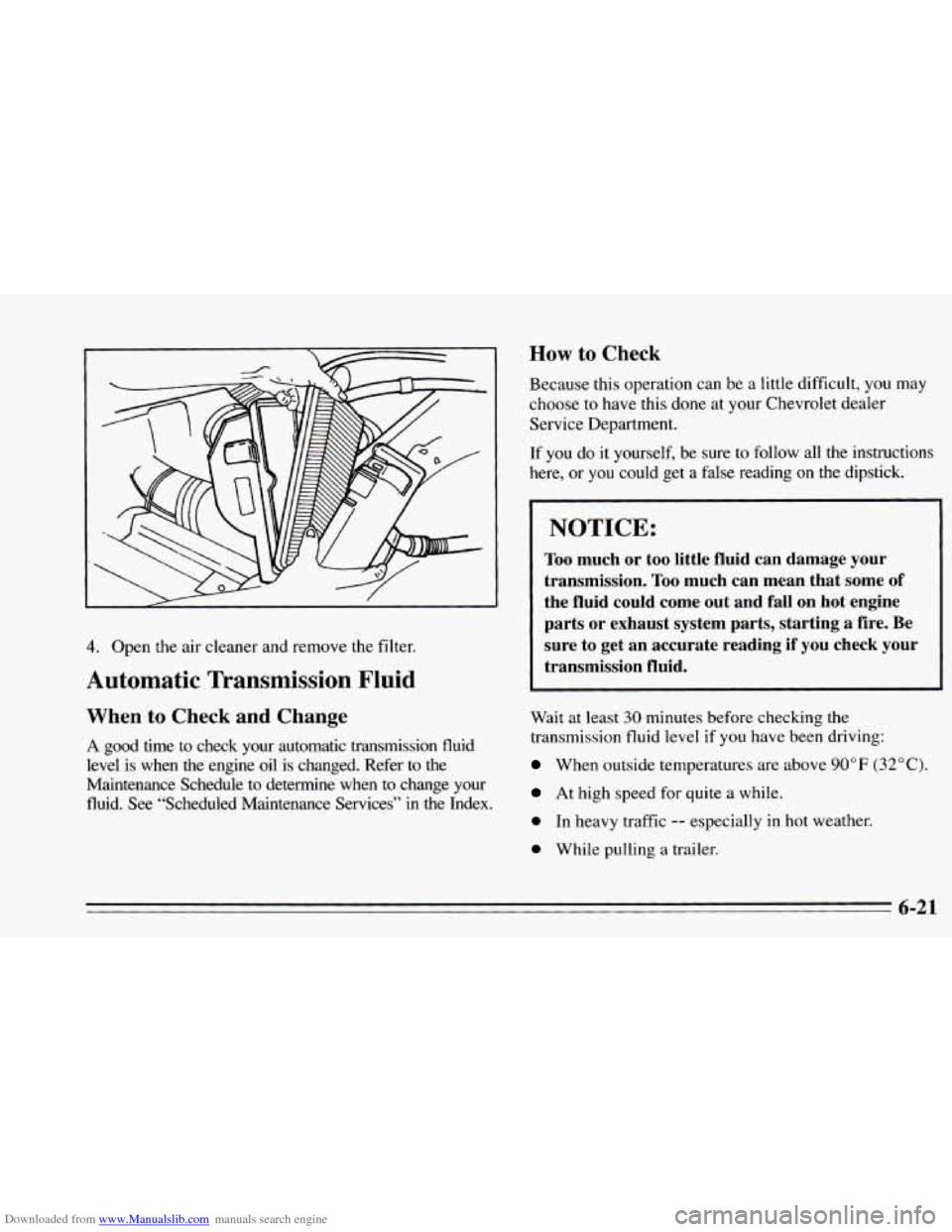
Downloaded from www.Manualslib.com manuals search engine 4. Open the air cleaner and remove the filter.
Automatic Transmission Fluid
When to Check and Change
A good time to check your automatic transmission fluid
level is when the engine oil is changed. Refer to the
Maintenance Schedule to determine when to change your
fluid. See “Scheduled Maintenance Services” in the Index.
How to Check
Because this operation can be a little difficult, you may
choose to have this done at your Chevrolet dealer
Service Department.
If you do it yourself,
be sure to follow all the instructions
here,
or you could get a false reading on the dipstick.
NOTICE:
Too much or too little fluid can damage your
transmission.
Too much can mean that some of
the fluid could come out and fall on hot engine
parts or exhaust system parts, starting a fire. Be
sure to get an accurate reading if you check your
transmission fluid.
Wait at least 30 minutes before checking the
transmission fluid level
if you have been driving:
When outside temperatures are above 90°F (32°C).
At high speed for quite a while.
0 In heavy traffic -- especially in hot weather.
0 While pulling a trailer.
Page 269 of 388
Downloaded from www.Manualslib.com manuals search engine Some driving conditions or climates may cause a brake
squeal when the brakes are first applied or lightly
applied. This does not mean something is wrong with
your brakes.
If you have rear drum brakes, they don’t have wear
indicators, but
if you ever hear a rear brake rubbing
noise, have the rear brake linings inspected. Also, the
rear brake drums should be removed and inspected each
time the tires are removed for rotation or changing.
When you have the front brakes replaced, have the rear
brakes inspected, too.
Brake linings should always be replaced as complete
axle sets.
Brake Pedal Travel
See your dealer if the brake pedal does not return to
normal height, or
if there is a rapid increase in pedal
travel. This could be
a sign of brake trouble.
Brake Adjustment
Every time you make a moderate brake stop, your disc
brakes adjust for wear. If you rarely make a moderate or
heavier stop, then your brakes might not adjust correctly.
If you drive in that way, then -- very carefully -- make
a few moderate brake stops about every 1,000
miles
(1600 km), so your brakes will adjust properly. If
your brake pedal goes down farther than normal, your
rear drum brakes may need adjustment. Adjust them by
backing up and firmly applying the brakes a few times.
Replacing Brake System Parts
The braking system on a modern vehicle is complex.
Its many parts have: to be of top quality and work well
together if the vehicle is to have really good braking.
Vehicles we design and test have top-quality
GM brake
parts in them, as your Chevrolet does when it is new.
When
you replace parts of your braking system -- for
example, when your brake linings wear down and you
have to have new ones put
in -- be sure you get new
genuine
GM replacement parts. If you don’t, your
brakes may no longer work properly. For example,
if
someone puts in brake linings that are wrong for your
vehicle, the balance between your front and rear brakes
can change
-- for the worse. The braking performance
you’ve come
to expect can change in many other ways if
someone puts in t+ wrong replacement brake parts.