cooling CHEVROLET CAMARO 1996 4.G User Guide
[x] Cancel search | Manufacturer: CHEVROLET, Model Year: 1996, Model line: CAMARO, Model: CHEVROLET CAMARO 1996 4.GPages: 402, PDF Size: 21.38 MB
Page 227 of 402
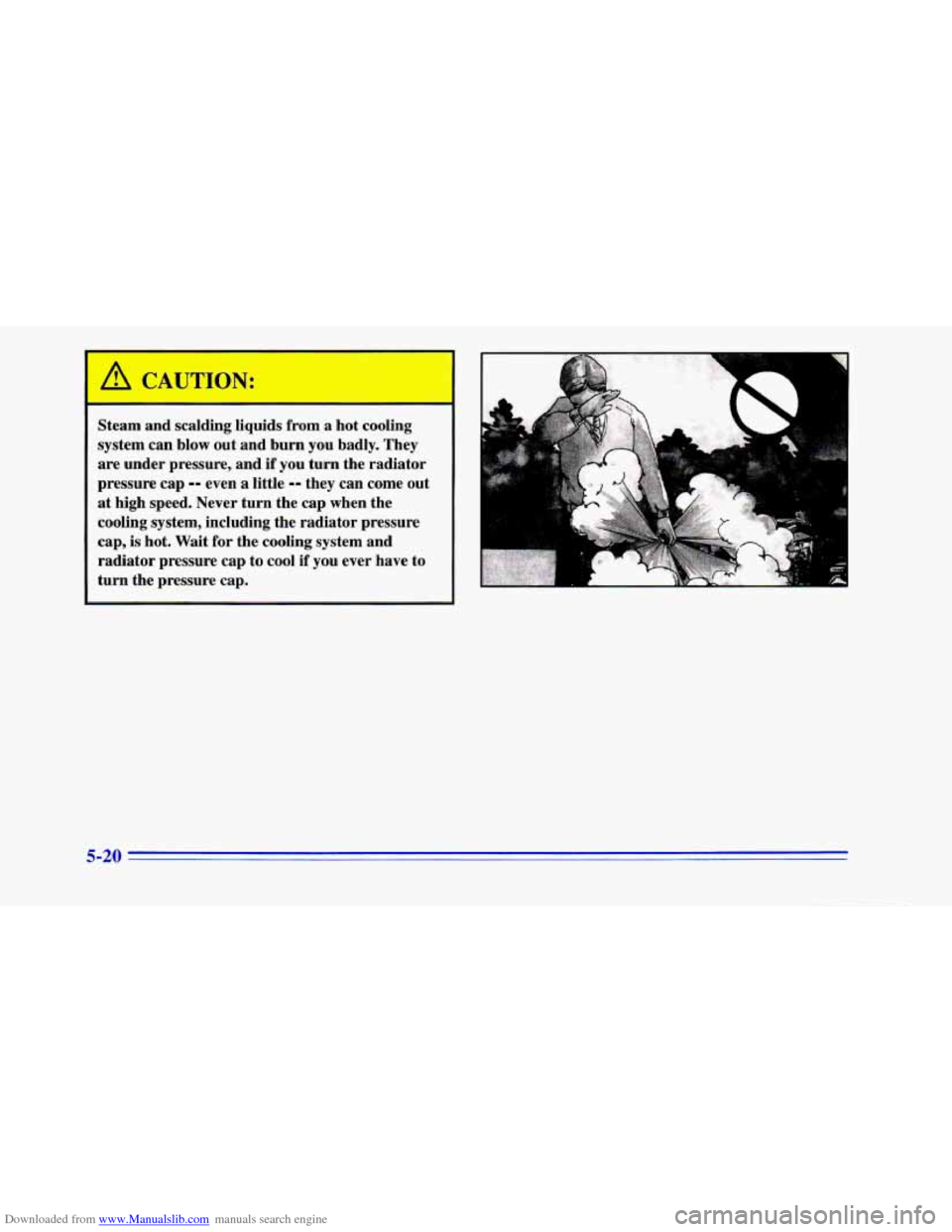
Downloaded from www.Manualslib.com manuals search engine Steam and scalding liquids from a hot cooling
system can blow out and burn you badly. They
are under pressure, and
if you turn the radiator
pressure cap
-- even a little -- they can come out
at high speed. Never turn the cap when the
cooling system, including the radiator pressure
cap, is hot. Wait for the cooling system and
radiator pressure cap
to cool if you ever have to
turn the pressure cap.
5-20
Page 228 of 402
Downloaded from www.Manualslib.com manuals search engine How to Add Coolant to the Radiator
(V6 Engine) Only
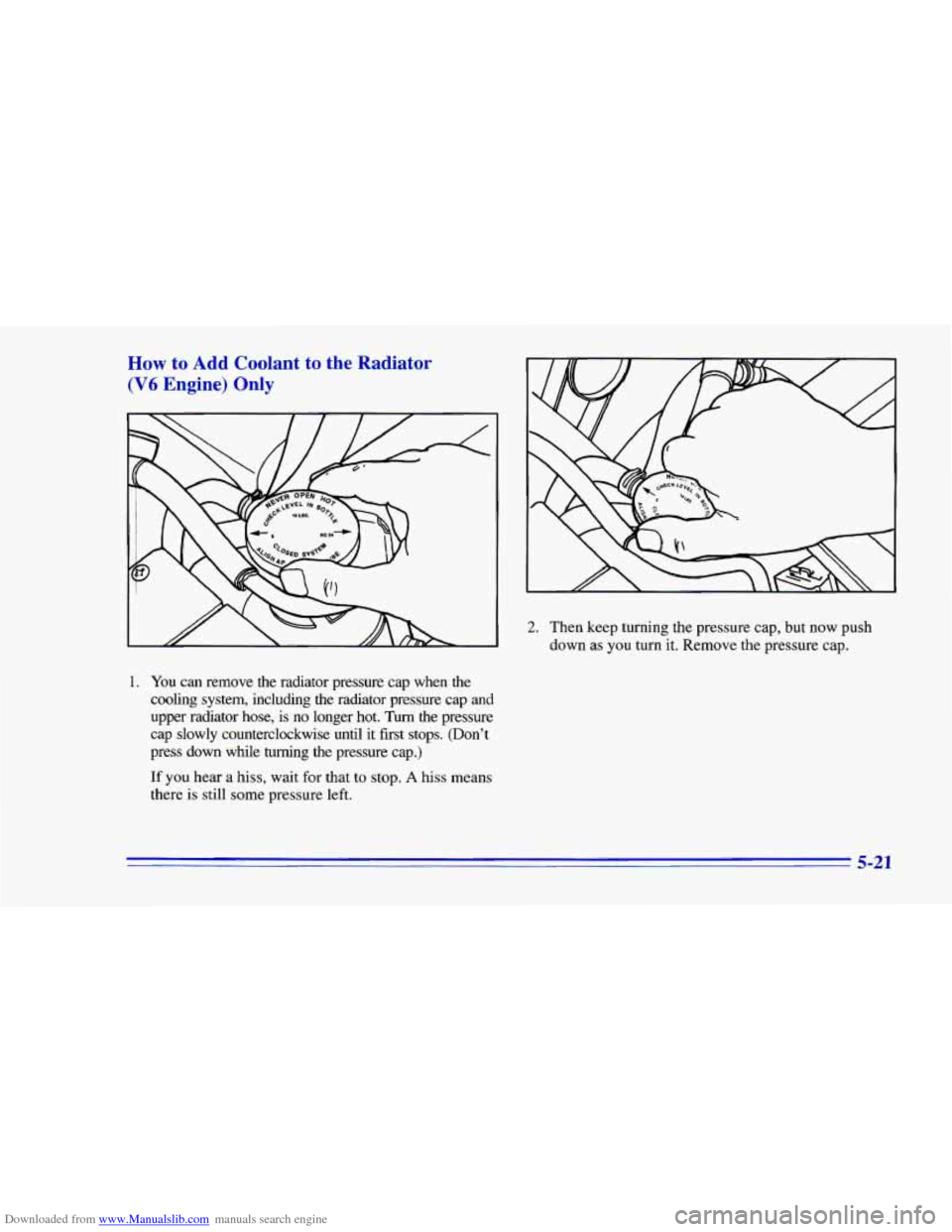
1. You can remove the radiator pressure cap when the
cooling system, including the radiator pressure cap
and
upper radiator hose, is no longer hot. Turn the pressure
cap slowly counterclockwise until it first stops. (Don’t
press down while turning the pressure cap.)
If you hear a hiss, wait for that to stop. A hiss means
there is still some pressure left.
2. Then keep turning the pressure cap, but now push
down as you turn
it. Remove the pressure cap.
5-21
Page 231 of 402
Downloaded from www.Manualslib.com manuals search engine How to Add Coolant to the Radiator
(V8 Engine Only)
NOTICE:
The LTl Engine (Code P) has a specific radiator
fill procedure. Failure
to follow this procedure
could cause your engine
to overheat and be
severely damaged.
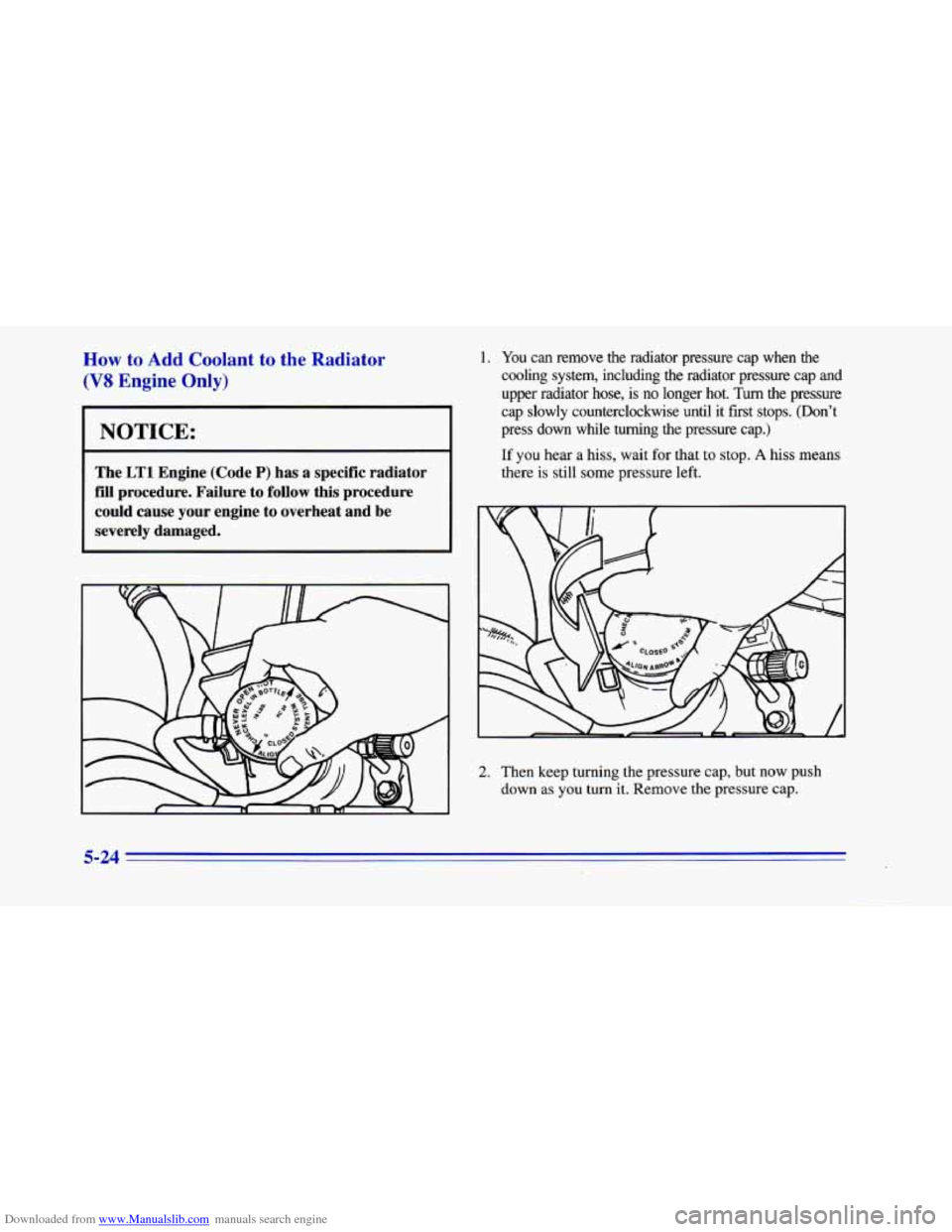
1. You can remove the radiator pressure cap when the
cooling system, including the radiator pressure cap
and
upper radiator hose, is no longer hot. Turn the pressure
cap slowly counterclockwise until it first stops. (Don’t
press down while turning the pressure cap.)
If you hear a hiss, wait for that to stop. A hiss means
there is still some pressure
left.
2. Then keep turning the pressure cap, but now push
down as you turn
it. Remove the pressure cap.
Page 277 of 402
Downloaded from www.Manualslib.com manuals search engine What to Use
Standard Differential
Use Axle Lubricant (GM Part No. 1052271) or
SAE 80W-90 GL-5 gear lubricant.
Limited-Slip Differential
To add lubricant when the level is low, use Axle
Lubricant (GM
Part No. 12345977). To completely refill
after draining, add 2 ounces (59
ml) of Limited-Slip
Differential Lubricant Additive (GM
Part No. 1052358).
Then fill to the bottom
of the filler plug hole with Axle
Lubricant (GM Part
No. 12345977).
Engine Coolant
The cooling system in your vehicle is filled with new
DEX-COOL
TM (orange-colored, silicate-free) engine
coolant. This coolant is designed to remain in your
vehicle for
5 years or 100,000 miles (166 000 km),
whichever occurs first.
The following explains your cooling system and how to add coolant when it is low. If you have a problem with
engine overheating
or if you need to add coolant to your
radiator, see “Engine Overheating” in the Index.
A 50/50 mixture of water and the proper coolant for
your Chevrolet will:
Give freezing protection down to -34°F (-37°C).
0 Give boiling protection up to 265 “F (1 29°C).
Protect against rust and corrosion.
Help keep the proper engine temperature.
Let the warning lights and gages work as they should.
NOTICE:
When adding coolant it is important that you use
DEX-COOL (orange-colored, silicate-free)
coolant meeting
GM Specification 6277M.
If silicated coolant is added to the system,
premature engine, heater core
or radiator
corrosion may result.
In addition, the engine
coolant
will require change sooner -- at
30,000 miles (50 000 km) or 24 months,
whichever occurs first.
6-26
I b
Page 278 of 402
Downloaded from www.Manualslib.com manuals search engine What to Use
Use a mixture of one-half clean water (preferably
distilled) and one-half
DEX-COOL TM (orange-colored,
silicate-free) antifreeze that meets
GM Specification
6277M, which won’t damage aluminum parts. Use
GM Engine Coolant Supplement (sealer) (GM Part
No. 3634621) with any complete coolant change. If you
use this mixture, you don’t need to add anything else.
Adding only plain water to your cooling system
can be dangerous. Plain water, or some other
liquid like alcohol, can boil before the proper
coolant mix will. Your vehicle’s coolant warning
system is set for the proper coolant mix. With
plain water or the wrong mix, your engine could
get too hot but you wouldn’t get the overheat
warning. Your engine could catch fire and you or
others could be burned. Use a
50/50 mix of clean
water and
DEX-COOL TM (orange-colored,
silicate-free) antifreeze.
1
NOTICE:
I
If you use an improper coolant mix, your
engine could overheat and be badly damaged.
The repair cost wouldn’t be covered by your
warranty.
Too much water in the mix can freeze
and crack the engine, radiator, heater core and
other parts.
If you have to add coolant more than four times a year,
have your dealer check your cooling system.
NOTICE:
If you use the proper coolant, you don’t have to
add extra inhibitors or additives which claim to
improve the system. These can be harmful.
6-27
Page 305 of 402
Downloaded from www.Manualslib.com manuals search engine Wheel Replacement
Replace any wheel that is bent, cracked, or badly rusted
or corroded. If wheel nuts keep coming loose, the wheel,
wheel bolts and wheel nuts should be replaced. If the
wheel leaks air, replace it (except some aluminum
wheels, which
can sometimes be repaired). See your
Chevrolet dealer if any
of these conditions exist.
Your dealer will know the kind
of wheel you need.
Each new wheel should have the same load-carrying
capacity, diameter, width, offset and be mounted the
same way as the one it replaces.
If you need to replace any of your wheels, wheel bolts
or wheel nuts, replace them only with new
GM original
equipment parts. This way, you will be sure to have the
right wheel, wheel bolts and wheel nuts for your
Chevrolet model.
Using the wrong replacement wheels, wheel
bolts or wheel nuts on your vehicle can be
dangerous. It could affect the braking and
handling of your vehicle, make your tires lose air
and make you lose control. You could have a
collision in which you or others could be injured.
Always use the correct wheel, wheel bolts and
wheel nuts for replacement.
NOTICE:
The wrong wheel can also cause problems with
bearing life, brake cooling, speedometer or
odometer calibration, headlamp aim, bumper
height, vehicle ground clearance and tire or tire
chain clearance to the body and chassis.
See “Changing a Flat Tire” in the Index for
more information.
6-54
Page 321 of 402
Downloaded from www.Manualslib.com manuals search engine Underhood Electrical Center Fuses
Fuse
ABS IGN
ACTUATORS
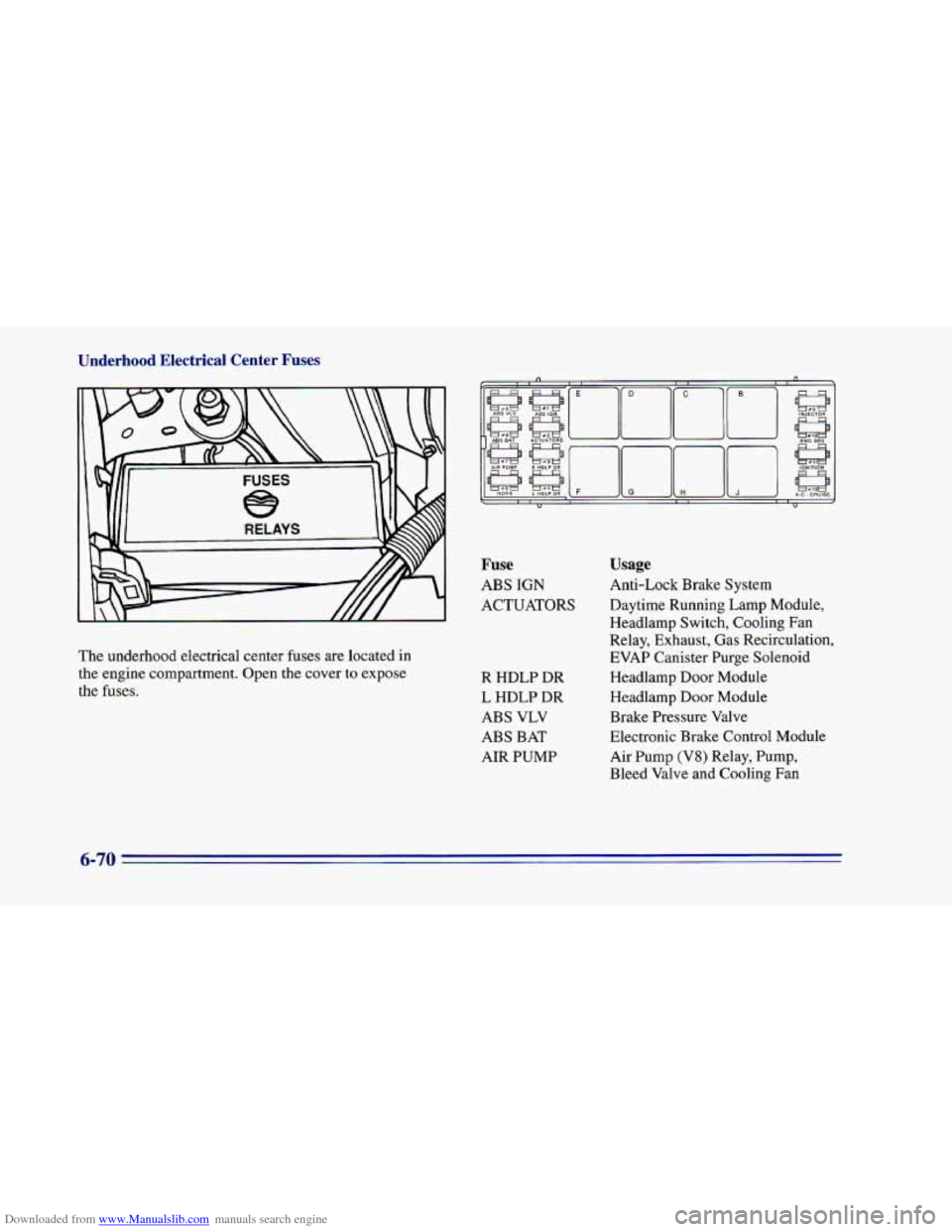
The underhood electrical center fuses are located in
the engine compartment. Open the cover to expose
the
fuses.
R HDLP DR
L HDLP DR
ABS VLV
ABS BAT
AIR PUMP
Usage
Anti-Lock Brake System
Daytime Running Lamp Module,
Headlamp Switch, Cooling Fan
Relay, Exhaust, Gas Recirculation,
EVAP Canister Purge Solenoid
Headlamp Door Module
Headlamp
Door Module
Brake Pressure Valve
Electronic Brake Control Module
Air Pump (VS) Relay, Pump,
Bleed Valve and Cooling Fan
6-70
Page 322 of 402
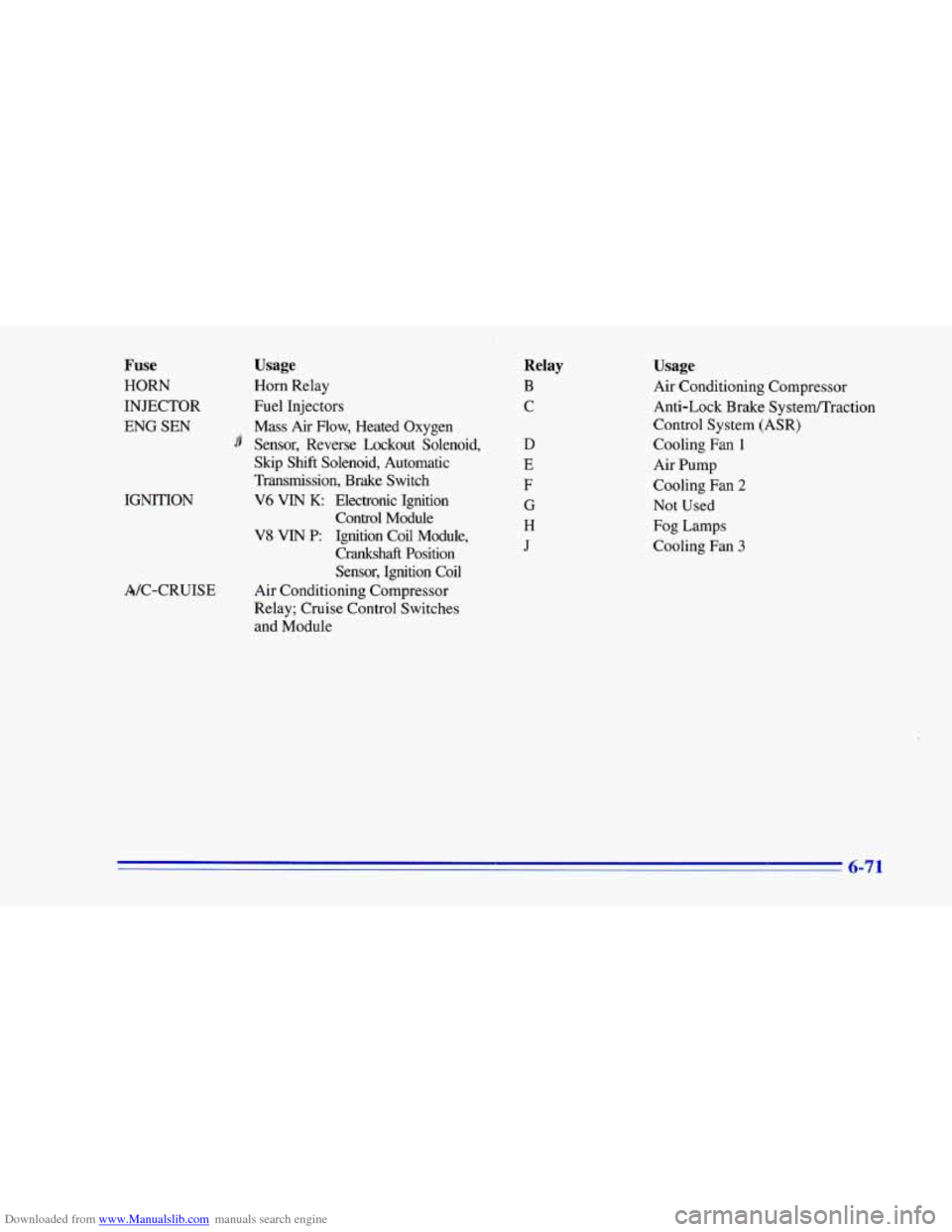
Downloaded from www.Manualslib.com manuals search engine Fuse
HORN INJECTOR
ENG SEN
IGNITION
A/C-CRUISE
Usage
Horn Relay
Fuel Injectors
~ Mass Air Flow, Heated Oxygen
fl Sensor, Reverse Lockout Solenoid.
Skip Shift Solenoid, Automatic
Transmission, Brake Switch
V6 VIN K: Electronic Ignition Control Module
V8 VIN P: Ignition Coil Module,
Crankshaft Position
Sensor, Ignition Coil
Air Conditioning Compressor
Relay; Cruise Control Switches
and Module
Relay
B
C
D
E
F
G
H
J
Usage
Air Conditioning Compressor
Anti-Lock Brake SystedTraction
Control System (ASR)
Cooling Fan
1
Air Pump
Cooling Fan
2
Not Used
Fog Lamps
Cooling Fan
3
6-71
Page 324 of 402
Downloaded from www.Manualslib.com manuals search engine Capacities and Specifications
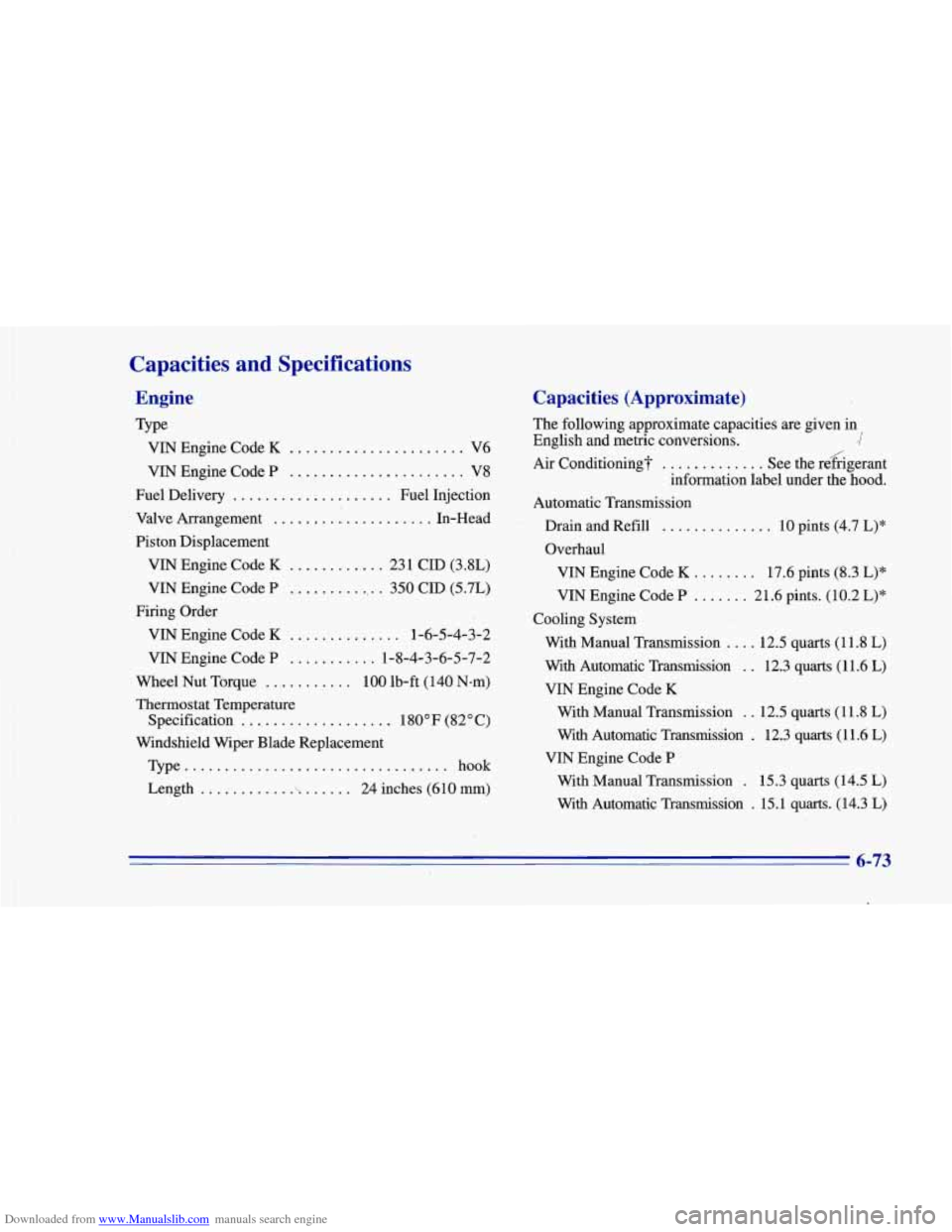
Engine
Type VIN Engine Code
K ...................... V6
VIN Engine Code P ...................... V8
Fuel Delivery
.................... Fuel Injection
Valve Arrangement
.................... In-Head
Piston Displacement
VIN Engine Code
K ............ 23 1 CID (3.8L)
VIN Engine Code
P ......... .I - - 350 CID (5.7L)
Firing Order VIN Engine Code
K ............ 1-6-5-4-3-2
VIN Engine Code
P ......... 1-8-4-3-6-5-7-2
Wheel Nut Torque
........... 100 lb-ft (140 N-m)
Thermostat Temperature Specification
.................... 1 80" F (82 O C)
Windshield Wiper Blade Replacement
Type
................................. hook
Length
..................... 24 inches (610 mm)
Capacities (Approximate)
The following approximate capacities are given in
English and metric conversions.
li
Air Conditioning? ............. See the refngerant /.
information label under the hood.
Automatic Transmission
Drain and Refill
.............. 10 pints (4.7 L)*
Overhaul VIN Engine Code
K ........ 17.6 pints (8.3 L)*
VIN Engine Code
P ....... 2 1.6 pints. ( 10.2 L)*
Cooling System
With Manual Transmission
.... 12.5 quarts (11.8 L)
With Automatic Transmission . . 12.3 quarts (11.6 L)
VIN Engine Code
K
With Manual Transmission . . 12.5 quarts (1 1.8 L)
With Automatic Transmission . 12.3 quarts (1 1.6 L)
VIN Engine Code P
With Manual Transmission
. 15.3 quarts (14.5 L)
With Automatic Transmission . 15.1 quarts. (14.3 L)
6-73
Page 331 of 402
Downloaded from www.Manualslib.com manuals search engine Maintenance Schedule
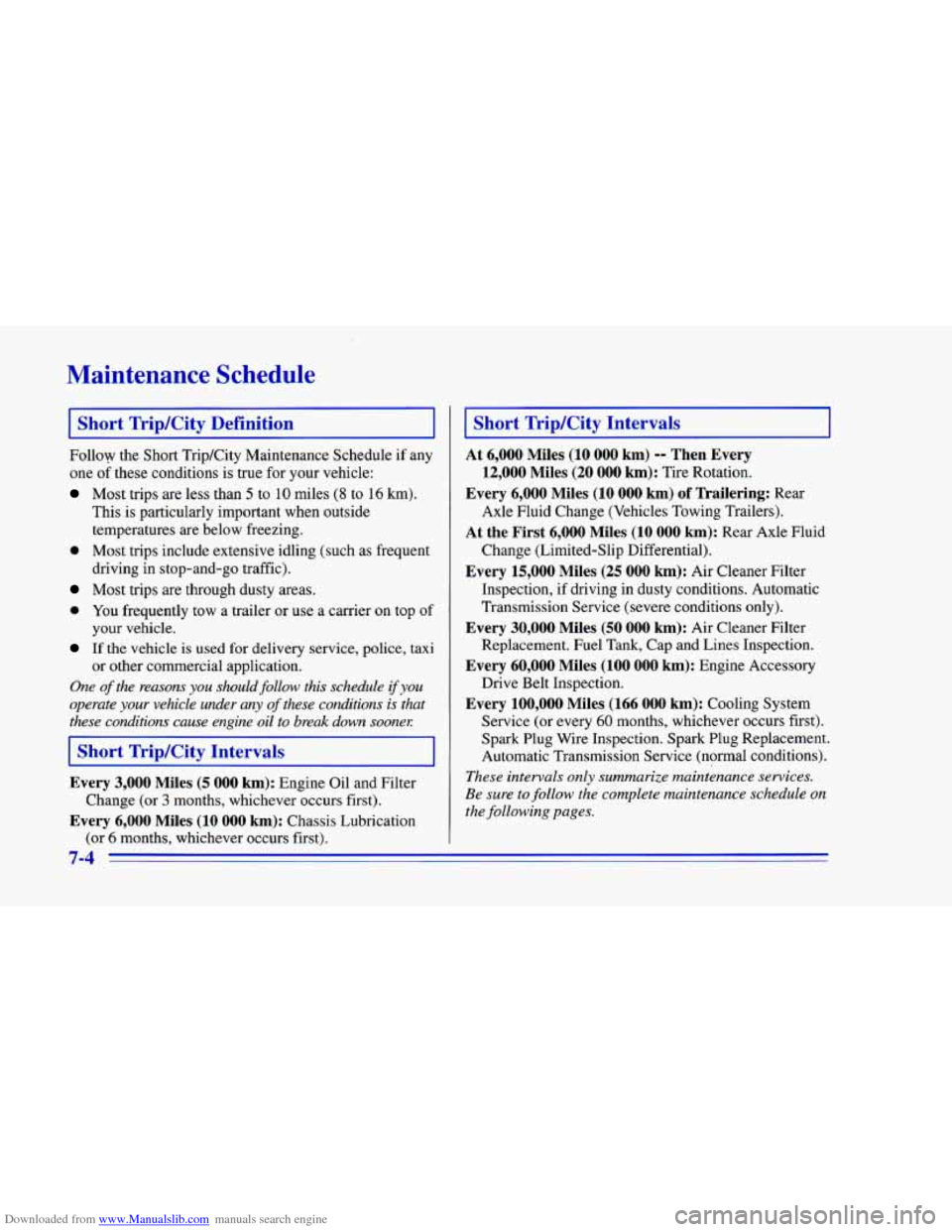
Short TriplCity Definition
Follow the Short Trip/City Maintenance Schedule if any
one of these conditions is true for your vehicle:
Most trips are less than 5 to 10 miles (8 to 16 km).
This
is particularly important when outside
temperatures are below freezing.
0 Most trips include extensive idling (such as frequent
driving in stop-and-go traffic).
Most trips are through dusty areas.
0 You frequently tow a trailer or use a carrier on top of
If the vehicle is used for delivery service, police, taxi
One of the reasons you should follow this schedule if you
operate your vehicle under any
of these conditions is that
these conditions cause engine oil to break down soonez
your vehicle.
or other commercial application.
Short TriplCity Intervals
Every 3,000 Miles (5 000 km): Engine Oil and Filter
Every 6,000 Miles (10 000 km): Chassis Lubrication
Change (or
3 months, whichever
occurs first).
(or
6 months, whichever occurs first).
Short TriplCity Intervals
At 6,000 Miles (10 000 km) -- Then Every
12,000 Miles (20 000 km): Tire Rotation.
Every 6,000 Miles (10 000 km) of Trailering: Rear
Axle Fluid Change (Vehicles Towing Trailers).
At the First 6,000 Miles (10 000 km): Rear Axle Fluid
Change (Limited-Slip Differential).
Every 15,000 Miles (25 000 km): Air Cleaner Filter
Inspection, if driving
in dusty conditions. Automatic
Transmission Service (severe conditions only).
Every 30,000 Miles (50 000 km): Air Cleaner Filter
Replacement. Fuel Tank, Cap and Lines Inspection.
Every 60,000 Miles (100 000 km): Engine Accessory
Drive Belt Inspection.
Every 100,000 Miles (166 000 km): Cooling System
Service (or every
60 months, whichever occurs first).
Spark Plug Wire Inspection. Spark Plug Replacement.
Automatic Transmission Service (normal conditions).
These intervals only summarize maintenance services.
Be sure to
follow the complete maintenance schedule on
the following pages.
7-4